Home » fiber optic network » Recent Articles:

FCC Commissioner Mignon Clyburn Speaks in Favor of Municipal Broadband Projects at SEATOA Conference
I had the pleasure of attending the SouthEast Association of Telecommunications Officers and Advisors (SEATOA) conference this past weekend in beautiful Asheville, North Carolina.  I was surrounded by some of the leading visionaries in the fields of next-generation broadband deployment, broadband policy and important Public, Educational, and Government (PEG) access networks.

Among those in attendance:

  • Kyle Hollifield, representing Bristol Virginia Utilities/BVU OptiNet, a municipally-owned fiber optic broadband provider in Bristol, Virginia;
  • Colman Keane, from municipal utility EPB Telecom in Chattanooga, Tennessee;
  • Tommy Jacobson from MCNC;
  • Ken Fellman from the National Association of Telecommunications Officers and Advisors (NATOA);
  • Hunter Goosman from ERC Broadband, which operates a regional fiber optic network in the western Carolinas;
  • Brian Bowman, Public Affairs & Marketing Manager of Wilson, North Carolina, home of municipal fiber network Greenlight, and
  • Michael Crowell, Broadband Services Director of Salisbury, North Carolina’s forthcoming fiber to the home network Fibrant.

The conference included several informational sessions for those working on broadband projects.

Tom Power, chief of staff for the National Telecommunications and Information Administration (NTIA) and Jessica Zufolo from the Rural Utilities Service at the U.S. Department of Agriculture discussed rounds one and two of the broadband stimulus grant program and lessons learned along the way.

Thomas Koutsky, representing the FCC Broadband Opportunities Initiative, the legendary Jim Baller and FCC Commissioner Mignon Clyburn also spoke about the importance of developing better broadband networks across the country.

FCC Commissioner Mignon Clyburn delivered the keynote address at the SEATOA conference held in Asheville, N.C.

Thomas Koutsky, speaking about the National Broadband Plan said, “The National Broadband Plan is just a plan.  It doesn’t do anything by itself, it requires action.”  I couldn’t agree more.  The National Broadband Plan could culminate in a giant missed opportunity if we do not reach out and demand that our representatives in Washington get on board with a definitive plan to deliver better broadband across the country.  Washington is full of studies and recommendations that are little more than words on paper, sitting on a shelf because Americans didn’t demand action to implement them.

I could go on all day about Jim Baller and his inspiration that drives us all to fight for better broadband in America, but I will highlight this quote: “It is a disgrace that every American does not have affordable access.”  Baller rallied the crowd with a video clip from Al Pacino’s speech in Any Given Sunday.  It’s not difficult to carry Pacino’s message about football to our fight in the broadband arena, and the enthusiasm Baller brings can only be a positive.

Perhaps the most newsworthy event from the conference was a speech from the newest FCC Commissioner, Mignon Clyburn.  She gets it.  In an amazing 20-minute speech, Clyburn succinctly delivered a message we wish some of our state lawmakers would understand and support:

“Thus, the Plan recommends that Congress clarify that state and local governments should not be restricted from building their own broadband networks. I firmly believe that we need to leverage every resource at our disposal to deploy broadband to all Americans. If local officials have decided that a publicly-owned broadband network is the best way to meet their citizens’ needs, then my view is to help make that happen.

When cities and local governments are prohibited from investing directly in their own broadband networks, citizens may be denied the opportunity to connect with their nation and improve their lives. As a result, local economies likely will suffer. But broadband is not simply about dollars and cents, it is about the educational, health, and social welfare of our communities. Preventing governments from investing in broadband, is counterproductive, and may impede the nation from accomplishing the Plan’s goal of providing broadband access to every American and every community anchor institution.”

Clyburn’s speech clearly illustrates she’s an advocate for consumers and is interested in knocking down barriers that block Americans from enjoying world class broadband service.  Clyburn considers the National Broadband Plan a group effort developed by and for the American people, not just a policy document from the FCC.  It was truly an uplifting speech that gave me hope positive change in broadband and broadband policies are possible with her presence on the Commission.

[flv width=”540″ height=”380″]http://www.phillipdampier.com/video/CommClyburn.mp4[/flv]

FCC Commissioner Mignon Clyburn delivers the keynote speech at the SEATOA conference.  Clyburn goes on record advocating municipally-run broadband projects where communities deem them appropriate.  This clip comes courtesy of Communities United For Broadband and you saw it first here on Stop the Cap! (April 27, 2010 — 20 minutes)

(This video is large in size.  If playback stops, please pause the video to allow more of the clip to load into the player’s buffer to reduce the chance of stalled playback.  If you still experience problems, please Contact Us.)
Senator Schumer Promotes Western NY Fiber Project: “Fiber Optic Broadband is the Erie Canal of the 21st Century”

Phillip Dampier April 5, 2010 Broadband Speed, Competition, Public Policy & Gov't, Rural Broadband, Video Comments Off on Senator Schumer Promotes Western NY Fiber Project: “Fiber Optic Broadband is the Erie Canal of the 21st Century”

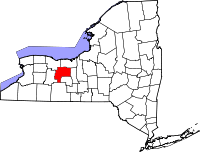
Ontario County, New York

Senator Charles Schumer (D-New York) visited Canandaigua Monday to promote Ontario County’s fiber optic broadband project, in hopes of securing federal funding to expand the fiber project into adjacent counties in the Rochester-Finger Lakes region.

Schumer likened fiber optic broadband development to other revolutionary transportation projects in New York’s past which transformed local economies, created jobs, and brought prestige to the region.

“One fact has proven true since the days of the Erie Canal: if you don’t have good infrastructure, you’re not gonna bring jobs, but when you do have good infrastructure, you are gonna bring jobs. And the fiber optic ring that we are talking about here in Ontario County is the Erie Canal of the 21st century. It’s that simple,” Schumer told an audience at the Center for Infotonics.

Ontario County began constructing a fiber ring more than a decade ago to improve connectivity across the often-rural county.  Bookmarked between high growth areas around Victor and Canandaigua to the east and Geneva to the west, large expanses of Ontario County are rural. Being a part of central New York’s Finger Lakes Region means the often hilly terrain and winding roads can make wiring expensive and difficult in certain areas.  But the prospect for 21st century connectivity has helped fuel growth — and jobs — into the region.

Sen. Schumer

Schumer wants FCC officials to visit Ontario County to explore the project as a potential blueprint for wiring other counties.

“We will not only put this region at the cutting edge of attracting new businesses that need high speed fiber optics, but we’ll do a service to the rest of the country by showing them how it can work,” said Schumer.

New York’s senior senator said he will aggressively pursue millions in federal funding to expand the project outside of Ontario County, and help complete the fiber optic network.

The senator may find some opposition to federal funding initiatives from incumbent providers Frontier Communications and Time Warner Cable, particularly if funds originate from broadband stimulus programs.  Both companies would likely object to federal spending on a fiber network that crosses areas both companies already serve.

Frontier Communications offers DSL service in many parts of Ontario County, and Time Warner Cable has wired most of the significant-sized towns and cities in the county.

The Ontario County project has been built without any federal stimulus money.

[flv]http://www.phillipdampier.com/video/Ontario County Fiber Schumer Visit 4-5-10.flv[/flv]

Sen. Schumer’s visit to Canandaigua, New York to promote Ontario County’s fiber project was covered in these three reports from YNN, WROC-TV, and WHAM-TV — all in Rochester, New York.  (6 minutes)

Comcast Selling “Unlimited Internet” Over A Fiber Network That Isn’t (And No Speed Guarantees Either!)

Phillip Dampier March 2, 2010 Broadband Speed, Comcast/Xfinity, Data Caps 5 Comments

Broadband providers love to tout their Internet services as “unlimited, always on access at blazing fast speeds.”  Increasingly, their service isn’t unlimited, it’s not always working, and those blazing fast speeds are doused in a shower of asterisks leading to fine print indicating “speeds are not guaranteed.”

Take Comcast, for example.

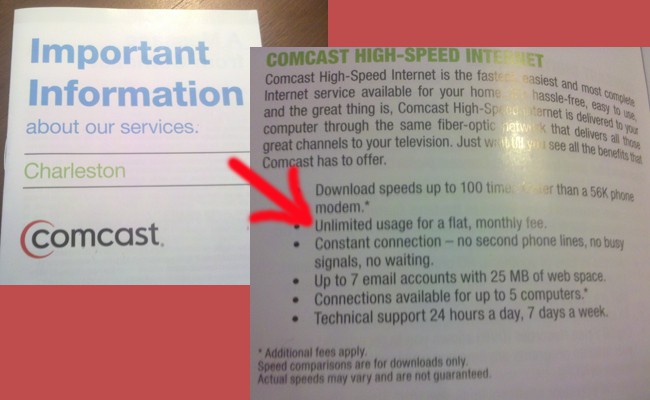
The Consumerist‘s reader Matt received a brochure from America’s largest cable operator filled with inaccuracies, falsehoods, and fine print.  In order of appearance, let’s fact check:

Source: The Consumerist

Fiber Fiction: “Comcast High Speed Internet is delivered to your computer through the same fiber-optic network that delivers all those great channels to your television.”

Fiber Fact: Comcast does not operate an all-fiber network.  Their distribution system uses a mix of fiber and standard copper coaxial cable.  The fiber network is only a backbone, which connects to the same coaxial cable companies like Comcast have used since the 1970s.  If you want a true fiber-optic network, you’ll need to sign up with Verizon FiOS or a municipally-run fiber provider.  No national cable operator runs one.  It’s part of their marketing rhetoric to try and capitalize on the benefits of fiber without actually spending the money to actually build a fiber system.

Speed Trap: “Download speeds up to 100 times faster than a 56K phone modem.”

Autobahn: This one has one of those asterisks attached — “actual speeds may vary.”  Comcast doesn’t guarantee speed, and relies on the familiar “up to” disclaimer that phone companies love to use with their DSL service.  If your neighborhood is clogged with users, the websites you visit run slowly, or Comcast has a problem somewhere, your speed will suffer.

Unlimited That Isn’t: “Unlimited usage for a flat, monthly fee.”

Unlimited Reality: Comcast has a usage limit of 250 GB per month.  Exceed it and you potentially will get a call from Comcast lecturing you about your usage.  Ignore them and you may be without your broadband service for a year.

Consumerist reader Matt was a victim of Comcast’s marketing doublespeak when he exceeded the limit and got a phone call from the company.  Instead of being browbeaten by Comcast customer service, he was ready and armed with the brochure the company sent him:

I was told I used more data than they allow (250GB). I do not argue that I used over 250GB, in fact I went quite a bit over. Though I did want to ask for proof that affected their network, I figured it wasn’t the nicest way to start the interaction. I informed them that I used this because it was sold as “Unlimited usage for a flat, monthly rate.” He then told me it said “access.”

I had the brochure right next to me and quoted, “Unlimited usage for a flat, monthly rate.” He told me their website says something different, and my local franchise overstepped its bounds, and their website overrules the “Important Information about our services, Charleston SC” sales brochure sent to me. If I went over again (It goes by calender month, not billing cycle) I would be disconnected for 1 year without giving me a call.

I asked if Comcast had a tool to help me monitor bandwidth. “Not in your market” he told me. “Download something from Google that will do it for you.”

As consumers continue to expand their broadband usage to take advantage of services like online video and file backup, services Comcast itself offers, more and more will run up against Comcast’s monthly usage limit.  Although your Comcast bill increases year after year, their usage limit has not.  It was 250 GB in 2008 and remains the same in 2010. Thanks to Stop the Cap! readers Dave and Michael who sent word our way.

Burlington Telecom ‘Not Financially Viable,’ Panel Urges Partially-Privatizing Municipally-Owned Fiber Service Provider

Burlington Telecom (BT), the city owned-and-operated fiber-based cable, broadband, and telephone provider is mired in debt and is not financially viable in its current form.

Those are the findings of a “blue ribbon” committee tasked with answering questions about the future of the financially-troubled municipally-owned provider serving 4,600 Burlington customers in Vermont.

In an 11-page public report, the committee recommended the city partner with a commercial entity that would assume a majority interest in BT.  As a minority stakeholder, the city could eventually recoup the 17 million dollar investment it has made in the company.

Although some residents have lobbied the city to abandon the 100 percent fiber network to stem ongoing losses, the committee advised against it.

“The city has a considerable asset in BT, and should not give this asset away at a fire sale price,” notes one independent consultant working with the committee. “BT is too important to be jettisoned, in part because it keeps the competition honest.”

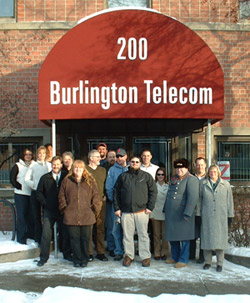
Burlington Telecom building and staff

But carrying forward as-is is not a good idea either, the report concludes.

“BT is not viable in relationship to its current debt load of $51 million and its ability to generate earnings to repay this debt. BT cannot meet its principal and interest obligations at this time,” the committee concluded, noting that the company’s current business plan can’t meet future financial challenges either.

As if to underscore that notion, BT this month asked the city of Burlington for a $386,000 loan from to make an interest payment to CitiLeasing by Wednesday, to prevent the company from technically defaulting on its $32 million municipal lease purchase.  On Friday, a judge issued a restraining order forbidding such a loan unless the Vermont Public Service Board agrees.

The committee noted that the reasons for BT’s financial problems weren’t rooted in its “first-class” fiber optic network, or its usefulness to the city.

In summary, the committee and its consultants blamed the problems on these factors:

  • HBC found BT overpaid for its fiber network, spending $1,000 per home passed, when fiber build-out prices have dropped in the past few years.

  • BT is spending too much money on customer installations.  HBC reports BT could save more than $600 off the $1,600 the company pays to hook up each customer.

  • The company uses the same door-to-door marketing company Comcast uses to get new customers.  Additionally, BT contracts with a third party service company to handle installations and service calls.  This work should be done in-house, HBC recommends, as paying a company based on how many installations are performed provides a built-in incentive to cut corners and quality.

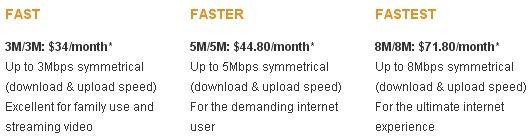
  • BT’s broadband products are too slow for a compete, handing incumbent cable provider Comcast an unnecessary competitive advantage.  Fiber can blow cable modem service out of the water when competing on speeds, but BT foolishly charges too much money for too slow service topping out at just 8Mbps/8Mbps, for a whopping $71.80 a month.  BT calls that “the ultimate Internet experience.”  It’s not.  HBC predicts broadband will become BT’s most important service, so it is critical for the company to make the product more attractive to customers.

  • BT is mired in politics that has nothing to do with its service to the community, and it creates unnecessary distractions that commercial providers do not have.  Some who oppose the municipal fiber project or the current city council use BT as a political football.

  • Because it is a public entity, too much financial and strategic business information is open to public review, which includes BT’s competitors.  That gives Comcast and FairPoint advance notice of BT plans, pricing, and growth strategies.  Restructuring as a semi-private entity under local government oversight would help guarantee competitive business information stays out of the hands of the competition.

  • BT lacks an effective marketing strategy to convince residents and businesses to change providers.  Without a compelling lineup of services, and a marketing effort to sell them, customers will be reluctant to go through a disruptive switch to BT service.  The provider’s bundled service packages are often compelling (a triple play with basic television and phone service only costs $89 a month, less than $20 more than standalone broadband service), but they often lack the services, speed, and channels consumers want.

  • The company does not pay enough attention to customer service strategies.  Customers complain BT does not accept cash payments from walk-up customers, who are told to return with a money order.  From a confusing automated attendant that answers customer calls to inconvenient hours and appointment scheduling, BT needs to hire marketing experts to help restructure how it serves potential and subscribing customers.

Burlington Telecom's fiber broadband speeds are the same uploading and downloading, but there is plenty of room for improvement in speeds at a lower price

  • BT utilizes a 200-megabit backbone at a cost of $6,000 a month and a 350-megabit backbone at a monthly cost of $16,331. It is HBCs belief that backbone costs can be reduced considerably, as much as $6,000 per month should be saved through re-negotiation. Costs should be in the neighborhood of $25 to $30 per megabit, as compared to the $40 per megabit of speed now being paid by BT. HBC buys twice as much bandwidth per month than BT and pays only $7,000 more for the additional capacity.
  • Finally, the company leaves a lot of potential earnings on the table.  It doesn’t provide local-ad insertions on cable channels and doesn’t leverage its excess broadband capacity with businesses by selling them web hosting, co-location, and speed critical services.  It doesn’t provide value-added services that cable companies now offer, such as caller ID on TV.

The Burlington mayor, Bob Kiss, expressed skepticism at some of the conclusions in the committee’s findings.

Kiss believes refinancing BT’s debt would give the telecom company more time to implement better marketing and service improvements, which could attract new customers and revenue.

For Burlington business leaders, the entire affair is an embarrassment.  Many believe significant harm will come from a city gaining a reputation for defaulting on its obligations.

The conclusion many have reached is that Burlington Telecom was naively planned, without sufficient regard to realistic projections of expenses and revenues, and lacks expertise to effectively compete with other local providers.  Building an advanced fiber network for your community is only as good as the services offered at a price that makes sense.  Alienate customers with ineffective marketing or out of touch product packaging, and your future will be in doubt.

[flv width=”368″ height=”228″]http://www.phillipdampier.com/video/WCAX Burlington Telecom Saga 12-15 02-01 02-05 02-11-2010.flv[/flv]

<

p style=”text-align: center;”>WCAX-TV in Burlington has followed the BT saga for months.  This video includes five reports covering the company’s future viability (13 minutes)

  1. Burlington Telecom Saga Continues (12-15-2009)
  2. Burlington Telecom Forces Changes In Burlington City Government (02-01-2010)
  3. Burlington Telecom Not Financially Viable (02-05-2010)
  4. Burlington Council Gets Blue Ribbon Committee Report (02-11-2010)
  5. Burlington Telecom’s Fate Under Discussion (02-11-2010)

[flv]http://www.phillipdampier.com/video/WFFF Burlington Burlington Telecom’s Future Unclear 02-11-2010.flv[/flv]

WFFF-TV in Burlington reports the telecom company’s future is unclear. (1 minute)

[flv width=”640″ height=”500″]http://www.phillipdampier.com/video/WPTZ Plattsburgh Burlington Telecom Not Viable.flv[/flv]

WPTZ in Plattsburgh covered the contention over an upcoming interest payment BT needs to pay by Wednesday.  (3 minutes)

Read our complete coverage on Burlington Telecom.

Frontier’s Low-Fiber Diet: ‘Most Users Don’t Need Ultra-Fast Internet Access,’ Says Company Official

Frontier's headquarters in Rochester, N.Y.

Frontier Communications has dismissed the proposition of Google constructing a 1Gbps fiber-to-the-home network, telling readers of the Rochester Democrat & Chronicle that most users don’t need ultra-fast Internet access.

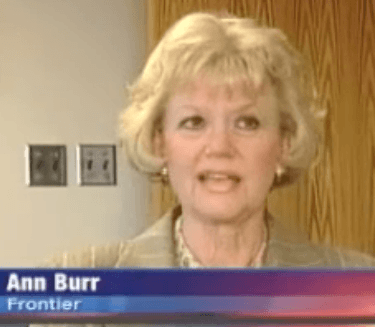
Ann Burr, chairman and general manager of Frontier Communications of Rochester made the remark in response to news that citizens and business leaders are excited about promoting Monroe County as a potential test location for Google’s fiber network experiment.

Frontier, which serves Rochester and most of the 585 area code, accused Google of having “a poor track record of following through on such proposals and that creating a fiber-optic network from scratch would be enormously expensive.”

Pot to kettle.  Frontier’s illusory promises for fiber optic connectivity in states like West Virginia, where it seeks to take over the majority of the state’s phone customers from Verizon, never seem to include specific assurances such projects will reach customer homes.

“If Google built its own network, we estimate it would cost $5,000 per household,” Burr told the newspaper.

That’s as exaggerated as Frontier’s DSL speed claims.

Verizon Communications, which is in the business of providing fiber connectivity to the home, disclosed the true costs are far lower than that, and continue to decline.  In the summer of 2008, Verizon’s Policy Blog noted:

Capital Costs
– We said our target per home passed was $700 by 2010, and we are ahead of plan to achieve that objective. In fact, we’ve already beaten the target.
– We said our target per home connected was $650 by 2010, and we’re on plan to hit that target.

No wonder Frontier doesn’t contemplate providing fiber service to customers.  It created its own sticker shock.

Still, the local phone company didn’t want to slam the door entirely on Google’s foot, suggesting it would be willing to talk about leasing space on Google’s network if it launched in the Flower City.

Frontier’s claim that customers don’t believe fast broadband service is important is a remarkable admission, particularly for a company that increasingly depends on broadband service to stop revenue loss from customers dropping traditional phone lines.  That philosophy should be carefully considered by state officials and utility commissions reviewing Frontier’s proposal to take over Verizon phone lines in several states.  Do communities want to receive broadband from a company that dismisses faster broadband speed as irrelevant for the majority of its customers?

Perhaps the remarks came with the understanding Frontier isn’t capable of delivering 21st century broadband speeds over its antique network of copper telephone wire anyway.

That’s the point Time Warner Cable has made repeatedly, especially in the Rochester metro area.  The cable operator routinely promotes its Road Runner cable modem service’s speed advantages over Frontier’s DSL product.  Frontier promises up to 10Mbps, but often manages far less (3.1Mbps was my personal experience with Frontier DSL last April.)  Time Warner Cable promises up to 15Mbps, and often exceeds that with its “PowerBoost” feature.  In rural areas, the phone company tops out at “up to 3Mbps.”  Time Warner Cable notes most of its new broadband customers come at the expense of phone companies like Frontier.  DSL customers switch because they do care about broadband speed.

Judging from the excitement in Rochester over Google’s proposal, Frontier’s dismissal of a fiber optic future seems out of touch, and potentially a drag on the local community’s economic future.

Rochester increasingly will become a broadband backwater because of anemic broadband competition from Frontier Communications.  Its reliance on ADSL technology, more than a decade old, to deliver distance-sensitive broadband service looks out of place compared with the rest of New York State.  Major cities throughout New York are being wired with fiber optic service by Verizon Communications.  Verizon FiOS delivers up to 50Mbps service.  Frontier maxes out at far lower speeds and defines an acceptable amount of broadband usage on its DSL service at just 5GB per month. Using Verizon’s FiOS fiber network, you’d exceed Frontier’s entire month’s ‘allowance’ in less than 15 minutes at Verizon’s speeds.

Rochester is one of many communities challenged by the transition away from a manufacturing economy towards a high technology future.  A world class fiber optic network doesn’t just benefit big business.  It spurs revolutionary growth in medicine, education, software development, telecommunications, and more.  That means good paying jobs.  For consumers with fiber to the home, it opens the door to telecommuting on a whole new level, distance learning opportunities, new ways to access information and entertainment, and allows home-based entrepreneurs to develop new businesses.

With Verizon FiOS unavailable to Rochester indefinitely, and Frontier unwilling to make appropriate investments to keep this city competitive with the rest of upstate New York, those jobs and economic benefits can go to Buffalo, Syracuse, Albany, Westchester County, and metropolitan New York City.  We’ll be held back on the frontier with Frontier and its ideas of rationed broadband service.

[flv width=”360″ height=”260″]http://www.phillipdampier.com/video/WROC Ontario County Makes Bid for Super Fast Internet 2-11-2010.flv[/flv]

WROC-TV in Rochester reports that Ontario County, to the southeast of Rochester, may have a built-in advantage with an already-installed fiber loop covering much of the county.  The county has a team working on a formal application to Google to provide service in communities like Geneva and Canandaigua.  Frontier’s claims that consumers don’t care about fast broadband speed are belied by the excitement of residents of both counties. (2 minutes)

Search This Site:

Contributions:

Recent Comments:

Your Account:

Stop the Cap!