Home » fiber optic network » Recent Articles:

Montana’s Struggle for Broadband Pits Cable, Phone Companies, and Native American Communities Against One Another

A controversial proposal by Montana’s largest cable operator to use public funding for construction of a fiber optic network linking the state’s seven Indian reservations has been rejected by federal officials.

Bresnan Communications sought $70 million broadband stimulus grant to construct the 1,885-mile fiber-optic network to improve broadband connectivity.  Independent and cooperative telephone providers objected, claiming the proposal would duplicate services they already provide.

The debate over broadband stimulus funding in rural Montana has been contentious, particularly after incumbent telephone providers accused Bresnan of lying on their application — implying funds would directly improve broadband service to Native American communities.  They accused the cable operator of using public funds to enhance their own “middle mile network,” infrastructure that helps Bresnan distribute broadband traffic between its central offices and data centers, but not “the last mile” connection customers actually rely on to obtain service.

Montana is not alone in the debate over how federal broadband stimulus money should be spent.  With a limited pool of funds, and an overwhelmed National Telecommunications and Information Agency tasked with processing an unexpected flood of applications, funding decisions have become increasingly political, and many incumbent providers have learned they can jam up an applicant just by flooding federal agencies with comments opposing projects that impact on their service areas.

[flv]http://www.phillipdampier.com/video/KULR Billings Montana Broadband Workshop and Broadband Speed 1-19-2009 and 8-30-2009.flv[/flv]

KULR-TV in Billings covered the NTIA Grant Broadband Workshop held last January and also covered Montana’s woeful existing broadband speeds in these two reports. (1/19/2009 & 8/30/2009 – 2 minutes)

Because “last mile” projects are the most threatening to incumbent providers, these applications typically get the most opposition.  The NTIA, in an effort to reduce their workload, has in turn started focusing on “middle mile” projects which often benefit incumbents, pushing public tax dollars into pre-existing private networks.  That looks great on provider balance sheets — that’s money they don’t have to raise from stockholders or other investors.  Diverting those funds away, even from currently unserved areas, also protects providers’ flanks from the potential threat of competition, both now and in the future.

In Montana, chasing few potential customers spread out over vast distances in rural areas makes the potential threat from competition even scarier.  There, many small phone companies exist as co-ops, less concerned with raking in profits.  They fear the potential threat Bresnan Communications could bring to their viability if the cable operator gets a stronger foothold in their territories, especially when using tax dollars to do so.  But is the threat that large for well-run, customer-oriented companies and co-ops?

Many rural areas served by co-ops and other small independent companies actually receive better and faster broadband service than their more urban counterparts, argues Bonnie Lorang, general manager of Montana Independent Telecommunications Systems, an independent phone company trade group.  That’s because the state’s large urban phone company – Qwest, does not provide DSL into more distant suburban and rural service areas, and has only reached 75 percent of its customers with broadband service.  Smaller independent providers, particularly member-owned cooperatives, are accustomed to serving residents Qwest has been slow to reach.

While true for those forced to rely on Qwest DSL service, those with access to cable modem service can do better.  Bresnan provides up to 8Mbps service for residents in its mountain west region covering parts of Wyoming, Montana, and the western slope of Colorado.  Expanding Bresnan’s service where economically feasible remains a priority for the company, and broadband stimulus funding may make the difference between an “unprofitable” area and one that can be profitable if certain infrastructure costs are underwritten.

“Bresnan has a history of investing in communities that are not considered larger communities,” according to said Shawn Beqaj, spokesman for Bresnan. “Our philosophy is that smaller communities deserve every bit of the services that large communities have.”

Bresnan’s grant application received support from Montana governor Brian Schweitzer, the state’s Native American population, and some consumers unhappy with their current broadband choices, if any.

Montana's phone companies are running these print ads objecting to the broadband stimulus proposal from Bresnan Communications (click to enlarge and see the full ad)

On the other side, the phone companies and their trade groups: the Montana Telecommunications Association and Montana Independent Telecommunications Systems, and the state’s utility oversight agency.  They protested Bresnan was unnecessarily duplicating existing service, and potentially getting taxpayer money to do so.  They also hinted Bresnan exploited Native Americans in an application tailor-written to appeal to federal officials seeking improved service for disadvantaged and challenged minority groups.  Besides, the phone companies argued, Bresnan broke the rules from the outset by only agreeing to provide $6 million in company-provided matching funds, less than the 20 percent in matching dollars required by the stimulus program.

“If an area is unserved, prove it and spend the money on that,” Geoff Feiss, a representative of the Montana Telecommunications Association (MTA), told the Billings Gazette.  “But don’t spend $70 million on an overbuild network that’s going to deprive investment from existing networks and leave behind collateral damage that we’ll never recover from.”

Montana’s Public Service Commission ended up on the side of the MTA, calling Bresnan’s proposal “seriously flawed.”

Bresnan and their allies shot back that phone companies complaining about federal dollars being spent on broadband projects was hypocritical, considering many of those companies receive government assistance from the Universal Service Fund to stay in business themselves.

Consumers looking for broadband were left in the middle or left out entirely.  Many residents of the state are forced to rely on dial-up, satellite, or have been left indefinitely on waiting lists for future DSL expansion projects that take forever to materialize.  Choice is an option too many residents don’t have.  The Great Falls Tribune shared a story familiar to many Montanans:

Tim Lanham can’t get Qwest DSL at his eastside Great Falls home. It’s available to his neighbors across the street and at his office a block away.

He’s called Qwest about the situation, but typically can’t get through to a real person. The whole thing is frustrating, he said.

Lanham used to use Sofast. After its service went down, he switched to a Verizon Wireless card, but that can only be used on one computer at time. Now he has broadband Internet through Bresnan. Still, he wishes he had more options.

“I’d like the different options,” Lanham said. “Essentially they leave us with very few choices.”

At the heart of the debate is how to address the “digital divide” between those with Internet access and those without, and improving connectivity for those stuck with outdated, expensive, and slow “broadband.”

The state’s utility commission believes Montana’s primary problem exists in “the last mile,” namely getting broadband service to rural residents who currently are forced to use dial-up or satellite fraudband service that offers slow speed, tiny usage allowances, and a high price tag.  In most cases, telephone companies have deemed these rural residents too few in number and too far apart to make investments in DSL service worthwhile.  Using broadband stimulus money to subsidize the costs of providing service to rural America provides a direct path to broadband for those who may not obtain access any other way short of moving.

Larger providers have been urging that less money be spent on “last mile” projects and that funding be redirected into “middle mile” projects, which could dramatically reduce the costs companies have to pay to maintain and upgrade their own backbone infrastructure.  Examples of these kinds of projects include installing fiber optic cables between telephone company central offices or extended service “remotes” which reduce the distances between customers and telephone company facilities, extending the distance DSL can cover in rural areas.

For now, Montana will have to wait for both.

Bresnan officials will meet with tribal and state commerce officials before deciding what to do next.

Walter White Tail Feather, director of economic development for the Assiniboine and Sioux tribes on the Fort Peck Indian Reservation in northeastern Montana, told the Gazette he hopes Bresnan reapplies for the funding.

“We think we can make a better proposal this second round,” he said. “This first one was a learning experience. … What we really are doing is working with the state to empower ourselves as a tribal government to create a business, to create opportunities that we don’t have.”

The state’s small phone companies may have won the battle, but are now concerned they could ultimately lose the war over obtaining broadband stimulus money themselves, at least from the NTIA.

Jay Preston, chief executive officer of Ronan Telephone Co., told the Gazette two federal agencies now will be deciding who gets broadband stimulus money: The National Telecommunications and Information Administration and the Rural Utilities Service.

The NTIA “seems to be really, really focusing on the middle-mile idea,” Preston said, while RUS probably will approve funds for rural telephone companies that already are the federal agency’s customers. The RUS loans money to rural co-ops for a variety of projects.

Regardless of where the money comes from, frustrated Montana residents just want better service.  The state ranks dead last, tied with Alaska, in broadband speed, according to a study from the Communications Workers of America.  Residents enjoy an average broadband speed of just 2.3Mbps.

[flv]http://www.phillipdampier.com/video/KFBB Great Falls Montana ISP Flounders 11-10 – 11-13-2009.flv[/flv]

Already-broadband-challenged Montana residents faced a major headache when one of the state’s large Internet Service Providers, SoFast, suddenly shut down last November.  KFBB-TV in Great Falls followed the story over three days in these three reports from November 10-13th, 2009.  (5 minutes)
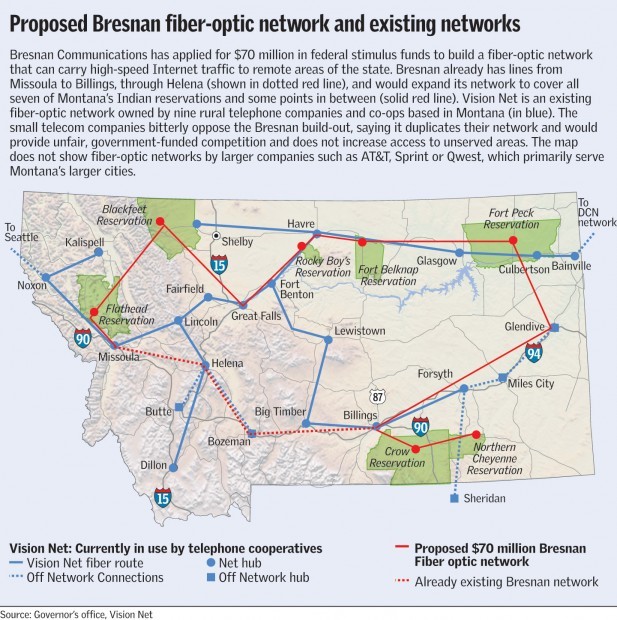
The Billings Gazette mapped out Montana's fiber landscape
Qwest: The Phone Company Nobody Wanted

Phillip Dampier February 9, 2010 Competition, Rural Broadband 3 Comments

Qwest, born from a merger between US West and Qwest Communications is up for sale.  Again.  Actually, analysts are wondering exactly when Qwest wasn’t for sale over the last several years.  Like that odd house on the corner of your street that nobody wants to buy, Qwest keeps lowering its asking price, hoping would-be suitors will stop driving past.

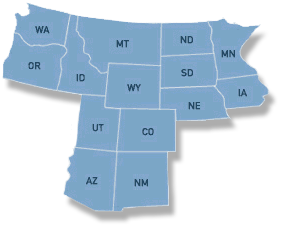
Qwest's service area

Qwest has a lot going against it.  Unlike its bigger cousin Baby Bells, mostly absorbed into the AT&T or Verizon Continuum, Qwest is saddled with a service area that often spells r-u-r-a-l.  The company got the short end of the stick when the Bell System was carved up in the mid-1980s, stuck with Arizona, Colorado, Idaho, Iowa, Minnesota, Montana, Nebraska, New Mexico, North Dakota, Oregon, South Dakota, Utah, Washington, and Wyoming.  That’s a service territory shaped like a “T” which spells “trouble.”  Outside of a few major cities like Phoenix, Denver, Minneapolis-St. Paul, Salt Lake City, and Seattle, the rest of Qwest Country is desert, ranch land, mountain ranges, farms, prairies, and some nice lakes and rivers.

While a great place to vacation, these spectacular landscapes are not what investors are looking for when considering what to do with a 100-year old copper wire telephone system.  Qwest never even managed to launch its own cell phone service, instead relying on reselling Verizon Wireless to interested customers.  Its foray into the cable TV business also flopped, and the company currently resells satellite TV service to customers.

The company was plagued with insider trading and other allegations of financial irregularities in the mid-2000s, and since 2005 has been rumored to be on the sales block.

The asking price keeps dropping, along with the company’s value.  Originally worth $45 billion dollars ten years ago, Qwest can’t attract buyers even at half the price.

Customers aren’t very impressed either.  In Lake County, Minnesota, the local newspaper printed a damning editorial Thursday accusing the company of being a villainous, untrustworthy liar after phone service went out for virtually the entire North Shore of Minnesota:

We’d like to have a villain in this story, but, so far, that character sketch is thin. Qwest is fitting the bill if you like obsequiousness on par with cigarette or multinational food companies.

Qwest touted the promise of high-tech 911 service, fast internet, a better connected North Shore. They’ve turned out to be good at promises but lousy on delivery when things go wrong.

The Lake County News-Chronicle excoriated Qwest in an editorial published last Thursday

Most people heard “All circuits are busy, please try your call again later” on their phones Tuesday. For more than a week, we’ve heard the same line from Qwest regarding what happened in Duluth and why there wasn’t a reroute up the Shore.

You can’t help becoming wary about how our technological infrastructure works after such failure Tuesday. Everyone was surprised to know that when fiber optic goes, so do cell phones. It was even more surprising to know that there was no detour for the line up the Shore. But that wasn’t technological indifference. That was a trust we put in Qwest.

[…]

It’s different when Qwest lies about why its line failed and we find out its assurance about a reroute was pure fantasy. There ends any trust or understanding to calmly wait out its line failures.

With Qwest, everything has been below the ground, literally and figuratively. It’s answer that repairing fiber optic is “difficult,” the empty promise of rerouting, and the lack of explanation of the real cause of the damage in Duluth, are all unacceptable.

It’s as if Qwest prefers a cloak of mystery about its technology and we should be happy to have it at all. That’s a poisoned relationship to have with fiber optic as it becomes ubiquitous in our lives.

Qwest, tell us what really happened under that street in Duluth, and, if it was the result of your own negligence, own up to it. Tell us why you told customers, including agencies responsible for public safety, you had a plan, a reroute in the case of a line break, but really didn’t.

And tell us why we should trust you again with this vital link to safety, health, and business along the North Shore.

While plots can be richer for their villains, we’d rather not have one in this story.

Ouch.

The Wall Street Mergers & Acquisition-vultures are circling over the company again, raising the stakes that Qwest is once again the common-sense choice for a takeover.  But even they realize nobody may want the entire company, saddled with rural states’ phone customers over an aging network that will cost billions to upgrade.  So the next best thing is to carve up the profitable bits and sell those to the highest bidder.  Companies like AT&T, Verizon, and BellSouth could do well serving the major population centers in Qwest’s territory, leaving folks in states like Wyoming, Idaho, Montana and the Dakotas to their choice of likely “rural telco” suitors: CenturyLink, Frontier Communications, or Windstream.  Qwest’s valued fiber optic network could fetch a billion or more on the open market.  Their data centers could manage another cool billion if sold.

As Qwest’s revenue continues to decline, the company is likely going to continue cutting costs, keeping themselves as attractive as possible to would-be suitors.

“It gets harder and harder to keep cutting costs,” Donna Jaegers, an analyst with D.A. Davidson & Co. told the Denver Post.  “As (former WorldCom chief executive) Bernie Ebbers used to say, ‘There’s no more lemon juice left in that lemon.’ ”

Just ask customers on the North Shore of Minnesota, as they sip Qwest’s bitter lemonade.

Novus To Launch Canada’s Fastest Broadband Service – 200Mbps for $279.95; Free Upgrade to 100Mbps Service For Some

Phillip Dampier February 4, 2010 Broadband Speed, Canada, Competition, Novus 1 Comment

Metro Vancouver residents will have access to Canada’s fastest residential broadband service next Friday when Novus Entertainment launches its Net 200 tier providing 200Mbps service over a fiber optic network for $279.95CDN per month.  Customers currently paying $179.95 for the company’s 60Mbps plan will also receive a free upgrade to 100Mbps service on that same date.  No word yet on what the new usage limits will be, but Novus previously limited its 60Mbps plan to 360GB per month, unfortunate for a plan that carries such a premium price.  Novus charges 50 cents for each additional gigabyte above their various plan allowances.  Novus’ upload speeds are the same as its advertised download speeds.

Novus Entertainment has wired fiber optic cable in 33,000 large multi-dwelling units in parts of greater Vancouver, providing broadband, telephone, and television competition for incumbent cable provider Shaw Communications.  The two companies were embroiled in a nasty price war last year, with Shaw slashing prices to as low as $10 per month for video, phone, or Internet access.  To date, Novus has 9,000 subscribers, 8,200 of which subscribe to the company’s broadband service.

“We noted a recent survey by Harvard University which found that Canadians’ access to superior broadband performance and infrastructure ranked poorly among developed countries,” said Donna Robertson, Co-President and Chief Legal Officer of Novus Entertainment Inc. “While these results are disappointing, this provided Novus with the opportunity to not only take this challenge head on and provide customers with superior Internet speeds, but to also set us apart from the competition.”

Vancouver is the home of Novus Entertainment

Novus’ Net 200 will be available in selective buildings that are configured for 200 Mbps technology. With the vision of becoming one of Metro Vancouver’s major Internet and communications service providers, Novus continues to expand its service in Vancouver and Burnaby and plans to launch services in Richmond in 2010.

“Canadians want a service provider that delivers a fast Internet connection to meet their growing needs at a reasonable cost,” said Doug Holman, Co-President and Chief Financial Officer of Novus Entertainment Inc. “Yet they’re paying among the highest prices for some of the lowest speeds. Novus’ superior fibre-optic network allows us to provide our customers with best-in-class, reliable and consistent transfer speeds that the incumbents simply can’t offer.”

Shaw probably cannot match Novus’ 200Mbps service tier on their non-fiber optic cable network, but will likely continue to compete heavily on price with discounts that stun Canadians outside of metro Vancouver.  Shaw’s pricing in Novus-wired buildings is as much as $60 less than in other areas where Novus does not compete.

Novus also owns some wireless spectrum covering Alberta and British Columbia, so eventually the provider could mount a competitive challenge in the mobile telephone market, at least in western Canada.  There are rumors the company could partner with an eastern Canadian spectrum holder like Public Mobile, which owns spectrum covering southern Ontario and Quebec.  Neither company has launched service, and probably won’t for the rest of 2010, but could eventually provide additional competition in the overpriced Canadian mobile phone market.

Burlington Telecom Needs to Create New Innovative Services Comcast Doesn’t Provide, Telecom Consultant Says

Steven Shepard, president of Shepard Communications Group

Steven Shepard, president of Shepard Communications Group

Burlington Telecom, the municipally owned fiber to the home cable and broadband provider still reeling from a late fall financial scandal, must think outside of the box if it is to survive and grow its business in Vermont’s largest city.  That’s the assessment of Steven Shepard, president of Shepard Communications Group, a consulting firm based in Williston.

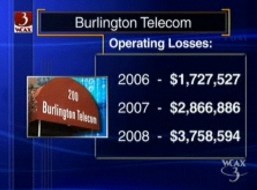
It comes as both city and state officials continue an investigation into a $17 million loan from city coffers to cushion the provider from substantial losses incurred over the past three years of operations.

Burlington Telecom has been criticized for underestimating the costs of wiring Burlington with fiber optics, something Shepard doesn’t think is unusual.

“I haven’t found one yet that has come it at budget, or even under budget,” Shepard told WCAX-TV news.

Burlington Telecom director, Chris Burns, says the company needed the additional money to cover capital expenses as it works to build its all-fiber network in every part of the city. He says the initial investment of $33 million dollars was not enough. “Some of the early estimates weren’t based on firm engineering quotes,” says Burns. “They were rough order magnitude estimates.”

Chris Burns, Burlington Telecom

Chris Burns, Burlington Telecom

Burns feels Burlington Telecom needs to expand its service area to bring in additional customers to help keep the provider up and running.  Some customers recognize Burlington Telecom is a unique, municipally-owned asset that can potentially provide services that Comcast, the dominant cable provider in the area, cannot.  Comcast operates a traditional hybrid fiber-coaxial cable network with more limited bandwidth than Burlington Telecom’s direct fiber optic connection to the home can provide.

But Shepard believes most consumers don’t know or care how service reaches them, and believes fiber optic networks alone do not bring instant success to providers.

Unless Burlington Telecom creates services that would be difficult for Comcast to deliver, they are just another telecommunications company, Shepard believes.

One suggestion from Shepard: an automatic file backup service.  Fiber optics can provide upstream speeds equivalent to downstream speeds, something Comcast cannot easily deliver.  Such a service would automatically send a copy of every file to a secured, encrypted off-site backup system.  If a customer needed the file restored, or an entire hard drive, Burlington Telecom could transmit the files on request.  Assuming privacy is protected, such a service would give consumers a potential reason to switch providers.

For broadband customers, providing upstream and downstream speeds faster and cheaper than Comcast will go a long way towards motivating consumers to switch.

[flv width=”368″ height=”228″]http://www.phillipdampier.com/video/WCAX Burlington Can Burlington Telecom Survive 11-05-2009.flv[/flv]

WCAX-TV Burlington interviews Steven Shepard about the ongoing viability of Burlington Telecom. (November 5, 2009 – 4 minutes)

For some Burlington Telecom customers, improving customer service is an important first step, as WCAX found:

“A few weeks ago, the whole BT was down for half hour, phone and cable. And probably internet but I don’t have that,” says Beth Cane, who lives in the city’s south end. Cane says getting through to customer service is “like trying to get into Fort Knox.”

She is not the only one complaining. Rob Lyman says he is “not happy” with Burlington Telecom’s service. “I watched a trailer for an on-Demand movie and the whole system froze up and required a reboot of BT’s box. When I called the help desk they said they’ve known about this problem for six months and didn’t know when it would be fixed,” he says.

burlington losses - from WCAXIn mid-November, a possible solution to the funding issues came from Piper Jaffray, a Minneapolis-based investment firm.  The company offered Burlington Telecom a $61.6 million dollar refinancing package that would help keep the company viable and return taxpayer funds caught up in the controversy to the city.

The proposal was met with political wrangling from the Burlington city council, which spent the last month and a half doing damage control.

“Once TelecomGate went radioactive in October, it was everyone for themselves on the city council as the finger pointing started,” Stop the Cap! reader Dwayne writes from Burlington. “The progressives are blaming the former Bush Administration’s economic catastrophe for wrecking the credit and financing markets BT needed to access, the Democrats are trying to play the role of moderates, and the Republicans are questioning why the city should compete with Comcast in the first place.  Demagoguery is universal,” he shares.

The rhetoric has grown so heated, it has stalled the city council’s approval of the loan package, to the disappointment of Mayor Bob Kiss.

[flv width=”368″ height=”228″]http://www.phillipdampier.com/video/WCAX Burlington Burlington Telecom Gets New Backing 11-13-2009.flv[/flv]

WCAX reports Burlington Telecom has the potential to secure new funding to refinance operations.  (November 13, 2009 – 3 minutes)

The Burlington Free Press has documented some of the language now a part of the debate:

“I do not believe that keeping Burlington Telecom alive during the absolute failure of our capitalist system was the wrong thing for any of us to do. We can’t afford to sit around. We have an interest payment (for BT’s current $33.5 million outside debt) that is due in February.” — Marrisa Caldwell, P-Ward 3, a Progressive Party member characterized as a fierce supporter of Burlington Telecom, is upset the city council delayed the approval of the loan package.

“The same forces that want to preserve the private insurance monopoly in health care by opposing the “public option” are now out to preserve the private corporate monopoly in Vermont telecommunications. The [Governor Jim Douglas (R)] administration is hell-bent on putting Burlington Telecom — which provides public sector competition to for-profit corporations such as Comcast and FairPoint — out of business, no matter what the consequences.” — John Franco, Vermont Progressive Party

“[Vermont Public Service Commissioner David O’Brien] is a political hack appointed by Douglas. They only want private-sector telecom in the state. He is out to get rid of the competition for the private companies. That’s very clear.” — Marrisa Caldwell

“I’m not going to engage in this kind of dialogue. It serves no purpose. We’re going to proceed with the investigation and work to resolve this situation.” — Deputy Public Service Commissioner Steve Wark, asked to comment on Caldwell’s remarks.

Caldwell also charged that the Free Press coverage of the BT issues has been influenced by advertising revenue from cable provider Comcast. She called the council’s vote to delay action on the new BT loan “disingenuous at best. It’s completely dysfunctional government,” she said. “They just tied the administration’s hands and hamstrung BT.”

“[On the city council’s lack of resolve and action] it’s erroneous and not well-founded. I never heard anyone say why they wouldn’t move forward (on the BT loan). It wasn’t leadership and (was) a lack of ability to collectively try to solve the problem.” Sharon Bushor, I-Ward 1, who generally supports Burlington Telecom.

“It seems only rational to do our homework on this (loan). I don’t think one of us is saying it isn’t feasible. All we’re saying is slow down and learn more.”  Councilman Paul Decelles, a Republican, called Caldwell’s remarks “destructive. I would challenge her to find one councilor who has thrown out the word ‘partisan,'” he said. “That word is coming from the administration and from the three Progressive councilors. We’re trying to do what is best for Burlington. This is the residents’ telecom. If acting in a slow, methodical way is unacceptable to some, so be it. It’s irresponsible of them to expect us to rubber-stamp this.” — Paul Decelles, R-Ward 7

“I am shocked and shocked again every time someone raises the partisan flag. This could have been a Republican or a Democratic blunder. The Progressives have been in office a long time. That’s just a fact. When we disagree, apparently, we’re being partisan, (but) it’s not personal, and it’s just not partisan.” — Nancy Kaplan, D-Ward 4

“No one is interested in destroying BT and the administration. Jonathan Leopold said Monday that (the council’s position on BT) was an attempt to destroy the administration. From my own perspective, that’s not the case at all. The first order is to take care of BT, but there have been missteps by the administration.” Mary Kehoe (D-Ward 6) said she has concerns about the loan proposal from Piper Jaffray, particularly the language that indicates the loan repayment will come from Burlington Telecom revenues in the form of city budget appropriations.  “If (BT is) short, what then?  How do we know BT is going to have the capacity?”  She said she voted to delay a decision on the loan, “because we want information. We’ve not been getting the information, and they want us to sign off. That’s not going to happen anymore.” — Mary Kehoe, D-Ward 6

“This is ridiculous. Burlington is starting to look more and more like Washington, with the level of partisan wrangling reaching an intensity that I’ve never seen before in my 15 years of living in Vermont.” — One resident commenting on the coverage and the back and forth.

[flv width=”480″ height=”380″]http://www.phillipdampier.com/video/WPTZ Plattsburgh Burlington Telecom Editorial Oct 28 2009.flv[/flv]

WPTZ in Plattsburgh, which is part of the Burlington television market, ran a station editorial on the Burlington Telecom matter on October 28th.  (1 minute)

FairPoint Dispute May Cost Maine-Based ISP Its Business And Good Paying Local Jobs With It

Phillip Dampier November 12, 2009 Competition, Data Caps, FairPoint, Public Policy & Gov't 1 Comment

gwiFairPoint Communications’ performance in New England, finally leading to bankruptcy, harms not only itself but also smaller local Internet companies providing jobs and service across the region.  That’s the gist of a report in this morning’s Kennebec Journal outlining a dispute between FairPoint and Great Works Internet, a Biddeford, Maine Internet Service Provider caught between FairPoint’s fiber optic network and a billing dispute that demands GWI pay more than $3 million dollars by December 19th, or face service termination by FairPoint.

GWI leased fiber optic cables with FairPoint’s predecessor Verizon back in 2005.  As part of the Communications Act of 1996, designed to spur competition, GWI obtained access at special interconnection rates, lower than the prices charged for retail customers.  Verizon felt the price was too low, and went to court in 2005 to seek the right to charge “market rates” for access, but the issue was never settled before Verizon sold its landline network to FairPoint last year.  In March of this year, FairPoint stopped accepting new orders from GWI for fiber service, which has kept the company from growing beyond its current fiber network agreements, costing the company plenty in new business.  Then, in September, FairPoint back-billed GWI for $3,085,025, representing the price FairPoint felt GWI should have been paying since 2006.  If the Maine-owned ISP doesn’t pay up, it has been threatened with having its service cut off altogether.

Fletcher Kittredge, GWI’s founder and chief executive officer, has been around the ISP business a long time.  The company was founded in 1994, before Internet access became common, and he has grown the company into a locally owned business serving 18,000 customers with phone and Internet connections.  At risk are the loss of up to 75 local jobs and a significant part of $13 million in annual revenues earned by what the Journal calls one of Maine’s leading Internet providers.

“For us, it’s vital that this be settled soon,” Kittredge told the newspaper. “FairPoint has been threatening us with some pretty draconian action.”

FairPoint’s threat has already cost the company customers, Kittredge said, and the uncertainty makes it hard to go after new business accounts.

But growth has been trimmed by FairPoint’s actions, according to Kittredge. For instance: The company signed a contract with the Skowhegan school system for high-speed access and set up equipment. But the connections it needed from FairPoint were never made, Kittredge said, and he had to cancel the school contract. That has had a chilling effect on efforts to go after new accounts.

“We can’t go out and solicit new businesses,” he said. “We can’t say, ‘This is going to be great, but we may not be able to deliver it to you.’ ”

Great Works hasn’t wanted to make a big deal in public of its fight with FairPoint. It’s concerned that the news will cause existing customers to worry that they could lose their Internet connections.

“It’s a threat I’m going to watch,” said Mitch Davis, chief information officer at Bowdoin College in Brunswick.

Bowdoin gets phone service from FairPoint, but most of its Internet access is from Great Works. Davis was aware of the initial court dispute, but didn’t realize FairPoint was threatening to cut line access. He hopes the bankruptcy judge will let the case go forward and get settled.

GWI told the Journal the company may just be trying to steal Great Works’ lucrative business customers.  That might come to pass if the circuits are cut.  Despite Davis believing FairPoint probably wouldn’t make good on their threat because of the bad publicity it would generate, he admits if they do, he might be forced to transfer the college account to FairPoint. Businesses need to seriously consider getting the best business law attorney to handle disputes such as this one.

“I would do what I need to do to keep the college running,” Davis said.

One Journal reader characterized the dispute as just one more consequence of approving FairPoint Communications’ takeover of Verizon service in Maine.

“I would like to thank the governor of Maine for letting such a strong stable company like FairPoint in this state. You really did your homework.  I thought we had a Public Utilities Commission that watched out for public interest.  Boy are they on the ball.  I am glad to see […] they are not running my business.”

Search This Site:

Contributions:

Recent Comments:

Your Account:

Stop the Cap!