Home » fiber optic network » Recent Articles:

Salisbury Launches Fibrant Service Bringing Fiber-Fast Broadband to More North Carolinians

The city of Salisbury on Monday “soft-launched” its fiber to the home service Fibrant to the community of 27,000.  Fibrant joins Wilson’s GreenLight system in giving residents a real choice between Time Warner Cable and phone companies like AT&T, Windstream and CenturyLink.

But the launch did not come without controversy.

The system has drawn some complaints from beta testers about set top DVR boxes that are not working as expected, video channels that are not ready for launch, a porn channel controversy, and some negative anonymous comments that suspiciously draw from the well of telecom talking points complaining about Fibrant’s business model.

Yet Fibrant’s eager group of more than 100 beta testers may quickly become the service’s first paying customers, delighted with the exceptionally faster broadband speeds finally available in the community.
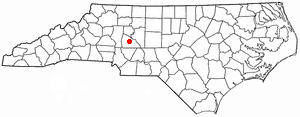
Salisbury, North Carolina

Indeed, some of the biggest complaints are that Fibrant didn’t arrive sooner and the speeds are not fast enough.  The city-owned service is still fighting its way to wire fiber optic cable on utility poles where its competitors have engaged in foot-dragging to move their existing cables to make room for Fibrant.  The company’s waiting list for sign-ups now numbers well into the hundreds.

Local media has been buzzing about Fibrant’s published pricing, which undercuts Time Warner Cable’s regular prices but not its promotional deals.  The cable company recently launched a national promotion marketing broadband, cable, and telephone service for $99 for the first year.  That’s about $45 cheaper than a comparable “deluxe” package from Fibrant.

Fibrant marketing director Len Clark told the Salisbury Post they cannot compete with those special deals.

“We can’t afford it,” he said.

But many municipal providers have turned these promotions upside down and told their potential customers their pricing does not come with tricks, traps, or temporary discounts that expire exposing customers to much higher prices down the road.

EPB, the utility provider in Chattanooga, has been successful with everyday pricing that beats Comcast and delivers far better service — faster broadband speeds, better picture quality, and no annoying Internet Overcharging schemes.

Clark hopes Salisbury residents will take notice that their temporarily higher prices include better quality service and faster broadband.

Also important: the money earned by Fibrant stays in Salisbury and could eventually help defray city expenses.

The Post explains the differences between the cable company and Fibrant:

The $99 special includes Road Runner High Speed Online with a download speed of 7 megabits per second and upload speed of .384 Mbps. For a limited time, subscribers can upgrade for free to Road Runner Turbo, boosting their Internet speed to 10 Mbps for downloads and .512 Mbps for uploads.

Fibrant’s standard Internet speed of 15 Mbps for both downloads and uploads is twice as fast as Road Runner High Speed Online and 50 percent faster than Road Runner Turbo. Fibrant customers can go faster — 25 Mbps up and down — for an additional $20 per month.

Both Time Warner’s $99 special and Fibrant’s comparable package offer about 150 TV channels. High definition is free for Time Warner subscribers, while Fibrant customers must pay more.

Time Warner’s package does not include a digital video recorder. Fibrant’s does.

However, people who sign up for the $99 Time Warner special this month get Showtime for free, Dan Ballister, director of communications for Time Warner Cable Charlotte said. Next month, it could be a free DVR, he said.

Time Warner’s phone service offered in the $99 deal has about a dozen features, including the popular caller ID that appears on the TV screen. Fibrant’s phone service offers 17 calling features.
Some area consumers and businesses expressed concern about Fibrant’s broadband speeds topping out at just 25Mbps, which is slow in comparison to many other fiber to the home providers.  They are also concerned the company did not more aggressively price services at launch.

Many municipal providers have learned from the mistakes of others who have tried to engage in all-out pricing wars with large cable companies.  Most cable companies can cross-subsidize rates to ridiculously low, predatory prices to win such pricing wars, making them untenable for municipal providers with bonds to pay back.  But at the same time, municipal providers are in serious danger or obliterating the marketing benefits fiber brings by not showcasing fiber’s capabilities and giving customers the motivation to throw their current provider overboard.  We urge Fibrant officials to consider reducing the price or increasing the speed of Fibrant’s 25Mbps service, which appears too expensive and slow priced at $65 a month.  It needs to be at least $10 less a month to make it an attractive alternative to Time Warner’s inevitable future speed upgrades in the area to 10/1 standard service and 15/2 for “turbo” service, commonly found wherever fiber competes.  Remember, Time Warner also markets “Speedboost” to consumers as though those temporary speeds are delivered consistently.

As EPB quickly learned, the “wow” factor can drive sign-ups, and they doubled their broadband speeds to get more bang for the buck.  Fibrant needs to remember the valuable marketing lesson of driving customers towards “sweet spot” premium tier pricing customers feel they got for a steal.  If 15Mbps service is $45 a month, how many would spring for 20 or 25Mbps for just $5-10 more?  Time Warner learned this selling their “turbo” speed package.  And most importantly of all, Fibrant risks harming their own argument fiber optics brings new businesses and jobs when their current price schedule shows speeds topping out at just 25Mbps.  Admittedly those are residential service offerings, but we encourage them to deliver faster speeds, especially to businesses.
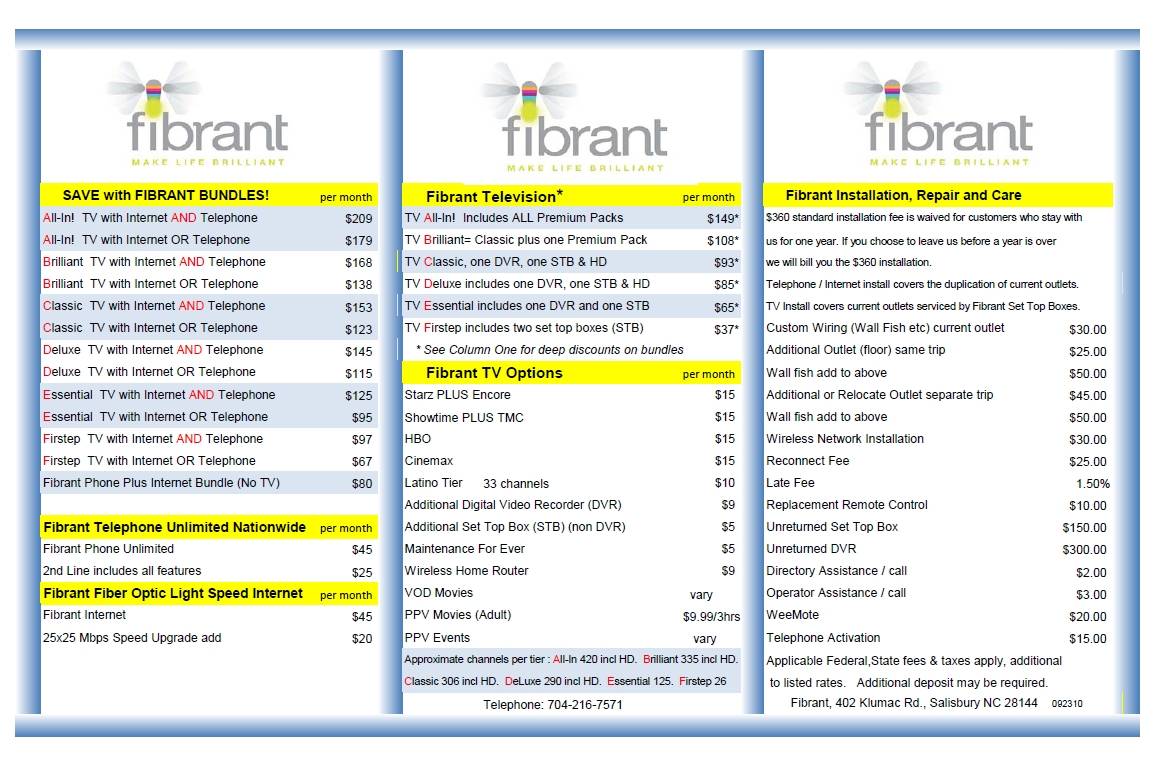
Fibrant's Price List (click to enlarge)

Fibrant even hides the names of its adult channels

The controversy about Fibrant carrying porn pay per view channels also popped up in the local media and drew complaints from conservative residents upset with their local government accommodating such programming.

Fibrant handily dealt with the controversy, noting tax dollars do not pay for Fibrant, it needs to compete with cable and satellite providers who offer such content, and Fibrant has gone beyond the competition in masking even the names of the channels to those who do not want such pay per view programming in their homes.

Time Warner Cable readily provides not only the names of the adult channels they carry, but also includes program titles that leave absolutely nothing to the imagination.  And who can forget Time Warner accidentally promoted its adult content on a free on-demand children’s channel earlier this year.

Fibrant officials also said the right thing telling residents they absolutely do not want to be in the business of telling people what they can and cannot watch.  It’s a personal decision, and the provider will go out of its way to make sure customers who do not want such material coming into their homes need not see a single bit of evidence it’s there.

That goes a long way to ameliorating a politically sensitive issue.

[flv width=”640″ height=”500″]http://www.phillipdampier.com/video/WBTV Charlotte Fibrant Porn Controversy 10-12-10.flv[/flv]

WBTV-TV covered the controversy of Salisbury’s Fibrant service carrying adult pay per view programming.  (3 minutes)

A vocal minority of comments left on the Post‘s website have also attacked the service with a considerable amount of false information.  Some are upset with a $360 installation fee that actually will only be charged to a customer leaving within the first year of service.  Others invented monthly fees that don’t exist, and one actually wrote:

“The field is already crowded enough with Windstream, Time Warner, AT&T and a slew of decent wireless ops. The existing internet providers offer far better deals. Fibrant which was supposed to have high speed fiber optic, really doesn’t. Fibrant’s download speeds are not as fast as Time Warner and higher end Windstream. Fibrant doesn’t seem to want to compete pricewise or service wise–so why bother?”

Of course, Fibrant’s matched upstream and downstream speeds leave Windstream’s DSL gone with the wind.  Time Warner Cable currently delivers standard speeds half that of Fibrant’s lowest speed service (and as you can see in the video below doesn’t even actually deliver that), and AT&T’s U-verse maxes out under the best conditions at real world speeds below what Fibrant can deliver.  Anyone who has used wireless broadband knows speed is the first thing sacrificed.  Unlimited, unthrottled wireless broadband is second.  Fibrant needs some social networking to put out these kinds of BS brushfires before they become accepted memes.  Stop the Cap! helped, at least for today.

Meanwhile, Time Warner Cable officials used Fibrant’s launch to, once again, draw false connections between local government funds paying for a cable system that duplicates existing services.

Back to the Post:

Time Warner is still surprised by “municipal overbuilds,” or city-owned fiber optic networks like Fibrant in Salisbury and Greenlight in Wilson, Ballister said.

“It’s just interesting that during these economic times, when city and county budgets are being cut back, that they would want to spend millions of dollars providing services that are already out there,” Ballister said.

Salisbury borrowed $33 million to launch Fibrant.

Cities have an unfair advantage in offering communication services, Ballister said.

“We’re all for competition, as long as people are on a level playing field,” he said.

Cities pay no property or income taxes. They can operate the utility at a loss and cross-subsidize from other areas of government, Ballister said.

“They can level taxes on citizens to recover their operating costs,” he said.

Fibrant is expected to operate at a loss for three years and have a positive cash flow by year four. It will take longer to make a profit, Clark said.

Eventually, Fibrant is supposed to generate revenue for the city.

Cities in the fiber optic business also can hike the fees their competitors must pay to get access to their subscribers, Ballister said.

“They are the gatekeepers to rights of way and pole attachments,” he said.

The company has no specific examples of fee hikes to hurt Time Warner, but “these are valid concerns that exist right now,” Ballister said.

It’s ironic Ballister complains about utility pole fees considering Fibrant is currently a victim of Time Warner’s slow progress making space on those poles to accommodate the city’s fiber optics.  No vendetta by city officials is apparent, as they patiently wait for the cable company to handle its responsibilities.

Ballister should not be surprised the city of Salisbury did for itself what Time Warner Cable refused to do in the community.  Just like in Wilson, Salisbury city officials pleaded with the cable company to deliver improved service in the community but it fell on deaf ears.  Many sections of the city center cannot access reliable broadband from the cable company to this day.  But most of them can now get service from Fibrant.  Cable companies like Time Warner have spent millions of subscriber dollars trying to legislatively ban networks like Fibrant, fearful of the competition they can bring.

Salisbury Assistant City Manager Doug Paris notes the enormous amount of money poured into North Carolina’s state legislature trying to ban projects year after year.  That Time Warner money could have made a real difference for residents and small businesses in Salisbury and other parts of North Carolina if used to improve service, not fight competition.

Kirk Knapp of Tastebuds Coffee and Tea doesn’t care what Time Warner does with the money at this point, so long as he can finally be liberated from them.  He told the Post he feels “held hostage by Time Warner.”

“Time Warner has the worst customer service I have ever dealt with,” Knapp said in an e-mail to the Post.

“Fibrant may have these same kind of issues, however I can actually go to the source to deal personally with someone who is vested in the community, not spend two hours on the phone and never solve the problem as I do with TWC,” he said.

“Even if pricing is higher, I would make the change. Price is important, but quality and service is tantamount.”

[flv width=”640″ height=”500″]http://www.phillipdampier.com/video/Fibrant Intro 11-2-10.flv[/flv]

Folks from the Walser Technology Group, Inc. in Salisbury gave an informal introduction of Fibrant on its YouTube channel, including a very revealing speed test comparing broadband service from Fibrant with Time Warner Cable.  (7 minutes)

Misrepresenting Broadband Stimulus Benefits: A Case in Point on Rhode Island

Phillip Dampier October 20, 2010 Broadband Speed, Competition, Editorial & Site News, Public Policy & Gov't, Video Comments Off on Misrepresenting Broadband Stimulus Benefits: A Case in Point on Rhode Island

Rhode Island politicians and some local television stations are celebrating a $21.7-million federal stimulus grant awarded to a non-profit consortium of educational, governmental and health-care organizations to construct a new fiber optic network that some claim will help “improve broadband service” for Rhode Island residents.

Unfortunately for residents of the Ocean State, the proposed network of 339 miles of fiber cable represents an example of “look, but don’t touch.”

The OSHEAN (pronounced ‘Ocean’) project is yet another example of an institutional network that is strictly off-limits to residential homeowners, unless they happen to use the service at an area school or library.

But politicians who appear at announcement ceremonies to celebrate stimulus awards, and the media that covers them, far too often sell the benefits of such projects to residents who can’t ultimately use the service their tax dollars are helping to fund.

Many parts of Rhode Island already receive access to fiber service from Verizon FiOS, which represents another reason to keep consumers out.

“Verizon would object strenuously if this stimulus grant allowed OSHEAN’s network to be available to anyone who wants access,” writes our reader Mike who lives in Providence.  “So to keep Verizon and other providers quiet, the network promises not to directly wire any residence or individual business who wants access.”

Instead, the network will predominately benefit Brown University, the City of Providence, Lifespan hospitals, the Rhode Island Division of Information Technology, the University of Rhode Island and the U.S. Naval War College.

[flv width=”480″ height=”380″]http://www.phillipdampier.com/video/WPRI Providence Providence RI to get statewide fiber optic network 10-17-10.flv[/flv]

Here is WPRI-TV in Providence misleading viewers about the benefits of a broadband stimulus award, suggesting it will somehow improve residents’ Internet service.  (1 minute)

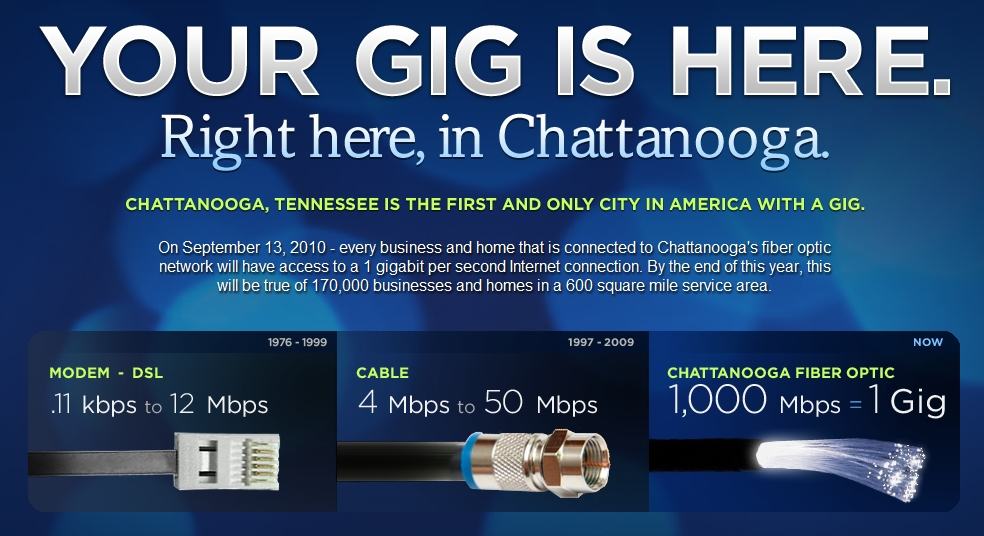
EPB’s 1Gbps Service Embarrasses Big Telecom; Who Are the Real Innovators?

EPB’s new 1Gbps municipal broadband service is causing some serious embarrassment to the telecom industry.  Since last week’s unveiling, several “dollar-a-holler” telecom-funded front groups and trade publications friendly to the industry have come forward to dismiss the service as “too expensive,” delivering speeds nobody wants, and out of touch with the market.

The “Information Technology and Innovation Federation,” which has historically supported the agenda of big telecom companies, has been particularly noisy in its condescending dismissal of the mega-speed service delivered in Chattanooga, Tenn.

Robert Atkinson, president of ITIF, undermines the very “innovation” their group is supposed to celebrate.  Because it doesn’t come from AT&T or Verizon, it’s not their kind of “innovation” at all.

“I can’t imagine a for-profit company doing what they are doing in Chattanooga, because it’s so far ahead of where the market is,” Atkinson told the New York Times.

“Chattanooga definitely is ahead of the curve,” Atkinson told the Times Free Press. “It’s like they are building a 16-lane highway when there is a demand for only four at this point. The private companies probably can’t afford to get that far ahead of the market.”

Bernie Arnason, formerly with Verizon and a cable industry trade association also dismissed EPB’s new service in his current role as managing editor for Telecompetitor, a telecom industry trade website:

Does anyone need that speed today? Will they in the next few years? The short answer is no. It’s kind of akin to people in the U.S. that buy a Ferrari or Lamborghini – all that power and speed, and nowhere to really use it. A more apropos question, is how many people can afford it – especially in a city the size of Chattanooga?

[…]Will there be a time when 1 Gb/s is an offer that is truly in demand? More than likely, although I still find it hard to imagine it being really necessary in a residential setting – I mean how many 3D movies can you watch at one time? Maybe a service that bursts to 1 Gb/s in times of need, but an always on symmetrical 1 Gb/s connection? Truth be told, no one really knows what the future holds, especially from a bandwidth demand perspective.

Supporting innovation from the right kind of companies.

Arnason admits he doesn’t know what the future holds, but he and his industry friends have already made up their minds about what level of service and pricing is good enough for “a city the size of Chattanooga.”

Comcast’s Business Class broadband alternative is priced at around $370 a month and only provides 100/15Mbps service in some areas.  Atkinson and Arnason have no problems with that kind of innovation… the one that charges more and delivers less.

For groups like the ITIF, it’s hardly a surprise to see them mount a “nobody wants it or needs it”-dismissive posture towards fiber, because they represent the commercial providers who don’t have it.

Fiber Embargo

The Fiber-to-the-Home Council, perhaps the biggest promoter of fiber broadband delivered straight to customer homes, currently has 277 service provider members. With the exception of TDS Telecom, which owns and operates small phone companies serving a total of 1.1 million customers in 30 states, the FTTH Council’s American provider members are almost entirely family-run, independent, co-op, or municipally-owned.

Companies like American Samoa Telecommunications Authority, Hiawatha Broadband Communications, KanOkla Telephone Association Inc., and the Palmetto Rural Telephone Cooperative all belong.  AT&T, CenturyLink, Frontier, Verizon, and Windstream do not.  Neither do any large cable operators.

While not every member of the Council has deployed fiber to the home to its customers, many appreciate their future, and that of their communities, relies on a high-fiber diet.

EPB’s announcement of 1Gbps service was made possible because it operates its service over an entirely fiber optic network.  Company officials, when asked why they were introducing such a fast service in Chattanooga, answered simply, “because we can.”

The same question should have been directed to the city’s other providers, Comcast and AT&T.  Their answer would be “because we can’t… and won’t.”

Among large providers, only Verizon has the potential to deliver that level of service to its residential customers because it invested in fiber.  It was also punished by Wall Street for those investments, repeatedly criticized for spending too much money chasing longer term revenue.  Wall Street may have ultimately won that argument, because Verizon indefinitely suspended its FiOS expansion plans earlier this year, despite overwhelmingly positive reviews of the service.

So among these players, who are the real innovators?

The Phone Company: Holding On to Alexander Graham Bell for Dear Life

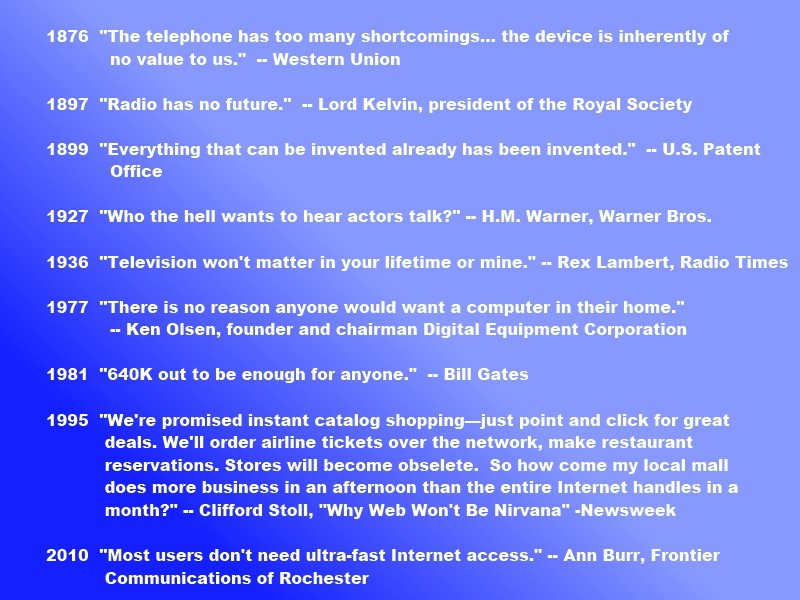
Last week, Frontier Communications told customers in western New York they don’t need FiOS-like broadband speeds delivered over fiber connections, so they’re not going to get them.  For Frontier, yesterday’s ADSL technology providing 1-3Mbps service in rural areas and somewhat faster speeds in urban ones is ‘more than enough.’

That “good enough for you” attitude is pervasive among many providers, especially large independent phone companies that are riding out their legacy copper wire networks as long as they’ll last.

What makes them different from locally-owned phone companies and co-ops that believe in fiber-t0-the-home?  Simply put, their business plans.

Companies like Frontier, FairPoint, Windstream, and CenturyLink all share one thing in common — their dependence on propping up their stock values with high dividend payouts and limited investments in network upgrades (capital expenditures):

Perhaps the most important metric for judging dividend sustainability, the payout compares how much money a company pays out in dividends to how much money it generates. A ratio that’s too high, say, above 80% of earnings, indicates the company may be stretching to make payouts it can’t afford.

Frontier’s payout ratio is 233%, which means the company pays out more than $2 in dividends for every $1 of earnings! But this ignores Frontier’s huge deferred tax benefit and the fact that depreciation and amortization exceed capital expenditures — the company’s actual free cash flow payout ratio is a much more manageable 73%. Dividend investors should ensure that benefit and Frontier’s cash-generating ability are sustainable.

In other words, Frontier’s balance sheet benefits from the ability to write off the declining value of much of its aging copper-wire network and from creative tax benefits that might be eliminated through legislative reform.

The nightmare scenario at Frontier is heavily investing in widespread network upgrades and improvements beyond DSL.  The company recently was forced to cut its $1 dividend payout to $0.75 to fund the recent acquisition of some Verizon landlines and for limited investment in DSL broadband expansion.

Frontier won’t seek to deploy fiber in a big way because it would be forced to take on more debt and potentially cut that dividend payout even further.  That’s something the company won’t risk, even if it means earning back customers who fled to cable competitors.  Long term investments in future proof fiber are not on the menu.  “That would be then and this is now,” demand shareholders insistent on short term results.

The broadband expansion Frontier has designed increases the amount of revenue it earns per customer while spending as little as possible to achieve it.  Slow speed, expensive DSL fits the bill nicely.

The story is largely the same among the other players.  One, FairPoint Communications, ended up in bankruptcy when it tried to integrate Verizon’s operations in northern New England and found it didn’t have the resources to pull it off, and delivered high speed broken promises, not broadband.

Meanwhile, many municipal providers, including EPB, are constructing fiber networks that deliver for their customers instead of focusing on dividend checks for shareholders.

Which is more innovative — mailing checks to shareholders or delivering world class broadband that doesn’t cost taxpayers a cent?

Cable: “People Don’t Realize the Days of Cable Company Upgrades are Basically Over”

While municipal providers like EPB appear in major national newspapers and on cable news breaking speed records and delivering service not seen elsewhere in the United States, the cable industry has a different story to share.

Kent

Suddenlink president and CEO Jerry Kent let the cat out of the bag when he told investors on CNBC that the days of cable companies spending capital on system upgrades are basically over.

“I think one of the things people don’t realize [relates to] the question of capital intensity and having to keep spending to keep up with capacity,” Kent said. “Those days are basically over, and you are seeing significant free cash flow generated from the cable operators as our capital expenditures continue to come down.”

Both cable and phone companies have called a technology truce in the broadband speed war.  Where phone companies rely on traditional DSL service to provide broadband, most cable companies raise their speeds one level higher and then vilify the competition with ads promoting cable’s speed advantages.  Phone companies blast cable for high priced broadband service they’re willing to sell for less, if you don’t need the fastest possible speeds.  But with the pervasiveness of service bundling, where consumers pay one price for phone, Internet, and television service, many customers don’t shop for individual services any longer.

With the advent of DOCSIS 3, the latest standard for cable broadband networks, many in the cable industry believe the days of investing in new infrastructure are over.  They believe their hybrid fiber-coaxial cable systems deliver everything broadband consumers will want and don’t see a need for fiber to the home service.

Their balance sheets prove it, as many of the nation’s largest cable companies reduce capital expenses and investments in system expansion.  Coming at the same time Internet usage is growing, the disparity between investment and demand on broadband network capacity sets the perfect stage for rate increases and other revenue enhancers like Internet Overcharging schemes.

Unfortunately for the cable industry, without a mass-conversion of cable-TV lineups to digital, which greatly increases available bandwidth for other services, their existing network infrastructure does not excuse required network upgrades.

EPB’s fiber optic system delivers significantly more capacity than any cable system, and with advances in laser technology, the expansion possibilities are almost endless.  EPB is also not constrained with the asynchronous broadband cable delivers — reasonably fast downstream speeds coupled with paltry upstream rates.  EPB delivers the same speed coming and going.  In fact, the biggest bottlenecks EPB customers are likely to face are those on the websites they visit.

EPB also delivered significant free speed upgrades to its customers earlier this year… and no broadband rate hike or usage limits.  In fact, EPB cut its price for 100Mbps service from $175 to $140.  Many cable companies are increasing broadband pricing, while major speed upgrades come to those who agree to pay plenty more to get them.

Which company has the kind of innovation you want — the one that delivers faster speeds for free or the one that experiments with usage limits and higher prices for what you already have?

No wonder Big Telecom is embarrassed.  They should be.

[flv width=”640″ height=”500″]http://www.phillipdampier.com/video/EPB Interviews 9-20-10.flv[/flv]

EPB and Chattanooga city officials appeared in interviews on Bloomberg News and the Fox Business Channel.  CNET News also covered EPB’s 1Gbps service, introduced last week.  (12 minutes)

Frontier Communications Tells Customers in Western NY They ‘Don’t Need FiOS Speeds That Fast’

Phillip Dampier September 15, 2010 Broadband Speed, Frontier, Video 9 Comments

Frontier's Ann Burr sat down for an interview with a Rochester television station to discuss the future of landlines.

Frontier Communications told customers in western New York not to expect FiOS fiber-to-the-home technology from them anytime soon, claiming residents in upstate New York do not need broadband speeds that fast.  That prompted regular Stop the Cap! reader Bob in Rochester to drop us a note.

Ann Burr, general manager of Frontier’s Rochester division, told WHAM-TV reporter Rachel Barnhart the company believes its current DSL service is more than adequate for residents in the company’s largest service area.  This, despite the fact Frontier recently adopted a handful of FiOS markets purchased from Verizon Communications.  While Frontier has promised to continue delivering the fiber-to-the-home service in areas already offered the service started by Verizon, they have no plans to expand FiOS.

“We’re constantly upgrading our local networks to make sure they can get higher and higher speeds,” Burr told Barnhart. “Fiber lines are installed in newer developments, and neighborhoods that report problems with DSL lines get attention from technicians.”

With Frontier’s DSL service already available in 95 percent of Frontier’s Rochester-area division, Burr added, there is no need to offer FiOS in Rochester.

Burr, who was formerly president of Time Warner Cable’s Rochester division from 1995-1999, has made similar remarks in the past.  In February, she told readers of the Rochester Democrat & Chronicle they didn’t need ultra-fast broadband speeds from Frontier either.

from 'The Bridge'

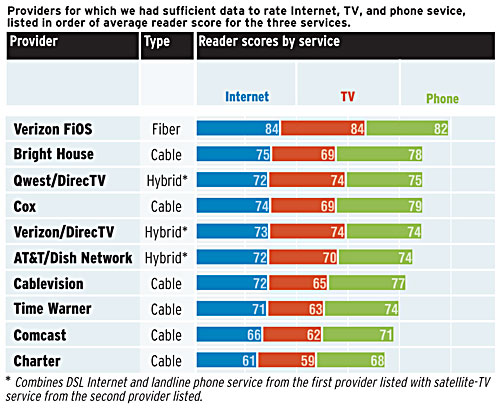
Yet Verizon, one of the nation’s largest phone companies, thinks otherwise.  In upstate New York, the company is still completing its fiber optic network in cities like Albany, Buffalo, and Syracuse.  Verizon FiOS remains a top-rated favorite among readers of Consumer Reports.  Frontier’s DSL managed a less impressive 12th place.

Barnhart learned about Frontier’s broadband plans as part of a larger story about how the phone company will survive the age of the cell phone, as local customers continue to disconnect their Frontier landlines in favor of wireless service from providers like Verizon and AT&T.

Burr warned customers to think twice before disconnecting service.

“Don’t do it. Because I’ve personally been in a situation where my home was without power for a couple of days and you have to recharge cell phone batteries, which you can’t do if you don’t have power,” Burr said.

Burr can’t see a day when no one has a landline phone any longer.

“I don’t see that for a long time. I think that wired phone, copper infrastructure that’s been here for many years provides [the] security [and] reliability that people want,” she said.

Burr’s beliefs are contrary to industry statistics that show Americans continue to drop landline service.  Among those under 30, it’s sometimes hard to find anyone who has a landline at all.

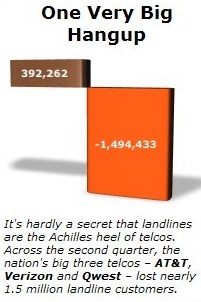
The Bridge reports in the second quarter of 2010 alone, just three phone companies — AT&T, Verizon, and Qwest lost nearly 1.5 million landline customers, mostly to cell phone service and competing “digital phone” products offered by the cable industry.

Consumer Reports says its readers gave top marks to Verizon FiOS for its speed, selection, and service. Frontier didn't make this list at all.

[flv]http://www.phillipdampier.com/video/WHAM Rochester Will Frontier Communications Survive in Cell Phone Age 9-15-10.flv[/flv]

WHAM-TV’s Rachel Barnhart talked with local residents who have disconnected their Frontier landlines and spoke with Frontier’s Ann Burr about the long term prospects for a company primarily delivering that service.  (2 minutes)

Ontario County, NY: We Need Fiber So Badly, We Just Did It Ourselves

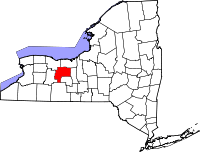
Ontario County, N.Y.

Ontario County, just south and east of Rochester, N.Y., is unleashing the power of fiber optics after private providers turned their noses up at the rapidly-growing Finger Lakes region.

“We just said we need this so badly, we just did it ourselves,” says Ed Hemminger, president and CEO of Axcess Ontario, a non-profit corporation created by the county government to run the $7.5 million dollar project.  Hemminger appeared on this afternoon’s edition of CNBC’s Power Lunch.

The 180-mile fiber optic network now two-thirds complete is expected to be finished by year’s end.  Hospitals and schools are already leasing capacity on the fiber ring.

Axcess Ontario doesn’t actually provide broadband service to businesses and consumers itself.  Instead it leases capacity to all-comers, inviting them to use the fiber ring to enhance their broadband infrastructure.  The company doesn’t provide residential service, for example, but it could enhance another provider’s ability to deliver service.  Right now, the county is contemplating a wireless Internet service for consumers, if they can find a provider.  Frontier Communications could be a likely contender, considering it already provides a Wi-Fi service in downtown Rochester and in portions of suburban towns like Brighton, Pittsford, and Greece.

Hemminger

Hemminger

Ontario County is one of the bright spots in western and central New York’s difficult economy.  Both residential and business growth continues, despite the recession, particularly in communities like Canandaigua, Victor and Geneva.  Having a state-of-the-art fiber ring enhances the area’s ability to attract new businesses and jobs to the Finger Lakes region, often better known for tourism.  At least that is the plan.

“Honestly every company is an Internet company because they all have to use the Internet,” Hemminger claims.

Having the county build the network was the only prospect for getting it done.

“We can have a Return on Investment of 25 years, while the private sector has to recoup its costs in three to four years,” Hemminger says.

Thanks to Stop the Cap! reader Jeff for sending word.

[flv]http://www.phillipdampier.com/video/CNBC Making Broadband Accessible 6-10.10.flv[/flv]

Ed Hemminger discusses the Axcess Ontario fiber ring project in Ontario County, N.Y., on today’s edition of Power Lunch on CNBC.  (2 minutes)

Search This Site:

Contributions:

Recent Comments:

Your Account:

Stop the Cap!