Home » Providers » Recent Articles:

Update #2: Charter Cable Adding More Junk Fees to Your Cable Bill: Here’s How to Fight Back and Save More

Phillip Dampier September 15, 2010 Charter Spectrum, Competition, Consumer News 14 Comments

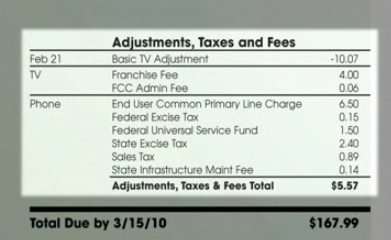
Charter's dumping ground for sneaky rate increases can be found in the Adjustments, Taxes and Fees portion of your monthly bill.

Charter Cable is literally passing the buck onto its cable TV subscribers.

Effective this October, Charter Cable customers will pay about a dollar more per month thanks to a new junk fee the company is adding to subscribers’ bills.

Federal law allows local U.S. broadcast television stations (i.e., affiliates of networks such as CBS, NBC, ABC, Fox, etc.) to negotiate with cable and satellite providers in order to obtain “consent” to carry their broadcast signals (Cable Television Consumer Protection and Competition Act of 1992).

As a direct result of local broadcast, or “network-affiliated,” TV stations increasing the rates to Charter to distribute their signals to our customers, we will be passing those charges on as a Broadcast TV Surcharge, in the Taxes and Fees section of the billing statement. These local TV signals were historically made available to Charter at no cost, or low cost. However, in recent years the prices demanded by local broadcast TV stations have necessitated that we pass these costs on to customers.

For most customers, the fee will average $0.94 per month, but in some areas it will be as high as $1.31 per month.  Charter argues the fee is not arbitrary. claiming it represents the average price the company pays – per subscriber – for local broadcast stations in the communities it serves.

Stop the Cap! contacted Charter this morning and learned the company intends to impose this new fee even on customers with Charter’s Price Guarantee Package, which is supposed to guarantee customers no change in pricing for up to two years (see notes at the end of the article for an update).  A Charter representative we contacted claimed the company will impose the fee on all customers, including those on contract, because of a clause in the terms and conditions which says, “The guaranteed price does not include the cost of installation and equipment, any applicable franchise fees, taxes or late fees, or costs for other ancillary services that you may order.”

Of course, the new fee is completely arbitrary and is neither a franchise fee or tax, nor is it for an “ancillary service.”  We predict a closer review of Charter Cable’s thinking on this matter by state regulatory agencies and Attorneys General.

Charter’s FAQ seeks to pass the blame for the new fee to the federal government and local broadcasters:

Federal law treats [cable networks and over-the-air TV stations] differently. Unlike cable TV networks, local broadcast TV stations distribute their signals over the air, using free spectrum granted to them by the federal government. In effect, taxpayers are subsidizing the distribution of broadcast TV signals. These same broadcast TV stations are then allowed by the government to charge for their signals — and if we don’t agree to pay, broadcasters can force us to drop their channels, thereby adversely impacting our customers.

“Given cable’s well-documented history of raising rates 4-6 times the annual rate of inflation, it seems rather disingenuous for them to now claim their rate hikes are coming as a result of broadcast TV stations, which provide the highest-rated entertainment and local news programming on the cable line-up,” National Association of Broadcasters Executive VP Dennis Wharton told Multichannel News in response to Charter’s move.

The new Broadcast TV Surcharge will appear in the Taxes and Fees section of your bill, joined by other junk fees Charter has invented to pass along the ordinary costs of doing business to cable subscribers while claiming they are not increasing rates:

Charter’s “It’s Someone Else’s Fault We Charge These” Junk Fees

  • TV and Internet Late Payment Fee — A late fee will be assessed for past due unpaid Charter TV and Internet charges.
  • Phone Processing Fee — This fee is assessed when Charter does not receive payment for the full balance of your phone charges.
  • Regulatory Cost Fee — The cost of doing paperwork and whatever else the company deems.
  • State Telephone Relay Charge — Funds a Telecommunications Relay Service for hearing impaired/speech disabled residents.
  • Federal Communications Commission (FCC) Fee — The FCC charges an annual regulatory fee for cable operators.
  • Franchise Fee — Local communities collect a percentage of revenue from cable operators in return for doing business in the community.
  • Public Education and Government Channels (PEG) Fee — Many cable franchise agreements ask cable operators to help fund the operations of these channels.
  • Public Utilities Commission (PUC) Fee — Some states ask regulated providers to defray the costs of utility commissions that oversee providers on the state level.
  • County 911 Charge (9-1-1 fee) — Some counties ask telephone providers to help pay to administer emergency 911 service.
  • Telephone Right Of Way Fee (Municipal right-of-way fee) — A fee used to compensate municipalities for the use of their rights-of-way.
  • E911 Equalization Surcharge (9-1-1 equalization fee) — A fee charged in wealthier, urban areas to help subsidize the costs of 911 service provision in rural and poor areas.

(Those fees in blue represent completely optional “junk fees” that hide revenue enhancements.)

(Those charges in red are fees mandated by government entities, but traditionally deemed “the cost of doing business.”  Nobody requires these fees be billed directly to subscribers on a line-by-line basis, and most cable operators used to include them in the monthly price for service.  But in a quest for increased revenue, cable companies began breaking them out of cable package pricing, charging for them independently.  That effectively raises your total bill without changing the price of the programming package.  It’s comparable to an airline charging for your airline ticket, but then padding the price with a Seat Rental Fee, a Boarding Fee to enter and exit the plane, an FAA Cost Recovery Fee to pay the Federal Aviation Administration for its services, a Flight Plan Filing Surcharge to cover the costs of filing a flight plan, and a Control Tower Charge to defray the expense of dealing with air traffic controllers.  Snacks and soft drinks are extra.)

Charter Cable has been notifying subscribers about the new fee in mailings sent to subscribers.  The company’s argument that broadcasters and the federal government conspired to make subscribers pay more may have some merit, but nobody forced Charter Cable’s hand to add a new junk fee to customer bills.

Local broadcasters are in an enviable position because federal government rules have given them all the cards to charge whatever they want for cable carriage.  Government policy forbids most cable systems from taking their business elsewhere — perhaps to a station in a nearby city or network affiliate delivered via satellite that is willing to accept less than what local stations demand.  Network-affiliated stations need not compete for cable carriage because they can demand cable systems not go outside of the area for an alternative.

Broadcasters do not enjoy “free spectrum granted by the federal government.”  Television stations pay license fees and taxes just like other spectrum users and are mandated by the federal government to meet certain minimum programming standards and decency rules.  Unlike other private license holders, broadcasters are supposed to serve the public interest, although what exactly defines that has evolved and eroded over the years.  Cable programming is not regulated.

Charter Cable’s claim that “taxpayers are subsidizing the distribution of broadcast TV signals” is dubious at best.  Broadcast radio and television preceded the paid television industry by decades, and was created to deliver unique “local service” to communities where stations were licensed in the public interest.  Should Charter argue that broadcasters should bid for auctioned spectrum, they’d have much more to complain about when those costs are passed on in considerably higher broadcast carriage fees.

As usual, regardless of who wins the spat over local broadcast carriage fees, it’s Charter’s subscribers who will lose thanks to the higher bills that follow.  But not our readers.

If you follow our advice, you can save far more than a dollar a month.

Score a new customer promotion and save far more than Charter hoped to collect from its new Broadcast TV Surcharge.

Stop the Cap! has been in touch with several Charter subscribers who successfully argued their way to considerably lower monthly bills, often by $20 or more a month.  Here’s how you can let the bully boys argue over someone else’s money:

Gather Information

Get out a copy of your latest Charter Cable bill showing your packages, programming fees and the taxes and surcharges piled on at the end of the bill.  Then, visit DISH Network or DirecTV’s website and gather pricing information for a comparable video package using their promotional pricing for new customers.  Also visit your local phone company website for pricing for their phone and broadband services, taking note of any new customer promotional pricing and gifts.

On a sheet of paper, list the costs for Charter’s services on one side and the prices you would pay with their competitor(s) on the other and determine how much you would save with the competition.

Armed with this information, you’re now ready to sit down, call Charter, and talk business.

Sit Down And Make the Call

When you call Charter, select the option to cancel service or just say the word “cancel.”  This will transfer you to Charter’s “customer retention” department.  This group of customer service representatives have been specially trained to talk you out of dropping your service.

Explain that you are calling to cancel your Charter service after you received word of the latest fee increase.  Tell them it was the last straw after years of rate increases and that you’ve been comparison shopping.

A Sample Conversation

You: “My husband/wife and I carefully considered an offer we received from [competitor] last night and decided it was time to make a change.  It’s really all about the pricing.  This economy has been killing us and we simply cannot handle a higher bill.  When we looked at [competitor’s] offer, we discovered we could be saving $20 (insert amount applicable to you) or more a month over your own pricing.  But I’ve been a Charter subscriber for a long time and I decided I should call and see if there was any way we could stay as a customer, if we could only negotiate a lower bill.”

Charter: “I see you have been a customer for a long time.  Did you know that Charter delivers… (expect a comparison about the differences between satellite and phone company competition and Charter at this point.  Your goal is to patiently wait until they finish and then stick to your guns that it’s really all about the monthly cost).

You: “I understand all that but you have to understand the only reason we are calling to cancel service is because of your prices.  I am really giving you a last chance to see if we could stay and pay a lower price.”

Charter: “Let’s review your bill and see if we can drop any services you may not be using or perhaps sign you up for a different tier of broadband service.”

You: “The thing is, with [competitor’s] service, I don’t have to drop anything and I will still get a much lower price.  Let me suggest an alternative idea.  You could save our family as a customer if you could sign me up for the same kind of package pricing new customers pay.”

Charter: “I’m sorry, but those prices are only for new customers.  But perhaps if we credited your account for a year’s worth of the fee you are upset about, that would help?”

You: “No, not really.  Not after I saw what we could be paying by switching.  Again, we’ve really already decided on making this change, but I decided it would be fair to give Charter a last chance to come closer to the prices I would be paying with your competitor.  Isn’t there anything you could do to sign me up to a new customer promotion?”

Charter: “Well, let me put you on hold and talk to my supervisor.”

At this point, you may or may not get your request granted.  Sometimes the representative will try and negotiate dollar amounts, try to sell you a bundled package of services to deliver “more savings,” or offer you a lower discount.  Stick to your guns, but always remain polite.  Sometimes their counteroffer may not deliver new customer pricing, but will still leave you saving far more than when you started, and keeps you off a term contract.  If you are uncomfortable with the progress of the negotiations, or find an unsatisfactory outcome, politely end the call telling the representative you would like some time to think about it.  It’s your chance to call back and speak with someone else.

In general, the more seriously they sense you are ready to commit to the competition, the better the offers will get to stay.  Feel free to let them know you’ve already scheduled an installation with the “other guy” or would like information about where to drop off your cable equipment.  If you are queasy about playing hardball, blame it on your spouse, letting Charter know “he/she will never go for that.”  Stay friendly with the representative at all times — try to make them your advocate by encouraging them to find an even better deal for you and that you appreciate the time they are spending working with you.  It’s a lot easier to get a better offer when you are not screaming at the representative that can’t wait to get off the phone with you.
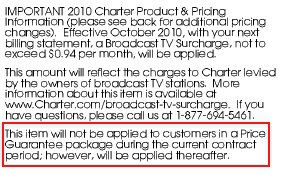
A Charter customer e-mailed this segment of their bill to clarify whether or not customers under a Price Guarantee contract would also pay the dollar fee.

If you find stubborn resistance to discounting your bill, consider showing up at the local cable office with your equipment and try negotiating one last time.

Charter Cable allows customers to cancel service and, after 30 days, sign up under a new customer promotion, so asking them to waive the 30 day requirement when it will save them money to reinstall service may be something they’ll consider.  You could also re-establish “new service” under a spouse’s name for an even faster turnaround.

As Charter has taught their subscribers, it’s all about business with them.  Turnabout is fair play, so give them the business about their pricing and demand savings.

[Updated 9:42pm ET — A Charter subscriber e-mailed Broadband Reports a copy of their latest Charter Cable bill saying the fee would -not- be applied to customers under a current Price Guarantee contract, in direct contradiction to what a Charter representative told us this morning.  This is not much of a surprise, considering it took eight calls to Time Warner Cable last week to get the straight story about their DVR price hike in upstate New York.

Perhaps we should start calling cable companies not less than five times for answers to basic questions and then average the responses we get.  As we said last week, we’ll believe the bill over what company representatives say any day.

Thanks to our reader Gabe and Broadband Reports for for alerting us to this development and helping clarify matters.]

[Update #2: 10:52am ET 9/16 — A Charter customer on Broadband Reports shared an online chat he had with Charter that shows I’m not the only one getting inaccurate information about this fee:

Scott: I heard that charter decided to add a new fee to user bills for “broadcast tv surcharge” even for customers that have locked in rates.

TTD Straissan : Yes. That is correct. The locked rates are for the services that are included on the locked promotion. Taxes and fees are not part of the locked promotion we have.

TTD Straissan : Broadcast TV Surcharge
Federal law allows local U.S. broadcast television stations (i.e., affiliates of networks such as CBS, NBC, ABC, Fox, etc.) to negotiate with cable and satellite providers in order to obtain “consent” to carry their broadcast signals (Cable Television Consumer Protection and Competition Act of 1992).

As a direct result of local broadcast, or “network-affiliated,” TV stations increasing the rates to Charter to distribute their signals to our customers, we will be passing those charges on as a Broadcast TV Surcharge, in the Taxes and Fees section of the billing statement. These local TV signals were historically made available to Charter at no cost, or low cost. However, in recent years the prices demanded by local broadcast TV stations have necessitated that we pass these costs on to customers.

This surcharge displays in the Taxes and Fees section of the bill statement.

Scott: when will this be on my bill?

TTD Straissan : Expected increase will be around October 1, 2010 on some areas.]

AT&T U-verse Arrives in the Triad, But Savings Are Elusive As Rate Hikes Continue

AT&T unveiled it’s U-verse system Monday in the Triad region of North Carolina, hoping to poach customers from Time Warner Cable’s “triple play” package of phone, broadband, and cable service.

AT&T U-verse services, which are delivered over AT&T’s Internet Protocol (IP) hybrid fiber-copper network, offer an alternative to cable with a DVR that can record more programming than the competition, features and apps not available from the local cable company, and additional channels new to the region. AT&T U-verse can combine every AT&T service a customer subscribes to onto a single monthly bill.

The most popular Internet-only tier of service has somewhat anemic download speeds up to 6 Mbps for $43 a month — other packages range from $38 for 3 Mbps to $65 for 24 Mbps.

U-verse TV packages include “local-channel only” service for $19 a month (with a stinging $199 installation fee), to more than 390 channels for $112 a month, with a $29 activation fee.  Other packages include U-100 with 130 channels for $54 a month and U-200 with 230 channels for $67.  High definition channels, now numbering more than 130, cost $10 extra per month.  Want premium channels in HD?  That’s another $5 a month.

Like other providers, AT&T has tinkered with pricing to deliver the most savings to customers who bring all of their business to AT&T with a triple-play bundle subscription.

“Today’s expansion of AT&T U-verse reflects our commitment to make the investments necessary to bring consumers across the Piedmont Triad a new era of true video competition,” Cynthia Marshall, AT&T North Carolina president said in a statement. “Local residents have asked for more choices in television service and today we’re delivering.”

[flv width=”640″ height=”500″]http://www.phillipdampier.com/video/ATT U-verse introduction.flv[/flv]

Watch this comprehensive video from AT&T explaining the many types of services U-verse offers and helpful tips to prepare for service installation.  Then view an actual installation in a customer’s home who shows off the equipment.  Stop the Cap! recommends you let AT&T do all of the required wiring for you.  That’s why you are paying that installation fee!  (22 minutes)

Brubaker

But despite the company’s claims that competition will deliver lower prices for consumers, the evidence suggests otherwise.

AT&T credits a statewide video franchising bill passed in the North Carolina legislature for making U-verse possible in the state.  Company officials showed their thanks by inviting the two state legislators instrumental in shepherding AT&T’s agenda through the General Assembly to be on hand to take credit for introducing cable competition in the state.  They also publicly thanked them in their press release.

Seventeen term House Rep. Harold Brubaker (R-Randolph) congratulated AT&T for its accomplishments.  Brubaker received $4,000 in campaign contributions from AT&T in the first quarter of 2010.

The representative from Asheboro co-sponsored the 2006 Video Service Competition Act which stripped local oversight of cable operators and made AT&T’s entry into North Carolina effortless.  For other would-be competitors, especially municipalities seeking to build their own fiber networks, Brubaker has been far less helpful.  Most recently, he voted against an effort to bring broadband service to Caswell County in areas incumbent provider CenturyLink has ignored for years.

Adams

“Prior to the legislation, you had geographic areas where you operated in, so it kind of like took the walls down. The legislation took the walls down to allow for more direct competition for the consumer. Competition is great.  The consumer’s the one that benefits,” said Brubaker.  “AT&T’s presence in the market will very definitely save customers money.”

Rep. Alma Adams (D-Guilford), another co-sponsor, said AT&T’s arrival was exactly what she hoped for when she supported the legislation.

“As policymakers, our goal was to increase investment in North Carolina and give consumers more choices and innovative new services,” said Adams. “Today’s announcement makes that goal a reality for Triad residents.”

Adams added that AT&T U-verse also provided a safety valve for consumers who want an alternative to incumbent provider Time Warner Cable.

“Even if they like a particular company, they always like to know that there’s some other opportunities out there that they can look at as well, so they can do some comparing,” she said.

[flv width=”480″ height=”380″]http://www.phillipdampier.com/video/Important Information about ATT U-Verse system.flv[/flv]

AT&T delivered more time and attention to North Carolina legislators at their launch event than they ever will on U-verse.  AT&T segregates Public Access, Educational, and Government channels on a single U-verse TV channel that makes for tedious viewing.  Watch this demonstration from the California Public Utilities Commission.  (4 minutes)

AT&T announced the service would initially be available in limited areas of Forsyth, Davidson, Guilford, Rockingham and Alamance counties, and we do mean “limited.”  Many Triad residents who checked to see if the service was available in their area found it was not.  In fact, AT&T refuses to disclose exactly how many customers in the region can actually sign up for the service.  We couldn’t find anyone who could order the service when it officially launched.

“There will be small pockets around most of the entire area,” Chuck Greene, AT&T’s regional director for the Piedmont Triad told the News-Record. “Once we complete the build-out, it will include parts of Davidson, Caswell and Randolph.”

AT&T lobbied hard to sweep away earlier provisions in local video franchises that committed providers to rapidly expand service to every possible customer in their respective service areas.  Under the Video Services Competition Act, AT&T can take its sweet time, perhaps for years before service becomes widely available across the region.  Some areas will never receive the service.

Time Warner Cable welcomed competition from AT&T U-verse.

“For a long time, Time Warner Cable has faced competition from satellite and dish providers,” Scott Pryzwansky, the company’s local public affairs manager, wrote to the News-Record. “We continue to invest in our network and remain committed to bring the best products and services to the Triad. We are confident we will maintain positive relationships with our customers.”

Time Warner Cable has little to fear from AT&T’s arrival.  Pryzwansky said Time Warner Cable has not lowered its pricing in any of the markets where it faces AT&T U-verse competition.  Both AT&T and Time Warner Cable have raised prices at least annually for their respective subscribers.  The only exception in North Carolina has been in Wilson, where municipal provider Greenlight has kept Time Warner Cable from increasing prices.

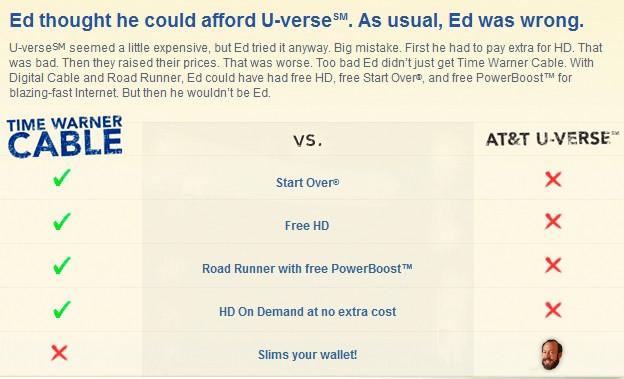
Time Warner Cable maintains a special website to cope with competition from AT&T U-verse and satellite providers. Hilariously, the site quotes a piece from DSL Reports about U-verse price increases. Time Warner subscribers might not want to venture too far beyond that piece, because editor Karl Bode reports on the cable company's own rate hikes as well. (Click image to visit TWC site)

Stop the Cap! reader Sam in Greensboro thinks AT&T’s arrival is much ado about nothing.

“AT&T prices their U-verse service nearly the same or more as Time Warner Cable, especially after the introductory rate expires,” he says.  “Few people are going to be bothered switching back to Time Warner after the year is up, so they’ll be paying the same high prices for cable service to AT&T instead of the cable company — a distinction with no difference.”

Sam won’t bother with U-verse because he is disgusted with AT&T’s lobbying efforts to stop consumer broadband reform and Net Neutrality.

“It’s like dealing with the devil,” Sam writes.  “Why would I want to pay AT&T my money so they can turn around and spend it working against my interests as a consumer?”

The only good thing about U-verse’s arrival is that it may stall Time Warner Cable from trying another Internet Overcharging scheme in the area.

“Time Warner has to think twice about another usage cap and overlimit fee ‘experiment’ in the Triad if customers can simply flee to U-verse, although knowing AT&T they’d love to have the same rationing of the Internet they force on their wireless customers,” Sam said.

[flv width=”636″ height=”373″]http://www.phillipdampier.com/video/TWC Fights Back U-verse.flv[/flv]

Time Warner Cable maintains a sometimes-bizarre web campaign to convince customers not to switch to U-verse or satellite.  We’ve put together the various videos so you can watch them all at once.  (4 minutes)

Like Time Warner Cable, AT&T does not offer a-la-carte cable programming, either.  Customers can only choose from large packages of programming, not individual channels.

Triad area cable customers told local media they were tentatively glad U-verse is competing, but many are taking a wait and see approach as to whether they’ll actually see any savings.

WFMY News 2 spoke with cable customers today. One man said he feels like a “hostage” to his cable company because they have a monopoly on TV, Internet and phone bundles. A woman said cable and satellite companies drive her “crazy,” so she gave up and now simply rents movies.

“I am happy, but it’s hard times. I have three children. We live on one income,” Jamie Rettie, a Time Warner Cable customer told News 2. Whether she switches to AT&T or not, she’s said she’s hoping for a change in her bill.

“Hopefully they’ll keep competing against each another and have better and better prices for their services,” she said. “(I’ll) wait out my contract and we’ll see what happens.”

Some residents, like Thomas, are left picking the lesser of two evils:

“I don’t know who’s worse at their game, as Time Warner Cable and AT&T are both evil corporate entities that care only about their bottom line,” he writes. “Search the Internet and understand this service limits the amount of TV’s that can be used at one time.”

[flv width=”640″ height=”500″]http://www.phillipdampier.com/video/Greensboro Media Cover U-Verse Launch 9-13-10.flv[/flv]

Watch several news reports from Triad area TV stations about the introduction of AT&T U-verse.  In order, we include reports from WXII, WGHP, and WFMY-TV.  (7 minutes)

Charter Cable: “Where’s Our Money?” Reno Woman Faces Huge Cable Bill, E-Mail Held Hostage After Tragic Fire

Phillip Dampier September 13, 2010 Charter Spectrum, Consumer News, Video 4 Comments

Anita Brown (left) watches as a January fire took everything she owned, including her two beloved cats.

A Reno, Nevada woman has learned that even after a disaster, Charter Cable wants their money and will stop at nothing to get it, even if it means holding your personal e-mail hostage.

Anita Brown lost everything in January after a tragic fire, started by another tenant in her building who left a candle burning unattended.  While she watched nearby as all of her possessions burned in the fire, her only thoughts were for her two companions  — her beloved cats.

They didn’t survive the fire. Neither did a cable box, phone jack and broadband modem belonging to Charter Cable.

As Brown tried to contemplate starting her life all over again, the cable company found out about the fire and began demanding their equipment back.

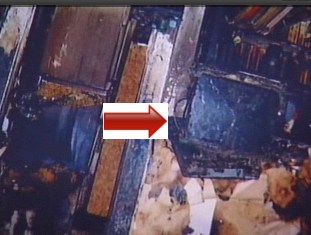
Brown was stunned to find the local cable company so insistent about the matter, so she showed them a picture they requested of the “modern art” her cable box now resembled.  It literally melted in the fire.  She also presented the cable company with a copy of the fire marshal’s report showing the fire was not her fault.

Charter’s response?  Pay us $1,000 immediately for the damaged equipment or else.

Brown, who faced replacing every article of clothing she owned and locating a new place to live had other priorities for her dwindling financial resources.  Still, she offered to make monthly payments to cover the loss, if only to avoid Charter’s collection department and damage to her credit. They told her someone would be in touch.

That someone was a Charter technician who turned up a week later to disconnect her relocated cable service.  A payment of $25 made him go away, service intact.  A week later, while she was attending a family funeral, a technician returned and disconnected service anyway.  Then the bills started arriving.

Charter had subsequently reduced the amount owed for the damaged equipment to $500, still out of reach financially for the Reno woman.  She signed up with another provider.  Meanwhile, Charter keeps sending her bills demanding payment and Brown worries they’re on the verge of trashing her credit.

Brown's cable box literally melted in the fire

A local Reno television station reporting on Brown’s plight found Charter’s local employees less than helpful, refusing to work out a solution to the cable nightmare.  A national media representative for Charter was sympathetic, however, and the company may find its way to a mutually acceptable resolution soon.

It can’t come soon enough for Brown, who isn’t even sure she should owe a penny for a box burned in a fire she didn’t start.

Even worse, the only contact list of friends and family Brown has left is locked up in her e-mail box, now held hostage by Charter Cable, who refuses to let her access it until her current bill is settled -and- she promises to stay with Charter Cable.

Cable customers often discover they are on the hook for lost or damaged company-owned equipment.  Most cable company subscriber agreements hold customers responsible for replacement or repair costs for returnable equipment. 

Stop the Cap! strongly recommends consumers obtain a signature or receipt when returning cable equipment and hang onto it at least six months after disconnecting service.  That evidence will save you hundreds of dollars in case the company claims you didn’t return equipment.  With today’s digital cable requiring set top boxes, many homes have several.  The cost of replacing all of them could become astronomical.

If you rent, purchasing inexpensive renter’s insurance is a must to protect your possessions.  Your landlord insures the building you live in, not the things inside your apartment.  Many homeowner and rental insurance policies cover damaged cable equipment in case of a fire or other natural disaster.  Ask your insurance agent to check your coverage.

After a loss, don’t forget to claim the value of that equipment so you can reimburse cable companies that do not forgive these types of losses.

As for Brown, she is still waiting to find out if Charter has a heart.  The damage stories like this do to a company’s reputation may carry a price higher than the cost of the cable box.  Some Reno viewers saw the story and are taking their business elsewhere.

“Thanks for the heads up. We just moved here, and are weighing our cable/satellite options,” writes Diana from Sparks. “That makes my decision a bit easier.”

Kelly in Reno added, “Sounds about right for Charter – big corporate, heartless, money-sucking [profanity deleted]! What do they think is going to happen if they just void this bill, that everyone will start burning down their houses to get out of paying for equipment? Come on, have a heart Charter!”

[flv]http://www.phillipdampier.com/video/KOLO Reno Charter Cable Pursues Fire Victim 9-11-10.flv[/flv]

KOLO-TV in Reno told Brown’s story.  The ironic part of this story is that an advertisement preceding the clip was from none other than… Charter Cable.  (1 minute)

Chattanooga Gets America’s Fastest Residential Broadband from Publicly Owned EPB: 1Gbps for $350

Although the price tag may be too rich for your blood, a municipally-owned utility today announced it was bringing America’s fastest broadband to residents and businesses in greater Chattanooga, Tenn., delivering 1 gigabit per second access for $350 a month.

That’s 200 times faster than what the average American broadband consumer receives, and just a fraction of what many Chattanooga area businesses pay other providers for that level of service

“One gigabit broadband service could be compared to the introduction of electric power in the 1930’s. At that time, most people saw electricity as an alternative to the oil lamp for producing light but the larger implications were soon realized,” said Harold DePriest, president and CEO of EPB. “We believe true high-speed Internet access, to both our urban and rural areas, will make Chattanooga the frontier of a new generation of opportunity and provide our community with a platform for engineering the 21st century.”

The mega-fast fiber-to-the-home broadband comes not from a multi-billion dollar private company like AT&T, Verizon, Comcast, or Time Warner Cable, but rather a small city-owned utility that has served Chattanooga’s electricity needs since 1939.

Just over one year old, EPB Fiber Optics is the latest service from the city’s municipal utility. EPB’s fiber broadband network was built after overcoming legal actions filed to stop it by Comcast and the state’s cable lobbyist group.

Since launching service in 2009, EPB’s fiber division has won over 169,000 residents in its 600 square mile service area in Tennessee and northwest Georgia.  This despite the presence of Comcast and AT&T’s U-verse operations, both competing with EPB for customers.  Neither the cable or phone company comes close to matching the speeds and demand EPB has managed to achieve.  In fact, AT&T’s U-verse launch week event in July was marred when an AT&T technician pepper-sprayed a local woman’s pets, and she wasn’t even a customer.

Google acknowledged the arrival of another provider extending 1Gbps broadband to Americans, noting it is still in the process of selecting locations for its own “Think Big With a Gig” 1Gbps fiber service.

“We’re excited to see enthusiasm for ultra high-speed broadband,” spokesman Dan Martin said in an e-mail statement. “It’s clear that people across the country are hungry for better and faster Internet access.”  Chattanooga now joins Hong Kong and just a handful of other cities delivering gigabit broadband.

Atkinson

A broadband industry trade group funded by large telecommunications companies was left making excuses for EPB’s thunder-stealing announcement.

“I can’t imagine a for-profit company doing what they are doing in Chattanooga, because it’s so far ahead of where the market is,” Robert D. Atkinson, president of the Information Technology and Innovation Foundation told the New York Times.

Atkinson is closely involved with several industry backed front groups, including the Alliance for Public Technology (AT&T & Verizon) and the Internet Education Foundation (Comcast & Verizon).

The irony of a telecom industry group that supposedly celebrates broadband innovation downplaying today’s achievement by EPB was not lost on DePriest.

When the Times asked DePriest why EPB would offer such a high speed service, DePriest said, “The simple answer is because we can.”

EPB’s latest announcement throws down the gauntlet against the idea that broadband innovation comes only from large commercial telecom companies.  Phone and cable operators claim their record of innovation will be harmed if municipal providers like EPB are able to offer service, claiming “private investment will dry up.”

It’s the same argument they use for deregulation and minimal oversight.  Yet it was a municipally-owned provider that established a network far superior to what Comcast and AT&T have in Chattanooga, launched America’s first residential 150Mbps service, and today launched America’s first residential 1Gbps broadband service.  EPB charges lower everyday prices for its bundle of TV, phone, and broadband services, too.

The cost to taxpayers?  Nothing.

Local residents can’t wait to get the service.

Keith in Soddy Daisy, Tenn., commented about EPB service: “I’m still waiting on it to become available where I live. It’s getting close because I see them stringing fiber all over the place. The crazy thing is that there are people in their service footprint that only have dial-up. Can you imagine going from having dial-up to having 1 Gbps symmetrical fiber as an option?”

[flv width=”480″ height=”380″]http://www.phillipdampier.com/video/WTVC Chattanooga EPB 1GBPS 09-13-10.flv[/flv]

WTVC-TV in Chattanooga investigates EPB’s newest 1Gbps broadband service.  (1 minute)

Frontier’s Fiber Fantasy Island: “We Deploy Fiber-to-the-Home All Across the Country”

Frontier's Maggie Wilderotter escapes reality

Frontier Communications CEO Maggie Wilderotter has bought a first class ticket to Fiber Fantasy Island, where phone companies dream of delivering fiber-optic broadband service without actually deploying fiber.  They just tell you they did.

In an interview published today in The Oregonian, Wilderotter tries to convince residents Frontier’s arrival is good news, making promises about broadband and service improvements based on a company track record an independent observer would conclude she simply made up.

If Wilderotter’s command of the facts about her own company are reflective of “a distinct, improved image in its new territories,” Oregon is in big trouble.

Let’s review:

CLAIM: “We deploy fiber to the home all across the country. We don’t call it FiOS. We call it high-speed Internet. For our customers, the technology doesn’t matter. What matters is access, speed and capacity.”

REALITY CHECK: Frontier, as far as we have been able to determine, has not deployed fiber to the home anywhere in the country, with the exception of the FiOS network it acquired from Verizon.  Frontier Communications’ deployment of fiber optics to the home is comparable to the amount of fiber found in a box of Cookie Crisp cereal.  In their largest market, Rochester, N.Y., Frontier relies on the same legacy copper wire phone network it utilizes everywhere else.  It is highly misleading for Wilderotter to represent otherwise.  Fiber to the home means exactly that — fiber optic cable brought right to the home.  This is not a case of “you call it corn, we call it maize.”

This kitten is not an iguana.

Fiber optic cable is not also known as “high-speed Internet,” just as the cute kitten on the left is not called an iguana.  For the significant number of customers who ask Frontier to disconnect their service year-after-year, technology matters very much, and this particular phone company lacks it.  Frontier relies on the same DSL technology other phone companies and customers increasingly consider yesterday’s news.

In many Frontier service areas, there is no access to broadband because line quality will not support the service.  In Brighton, N.Y., a suburb of Rochester less than a minute from the Rochester city line, Frontier could only manage to deliver 3.1Mbps DSL speeds, and until recently Frontier was crying it needed a 5GB usage allowance because of the threat higher amounts of consumption might have on its network capacity.  Access, speed, and capacity does matter, which is why Time Warner Cable is picking up the bulk of its new broadband subscribers at Frontier’s expense.

CLAIM: “For high-speed, it means having speed and capacity in addition to reach. We’ll do add-on services. We have a terrific Yahoo-Frontier portal that will be a gateway on our high-speed Internet service. We are in the throes of putting together Wi-Fi hotspots that will be distributed throughout this market for customers.  If you’re a high-speed Internet customer of ours it’s free. We’re looking to put one at Hillsboro Stadium. Typically, we put them in hotels, convention centers, truck stops, trailer parks, outside parks, campuses for colleges, shopping centers, business campuses.”

REALITY CHECK:  Those “add-on services,” such as Frontier’s Peace of Mind, come with a price tag and are often required components of a bundled service discount offer.  As first impressions go, a company still relying on Yahoo! for a front end is not exactly on the cutting edge, nor are “portals.”  It’s like trying to impress new customers with free web space through GeoCities.  Actually, that is something Frontier could offer because GeoCities is now owned by Yahoo!

Frontier’s Peace of Mind Services

  • Hard Drive Backup: $4.99 per month
  • Hard Drive Backup + Unlimited Technical Support: $9.99 per month
  • Hard Drive Backup + Unlimited Technical Support + Inside Wire Maintenance: $12.99 per month
  • $50 early cancellation penalty if you get these services with a term commitment

Rochester’s experience with Frontier Wi-Fi has not been very impressive.  Most residents don’t even know the service exists.  The city and several suburbs offer limited Frontier pay-walled Wi-Fi service and a handful of free access hotspots in cooperation with Monroe County.  Unfortunately, many of the fee-based and free hotspots have fallen into disrepair and no longer function.  Signal strength is not impressive either, and many were not usable indoors.  We tested several of the free hotspots and discovered one only delivered a signal into a suburban parking lot, another only into an empty soccer field, and the third was not functioning at all.  Frontier’s record in Wi-Fi delivered more promises than actual service.

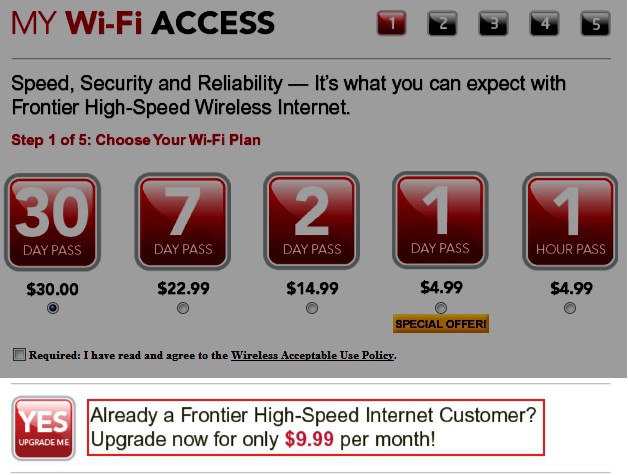
Those Wi-Fi services, by the way, are not free for all Frontier broadband customers.  Evidently Ms. Wilderotter is not acquainted with her own company’s products and services, nor Frontier’s own website:

So much for Wilderotter's claim Frontier's Wi-Fi network was free for all Frontier broadband customers.

CLAIM: “We deliver the highest value for the price you pay. We also have excellent customer service. We also don’t raise our rates every 12 months, no matter what.”

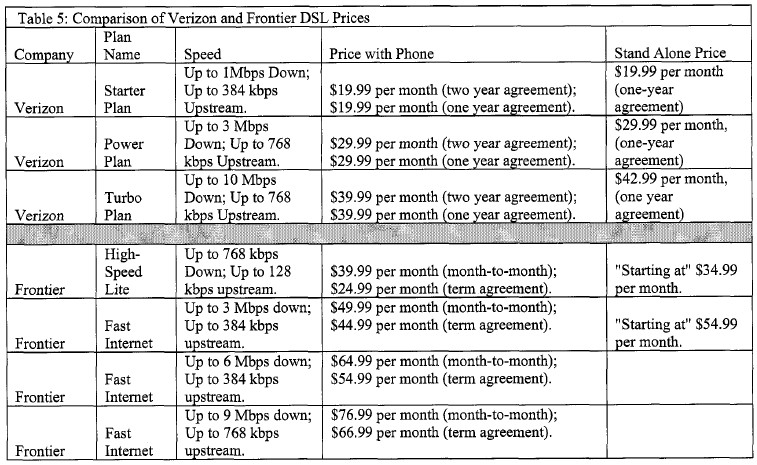
REALITY CHECK:  In Rochester, the out-the-door price Frontier charges its broadband customers is actually higher than that charged by Time Warner Cable, which delivers far faster connections.  In West Virginia, the state’s Consumer Advocate put together a chart depicting Frontier’s broadband prices.  Determine for yourself if it delivers the “highest value for the price you pay.”

Comparing Prices: Frontier's pricing doesn't look as exciting as Wilderotter would have you believe, as the West Virginia Consumer Advocate discovered

CLAIM: “If I look across the board at our basic service pricing, I don’t think we’ve raised prices anywhere in the last four or five years.”

REALITY CHECK: We looked and found Frontier demanding the right to increase basic service rates in New York by $2 a month each year for up to two years.  In fact, last November, the New York State Public Service Commission, at the request of Frontier, sent the company a letter authorizing a rate hike of $2 a month for customers in the state.  Even more enlightening was Frontier’s filing in August 2005 with the PSC demanding near-complete deregulation and rate relief allowing Frontier to raise rates up to $1 per month annually indefinitely for basic service.  Frontier also wanted consumer protection rules “relaxed” and ban the PSC from investigating consumer complaints.  One of the reasons they cited is that basic phone service is not the same critical service it used to be because people can communicate through blogs instead.

In fact, consumers should be asking why Frontier’s rates haven’t decreased.  From that same filing: “Frontier believes that with the decreasing costs and increasing bandwidths of new technologies and the acceleration of intermodal market entry, the market will cause rates for non-basic services in all parts of the State to decline.”

CLAIM: Local regulators tell me they did see a spike in billing complaints after Verizon took over. Any thoughts on why?“Whenever there’s a change — you change the name on the bill, you change the format — customers tend to look at it more closely. We always expect a spike in billing calls whenever we’ve done acquisitions. It has already (settled out).”

REALITY CHECK: As Stop the Cap! has reported, Frontier’s takeover in West Virginia has hardly “settled out.”  Service interruptions, forgotten service calls, and other problems have plagued the state to the point the PSC needed new hearings to review the situation.  Many of Frontier’s billing complaints come from customers choosing to cancel Frontier service, only to find unjustified early termination fees added to their final bills, even when customers never agreed to a term contract.  That problem was so serious in New York, the state Attorney General fined the company and ordered customer refunds.  Changing a customer’s bill by adding $100 or more to the total amount due will always get a customer to look at the bill more closely.

CLAIM: “One of the big opportunities that we’re working on is the ability to display Internet content and video on the television set.”

REALITY CHECK: That “big opportunity” has been available to broadband users for several years now.

CLAIM: We also have a new site that’s called myfitv.com. We carry over 100,000 titles of free television content on this site. It’s a little bit like Hulu on steroids. It’s provided free of charge to all our customers.

REALITY CHECK: MyFitv is not “a little bit like Hulu on steroids.”  In fact, it is Hulu.  Frontier simply used Hulu’s “embed” feature to take content, slap the Frontier logo on it, and add Google ads in an attempt to rake in a few extra dollars.  You can do exactly the same thing yourself.  Meanwhile, the service is added to customer bills showing an amount of $0.00, a very inexpensive way to try and impress customers with content Frontier never developed, deployed, or created — just like their phantom fiber to the home network.

CLAIM: “We think over time the Internet will also provide different packaging, different prices, different ways to buy content than the traditional viewing platform. We also think that mobility is important. We want to make sure that whatever you do you’ll be able to take it with you.  The Sling technology is interesting, too. It’s something we’re talking about DISH Network with.”

REALITY CHECK: Every time Maggie has talked about “different packaging and prices,” it has been in the context of an Internet Overcharging scheme — limited usage allowances, extremely high rate increases for those deemed to have consumed too much, etc.  And yes, Sling technology is interesting.  A company conceived of the idea, built it, developed a marketing plan, and sold it.  That’s a concept Frontier needs to understand.  You cannot transform a legacy network with words alone.  Here’s an idea.  How about conceiving of a real fiber-to-the-home network, build one, develop a marketing plan, and then sell it.  For those in markets like Rochester, it’s the only way Frontier Communications will avoid becoming the horse and buggy carriage maker of the 21st century.

CLAIM: You’re around Seattle, around Portland, but not in them yet. Is there any possibility that Frontier would build into another company’s market? — “There’s always a possibility. It’s not a priority for us. And the reason why it’s not a priority is we’ve got a lot to do, just in the service areas that we own today. When I’m humming on all cylinders there, and I’ve been able to do everything I possibly can in those areas, then I might look to extend service areas out.”

REALITY CHECK: Translation — “when pigs fly.”  Frontier would be laughed out of the Seattle and Portland markets.

Ms. Wilderotter needs to be a lot more open and forthcoming with the press.  Frontier’s business plan makes it clear the company’s future is serving uncompetitive rural markets that will be forced to tolerate the products and pricing Frontier delivers.  Where competition exists, let’s face facts.  Frontier is not gaining market share — it is losing it, eroded away year after year by uncompetitive, substandard products at high prices.

That’s a reality you are bound to miss if you spend too much time with Mr. Rourke and Tattoo.

Search This Site:

Contributions:

Recent Comments:

Your Account:

Stop the Cap!