Home » Providers » Recent Articles:

Rethink Possible: Overcharging AT&T Customers With Phantom Data Charges

Phillip Dampier September 20, 2010 AT&T, Data Caps, Wireless Broadband 3 Comments

AT&T wireless broadband customers who thought they could survive a smartphone data plan with only a 200MB usage allowance are discovering $15 overlimit fees applied to their bill because of mystery data usage consumed while they were asleep.

Stop the Cap! reader Pat dropped us a note to say she accumulated a whopping $45 in overlimit fees on her August bill for her family’s three iPhones because they exceeded their 200MB usage allowances while the family was unconscious:

At around 2AM most mornings, our phones regularly show usage of around 5-10MB each even though they are being charged and are not used by anyone in the family.  At first my husband thought an application on the phone was automatically exchanging data so we tried switching off 3G access and relied exclusively on Wi-Fi access, to no avail.  Sure enough, for the next seven days in a row, the phones all used between 5-10MB of usage.  We tried disabling and removing various applications and told others only to communicate manually.  That didn’t work either.  The mystery usage remained.

We contacted AT&T multiple times about this issue, because this usage easily put us over the limit, at which point AT&T bills a $15 penalty to buy you another 200MB of usage.  We got a lot of excuses, one month’s credit, but no answers.  One representative used the opportunity to try and upsell us on the 2GB plan to “avoid this from happening.”  It sounds like a nice scam.

Pat, it turns out this has been a significant issue for many AT&T customers dating back to the June introduction of the usage-limited smartphone data plans from AT&T.  We found threads on both AT&T and Apple’s websites running well into the dozens of pages, with nobody getting a definitive, consistent answer as to why this keeps happening.

In late July, the folks at Gizmodo got a statement from AT&T about the problem:

This is a routine update of your daily data activity on your device to ensure the accuracy of your data billing. Customers are not charged for data usage, given that no data session is generated. It’s not uncommon for devices that are ‘always on’, like iPhone, to process data event records for billing purposes after a certain amount of inactivity or after long periods of time. It’s also separate from how our system lets you monitor your data consumption.

Unfortunately, it’s also apparently inaccurate because subsequent comments indicate customers were, in fact, billed for that usage.

Customers have been told a variety of things to justify AT&T’s usage billing:

  1. It’s an application on your phone polling for data and/or updates;
  2. Your phone is sending and receiving e-mail;
  3. If your phone goes “to sleep” it switches away from Wi-Fi and back to AT&T’s 3G usage, incurring data usage fees;
  4. In the early morning, AT&T communicates with phones to exchange updates and data;
  5. The usage reports represent cumulative usage made during the day but only later reported to AT&T;
  6. It’s iTunes diagnostic information you agreed to share with Apple being sent to them every night;
  7. It’s Apple’s fault.

The biggest problem? AT&T’s stingy usage allowances.  Many customers do not understand what a megabyte represents, but 200 of them sounds like a lot… until you browse to a page with multimedia content or utilize an application that exchanges a lot of data during the day.  AT&T has really not addressed the problem, other than to throw $10 credits to customers who complain the loudest.  Many just upgrade to the higher priced 2GB plan and hope the problem goes away.

AT&T’s Internet Overcharging scheme for wireless has trained customers to use less of a service they pay good money to receive:

  • Customers think twice before installing and using data applications that could consume too much of their allowance;
  • Customers train themselves to jump off of AT&T’s 3G network and switch to Wi-Fi wherever possible, despite paying for AT&T’s wireless data network;
  • Customers quickly learn paying more for a more “generous allowance” is a “better value,” saving them the time and hassle of worrying about overlimit fees;
  • Customers can complain all they like, but in the end they’ll grumble and pay the bill, facing exorbitant early termination fees if they want out of AT&T’s fee maze.

Unfortunately, without a team of lawyers or regulatory agencies breathing down AT&T’s neck to deliver a credible response to these overcharges, they are very likely to continue.  Although AT&T claims the 200MB usage plan was designed to save customers money and attract new users to smartphones, it’s no mistake the cheapest plan delivers a minuscule allowance.

The company knows very well that smartphone data usage increases as the phones and the software that runs on them become more sophisticated.  Customers delivered a tasty sample of 3G usage are likely to enjoy it and find themselves upgrading to a more profitable data plan with a comparatively larger allowance.  If they don’t, AT&T wins again because customers face paying at least $30 for 400MB of usage, even though a 2GB plan would have only set them back $25.

For now, the best we can recommend is completely powering off the phone overnight and seeing if it still incurs any phantom charges.  You should also complain, regularly and loudly, to AT&T each time it happens.  Contact your state Attorney General and file a complaint if AT&T’s answers are unsatisfactory and urge their office to begin an investigation.

As Stop the Cap! has said from day one, Internet Overcharging schemes force customers to spend time and energy doublechecking usage gauges that may or may not be accurate and make you think twice about everything you do online, wondering what it will ultimately do to your bill at the end of the month.  It’s all a win for service providers, who get the benefit of conservative usage from the “think-twice” mindset and revenue enhancing overlimit fees from those who never worry.  You lose either way.

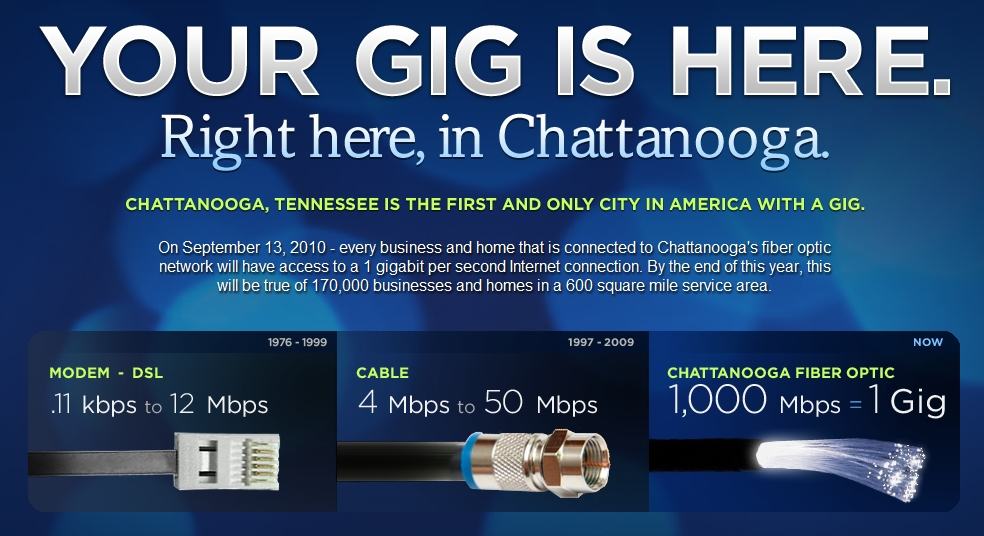
EPB’s 1Gbps Service Embarrasses Big Telecom; Who Are the Real Innovators?

EPB’s new 1Gbps municipal broadband service is causing some serious embarrassment to the telecom industry.  Since last week’s unveiling, several “dollar-a-holler” telecom-funded front groups and trade publications friendly to the industry have come forward to dismiss the service as “too expensive,” delivering speeds nobody wants, and out of touch with the market.

The “Information Technology and Innovation Federation,” which has historically supported the agenda of big telecom companies, has been particularly noisy in its condescending dismissal of the mega-speed service delivered in Chattanooga, Tenn.

Robert Atkinson, president of ITIF, undermines the very “innovation” their group is supposed to celebrate.  Because it doesn’t come from AT&T or Verizon, it’s not their kind of “innovation” at all.

“I can’t imagine a for-profit company doing what they are doing in Chattanooga, because it’s so far ahead of where the market is,” Atkinson told the New York Times.

“Chattanooga definitely is ahead of the curve,” Atkinson told the Times Free Press. “It’s like they are building a 16-lane highway when there is a demand for only four at this point. The private companies probably can’t afford to get that far ahead of the market.”
Bernie Arnason, formerly with Verizon and a cable industry trade association also dismissed EPB’s new service in his current role as managing editor for Telecompetitor, a telecom industry trade website:

Does anyone need that speed today? Will they in the next few years? The short answer is no. It’s kind of akin to people in the U.S. that buy a Ferrari or Lamborghini – all that power and speed, and nowhere to really use it. A more apropos question, is how many people can afford it – especially in a city the size of Chattanooga?

[…]Will there be a time when 1 Gb/s is an offer that is truly in demand? More than likely, although I still find it hard to imagine it being really necessary in a residential setting – I mean how many 3D movies can you watch at one time? Maybe a service that bursts to 1 Gb/s in times of need, but an always on symmetrical 1 Gb/s connection? Truth be told, no one really knows what the future holds, especially from a bandwidth demand perspective.

Supporting innovation from the right kind of companies.

Arnason admits he doesn’t know what the future holds, but he and his industry friends have already made up their minds about what level of service and pricing is good enough for “a city the size of Chattanooga.”

Comcast’s Business Class broadband alternative is priced at around $370 a month and only provides 100/15Mbps service in some areas.  Atkinson and Arnason have no problems with that kind of innovation… the one that charges more and delivers less.

For groups like the ITIF, it’s hardly a surprise to see them mount a “nobody wants it or needs it”-dismissive posture towards fiber, because they represent the commercial providers who don’t have it.

Fiber Embargo

The Fiber-to-the-Home Council, perhaps the biggest promoter of fiber broadband delivered straight to customer homes, currently has 277 service provider members. With the exception of TDS Telecom, which owns and operates small phone companies serving a total of 1.1 million customers in 30 states, the FTTH Council’s American provider members are almost entirely family-run, independent, co-op, or municipally-owned.

Companies like American Samoa Telecommunications Authority, Hiawatha Broadband Communications, KanOkla Telephone Association Inc., and the Palmetto Rural Telephone Cooperative all belong.  AT&T, CenturyLink, Frontier, Verizon, and Windstream do not.  Neither do any large cable operators.

While not every member of the Council has deployed fiber to the home to its customers, many appreciate their future, and that of their communities, relies on a high-fiber diet.

EPB’s announcement of 1Gbps service was made possible because it operates its service over an entirely fiber optic network.  Company officials, when asked why they were introducing such a fast service in Chattanooga, answered simply, “because we can.”
The same question should have been directed to the city’s other providers, Comcast and AT&T.  Their answer would be “because we can’t… and won’t.”

Among large providers, only Verizon has the potential to deliver that level of service to its residential customers because it invested in fiber.  It was also punished by Wall Street for those investments, repeatedly criticized for spending too much money chasing longer term revenue.  Wall Street may have ultimately won that argument, because Verizon indefinitely suspended its FiOS expansion plans earlier this year, despite overwhelmingly positive reviews of the service.

So among these players, who are the real innovators?

The Phone Company: Holding On to Alexander Graham Bell for Dear Life
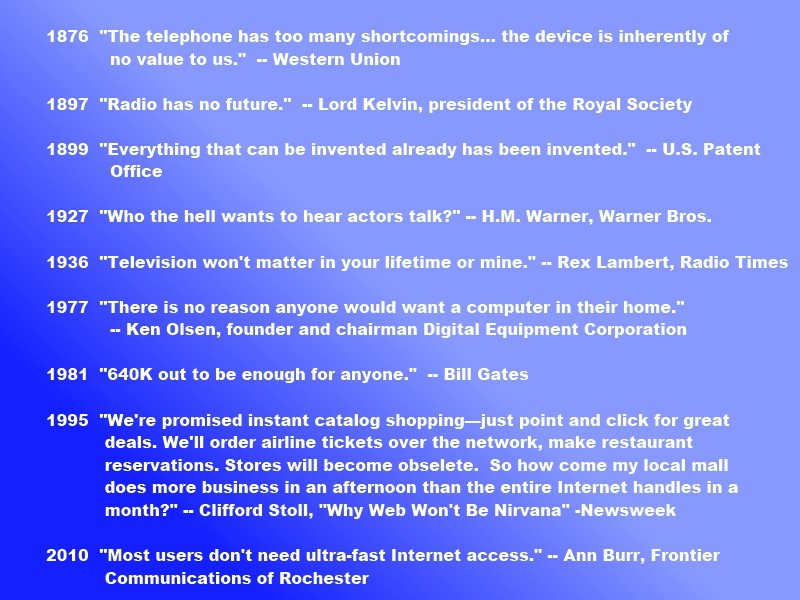
Last week, Frontier Communications told customers in western New York they don’t need FiOS-like broadband speeds delivered over fiber connections, so they’re not going to get them.  For Frontier, yesterday’s ADSL technology providing 1-3Mbps service in rural areas and somewhat faster speeds in urban ones is ‘more than enough.’

That “good enough for you” attitude is pervasive among many providers, especially large independent phone companies that are riding out their legacy copper wire networks as long as they’ll last.

What makes them different from locally-owned phone companies and co-ops that believe in fiber-t0-the-home?  Simply put, their business plans.

Companies like Frontier, FairPoint, Windstream, and CenturyLink all share one thing in common — their dependence on propping up their stock values with high dividend payouts and limited investments in network upgrades (capital expenditures):

Perhaps the most important metric for judging dividend sustainability, the payout compares how much money a company pays out in dividends to how much money it generates. A ratio that’s too high, say, above 80% of earnings, indicates the company may be stretching to make payouts it can’t afford.

Frontier’s payout ratio is 233%, which means the company pays out more than $2 in dividends for every $1 of earnings! But this ignores Frontier’s huge deferred tax benefit and the fact that depreciation and amortization exceed capital expenditures — the company’s actual free cash flow payout ratio is a much more manageable 73%. Dividend investors should ensure that benefit and Frontier’s cash-generating ability are sustainable.

In other words, Frontier’s balance sheet benefits from the ability to write off the declining value of much of its aging copper-wire network and from creative tax benefits that might be eliminated through legislative reform.

The nightmare scenario at Frontier is heavily investing in widespread network upgrades and improvements beyond DSL.  The company recently was forced to cut its $1 dividend payout to $0.75 to fund the recent acquisition of some Verizon landlines and for limited investment in DSL broadband expansion.

Frontier won’t seek to deploy fiber in a big way because it would be forced to take on more debt and potentially cut that dividend payout even further.  That’s something the company won’t risk, even if it means earning back customers who fled to cable competitors.  Long term investments in future proof fiber are not on the menu.  “That would be then and this is now,” demand shareholders insistent on short term results.

The broadband expansion Frontier has designed increases the amount of revenue it earns per customer while spending as little as possible to achieve it.  Slow speed, expensive DSL fits the bill nicely.

The story is largely the same among the other players.  One, FairPoint Communications, ended up in bankruptcy when it tried to integrate Verizon’s operations in northern New England and found it didn’t have the resources to pull it off, and delivered high speed broken promises, not broadband.

Meanwhile, many municipal providers, including EPB, are constructing fiber networks that deliver for their customers instead of focusing on dividend checks for shareholders.

Which is more innovative — mailing checks to shareholders or delivering world class broadband that doesn’t cost taxpayers a cent?

Cable: “People Don’t Realize the Days of Cable Company Upgrades are Basically Over”

While municipal providers like EPB appear in major national newspapers and on cable news breaking speed records and delivering service not seen elsewhere in the United States, the cable industry has a different story to share.

Kent

Suddenlink president and CEO Jerry Kent let the cat out of the bag when he told investors on CNBC that the days of cable companies spending capital on system upgrades are basically over.

“I think one of the things people don’t realize [relates to] the question of capital intensity and having to keep spending to keep up with capacity,” Kent said. “Those days are basically over, and you are seeing significant free cash flow generated from the cable operators as our capital expenditures continue to come down.”

Both cable and phone companies have called a technology truce in the broadband speed war.  Where phone companies rely on traditional DSL service to provide broadband, most cable companies raise their speeds one level higher and then vilify the competition with ads promoting cable’s speed advantages.  Phone companies blast cable for high priced broadband service they’re willing to sell for less, if you don’t need the fastest possible speeds.  But with the pervasiveness of service bundling, where consumers pay one price for phone, Internet, and television service, many customers don’t shop for individual services any longer.

With the advent of DOCSIS 3, the latest standard for cable broadband networks, many in the cable industry believe the days of investing in new infrastructure are over.  They believe their hybrid fiber-coaxial cable systems deliver everything broadband consumers will want and don’t see a need for fiber to the home service.

Their balance sheets prove it, as many of the nation’s largest cable companies reduce capital expenses and investments in system expansion.  Coming at the same time Internet usage is growing, the disparity between investment and demand on broadband network capacity sets the perfect stage for rate increases and other revenue enhancers like Internet Overcharging schemes.

Unfortunately for the cable industry, without a mass-conversion of cable-TV lineups to digital, which greatly increases available bandwidth for other services, their existing network infrastructure does not excuse required network upgrades.

EPB’s fiber optic system delivers significantly more capacity than any cable system, and with advances in laser technology, the expansion possibilities are almost endless.  EPB is also not constrained with the asynchronous broadband cable delivers — reasonably fast downstream speeds coupled with paltry upstream rates.  EPB delivers the same speed coming and going.  In fact, the biggest bottlenecks EPB customers are likely to face are those on the websites they visit.

EPB also delivered significant free speed upgrades to its customers earlier this year… and no broadband rate hike or usage limits.  In fact, EPB cut its price for 100Mbps service from $175 to $140.  Many cable companies are increasing broadband pricing, while major speed upgrades come to those who agree to pay plenty more to get them.

Which company has the kind of innovation you want — the one that delivers faster speeds for free or the one that experiments with usage limits and higher prices for what you already have?

No wonder Big Telecom is embarrassed.  They should be.

[flv width=”640″ height=”500″]http://www.phillipdampier.com/video/EPB Interviews 9-20-10.flv[/flv]

EPB and Chattanooga city officials appeared in interviews on Bloomberg News and the Fox Business Channel.  CNET News also covered EPB’s 1Gbps service, introduced last week.  (12 minutes)

Time Warner Cable Explores Partnership with Cox Cable As Subscriber Numbers Expected to Tumble

Phillip Dampier September 16, 2010 Cox 6 Comments

Time Warner Cable’s shares tumbled on news that the nation’s second largest cable operator is likely to report it is losing subscribers tired of high cable prices in a tough economy.  These challenges are fueling press speculation the company is exploring a “broad alliance” with Cox Cable to join forces in an effort to reduce programming costs.

Bloomberg reports growth has slowed across the board at Time Warner.  The cable company blamed the weak economy for most of its troubles, suggesting the lack of new housing developments and home purchasers is responsible for a lot of the negative growth.

“Overall, I would say that the subscriber environment is very, very weak,” Chief Financial Officer Rob Marcus told investors at a Bank of America Corp. conference in Newport Beach, California. “We’re being negatively affected by very high rates of unemployment, high vacancy rates, both at the rental and the owned home levels, and really anemic new home formation.”

Growth has slowed across all Time Warner Cable’s businesses and because of that the company may see a loss in total customers, or what it calls primary service units, Marcus said.

Last quarter, the U.S. pay-TV industry lost basic-cable subscribers for the first time ever, according to research firm SNL Kagan.

Despite subscriber losses, Marcus calmed Wall Street reminding them the company expects to meet expectations for 20 percent growth in adjusted operating income thanks to a series of revenue-enhancing rate increases underway this year and declining costs in some areas of the business.

Reuters reported this week that Time Warner Cable was in the early stages of a discussion about a potential system swap affecting southern California that could blossom into a “broad alliance” on programming negotiations and potentially even a Time Warner buyout of Cox’s cable systems nationwide.

The Cox systems rumored to be at issue serve Irvine and San Diego and smaller properties in Santa Barbara and Rancho Palos Verdes.  Light Reading speculated Time Warner Cable wants Cox’s Irvine system to increase the size of its footprint in Orange County and Cox would get Time Warner’s San Diego system.

Reuters speculated Time Warner Cable would also negotiate programming carriage contracts on behalf of Cox, just as they currently do with Bright House Networks.  A combination of all three systems could deliver programmers carriage commitments for more than 20 million subscribers across all three systems.  That is still a few million short of Comcast, but easily worth significant volume discounts on programming.

A few industry reports shared rumors Time Warner Cable would eventually buy out the Cox family, which privately owns Cox Cable, and combine those cable properties under the Time Warner Cable name.

But in today’s political climate, and concerns about market power and concentration, such a combination would likely face considerable scrutiny from regulators.

Comcast: Expect Price Increases to Xfinity, Increased Lobbying, and Customer Losses

Phillip Dampier September 16, 2010 Comcast/Xfinity, Consumer News, Net Neutrality, Public Policy & Gov't Comments Off on Comcast: Expect Price Increases to Xfinity, Increased Lobbying, and Customer Losses

Comcast wants you to know your bill for cable television is going to keep going up and up and up, even as the company spends more of your money on political lobbying and rebranding efforts.  As a result, more of you are pulling the plug on Comcast cable television subscriptions.

Speaking Sept. 15 at the Bank America Merrill Lynch media conference in Newport Beach, Calif., Comcast CFO Michael Angelakis warned that programming costs are continuing to increase, and the cable company is going to pass those increases on to its customers through rate hikes.

Angelakis admitted these costs represent one of Comcast’s toughest challenges, because the cable programming industry has become increasingly consolidated.  If Comcast won’t play ball over fees charged by a single network, a dozen or more other channels owned by that programmer could be withheld from the cable company.

The cable programming industry increasingly relies on “Three Musketeer”-package deals that renew carriage agreements for popular cable networks only if other co-owned channels come along for the ride.  Want USA, SyFy, and Bravo from NBC-Universal?  Then you better make room for the rest of their extended family like Sleuth, Chiller, and qubo.

Most years, these cable networks increase their wholesale prices, which shows up eventually on your Comcast bill in the form of a rate hike.

Subscribers have clamored for a-la-carte opportunities to pick and choose only channels actually watched, but that’s a scary proposition to companies like Comcast, who could see revenues plunge from a “pick your own channels” plan.  Instead, Angelakis told investors he’d rather pay less for networks that simply don’t attract many viewers.

“If programmers aren’t performing, we’d like to see rates go down,” he said.

The impact of those price increases is now more apparent than ever for the nation’s largest cable operator as subscribers reach a virtual ceiling in the price they’re willing to pay for cable television.

Comcast management reported adding 165,000 new customers after the digital television transition in the first half of 2009.  Many of those customers signed up for service with one year promotional deals that are now expiring, exposing customers to Comcast’s usual retail prices.  As a result, so far this year, 169,000 customers looking for basic cable service have canceled.

The cable industry is trying to reduce the revenue impact of subscriber losses by increasing prices for the customers that remain.  Comcast is no different, and Angelakis told investors the company’s financial performance can still be strong with increased average revenue per subscriber and cost-cutting.

One expense Comcast is not cutting: political lobbying.

In the second quarter of 2010 alone, Comcast spent $3.82 million dollars on lobbying activities — a 16 percent increase from the amount it spent at the same time last year, according to the U.S. House of Representatives clerk’s office.  Comcast made campaign contributions to elected officials, paid an army of lobbyists to promote its proposed Comcast-NBC merger, and made payments to fund front groups, astroturf projects, and say “thanks” to non-profit groups engaging in “dollar-a-holler” advocacy for the company’s political agenda.

Comcast also lobbied to stop broadband reforms like Net Neutrality, advocated roadblocks for potential competitors, added its two cents on how the government promotes broadband expansion, and sought to inhibit shareholder rights to influence executive pay.

Comcast’s biggest innovation this year is — changing its name.  The march towards rebranding the company’s cable TV, broadband, and phone products continues, with 63 percent of its cable systems now flying the Xfinity flag.  Comcast hopes customers will take a second look at Comcast’s product lineup once they see the new name.  Kevin Upton, a senior lecturer in marketing at the University of Minnesota’s Carlson School of Management says companies can use rebranding to suggest the introduction of new products and services.

Starting Monday, Minneapolis and St. Paul, Minn., customers will find the Xfinity name plastered all over the place, and Upton noted Comcast’s rebranding effort worked on him.

When Upton got a flyer about Xfinity recently, he thought it would offer faster Internet service than Comcast.

“It called attention to itself, and it got me to pay attention to the stuff I’m already overpaying for anyway.”

[flv]http://www.phillipdampier.com/video/CNBC Inside Comcasts Quarter 7-28-10.flv[/flv]

CNBC covered Comcast’s second quarter financial results back on July 28th in this report.  (3 minutes)

Frontier Communications Tells Customers in Western NY They ‘Don’t Need FiOS Speeds That Fast’

Phillip Dampier September 15, 2010 Broadband Speed, Frontier, Video 9 Comments

Frontier's Ann Burr sat down for an interview with a Rochester television station to discuss the future of landlines.

Frontier Communications told customers in western New York not to expect FiOS fiber-to-the-home technology from them anytime soon, claiming residents in upstate New York do not need broadband speeds that fast.  That prompted regular Stop the Cap! reader Bob in Rochester to drop us a note.

Ann Burr, general manager of Frontier’s Rochester division, told WHAM-TV reporter Rachel Barnhart the company believes its current DSL service is more than adequate for residents in the company’s largest service area.  This, despite the fact Frontier recently adopted a handful of FiOS markets purchased from Verizon Communications.  While Frontier has promised to continue delivering the fiber-to-the-home service in areas already offered the service started by Verizon, they have no plans to expand FiOS.

“We’re constantly upgrading our local networks to make sure they can get higher and higher speeds,” Burr told Barnhart. “Fiber lines are installed in newer developments, and neighborhoods that report problems with DSL lines get attention from technicians.”

With Frontier’s DSL service already available in 95 percent of Frontier’s Rochester-area division, Burr added, there is no need to offer FiOS in Rochester.

Burr, who was formerly president of Time Warner Cable’s Rochester division from 1995-1999, has made similar remarks in the past.  In February, she told readers of the Rochester Democrat & Chronicle they didn’t need ultra-fast broadband speeds from Frontier either.

from 'The Bridge'

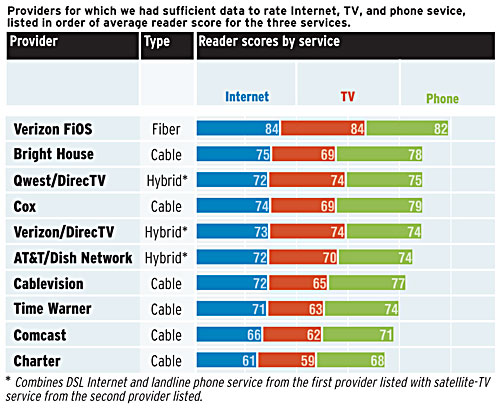
Yet Verizon, one of the nation’s largest phone companies, thinks otherwise.  In upstate New York, the company is still completing its fiber optic network in cities like Albany, Buffalo, and Syracuse.  Verizon FiOS remains a top-rated favorite among readers of Consumer Reports.  Frontier’s DSL managed a less impressive 12th place.

Barnhart learned about Frontier’s broadband plans as part of a larger story about how the phone company will survive the age of the cell phone, as local customers continue to disconnect their Frontier landlines in favor of wireless service from providers like Verizon and AT&T.

Burr warned customers to think twice before disconnecting service.

“Don’t do it. Because I’ve personally been in a situation where my home was without power for a couple of days and you have to recharge cell phone batteries, which you can’t do if you don’t have power,” Burr said.

Burr can’t see a day when no one has a landline phone any longer.

“I don’t see that for a long time. I think that wired phone, copper infrastructure that’s been here for many years provides [the] security [and] reliability that people want,” she said.

Burr’s beliefs are contrary to industry statistics that show Americans continue to drop landline service.  Among those under 30, it’s sometimes hard to find anyone who has a landline at all.

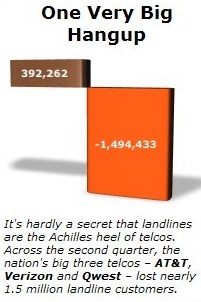
The Bridge reports in the second quarter of 2010 alone, just three phone companies — AT&T, Verizon, and Qwest lost nearly 1.5 million landline customers, mostly to cell phone service and competing “digital phone” products offered by the cable industry.

Consumer Reports says its readers gave top marks to Verizon FiOS for its speed, selection, and service. Frontier didn't make this list at all.

[flv]http://www.phillipdampier.com/video/WHAM Rochester Will Frontier Communications Survive in Cell Phone Age 9-15-10.flv[/flv]

WHAM-TV’s Rachel Barnhart talked with local residents who have disconnected their Frontier landlines and spoke with Frontier’s Ann Burr about the long term prospects for a company primarily delivering that service.  (2 minutes)

Search This Site:

Contributions:

Recent Comments:

Your Account:

Stop the Cap!