Home » Providers » Recent Articles:

Connecticut: AT&T’s Island of Hell in a Sea of Verizon

Phillip Dampier May 11, 2011 AT&T, Consumer News, Public Policy & Gov't 1 Comment

On January 27, 1878 America witnessed the establishment of its first telephone exchange run by the District Telephone Company of New Haven, Conn. In addition to bringing the first phone service to Connecticut, District Telephone also published the world’s first telephone directory.  By the early 1920s, when America’s Bell System was taking hold in most cities, the company — now named Southern New England Telephone, had spread its network across most of the state.  SNET prospered for decades until Southwestern Bell (SBC) bought the company in 1998.  SBC rechristened itself AT&T in 2005.  It has been all downhill from there for many customers.

Today, AT&T Connecticut is the dominant phone company across the state, an unusual anomaly in the northeast, presided over mostly by Verizon Communications.  They also dominate the inbox at the office of the state Attorney General, who receives regular complaints about the phone company’s performance in the state:

In 2008, AT&T began installing refrigerator-sized cabinets on telephone poles and in right-of-way locations, often within feet of homes.  These Video Ready Access Devices (VRADs) connect AT&T’s U-verse fiber to copper wire telephone lines going to individual customers.  Dubbed “lawn refrigerators” by critics, the boxes are not only an unsightly 4-6 feet tall, they are also often noisy because of internal cooling fans.  More than one has burst into flames, thanks to malfunctioning power backup batteries found inside.
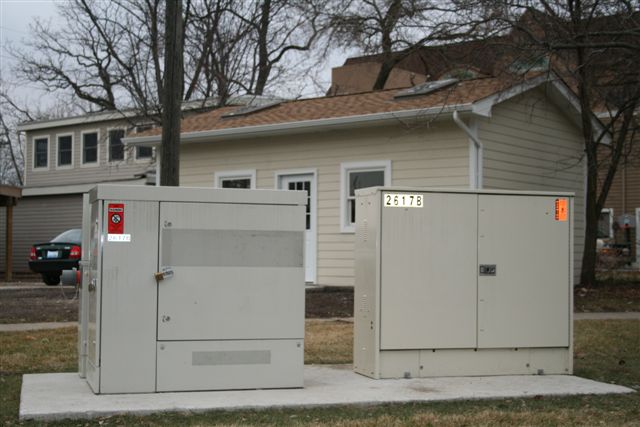
The perfect addition to any front yard... new boxes from AT&T. (Courtesy: Stopthebox.org)

AT&T’s often careless placement alienated residents, who complained they impeded views of turning drivers and pedestrians navigating sidewalks.  Many suggested the boxes reduced property values, especially when installed in front yards without screening or shrubbery to partly hide them from view.

One Trumbull man took his ire all the way to the state Department of Public Utility Control (DPUC), eventually winning noise dampening and two AT&T-supplied pine trees for the box in his backyard.

By 2009, AT&T was realizing “cost savings” promoted in the deal to merge with SBC — by laying off engineers and technicians responsible for maintaining the company’s landline network.  Service complaints soared, leading then-state Attorney General Richard Blumenthal to charge AT&T was cutting accountability for faulty phone lines and flimsy service.  In fact, even as service quality deteriorated, AT&T was lobbying to dispense with service standards altogether, arguing disappointed customers had other choices.

“AT&T is literally hanging up on consumers — slashing jobs and service quality, even after violating state customer service standards,” said Blumenthal. “Our message to the DPUC: don’t let AT&T off the hook. Preserve customer service standards to protect consumers.”

In 2010, service complaints had grown so bad the DPUC finally acted, by fining AT&T the maximum amount possible — $1.2 million.  Blumenthal called it a ringing wake-up call for AT&T.

But by December of last year, AT&T had still not paid the fine, and was caught by Blumenthal trying to negotiate a secret discounted settlement directly with the DPUC, cutting the state Attorney General out of the negotiations.  Blumenthal released a statement blowing the whistle on the reported talks:

Blumenthal

“AT&T’s stalling should be stopped — and the fine enforced,” Blumenthal said. “This multibillion dollar company sought secret negotiations — cutting out my office and the public — to reduce its fine for failing to meet legally required service standards. We halted its concealment; and now AT&T should stop its delay in paying taxpayers the fine that it owes.”

“AT&T was fined for failing consistently, year after year over a decade, to fix phone lines in a timely manner. Failure to repair lines quickly endangers public health and safety, especially seniors and the handicapped for whom a working line is literally a lifeline.”

Richard Blumenthal went on to represent the state in the U.S. Senate, but his successor, George Jepsen is proving to be every bit as tenacious as the state’s new Attorney General.  In March 2011, the DPUC formally imposed a fine of $745,000 on AT&T after negotiations with the phone company, which also required AT&T to meet its service standards.  The fine was reduced because AT&T had previously made refunds and settlements with customers independent of the fine.  The company is appealing it anyway.

“While I believe the full, $1.2 million penalty was warranted, the $745,000 fine sends a clear message to AT&T that it needs to improve its response to out-of-service customers.” Jepsen said. “The company’s responses in the future will be closely monitored.”

But has AT&T fixed the problems in the state of Connecticut?  Judging from press accounts, the answer may be no.

James Bruni, who lives in Hamden, had U-verse installed in his new home back in December, and there has not been a day since when the service has worked properly.

“We have had tech after tech come into our home, each one telling a different story,” Bruni says. “When our TV [picture] freezes, our phone and Internet go out as well.”

When that happens, Bruni’s home alarm, connected to his U-verse phone line, is subject to going off as well.  Many home alarm systems signal an alert if they detect a phone line has gone out of service, a possible sign of a robbery in progress.

Bruni has kept a log of AT&T’s comings-and-goings since December.  He counts 23 technician visits, working both inside and outside of the home.  When calling customer service, he is left on hold for extended periods, and often has to explain his issues repeatedly to technical support each time he calls.  He takes virtually every service AT&T offers, but not for long.

“I have had it with how I have been treated as a customer.”

Former Bridgeport city councilman Gilberto Hernandez proves AT&T doesn’t treat the well-connected any better than anyone else in the state.  Hernandez, now over 75, was so desperate to get repeating service outages fixed, he took his case to the consumer reporter at the Connecticut Post.

Hernandez’s wife is very ill, but he can’t depend on his AT&T landline to summon help in case of an emergency because it is always out of service.

Hernandez says the answer to his problem is a new overhead line installed through the neighborhood.  But AT&T won’t pay for that.  Instead of making an investment to correct long-term problems, the company prefers short-term fixes, which often fail within days. Performing short term repairs may help boost on-time appointment and service repair requirements, but when not followed up with more extensive repairs and upkeep, the problems just keep coming back.

The Post reporter sought an explanation from AT&T about Hernandez’s problems, and the phone company forwarded the matter to the company’s hired gun — the public relations firm of Fleishman-Hillard.  After a delay, the firm told the reporter Hernandez signed off on AT&T’s repairs… four days before Hernandez called to report there was a problem.

The reporter summarized AT&T’s performance in Connecticut as spotty:

During the hearing [over AT&T’s quality of service], AT&T defended its record, saying it already paid people off for the rotten service by not charging them for the time their phones were out and for crediting them and paying other penalties to the tune of $5.3 million between 2001 and 2008.

The DPUC did find AT&T was particularly good at reducing the number of troubles reported per 100,000 customers and showing up for maintenance appointments. AT&T has met appointments for repair work more than 90 percent of the time. Installation of new service is also a strong suit for AT&T, where it showed up for more than 99 percent of appointments. The company also installed new service within five days of ordering more than 95 percent of the time.

But repairing stuff, at least within 24 hours, is not AT&T’s bag. The company never managed to put better than 72 percent of repairs back in service within 24 hours between 2001 and 2008.

Boston’s Cable Conundrum: Mayor Upset With Comcast Rate Hikes, But Did Little to Bring Competition

Menino

Boston Mayor Thomas Menino has problems with Comcast.  The cable operator, long a dominant player in the city of Boston, has been raising basic cable prices for the last several years, and the mayor’s office has had enough.  This week Menino filed a petition asking the Federal Communications Commission to give the city “emergency control” over the price of basic cable service in Boston — the only control permitted in the largely deregulated cable television marketplace.

Menino waved a study done at the behest of the city showing residents were paying substantially higher prices for the lowest level of service from Comcast.  Basic Service, which includes 37 local over the air stations and a handful of shopping and public access channels costs $15.80 inside city limits — up from $9.05 in 2009.  In nearby Cambridge, the same service costs $7.30 a month.  What’s the difference?  Cable rates are completely deregulated in the city, but smaller communities around Boston lack sufficient meaningful competition, so they are permitted by law to continue regulating rates for the lowest tier: Basic Service.

Now Menino wants those rates brought back under control for the benefit of seniors and low income residents, among the 10,000-15,000 local homes that subscribe to the economy service.

It’s just the latest challenge for Boston, which is among a few cities along the coast of the northeastern United States not benefiting from aggressive broadband and video competition between the phone and cable company.  Just over 200 miles away, metropolitan New York and the bedroom communities in that state, as well as New Jersey and Connecticut, have access to super fast broadband from Verizon FiOS, Time Warner Cable, Cablevision, and Comcast — the latter predominately serving greater Philadelphia.

Boston has been bypassed for Verizon FiOS, is ignored by other potential cable competitors, and is stuck with poor-performing cable overbuilder – RCN, which has focused most of its efforts on multi-dwelling apartment and condo units in the city.  The rest of Boston gets ‘take it or leave it’ service from Comcast or DSL from Verizon.

Comcast was quick to respond to Menino’s call for reregulation, noting they provide $5 senior discounts for their cable customers and offer cheaper service than the alternatives — $17.50 a month from RCN or between $30-35 for promotions from DirecTV and DISH Satellite.

Menino’s dealings with telecommunications companies in Boston have run hot and cold for years.  In February, Menino appeared with Comcast senior vice president Steve Hackley to celebrate the opening of a Digital Connectors program for up to 2,800 low income households, paid for by federal stimulus grant money.  Under the program, students who complete computer training courses receive discounted Comcast Internet service for $10.95 a month for the first year and $15.95 for the second year.

Boston

Menino’s office has often been a watchdog when it comes to Comcast fulfilling its franchise obligations, and the city had high hopes competition from RCN would extend a choice of cable providers to most city residents.  That has not happened.

The city’s other telecommunications provider, Verizon, has been in contention with the city for several years.  The trouble began in 2007 when Menino declared war on property tax exemptions for utility poles dating back to 1915, granted to telecom companies like Verizon.  Four years later, that battle has culminated in Verizon literally wiring its fiber optic FiOS service around the city of Boston, refusing to deliver service inside it.

The promise of Verizon fiber has often gone unfulfilled or delayed in many larger cities, subject to bureaucratic delays not experienced in smaller communities.  Some towns and villages in Massachusetts signed franchise agreements just a few months after the company came knocking.

One local official, not authorized to speak publicly on the matter, told Stop the Cap! many communities welcomed Verizon’s fiber optic initiative with open arms.

“You have to understand there is a different mentality among government officials in smaller towns than there is among larger cities,” the official tells us. “In our town of 35,000 when Verizon offered to wire competitive service in our area, we wanted to know where to sign and when they could get started.”

The official says the local government was concerned about making sure Verizon repaired any damage to local infrastructure, abided by local zoning rules, and guaranteed they would not bypass parts of the town.  Negotiators also fought for funding to upgrade equipment for the community’s public access channels, but never went into the negotiations thinking about how much they could extract from the phone company.

“In larger cities in this state, there is a definite mentality that Verizon represents a golden goose ready and willing to lay golden eggs in return for franchise agreements,” the official told us.  “Maybe that is true, but when you are in a smaller town, you recognize the degree of willingness to invest capital to tear out old wires and replace them with fiber is far less here than a city like Boston, which has the potential of many more customers.”

Boston, like other large cities, prepared for protracted negotiations with the phone company over the new fiber service.  At the same time, Mayor Menino infuriated Verizon when he won his property tax lawsuit against the company, collecting $5 million in tax payments that one city official rubbed in.

Ronald W. Rakow, Boston’s commissioner of assessing, told the Boston Globe at the time: “We will actually be sending a bill to them for that later today,’’ Rakow said. “Don’t want to let the ink dry.’’

No Verizon FiOS for Boston

The argument over property taxes may have been the final straw for Verizon FiOS in Boston.  Menino suspected as much, telling the Globe “they insinuated that we weren’t going to get it because of my position on telecommunications.’’

Even then-Verizon CEO Ivan Seidenberg warned the city during a speech at the Boston College Chief Executives’ Club of Boston “to be careful when considering new taxes or regulations.”

Verizon has since stopped expanding its FiOS service to new cities.

“We knew as the financial crisis grew we were smart to sign up earlier rather than later, because if we didn’t, we would never have the service today,” the local official tells us.  “I have sympathy with local officials in every city trying to do what is best for their residents, but anyone who understands wired telecommunications should know these kinds of projects are exceedingly rare — grab them when you have the chance.”

Just a few years later, the impact of earlier decisions not to hurry competition into the city of Boston and the city’s tax policies have become clear:

  • Comcast may be forced to reduce their Basic Service rate, but nothing prevents them from increasing Digital Service cable rates to make up the difference;
  • RCN’s network has languished, providing competitive choice to just 15,000 local residents.  Comcast serves at least 170,000;
  • Verizon has no plans to offer FiOS in the city indefinitely;
  • Menino’s victory claim that Verizon should pay its fair share in property taxes seems less victorious today as the phone company began passing on the new taxes to ratepayers as a “Massachusetts Property Tax Recovery Surcharge” in March, 2010.
  • No other competitor has appeared on the horizon willing to take on Comcast in the city of Boston.

Where’s Our Refund? Two Months and $26.09 Later, Frontier Finally Sends A Check

Phillip Dampier May 9, 2011 Competition, Consumer News, Editorial & Site News, Frontier Comments Off on Where’s Our Refund? Two Months and $26.09 Later, Frontier Finally Sends A Check

Stop the Cap! readers will recall we pulled the plug on Frontier Communications with the disconnection of our landline back in early February.  After at least 25 years doing business with Rochester Telephone Corporation, later Frontier-Global Crossing, later Frontier-Citizens Communications, we had enough.  Frontier Communications has done nothing of merit for the metropolitan Rochester, N.Y., area since the late 1990s.  Their DSL broadband service is handily beaten in quality, reliability, and price by cable competitor Time Warner Cable, and Frontier’s lack of willingness to invest in something better for their largest service area of nearly one million people in western New York has left us cold.  After a one week experiment with Frontier’s DSL service in 2009, we dropped the service like a hot potato after it achieved an underwhelming 3.1Mbps in the town of Brighton, less than one mile from the Rochester city line.

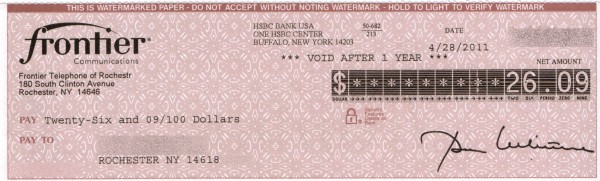
In early February, our last remaining service — the landline — was transferred to Time Warner Cable.  But even on the way out the door, Frontier continued to disappoint.  After more than two months (and two invoices later), Frontier had still not refunded our credit balance of $26.09.  We’re a long way from Rochester Telephone, a well-regarded predecessor to Frontier which traditionally enclosed a refund check with the final bill.  Frontier makes you wait, and wait, and wait some more, reminding you they owe you money with repetitious “do not pay – credit balance” invoices for long-terminated service.

More than two months after disconnecting service, our refund check finally arrives!

On Monday, the refund check finally arrived, in an obscure envelope resembling one of those PIN reminders banks send you.  After tearing away three sides of perforated strips, there it was — $26.09 from Frontier Communications.

The long wait is hardly a random glitch.  Stop the Cap! covered the story of a Frontier customer in California who waited several months for the phone company to refund her just over $15, and just this evening we heard from one of our regular readers in Rochester disappointed by Frontier’s hardly-rapid refund policy.

The only good news is that we weren’t overbilled on the way out the door, as one Elk Grove, Calif. customer was — to the tune of $680.

To Frontier we say goodbye and good luck (and we’ll be cashing that check faster than you sent it).

Loud Critic of North Carolina Community Broadband Exposed As Time Warner Cable Employee

Phillip "Not a Time Warner Cable Employee" Dampier

One of the most vociferous critics of the publicly-owned cable system serving the communities of Mooresville, Cornelius and Davidson, N.C. has been exposed as an employee of Time Warner Cable.

MI-Connection, the community-owned cable system, has been subjected to withering criticism since town leaders purchased it from bankrupt Adelphia Cable in 2007.  The efforts to rebuild the system to current standards has proved time-consuming and expensive, and ongoing expenses will require an investment of at least $17 million over the next three years to keep the cable system up and running.  Despite the fact Time Warner Cable has run into larger, more expensive headaches rebuilding similar rundown Adelphia systems they purchased in Ft. Worth, Texas and Los Angeles, critics of community cable have pounced on the costly rebuild to attack public involvement in private enterprise and suggest city officials have not competently run the operation.

Some of the loudest criticism has come in the comment sections of local newspapers and media sites.  Just as Fibrant has faced similar attacks in the comment section of the Salisbury Post, critics of MI-Connection have piled on in newspapers like the Davidson News and Hunterville’s Herald Weekly.  One of the loudest critics of all, Andy Stevens, even started a blog devoted to attacking what he calls “Government Cable.”

David Boraks, editor of the Davidson News, has reported extensively on MI-Connection, and he reads the comments that follow his articles published online, including those written by Stevens.

In a story written today by Boraks, the Davidson News revealed a fact that consumers, the media, and local officials deserved to know — Stevens works for Time Warner Cable.  That revelation comes despite repeated earlier denials from Stevens when asked by reporters and local officials if he worked for the cable company.

Mooresville, North Carolina

How did the newspaper find out about Mr. Stevens’ day job?

MI-Connection board chair John Venzon has gotten fed up reading unrelenting, and often fact-free attacks on the publicly owned cable system he oversees.  Venzon told the Herald Weekly he used to ignore the often anonymous critics of the local cable system, but he’s changing tactics.  Venzon and some other MI-Connection supporters have jumped into the online debate, correcting false information and taking on some of the cable system’s loudest critics, including Stevens.

As part of that effort, Venzon decided to publicly disclose a recent encounter with Stevens at a local shopping center.  Venzon was especially interested to find Stevens wearing a Time Warner Cable uniform, driving a Time Warner Cable truck.

Venzon went public on the Davidson News website Friday:

I would like to point out that today we confirmed that Andy Stevens, a frequent attendee at our board meetings and vocal community critic works for Time Warner Cable. He was greeted by one of our employees while in a TWC uniform and driving one of their logo-ed vehicles. He has been active in using our publicly available information to turn our potential customers against us and to stir up fear, uncertainty and doubt about MI-Connection while hiding his motives. He does not live in our town or service area, so he does not ‘have a dog in the fight’ unless you consider who signs his paycheck. Could I attend competitors’ regular board meetings to see what they are doing?

To make matters worse, he has used the Freedom of Information Act to gain access to every communication between the towns, the board and management. So Time Warner does in fact sit in our meetings … and we are required to provide the meeting notes.

In corporate America, this would constitute espionage. In our situation, it is free and legal. I find it deplorable. I hope you agree.

I believe we should be required to report information just as publicly traded companies do and would adhere to all such requirement. That system promotes transparency to shareholders on a quarterly basis. In addition, we would continue to attend town board meetings and community roundtables to disclose information to citizens.

In another setting, I would be happy to debate the merits of public ownership of a utility that promotes the well being of its citizens and businesses within their community. However, we are in the midst of executing a decision that was made several years ago and are responsible to grow the business.

I do not mind a fair fight, and we must win based on the value of our products and services. However, don’t unfairly give advantage to our competitors and put our citizens at greater risk.

Boraks

Boraks has gotten an admission from Stevens he does, in fact, work for Time Warner Cable, a pertinent detail omitted from Stevens’ anti-MI-Connection blog.  Before deleting about a dozen articles attacking the community cable system, Stevens even noted on the home page of his website, “As I have a full time job, this effort will be accomplished during my free time (evenings and weekends),” without bothering to disclose what that job was.  His “About” section didn’t make mention of his employer either.

The now-defunct blog of secret Time Warner Cable employee Andy Stevens

Now that Time Warner Cable, a regular critic of community-owned broadband, has been put in the embarrassing position of having an employee indirectly do its dirty work, a company spokesman was reduced to telling Boraks they cannot control what their employees do.

But apparently behind closed doors, all is not sweetness and light between Stevens and his employer.  Stevens’ highly active blog suddenly was deprived of all its content after revelations about his employer made the newspaper.  Bing’s cache of Stevens’ site (which Stop the Cap! has captured) shows he had plenty to say about the cable system — none of it good.  That all changed today.

Boraks opined in his piece in the News that Stevens ongoing denials of involvement with Time Warner Cable and his lack of disclosure left him concerned.

Indeed, Stevens’ efforts to hide his employer’s identity and his subsequent decision to bring his blog down after the cat was let out of the bag suggests there is nothing for Stevens or Time Warner Cable to be proud of in their relentless, often sneaky efforts to bring community-owned competition to its knees.  When it comes to protecting duopoly profits of local cable and phone companies in North Carolina, it’s total war on all fronts.

Cable One’s Ongoing Math Problem: Broadband Pricing Like a Cell Phone Data Plan

Cable One or Cellular One?

Cable One is unique among America’s top-10 large cable system owners for its nearly incomprehensible broadband usage policies, only fully disclosed to customers after they sign up for service.

The cable company, owned by the owners of the Washington Post, have been tinkering with their broadband pricing and Internet Overcharging schemes as they embark on upgrades to DOCSIS 3 broadband service.  The result: faster broadband service priced like a cell phone plan.

Currently, Cable One controls usage of their customers with a daily usage ration coupled with a speed throttle.  For customers, it means keeping track of usage, time of day, and whether you are in the over-usage doghouse with speeds cut in half.

Stop the Cap! went through the sign-up procedure offered online at the Cable One website, suggesting we were new customers in the Anniston, Alabama area.  While the company is quick to disclose speeds and plan features, it takes some deep wading through an Acceptable Use Policy for new customers to unearth the company’s extensive and complicated limits on broadband usage.  The company doesn’t even like to disclose they are throttling your speeds in half as a punishment.  Instead they refer to them as ‘Standard Speeds’:

Standard & Extended Speeds: Residential

Plan Speeds Download 1.5 Mb 3.0 Mb 5.0 Mb 8.0 Mb 10.0 Mb 12.0 Mb
Upload 150 Kb 300 Kb 500 Kb 500 Kb 1000 Kb 1500 Kb
Standard Speeds Download Speed (+/-) 1500 kbps 1500 kbps 2500 kbps 4000 kbps 5000 kbps 6000 kbps
Upload Speed (+/-) 150 kbps 150 kbps 250 kbps 250 kbps 500 kbps 750 kbps
Extended Speeds Download Speed (+/-) 1500 kbps 3000 kbps 5000 kbps 8000 kbps 10000 kbps 12000 kbps
Upload Speed (+/-) 150 kbps 300 kbps 500 kbps 500 kbps 1000 kbps 1500 kbps

Standard & Extended Speeds: Business

Plan Speeds Download 5.0 Mb 10.0 Mb 12.0 Mb 15.0 Mb 20.0 Mb
Upload 1.0 Mb 1.0 Mb 1.5 Mb 2.0 Mb 2.5 Mb
Standard Speeds Download Speed (+/-) 2500 kbps 5000 kbps 6000 kbps 7500 kbps 10000 kbps
Upload Speed (+/-) 500 kbps 500 kbps 750 kbps 1000 kbps 1250 kbps
Extended Speeds Download Speed (+/-) 5000 kbps 10000 kbps 12000 kbps 15000 kbps 20000 kbps
Upload Speed (+/-) 1000 kbps 1000 kbps 1500 kbps 2000 kbps 2500 kbps

Threshold Limits: Residential

Plan Speeds 1.5 Mb Download 3.0 Mb Download 5.0 Mb Download 8.0 Mb Download 10.0 Mb Download 12.0 Mb Download
150 Kb Upload 300 Kb Upload 500 Kb Upload 500 Kb Upload 1000 Kb Upload 1500 Kb Upload
Period of Measurement No Measurement 12 p.m. – 12 a.m.
(Noon to Midnight)
12 p.m. – 12 a.m.
(Noon to Midnight)
12 p.m. – 12 a.m.
(Noon to Midnight)
12 p.m. – 12 a.m.
(Noon to Midnight)
12 p.m. – 12 a.m.
(Noon to Midnight)
Max Threshold Bytes Downstream
During Period of Measurement
N/A 1,400 MB 2,250 MB 3,600 MB 4,500 MB 11,000 MB
Max Threshold Bytes Upstream
During Period of Measurement
N/A 140 MB 225 MB 225 MB 450 MB 1,380 MB
Period at Standard Speed N/A 4 p.m to Midnight 4 p.m to Midnight 4 p.m to Midnight 4 p.m to Midnight 4 p.m to Midnight

Threshold Limits: Business

Plan Speeds 5.0 Mb Download 10.0 Mb Download 12.0 Mb Download 15.0 Mb Download 20.0 Mb Download
1.0 Mb Upload 1.0 Mb Upload 1.5 Mb Upload 2.0 Mb Upload 2.5 Mb Upload
Period of Measurement 2 p.m. – 12 a.m.
(midnight)
2 p.m. – 12 a.m.
(midnight)
2 p.m. – 12 a.m.
(midnight)
2 p.m. – 12 a.m.
(midnight)
2 p.m. – 12 a.m.
(midnight)
Max Threshold Bytes Downstream
During Period of Measurement
2,300 MB 6,900 MB 11,000 MB 20,700 MB 27,600 MB
Max Threshold Bytes Upstream
During Period of Measurement
460 MB 460 MB 1,380 MB 3,680 MB 4,600 MB
Period at Standard Speed 5 p.m. to Midnight 5 p.m. to Midnight 5 p.m. to Midnight 5 p.m. to Midnight 5 p.m. to Midnight

Company officials have been telling Cable One customers some of these complicated usage formulas are about to be relaxed as they introduce their new 50Mbps DOCSIS 3 broadband service.  With Cable One delivering service primarily in small cities and rural areas, the arrival of 50Mbps broadband has generated considerable excitement, until customers learned the cable company has decided to market it like a cell phone plan.

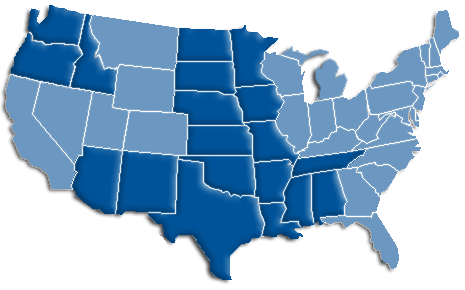
Cable One primarily serves small cities and towns in the central and northwestern United States.

“The new 50Mbps plan is downright bizarre here in Fargo, N.D.,” writes Stop the Cap! reader Paul.  “It actually costs less than their 10Mbps plan — I was quoted $45 a month for the broadband-only option, $35 if I signed a two year contract.  That actually saves me money as I currently spend just over $50 a month for their 10Mbps plan.”

But Paul learned the super fast broadband plan comes with some major strings attached.

“It is limited to 50GB of usage per month on what they are calling their ‘data plan,'” Paul shares.  “The customer service representative said it was like ordering a data plan with your wireless phone.”

Currently, the 50GB limit is the only data plan on offer, and the usage cap does not apply to usage overnight from midnight until noon the following day.  But those exceeding it at other times face a $0.50/GB overlimit fee.

Paul also says Cable One appears to be ready to dispense with the complicated speed throttle it uses on its mainstream 3-12Mbps broadband plans.  Cable One traditionally gave customers a daily usage allowance ranging from 1-11GB, after which accounts were subject to throttled speeds for the next 24 hours.

“Customers have complained about the slow speeds, throttles, and usage limits for years, if only because they couldn’t navigate all of them and Cable One’s usage measurement tool is often offline or inaccurate,” Paul writes.

“I first learned about Stop the Cap! when Cable One tried to charge some of our local residents $1,000 for cable equipment lost in a fire,” Paul says.  “Cable One has been so bad my wife was hoping Mediacom… Mediacom, would deliver us from them with a buyout.”

Cable One is an example of a cable company that has gone all out with Internet Overcharging, delivering customers an expensive and speed throttled broadband experience.

“Even though the lower price for the 50Mbps plan looks nice, it’s not if you start going over the limit,” Paul says.  “Sorry, broadband is not cell phone service.”

He is sticking with his current 10/1Mbps service plan.

Cable One representatives argue very few customers exceed any of the company’s plan limits, less than 1 percent exceeding them consistently.

Search This Site:

Contributions:

Recent Comments:

Your Account:

Stop the Cap!