Home » Providers » Recent Articles:

AT&T vs. Our Troops: Sticks Our Finest With Hefty Cancel Fees When Ordered to Deploy

Phillip Dampier May 9, 2011 AT&T, Consumer News, Public Policy & Gov't Comments Off on AT&T vs. Our Troops: Sticks Our Finest With Hefty Cancel Fees When Ordered to Deploy

Soldiers starting basic training or preparing to deploy overseas have a lot on their minds.  Worrying about their AT&T cell phone service isn’t supposed to be one of them.

Stop the Cap! has been hearing from soldiers in several states who are sharing similar stories about AT&T insisting on hefty early termination fees when calling to suspend or cancel service because of military training or deployment abroad.  Cell phones are prohibited during basic training, which lasts 10 weeks.  So why pay for a service you cannot use for two and a half months?

The Chicago Tribune shared the story of Nathaniel Jungheim, of Chicago, who faced an intransigent AT&T when he called to put his account on hold during basic training.

“They informed me that they have recently changed how they handle military accounts and said I would have to pay $10 a month plus taxes to keep my account in suspension,” he said.

Jungheim said he complained and was told he would either have to pay the monthly fee or $275 to terminate his contract.

“I asked to speak to a supervisor but was told they would say the same thing,” Jungheim said.

Those “changes” are likely illegal under the Service Member Civil Relief Act, a federal law which protects America’s soldiers from predatory practices from bankers, property management companies, insurance companies, and yes, cell phone companies.

Text of S. 3023 [110th]: Veterans’ Benefits Improvement Act of 2008
Oct 10, 2008: Became Public Law No: 110-389

SEC. 805. TERMINATION OR SUSPENSION OF CONTRACTS FOR CELLULAR TELEPHONE SERVICE FOR CERTAIN SERVICEMEMBERS.

(a) In General- Title III of the Servicemembers Civil Relief Act (50 U.S.C. App. 531 et seq.) is amended by inserting after section 305 the following new section:

SEC. 305A. TERMINATION OR SUSPENSION OF CONTRACTS FOR CELLULAR TELEPHONE SERVICE.

(a) In General- A servicemember who receives orders to deploy outside of the continental United States for not less than 90 days or for a permanent change of duty station within the United States may request the termination or suspension of any contract for cellular telephone service entered into by the servicemember before the date of the commencement of such deployment or permanent change if the servicemember’s ability to satisfy the contract or to utilize the service will be materially affected by such deployment or permanent change. The request shall include a copy of the servicemember’s military orders.

(b) Relief- Upon receiving the request of a servicemember under subsection (a), the cellular telephone service contractor concerned shall–
(1) grant the requested relief without imposition of an early termination fee for termination of the contract or a reactivation fee for suspension of the contract; or
(2) in the case that such servicemember is deployed outside the continental United States as described in subsection (a), permit the servicemember to suspend the contract at no charge until the end of the deployment without requiring, whether as a condition of suspension or otherwise, that the contract be extended.

AT&T doesn’t feel the law applies to them, however, judging from complaints we’ve been receiving from readers.

Stop the Cap! came up on a private military forum open to service members, and ever since, we’ve heard some stunning complaints about AT&T and suspicions the phone company is hoping to rely on soldiers not fully understanding their rights.  Remarkably, all of the complaints have been about AT&T.  Verizon and Sprint reportedly treat the troops with considerably more respect.

“I was ordered to Europe last November and wanted to call and cancel my AT&T service and ran straight into a brick wall with those people,” shares Elizabeth.  “They told me they don’t suspend accounts for anyone, only cancel them, and demanded $200 in early cancel fees to be paid immediately on my credit card or they would ruin my credit.”

Nathan, who is now serving in rural Alaska, shared a similar story.  On his third call to AT&T, the representative offered him just one choice — a $10 a month suspended plan, if he agreed to extend his service contract when he got back.

“I was reading off of AT&T’s own website stating the company would cancel my service with no penalty, but the operator could have cared less,” Nathan writes.  “If I didn’t like it, he would charge me $300 to immediately cancel my contract and that was that.”

Nathan got the distinct impression the representative was accusing him of ripping off AT&T for a new phone he wanted to “walk away” with free and clear.

JJ managed to get a supervisor to “do him a favor” and cancel his contract with no penalty, but only if he faxed over his military ID, birth certificate, driver’s license, orders of deployment, and a copy of a major credit card for “verification purposes.”

“I told them to forget it — I was not about to send some low paid AT&T call center guy every form of ID I had so I could discover my identity stolen when I got back,” JJ said.

“AT&T cares less about the troops who defend their right to exist in a free United States; they only care about money and that is disgusting and unpatriotic,” JJ shares.

Another customer, deployed overseas, was told to report to an AT&T store in the United States to discontinue service — there was no other way to cancel penalty-free.

As has been so often the case, when media attention shines a bright light on potentially illegal business practices or bad service, relief is soon in sight, for at least a few people.

The Problem Solver called Brooke Vane, a spokeswoman for AT&T, and described Jungheim’s situation.

Vane emailed Thursday to say AT&T adheres to the federal Service Member Civil Relief Act, which provides guidelines for how companies deal with those who are called to duty.

Vane instructed Jungheim to call AT&T’s customer care phone number again and go through the process of suspending service.

“Once he meets the requirements, including providing us with his orders, as required by law, we can process this request,” Vane said.

Thursday evening, Jungheim called AT&T and spoke to a representative.

“I faxed over my deployment orders … so I should be a go,” he said.

He will not be charged the $10 a month.

AT&T's website for servicemembers makes it easy to buy more of their products and services, but doesn't deliver much help to those who want to put their accounts on hold or leave. (Click image to visit site.)

Stop the Cap! recommends you arrange to cancel or suspend service as soon as you have a date in hand for basic training or deployment abroad.  Then call AT&T at 1-800-331-0500 and notify them you need to fax your written request to discontinue service, penalty-free, and are including a copy of your military orders.  By declaring your intent, you will present yourself as knowledgeable about your rights, and are less likely to encounter resistance from AT&T.

Do not fax or mail copies of any forms of personal identification.  They are not required under the law and there is no reason to expose yourself to identity theft.  We recommend you consider service cancellation over service suspension, because it lets you walk away from AT&T free and clear.  You will lose your cell phone number, but when you return, you can sign up as a new customer and receive a new phone discount.

Always write down the name and extension of the person you spoke with along with the time and date of your call and keep it in a file until you are assured the request was processed properly.

If you encounter problems, insist that your call be escalated to a supervisor.  If that fails, two of our readers reported they had near instant resolution to their ongoing problems with AT&T by calling their member of Congress or two Senators.

Public Knowledge Dips Its Toe Into Fight Against Internet Overcharging – Learn From Canada

Phillip Dampier May 9, 2011 AT&T, Bell (Canada), Broadband "Shortage", Canada, Competition, Data Caps, Editorial & Site News, Public Policy & Gov't, Video, Wireless Broadband Comments Off on Public Knowledge Dips Its Toe Into Fight Against Internet Overcharging – Learn From Canada

Among the public interest groups that have historically steered clear of the fight against usage caps and usage based billing is Public Knowledge.

Stop the Cap! took them to task more than a year ago for defending the implementation of these unjustified hidden rate hikes and usage limits.  Since then, we welcome the fact the group has increasingly been trending towards the pro-consumer, anti-cap position, but they still have some road to travel.

Public Knowledge, joined by New America Foundation’s Open Technology Initiative, has sent a letter to the Federal Communications Commission expressing concern over AT&T’s implementation of usage caps and asking for an investigation:

[…] Public Knowledge and New America Foundation’s Open Technology Initiative urge the Bureau to exercise its statutory authority to fully investigate the nature, purpose, impact of those caps upon consumers. The need to fully understand the nature of broadband caps is made all the more urgent by the recent decision by AT&T to break with past industry practice and convert its data cap into a revenue source.

[…] Caps on broadband usage imposed by Internet Service Providers (ISPs) can undermine the very goals that the Commission has committed itself to championing. While broadband caps are not inherently problematic, they carry the omnipresent temptation to act in anticompetitive and monopolistic ways. Unless they are clearly and transparently justified to address legitimate network capacity concerns, caps can work directly against the promise of broadband access.

The groups call out AT&T for its usage cap and overlimit fee model, and ponder whether these are more about revenue enhancement than network management.  The answer to that question has been clear for more than two years now: it’s all about the money.

The two groups are to be commended for raising the issue with the FCC, but they are dead wrong about caps not being inherently problematic.  Usage caps have no place in the North American wired broadband market.  Even in Canada, providers like Bell have failed to make a case justifying their implementation.  What began as an argument about congestion has evolved into one about charging heavy users more to invest in upgrades that are simply not happening on a widespread basis.  The specific argument used is tailored to the audience: complaints about congestion to government officials, denials of congestion issues to shareholders coupled with promotion of usage pricing as a revenue enhancer.

If Bell can’t sell the Canadian government on its arguments for usage caps in a country that has a far lower population density and a much larger rural expanse to wire, AT&T certainly isn’t going to have a case in the United States, and they don’t.

The history of these schemes is clear:

  1. Providers historically conflate their wireless broadband platforms with wired broadband when arguing for Internet Overcharging schemes.  When regulators agree to arguments that wireless capacity problems justify usage limits, extending those limits to wired broadband gets carried along for the ride.  Dollar-a-holler groups supporting the industry love to use charts showing wireless data growth, and claim a similar problem afflicts wired broadband, even though the costs to cope with congestion are very different on the two platforms.
  2. Providers argue one thing while implementing another.  Most make the claim pricing changes allow them to introduce discounted “light user” plans.  But few save because true “pay only for what you use” usage-based billing is not on offer.  Instead, worry-free flat use plans are taken off the menu, replaced with tiered plans that force subscribers to guess their usage.  If they guess too little, a stiff overlimit fee applies.  If they guess too much, they overpay.  Heads AT&T wins, tails you lose.  That’s a clear warning providers are addressing revenue enhancement, not network enhancement.
  3. Claims of network congestion backed up with raw data, average usage per user, and the costs to address it are all labeled proprietary business information and are not available for independent inspection.

There are a few other issues:

In the world of broadband data caps, the caps recently implemented by AT&T are particularly aggressive. Unlike competitors whose caps appear to be at least nominally linked to congestions during peak-use periods, AT&T seeks to convert caps into a profit center by charging additional fees to customers who exceed the cap. In addition to concerns raised by broadband caps generally, such a practice produces a perverse incentive for AT&T to avoid raising its cap even as its own capacity expands.

In North America, only a handful of providers use peak-usage pricing for wired broadband.  Cable One, America’s 10th largest cable operator is among the largest, and they serve fewer than one million customers.  Virtually all providers with usage caps count both upstream and downstream data traffic 24 hours a day against a fixed usage allowance.  The largest — Comcast — does not charge an excessive usage fee.  AT&T does.

Furthermore, it remains unclear why AT&T’s recently announced caps are, at best, equal to those imposed by Comcast over two years ago.  The caps for residential DSL customers are a full 100GB lower than those Comcast saw fit to offer in mid-2008. The lower caps for DSL customers is especially worrying because one of the traditional selling points of DSL networks is that their dedicated circuit design helps to mitigate the impacts of heavy users on the rest of the network. Together, these caps suggest either that AT&T’s current network compares poorly to that of a major competitor circa 2008 or that there are non-network management motivations behind their creation.

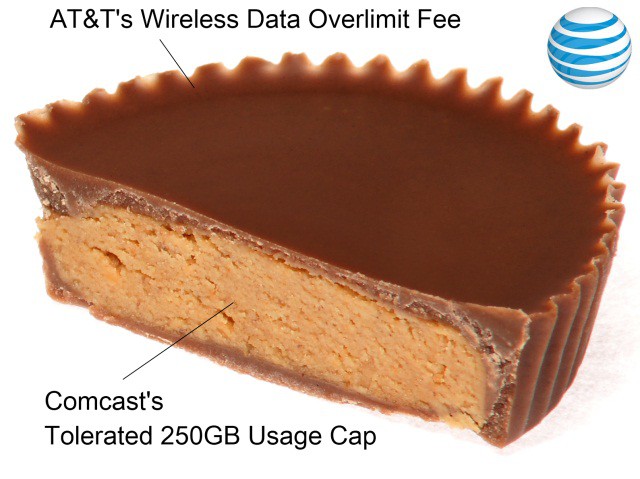
AT&T has managed to create the first Internet version of the Reese's Peanut Butter Cup, combining Comcast's 'tolerated' 250GB cap with AT&T's style of slapping overlimit fees on data plans from their wireless business.

As Stop the Cap! has always argued, usage caps are highly arbitrary.  Providers always believe their usage caps are the best and most fair around, whether it was Frontier’s 5GB usage limit or Comcast’s 250GB limit.

AT&T experimented with usage limits in Reno, Nevada and Beaumont, Texas and found customers loathed them.  Comcast’s customers tolerate the cable company’s 250GB usage cap because it is not strictly enforced — only the top few violators are issued warning letters.  AT&T has established America’s first Internet pricing version of the Reese’s Peanut Butter Cup: getting Comcast’s tolerated usage cap into AT&T’s wireless-side overlimit fee.  The bitter aftertaste arrives in the mail at the end of the month.

Why establish different usage caps for DSL and U-verse?  Marketing, of course.  This is about money, remember?

AT&T DSL delivers far less average revenue per customer than its triple-play U-verse service.  To give U-verse a higher value proposition, AT&T supplies a more generous usage allowance.  Message: upgrade from DSL for a better broadband experience.

Technically, there is no reason to enforce either usage allowance, as AT&T DSL offers a dedicated connection to the central office or D-SLAM, from where fiber traditionally carries the signal to AT&T’s enormous backbone connection.  U-verse delivers fiber to the neighborhood and a much fatter dedicated pipeline into individual subscriber homes to deliver its phone, Internet, and video services.

A usage cap on U-verse makes as much sense as putting a coin meter on the television or charging for every phone call, something AT&T abandoned with their flat rate local and long distance plans.

Before partly granting AT&T’s premise that usage limits are a prophylactic for congestion and then advocate they be administered with oversight, why not demand proof that such pricing and usage schemes are necessary in the first place.  With independent verification of the raw data, providers like AT&T will find that an insurmountable challenge, especially if they have to open their books.

[flv width=”640″ height=”368″]http://www.phillipdampier.com/video/Bell’s Arguments for UBB 2-2011.flv[/flv]

Canada’s experience with Usage-Based Billing has all of the hallmarks of the kind of consumer ripoff AT&T wants Americans to endure:

  • A provider (Bell), whose spokesman argues for these pricing schemes to address congestion and “fairness,” even as that same spokesman admits there is no congestion problem;
  • Would-be competitors being priced out of the marketplace because they lack the infrastructure, access, or fair pricing to compete;
  • Big bankers and investors who applaud price gouging and are appalled at government checks and balances.

Watch Mirko Bibic try to rationalize why Bell’s Fibe TV (equivalent to AT&T U-verse) needs Internet Overcharging schemes for broadband, but suffers no capacity issues delivering video and phone calls over the exact same line.  Then watch the company try and spin this pricing as an issue of fairness, even as an investor applauds the company: “I love this policy because I am a shareholder.  That’s all I care about.  If you can suck every last cent out of users, I’m happy for you.”  Finally, watch a company buying wholesale access from Bell let the cat out of the bag — broadband usage costs pennies per gigabyte, not the several dollars many providers want to charge.  (11 minutes)

Charter Cable’s Los Angeles System Up for Bidding – Wisconsin/LA Cable Swap Falls Through

Phillip Dampier May 5, 2011 Charter Spectrum, Consumer News Comments Off on Charter Cable’s Los Angeles System Up for Bidding – Wisconsin/LA Cable Swap Falls Through

Charter Cable, one of America’s worst-rated cable companies, wants out of greater Los Angeles.  Its cable system, serving parts of LA, has been rumored for sale for years.  Now the cable company has gotten serious, hiring Goldman Sachs and Citibank to run an auction to sell off the system.

The most logical buyer, Time Warner Cable, has been engaged in on-again, off-again talks with Charter about Los Angeles for sometime, according to several sources in the cable investment community.  Charter proposed a swap, trading its Los Angeles system to Time Warner if they could acquire Time Warner’s subscribers in Wisconsin.

Time Warner Cable currently serves 560,000 subscribers in Green Bay, Milwaukee and Appleton.  Charter serves much of the rest of the state.  Thankfully for many Wisconsin customers, Time Warner Cable told Charter they were not interested.  Time Warner gets significantly higher customer ratings than Charter does.

Now that Goldman Sachs and Citibank will be running an auction, Time Warner Cable could still ultimately acquire the Charter systems in Los Angeles, if they are willing to pony up an estimated $2 billion asking price.  If Time Warner won’t bid that high, speculation is that Comcast, Cox, or Cablevision will.

A surprise bonus for buyers are rumors Charter will throw in its cable system in Fort Worth, Tex.  That move would also seem to benefit a Time Warner Cable takeover, considering the nation’s second largest cable operator already has an enormous presence in the Dallas/Fort Worth Metroplex.  But Multichannel News points out that part of Texas brings bad memories for Time Warner, when it had to effectively commit to an expensive rebuild of the nearby ailing system acquired from bankrupt Adelphia Cable in 2006.

Time Warner Cable is still rumored to be the logical buyer of Insight Cable’s systems, also for sale, in Indiana, Kentucky, and Ohio, although the cable company is still balking at an asking price of up to $4 billion.

Verizon Wireless and T-Mobile Start Cracking Down on Tethering ‘Freeloaders’

Phillip Dampier May 5, 2011 AT&T, Data Caps, T-Mobile, Verizon, Wireless Broadband 8 Comments

Naughty! (Unless you pay extra)

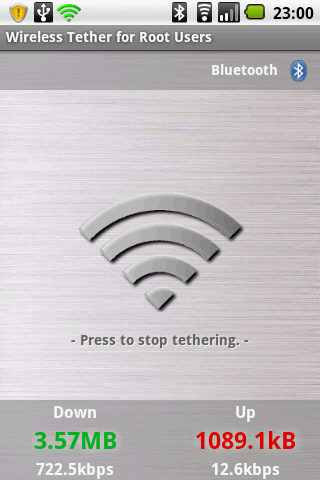
Wireless carriers want you to pay them extra if you use your phone’s built-in Wi-Fi hotspot feature to share wireless data with your other devices.  Now Verizon and T-Mobile are joining AT&T in shutting down some loopholes that allowed third party applications to deliver tethering service at no additional monthly charge.

The first step in locking down tethering is removing easy access to applications that allow it to happen.  As of this week, access to the most popular tethering apps, including Easy Tether, Internet Sharer, Klink, PDAnet and Tether for Android have been blocked from the Android Market, which means customers can only install these applications using a complicated process to manually install the software.

The next step, already underway at AT&T, is to identify and warn customers using these “unauthorized” apps that they are violating the terms of their wireless contract.

AT&T customers began receiving text messages warning them that the company’s own tethering plan would be automatically added to their accounts if tethering continued.  Verizon has not gone that far yet, but T-Mobile has, sending warnings and blocking access for customers who are not paying an additional $14.99 a month for the service, currently unlimited.

Verizon Wireless customers will have to pay $20 a month for up to 2GB of access, each additional gigabyte priced at $20.

AT&T customers can add tethering for an additional $15 (for 200MB), with additional plans delivering more access for more money.

Google, responsible for administering the Android Market, notes it is not “blocking” the app, merely making it “unavailable for download at the request of wireless carriers” — a distinction without a difference for most consumers.

5-10-2011 Correction:  AT&T’s website claims you need the 4GB DataPro plan for Smartphone tethering, which provides an allowance of 4GB of data for $45 a month, with a $10/GB overlimit fee per GB over.


Less is More? AT&T’s Fanciful Claim That T-Mobile Merger ‘Increases Competition’

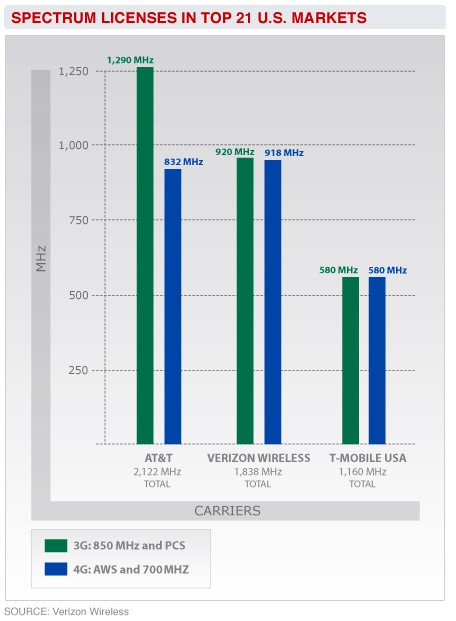
Verizon Wireless provides evidence AT&T already has more spectrum than any other carrier -- spectrum they are not using.

AT&T’s alternate reality of the wireless universe is on full display as the company makes statements promoting its proposed merger with T-Mobile that, in some cases, retreat from the facts or otherwise distort them.

AT&T CEO Randall Stephenson has been visiting with journalists, often from the business press, to talk up the merger’s potential.  The company has supplemented those PR tours with a 400-page filing with the Federal Communications Commission that has won converts among some non-profit groups, many of which receive direct funding from AT&T.

Stop the Cap! felt a fact check was in order, so we reviewed Stephenson’s recent claims made in an interview with USA Today:

Claim:  In the last four years, the volume of (traffic on) these (wireless broadband) networks is up 8,000%. We believe that we’re going to go up, in five years, eight to 10 times from where we are today. We don’t have the spectrum position to accomplish that.  T-Mobile’s spectrum is very compatible with ours. In cities like New York, we put the two companies together, and we get a very quick lift in capacity of about 30%. That means fewer dropped calls, better service quality, and it gives us a path to do something that neither one of us could do independently, and that is deploy fourth-generation mobile broadband to 95% of the U.S.

Fact: Although wireless broadband traffic is up, AT&T holds more wireless spectrum than any other carrier, a good deal of it unused.  In fact, some of AT&T’s competitors and critics suggest the company is hoarding spectrum, and its insatiable appetite for more could get fulfilled if the company can sell Congress on its “shortage theory.”  Although some of that spectrum is being reserved for the company’s future LTE network, critics contend AT&T spent a lower percentage of its revenue on network expansion (despite being the exclusive holder of the Apple iPhone during the period) than its competitors.

Between 2008 and 2010, AT&T’s FCC filing said it spent $21.1 billion in capital expenditures to upgrade its wireless network. That’s less than the $22.1 billion spent by Verizon Wireless over the same period. As a percentage of revenue, AT&T’s total was a little higher, at 13%, to Verizon’s 12.8%. Even so, given its congestion problems, AT&T should have spent significantly more. Complaints about congestion were apparent at least two years ago, yet in 2009 AT&T increased wireless capital expenditures by only 1% to Verizon’s 10%.

AT&T has admitted it has faced congestion issues in several large cities — an especially serious problem for a company using GSM technology, which combines voice and data traffic onto a single wireless pipe.  When the network gets overcongested, data sessions fail and voice calls drop.  CDMA networks like Verizon and Sprint have two virtual pipes, one for data and one for calls.  If one gets congested, it doesn’t necessarily harm the other.

Additionally, although T-Mobile will provide some additional capacity in selected urban markets, some of their towers are remarkably close to AT&T’s own towers, effectively making them redundant.  Because T-Mobile uses different spectrum, in some cases AT&T customers will see no benefit from the combination of the two networks, unless they buy new equipment capable of accessing both.

AT&T using T-Mobile as the key to deploying fourth-generation mobile broadband is more than a little hard to believe, considering the German-owned carrier is dwarfed by AT&T.

Claim: Anybody who opens the newspaper or watches TV sees this as a fiercely competitive industry — maybe the most competitive in the United States.  The large majority of Americans, when they go to buy cellphone service, have a choice of at least five providers. In 18 of the top 20 markets, the customer has a choice of five different competitors. It’s a fiercely competitive market today. It will be a fiercely competitive market after this deal is done. We don’t see that changing.

Free Press characterizes AT&T's claims of more competition by absorbing a competitor to be the equivalent of chucking your smartphone down the rabbit hole.

Fact: If ad purchases were evidence of a robust, competitive market, we could say phone and cable companies were hot competitors.  Both advertise heavily, but charge similar prices for similar service — a classic case of duopoly market pricing power. In the cell phone business, the overwhelming majority of Americans subscribe to either AT&T or Verizon Wireless.  Sprint is a distant third at around 12%.  After T-Mobile, all other carriers represent just 1-2% of the remaining market share.  Many cities don’t have access to smaller providers like Cricket, US Cellular, or MetroPCS, either.  In those areas, the choices are usually AT&T, Verizon, and perhaps Sprint.

How does this marketplace concentration impact customers?  Loss of innovation.  Typically, smaller carriers have to innovate to attract attention and compete successfully with larger providers.  AT&T and Verizon have long track records of locking up access to the most innovative phones, so smaller providers have to create unique service plans, offer lower prices, or provide attractive bundles.  Sprint sells unlimited access in a marketplace full of restrictive data caps or calling minute allowances.  T-Mobile provided some of the least expensive plans around, especially for families.  Cricket offers pay-per-day prepaid calling plans that can make a wireless phone affordable for anyone.  US Cellular has stellar customer service.

All competitors are not equal.  Anyone who lives or visits rural areas understands the implications of relying on Cricket, MetroPCS, or even Sprint for cell phone service well off the main highway.  With coverage being a major factor, many quickly decide there are only two realistic choices for robust service — AT&T and Verizon.

AT&T’s myopia aside, eliminating T-Mobile, one of the market’s most fiercely innovative providers, will do nothing to benefit consumers.

Q&A Claims:

Q: There are small companies in the market, but one commentator said that they’re like grocery stores trying to compete with Walmart.

A: Everybody has their analysis. We can evaluate the numbers nine ways to Sunday. At the end of the day, the Justice Department will do the fact gathering and data gathering and will evaluate it market by market, then make those determinations. Based on our analyses, this is a deal that should be approved.

Q: If the market is so competitive, why might two companies have 70% of the business?

A: We all make technology decisions. We all put marketing plans into place. We all make decisions that drive how effective we are in the marketplace. I think we’ve done pretty well. I think Sprint has done a remarkable job over the last couple of years and will do very well tomorrow.

Q: Consumers only have two places where they can get an iPhone.

A: But there are RIM (BlackBerry) devices. There are Windows (Phone) 7 devices. Android devices tend to be doing very well throughout the market — in fact, we are having a lot of success with Android. Metro PCSand a lot of our competitors are having a lot of success there. So there are plenty of options for the customer.

Q&A Facts:

  1. AT&T’s in-house analysis decides what is best for AT&T, not for individual American consumers.  The Justice Department and the Federal Communications Commission are subject to political pressure and are not independent arbiters of competitive fairness.
  2. Sprint has lost customers for years and is only now attracting some of them back.  While charitable to Sprint, Stephenson’s remarks are not welcomed by them.  They consider this deal anti-consumer and anti-competitive.
  3. Perhaps with the exception of the Evo, available first from Sprint, almost every other cutting-edge phone launches exclusively with AT&T and/or Verizon.  Other carriers get to sell these popular phones much later, or sell stripped down models that don’t deliver the same features.  Just review the phones available to Cricket and MetroPCS customers and compare them with what is on offer from Verizon and AT&T.

Claim:  History tells you that prices in this industry have come down for 10 years. In the last 10 years, there’s been a significant number of business combinations in this industry, and prices have come down by 50%. And prices continue to come down. We have a history, when we acquire one of these companies, we map their rate plans into AT&T. So if somebody chooses to stay on that rate plan, those rate plans are available. I don’t see why we would change it for this case. It’s just a customer-friendly thing to do.

Fact: More and more customers are no longer simply buying voice plans, on which Stephenson’s claims are based.  Instead, they are upgrading to smartphones, where they discover carriers’ mandatory add-on fees for data services.  Although prices for voice plans have not increased, rates for text messaging, data, and other add-ons have.  That can add $25 a month or more per phone.  Many carriers are reducing their discounts on new phones while adding new “junk fees” to their bills to cover “regulatory costs” as well.

AT&T also doesn’t specifically promise to retain T-Mobile’s innovative rate plans.  Instead, they propose to grandfather existing customers on those plans until they purchase new phones or switch carriers.  That does not mean existing AT&T customers can jump to a T-Mobile plan.  It also doesn’t mean those plans will still be available for new customers.

AT&T has a track record of not being particularly customer-friendly, either.

Claim: T-Mobile will continue to operate their business exactly like they have. They’ve demonstrated that they’ve had a lot of success. They market directly against AT&T. I envision them to continue marketing against AT&T in the marketplace.

Fact: T-Mobile is so successful, they have been shopping around for a buyer for some time to allow them to exit the business.  A success story that is not.

Claim: Q. If the deal goes through, would you offer all of the AT&T handsets to T-Mobile? A: Of course. If you’re a T-Mobile customer, that’s one of the great advantages. The handset selection that AT&T offers would become available to T-Mobile customers.

Fact: This proves our point T-Mobile customers do not have access to the latest and greatest equipment available to AT&T customers.

AT&T has also claimed the deal will create new jobs and stimulate economic growth.  Tell that to the T-Mobile employees who will be collecting unemployment shortly after being deemed redundant by AT&T.  Virtually all of T-Mobile’s current service areas overlap AT&T.

Free Press’ Tim Karr compares the consolidation of the cellular industry to the railroad mergers of the 19th century.  By locking up competition, carriers can raise prices and call the shots in the marketplace.  While a handful of competitors could eke out their 1-2% market share in such a duopoly, all will be starved for capital and considered a risky bet in light of the domination by AT&T and Verizon.

Karr is asking Americans to put their elected officials on notice they don’t want this anti-consumer merger:

So should it be left to Washington and one exceedingly powerful company to decide the fate of our communications? (If you’re thinking “no,” you can help stop this merger by contacting the members of the Antitrust Subcommittee and urging them to grill AT&T next Wednesday.)

If Congress, the FCC and Department of Justice hear from enough people like you and me, they can muster the courage to ask the right questions of AT&T.

Next Wednesday’s hearing on the Hill is our first chance to expose this merger for the nightmare that it is, and save our smartphones from following AT&T down the rabbit hole.

Search This Site:

Contributions:

Recent Comments:

Your Account:

Stop the Cap!