Home » Providers » Recent Articles:

Virgin Mobile Tightens the Noose on Its ‘Unlimited Mobile Broadband’ With Even More Speed Throttles

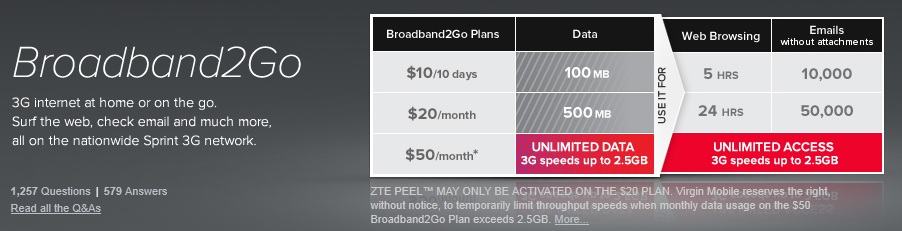
Virgin Mobile, which last year excited a number of our readers with the introduction of its Broadband2Go unlimited mobile broadband plan, has continued to evolve the meaning of “unlimited,” to now mean just 2.5GB of usage per month before speeds are reduced to the very un-broadband level of 256kbps.

It’s just another in a series of limits Virgin Mobile has placed on its 3G “unlimited” pay-as-you-go service since last August.

Last summer, customers paid up to $100 to purchase the mobile broadband device used with the service, and promptly discovered a lot of people were doing the same thing, which promptly overloaded the network and drove speeds downward.  Within months, our readers reported Virgin had quietly implemented a “fair access policy” that began reducing customers’ speeds after as little as 200MB of use daily, usually to 256kbps or less.  By February 2011, Virgin announced a 5GB usage cap, after which speeds would be permanently throttled until customers either paid an additional $40 or waited out the end of their billing cycle.

Apparently, even 5GB of usage per month is considered too much, so now Virgin Mobile is slashing that in half to 2.5GB.  Despite the ongoing decreases, company officials insist whatever level they are, they are still generous.  The company said less than 3 percent of its customer base will be impacted by a 2.5GB limit on their supposedly “unlimited” plan.  Virgin Mobile, now a wholly-owned subsidiary of Sprint, gets around that pesky contradiction by calling their plan “unlimited access,” which means you can access it day or night at speeds that either might be fast, or heavily throttled.

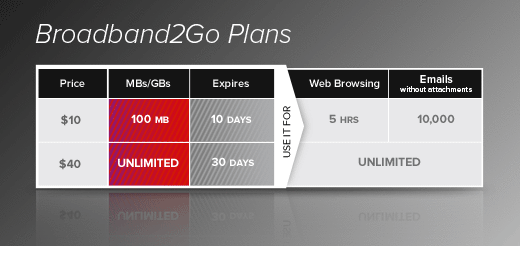
What used to cost $40 a month for truly unlimited service today costs $50 for 2.5GB.

Virgin Mobile's Broadband2Go "Before" Pricing from August, 2010

Virgin Mobile's Broadband2Go "New and 'Improved'" Pricing

The days of "Sugar Mama" are long gone.

Virgin Mobile is also hiking rates for two budget handset plans that include data:

  • 300 minutes, including unlimited texting and data up $10 to $35 a month
  • 1,200 minutes, including unlimited texting and data up $5 to $45 a month

But competition does occasionally deliver some benefits to consumers as Virgin recognizes it is being killed by cheaper unlimited smartphone plans from MetroPCS and Cricket, so it has cut the price on its own unlimited calling, texting, and data smartphone plan by $5 to match its competitors’ $55 monthly price.

Virgin Mobile is in the process or repositioning itself away from being a prepaid budget-priced carrier towards a smartphone-oriented provider for customers who do not want to sign lengthy service contracts with Verizon, AT&T, or even parent company Sprint.

This certainly means the days of Virgin Mobile’s Sugar Mama are long gone. 

Thanks to Bones and several other Stop the Cap! readers for sharing this news with us.

How Comcast’s Usage Cap Costs Them Business and Your Internet Connection

Andre Vrignaud of Seattle has been benched for a year by Comcast for using too much of its Internet service.

From time to time, we get reports from Comcast customers victimized by the company’s 250GB usage cap.  The nation’s largest cable broadband provider implemented that arbitrary limit back in 2008 after the Federal Communications Commission told the company they could not throttle the speeds of customers using applications like peer-to-peer file sharing software — then pegged as the usual suspect for turning “ordinary” broadband users into “data hogs.”

For at least 18 months, Comcast’s usage cap came with no measurement tools or real explanation most customers could find about what a “gigabyte” was, much less how many of them they “used” that month.  Only last year, Comcast finally rolled out usage measurement tools for customers who bother to find them on their website.  New customers signing up for service never even realize there is a usage cap until a thick brochure of legalize comes with the installer outlining the company’s Acceptable Use Policy.

Still, compared to some of the usage cap battles Stop the Cap! was fighting three years ago, Comcast was the least of our problems.  Frontier’s infamous 5GB usage allowance was the worst we’d ever seen, Cable One’s IRS-like usage policies required an academic to explain them, and Time Warner Cable’s ‘lil experiment in broadband rationing with a 40GB usage cap experiment crashed and burned soon after being announced in the lucky test cities scheduled to endure it.  That doesn’t make Comcast’s cap fair or right, but protecting consumers from these schemes requires triage.

But we remember well Comcast’s promise that it would regularly revisit and adjust its usage cap to reflect the dynamic usage of its customers.  That’s just one more broken promise from a broadband provider with an Internet Overcharging scheme.  In fact, Comcast has not moved its cap one inch since the day it was announced, although they have increased their rates.  The only thing going for the cable giant is that it doesn’t treat “250GB” as a guillotine.  In fact, the cable company only sends the usage police after the top few percent of users that exceed it, issuing a warning not to exceed the cap again during the next six months, or face a year without having the service.

This punitive policy is what Time Warner Cable CEO Glenn Britt loves to rail against.  For him, broadband usage should never be penalized — it should be exploited for all the money the provider can possibly get from customers.  That’s why Britt favors a consumption billing system that starts off with a high monthly price for everyone, than goes much higher the more you use.  Would the neighborhood crack dealer cut you off for using too much?  Of course not.  Feeding your broadband usage habits can mean fat profits, and investors love it.

Andre Vrignaud, a 39-year-old gaming consultant in Seattle, wrote us (and many others) about his own experience with Comcast’s usage ban.  He’s a victim of it, having been warned once about usage and then ultimately told his cable modem was disabled for a year.  For Vrignaud, it was a case of using a cloud storage file backup provider, moving very high resolution images around, and having roommates.  Since Comcast counts upload and download traffic towards its usage limit, it’s not hard to see what can happen to anyone trying to back up today’s supersized hard drives.  What’s especially ironic is that Comcast itself sells online file backup services — which also counts towards your cap.
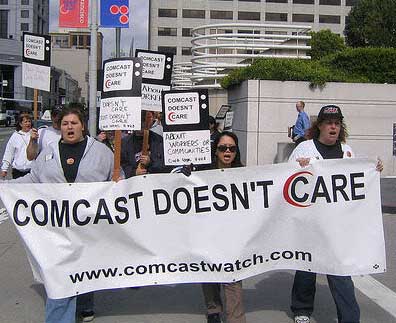
Comcast’s attitude about its decision to ban Vrignaud from its broadband service for a year was simple enough: it’s a clear cut case of violating their usage caps.  In their view, heavy users slow down broadband service for everyone else in the neighborhood.  So they set a policy that cuts them off when they use too much.

To add insult to injury, broadband-disabled Comcast customers have to call Comcast’s Retentions & Cancellations Department to get the billing stopped on his disabled service.  Vrignaud had to negotiate with a representative whose instinct is to keep you a Comcast customer at all costs, even when the company won’t allow you to be one!

But is Comcast really facing a congestion issue?  Not if you happen to be a business customer at the same address, using the exact same infrastructure that residential customers in the neighborhood use.  Business Class service has no usage limits at all — “congested neighborhood” or not.  And that is where Comcast’s argument simply starts to fall apart.

We’ve been in touch with Vrignaud privately in an effort to help him find a way back to his broadband service.  The alternative is DSL from Qwest/CenturyLink, and unless you live in an area where the phone company has upgraded their networks to support ADSL 2+ or other advanced flavors of DSL, that represents quite a speed downgrade.

Our readers have told us Comcast representatives have several unofficial ways of dealing with heavy users who have gotten their first warning from the company.  Some have told customers to sign up for a second residential account under the name of someone else in the home to allot themselves an additional 250GB of usage.  Others recommend signing up for a business account, which means no usage cap at all.  For those who have been cut off, signing up as a new customer under the name of someone else in the household usually gets you back in the door, albeit facing the same usage cap issue all over again.

The problem Vrignaud encountered is Comcast’s clumsy way of dealing with customers, like himself, who have been sentenced to a year without broadband service (from them).

Vrignaud explored the route we recommended — Business Class service — and found he couldn’t sign up.  Evidently Comcast’s ban is tied to his personal Social Security number, and when he tried to enroll in Business Class service using it, he was stopped dead in his tracks.

Turns out that once Comcast has cut your broadband account for violating their data cap policy you are verboten from being a Comcast customer for 1 year. That’s right:

After being cut off from Comcast’s consumer internet plan due to using too much data, I’m told I’m ineligible to use Comcast’s recommended solution, their business internet plan that allows the unlimited use of data — solely because I made the mistake of actually using “too much” data in the first place.

As the sales rep said in my Google Voicemail message, “what’s interesting is that if you would have started off on the business side of the house, since we don’t have a cap limitations [sic] you would’ve been fine.”

Vrignaud also mentioned he was unsure if Comcast required a business Taxpayer Identification Number (TIN) in order to sign up for Business Class service.  In fact, for our readers who have gone this route, it turned out not to be necessary.  They just put their Social Security number in the space reserved for a TIN and had no problems.  Vrignaud would have a problem, however, because his Social Security number is effectively “poisoned” for the year.  He would need to obtain a specific kind of TIN — an Employer Identification Number (EIN) to proceed.  Luckily, it takes less than five minutes to apply for one online and is free.  The number displayed at the end of the process would be the one to use with Comcast.  An alternative suggestion would be to sign up for service under the name of someone else in the household.

For those on Comcast’s bad side, there is more hoop-jumping to get your service back than at the Ringling Bros. circus.

Should all this even be necessary?

Broadband service carries up to a 90% profit margin.

Stop the Cap! thinks not.  While Comcast may have endured last-mile congestion on its shared cable broadband network in days past, the company’s aggressive upgrades to DOCSIS 3 technology makes congestion-based usage limits more of an excuse than a reality.  Comcast is pitching faster broadband speeds than ever, all hampered by the same 250GB usage limit.  While residential and business class customers share the same physical cable lines strung across neighborhoods, one faces a usage cap and the other does not.  It’s simply not credible.  Comcast’s punitive usage cap scheme throws away their own customers and the revenue they bring.

Vrignaud wants the option of getting his service back, perhaps by buying additional usage.  That’s Time Warner Cable’s dream-come-true, and one we are concerned about.  Once broadband usage is limited and monetized, it becomes a commodity that can be priced to earn enormous additional revenue for cable operators, regardless of the actual cost of providing the service.  That’s a dangerous precedent in today’s duopolistic broadband marketplace, because the cost per gigabyte will likely be on the order of a thousand times or more the actual cost, with no competitive pressure to keep that cost down.  That’s how Canada ended up in its Internet Overcharging pickle, where providers call $1.50-$5 per gigabyte “reasonable,” even though it costs them only pennies (and dropping) to deliver.  Some providers are even raising those prices, even as their costs plummet.  That’s not a road we want the cable or telephone industry walking down, or else we’ll find today’s enormous cable TV bills pale in comparison to the outrageous broadband service bills of the future.  Time Warner Cable provided a helpful preview in 2009 when they proposed unlimited 15/1Mbps residential service at the low, low price of $150 a month.

Vrignaud is just one more example of why Internet Overcharging risks America’s broadband future.  It’s an end run around Net Neutrality, its arbitrary, and unjustified.  The rest of the world is racing to discard what they called congestion pricing almost as fast as America’s providers (and their Wall Street cheerleaders) are racing towards Internet Overcharging.  The United States should be following Canada’s lead and hold providers to account for this kind of Internet pricing and force them to prove its warranted, or be rid of it.  With virtually every provider earning enormous profits off Internet service at today’s speed-based pricing, there remains no justification to overcharge customers for their broadband usage.


GLAAD Withdraws Support for AT&T/T-Mobile Merger; Reaffirms Support for Net Neutrality

Phillip Dampier July 13, 2011 Astroturf, AT&T, Competition, Net Neutrality, Public Policy & Gov't, T-Mobile Comments Off on GLAAD Withdraws Support for AT&T/T-Mobile Merger; Reaffirms Support for Net Neutrality

In the wake of a scandal that forced the resignation of the president and a board member of one of America’s largest gay civil rights organizations, The Gay and Lesbian Alliance Against Defamation (GLAAD) has withdrawn its prior support for the merger of AT&T and T-Mobile and reaffirmed its support of strong Net Neutrality policies.

In a letter filed with the Federal Communications Commission earlier today, GLAAD did an about-face on its earlier support for the merger, telling the federal agency it now has a “neutral position” with respect to the deal.

Mike Thompson, GLAAD acting president, used the communication to also express the group’s strong support of Net Neutrality, which guarantees a free and open Internet.

“A rigorous review process considered GLAAD’s unique mission and concluded that while AT&T has a strong record of support for the LGBT community, the explanation used to support this particular merger was not sufficiently consistent with GLAAD’s work to advocate for positive and culture-changing LGBT stories and images in the media,” Thompson said in a statement.

Thompson’s belief that AT&T has a strong record of support for gay and lesbian issues remains controversial in many segments of the gay community. John Aravosis of Americablog would take issue with Thompson, accusing AT&T of “screwing” the gay community in the state of Tennessee:

AT&T was one of the companies whose local representatives sits on the board of directors of the Tennessee chamber of commerce.  You remember them, the group that endorsed and actively lobbied for the measure repealing gay and trans rights ordinances in the state, mandating it so that no trans person can ever change their birth certificate gender in the future, and banning any future civil rights ordinances for anyone in the future.  That AT&T.  The AT&T that weighed in early with a statement, when we asked the 13 companies to disavow the legislation and call on the governor to veto, but then whose statement pretty much didn’t say anything.  The AT&T then that emailed me multiple additional statements AFTER the governor signed the hateful bill into law.

Aravosis

GLAAD has taken its first steps to move as far away from dollar-a-holler advocacy as possible as a result of the hostile reception GLAAD’s original position got from rank and file members of the civil rights group.  After AT&T’s financial contributions to the group were exposed, along with the interests of one of their board members with direct ties to the telecommunications company, GLAAD accepted the resignation of group president Jarrett Barrios and board member Troup Coronado.

Remaining board members want the controversy to be over and done with.

“I am confident that Mike made the right decision both in withdrawing GLAAD’s endorsement of the AT&T merger application and in affirming our support of general net neutrality principles,” said GLAAD board member Tony Varona.

Politico obtained a statement in response to these events from AT&T:

“As we’ve previously said, we recognize, and fully respect that these organizations, which do important work, will make up their own minds about whether to support the merger or remain neutral. And, though it should go without saying, the decisions made by these organizations will not in any way impact our desire to work with, partner with or support those organizations in the future.”


The ’19 Most Hated Companies in America’ Includes Big Telecom Abusers; TWC Is #3, Comcast #4

Cox alienates their customers.

Six of the 19 ‘Most Hated Companies in America’ are big cable, satellite and phone companies.  The list, published this month by The Atlantic magazine, call out the perpetrators of bad customer service, high prices, and in the case of Time Warner Cable (#3) — Internet Overcharging.

The American Customer Satisfaction Index rates companies based on thousands of surveys. In the latest index, the most-hated companies include large banks, airlines, power and telecom companies.  Especially called out this year was Time Warner Cable, celebrating a decade of public relations blunders ranging from gouging experiments on Internet service pricing, showing pornography on children’s channels, high rates, and downright lousy service in some areas.  And with CEO Glenn Britt entertaining a return to Internet rate gouging, the company’s 59/100 score still has plenty of room to fall.

#3 — Time Warner Cable (59/100) — All of the above, plus sexually harassing a North Carolina customer.

#4 — Comcast (59/100) –Dreadful customer service and poor communications left consumers with dozens of channels gone missing, outrageous rate hikes, their phone service implicated in a Florida woman’s death, and who could forget the technician that set a customer’s house on fire. This one actually lost two score points since last year.

#5 — Charter Communications (59/100) — The usual rate increases were bad enough, but Charter also told their customers they were on the hook for cable boxes lost in fires that were not their fault, was held accountable for faulty billing practices, went bankrupt, introduced its own Internet Overcharging scheme, and worst of all — their infamous PR disaster telling tornado victims in Alabama to go and find their lost cable boxes scattered somewhere in the neighborhood.  The representative on the line will wait.

#14 — AT&T (66/100) — Limited coverage and the introduction of usage pricing for data pl    …   oh sorry, AT&T dropped the call.  All reasons why AT&T wins the ‘you suck’ award among mobile providers this year.

#17 — Cox Cable (67/100) — The home of the $480 early termination fee, Cox alienates customers like few others.  They even use spacemen to harass their customers.  Bemusingly, Cox is considered a customer service success compared with our other bad boys.

#18 — Dish Network (67/100) — Trending downwards, Dish is still giving their customers a bath in bad billing and worse customer service.  They are lovers of big ad splashes with a terrifying excess of fine print which ruins the deal, if you read it.

Cricket Raising Wireless Broadband Prices Again; Announces Data Roaming On Sprint’s 3G Network

Phillip Dampier July 13, 2011 Cricket, Data Caps, Wireless Broadband 3 Comments

Leap Wireless’ Cricket is raising prices $5 a month on its prepaid 3G mobile broadband service for the second time in nearly a year, with the announcement the company will offer limited data roaming on Sprint’s 3G network.

In return for being able to access Cricket mobile broadband outside of the company’s highly limited network of cell towers, the price has to increase, according to statements made on Cricket’s website.  Cricket will now sell three different broadband plans, all without a contract:

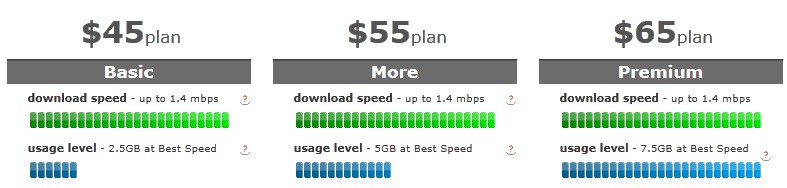
$45/month for 2.5GB, $55/month for 5GB, or $65/month for 7.5GB

But there are a number of catches.

First, your service will be terminated if you do not live in a zip code where Cricket provides its own cellular service.  The company is only interested in selling service to customers who will primarily use it inside of its own coverage areas.  Second, if you are caught data roaming on Sprint’s network for more than 50 percent of your monthly usage, the company can throttle your speed to dial-up for at least one month or terminate your account.

These pricing changes could also impact certain grandfathered Cricket mobile broadband customers, some of whom are still paying Cricket’s rate of $40 a month for up to 5GB of usage that was being sold until last summer.  Who will pay the added $5 bite depends on when and where you activated your account:

Customers activated prior to August 2, 2010: You are likely grandfathered on Cricket’s $40 a month plan, good for up to 5GB of usage per month.  Most of these customers never activated last year’s newly introduced limited 3G mobile data roaming, so they will not be able to use their service outside of a Cricket service area.  They will not see a rate increase unless they opt-in to “roaming” service from a menu on their wireless device’s configuration panel.  If you opt in, you cannot opt back out.

Customers who purchased their device at Best Buy, Wal-Mart, or Radio Shack at any time: You are not eligible for 3G data roaming service at this time.  You will not see a rate change unless and until that changes.

Customers activated after August 3, 2010: Your device was activated with 3G roaming capability and you will be impacted by the price change.  Existing customers on an impacted account will receive Nationwide 3G coverage beginning July 12.  The first bill with increased pricing will be for customers with a bill due on August 11.  Your bill will see an increase on or after this date.  Technically that equals one month of free roaming coverage.

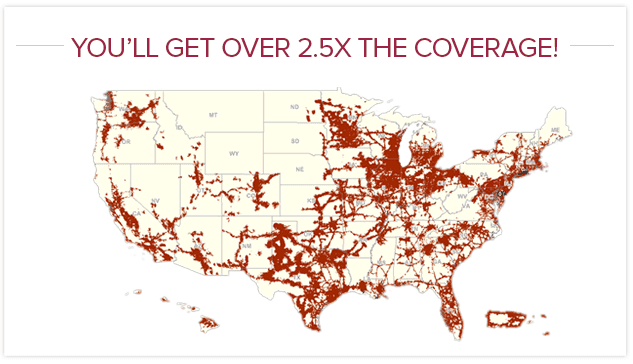
Cricket's new data coverage map, with Sprint roaming included.

For some customers, this is quite a price increase from two years ago when the company claimed to provide “unlimited” 3G wireless broadband service for $40 a month.  Customers soon learned Cricket’s definition of “unlimited” meant around 5GB of usage before the company throttled broadband speeds to near dial-up for the remainder of the billing month.  By last summer, “unlimited” was gone, replaced with usage allowances enforced by the aforementioned “fair access policy” speed throttles.

Although the company touts the service will run at speeds up to 1.4Mbps, in reality, most will see speeds much lower than that.  From Stop the Cap! headquarters in Rochester, N.Y., we routinely see speeds on Cricket’s 3G network operating at between 300-600kbps.

Cricket still delivers a cheaper plan over Sprint-owned Virgin Mobile, which charges $50 for 2.5GB.  For those who want more, Clearwire is still pitching 5GB of usage on Sprint’s 3G network and “unlimited” use on its 4G network, although “unlimited” really isn’t when the provider deems you a heavy user and throttles your speeds.  T-Mobile offers a data pass for some of their customers allowing 1GB of data for $30, 3GB of data for $50 — all prepaid.

Search This Site:

Contributions:

Recent Comments:

Your Account:

Stop the Cap!