Home » Providers » Recent Articles:

Bresnan’s Montana Customers Now Part of Cablevision’s Optimum West

Phillip Dampier July 20, 2011 Bresnan, Broadband Speed, Cablevision (see Altice USA), Consumer News Comments Off on Bresnan’s Montana Customers Now Part of Cablevision’s Optimum West

Cable Montana is now Optimum West, Cablevision’s marketing name for the cable systems it acquired from Bresnan Communications.

Earlier today, customers in Billings, Laurel, Park City and Columbus were able to start using upgraded cable, phone, and broadband equipment on the updated cable system.  More than 2,200 Montanans were introduced to the Optimum name in a mailing sent to neighborhoods where service has been upgraded.  But all of the new equipment that comes with the service has created considerable confusion for long-standing Bresnan customers who have been using older Bresnan equipment for years.

The changes have been overwhelming for those used to Bresnan’s modest level of service for more than a decade.  Cablevision, best known for its Optimum service in suburban New York City, Connecticut, and New Jersey, has brought an enormous increase in programming, and improvements in broadband service, for many customers.

“All existing customers in Laurel, Park City and Columbus will be upgraded to Optimum TV by July 20, which will deliver many more channels, including access to more than 100 channels of free HD (high definition), thousands of titles of video on demand and other benefits like faster high-speed Internet and a better phone service with lower prices and more features than are available from any other provider,” says a Cablevision spokesperson.

When it works properly.

The Laurel Outlook reports some customers frustrated with the changeover have found themselves at local cable stores trying to sort out all the problems:

One Laurel customer installed his modem, but was not receiving service. A visit to the Laurel office did not provide answers to his satisfaction, so he drove to the Billings office on Monad Road, where he received two telephone numbers to call for tech support. He called one of the numbers, followed a menu, and was able to troubleshoot with a technician to get his Internet up and running.

A second customer installed her set-top box but was not receiving Optimum TV channels. She called the 1-800 number provided in the mailing packet, but technicians were unable to walk her through the necessary steps to receive service. Frustrated, she drove to the Laurel walk-in center on West First Street and made an appointment for a technician to come to her home. She discovered that not only must she program her television with the new Optimum channel numbers, she must also program the TV-top box with the correct numbers. After doing so, she was able to receive the new channels.

Many customers are likely going to need to reprogram their televisions more than once.  When the upgrades are complete, Cablevision says it plans to unify channel lineups across the area.

Free Communal Broadband? Boston Firm Says Share and Share Alike and Get Service for Free

A Boston firm believes broadband is something best shared, and plans to put that notion to the test by bringing free access to wireless broadband to anyone in range of its equipment.

NetBlazr starts with gigabit fiber from Cogent Communications, and then delivers free or low-cost access to any customer that is willing to do two things:

  1. Spend $299 for their basic installation kit, which includes a high speed router, three antennas, and some cabling;
  2. Use the included equipment to receive service from NetBlazr and agree to share it with anyone in range of the wireless antennas included in the kit.

Reception of the wireless broadband signal, comparable to Business Class DSL, comes with no ongoing fees.  If you want dedicated, guaranteed speeds, NetBlazr will sell them to you at an added cost.  The more customers exchanging signals, the more robust and faster the network becomes, says NetBlazr CEO Jim Hanley.

Although the service is currently designed to operate for business customers in downtown Boston, Hanley sees the possibility of crowdsourcing a broadband platform eventually large enough to cover residential homes and businesses across the country, at almost no expense.

The venture is new, however, and the company’s FAQ warns businesses not to depend entirely on NetBlazr for dependable broadband just yet.

Because it’s still new, the quality and level of service is highly dependent on what kind of signal one can receive from the next nearest business that belongs to the cooperative.  If you are the only one for blocks around, the signal could be marginal to non-existent.

Such communal networks only work when they reach a critical mass of cooperative members to blanket areas with coverage.  At the moment, that means Boston’s Back Bay and downtown, where high-rise buildings help get the signals around densely populated neighborhoods.

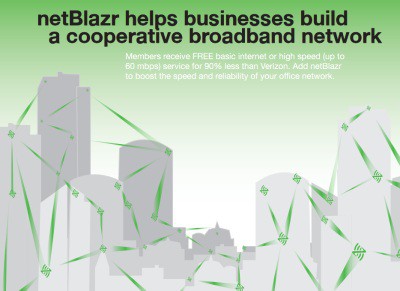
NetBlazr’s marketing brochure touts the service can deliver symmetrical speeds up to 60Mbps for free, and is particularly suited to offices that need additional broadband resources, but don’t want to sign a pricey upgrade agreement with incumbent providers like Verizon.

NetBlazr’s competitors like the aforementioned phone company are reacting with a shrug of the shoulders so far.

Verizon spokesman Phil Santoro: “Competition is always healthy and the market for Internet service is already highly competitive.”

“We aren’t familiar with this company’s business proposition, but I can tell you that Comcast already offers secure and reliable high speed Internet,” spokesman Marc Goodman told the Boston Herald.

Earlier efforts to share Internet services in neighborhoods through Wi-Fi ran into trouble when Internet Service Providers found out.  Virtually all providers specifically prohibit customers from sharing their residential service with non-paying customers beyond the property line.  But since NetBlazr arranges for its own access, this stumbling block is overcome.

Company officials say they have enough connectivity to support the demand, although business users don’t traditionally pound networks with peer-to-peer file requests or lots of online video, so how NetBlazr will ultimately perform in a residential setting remains to be seen.

The company has impressed technology mavens at the Massachusetts Innovation & Technology Exchange.  NetBlazr won this year’s “Best Bootstrapped Start-up” award.  It was also a finalist for the $1 million MassChallenge competition held earlier this year.

Hanley’s ultimate goal is to provide cheap, commodity Internet access, and thinks within five years his idea will be a major game-changer for how broadband service is delivered in the United States.

[flv width=”480″ height=”380″]http://www.phillipdampier.com/video/NetBlazr.flv[/flv]

netBlazr CEO Jim Hanley indicts America’s broadband duopoly and says direct action through new competition will solve the problem faster than public policy can.  Hanley also explains how his service works. (10 minutes)

Man Cut Off for a Year for Exceeding Comcast’s 250GB Cap-Story Going Viral

[flv width=”640″ height=”380″]http://www.phillipdampier.com/video/KOMO Seattle Man Loses Internet for a Year 7-14-11.mp4[/flv]

Last week, Stop the Cap! shared the story of Andre Vrignaud, a 39-year-old gaming consultant in Seattle who found his Comcast Internet service shut off for a year for twice exceeding the company’s arbitrary 250GB usage cap.  The story continues to draw media attention, including this TV news report from Seattle station KOMO-TV.  Cloud computing is implicated, but Vrignaud’s cure — paying more for additional usage, strikes us as the wrong answer.  Monetizing broadband usage is a provider’s dream come true.  The better solution would be to fight to remove the cap or at least ensure residential customers can upgrade to business service, if they choose, without the year-long “ban” in place.  (3 minutes)

West Virginia’s Institutional Broadband Funding Scandal: Throwing Money at a Non-Problem

Phillip Dampier July 18, 2011 Broadband Speed, Competition, Frontier, Public Policy & Gov't, Rural Broadband Comments Off on West Virginia’s Institutional Broadband Funding Scandal: Throwing Money at a Non-Problem

Martin

While thousands of West Virginians continue to struggle without any broadband service, the state government is having trouble finding a way to spend up to $40 million in broadband stimulus money on institutional broadband projects that often already have cutting edge fiber networks.

State officials won $126 million in federal stimulus grant money last year, from which the state announced it would lay more than 2,400 miles of fiber optic cable to wire government offices, schools, and libraries.  Now, a vocal critic says a combination of government waste, preferential treatment for the state’s largest phone company — Frontier Communications, and bad planning could leave up to $40 million of the grant money on the table, unspent for better broadband.

Jim Martin, president of business broadband provider Citynet, says the state overestimated the number of public facilities that need broadband improvements.  Many of the facilities involved already have high speed service, and do not require additional infrastructure.  As the grant expires, Martin says he would not be surprised if the state only managed to fund the installation of 300 miles of fiber.

Martin believes funds should be redirected to bolstering the state’s “middle mile” network — fiber infrastructure that would serve as an open network backbone to ensure capacity exists to support growing broadband demands in the state.  Instead, Martin told the Charleston Gazette, the state has been spending money providing fiber broadband to small libraries with fewer than a dozen computers that are unlikely to have the resources to pay the monthly fees Frontier Communications will charge for the service.

“There’s no value to any of this to anyone but Frontier,” Martin said.

In fact, Martin believes many of the current projects funded by taxpayer dollars deliver enormous benefits to Frontier’s bottom line, but only incremental improvement to some institutional users.

Martin claims Frontier has, in some cases, only spent enough money to install fiber from the pole to the building. That assures Frontier of being the only provider that can deliver ongoing service to institutional users.  Martin has a dog in this fight — his company competes with Frontier for business service contracts.

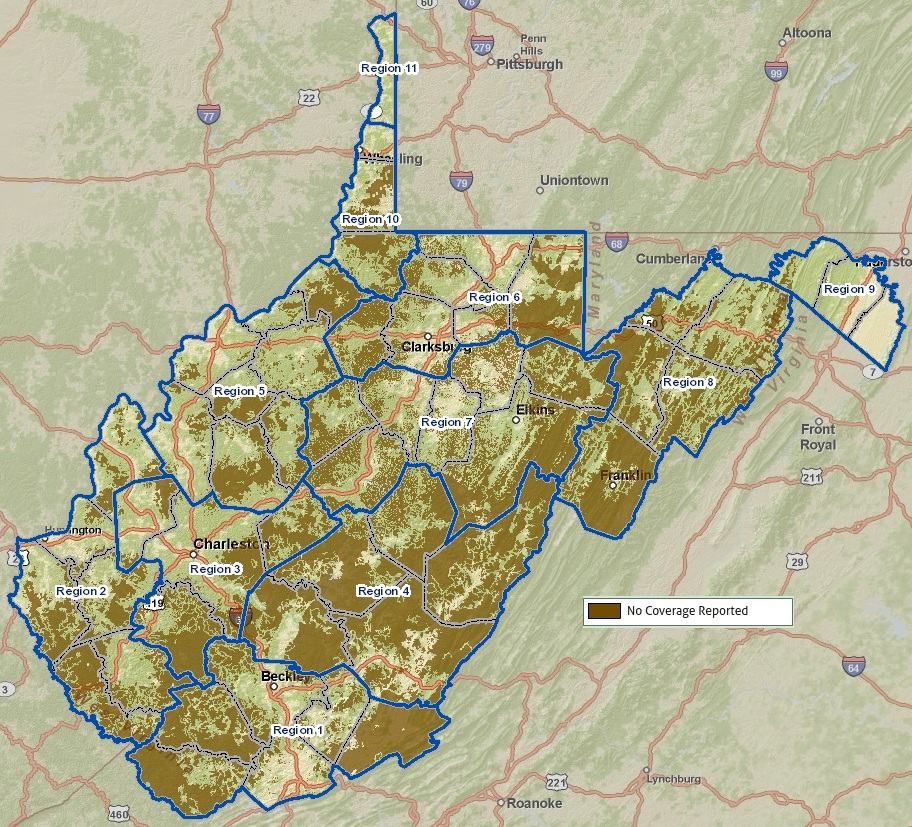
West Virginia's current broadband map shows large areas of the state have access to no broadband at all. (Olive color = No broadband.) (Click to enlarge)

Before the grant expires in February 2013, the state is hurrying to bolster its list of would-be recipients.

Jimmy Gianato, the state’s homeland security chief, said his office recently identified 330 additional “replacement locations” — higher education facilities, schools, health departments and state-owned hospitals — that could be eligible for the project, according to the newspaper.

Not on the list are individual consumers and small businesses who currently do not have access to any broadband service.  One of the ongoing problems of broadband stimulus funding is that public funds are often available to bolster broadband for state and locally-owned institutions, such as government offices, health care facilities, schools and libraries, but no funding to improve infrastructure for individual broadband service for “last mile” users.  This can result in Cadillac-style installations for small schools and libraries who win superb quality networks they ultimately cannot afford to operate on an ongoing basis.  For most, that service would come from Frontier Communications.

Martin already accused the state of investing in more than 1,000 routers without being certain if they were needed or where they would be installed.  At $20,000 each, Martin called the routers “Lamborghinis” and suggested they were largely unnecessary.

FairPoint Reaches 90% DSL Availability in Vermont, Drops Thousands of Customers After Power Outage

Phillip Dampier July 18, 2011 Broadband Speed, Consumer News, FairPoint, Video Comments Off on FairPoint Reaches 90% DSL Availability in Vermont, Drops Thousands of Customers After Power Outage

With FairPoint Communications, customers often have to take the good with the bad.  The formerly bankrupt telephone company providing service in northern New England announced last week it had met its obligation to provide at least 90 percent of Vermont residents with a broadband option — typically 1-3Mbps DSL — and has trumpeted results showing 83 percent of Maine and 85 percent of New Hampshire is now served by FairPoint DSL, an improvement over former owner Verizon Communications, which routinely ignored rural areas in all three states.

But while winning the option to buy DSL service, thousands of customers found service lacking last week when a power cable in the Manchester Millyard area brought down both broadband and voicemail service across all three states.

In such circumstances, FairPoint’s backup generators are supposed to maintain service, but not in this case.

“I’m on dialup and went down for 10 (hours),” Wolfgang Milbrandt of Mason wrote in an e-mail to the Nashua Telegraph. “So why does FairPoint have so many eggs in the Manchester basket and is the backup power system that feeble?”

In Milford, Tom Schmidt lost his DSL broadband for about five hours last Monday, with it returning “around 6-ish.”

Company officials admitted they didn’t switch to the generator after the power failed, and customers noticed as voicemail and DSL service began to fail.  Service problems were ongoing even after power was restored after about 90 minutes, with some FairPoint customers reporting problems through the early part of last week.

FairPoint plans to press forward with DSL broadband expansion and has also prioritized build-out of its Ethernet-Over-Fiber service for cell phone towers, delivering fiber-fast connections to more than 800 tower sites to support 4G wireless broadband from major wireless carriers.

[flv]http://www.phillipdampier.com/video/WGME Portland FairPoint customers lose service 7-11-11.flv[/flv]
WGME-TV in Portland, Maine covers FairPoint’s substantial broadband outage last week. (1 minute)

Search This Site:

Contributions:

Recent Comments:

Your Account:

Stop the Cap!