 One of the chairs of the North Carolina House Finance Committee abruptly resigned his chairmanship on the House floor Wednesday, submitting a letter read aloud in the chamber that accused fellow Republican House Speaker Thom Tillis (R-Mecklenburg) of having an unexplained business relationship with Time Warner Cable.
Rep. Robert Brawley (R-Iredell) wrote Tillis burst into his office demanding to know about a bill Brawley introduced that would have weakened the 2011 law Tillis strongly supported that severely restricted publicly owned broadband networks in the state.
“You slamming my office door shut, standing in front of me and stating that you have a business relationship with Time Warner and wanting to know what the bill was about,” Brawley wrote in his resignation letter. “You and I both know the bill stifles the competition with MI Connections in Mooresville. MI Connections is being operated just as any other free enterprise system and should be allowed to do so without the restrictions placed on them by the proponents of Time Warner.”
Tillis’ office described the resignation of Brawley’s chairmanship as “a mutual decision.”
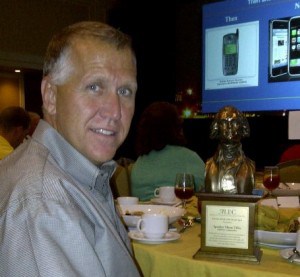
Tillis was honored in 2011 as ALEC’s “Legislator of the Year” and received an undisclosed cash reward. Time Warner Cable is a corporate member of ALEC.
House Bill 557, introduced by Brawley, would have permitted an exception under state law for the community-owned MI Connection cable system to expand its area of service to include economic development sites, public safety facilities, governmental facilities, and schools and colleges located in and near the city of Statesville. It would also allow the provider to extend service based on the approval of the Board of County Commissioners and, with respect to schools, the Iredell County School Board.
The bill died in the Committee on Government earlier this month.
MI Connection is the publicly owned and operated cable and Internet system serving the towns of Mooresville, Davidson and Cornelius in the counties of Mecklenburg and Iredell. It was originally a former Adelphia-owned cable system that fell into disrepair before it was sold in a bankruptcy proceeding. MI Connection has proved financially challenging to the local communities it serves because the antiquated cable system required significant and costly upgrades, faces fierce competition from AT&T and Time Warner Cable, and lacks the technological advantage fiber to the home offers other public networks like Greenlight in Wilson and Fibrant in Salisbury. Despite the challenges, MI Connection has successfully upgraded its broadband infrastructure with the fastest speeds available in the area — up to 60/10Mbps.
Tillis helped shepherd into law the 2011 bill that Time Warner Cable helped write and sponsor designed to stop public networks like MI Connection from expanding and new public networks ever seeing the light of day. The legislation places strict limits on public broadband network deployment and financing. The bill Brawley introduced would have chipped away at the law’s limits on network expansion. Brawley’s letter suggests Tillis had direct involvement stopping his bill from getting further consideration.

Brawley
Both Brawley and Tillis represent portions of the MI Connection service area.
Time Warner Cable has a long history pushing for community broadband bans in North Carolina, but the bills never became law when the legislature was still in the hands of Democrats. But in late 2010, Republicans took control of the state house for the first time in more than a century. Time Warner Cable’s fortunes brightened considerably under Republicans like Rep. Marilyn Avila (R-Wake). Avila willingly met with Time Warner Cable’s top lobbyist to coordinate movement on the community broadband ban legislation she introduced and after it became law was honored by the state cable lobby at a retreat in Asheville.
Tillis, who became speaker of the house in 2011 under the new GOP majority, received $37,000 in telecom contributions in 2010–2011 (despite running unopposed in 2010), which is more than any other state lawmaker and significantly more than the $4,250 he received 2006–2008 combined. AT&T, Time Warner Cable, and Verizon each gave Tillis $1,000 in early-mid January, just before he was sworn in as speaker on January 26. Tillis was in a key position to make sure the anti-competitive bill moved along the legislative pipeline.
Last summer, Time Warner Cable returned the favor inviting Tillis to serve a prominent role at a media event inaugurating its Wi-Fi network in time for last year’s Democratic National Convention, held at the Time Warner Cable Arena.
Despite all that, newspapers in the state are having trouble determining exactly what ties Tillis has to Time Warner Cable. The Raleigh News & Observer noted, “It’s unclear what relationship Tillis might have to Time Warner. His financial disclosure lists no connection.”
 The Greensboro News & Record published a non-denial denial from Tillis spokesman Jordan Shaw: “Shaw said he doesn’t know of any business relationship between Tillis and Time Warner.” The paper added, “a regional Time-Warner spokesman said Tillis has no ties to the company.”
“Not knowing” is not a total denial and a legislator need not have direct ties to a company to be influenced by their agenda through lobbyists like the North Carolina Cable Telecommunications Association, the statewide cable trade association that includes Time Warner Cable as its largest member. Then there are third-party groups.
A May 7 editorial in the News & Observer pointed out Tillis does have close ties to the American Legislative Exchange Council (ALEC), a group financed in part by Time Warner Cable and cited by CEO Glenn Britt as a useful asset to the cable operator because it was “particularly focused on telecom matters.” The commentary, “ALEC’s Guy is Thom Tillis,” reminded readers Tillis wasn’t just a casual member of the corporate-funded group, he’s a national board member. In fact, Stop the Cap! has learned he was ALEC’s 2011 Legislator of the Year. On hand at the 2011 New Orleans ALEC event to applaud Tillis were more than two dozen fellow North Carolina Republican legislators, including Reps. Marilyn Avila and Julia Howard.
 Among the model, corporate ghost-written bills ALEC maintains in its extensive database is one that restricts or bans publicly owned broadband networks, similar to what passed in North Carolina in 2011.
The fortunes of ALEC (and the corporations that underwrite its operations) have continued to improve in North Carolina this year. The News & Observer notes:
ALEC, as it’s known, has provided language for bills that [have been] used this session in North Carolina, ranging from creating an independent board to take charter school governance away from the State Board of Education to protecting a Philadelphia-based company from lawsuits involving asbestos exposure to installing an anti-union amendment in the state constitution. Closer to home, the Civitas Institute, a conservative group, used ALEC literature in an indoctrination…er, training…session for freshman lawmakers.

“I wish you’d turn the camera off now because I am going to get up and leave if you don’t,” said Rep. Julia Howard
Uncovering the corporate influence and pay to play politics pervasive in North Carolina’s legislature on broadband matters has proved historically scandalous for members and ex-members alike, as Stop the Cap! has reported for more than four years:
Tillis is following in others’ footsteps and is suspected of having even bigger political ambitions for 2014 — challenging the U.S. Senate seat now held by Democrat Kay Hagan.
The News & Observer thinks Tillis is forgetting about the people who elected him to office:
For North Carolinians of any political philosophy, however, the larger concern here is that laws are being written by those outside the state with only an ideological interest. ALEC, except for advancing its agenda, likely could care less about issues specific to North Carolina, things of intense, day-to-day concern to North Carolinians.
And not only are bills being influenced by ALEC, the speaker of the House is on the group’s board.
Thom Tillis and his Republican mates on Jones Street weren’t elected to march to orders issued by some national organization. Perhaps if they kept their eyes and ears open for constituents, their legislative agenda might be more about them and less about doing ALEC’s bidding.
Brawley himself is not free from controversy. In addition to attending the aforementioned ALEC event in New Orleans with Tillis, Avila, and Howard, earlier this year Brawley introduced House Bill 640, legislation that would roll back ethics reforms and allow lobbyists to once again give gifts to state lawmakers without any public disclosure.
Brawley told WRAL-TV that required ethics classes on gifts and disclosure requirements “are useless for anyone without internal ethics anyway. They only tell you the law. They do not guarantee integrity. What makes you think a person without ethics is going to obey a law anyway?”
The laws were enacted after a major 2006 scandal involving then-House Speaker Jim Black.
Corrections: In the original article, we mistakenly identified the News & Observer as a Charlotte newspaper. It is actually published in Raleigh. We also wrote that House Bill 557 died without being assigned to any committee for consideration. We received word the bill was actually referred to the Committee on Government on Apr. 4, 2013 where no further action was apparently taken. We regret the errors.


 Subscribe
 More than a year ago, Comcast temporarily suspended its nationwide 250GB usage cap to study its impact and consider what to do about increasing broadband traffic.
 But if Comcast brings back the cap, Cox will downgrade his service back to where he started.
 Cricket wants to convince you that paying AT&T or Verizon $90-120 a month for a cell plan with unlimited calling, texting and a 1-3GB data plan is too much, because it can sell you an “all-unlimited plan” for $45.
 AT&T says government regulations have hampered the company’s plans to roll out faster broadband networks to areas where consumers and businesses want faster speeds.