Home » rural areas » Recent Articles:

Connected Tennessee Notes 5.3% of State Now Has Access to 1Gbps Broadband, Thanks to EPB Fiber

Phillip Dampier January 31, 2012 AT&T, Broadband Speed, Comcast/Xfinity, Community Networks, Competition, Consumer News, EPB Fiber, Public Policy & Gov't, Rural Broadband Comments Off on Connected Tennessee Notes 5.3% of State Now Has Access to 1Gbps Broadband, Thanks to EPB Fiber

A group whose national umbrella organization has close connections to the nation’s largest phone companies estimates 5.3% of residents in the state of Tennessee now have access to world-class fiber broadband at speeds up to 1Gbps, but no thanks to AT&T or Comcast.

As part of updated broadband availability estimates, the group noted that only a fraction of the state gets access to the community-0wned Chattanooga-based utility that provides fiber to the home service, EPB.

Key findings from this update include:

  • 95.2% of Tennessee households have access to fixed broadband service of at least 768 Kbps downstream and 200 Kbps upstream (excluding mobile and satellite services).
  • 93% of Tennessee households have access to fixed broadband service of at least 3 Mbps downstream and 768 Kbps upstream (excluding mobile and satellite services).
  • 4.8% of Tennessee households remain unserved by any fixed broadband provider, representing approximately 120,000 unserved households that do not have access to a fixed wireless or wired broadband service offering (excluding mobile and satellite services).
  • Across rural areas of Tennessee, the percentage of unserved households by any fixed broadband service is 8.4%, representing approximately 110,000 unserved rural Tennessee households.
  • 5.3% of Tennessee households now have access to broadband service of at least 1 Gbps, marking the first time in Tennessee.

Most households receiving the slowest speeds get them from phone-company marketed DSL service and some fixed wireless ISPs operating in the state.

In Chattanooga, consumers have a choice between AT&T U-verse in selected neighborhoods, Comcast Cable, or EPB Fiber.  Recently, Christopher Mitchell at Community Broadband Networks alerted us that The Chattanoogan newspaper shared the difference between Comcast and EPB customer service:

You’ve got to be kidding me, Comcast! Several days ago our On Demand stopped working with a message to contact customer service and report that error seven occurred.

My husband called and after being given the self-help/troubleshoot option over the phone selected and requested a signal to be re-sent to the box. The box had already been unplugged, the appropriate amount of time waited, and the box plugged back in. No luck. The box was sent the refresh signal…it didn’t work; surprise.

So, he called back and spoke with someone who wanted to re-send the signal again and if that didn’t work then a technician would be needed.

[…]

I called Comcast this morning to schedule the technician to be told that it was going to cost me $30 for them to come out regardless of the problem. Let’s see, Comcast’s DVR box that they own and I rent shot trouble and I have to pay them another $30; I asked at least twice – “if Comcast’s equipment is the problem, I still have to pay $30?” “Yes, mam”.

They should bring out a replacement DVR for me, adjust my account for the days we’ve been without the On Demand plus an amount plus or minus $30 for the time we’ve had to take to mess around with this; not counting the time that will have to be arranged to be taken to have their technician come out.

Since I’m going to have to arrange to take more time, maybe we’ll just have someone else come out and put in something other than Comcast and they can have their broken DVR and all their other stupid little additional cable boxes returned to them.

Melanie Henderson
Hixson

EPB provides municipal power, broadband, television, and telephone service for residents in Chattanooga, Tennessee

The community-owned broadband alternative, EPB Fiber

We experienced the same “customer service” issues with Comcast. We finally cancelled our service when the tornado came through our neighborhood and we were forced to move for six months. When we finally moved back home we became EPB customers.

We have had one instance where we needed to contact customer service, and the problem was fixed quickly and easily by the most polite customer service rep I’ve ever dealt with.

Comcast came by recently to offer us a “substantial savings” if we’d make the switch back to them. My question was, why now? I was a customer for years and treated poorly as rates increased exponentially. Now the offer the discount? No thanks.

For the $5 extra per month that we pay for EPB, we receive better features, prompt and polite customer service, and an all around trouble free experience. Thanks EPB!

Leah Crisp
Harrison

Satellite Revolt: ViaSat’s WildBlue Customers Upset Over “Bait & Switch Upgrade”

Getting Internet service in rural America can involve a whole lot more than calling the local phone company to check if DSL service is available.  When it is not, satellite broadband is often the only realistic choice to access the Internet.  Unfortunately, navigating through the options, terms and conditions, and restrictions requires the help of a lawyer or rocket scientist.

Kevin Hanssen, a dairy farmer in rural Wisconsin is just one of a dozen Stop the Cap! readers who access us over a satellite Internet connection.  He, along with others, have been writing requesting assistance navigating an increasingly confusing amount of detail about recent upgrades taking place at the parent company of his provider — WildBlue, a service of ViaSat.

As Stop the Cap! recently reported, ViaSat is placing a new satellite into service that will bring improved service for certain customers.  Long time customers like Hanssen have waited more than two years for company-promised upgrades that would bring better speeds and more generous usage policies. Currently, Hanssen faces a tiny usage allowance and “broadband” speeds of well under 1Mbps, especially in the evening.

“As a long term customer, I have lived under a plan that gives me 7.5GB in downloads and 2.3GB in uploads, but my experience with WildBlue may be very different than other customers, because the company has so many legacy and special plans that apply to different customers, so it is very hard to say ‘this is WildBlue’s policy’ because it can vary so much,” Hanssen tells us.

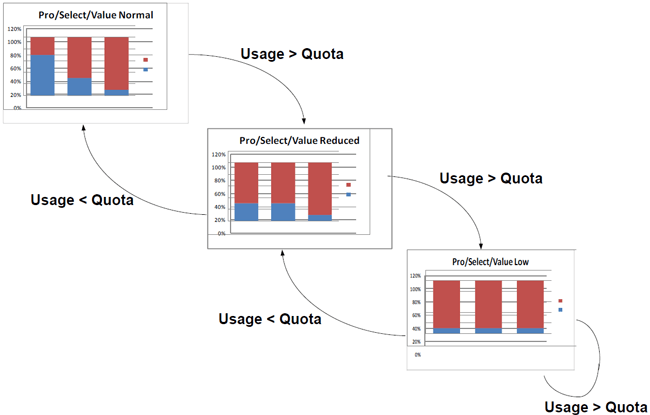
Indeed, over WildBlue’s history, ViaSat has changed its access policies several times, sometimes raising, but often lowering usage allowances accompanied by rate adjustments.  Since 2005, WildBlue customers who originally faced a simple 30-day consumption limit that reset after each billing cycle now face a combination of a usage allowance under the company’s “Fair Access/Data Allowance Policy (FAP),” and an even more confusing rolling speed throttle called the “Quota Management Threshold (QMT).”  Exceeding a monthly usage allowance guarantees broadband speeds of dial-up or less.  Speeds are also curtailed temporarily for customers who run browsing sessions that consume as little as 30MB over a 30 minute period.
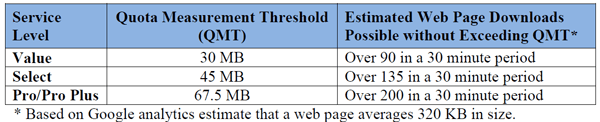
WildBlue's Quota Management Threshold starts reducing your speeds after a heavy browsing session.

With the help of Cisco, which created the throttled bandwidth technology, WildBlue’s combined FAP and QMT systems make it impossible for a customer punished just once by speed throttles to completely clear their record as a ‘known bandwidth abuser’ unless they avoid using any bandwidth for a month.  For most customers unequipped to fully grasp the highly technical explanations of both policies, customer service representatives boil it down to something easier to understand: the less service you use, the better the chance you will not face a speed throttle rendering your connection practically unusable.
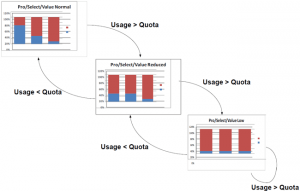
WildBlue's confusing throttle.

With strict limits in place, WildBlue not surprisingly scores among the lowest of all Internet Service Providers for customer satisfaction, and its nearest competitor Hughes does no better.

“As you have written before, satellite really is ‘take it or leave it broadband’ — heavily rationed, confusing, and very expensive,” Hanssen says.

For Hanssen and other Stop the Cap! readers who rely on satellite Internet, the promise of new capacity and faster speeds were supposed to turn “satellite as a last resort” into something more comparable to 4G wireless in America’s most rural areas.  But as our readers share, there is a big chasm between marketing hype and reality for customers on the ground.

Confusing Brands & Pricing

ViaSat has not been content to offer customers a single brand of satellite broadband service.  In addition to WildBlue itself, ViaSat markets plans under the American Recovery Act (the broadband stimulus program), co-branded service from DirecTV, DISH, AT&T and the National Rural Telecommunications Cooperative (NRTC), and forthcoming service on its newest satellite, ViaSat 1, which the company is marketing as “Exede” Internet. Customers west of the Mississippi who qualify for the American Recovery Act program get free installation and more generous usage allowances of up to 60GB per month.

“For two years, WildBlue has told us better usage allowances and faster service was coming with the new upgraded satellite, which we assumed would service all existing WildBlue customers,” Hanssen shares. “Now it turns out they are leaving existing WildBlue customers behind on the old satellite and creating a brand new service to sell new customers on the new satellite.”

Indeed, for marketing purposes, WildBlue and Exede are two different entities, and WildBlue customers looking for faster speeds from Exede will need to pony up at least $150 for new equipment, sign a new contract, and switch to a new Fair Access Policy that actually delivers many customers a lower usage allowance than their existing service from WildBlue offers.

“It’s total bait and switch, promising us faster service and then reducing the usage allowance that goes with it and adding around an $8/GB over-usage fee on Exede,” Hanssen says.

For customers served by the new ViaSat 1 satellite, Exede sells service based on usage, not speed.  The advertised speed (not independently verified) is 12/3Mbps, which will cost $49.99 for up to 7.5GB per month, $79.99 for 15GB per month, or $129.99 for 25GB per month.

“Highway robbery I call it, because some of those caps are lower than on WildBlue so you are paying for better speed you won’t be able to use unless you agree to pay a lot more for a bigger allowance,” Hanssen says.

New Customers Get Priority Over Old Ones?

Customers eager to switch to the new, faster satellite broadband service report they are encountering roadblocks from ViaSat and their large independent dealer network responsible for sales and service of the satellite reception equipment.  An often-heard accusation is that current customers are taking a back seat to new customers already invited to sign up.

That is a charge ViaSat, through its support forum, has strongly denied.

“We’re not giving preferential treatment to new vs. existing customers,” says WildBlue Forum Administrator Steve. “The dates we’ve quoted to existing customers who call in are approximately April/May, but yes, it could be sooner. It all depends on the number and availability of certified installer technicians in a given area. If someone absolutely wanted it now, we’ll try our best to accommodate that along with the big flood of new orders we’re receiving.”

Steve explains the delays to upgrade existing customers are occurring because new customer installations are currently “through the roof.”
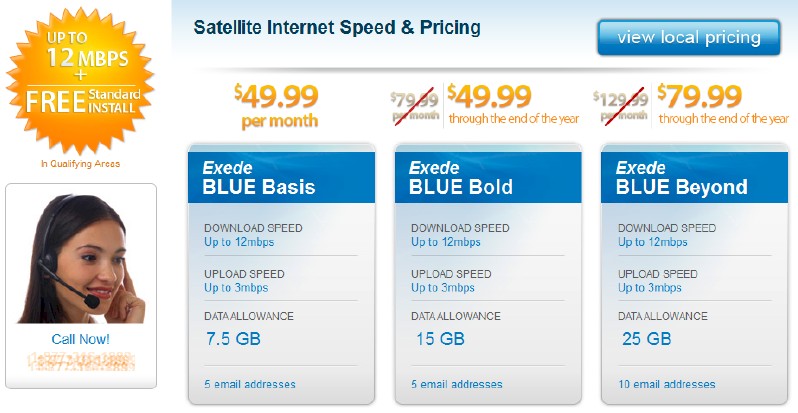
An independent dealer offers new customers a better deal.

But Stop the Cap! has also learned from an independent WildBlue dealer that ViaSat is offering a bonus for dealers who sign new customers, an incentive not paid to upgrade existing ones.  Some new customer promotions also offer free installation and deep discounts until the end of 2012 for 15GB ($49.99) and 25GB ($79.99) service on the new ViaSat 1.  Existing customers do not get the discount pricing and have to pay a $150 installation fee for new equipment required for the new satellite.  Customers within a 2-year initial contract term pay even more: $250.

Customers Revolt

The government-sponsored Broadband Initiative program required WildBlue to provide a more generous usage allowance in return for broadband stimulus money.

Customers learning about the new pricing are unhappy.

Bill Cameron feels let down as a loyal customer by ViaSat’s pricing:

This new Excede 12 plan is an absolute joke. 12Mbps is awesome but the top plan limits you to a up/down total of 25GB and its $129.99 +$9.99 lease fee. So what good is 12Mbps if you really cant use it? Forget Netflix, Hulu or any Video on Demand. I have DirecTV and was hoping to be able to do some streaming but there is no way. If I want to stay at the same $80/mo price point I will loose 7GB of monthly cap since the mid tier plan is 15GB combined up and down. I don’t know what WildBlue is thinking here. Come on, $140/mo in the middle of a recession? Plus there is a $149 setup fee and even customers who have been with them for 7 years, like me, has to pay it. My loyalty is not rewarded one bit. A brand new customer pays the same amount.

A Broadband Reports reader sums up his views about WildBlue’s broken promises:

[…] We have been living with low caps on Wildblue for years, then for several years they -promise- an upgrade that will change everything. Then they up the speed to something most people don’t need, and REDUCE the amount of data available by a LARGE amount, increasing the price as well significantly. It was not what we were lead to believe. This was supposed to be an upgrade, but the speed is useless without quantity, that point has been made over and over.

And it doesn’t take someone sitting all day to go over the caps. It can take a little over an hour every day for one person to go over on the current 512Kbps plan, imagine with more speed how easy the person can go over with about 23% less data available.

Bottom line, it was not an upgrade, period, for many of us. Every neighbor I know is thinking the same thing, some currently drive 30 miles one way to get to a free hotspot to have enough bandwidth for online classes. The offered new plans are not enough for what they do either. Is anyone that understands the limits of satellite asking for anything unreasonable, NO. We were expecting an increase of some sort, any kind, not further insane restrictions after years of being restricted. A downgrade and overcharging is not an upgrade no matter how they try to spin it to us. If so few use what’s available as they say anyway, what would have been the harm of doubling the current caps. PERFECTLY REASONABLE EXPECTATIONS.

Kevin Hanssen wishes he had better options:

At this point, just about anything would be better than WildBlue.  Since AT&T shows no interest in bringing me DSL service, it’s probably going to be wireless broadband or nothing.  We have spotty cell coverage in this part of Wisconsin, but should a provider do something about that, we would still be facing tiny usage allowances in the 2-10GB range.

This is why universal service policies should extend to broadband service, to make certain rural America has reasonable access at reasonable prices.

There is nothing reasonable about satellite or wireless Internet at these speeds, allowances, and prices.  WildBlue wants new customers at all costs, even if they walk over their loyal customers to sign them up. But why shouldn’t they? Their only effective competition is Hughes, and they are actually worse!


The Fat Lady Sings: What Happens Next Now That AT&T-Mobile Merger Deal is Dead

FAIL

AT&T announced Monday it has officially dropped its bid for Deutsche Telekom’s T-Mobile USA.

The company blamed regulator opposition for the failure of the merger, underestimating the Obama Administration’s tolerance for super-sized acquisition deals that could reduce competition and raise prices for consumers.

The real challenge for AT&T initially came not from the Federal Communications Commission, but from the U.S. Department of Justice which filed suit against the merger in August. FCC Chairman Julius Genachowski soon followed with statements that suggested the merger would have a difficult time at the Commission as well, and after a scathing report from FCC staffers was made public, Wall Street began to reduce the chances of the merger getting through to the single digits.

Had AT&T successfully merged with fourth-place T-Mobile, it would have easily become the nation’s largest and most powerful wireless provider, advancing beyond current leader Verizon Wireless.

The failure for AT&T will cost the company at least $4 billion in cash and spectrum it earlier agreed to give T-Mobile if the merger failed to complete.  Industry analysts say the real winner this year will easily be Verizon Wireless, which successfully accomplished its own spectrum acquisition by quietly buying unused spectrum from some of the nation’s largest cable companies.  With that spectrum now under Verizon’s control, AT&T has been reduced to signing new roaming agreements with an independent T-Mobile to share their GSM technology networks.  That will do little to alleviate AT&T’s dropped call problem in large cities, analysts say, because most roaming agreements specify sharing network resources only in areas where one carrier does not provide service.

Where U.S. Cell Phone Companies Stand Today

AT&T: AT&T still retains a considerable amount of unused wireless spectrum, but some of it is located on frequency bands that provide a lower quality of service indoors.  AT&T may have a difficult time finding new spectrum, because other carriers have signed partnership deals with most of the companies still holding unused frequencies. One of the largest holders of unused, warehoused spectrum is DISH Networks, and they’ve indicated no interest in selling.  DISH may partner with T-Mobile now that AT&T has exited.  That leaves AT&T with lobbying the government to speed up new spectrum auctions and working internally to expand their cell tower network to divide the traffic load.  It’s an expensive proposition, and several Wall Street analysts are advising their clients to dump AT&T stock.  Kevin Smithen, a Macquarie Capital USA Inc. analyst who downgraded AT&T to “sell” from “hold” last week advised AT&T was running out of options.

Verizon Wireless: Big Red remains in excellent shape to maintain its current market leadership position, particularly as it uses recently-acquired spectrum to bolster its 4G LTE network.  A UBS analyst was more direct: It will have 56 percent more 4G spectrum than AT&T in the top 10 markets and 46 percent more in the top 100, giving it a “meaningful competitive advantage.” Verizon has also cut a deal with cable operators that could reduce competitive pressure on Verizon’s landline/FiOS network from cable companies.  That fringe benefit comes courtesy of an agreement to market each others’ products to consumers.

Sprint: In addition to building its own 4G network, the company still has an agreement with Clearwire that allows Sprint to purchase the former company’s spectrum if it ever becomes available for sale.  With T-Mobile still obviously up for sale, Sprint could attempt its own merger, although it may be wary of stirring the same regulatory pot that got AT&T into trouble.  That leaves T-Mobile’s next buyer likely to be a regional cell phone company, a foreign firm entering the U.S. market, or an existing telecommunications company that decides a wireless division would be of benefit.

Extended Video Coverage

News of AT&T/T-Mobile Merger Failure Breaks

[flv width=”480″ height=”290″]http://www.phillipdampier.com/video/AP T-Mobile Merger Dead 12-19-11.mp4[/flv]

This report from the Associated Press informs consumers of the basics — the merger is no-go, leaving AT&T and T-Mobile as competitors, at least for now.  (1 minute)

[flv width=”360″ height=”290″]http://www.phillipdampier.com/video/Bloomberg ATT Pulls T-Mobile Bid After Regulator Opposition 12-19-11.mp4[/flv]

AT&T Inc. abandoned a $39 billion takeover bid for T-Mobile USA after underestimating opposition from regulators, thwarting its ambitions to become the biggest U.S. wireless carrier. AT&T will take a pretax charge of $4 billion to reflect cash payments and other considerations due to T-Mobile-owner Deutsche Telekom AG, the Dallas-based company said in a statement today. Peter Cook, Lisa Murphy, Adam Johnson and Sheila Dharmarajan report on Bloomberg Television’s “Street Smart.” (7 minutes)

[flv width=”360″ height=”290″]http://www.phillipdampier.com/video/Bloomberg Blair Says ATT’s T-Mobile Bid Was All About Spectrum 12-19-11.mp4[/flv]

Brian Blair, an analyst at Wedge Partners Corp., talks about AT&T Inc.’s decision to abandon a $39 billion takeover bid for T-Mobile USA and Apple Inc.’s victory in a final patent-infringement ruling that bans some HTC Corp. smartphones from the U.S. Blair speaks with Emily Chang on Bloomberg Television’s “Bloomberg West.”  (11 minutes)

[flv]http://www.phillipdampier.com/video/CNBC Baird on ATT T-Mobile Failure 12-20-11.mp4[/flv]

Apologists for AT&T on CNBC wring their hands over how wireless networks will get built out into rural areas now that the T-Mobile deal is dead. Will Power, R.W. Baird & Co, weighs in with a host who clearly cheerleads AT&T’s world-view.  (5 minutes)

[flv]http://www.phillipdampier.com/video/CNBC ATT Drops Bid for T-Mobile 12-20-11.mp4[/flv]

AT&T drops its $39 billion bid for T-Mobile USA, with Todd Rethemeier, Hudson Square Research.  AT&T’s talking points don’t fly with Rethemeier.  (4 minutes)

T-Mobile’s CEO Speaks About the Merger Failure

[flv]http://www.phillipdampier.com/video/CNBC Deutsche Telekom CEO on Failed T-Mobile Merger 12-20-11.mp4[/flv]

Rene Obermann, Deutsche Telekom CEO, explains why the merger between AT&T and T-Mobile USA should have gone through. “This transaction would have solved a number of industry issues,” he says.  Obermann is in friendly territory on CNBC.  (8 minutes)

The Impact on Sprint

[flv width=”360″ height=”290″]http://www.phillipdampier.com/video/Bloomberg Horan Sees T-Mobile Eventually Merging With Sprint 12-19-11.mp4[/flv]

Tim Horan, an analyst with Oppenheimer & Co., talks about AT&T Inc.’s decision to abandon a $39 billion takeover bid for T-Mobile USA, thwarting its ambitions to become the biggest U.S. wireless carrier. Horan speaks with Adam Johnson and Lisa Murphy on Bloomberg Television’s “Street Smart.” (3 minutes)

[flv width=”640″ height=”500″]http://www.phillipdampier.com/video/Bloomberg Gamcos Haverty Says Sprint an Endangered Species 12-19-11.flv[/flv]

Larry Haverty, portfolio manager at Gamco Investors Inc., talks about AT&T Inc.’s decision to abandon a $39 billion takeover bid for T-Mobile USA, and the outlook for Sprint Nextel Corp. and the wireless industry. Haverty speaks with Cory Johnson on Bloomberg Television’s “Bloomberg West.” (6 minutes)

 Will DISH Network Be AT&T’s Next Acquisition Target?

[flv]http://www.phillipdampier.com/video/CNBC Trading on ATT’s Failed T-Mobile Bid 12-20-11.mp4[/flv]

Shares of Dish Network up 9% in the aftermath of AT&T’s failed bid to acquire T-Mobile. Michael McCormack, Nomura telecom analyst, weighs in on whether Dish is the next target for AT&T.  (2 minutes)

Copper Thieves Wipe Out Phone Service in Eugene, Oregon

Phillip Dampier December 20, 2011 CenturyLink, Consumer News, Video Comments Off on Copper Thieves Wipe Out Phone Service in Eugene, Oregon

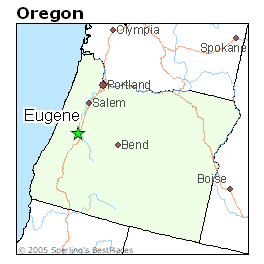
Copper thieves left thousands of phone customers in Eugene, Ore. without telephone service, forcing volunteer firefighters to get walk-in reports of fire and medical emergencies after 911 service was disrupted.

Authorities are looking for the suspects who scaled telephone poles and removed several hundred feet of critical phone wiring that provided service in the Eugene area.  CenturyLink officials rushed to pull new cables across phone poles to get service restored, and much of Eugene had their telephone landlines back within 24 hours.

CenturyLink and Oregon authorities claim copper thieves are now primarily targeting copper landlines because electrical lines are more dangerous and phone wire insulation is easier to burn or strip off, leaving the thieves with spools of bare copper wiring easily sold to scrap dealers.

Copper prices have spiked over the past few years, increasing interest among thieves.  Officials in several states have partnered with scrap dealers to try and limit illicit sales, and criminal penalties have been increased.

Occasionally, copper line theft also disrupts cell phone service, because many cell towers are still connected via copper circuits, especially in rural areas thieves favor.

[flv width=”360″ height=”290″]http://www.phillipdampier.com/video/KMTR Eugene Phone Service Restored in Eugene 12-19-11.mp4[/flv]

KMTR in Eugene covers the latest copper caper affecting CenturyLink phone customers in Oregon.  (2 minutes)


Hype: Clear Cast — A $38 ‘New Invention’ That Eliminates Cable/Satellite Bills Forever?

Phillip Dampier December 19, 2011 Consumer News, Editorial & Site News, Video 160 Comments

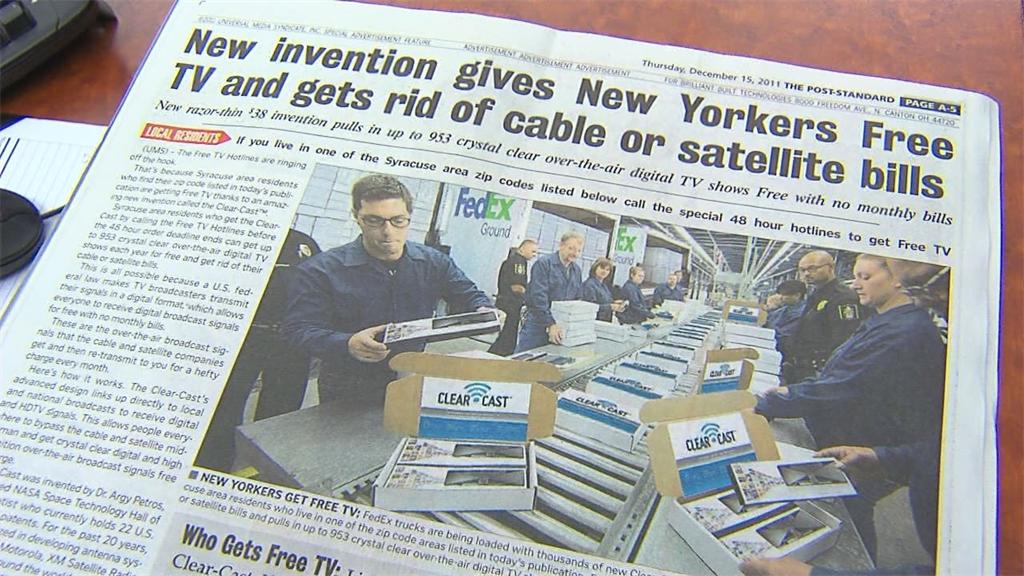
An ad in the Syracuse Post-Standard announces a new invention -- a variation on the bow tie antenna design originally designed in the 1950s.

Last Thursday, Syracuse newspaper readers were treated to news of an impressive breakthrough that promises to deliver salvation from high cable and satellite TV bills forever.

Clear Cast, a “razor thin” indoor digital HDTV antenna lets you watch television… for free.

The product is shown being packaged up for shipping while an impatient-looking FedEx driver tries to coordinate the apparent extraordinary demand for a downright revolutionary development in television engineering.

Local residents called the newspaper and other local news outlets to try and learn more about the curious new device.

Stop the Cap! can now report the revolution can be postponed.

In fact, the published account  about the “new invention” was actually a paid advertisement-designed-to-look-like-a-news-story.  Clear Cast is effectively a variation on the traditional indoor UHF bow tie antenna your local Radio Shack used to sell for $1.49.  The major difference is that it is designed to be attached to a window with accompanying suction cups.  That is a valid approach to improving reception, but whether it is worth the asking price of $38 is another matter.

As consumers seek alternatives to higher cable and satellite TV bills, overhyped ad copy promising freedom from high bills cannot be far behind.  Repackaging basic antennas that were part of our lives from the 1950s-on can go too far when leaving some residents with the impression they are getting more than a basic television antenna.

In fact, over-the-air viewing can be easily accomplished in strong signal areas with the cheapest antenna, as long as it is designed for both VHF and UHF reception.  Many VHF stations with channel numbers from 2-13 quietly relocated to the UHF dial, but still advertise their original channel numbers.  If your television is not equipped with a UHF antenna, reception may be difficult.

For the benefit of those under the age of 40: most televisions used to come equipped with both antenna designs — two elongated antenna rods some used to call “rabbit ears” and an accompanying round loop antenna, or often a bow tie design that clipped to one of the two longer aerials.  The long straight antennas are designed for VHF signals, the bow tie or loop design accommodated improved UHF reception.

Over the last decade, marketing has attempted to revolutionize what remains basic, sober, antenna design — with an accompanying “revolutionary” price tag.  When satellite television was first introduced, some manufacturers redesigned set top aerials to look like a satellite dish and then pitched them as “saving you the high price of satellite TV because it is not satellite!”  In today’s HD-ready era, marketers have done it again.

Will Clear Cast work?  Undoubtedly, but probably not much better than any other traditional bow tie design that costs $35 less.

If you are cutting cable’s cord and want to rely on over-the-air television, our best advice is to start with something inexpensive and upgrade only when necessary.  In urban and suburban areas, an effective indoor antenna can cost less than $5.  Try repositioning it until you find the best spot to receive the most channels with the least signal reception errors.  Directional indoor antennas can offer mild signal improvement, especially in areas where adjacent signals from nearby cities create reception problems.  Because the American digital broadcast standard is frankly less robust than the European counterpart, those in more distant suburbs or rural areas will really need to invest in a rooftop antenna to enjoy consistent reception.  A potential compromise would be to mount an outdoor antenna in the attic.

Avoid “futuristic” designs and powered indoor antennas and read consumer reviews carefully.  We’ve found most indoor antennas priced above $35 to be more hype than performance-per-dollar.  If you need an outdoor antenna, check your local Yellow Pages for antenna specialists who understand local reception conditions and can recommend high quality, long lasting antennas that will work for the stations you want to receive.

[flv width=”480″ height=”290″]http://www.phillipdampier.com/video/WSYR Syracuse Newspaper ad for free TV The Real Deal 12-15-11.mp4[/flv]

WSYR in Syracuse investigates the ‘revolutionary’ new indoor TV antenna that is so popular, only residents in certain zip codes can order it.  (2 minutes)

Search This Site:

Contributions:

Recent Comments:

Your Account:

Stop the Cap!