

Home » robert marcus » Recent Articles:

Time Warner Cable Plans to Triple Broadband Speeds (If They Survive a Hostile Takeover)

Time Warner Cable today announced major improvements in its service, including a tripling of broadband speeds and equipment upgrades that will first arrive in New York City and Los Angeles.

With the cable company facing a hostile takeover effort by Charter Communications with Comcast’s help, CEO Rob Marcus sought to appease shareholders that worry the cable company’s recent lackluster results originate from outdated technology, poor customer service, and broadband speeds that are well below the cable industry average.

Time Warner Cable will have to increase capital spending to pay for the upgrades, expected to cost $3.8 billion annually for the next three years.
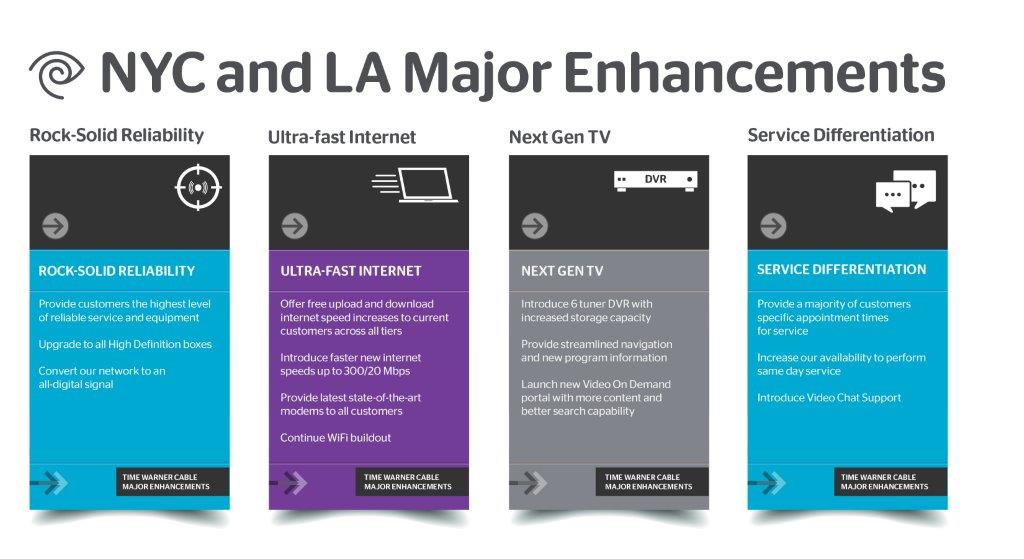
nycla enhancements

CEO Rob Marcus calls the effort a “transformation of the Time Warner Cable customer experience.” The upgrade program is called TWC Maxx for now inside Time Warner Cable, but will have its own brand when it publicly launches later this year.

Here are some highlights:

Marcus

Marcus

TV Service

  • Network infrastructure upgrades to enhance reliability
  • New advanced set-top boxes
  • A six-tuner DVR
  • A cloud-based interface and navigation
  • An expanded on-demand library

Internet

  • Dramatic free speed boosts for all customers
  • A new Ultimate speed tier of 300/20Mbps

Unfortunately, customers outside of Los Angeles and New York will have to wait up to two years for the upgrades to reach their community.

twcmax

“With ‘TWC Maxx,’ we’re going to essentially reinvent the TWC experience market–by-market,” said Marcus. “We’ll triple Internet speeds for customers with our most popular tiers of service, add more community WiFi, dramatically improve the TV product and, perhaps most importantly, we’ll set a high bar in our industry for differentiated exceptional customer service. We’re focused on providing the features and benefits that matter most to our customers.”

The most noticeable improvement will be free broadband speed upgrades. Customers with Standard or above Internet service will also receive the latest generation cable modems including Advanced Wireless Gateways for customers with Turbo to Ultimate tier service. Marcus did not say whether the company is ending is monthly equipment fees for cable modems.

Here are the new speed tiers:

  • Everyday Low Price – Currently 2/1Mbps – New 3/1Mbps
  • Basic – Currently 3/1Mbps – New 10/1Mbps
  • Standard – Currently 15/1Mbps – New 50/5Mbps
  • Turbo – Currently 20/2Mbps – New 100/10Mbps
  • Extreme – Currently 30/5Mbps – New 200/20Mbps
  • Ultimate – Currently 50/5Mbps – New 300/20Mbps

nyla

New York and Los Angeles Upgrade Schedule

The first four network hubs scheduled for upgrade are those in West Hollywood and Costa Mesa, Calif. and portions of Woodside (Queens) and Staten Island, N.Y. The rest of both cities will be upgraded by the end of this year.

Los Angeles customers will also see analog cable television service discontinued in favor of digital later this year. New York City has already been converted to all-digital television. Customers in both cities will be able to schedule same-day appointments and one-hour service windows.

Who Gets Upgraded Next?
Analysts expect Time Warner Cable will upgrade cities where they face competition from U-verse and FiOS after completing NYC and LA.

Analysts expect Time Warner Cable will upgrade cities where they face competition from U-verse and FiOS after completing NYC and LA.

Analysts say Time Warner Cable’s upgrade plans are more aggressive than initially anticipated and many expect the company to move quickly, especially in competitive markets, to boost subscriber numbers and cut customer defections to help convince shareholders it is worthwhile to reject Charter’s hostile takeover bid.

The most likely markets to be targeted for upgrades after New York and Los Angeles are those facing stiff competition from Google Fiber and Verizon FiOS. Cities where AT&T U-verse delivers competition are likely to come next, and those cities where Time Warner Cable only faces competition from telephone company DSL service will likely be the last to be upgraded. However, long before that, Time Warner Cable could be sold off to other cable operators that will make these upgrade plans moot.

Marcus today reiterated his rejection of Charter’s latest $132.50 a share offer. Marcus said the cable company is only interested in an offer above $160 a share, and that at least $100 of that must be in cash, with the balance in Charter stock. Charter will have trouble delivering that amount of cash without the assistance of other cable operators.

Craig Moffett with MoffettNathanson Research isn’t sure Marcus’ plans are enough to keep TWC from being sold. He expects Charter to soon increase its offer above $140 with the help of Comcast, which is willing to pay cash for Time Warner Cable systems in New York, New England, and North Carolina after a deal with Charter is complete.

[flv]http://www.phillipdampier.com/video/Bloomberg Rob Marcus Interviewed 1-30-14.flv[/flv]

Robert Marcus, chief executive officer of Time Warner Cable Inc., talks about the cable company’s fourth-quarter earnings and its forthcoming upgrades, and Charter Communications Inc.’s $37.4 billion buyout bid. Time Warner Cable beat fourth-quarter profit estimates and forecast subscriber growth. Marcus speaks with Betty Liu on Bloomberg Television. (8:38)

Incoming Time Warner Cable CEO Gets $50+ Million Bonus if Company Sold

Phillip Dampier December 3, 2013 Consumer News 1 Comment

Money-Stuffed-Into-PocketThe incoming CEO of Time Warner Cable will walk away with more than $50 million just for getting out-of-the-way of a sale or breakup of the company.

Robert Marcus is scheduled to take over the CEO role Jan. 1 after Glenn Britt retires. But there is a good chance Marcus won’t have a cable company to run if executives decide to accept anticipated takeover offers due within weeks that could turn ownership of Time Warner over to Charter Communications or split up subscribers among several potential buyers including Comcast, Cox, and Charter.

Reuters reports Marcus will earn the most if he can hold off buyers for the next four weeks until he becomes CEO. Under his employment contract, Marcus would then qualify for a generous goodbye package:

  • A compensation bonus amounting to three times his base salary of $1.5 million;
  • A departure award amounting to three times his usual $5 million annual bonus;
  • Permission to cash out the large amount of stock he has earned as part of his compensation, now valued at $37 million.

In total, Marcus could earn $56.5 million for just one day of work — long enough to shake the hands of the new buyer(s) and head for the elevators for the last time. If the company sells before Dec. 31, Marcus will still land on his feet, earning a severance package valued at $47.5 million.

In a separate move, Time Warner Cable executive vice president Peter Stern dumped 4,253 shares of his company’s stock at $130 a share, taking $552,890 in compensation.

While top managers are routinely offered generous departure packages more commonly known as “golden parachutes,” thousands of lower-level Time Warner Cable employees will likely face the ax within months of any sale, predicted one analyst. In similarly sized mergers and buyouts, the largest job losses will impact call center workers and middle management. Other employees will likely leave if asked to move to regional operations centers in other cities where the buyer(s) operate. At least one analyst said it was unusual for Time Warner Cable to proceed with a CEO switch while the company is in play.

Marcus understands how the business of mergers and acquisitions work; he started his career as an attorney specializing in the practice.

Time Warner Cable’s Halloween Nightmare: 3% of Customers Left This Summer, With More to Follow

Phillip Dampier October 31, 2013 Broadband Speed, Competition, Consumer News 2 Comments

pumpkinTime Warner Cable’s summer was “horrible,” to quote one analyst, after three percent of customers left over programming disputes and increasing prices for broadband and telephone service, with more likely to follow as price promotions expire and rates increase further.
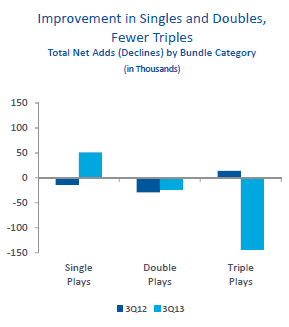
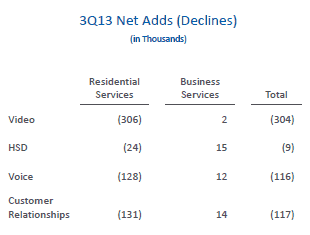
Cable analysts were shocked Time Warner Cable lost 308,000 customers in the last three months, most leaving over interruptions of CBS and Showtime over a contract dispute. But customers were also ready to leave over increasing modem rental fees, rate increases, and the company’s growing pullback on promotional pricing. Time Warner Cable’s poor results have ironically caused its stock price to increase this morning, but only because investors suspect a shareholder value-boosting merger with Charter Communications could come within months.

“Just horrible,” MoffetNathanson analyst Craig Moffett wrote in a note to investor clients this morning. “The CBS dispute apparently took a much larger toll than anyone would have imagined, and this colored all the results.”

Sources have told Reuters that cable billionaire John Malone has approached Time Warner Cable about a full takeover by Charter Communications, but has been rebuffed by Britt so far. But with Britt exiting and Time Warner Cable’s underperformance, shareholder pressure for a deal with Charter will only increase.

“This enhances Malone’s appeal to Time Warner Cable shareholders that they would be better off with another management team,” Brean Capital analyst Todd Mitchell told Reuters.

When promotional prices end, a growing percentage of TWC customers drop services or take their business elsewhere.

When promotional prices end, a growing percentage of TWC customers drop services or take their business elsewhere.

The subscriber losses pushed profits down 34 percent at the cable company, to $532 million. The triple play tragedy saw subscriber losses for all the company’s residential services. At a time when other cable companies cannot process High Speed Internet sign ups fast enough, at least 24,000 Time Warner Cable broadband customers left over rate hikes and equipment fees. Analysts had expected the company to pick up more than 46,000 broadband customers during the last three months, not lose them. The company’s phone service is also in decline. Only rate increases and customers upgrading to higher speed tiers delivered a slight revenue boost.

Outgoing CEO Glenn Britt set the stage for the current forced retreat on its revenue forecast for the year:

  • Time Warner Cable executives made the decision at the end of 2012 to stop heavily discounting service and cut back on promotions. Their theory was the company would attract a larger base of stable customers willing to pay non-promotional rates and tolerate rate increases;
  • Executives announced as Time Warner’s phone service was brought “in-house,” the company would stop aggressively pricing triple play bundles that included phone service. That turned out to be a bad decision for growth because customers, already prone to landline cord-cutting, downgraded their bundle or left when promotions expired and ditched the phone line;
  • A year of broadband price increases and the introduction of a modem rental fee rubbed customers the wrong way. “We have raised prices recently in the form of modem rental fees, but it’s really just broadband price increase,” again admitted Britt this morning. Future rate increases on modem rentals will give broadband customers another push to shop around for a better deal. At least 24,000 did that over the summer and left, mostly for AT&T U-verse in the midwest and Verizon FiOS in the east.

The lengthy dispute between Time Warner and CBS did the most damage and not just to customers directly affected by channel losses. A major increase in call volumes from alienated customers overwhelmed national call centers, creating long hold times for everyone calling in.

Time Warner expects 40 percent of the cable company’s service area will be overlapped by major competitors AT&T U-verse (now 27%) and Verizon FiOS (now 13%). That represents one million more homes than last year.

Bye Bye: Time Warner Cable lost residential customers for all of its services during the third quarter.

Bye Bye: Time Warner Cable lost residential customers for all of its services during the third quarter.

Incoming CEO Robert Marcus said he was dissatisfied with subscriber results from current promotions and rates. New Time Warner Cable customers, Marcus noted, are paying higher prices for fewer or less robust services as part of current promotional packages. Although that has driven a “dramatic improvement in recurring revenue” among customers actually signing up, many choose the lower-priced competition instead.

Marcus also noted customers are taking fewer services and are resistant to upgrading to double or triple play packages, reducing the potential average revenue per customer (ARPU).

“To a great extent, these are expected outcomes of our pricing and packaging strategy and the trade-off between ARPU and volume, but I’m confident we can do better on volume without giving up the ARPU benefits we’ve been achieving,” Marcus told analysts on a morning conference call.

Instead of getting more aggressive on pricing, the company plans to trot out free gifts and pitch discounted slow speed Internet to attract price-resistant DSL customers.

“Next week, we’ll launch our holiday offer, which includes a free Samsung tablet loaded with all of our apps, including TWC TV, with the purchase of higher-end packages,” Marcus said. “I think this will generate lots of interest and really highlight TWC TV and the value it adds to our service offerings.”

Marcus called it inconceivable and unacceptable that at least 4.5 million people are still subscribed to telephone company DSL in Time Warner Cable service areas. The company plans an advertising blitz to steal customers away from companies like AT&T, Verizon, Frontier, CenturyLink, Windstream and FairPoint.

At the center of that effort is the recently announced 2/1Mbps Lite package, which will sell at the everyday price of $14.95 a month. Marcus wants at least 500,000 DSL customers switched to Time Warner over the next 18 months.

“Over time, as these customers’ speed and capacity needs increase, we’ll be well positioned to sell them higher-end product,” Marcus said.

Or they will switch back to the phone company if Time Warner increases the price.

Time Warner Cable’s Incoming CEO Promises to Keep Unlimited Broadband Tier

Phillip Dampier September 12, 2013 Competition, Consumer News, Data Caps 15 Comments

twcGreenTime Warner Cable will not follow Comcast, Charter, Cox and Mediacom by imposing usage caps or move towards a compulsory usage-based billing scheme.


Yesterday, incoming CEO Robert Marcus told investors attending the Bank of America Merrill Lynch 2013 Media, Communications, and Entertainment Conference that he recognizes the majority of Time Warner Cable’s broadband customers want the company’s unlimited use offering and made it clear that option will continue to be available.

Marcus

Marcus

“Most customers today — the vast, vast majority — take our unlimited offering and I think over time most customers will continue to take unlimited,” said Marcus, who currently serves as Time Warner Cable’s chief operating officer. “They value it and will be willing to pay for it. I think that is great and we have no desire to change that.”

However, Marcus also reflected on the revenue opportunities available to the company from its broadband offering, and signaled investors the company would continue to price the service commensurate with its perceived value.

“High Speed Data is a tremendous product for us,” Marcus said. “Our customers continue to use it more and more for all different sorts of applications. I think consumption growth year over year in the second quarter is somewhere north of 40 percent. It has been in that kind of range for a long time and we expect it to continue to grow at a pace like that for as long as we can see. With that increasing usage comes an increasing utility to customers and we believe an increasing willingness to pay for that incremental utility.”

Time Warner Cable increased its broadband average revenue per user (ARPU) by 9% for residential High Speed Data during the second quarter, with total broadband revenue up more than 12%, according to Marcus. Those revenue increases have been made possible by three things:

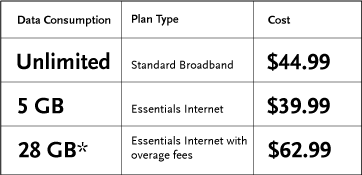
Less is More: With the FCC claiming the average Internet user consumes 28GB of broadband per month, this may explain why Time Warner Cable customers have little interest in the company's 5GB Internet Essentials offer. (Chart: New America Foundation)

Less Costs More: *-With the FCC claiming the average Internet user consumes 28GB of broadband per month, this may explain why Time Warner Cable customers have little interest in the company’s 5GB Internet Essentials offer. (Chart: New America Foundation)

  • Adding new broadband customers, mostly those abandoning telephone company DSL;
  • Implementing general price increases on broadband service for existing customers and the introduction (and later increase) of modem rental fees starting last fall;
  • Successfully encouraging customers to upgrade to faster speed tiers, which are sold at a higher cost.

Despite Marcus’ commitment to maintain unlimited broadband service for Time Warner Cable customers, the cable company is moving forward with several optional, usage-based tiers sold at a discount.

“There are customers who choose to consume less and we feel strongly that we need an offering for them which allows them to pay less and eliminate the structure where they have to subsidize the heavy users,” Marcus explained.

For more than a year, Time Warner has offered a little noticed, usage-limited plan for customers willing to confine their Internet browsing to a maximum of 5GB per month. The plan has not been popular with customers and very few have signed up. Time Warner announced earlier this summer they would try again.

“We’re now in the process of rolling out yet another usage-based tier of service which I think is a more meaningful one because it comports with what real-life usage is like, which allows customers to use 30GB a month of service again at a discount from the unlimited pricing,” said Marcus. “When you put 30GB in context, our average usage today is about 50GB a month, median usage is actually less than 30GB, so for some customers there is going to be an economically rational reason for them to choose that 30GB tier. I expect the take rate will be certainly higher than for the 5GB service.”

Marcus, like the current CEO Glenn Britt, admits the company is attempting to educate customers that broadband usage carries a cost.

“There is a principle at stake: that value, price and usage are related to one another and that is important over time,” Marcus said.

Time Warner Cable: ‘Our Promotion Cutbacks and Rate Hikes Cost Us Customers’

timewarner twcTime Warner Cable admitted this morning extracting more revenue from existing customers was more important than attracting new ones, and long time subscribers responded by canceling service in above average numbers.

In a conference call largely hosted by incoming CEO Robert Marcus, a number of Wall Street analysts listened to Marcus’ vision for Time Warner under his forthcoming leadership. Marcus offered competing, potentially incompatible visions in his defense of a lackluster quarter: charge existing customers higher prices for service to boost average revenue per subscriber (ARPU) while also improving the customer-company relationship.

For most of 2013, Time Warner has been aggressively moving away from heavily discounted promotional offers to attract customers. Both outgoing CEO Glenn Britt and Marcus have repeatedly stressed heavy discounting of service during the past two years is now over, and the company is looking forward to resetting prices higher when the promotions end later this year.

It is part of the company’s plan to “drive better performance in the residential business.” An unfortunate side effect is that the company continues to lose video and phone customers and its broadband service growth has been so slow, one analyst called it “anemic.” The company’s quarterly results show Time Warner added only 8,000 new broadband customers in the last three months. The company still earned $1.42 billion from broadband sales alone over the last three months, mostly because of rising broadband bills.

Courtesy: Jacobson

Courtesy: Jacobson

Offsetting that growth, TWC lost 191,000 residential video subscribers, leaving it with about 11.9 million video customers. At least 56,000 customers also pulled the plug on Time Warner Cable telephone service.

“As we discussed before, this [new pricing] approach represents a conscious decision to pursue subscribers with higher ARPU, higher profit and lower churn even if that means fewer connects,” said Marcus as he defended the results. “So it’s not a surprise that as in the first quarter of 2013, subscriber net adds were down in the second quarter on a year-over-year basis.”

As customers deal with increasing prices for cable television and broadband service and the irritation of modem rental fees, many are cutting back on their packages to keep their bill stable.

Marcus admitted customer sign ups of triple play — phone, broadband, and cable TV service — were way down in the second quarter and a lot fewer single and double-play customers were convinced to upgrade. The company’s promotional offers have come with a higher price and slower broadband service, often only 3Mbps.

In a number of markets, especially in the midwest, customers are shopping around for other providers. They are finding AT&T U-verse to be a formidable competitor.

“Throughout the quarter, U-verse was pretty aggressive with a beacon price of $79 for their triple play and $49 for their double play,” said Marcus. “I would characterize those as aggressive promotional prices, and they had an impact. I would say that the impact was more pronounced as the quarter wore on. We’ve now responded to that in the market, and I expect that our relative performance should improve there.”

But for much of the rest of the country where competition is less robust, Time Warner intends to continue to hold the line on pricing and resist discounting even if it means subscribers threaten to cancel.

Time Warner Cable has gotten itself ready for an onslaught of unhappy customers, assigning nearly 1,000 employees to staff four national customer retention centers dedicated to trying to persuade customers not to leave. But these specially trained representatives have a dual mission — keep customers with Time Warner Cable, but don’t give away the store doing so.

Stock buybacks and shareholder dividends were a major priority for Time Warner Cable's cash on hand.

Stock buybacks and shareholder dividends were a major priority for Time Warner Cable’s cash on hand.

“Not only are our reps saving more customers, they are also preserving more ARPU among the customers they save,” said Marcus. “As promotional roll-offs peak in the second half of 2013, we expect that our new retention capabilities will drive better revenue growth.”

In the broadband market, Time Warner changed little in the second quarter except to raise prices on service and equipment. Marcus could only point to the addition of 3,500 new Wi-Fi hotspots, mostly in New York City, as its signature achievement over the past three months.

On the residential side, broadband revenues were up 12.5%, but most of that growth came from a combination of the modem lease fee, an increase in the number of 30/5 and 50/5Mbps customers and a successful Turbo promotion.

Results for video and voice were considerably worse. Revenues were down about 4%.

But the company managed to report its highest ARPU ever, with customers now paying an average of more than $105 a month for Time Warner service. Most of that increase came from rising broadband prices.

Time Warner Cable has also been preoccupied with spending excess cash on hand to buy back its own stock, which creates shareholder value. Time Warner expects to spend at least $2.5 billion on stock buybacks this year. Shareholders also received $829 million in dividends (113% of Time Warner’s free cash flow).

“We repurchased 6.6 million shares for $638 million, and through July, we have repurchased approximately 83 million shares at an average cost of around $78.50 per share since we began the program in November of 2010,” reported chief financial officer Arthur T. Minson.

Time Warner Cable’s Board of Directors recently approved increasing spending up to $4 billion on stock buybacks.

[flv width=”640″ height=”380″]http://www.phillipdampier.com/video/WRGB Albany TWC Modem Fee 7-31-13.flv[/flv]

WRGB in Albany reports Time Warner Cable customers are angry about another price hike on the company’s modem lease fee effective Aug. 18. WRGB recommends customers buy their own modems to avoid the fee. Time Warner Cable’s Glenn Britt admitted earlier the fee is really just a hidden rate increase. (3 minutes)

Search This Site:

Contributions:

Recent Comments:

Your Account:

Stop the Cap!