Home » rate hike » Recent Articles:

Charter: Time Warner Cable’s Too-Low Pricing Meant It Couldn’t Afford Upgrades

Charter Communications has a new argument for raising your cable bill: Time Warner Cable’s promotions were so low-priced, the company couldn’t afford upgrades. By ending promotional pricing and raising prices, Charter can finally afford to manage the upgrades Time Warner Cable never made.

That novel argument comes courtesy of Charter Communications’ director of government affairs Anna Lucey, who made it in response to complaints from customers in western Massachusetts about substandard service and bill shock from Charter’s Spectrum. She was invited to answer questions and complaints raised during last week’s Board of Selectmen meeting in Adams, Mass.

Cheshire resident Peter Gentile, who was serving as cameraman to televise the public meeting with the cable company for Northern Berkshire Community Television, complained that when his Time Warner Cable promotion ended, Charter promptly raised his bill from $103 to $182 a month — nearly an $80 a month rate hike.

“It is absurd … I was told I could save some money by downgrading my internet so it would be slower and I would lose approximately 30 channels and my bill would only go down $7.75,” he said. “This is an impoverished community, this is an elderly community that is getting older and poorer and … I wish that you would go back to your team and explain.”

Lucey explained Charter is adopting one-size-fits-all nationwide pricing for its customers and is ending promotional pricing, explaining that Time Warner’s policy of “subsidizing” cable bills to give customers a lower rate did not allow Time Warner Cable to invest in its infrastructure.

Lucey

“It did lend a problem to infrastructure reinvestment that Time Warner could do, which is one of the reasons why we don’t have similar promotional packages that constantly deflate the cable bills,” Lucey said. “We want to keep all of our services up to date and continue to reinvest but I understand the sticker shock isn’t pleasant.”

Unfortunately for Lucey’s creative justification for rate increases, the financial facts disprove her assertion. In fact, Time Warner Cable outperformed Charter Communications in the first quarter of 2016, just before Charter closed on its acquisition of Time Warner Cable.

In April 2016, Time Warner Cable chairman and CEO Rob Marcus reported “the best ever customer relationship net additions,” “accelerated revenue growth of 7.5%,” and “robust adjusted OIBDA growth of 8.2%.”

“Our first-quarter results are the clearest indication yet that our efforts over the last 27 months are paying off. We have made our network more reliable, our products more compelling and our customer service far better. We’ve refined our marketing, enhanced our sales channels and strengthened our retention capability. All of that has driven robust customer growth, which in Q1 translated into very strong revenue and OIBDA growth. I couldn’t be prouder of what our talented, committed, passionate team has accomplished,” Marcus said, reflecting on the history of Time Warner Cable’s Maxx upgrade project, which delivered more compelling broadband speeds at a lower cost to Time Warner Cable customers than what Charter Communications offers today.

In fact, financial results for that period showed as Time Warner methodically worked through upgrading its systems, customer and revenue growth went up. The only exception was Free Cash Flow, which the company attributed to merger-related expenses, not promotional pricing:

SELECTED CONSOLIDATED FINANCIAL RESULTS
(in millions, except per share data; unaudited) 1st Quarter
Change
2016 2015 $ %
Revenue $ 6,191 $ 5,777 $ 414 7.2 %
Adjusted OIBDA(a) $ 2,159 $ 1,996 $ 163 8.2 %
Operating Income(b) $ 1,145 $ 1,084 $ 61 5.6 %
Diluted EPS(c) $ 1.72 $ 1.59 $ 0.13 8.2 %
Adjusted Diluted EPS(a) $ 1.81 $ 1.65 $ 0.16 9.7 %
Cash provided by operating activities(b) $ 1,608 $ 1,508 $ 100 6.6 %
Capital expenditures $ 1,318 $ 1,134 $ 184 16.2 %
Free Cash Flow(a)(b) $ 346 $ 407 $ (61 ) (15.0 %)
(a) Refer to Note 4 to the accompanying consolidated financial statements for definitions of Adjusted OIBDA, Adjusted Diluted EPS and Free Cash Flow and below for reconciliations.
(b) Operating Income is reduced by merger-related and restructuring costs of $40 million and $26 million for the first quarters of 2016 and 2015, respectively. Cash provided by operating activities and Free Cash Flow are reduced by merger-related and restructuring payments of $14 million and $26 million for the first quarters of 2016 and 2015, respectively.
(c) Diluted EPS represents net income per diluted common share attributable to TWC common shareholders.

Charter’s later announcement of upgrades for the remaining Time Warner Cable systems not upgraded to Maxx service before the merger deal was completed are occurring more slowly than Time Warner’s own original timetable. As soon as the ink was dry on the merger deal, Charter immediately canceled the Maxx upgrade program for all markets not already in progress with upgrades.

Charter’s own upgrade plan is less compelling than the Maxx menu of options, which gave customers more choices at a lower cost. Charter’s own financial reports admit the company is losing former Time Warner Cable customers as their promotions expire. Charter’s own executives attribute those losses not on deferred upgrades, but on the cost of service going forward after promotional pricing expires.

Spectrum Customer Service Reps Apologizing for Awful Pricing

…for our outrageous pricing!

Spectrum’s customer service agents are apologizing to customers for the rate shock they are experiencing when their existing Time Warner Cable or Bright House Networks promotions expire and customers find out the Spectrum plans and pricing being offered instead turn out to be nothing close to the deals customers used to get.

“You may get a call asking about my performance today, the survey is about me and my job today only,” a customer service agent explained to Jason, a Spectrum customer in Elmhurst, N.Y., who shared his experience on DSL Reports. “It doesn’t have anything to do with how you feel about Spectrum or TWC. If you are upset about the new pricing, please use the comments portion to explain. I look forward to hearing your feedback.”

Customer service representatives are on the front line of delivering bad news to cable customers facing double-digit rate increases, especially when customers realize they also receive fewer TV channels after changing plans.

“I’m guessing these agents must be getting destroyed in the surveys, [and] having worked retail where these types of surveys are used, I felt bad for the reps,” explained the Spectrum customer. “I know in my neighborhood, everyone seems to have their TWC promos expiring in the next month or so and are very unhappy.”

That unhappiness is getting worse as word about Charter Communications’ mid-year rate increase is showing up on customer bills. Broadband prices are increasing at least $1 a month, the Broadcast TV Surcharge is rising to $7.50 a month, and set-top box equipment rentals also increased by $1 a month for each piece of equipment starting in August 2017.

Premium speed broadband customers are now also facing a higher internet bill.

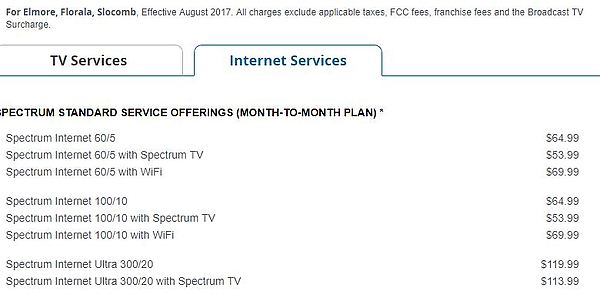
Spectrum’s Ultra tier, which is 100Mbps in some markets, 300Mbps in others, is increasing to $119.99 a month, up from $104.99 in most markets. The increase is less if you also subscribe to Spectrum TV, which reduces the rate to $113.99 a month. Spectrum rate cards from around the country do not yet reflect the $1 rate increase for traditional Spectrum 60/5Mbps internet (100Mbps in select markets):

Low income customers enrolled in Spectrum’s Everyday Low Price (ELP) internet package — a carryover from Time Warner Cable — also got the rude shock of a $5 rate increase on a service that used to cost $14.99 a month. That represents more than a 33% rate hike, which is just fine with Charter.

“In some of our markets the price has increased for the ELP package,” said spokesperson “Julie_R”. “Notifications were sent via bill statements and became effective with the August statements. Our ELP package is not a promotion.  From time to time, Spectrum makes decisions to adjust the pricing for our products and services to account for network investments.  We understand that value is important.  ELP is still a very good value at $19.99.”

The rate increase does not apply to New York State residents, where regulators placed significant deal conditions on the Charter/Time Warner Cable merger to help protect consumers in that state.

We have also been receiving reports from readers that Spectrum’s Internet Assist (SIA) program, designed for the elderly and income-challenged, is not easy to enroll in and customer service representatives have rejected a number of applicants for a variety of reasons. SIA offers a 30Mbps broadband connection for $14.99 a month to those qualified for:

  • The National School Lunch Program (NSLP); free or reduced cost lunch
  • The Community Eligibility Provision (CEP) of the NSLP
  • Supplemental Security Income (SSI) ( ≥ age 65 only) Programs that do not qualify for Spectrum Internet Assist: Social Security Disability (SSD), Social Security Disability Insurance (SSDI), and Social Security Retirement and Survivor Benefits are different from Supplemental Security Income (SSI) and do NOT meet eligibility requirements.

The biggest problems encountered so far:

  • Representatives lack information about the program and attempt to upsell customers to regular pricing and packages.
  • Bundling additional services with SIA can be more expensive than just choosing a traditional bundled package sold to everyone, especially if it is a new customer promotion.
  • There is considerable confusion over the qualifications for SSI recipients. Be sure to recognize you must be 65 or older and note SSD, SSDI, and certain other programs noted above do not qualify you to receive SIA.

We are continuing to monitor the SIA program looking to ensure Spectrum is making the program available to customers that qualify for it.

John Malone’s Virgin Media Teaches Brits About American-Style Rate Hikes

Phillip Dampier July 31, 2017 Consumer News, Virgin Media (UK) 2 Comments

British cable subscribers are getting a taste of American bill shock, courtesy of another dramatic rate hike from cable giant Virgin Media, now owned and operated by John Malone’s Liberty Broadband.

Virgin announced it will hike rates for a 13 TV channel and broadband package by $44.50 a month starting in August. Customers used to pay $8.92 a month for the package, or $51.89 for the year. Next month, they will pay $53.51 for the first month and $77.84 each month thereafter.

If you can afford the VIP Bundle, which includes 97 TV channels, you will also pay more next month. Virgin charges $137.84 a month today for the package. Next month, the same package will cost about $146 a month for the first year, increasing to $195 a month after that. Broad rate increases will also impact students on nine-month discount contracts, generally around $5 more a month.

Last August, Virgin jacked rates up quite a bit as well — $68.11 a year for those with a broadband and phone or “big bundle” package and just under $58 a year for those with broadband-only service.

“Nobody likes a price rise, and we understand this,” Virgin Media always writes on its website in response to rate increases. “That’s why we’re always looking to bring you the best Virgin Media experience.”

It seems Virgin is determined to get those in the United Kingdom experienced with American-style cable bills.

Charter Spectrum Announces Mid-Year Rate Hikes; Privacy Changes

Phillip Dampier July 27, 2017 Charter Spectrum, Consumer News 4 Comments

Spectrum customers will be paying more for their cable TV and broadband service starting in August, according to notifications now starting to appear on customers’ bills around the country.

Important Billing Update. At Spectrum, we continue to enhance our services, offer more of the best entertainment choices and deliver the best value. We are committed to offering you products and services we are sure you will enjoy.

Effective with your next billing statement, pricing will be adjusted for:

  • Broadcast TV Surcharge from [generally between $4-6] to $7.50. This reflects costs incurred from local Broadcast TV stations.

  • Spectrum Receivers from $4.99 to $5.99 (per receiver).

  • Internet Services from $53.99 to $54.99 (for standard 60 or 100Mbps service, depending on area, per modem and bundled with cable TV).

The average customer will see a rate hike of about $4-5 a month as a result. Customers on promotional Spectrum plans may not see a rate change immediately, but all cable TV customers will be subject to the Broadcast TV surcharge, because it is not a part of a promotional package.

Charter traditionally reviews its rates twice a year.

Charter Communications has also updated its Privacy Policy, which takes effect on Aug. 1, 2017. Customers can opt out of targeted emails, targeted marketing campaigns, and targeted TV ad inserts sent to your cable boxes.

Wall Street Hissyfit: Raise Broadband Prices to $90/Month Immediately! (Or Else)

If the average customer isn’t paying $90 a month for broadband service, they are paying too little and that needs to stop.

That is the view of persistent rate hike advocate Jonathan Chaplin, a Wall Street analyst with New Street Research, who has advocated for sweeping broadband rate increases for years.

“We have argued that broadband is underpriced, given that pricing has barely increased over the past decade while broadband utility has exploded,” Chaplin wrote in a note to investors. “Our analysis suggested a ‘utility-adjusted’ ARPU target of ~$90. Comcast recently increased standalone broadband to $90 with a modem, paving the way for faster ARPU growth as the mix shifts in favor of broadband-only households. Charter will likely follow, once they are through the integration of Time Warner Cable.”

Companies that fail to raise prices risk being downgraded by analysts with views like these, which can have a direct impact on a stock’s share price and the executive compensation and bonus packages that are often tied to the company’s performance.

But there is a dilemma and disagreement between some cable industry analysts about how much companies can charge their customers. Companies like Cable ONE have been aggressively raising broadband prices to unprecedented levels in some of the poorest communities in the country, which worries fellow Wall Street analyst Craig Moffett from MoffettNathanson LLC.

“Never mind that the per capita income in Cable ONE’s footprint is the lowest (by far) of the companies we [Moffett’s firm] cover, or that the percentage of customers living below the poverty line is the highest (also by far),” Moffett told his investor subscribers. “What matters is that there is very little competition in Cable ONE’s footprint. If you want high-speed broadband, where else are you going to go? The unspoken fear among their larger peers is that over-reliance on broadband pricing invites regulatory intervention, not just for Cable ONE, but for everyone.”

Chaplin thinks the risk from gouging broadband customers is next to zero. With cable TV becoming less profitable every day, all the big profits that can be made will be made from broadband, where cable operators often enjoy a monopoly on high-speed service.

According to Chaplin, if customers value internet access, they will pay the higher prices cable companies charge. So what are companies waiting for? Raise those prices!

Search This Site:

Contributions:

Recent Comments:

Your Account:

Stop the Cap!