

 Subscribe
 Charter Communications has begun forcing some former Time Warner Cable customers into new Spectrum packages and pricing without their permission, causing customers to lose channels, pay higher prices, and have to exchange working cable boxes at a cost of up to $24.
The cable operator has begun “sweeping” accounts looking for customers it deems to have paid too little for too long or who are getting grandfathered cable channels the company feels they are no longer entitled to receive.
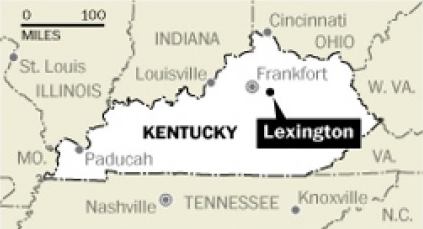
One of the first cities to be hit with Charter CEO Thomas Rutledge’s ‘account sweeps for more cash’ initiative is Lexington, Ky., where longtime customers are discovering their cable service is missing more than a dozen channels with no warning or explanation.
Daniel Fitzgerald discovered many of his cable channels were gone, replaced with a message that his subscription no longer included the cable channels that had been a part of his Standard cable package for years.
“I thought, ‘What the hell? I just paid the cable bill,’” Fitzgerald told the Herald-Leader last week at his tiny Lexington apartment he shares with his disabled 16-year-old son.
It turns out he wasn’t paying enough to satisfy Charter Communications.
A Spectrum representative told Fitzgerald that he hadn’t been paying Time Warner enough for the standard cable package. If he wanted those channels back, his monthly bill for cable and internet would jump $36 a month, from $103 to $139, effective immediately. No new channels, no new features, just a new much higher bill. To add insult to injury, the representative didn’t much care for the cable box Time Warner Cable provided him several years earlier and demanded its replacement, for a $24 service fee to send a technician out to check his service and replace his equipment.
When Fitzgerald attempted to negotiate with the cable company that claims it’s a “new day” for how cable companies treat their customers, the representative promptly cut him off.
‘This is Spectrum’s deal, take it or leave it,’ he was told.
“It was bull crap,” Fitzgerald said. “They don’t give us any notice, they just spring it on us in the middle of the month. And then they tell us we’re getting an ‘upgrade.’ This isn’t an upgrade, it’s the same channels we already had!”
Fitzgerald was not the only customer affected with Charter’s “surprise ‘upgrade,'” according to Lexington city officials, whose phones have rung off the hook about cable channels being held ransom for steep rate increases.
City officials who called on Spectrum to explain themselves eventually heard back from the cable company in a terse e-mail claiming Charter has begun performing “sweeps of customer accounts” looking for customers who have got too good of a deal from the cable company. Those customers are then summarily “repackaged” with no warning. Charter was busy “repackaging” a lot of Fitzgerald’s neighbors in his Alexandria Drive apartment building as well.
 Rutledge told Wall Street investors this quarter it was all a part of Charter’s commitment to “move prices in the right direction.”
At Ximena McCollum’s home in Lexington, Charter cut off the NCAA men’s basketball tournament in-progress. When McCollum called Spectrum, she was informed she was “repackaged” as well, and could get her basketball game back for the right price: $45 more every month.
The customer service representative told her the channels she claimed she was getting were no longer part of her subscription.
“So if I had been getting them, I shouldn’t have been getting them,” McCollum said last week. “I told her that I’ve lived in this house for seven years. I’ve always had the same channels. She kept insisting that I wasn’t supposed to be getting these channels unless I paid them some ridiculous price. You could tell that she was confused and reading from some sort of script they had given her. Finally, I said, ‘Just cancel my subscription. I cut the cord.”
The Herald-Leader reported the “repackaging” comes down to one issue: money. Charter wants more, a lot more in some cases.
Rutledge has repeatedly claimed Time Warner Cable was effectively giving away the store and kowtowing to appease customers with lower rates when they complained about their cable bill. As far as Rutledge is concerned, the iron hand of discipline for former Time Warner customers is long overdue.
Rutledge promised he will force higher cable prices this spring as the company starts driving customers out of the Time Warner Cable packages into more expensive Spectrum packages. The company does that by allowing bundled discounts and promotions to expire on existing Time Warner packages, which results in sometimes-shocking rate increases of $50 or more per month. When customers call to complain, they are pushed towards slimmed-down Spectrum TV packages that cost slightly more than what customers used to pay and include more than a dozen fewer cable channels.
No one is exempt from being herded into Spectrum’s vision for the future. Even some of the city government’s office televisions have gone dark after “repackaging.”

Mossotti
City councilwoman Jennifer Mossotti got the Spectrum treatment as well, told if she wanted to keep her cable service, she needed to pay $21.50 more a month. Mossotti assumed she could whittle that amount down by dropping her Time Warner Cable phone service, but Spectrum told her that would cost her even more because it would break up her triple play bundle, resulting in an even bigger rate hike.
Lexington officials claim they feel held hostage by Charter and the ransom the city and its citizens have to pay doesn’t get them better service, just the same service they used to have for more money.
“It’s frustrating to the Nth degree. People are calling our offices daily about this,” Mossotti told the newspaper. “We felt like we at least had a little leverage with Time Warner. You could talk to them and usually you could work something out. With Spectrum, everything falls on deaf ears.”
In the face of the public relations disaster this is causing Charter in Kentucky, company representatives are trying to shift the blame on to customers, claiming they have been freeloading channels that have been part of legacy cable packages from years earlier that were either grandfathered or long forgotten, and Charter is simply tidying up.
For example, a local man who lives on Social Security benefits and who received the same cable lineup for 20 years “has only been paying for the Starter TV package,” Jason Keller, Charter’s senior director of government affairs, told city officials in an April 10 email. “The most recent sweep of customer accounts is what knocked out the channels, since he wasn’t paying for them. However, we’ve now repackaged him into a new service offering that has restored the channels and provides him with a new HD box.”
Keller did not respond to calls from the Herald-Leader asking how many Lexington customers now face higher cable prices.
In a prepared statement, Charter spokesman Michael Pedelty wrote: “Time Warner Cable was providing some programming inadvertently to a small number of customers whose packages didn’t include them. We want our customers to have the best quality and most reliable video experience. Earlier this year, we started a network project that adds an element of security and ensures individual channels are encrypted and available exclusively to those who subscribe to them.”
A few Lexington area residents told Stop the Cap! they felt abused by the entire process.
Barbara Montgomery, a subscriber of Charter (and two of its predecessors) claims she faced a higher bill after many of her channels disappeared a few weeks ago.
“We were ‘repackaged’ and told it would cost us $34 to get channels back,” Montgomery told us. “The [Charter] guy literally told us ‘tough luck, honey!'”
Edgar, who withheld his last name, reported that a Charter representative came close to accusing him of being a cable thief for getting channels he was not supposed to receive.
“I had this cable package for 27 years, no less and no more, and the last two companies – Insight and Time Warner Cable – let me keep paying for it year after year and I never saw any reason to change it,” he told us. “But Charter did, and on their own. One day the channels were there, the next day they were not. They tell you it’s too bad but that is way things are with Spectrum and they keep telling me their internet service is better, but I am 92 years old and don’t even have a computer.”
The experience of customers in Lexington may explain why tens of thousands of former Time Warner Cable customers are dropping Spectrum like a hot rock when the rate increase hits. For Rutledge, who was rewarded with a $98.5 million pay package in 2016, charging current customers a lot more for cable service more than makes up for the former subscribers they manage to drive off. For him, customers either get with the Spectrum program or they can go somewhere else, if there is somewhere else for customers to go.
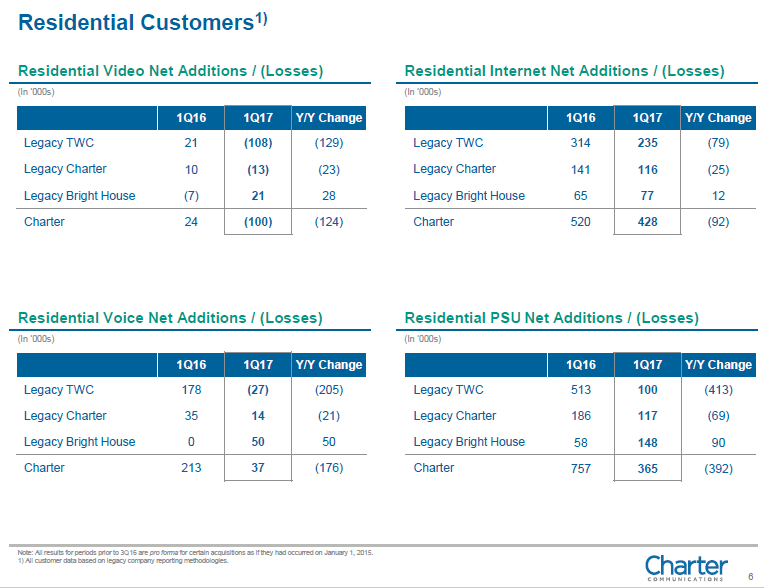
From: Charter Communications’ 1Q 2017 investor presentation
Those experiencing the Spectrum Treatment are switching to AT&T U-verse, although AT&T is trying very hard to get them to sign up for DirecTV instead.
Montgomery tells us AT&T really doesn’t want their cable business, but they will sell her an expensive cell phone or satellite TV.
 “AT&T is a happy hog making a lot of money in the cell phone business, but they sure don’t want to spend much on giving me TV service, and told me I’d be happier with satellite TV,” she said. “If I wanted satellite TV, I would have called DirecTV or Dish myself.”
The other option for parts of Lexington is Windstream’s Kinetic TV, a fiber to the neighborhood service available in some Windstream service areas. But Kinetic TV is getting mixed reviews from customers who have the service, and for those that want broadband, Kinetic speeds don’t cut it for many.
While Rutledge figures out how to spend his eye-popping compensation package, those on fixed incomes like Fitzgerald who live on less than $1,000 a month are trying to figure out where they will get the extra money to pay Charter.
 Fitzgerald was giving the cable company $103 a month for standard cable television with no premiums and internet service. Now Spectrum wants 35% more for the same service he used to get.
A nearby neighbor told Fitzgerald and the newspaper their Spectrum bill went up $18 a month.
“A five dollar increase, OK, fine, I guess I could deal with that,” the neighbor said. “But twenty bucks just because a new company comes in? This is felonious. What am I gonna do, tell Social Security that I need $20 more every month because Spectrum wants it? It doesn’t work that way.”
“There ain’t much you can do about it, though,” Fitzgerald told the neighbor. “They’re the cable company.”
 The last remaining parts of the country formerly served by Time Warner Cable are rebranding as Charter/Spectrum today, with the introduction of new service plans in upstate New York, western Massachusetts, Maine, and parts of the Carolinas.
 It isn’t known how many other Tampa area customers were also overbilled or if Charter was working to identify and refund those who did not pursue a complaint with a local television newscast.

 Suddenlink customers around the country are finding accessing the internet has suddenly gotten more expensive. For many service areas, the cable operator raised its rates in December for television and broadband service, with some of the biggest hikes coming from sneaky surcharges.
 “They also had their artificial internet rate hike when they implemented data ‘allowances’ (caps),” retorted Ryan, a Suddenlink customer. “Their upgrades are anything but complimentary.”
 Tis the season for rate increases. Fa-la-la-la-la, La-La-La-La.
 The absence of viable broadband competition in states like Maryland, bypassed by Verizon FiOS, means Comcast can raise broadband prices almost at will.