Home » rate hike » Recent Articles:

Cable Internet Providers: We Upgraded Speeds and Hate When Customers Use Them

Phillip "Try the Gouda" Dampier

Welcome to the Broadband Usage Whine & Cheese Festival

Midcontinent Communications earlier this month announced a big boost in broadband speeds for more than 250,000 customers in the Dakotas and Minnesota, bringing up to 100/15Mbps service to customers who wanted or needed that speed.

MidcoNet Xstream Wideband, made possible with a DOCSIS 3 upgrade, delivers 1/1Mbps ($30.95), 30/5Mbps ($44.95), 50/10Mbps ($64.95), or 100/15Mbps ($104.95) service.  Those are mighty fast speeds for an upper midwestern cable company, especially in states where 1-3Mbps DSL is much more common.

The cable provider was excited to introduce the speed upgrades earlier this month, telling customers:

At up to 100 Mbps, MidcoNet Xstream® Wideband is fast. But today’s online experience is about more than speed. It’s about the power and capacity to run every streaming, blogging, downloading, surfing, gaming, chatting, working, playing, connected device in the house. All at the same time. MidcoNet Xstream Wideband delivers…it’s everyone in your entire family online at once, doing the most intense online activities, no problem.

But now there is a problem.  Customers spending upwards of $105 a month for the fastest Internet speeds are actually using them to leverage the Internet’s most bandwidth-intensive services, and evidently Midco isn’t too happy about that.  Todd Spangler, a columnist for cable industry trade magazine Multichannel News, was given a usage chart by Midco, and used it to lecture readers about the need for usage caps: “One thing is clear: Broadband service providers will all need to do something to contain the rapidly rising flood of Internet data.”  The implication left with readers is that limiting broadband usage is the only way to stem the tide.
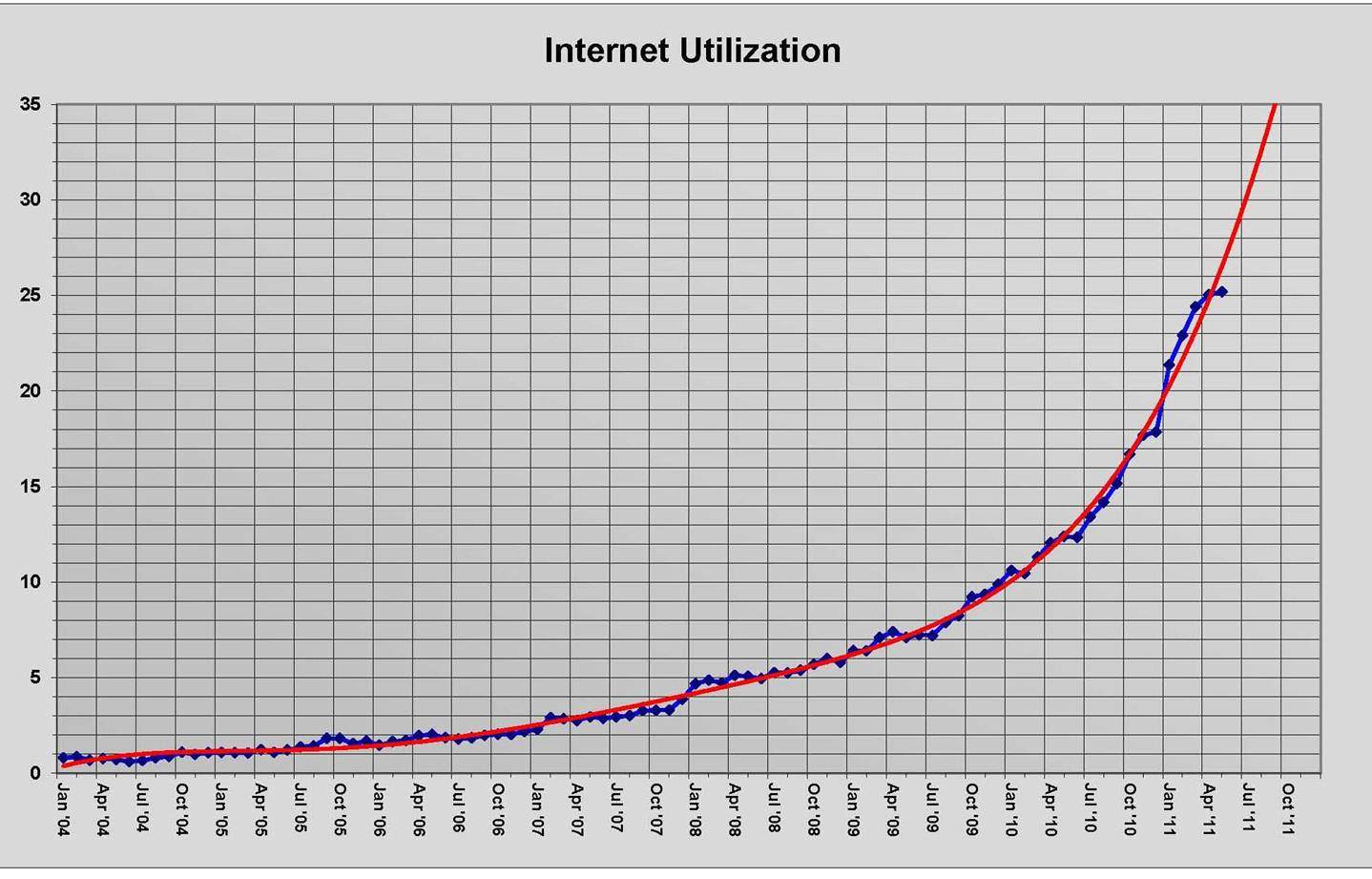
Midco's not-so-useful chart looks mighty scary, showing usage growth on their 100Gbps backbone network, but leaves an enormous amount of information out of the equation. (Source: Midcontinent Communications via Multichannel News)

Spangler quotes Midco’s vice president of technology Jon Pederson: “Like most network providers we have evaluated this possibility, but have no immediate plans to implement bandwidth-usage caps,” he said.

So Midco is more than happy to pocket up to $105 a month from their customers, so long as they don’t actually use the broadband service they are paying top dollar to receive.  It’s an ironic case of a provider desiring to improve service, but then getting upset when customers actually use it.

We say ironic because, from all outward appearances, Midco is well-aware of the transformational usage of broadband service in the United States these days:

If you have ever once said “my Internet is too slow,” then you need MidcoNet Xstream Wideband. With it, you can do all the cool things you’ve heard people are doing online. Explore all the great stuff your online world has to offer. Play the most intense games. Try things you could never do before, from entertainment to finance, video chat or video streaming. Like we said, MidcoNet Xstream Wideband is all about speed, capacity, choice and control.

What this means for you is that you’ll be able to do things like:

  • Download and start enjoying entire HD movies in seconds, not minutes.
  • Stream video and music without a hitch while you simultaneously perform other intense online tasks.
  • Choose from three different pipelines, from 3.0 to 1.0, for the capacity and price your family needs.
  • Monitor your bandwidth use to determine if you need more capacity or can do what you want with less.
  • Upload files or signals, such as webcam footage, faster than ever before possible for a better online experience.
  • Watch ESPN3.com. Your Favorite Sports. Live. Online.

Just don’t do any of these things too much.  Indeed, when providers start toying with usage caps, it’s clear they want you to use your service the same way you did in 2004 — reading your e-mail and browsing web pages.  Real Audio stream anyone?

Let’s ponder the facts Mr. Spangler didn’t entertain in his piece.

Midco upgraded their network to DOCSIS 3 technology to deliver faster speeds and provide more broadband capacity to customers who are using the Internet much differently than a decade ago, when cable modems first became common.  Some providers and their trade press friends seem to think it’s perfectly reasonable to collect the proceeds of premium-priced broadband service while claiming shock over the reality that someone prepared to spend $100 a month for that product will use it far more than the average user.

Part of the price premium charged for faster service is supposed to cover whatever broadband usage growth comes as a result.  That’s why Comcast’s 250GB usage cap never made any sense.  Why would someone pay the company a premium for 50Mbps service that has precisely the same limit someone paying for standard service has to endure?

Cringely

Midcontinent Communications is a private company so we do not have access to their financial reports, but among larger providers the trend is quite clear: revenues from premium speed accounts are being pocketed without a corresponding increase in investment to upgrade their networks to meet demand.  Inevitably that brings the kind of complaining about usage that leads to calls for usage caps or speed throttles to control the growth.

We’re uncertain if Midco is making the case for usage caps, or simply Mr. Spangler.  We’ll explain that in a moment.  But if we are to fully grasp Midco’s broadband challenges, we need much more than a single usage growth chart.  A “shocking” usage graph is no more impressive than those showing an exponential increase in hard drive capacity over the same period.  The only difference is consumers are paying about the same for hard drives today and getting a lot more capacity, while broadband users are paying much more and now being told to use less.  Here is what we’d like to see to assemble a true picture of Midco’s usage “dilemma:”

  1. How much average revenue per customer does Midco collect from broadband customers.  Traditional evidence shows ARPU for broadband is growing at a rapid rate, as consumers upgrade to faster speeds at higher prices.  We’d like to compare numbers over the last five years;
  2. How much does Midco spend on capital improvements to their network, and plot that spending over the last 10 years to see whether it has increased, remained level, or decreased.  The latter is most common for cable operators, as the percentage spent in relation to revenue is dropping fast;
  3. How many subscribers have adopted broadband service over the period their usage chart illustrates, and at what rate of growth?
  4. What does Midco pay for upstream connectivity and has that amount gone up, down, or stayed the same over the past few years.  Traditionally, those costs are plummeting.
  5. If the expenses for broadband upgrades and connectivity have decreased, what has Midco done with the savings and why are they not prepared to spend that money now to improve their network?

While Midco expresses concern about the costs of connectivity and ponders usage caps, there was plenty of money available for their recent purchase of U.S. Cable, a state-of-the-art fiber system serving 33,000 customers — a significant addition for a cable company that serves around 250,000 customers.

A journey through Midco’s own website seems to tell a very different story from the one Mr. Spangler is promoting.  The aforementioned Mr. Pederson is all over the website with YouTube videos which cast doubt on all of Spangler’s arguments.  Midco has plentiful bandwidth, Mr. Pederson declares — both to neighborhoods and to the Internet backbone.  Their network upgrades were designed precisely to handle today’s realistic use of the Internet.  They are marketing content add-ons that include bandwidth-heavy multimedia.  Why would a provider sell customers on using their broadband service for high-bandwidth applications and then ponder limiting their use?  Mr. Pederson seems well-aware of the implications of an increasingly connected world, and higher usage comes along with that.

That’s why we’d prefer to attack Mr. Spangler’s “evidence” used to favor usage caps instead of simply vilifying Midco — they have so far rejected usage limits for their customers, and should be applauded for that.

Robert X. Cringely approached Midco’s usage chart from a different angle on his blog, delivering facts our readers already know: Americans are overpaying for their broadband service, and the threat of usage caps simply disguises a big fat rate hike.  He found Midco’s chart the same place we did — on Multichannel News’ website.  He dismisses its relevance in the usage cap debate.  Cringley’s article explores the costs of broadband connectivity, which we have repeatedly documented are dropping, and he has several charts to illustrate that fact.

You’ll notice for example that backbone costs in Tokyo, where broadband connections typically run at 100 megabits-per-second, are about four times higher than they are in New York or London. Yet broadband connections in Tokyo cost halfwhat they do in New York, and that’s for a connection at least four times a fast!

So Softbank BB in Tokyo pays four times as much per megabit for backbone capacity and offers four times the speed for half the price of Verizon in New York. Yet Softbank BB is profitable.

No matter what your ISP says, their backbone costs are inconsequential and to argue otherwise is probably a lie.

Cue up Time Warner Cable CEO Glenn Britt, who said precisely as much Thursday morning when he admitted bandwidth costs are not terribly relevant to broadband pricing.

We knew that, but it’s great to hear him say it.

Cringely’s excellent analysis puts a price tag on what ISP’s want to cap for their own benefit — their maximum cost to deliver the service:

That 250 gigabytes-per-month works out to about one megabit-per-second, which costs $8 in New York. So your American ISP, who has been spending $0.40 per month to buy the bandwidth they’ve been selling to you for $30, wants to cap their maximum backbone cost per-subscriber at $8.

[…] IP Transit costs will continue to drop. That $8 price will most likely continue to fall at the historical annual rate of 22 percent. So what’s presented as an ISP insurance policy is really a guaranteed profit increase of 22 percent that will be compounded over time because consumption will continue to rise and customers will be for the first time charged for that increased consumption.

This isn’t about capping ISP losses, but are about increasing ISP profits. The caps are a built-in revenue bump that will kick-in 2-3 years from now, circumventing any existing regulatory structure for setting rates. The regulators just haven’t realized it yet. By the time they do it may be too late.

Unfortunately, even if they knew, we have legislators in Washington who are well-paid in campaign money to look the other way unless consumers launch a revolution against duopoly broadband pricing.

Cringely believes usage caps will be the form of your provider’s next rate increase for broadband, but he need not wait that long.  As the aforementioned CEO of Time Warner Cable has already admitted, the pricing power of broadband is such that the cable and phone companies are already increasing rates — repeatedly — for a service many still want to cap.  Why?  Because they can.

Consumers who have educated themselves with actual facts instead of succumbing to ISP “re-education” efforts designed to sell usage limits under the guise of “fairness” are well-equipped to answer Mr. Spangler’s question about whether bandwidth caps are necessary.

The answer was no, is no, and will always be no.

[flv width=”640″ height=”500″]http://www.phillipdampier.com/video/Midco D3 Upgrade Promo 7-11.flv[/flv]

Jon Pederson’s comments on Midcontinent’s own website promoting its new faster broadband speeds can’t be missed.  He counts the number of devices in his own home that connect to the Internet, explains how our use of the Internet has been transformed in the past several years, and declares Midco well-prepared to deliver customers the capacity they need.  Perhaps Mr. Spangler used the wrong company to promote his desire for Internet usage caps.  Pederson handily, albeit indirectly, obliterates Spangler’s own talking points, which makes us wonder why this company even pondered Internet Overcharging schemes like usage caps in the first place.  (10 minutes)

The ’19 Most Hated Companies in America’ Includes Big Telecom Abusers; TWC Is #3, Comcast #4

Cox alienates their customers.

Six of the 19 ‘Most Hated Companies in America’ are big cable, satellite and phone companies.  The list, published this month by The Atlantic magazine, call out the perpetrators of bad customer service, high prices, and in the case of Time Warner Cable (#3) — Internet Overcharging.

The American Customer Satisfaction Index rates companies based on thousands of surveys. In the latest index, the most-hated companies include large banks, airlines, power and telecom companies.  Especially called out this year was Time Warner Cable, celebrating a decade of public relations blunders ranging from gouging experiments on Internet service pricing, showing pornography on children’s channels, high rates, and downright lousy service in some areas.  And with CEO Glenn Britt entertaining a return to Internet rate gouging, the company’s 59/100 score still has plenty of room to fall.

#3 — Time Warner Cable (59/100) — All of the above, plus sexually harassing a North Carolina customer.

#4 — Comcast (59/100) –Dreadful customer service and poor communications left consumers with dozens of channels gone missing, outrageous rate hikes, their phone service implicated in a Florida woman’s death, and who could forget the technician that set a customer’s house on fire. This one actually lost two score points since last year.

#5 — Charter Communications (59/100) — The usual rate increases were bad enough, but Charter also told their customers they were on the hook for cable boxes lost in fires that were not their fault, was held accountable for faulty billing practices, went bankrupt, introduced its own Internet Overcharging scheme, and worst of all — their infamous PR disaster telling tornado victims in Alabama to go and find their lost cable boxes scattered somewhere in the neighborhood.  The representative on the line will wait.

#14 — AT&T (66/100) — Limited coverage and the introduction of usage pricing for data pl    …   oh sorry, AT&T dropped the call.  All reasons why AT&T wins the ‘you suck’ award among mobile providers this year.

#17 — Cox Cable (67/100) — The home of the $480 early termination fee, Cox alienates customers like few others.  They even use spacemen to harass their customers.  Bemusingly, Cox is considered a customer service success compared with our other bad boys.

#18 — Dish Network (67/100) — Trending downwards, Dish is still giving their customers a bath in bad billing and worse customer service.  They are lovers of big ad splashes with a terrifying excess of fine print which ruins the deal, if you read it.

Netflix Customers Erupt in Firestorm Over Plan Changes: More Than 35,000 Negative Comments Logged

Phillip Dampier July 13, 2011 Consumer News, Online Video 4 Comments

fire - courtesy Dan HammontreeMore than 35,000 Netflix subscribers flooded the company’s blog and Facebook page with negative comments less than 24 hours after the company announced major pricing changes for its DVD-by-mail and streaming services.

News that Netflix would unbundle discounts for customers who enjoy online streaming and still need to rent an occasional DVD-by-mail went over like a lead balloon for the overwhelming majority, who hit the 5,000 comment limit on Netflix’s own blog by 5:30pm Tuesday, and continue to pound the company’s Facebook page by the tens of thousands this morning.

One of the most “liked” comments came from longtime Netflix customer Scotty Fagaly:

“The only way that this is terrific for the customer is if you plan to offer your entire collection available for streaming,” Fagaly lamented. “Otherwise, this is just yet another way to choke more change out of your customers.”

Only about 20 percent of Netflix’s library is available for streaming at any time, with some titles and studios coming and going.  Several television series are available online, but certain episodes are often missing from the streaming library, requiring customers to rent the DVD to see everything.

Are these discs made of gold now?

The biggest negative response came from the loss of the popular $9.99 plan, which allowed unlimited streaming and an unlimited number of DVD’s — sent one at a time — to customers.  With the unbundling of discounts, that same plan now costs $15.99 — a 60% increase.

Netflix officials have yet to respond to the firestorm of criticism, in part laid at the feet of Jessie Becker, who tried to make lemonade out of the price increase most customers describe as a lemon.

“It’s insulting that Netflix think we’re stupid enough to believe this change is either ‘exciting’ or ‘good news,'” one hostile commenter noted.  “Stop couching this as anything other than what it is — a price hike.”

“So far you have 32,446 people on your Facebook page planning to or already have canceled, and 6,857 on this blog [over an] announcement yesterday. If nothing else there might be an award in it for you guys for most Internet hits for pissing off customers in the shortest amount of time,” said Christine Perry.  “I can go to Redbox and rent a new release for a dollar, watch it and return it the same day and get a new one. Why would I pay $7.99 to wait 3 days to get a DVD, and the another 3 days after I watch it for you to get it back, and then another 3 days to get another one?”

Daniel Indiviglio, a former investment banker who works today as an associate editor at The Atlantic, called Netflix’s price changes “boneheaded,” particularly for investors if it backfires:

“How much could Netflix lose? Let’s do a quick analysis. According to one estimate, about 80% of Netflix subscribers currently have by-mail service that includes free streaming. Of that portion, let’s say half cancel streaming but keep by-mail service. Remember, many people don’t use streaming at all. In particular, if you don’t have an Internet-ready device connected to your television with a Netflix widget, then streaming is far less attractive. Through Netflix’s new pricing, by-mail only service will be about 20% cheaper than the current rate that includes free streaming.

[…] “Netflix has been a darling of investors for some time now. In just the past year, its stock price has increased by an amazing 144%. But Wall Street might begin to question its strategy. The company has said that streaming is the future. It’s right. But the future isn’t here yet. If its streaming subscriber base suddenly plummets by 50% or even by a smaller margin like 30%, then investors might worry about whether consumers are really ready to embrace the service on which Netflix has been investing a huge portion of its revenue. And if its profits dive as a result of the rate hike, then investors will be even more concerned with Netflix’s vision.

“So what should Netflix have done? It should have increased its rates slightly, maybe by a dollar or two, and broke out streaming and by-mail service. For example, the company could have increased the cost of its basic plan from $9.99 to $11.98 for streaming plus by-mail service. If you wanted the two a la carte, it could have charged $4.99 for streaming and $6.99 for one DVD-by-mail. Although customers wouldn’t love the rate increase, they’d be better able to stomach it. It would also give Netflix the ability to up its fees in future years gradually, to hit the target that it believes is appropriate. But putting the hike in place immediately may do the company more harm than good.”

Your Alternatives

Bankrupt Blockbuster wasted no time taking advantage, pelting many of their former rental members with e-mail reminding them they can rent Blockbuster DVD’s by mail without a monthly subscription.  Unfortunately, it’s not cheap.  A seven day rental of a single disc will cost $4.99.  Subscription plans offer a better value for frequent renters.  Blockbuster also benefits from not being perceived these days as a “bad boy” by Hollywood studios, who have been penalizing Netflix with longer rental embargo windows.  Many new releases reach Blockbuster a month before showing up in Redbox or on Netflix’s roster.  Customers can also swap out up for five DVD’s a month at BlockBuster retail outlets, and video game rentals are also available.

Prices:

  • One DVD out at a time: $12 per month
  • Two DVDs out at a time: $17 per month
  • Three DVDs out at a time: $20 per month

Hulu Plus has not been a runaway success for its owners, charging $8 a month to paying customers who win the right to watch additional content, but with the same commercial load the free alternative service provides.  People don’t think of Hulu for movies because the service is heavily focused on television series, but Hulu Plus does deliver a small selection.  Amazon Instant Video is another alternative, for those paying Amazon.com $79 a year for the privilege of getting their orders shipped to arrive in 48 hours for no additional shipping charges.  Amazon added unlimited access to their Instant Video streaming library at no additional charge for Amazon Prime members.  Just about anyone signing up with a new account at Amazon can get a 30-day free trial of Amazon Prime, with the movie service.  But you will make due with watching around 6,000 titles, many of which are obscure or a distant memory.

Many of Netflix’s upset customers report they are headed for the Movie Tardis — the 27,000+ giant red boxes erected in front of grocery and drug stores.  Redbox pitches $1 movie rentals, but you need to return them by 9pm the following day.  Blu-ray movies cost 50 cents more.  Redbox carries a healthy selection of current titles, and you only interact with a machine, so you won’t deal with the eye-rolling you might get renting at area video stores.  This option works best if you are within a very short distance from the nearest kiosk.  Otherwise, you may find returning discs a hassle.

[flv width=”360″ height=”290″]http://www.phillipdampier.com/video/WNAC Providence Netflix raising prices 60pct 7-13-11.mp4[/flv]

Netflix is raising prices and subscribers are not happy, shares WNAC-TV in Providence.  Their advice? “Stick to Redbox.”  (1 minute)

Is Netflix Driving Cord Cutting? New Evidence Suggests ‘Not Really’

Phillip Dampier June 23, 2011 Online Video Comments Off on Is Netflix Driving Cord Cutting? New Evidence Suggests ‘Not Really’

As Netflix traffic continues to grow, analysts are pondering whether Netflix is a primary driver behind consumers cord-cutting their pay television packages in favor of watching video content online.

A recent article in The New York Times claims that Netflix may be behind the recent decrease in cable television households, citing a report from the Diffusion Group, a media analyst.  The group’s study claims 32% of satellite, telephone, or cable-delivered pay television customers were planning to downgrade or cancel their packages in 2011, a giant increase from the 16% measured in 2010.

[trefis_forecast ticker=”NFLX” driver=”0532″]

Trefis, another research firm, is challenging those assertions, noting an in-depth review of the study finds only around 7% of those planning to pull the plug cited Netflix as the chief reason.

What is causing a rush to downgrade or cancel service?  Rate increases, particularly for add-on services like premium channels or extra tiers including sports and movies.  Time Warner Cable recently boosted prices for HBO to as high as $15 a month for many subscribers.  Netflix may have an impact on these consumers, deciding to drop premium services like HBO, Showtime, and Starz!  For several dollars less than what these premium channels charge, Netflix customers have unlimited access to the company’s streaming video library.

Relentless annual rate hikes have often triggered subscribers to review their packages and delete services to keep the bill stable.  Economic distress is also a widely cited factor among those completely canceling pay television.  The report does not measure how many consumers, especially younger ones, don’t ever start a pay television subscription.  These subscribers never had a cord to cut.

Media Treats Sanford Bernstein’s Craig Moffett as ‘Independent Analyst’ on Broadband; He’s Not

Phillip 'Not Picking Up What Moffett Puts Down' Dampier

Tech, business, and even a few mainstream media outlets have been booking Sanford Bernstein’s Craig Moffett as an independent observer of all-things-broadband, without revealing he literally has a vested interest in boosting profits for the telecommunications industry.

The latest of Moffett’s heavily-slanted ideas appeared over the weekend on ZDNet, where Larry Dignan’s Between the Lines column used one of Bernstein’s “research notes” to provoke readers into a discussion about Internet Overcharging:

Metered broadband access is inevitable and may even be good for adoption of speedy Internet access.

That’s the argument from Bernstein analyst Craig Moffett in a research note. Moffett sets the scene:

  • The FCC’s open Internet push allows for metered broadband.
  • AT&T has introduced usage caps across its wireline business. DSL customers are limited to 150 GB of monthly consumption. U-Verse subscribers get 250 GB, or the same as Comcast. Users will be charged an extra $10 a month if they exceed the cap and it’s $10 per 50 GB after that.
  • AT&T has already introduced tiered wireless plans.
  • Time Warner Cable has a few usage based pricing pilots underway.

Moffett

Nowhere in Dignan’s column does he disclose Moffett is a paid Wall Street analyst working for the interests of investor clients of Sanford Bernstein who want to maximize the value of their telecommunications stocks.  Moffett’s long history of statements about industry pricing reflect those interests, which are often very different from those of most consumers.  Moffett’s world view: anything that brings in more revenue is good for shareholders (rate hikes, metered billing), anything that drives down shareholder value is not (infrastructure upgrades, pricing cuts, customer defections).

On that basis, Moffett has been called a “cable stock fluffer” by our friends at Broadband Reports for his relentlessly pro-cable industry commentary, even while ridiculing transformational projects like Verizon’s FiOS fiber to the home network for being “too expensive” and not delivering enough return on shareholder investment.  Consumer Reports delivers the opposite view: high marks for Verizon FiOS, mediocre to lousy marks for most of the nation’s cable operators.

While there is nothing inherently wrong with Moffett doing his job on behalf of his paying clients, using his views outside of that context — particularly when those interests go undisclosed — is journalistic malpractice.

Oh, and Time Warner Cable abandoned their usage-based pricing pilots in 2009 after customers declared war on the cable company.  Those darn customers, ruining the industry’s plans!

The rest of Moffett’s research note doesn’t get much better in the “true facts”-department:

The goal of moving to usage based pricing is not to undermine competition from Netflix (or anyone else… although it certainly wouldn’t be good news for Internet video). And it is most decidedly not to simply “raise prices for broadband” as Public Knowledge or New America would have it (although it might well do precisely that, too). Instead, it is nothing less than to re-align the entire business model of today’s infrastructure providers with the next generation of communications… so that broadband providers might stop fighting against the tide and embrace it instead.

With usage based pricing, broadband providers, and Cable operators in particular, can create an “iso-profit” curve, where the amount they make from a physical connection is about the same whether someone uses that connection for linear video or, alternatively, web video. The goal is not to stifle competition, but instead to create indifference not just to the end state of video by-pass, but indeed for all points along the way. The adoption of usage based pricing would be transformational to the debate for Cable operators, inasmuch as it would essentially indemnify them against all potential outcomes.

Moffett represents his interests, not yours.

Yet some of Moffett’s earlier statements would seem to argue with himself.

For instance, back in March Moffett was making plenty of noise about AT&T’s caps precisely targeting video providers like Netflix:

Moffett believes usage caps have everything to do with stopping the torrent of online video.  He notes AT&T’s caps are set high enough to target AT&T customers who use their connections to watch a considerable amount of video programming online.

“Only video can drive that kind of usage,” Moffett writes.

Moffett has repeatedly predicted any challenge to pay television models from online video will be met with pricing plans that eliminate or reduce the threat:

“[I]f consumption patterns change such that web video begins to substitute for linear video, then the terrestrial broadband operators will simply adopt pricing plans that preserve the economics of their physical infrastructure,” Moffett said. “Of course, any move to preserve their own economics has far-ranging implications. Any move towards usage-based pricing doesn’t just affect the returns of the operators, it also affects the demand of end users (the ‘feedback loop’).”

The only thing usage-based pricing indemnifies is the industry’s confrontation with revenue-eroding cable-TV cord-cutting.  And Moffett knows this, although he would probably give rave reviews to bringing similar usage-based-billing to cable television packages, which would charge you for every show you watched on top of your monthly bill.

These pricing models, already firmly rooted in Canada, have done nothing to bring the “next generation of communications” to our neighbors to the north.  Indeed, Canada’s ranking in broadband continues its decline as large cable and phone companies pocket the profits instead of committing to wholesale upgrades of their networks to deliver the kind of service increasingly common in Europe and Asia.

But the real laugh out loud moment comes last: Moffett’s prediction that AT&T’s usage pricing will increase broadband adoption.  Perhaps that’s true if you prefer telecommunications companies abuse you, but as we’ve documented over the past three years, these pricing schemes never save anyone money — they just increase the price of your service while decreasing the value of it.

Search This Site:

Contributions:

Recent Comments:

Your Account:

Stop the Cap!