Time Warner Cable intends to implement a series of rate increases for 2012 across many of their service areas, beginning with a 4% rate hike for their cable television service that will take effect in December.
A cable company memo received by Stop the Cap! indicates this isn’t likely to be the only rate increase from the cable operator, with possible rate adjustments for broadband and phone products to be announced at a later date. The cable television portion of your bill will increase because of what the company calls “dramatically higher programming costs, additional programming and features, and continued investment in the company’s network and customer service operations.”
Some examples of the new rates¹, which will vary slightly in different service areas, includes new pricing for the company’s DVR box in some regions:
Digital Cable (was $72.99) $77.49
Talk & Surf (was $86.99) $89.94
Watch & Surf (was $118.99) $125.49
Watch & Surf Plus (was $141.99) $148.49
DVR Service (was $11.95) $12.95 (additional equipment rental charges may apply)
¹Time Warner Cable Maine
Customers currently on price protection agreements, term contracts, or special rate promotions will not be impacted by the rate increases until the expiration of their contract or promotion. Customers will receive an official notification of the rate adjustment on their next billing statement.
Some of Clearwire’s very first, and most loyal customers in the Pacific Northwest are receiving an unwelcome message of thanks for their years of service with the company: a massive rate increase.
The company is nearly doubling rates for customers who were promised special “lifetime” discounts for agreeing to remain with the wireless 4G broadband service, which has been experiencing financial problems recently.
D.B. in Seattle has been a Clearwire customer for years, even before the company upgraded to WiMax speeds. In 2009, Clearwire sent him an offer he couldn’t refuse: stay with Clear and pay just $22 a month (plus $5 modem rental fee) for life.
“Of course I accepted immediately,” D.B. writes. “Then Clear [sent me a letter recently] telling me my monthly fee was going up to approximately $47 a month with the modem fee.”
D.B. has been calling and e-mailing Clearwire asking what happened to the $22-for-life promotion he has in writing from the company, but “nobody knows anything.”
Clearwire says they have improved their service recently in Seattle, but D.B. isn’t impressed.
“I’m here to tell the world that is not true,” he says. “Plus the times I’ve had this thing freeze up has greatly increased, and usually I have to unplug the modem for five minutes [to get service back].”
Mireille in Seattle managed to get an even lower “lifetime” rate from Clearwire two years ago.
“They offered me a monthly rate of $19.95 for as long as I maintained uninterrupted Clearwire service. That means forever and ever until I cancel.,” she says. “Last week they sent me an email letting me know that they were raising my rate to $35.95 a month (that includes a $10 a month ‘long time customer discount’) and since I was such a good customer I was being offered that rate for the life of my uninterrupted Clearwire service. Sound familiar?”
Mireille calls it something else: breach of contract.
“I spoke to three different people and no one had anything to say besides that they were sorry but they were not able offer me that rate anymore.”
Customers in the Portland, Ore. area are getting similar e-mails, and The Oregoniantook note:
Clearwire Corp., a wireless Internet provider that operates as Clear, is raising prices for 30,000 customers who signed up for the service soon after its 2009 launch.
The Kirkland, Wash.-based company didn’t provide details of the rate hikes, but e-mails to customers show that monthly rates for some home Internet plans will rise from $35 to $45 beginning in October.
Clearwire said the rate hike affects both home and mobile customers who subscribed when the service was first available, at a time when rates were lower or promotional prices were available.
Clearwire still offers a home Internet plan for $35 a month, but it limits download speeds to 1.5 megabits per second — one-eighth the speed of Comcast’s standard plan. Clear’s standard plan, which now costs $45, promises downloads between 3 and 6 megabits per second.
Phillip DampierSeptember 7, 2011Broadband Speed, Consumer News, Shaw, VideoComments Off on Shaw Uses DTV Conversion to Sneak Through Its Own Digital Conversion Rate Hike
Canada’s transition to digital television was supposed to be a non-event for cable and satellite customers, because those providers will continue to service analog televisions for sometime to come. But Shaw Communications found a way to squeeze a few more dollars out of some of their subscribers anyway.
While Canadian broadcasters were discontinuing analog over-the-air television, many Shaw Cable service areas were also dumping an increasing number of analog channels in favor of digital. In Kamloops, B.C., Cheryl Whiting discovered that conversion was going to cost her plenty. Although Shaw provides one digital set top box for free, each additional box rents for $2.95 per month, and Whiting will need four of them if she wants to continue watching cable stations above channel 13 throughout her home.
“I may as well sign my paycheque over to them,” Whiting toldThe Daily News.
Shaw’s ongoing “digital upgrade” is clearing away much of the analog cable dial to make room for additional digital television signals and faster broadband, but that transition comes at a price to customers who now need a set top box on most of their televisions.
Many customers were upgraded during the month of August, with most of the rest scheduled for conversion during September.
[flv width=”540″ height=”416″]http://www.phillipdampier.com/video/Shaw Digital Network Upgrade – Analog Customers.flv[/flv]
Shaw tells customers it is moving all of their cable channels above “broadcast basic” to a digital platform, requiring customers to place digital set top boxes on all of their televisions. (1 minute)
A year after Frontier Communications assumed control of Verizon’s assets in the Pacific Northwest, customers are fleeing the company’s inherited fiber-to-the-home service FiOS, after announcing a massive (since suspended, except in Indiana) 46 percent rate hike for the television portion of the service. A new $500 installation fee has kept all but the bravest from considering replacing customers who have left for Comcast and various satellite TV providers.
Frontier’s second-quarter financial results revealed the company has lost at least 14,000 out of 112,000 FiOS TV customers in the region (and in the Fort Wayne, Ind. market, where the service is also available.)
Early reaction to the original rate hike announcement started customers shopping for another provider — mostly Comcast, which competes in all three states where Frontier FiOS operates. Even after the rate hike was suspended in some markets, intense marketing activity by Frontier to drive customers towards its partnership with satellite provider DirecTV managed to convince at least some of those customers to pull the plug on fiber in return for a free year of satellite TV, although an even larger number presumably switched to the cable competition.
D.A. Davidson, a financial consulting firm, toldThe Oregonian the message was clear.
“They would love to get rid of the FiOS TV customers,” Donna Jaegers, who follows Frontier, told the newspaper. “They’re programming costs are very high compared to the rates that they charge.”
Jaegers said Frontier Communications completely botched their efforts to transition customers away from FiOS TV towards satellite, because most of those departing headed for the cable competition, attracted by promotional offers and convenient billing.
Many others simply don’t want a satellite dish on their roof, and are confounded about Frontier’s message that satellite TV is somehow better than fiber-to-the-home service.
Frontier admits its FiOS service is now underutilized, but claims it will continue to provide the service where it already exists.
Wilderotter
Frontier Claims Its DSL Service is Better Than Cable Broadband
Frontier’s general business plan is to provide DSL service in rural areas where it faces little or no competition, and most of Frontier’s investment has been to upgrade Verizon’s landline network to sustain 1-3Mbps DSL service, for which it routinely charges the same (or more) for standalone broadband service that its cable competitors charge for much faster speeds.
But Frontier Communications CEO Maggie Wilderotter says their DSL service is better than the cable competition.
“A key differentiator between our network and cable competition is that you consistently get the speed you pay for,” Wilderotter told investors on a conference call. “There’s no sharing at the local level. High demand for bandwidth-intensive applications like video are putting pressure on all wired networks. To that end, we want to make sure that we have more than enough capacity to satisfy the expectations of our customers. We’re spending capital in all parts of the network with specific emphasis in the middle mile, which will enable us to consistently deliver a quality customer experience for our customers of today and tomorrow.”
Frontier Communications CEO Maggie Wilderotter defends anemic broadband additions during the 2nd quarter of 2011 and tries to convince investors DSL service is better than the cable competition. August 3, 2011. (4 minutes)
You must remain on this page to hear the clip, or you can download the clip and listen later.
Netflix Traffic Represents 25% of Frontier’s Broadband Traffic; Online Video — 50%
Wilderotter admitted Frontier’s broadband network is overcongested in many regions, which she partly blamed for the company’s anemic addition of new broadband customers.
“Video is about 50 percent,” Wilderotter added. In an investor conference call, she explained network congestion in more detail:
“In [the second quarter], we had many areas with unacceptable levels of network congestion, which negatively impacted our growth in net high-speed additions.” Wilderotter said. “We believe all of the major congestion issues will be fixed by the end of [the third quarter], and that will enable us to drive higher growth and net broadband activation in [former Verizon service areas.]”
“What we decided to do is to go for fixing the middle mile, which is the [central office] to the […] neighborhood and to expand that capability by 100-fold. And then also, expand from the [central office] out to the Internet and make sure that we have huge capacity to deliver and receive capability to our customers. So when we sell 6 meg, 10 meg, 25 meg, 50 meg, the customer gets what we sell them and that was extremely important for us.”
“So what we did is in the areas where we saw the congestion increase based upon usage increases, and we’ve built new households. We’ve held off on marketing to a lot of those new households until we fixed the congestion problem because we didn’t want to exacerbate what we had already. We’ve shifted capital in terms of the mix of how we’ve spent capital to fix this problem. I’d say we’re probably 75% of the way there in fixing congestion. This quarter is another big quarter for us to get all of the major issues out of the network, which will allow us in the back end of this quarter through the fourth quarter, to really start pushing the penetration levels where we’ve built new households in the areas that have been affected by congestion.”
Frontier Introduces Line Bonded DSL — Two Connections Can Improve DSL Speeds
Frontier Faster? Frontier announces line bonded DSL.
Frontier Communications also announced the introduction of Frontier Second Connect, a DSL line bonding product that delivers two physical connections to a single household. Line bonding allows for improved broadband speeds.
“Second Connect gives our customers two exclusive connections in one household, and we’re the only provider in every market that can do that,” Wilderotter claimed.
In more urban markets, Frontier’s DSL speeds are woefully behind those available from most cable competitors. Frontier has begun upgrading some of their legacy service areas and retiring older equipment in an effort to improve the quality of service.
“The real initiatives that we have underway are called middle mile, interoffice facilities, as well as some of the more aged equipment that’s in the network,” said Dan McCarthy, Frontier’s chief operating officer. “So as we go through, there’s about 600 projects that are underway today that will improve both the speed and capability.”
“We’ve inherited markets that there has not been upgrades to capacity in these markets for many years and fixes to the networks, plus the elements as the DSLAMs, even the DSLAMs themselves are old,” Wilderotter said. “So we’re replacing network elements in the neighborhood. We’re splitting them and moving customers to other network elements to make sure that they have a good experience.”
Frontier executives answer a question from a Wall Street banker about DSL speeds and congestion problems on Frontier’s broadband network. A detailed technical discussion ensues as the company tells investors it is redirecting some capital to fixing Frontier’s overcongested network. August 3, 2011. (5 minutes)
You must remain on this page to hear the clip, or you can download the clip and listen later.
Frontier Still Losing More than 8% Of Its Landline Customers Every Year
Despite broadband rollouts and incremental improvements, more than eight percent of Frontier’s landline customers disconnect service permanently every year. Frontier called that disconnect rate an improvement over its line losses last year, which exceeded 11 percent in some areas.
“Total line losses improved to an 8.6% year-over-year decline, our lowest level since taking ownership when the pro forma loss rate was 9.7%,” reported Wilderotter. “We also improved [the] loss rate [in former Verizon service areas to] 10.1% compared to 11.4% in Q2 2010.”
Most of Frontier’s departing customers are switching to cable providers and/or cell phone service.
(Update 8-23-2011: We are now told in many areas, Frontier’s Second Connect service is not actually a bonded DSL product, but rather a “dry loop” second DSL line that carries the same speed as your primary line. Presumably, household members can divide up who uses which DSL circuit for Internet access. The charge for Second Connect in ex-Verizon service areas is $14.99 per month plus a second mandatory monthly modem rental fee of $6.99. If the web link does not work, it means the service is not available in your service area.)
Cogeco Cable customers are about to pay for the company’s tragic financial results from its Portuguese operations in the form of broad-based price increases the company is selling as service “improvements.”
July’s financial results for Cogeco, which owns cable systems in Ontario, Quebec, and Portugal, are not good. With mass subscriber defections and downgrades from Cogeco’s Portuguese cable system Cabovisao, company officials have decided to write off their European investment, resulting in a $56.7 million loss in the third quarter.
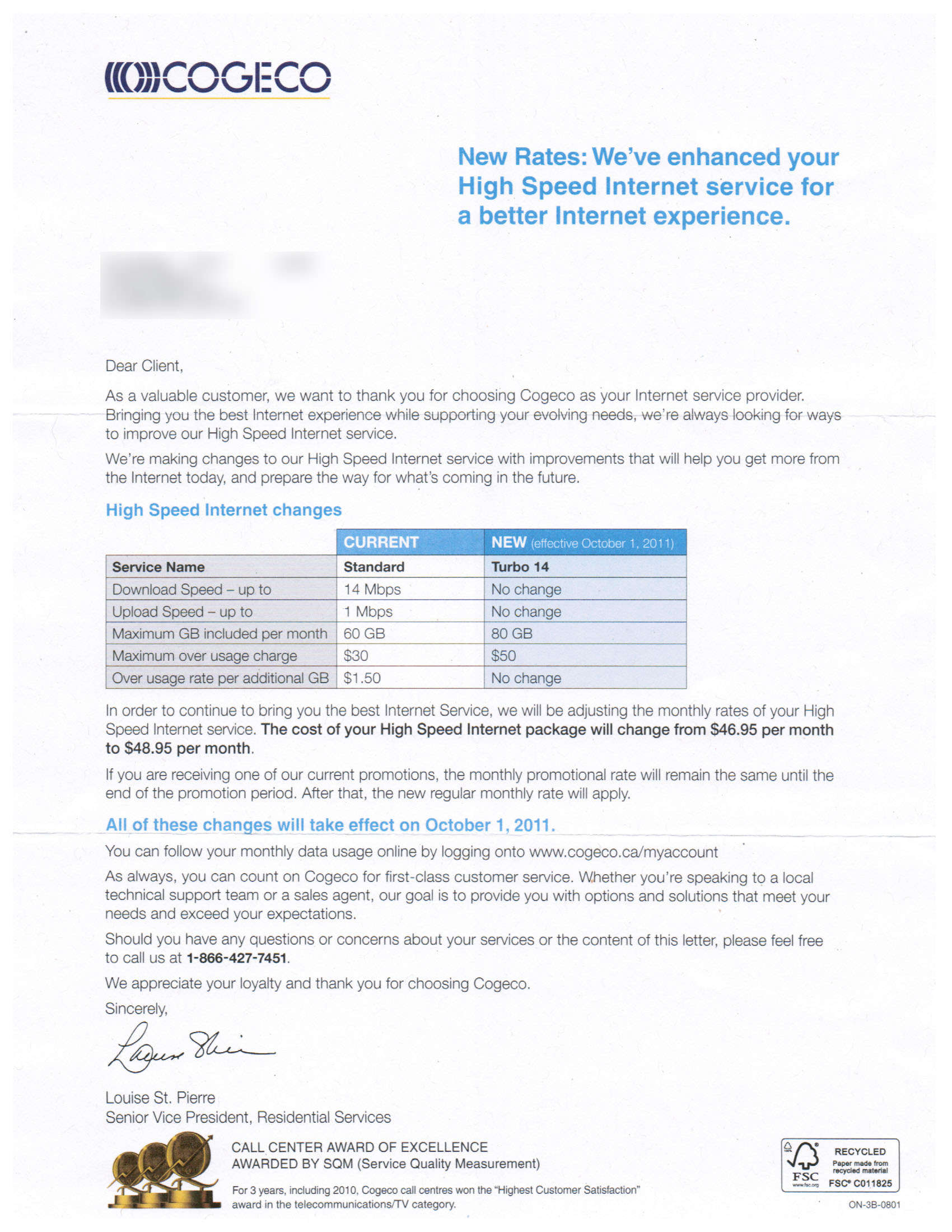
Tempering the damage is the company’s decision to raise broadband prices for Canadian customers by $2 a month for their Standard broadband package, soon to be priced at $48.95.
(Courtesy: 'Gone' from Fort Erie, Ontario)
“To add insult to injury, they are calling these changes ‘improvements,'” writes Stop the Cap! reader Claudette, who is a Cogeco customer in Ontario. “In fact, the only thing Cogeco is improving is their skill at overcharging us.”
Cogeco's financial mess in Portugal.
Cogeco has sent letters to subscribers notifying them about the “improvements,” mostly in the form of a name change for the company’s ‘Standard’ plan, soon to be renamed ‘Turbo 14.’ They have also launched a new section on their website to break down the changes.
The only benefit Cogeco is introducing for customers with their Standard plan is a slight bump in usage allowances, from 60 to 80GB. But that change comes with a major catch. Cogeco charges customers a $1.50/GB overlimit fee with a monthly maximum overcharge of $30. When ‘Turbo 14’ premieres Oct. 1, the maximum overlimit fee will jump to $50 a month.
“That is a total ripoff, because the next plan up with bigger allowances — just over 100GB a month — costs nearly $77 a month, for a whopping 16Mbps,” she adds. “They just raised our rates last July and now they want more.”
Cogeco is punishing their premium customers even more by taking the maximum overlimit fee cap completely off their DOCSIS 3-based Ultimate 30Mbps and 50Mbps plans. Available in some Cogeco service areas at prices of $60 and $100 a month respectively, the plans come with usage limits of 175-250GB. The sky is the limit for overlimit fees, racked up at $1 per gigabyte.
Cogeco customers are outraged, and have begun shopping for alternatives, just like their counterparts in Portugal who have put their cable service on the chopping block.
The ongoing Portuguese financial crisis has been met with tax increases and benefit reductions by the government, and Portuguese consumers have responded with wholesale cord-cutting, cancelling Cabovisao cable-TV service in droves.
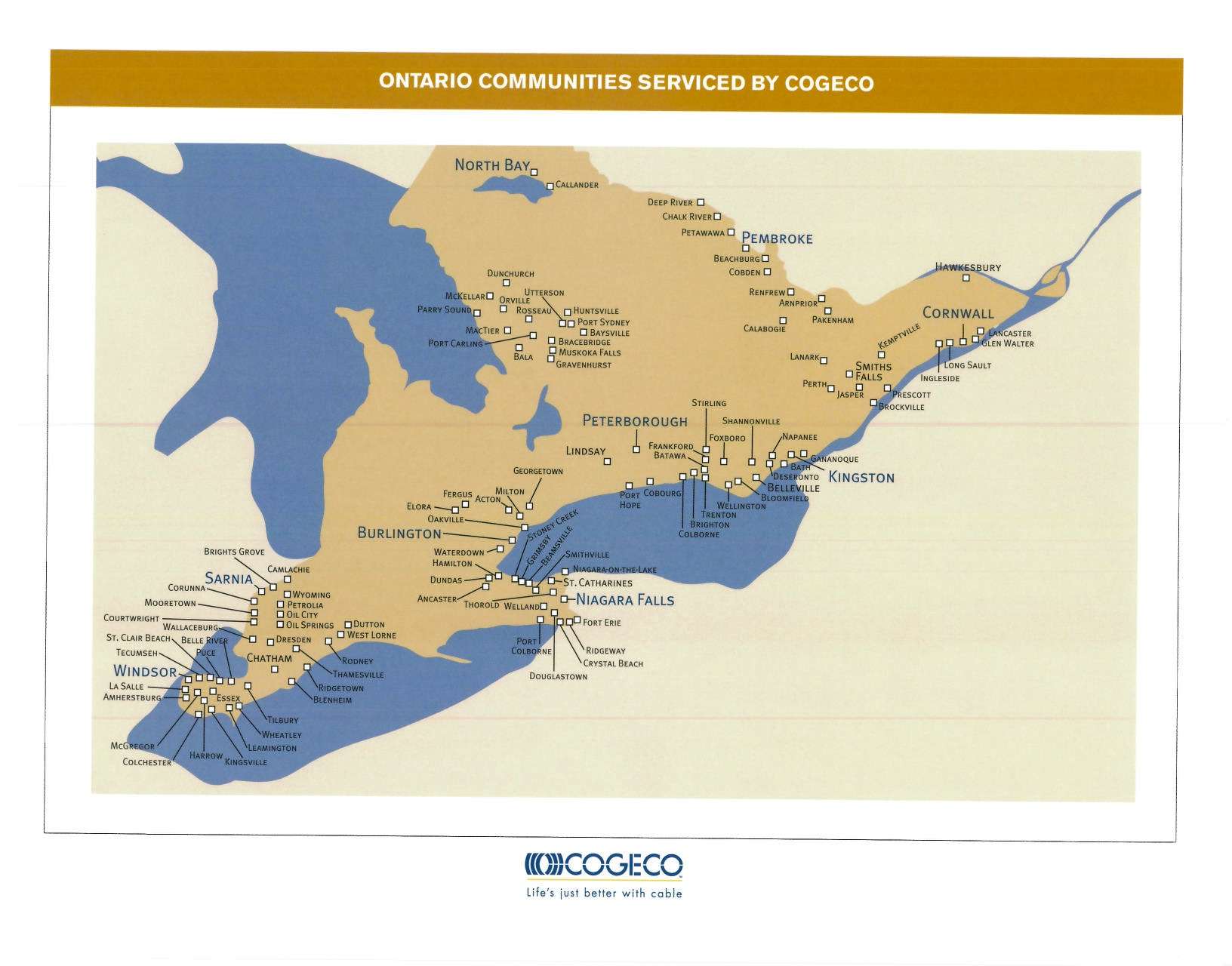
Cogeco's systems in Ontario (click to enlarge)
“You now have customers squarely opting out of [cable TV],” said Louis Audet, Cogeco’s president and chief executive officer. “These are economic circumstances that we have not, nor has anyone here, witnessed in North America. These are very unique to the circumstances in Portugal.”
At least Audet hopes they are.
With fewer competitive choices in the rural and suburban Ontario and Quebec markets Cogeco favors, consumers have a tougher time finding alternative providers, but not an impossible one. Many are dropping Cogeco’s phone and broadband packages, moving to Voice Over IP or cell phone service for the former, and independent broadband providers like TekSavvy for the latter. TekSavvy still retains unlimited use plans and has been traditionally more generous with allowances for the usage-based plans the company also sells.
Investors have been placated with a boost in Cogeco’s dividend payout… for now. But many have adopted a “told you so” attitude about the company’s controversial decision to invest in overseas cable to begin with.
Scotia Capital analyst Jeff Fan said he had a negative view about Cogeco’s Portuguese venture.
“We hope this paves the way for a sale,” he wrote in a note to investors, “as Portugal is still cash-flow negative and dilutes the strong Canadian results.”
In fact, many investor groups dream of an even bigger sale — of Cogeco itself.
Joseph MacKay of Mackie Research said Canada’s fourth-largest cable company is ripe for a takeover by a larger cable operator, presumably Rogers or Shaw Communications. Rogers already blankets Ontario with cable services, so Cogeco’s operations in eastern provinces would be a ‘natural fit’ for the company. Shaw’s interest in expanding eastward could also get a boost from the buyout of Cogeco.
But one significant roadblock remains — the controlling interests of the Audet family, which have no intention of selling and control enough voting shares to stymie a hostile takeover. In fact, despite the poor showing of the company’s Portuguese operations, the Audet family claims to be interested in acquiring other providers and expanding Cogeco’s size.
With the benefit of a two-dollar rate increase and the proceeds of Internet Overcharging, they’ll be in a position to put more dollars toward that goal.
Be Sure to Read Part One: Astroturf Overload — Broadband for America = One Giant Industry Front Group for an important introduction to what this super-sized industry front group is all about. Members of Broadband for America Red: A company or group actively engaging in anti-consumer lobbying, opposes Net Neutrality, supports Internet Overcharging, belongs to […]
Astroturf: One of the underhanded tactics increasingly being used by telecom companies is “Astroturf lobbying” – creating front groups that try to mimic true grassroots, but that are all about corporate money, not citizen power. Astroturf lobbying is hardly a new approach. Senator Lloyd Bentsen is credited with coining the term in the 1980s to […]
Hong Kong remains bullish on broadband. Despite the economic downturn, City Telecom continues to invest millions in constructing one of Hong Kong’s largest fiber optic broadband networks, providing fiber to the home connections to residents. City Telecom’s HK Broadband service relies on an all-fiber optic network, and has been dubbed “the Verizon FiOS of Hong […]
BendBroadband, a small provider serving central Oregon, breathlessly announced the imminent launch of new higher speed broadband service for its customers after completing an upgrade to DOCSIS 3. Along with the launch announcement came a new logo of a sprinting dog the company attaches its new tagline to: “We’re the local dog. We better be […]
Stop the Cap! reader Rick has been educating me about some of the new-found aggression by Shaw Communications, one of western Canada’s largest telecommunications companies, in expanding its business reach across Canada. Woe to those who get in the way. Novus Entertainment is already familiar with this story. As Stop the Cap! reported previously, Shaw […]
The Canadian Radio-television Telecommunications Commission, the Canadian equivalent of the Federal Communications Commission in Washington, may be forced to consider American broadband policy before defining Net Neutrality and its role in Canadian broadband, according to an article published today in The Globe & Mail. [FCC Chairman Julius Genachowski’s] proposal – to codify and enforce some […]
In March 2000, two cable magnates sat down for the cable industry equivalent of My Dinner With Andre. Fine wine, beautiful table linens, an exquisite meal, and a Monopoly board with pieces swapped back and forth representing hundreds of thousands of Canadian consumers. Ted Rogers and Jim Shaw drew a line on the western Ontario […]
Just like FairPoint Communications, the Towering Inferno of phone companies haunting New England, Frontier Communications is making a whole lot of promises to state regulators and consumers, if they’ll only support the deal to transfer ownership of phone service from Verizon to them. This time, Frontier is issuing a self-serving press release touting their investment […]
I see it took all of five minutes for George Ou and his friends at Digital Society to be swayed by the tunnel vision myopia of last week’s latest effort to justify Internet Overcharging schemes. Until recently, I’ve always rationalized my distain for smaller usage caps by ignoring the fact that I’m being subsidized by […]
In 2007, we took our first major trip away from western New York in 20 years and spent two weeks an hour away from Calgary, Alberta. After two weeks in Kananaskis Country, Banff, Calgary, and other spots all over southern Alberta, we came away with the Good, the Bad, and the Ugly: The Good Alberta […]
A federal appeals court in Washington has struck down, for a second time, a rulemaking by the Federal Communications Commission to limit the size of the nation’s largest cable operators to 30% of the nation’s pay television marketplace, calling the rule “arbitrary and capricious.” The 30% rule, designed to keep no single company from controlling […]
Less than half of Americans surveyed by PC Magazine report they are very satisfied with the broadband speed delivered by their Internet service provider. PC Magazine released a comprehensive study this month on speed, provider satisfaction, and consumer opinions about the state of broadband in their community. The publisher sampled more than 17,000 participants, checking […]


 Subscribe
 Time Warner Cable intends to implement a series of rate increases for 2012 across many of their service areas, beginning with a 4% rate hike for their cable television service that will take effect in December.