Home » rate hike » Recent Articles:

Time Warner Cable: ‘Our Promotion Cutbacks and Rate Hikes Cost Us Customers’

timewarner twcTime Warner Cable admitted this morning extracting more revenue from existing customers was more important than attracting new ones, and long time subscribers responded by canceling service in above average numbers.

In a conference call largely hosted by incoming CEO Robert Marcus, a number of Wall Street analysts listened to Marcus’ vision for Time Warner under his forthcoming leadership. Marcus offered competing, potentially incompatible visions in his defense of a lackluster quarter: charge existing customers higher prices for service to boost average revenue per subscriber (ARPU) while also improving the customer-company relationship.

For most of 2013, Time Warner has been aggressively moving away from heavily discounted promotional offers to attract customers. Both outgoing CEO Glenn Britt and Marcus have repeatedly stressed heavy discounting of service during the past two years is now over, and the company is looking forward to resetting prices higher when the promotions end later this year.

It is part of the company’s plan to “drive better performance in the residential business.” An unfortunate side effect is that the company continues to lose video and phone customers and its broadband service growth has been so slow, one analyst called it “anemic.” The company’s quarterly results show Time Warner added only 8,000 new broadband customers in the last three months. The company still earned $1.42 billion from broadband sales alone over the last three months, mostly because of rising broadband bills.
Courtesy: Jacobson

Courtesy: Jacobson

Offsetting that growth, TWC lost 191,000 residential video subscribers, leaving it with about 11.9 million video customers. At least 56,000 customers also pulled the plug on Time Warner Cable telephone service.

“As we discussed before, this [new pricing] approach represents a conscious decision to pursue subscribers with higher ARPU, higher profit and lower churn even if that means fewer connects,” said Marcus as he defended the results. “So it’s not a surprise that as in the first quarter of 2013, subscriber net adds were down in the second quarter on a year-over-year basis.”

As customers deal with increasing prices for cable television and broadband service and the irritation of modem rental fees, many are cutting back on their packages to keep their bill stable.

Marcus admitted customer sign ups of triple play — phone, broadband, and cable TV service — were way down in the second quarter and a lot fewer single and double-play customers were convinced to upgrade. The company’s promotional offers have come with a higher price and slower broadband service, often only 3Mbps.

In a number of markets, especially in the midwest, customers are shopping around for other providers. They are finding AT&T U-verse to be a formidable competitor.

“Throughout the quarter, U-verse was pretty aggressive with a beacon price of $79 for their triple play and $49 for their double play,” said Marcus. “I would characterize those as aggressive promotional prices, and they had an impact. I would say that the impact was more pronounced as the quarter wore on. We’ve now responded to that in the market, and I expect that our relative performance should improve there.”

But for much of the rest of the country where competition is less robust, Time Warner intends to continue to hold the line on pricing and resist discounting even if it means subscribers threaten to cancel.

Time Warner Cable has gotten itself ready for an onslaught of unhappy customers, assigning nearly 1,000 employees to staff four national customer retention centers dedicated to trying to persuade customers not to leave. But these specially trained representatives have a dual mission — keep customers with Time Warner Cable, but don’t give away the store doing so.

Stock buybacks and shareholder dividends were a major priority for Time Warner Cable's cash on hand.

Stock buybacks and shareholder dividends were a major priority for Time Warner Cable’s cash on hand.

“Not only are our reps saving more customers, they are also preserving more ARPU among the customers they save,” said Marcus. “As promotional roll-offs peak in the second half of 2013, we expect that our new retention capabilities will drive better revenue growth.”

In the broadband market, Time Warner changed little in the second quarter except to raise prices on service and equipment. Marcus could only point to the addition of 3,500 new Wi-Fi hotspots, mostly in New York City, as its signature achievement over the past three months.

On the residential side, broadband revenues were up 12.5%, but most of that growth came from a combination of the modem lease fee, an increase in the number of 30/5 and 50/5Mbps customers and a successful Turbo promotion.

Results for video and voice were considerably worse. Revenues were down about 4%.

But the company managed to report its highest ARPU ever, with customers now paying an average of more than $105 a month for Time Warner service. Most of that increase came from rising broadband prices.

Time Warner Cable has also been preoccupied with spending excess cash on hand to buy back its own stock, which creates shareholder value. Time Warner expects to spend at least $2.5 billion on stock buybacks this year. Shareholders also received $829 million in dividends (113% of Time Warner’s free cash flow).

“We repurchased 6.6 million shares for $638 million, and through July, we have repurchased approximately 83 million shares at an average cost of around $78.50 per share since we began the program in November of 2010,” reported chief financial officer Arthur T. Minson.

Time Warner Cable’s Board of Directors recently approved increasing spending up to $4 billion on stock buybacks.

[flv width=”640″ height=”380″]http://www.phillipdampier.com/video/WRGB Albany TWC Modem Fee 7-31-13.flv[/flv]

WRGB in Albany reports Time Warner Cable customers are angry about another price hike on the company’s modem lease fee effective Aug. 18. WRGB recommends customers buy their own modems to avoid the fee. Time Warner Cable’s Glenn Britt admitted earlier the fee is really just a hidden rate increase. (3 minutes)


Comcast Has ‘Plenty of Broadband Capacity,’ Reserves the Right to Acquire Others

Phillip Dampier August 1, 2013 Broadband "Shortage", Broadband Speed, Comcast/Xfinity, Competition, Consumer News, Online Video, Public Policy & Gov't, Video, Wireless Broadband Comments Off on Comcast Has ‘Plenty of Broadband Capacity,’ Reserves the Right to Acquire Others
Big, Bigger, Biggest, Still Bigger

Big, Bigger, Biggest… Bigger Still

Comcast has plenty of available bandwidth to indefinitely expand its High Speed Internet services at speeds up to 3Gbps and believes it has won the legal right to grow its cable business as large as it likes.

Comcast executives admitted Wednesday they have more than enough network capacity to meet the demands of customers, both now and well into the future.

“With regard to usage and capacity, we feel the network is flexible and has plenty of opportunity to grow in capacity,” said Neil Smit, president and CEO of Comcast Cable Communications. Smit was responding to a Wall Street analyst asking about future capacity during a quarterly financial results conference call.

Smit noted that some of the biggest bandwidth users served by Comcast are businesses, and the cable operator was well-positioned to service them by extending fiber or deploying its Metro Ethernet product. Residential customers get increased bandwidth through neighborhood node splitting or DOCSIS 3 channel bonding that combines several channels together to increase speed and capacity.

Brian Roberts, CEO of Comcast Corporation, agreed with Smit, adding, “the more the consumer desires speed, the better that is for our company.”

Roberts noted DOCSIS 3.1 — the next generation of cable broadband — was “promising technology.”

“At the cable convention, we demonstrated 3Gbps” over Comcast’s existing cable infrastructure, said Roberts.

Smit

Smit

Comcast is easily the country’s largest cable operator, but many believe it is restrained from growing larger through mergers and acquisitions because of antitrust concerns. But thanks to a number of lawsuits initiated by Comcast, the company believes it can now grow as large as it likes.

Roberts admits the question of cable industry consolidation remains a gray area, particularly for Comcast. But he told investors he does not believe there are any remaining legal hurdles preventing Comcast from buying out other cable operators, despite earlier FCC rulemakings limiting the maximum size a cable company can grow through buyouts.

Comcast yesterday announced its last buyout — NBCUniversal — helped fuel a 29% increase in net income in the second quarter, thanks in part to strong results from film and television.

But many of Comcast’s largest gains came from its cable business.

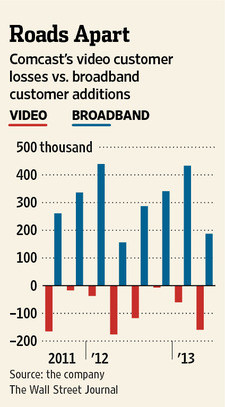
Despite continued losses of video subscribers (159,000 in the second quarter), Comcast’s cable revenue increased 5.8% to $10.47 billion, and operating cash flow grew 5.7% to $4.3 billion. Comcast, which also owns several NBC broadcast affiliates, is playing for both sides of the retransmission consent wars. Its owned and operated television stations have demanded higher fees to be carried on cable systems, many owned by Comcast itself. The increased programming costs fuel subscriber rate increases, which also boost revenue.

Broadband way up, although the company keeps losing video customers to cord-cutting.

Broadband is way up, although the company keeps losing video customers to cord-cutting.

Comcast’s broadband revenue has continued to grow dramatically. Customer additions for High Speed Internet access were up more than 20% in the quarter — the best second-quarter growth in five years — even as subscribers paid more for the service because of rate increases. Customer growth and price hikes delivered 8% growth in broadband revenue. In the last quarter alone, Comcast earned $2.6 billion from its broadband business.

Comcast is not spending a significant percentage of that revenue on enhanced broadband network upgrades. Instead, the company has increased investments to wire office parks and businesses to entice commercial customers, which account for a substantial amount of new customer growth. Comcast is also investing in research and development of new products and services, such as set-top boxes. The company also expects to pay 10% more in programming costs than it did a year earlier.

Year-to-date cable communications capital expenditures have increased 7.1% to $2.3 billion representing 11.3% of cable revenue. Comcast expects that for the full-year of 2013, cable capital expenditures will increase by about 10% over 2012.

Some other highlights from the quarter:

  • In the last six months, Comcast completed broadband speed increases for 70 percent of its customers;
  • High Speed Internet revenue was again the largest contributor to Comcast’s cable revenue growth;
  • At the end of the quarter, 33% of Comcast’s residential high-speed customers take a higher speed tier above its primary service;
  • Comcast has pushed Wi-Fi hard, installing more than four million wireless gateways and boosted Wi-Fi coverage to 250,000 hotspots through both cable partnerships and its home hotspot initiative;
  • Comcast’s new X1 cloud-based set-top platform has been introduced to more than half of its national service area and will be available everywhere by the end of 2013. By the end of the year, Comcast also expects to push a firmware update to installed boxes to upgrade them to its new X2 platform;
  • The average Comcast subscriber now pays the company $160 per month, up 7.4% from last year. Rate hikes, speed upgrades and growing programming packages account for the higher price;
  • 77% of Comcast video customers took at least two products and among those, 42% took phone, broadband and television service.

[flv width=”640″ height=”380″]http://www.phillipdampier.com/video/Bloomberg Comcasts Cable and Media Units Grow 7-31-13.flv[/flv]

Bloomberg reports Comcast is still having trouble holding on to its video-only customers, but broadband customer growth continues to explode. Comcast also does well because it owns a number of cable networks and entertainment properties. Expect Comcast to continue evolving its products to bring them closer to the things people do online.  (3 minutes)

Why Time Warner Cable Can Jack Up Rates Willy-Nilly: Lack of Competition

cable ratesAlthough cable and phone companies love to declare themselves part of a fiercely competitive telecommunications marketplace, it is increasingly clear that is more fairy tale than reality, with each staking out their respective market niches to live financially comfortable ever-after.
In the last week, Time Warner Cable managed to alienate its broadband customers announcing another rate increase and a near-doubling of the modem rental fee the company only introduced as its newest money-maker last fall. What used to cost $3.95 a month will be $5.99 by August.

The news of the “price adjustment” went over like a lead balloon for customers in Albany, N.Y., many who just endured an 18-hour service outage the day before, wiping out phone and Internet service.

“They already get almost $60 a month from me for Internet service that cuts out for almost an entire day and now they want more?” asked Albany-area customer Randy Dexter. “If Verizon FiOS was available here, I’d toss Time Warner out of my house for good.”

Alas, the broadband magic sparkle ponies have not brought Dexter or millions of other New Yorkers the top-rated fiber optic network Verizon stopped expanding several years ago. The Wall Street dragons complained about the cost of stringing fiber. Competition, it seems, is bad for business.

In fact, Verizon Wireless and Time Warner Cable are now best friends. Verizon Wireless customers can get a fine deal — not on Verizon’s own FiOS service — but on Time Warner’s cable TV. Time Warner Cable originally thought about getting into the wireless phone business, but it was too expensive. It invites customers to sign up for Verizon Wireless service instead.

timewarner twcThis is hardly a “War of the Roses” relationship either. Wall Street teaches that price wars are expensive and competitive shouting matches do not represent a win-win scenario for companies and their shareholders. The two companies get along fine where Verizon has virtually given up on DSL. Time Warner Cable actually faces more competition from AT&T’s U-verse, which is not saying much. The obvious conclusion: unless you happen to live in a FiOS service area, the best deals and fastest broadband speeds are not for you.

Further upstate in the Rochester-Finger Lakes Region, Time Warner Cable faces an even smaller threat from Frontier Communications. It’s a market share battle akin to United States Cable fighting a war against Uzbekistan Telephone. Frontier’s network in upstate New York is rich in copper and very low in fiber. Frontier has lost landline customers for years and until very recently its broadband DSL offerings have been so unattractive, they are a marketplace afterthought.

Rochester television reporter Rachel Barnhart surveyed the situation on her blog:

Think about this fact: Time Warner, which raked in more than $21 billion last year, has 700,000 subscribers in the Buffalo and Rochester markets. I’m not sure how many of those are businesses. But the Western New York market has 875,000 households. That’s an astounding market penetration. Does this mean Time Warner is the best choice or the least worse option?

Verizon-logoThat means Time Warner Cable has an 80 percent market share. Actually, it is probably higher because that total number of households includes those who either don’t want, need, or can’t afford broadband service. Some may also rely on limited wireless broadband services from Clearwire or one of the large cell phone companies.

In light of cable’s broadband successes, it is no surprise Time Warner is able to set prices and raise them at will. Barnhart, who has broadband-only service, is currently paying Time Warner $37.99 a month for “Lite” service, since reclassified as 1/1Mbps. That does not include the modem rental fee or the forthcoming $3 rate hike. Taken together, “Lite” Internet is getting pricey in western New York at $47 a month.

Retiring CEO Glenn Britt believes there is still money yet to be milked out of subscribers. In addition to believing cable modem rental fees are a growth industry, Britt also wants customers to begin thinking about “the usage component” of broadband service. That is code language for consumption-based billing — a system that imposes an arbitrary usage limit on customers, usually at current pricing levels, with steep fees for exceeding that allowance.

frontierRochester remains a happy hunting ground for Internet Overcharging schemes because the only practical, alternative broadband supplier is Frontier Communications, which Time Warner Cable these days dismisses as an afterthought (remember that 80 percent market share). Without a strong competitor, Time Warner has no problem experimenting with new “usage”-priced tiers.
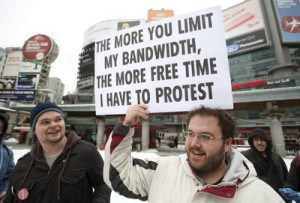
Time Warner persists with its usage priced plans, despite the fact customers overwhelmingly have told the company they don’t want them. Time Warner’s current discount offer — $5 off any broadband tier if you keep usage under 5GB a month, has been a complete marketing failure. Despite that, Time Warner is back with a slightly better offer — $8 off that 5GB usage tier and adding a new 30GB usage limited option in the Rochester market. We have since learned customers signing up for that 30GB limit will get $5 off their broadband service.

internet limitIn nearby Ohio, the average broadband user already exceeds Time Warner’s 30GB pittance allowance, using 52GB a month. Under both plans, customers who exceed their allowance are charged $1 per GB, with overlimit fees currently not to exceed $25 per month. That 30GB plan would end up costing customers an extra $22 a month above the regular, unlimited plan. So much for the $5 savings.

Unfortunately, as long as Time Warner has an 80 percent market share, the same mentality that makes ever-rising modem rental fees worthwhile might also one day give the cable company courage to remove the word “optional” from those usage limited plans. With usage nearly doubling every year, Time Warner might see consumption billing as its maximum moneymaker.

In 2009, Time Warner valued unlimited-use Internet at $150 as month, which is what they planned to charge before pitchfork and torch-wielding customers turned up outside their offices.

Considering the company already earns 95 percent gross margin on broadband service before the latest round of price increases, one has to ask exactly when the company will be satisfied it is earning enough from broadband service. I fear the answer will be “never,” which is why it is imperative that robust competition exist in the broadband market to keep prices in check.

Unfortunately, as long as Wall Street and providers decide competition is too hard and too unprofitable, the price increases will continue.

Cablevision to Your Grandfathered Cable Package: Drop Dead – Rate Hikes for All

Phillip Dampier May 30, 2013 Cablevision (see Altice USA), Consumer News 1 Comment
Optimum profits.

Optimum profits.

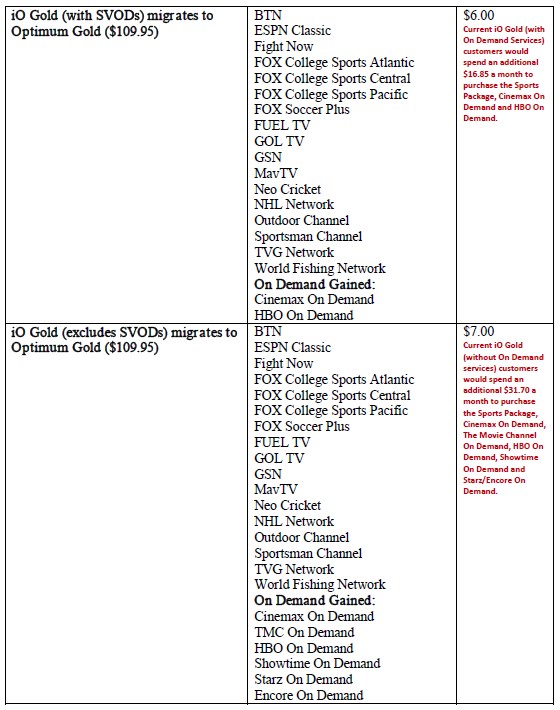
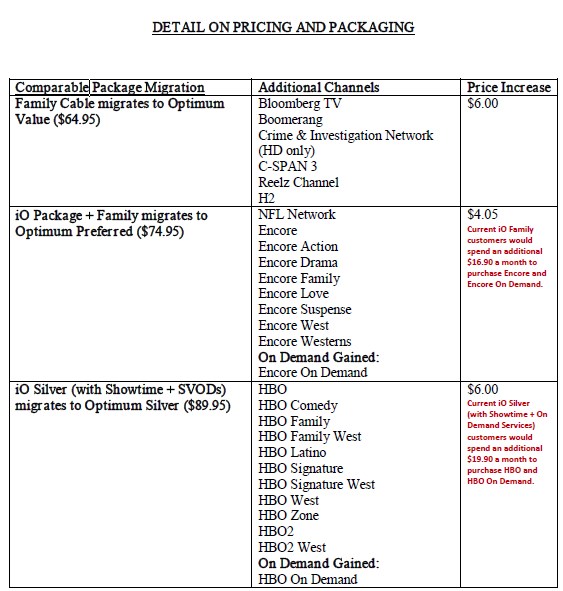
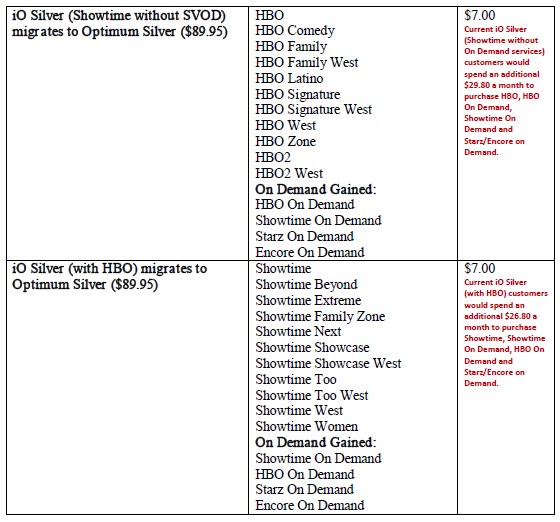
Cablevision customers that managed to keep now-discontinued television packages will soon have to pay an extra $4-7 a month to upgrade to one of several newer packages this summer.

In March 2012, Cablevision dropped many of their “iO” packages in favor of new ones dubbed “Optimum.” The cable company originally let current customers keep the older, cheaper packages, but starting June 3 that will be no more.

Michael Chowaniec from Cablevision’s Government Affairs department notified Connecticut regulators the company was preparing to force customers into newer Optimum packages at a higher cost.

“Legacy customers migrating to comparable packages will experience a rate increase, but will gain between 6 to 23 linear networks and/or premium channels and enhancements and additional On Demand services,” Chowaniec wrote. “In many cases, the rate change is significantly less than the price of the additional channels and services, if purchased on an a la carte basis.”

“Customers on promotions for a legacy video package that is being eliminated will be able to keep their promotional rate through the end of the promotional period and will be migrated at the end of the promotion,” he added.

sheet 1
sheet 2
sheet 3

The rate increases come after an earlier $5 rate hike for broadband service and the introduction of a $2.95 monthly “sports programming fee” paid by most customers. That represents a total rate increase for some of up to $15 a month in 2013.

Life has been getting tougher for Cablevision customers over the past few months. Optimum Rewards members are losing their “Free Movie Tuesday” and discount ticket benefits with the sale of Cablevision’s 47 movie theater chain Clearview Cinemas.

Cablevision’s ruling family even canceled the July 4 fireworks display run for years from their home on Oyster Bay, N.Y. “for personal reasons.”

NY: Verizon Asking to Report Your Payment History to Credit Agencies; Wants New Fees

Phillip Dampier April 23, 2013 Competition, Consumer News, Public Policy & Gov't, Verizon Comments Off on NY: Verizon Asking to Report Your Payment History to Credit Agencies; Wants New Fees

Verizon-logoVerizon Communications has filed separate requests with the New York State Public Service Commission that would report customers’ payment histories to credit reporting agencies, share your payment history with competing providers, and increase phone bills statewide to recoup expenses related to construction costs.

Verizon Wants to Influence Your Credit Score

One of the most substantial changes proposed by Verizon is the deregulation of privacy requirements that limit the amount of information the phone company can share with credit reporting agencies about your past payment history and whether you could represent a credit risk to the next telecommunications company you choose to do business with.

New York regulators originally enforced limits on how much information Verizon could share and with whom. Generally, the rules now state the phone company can only share your payment history with other telephone companies, such as in the case of moving to an area served by a different provider or if you choose to sign up with a competitor. Providers use this information to decide if they will require a deposit before connecting service.

Verizon claims the current rules do not go far enough to protect the company from deadbeats who bounce between unregulated telecom providers (wireless, Voice over IP, and cable telephone service) and Verizon. The company is asking the PSC to:

  • to report final unpaid undisputed accounts of its local exchange customers to credit reporting agencies,
  • to engage in full file reporting with the NCTUE, a special credit reporting service created by and for cable, telephone, and other utility companies to track customer payment histories (i.e., reporting monthly on all payment history for all customers), and
  • to engage in full file reporting with Equifax, Experian and TransUnion should Verizon choose to do so in the future.

experianLate phone company payments appearing on a consumer’s credit report can be devastating to a consumer’s general credit score, which can affect credit lending decisions, home purchases, apartment leases, insurance rates, and employment prospects. Disconnected, unpaid accounts turned over to an independent collection agency may already appear on credit reports, but Verizon late-payers who still have service with the company might be affected much sooner.

Verizon hopes the change will convince customers to pay Verizon first instead of last or not at all:

“Consumer reporting agencies serve an important function by enabling businesses to avoid bad-debt costs and by preventing consumers, in a competitive market, from hopping with impunity from one company to another, accumulating unpaid debts at each step of the way,” Verizon argues in its regulatory filing. “In that way, information obtained from consumer reporting agencies reduces bad-debt costs that would otherwise have to be passed on to consumers who do pay their bills. Further, consumers who know that their credit scores will be reported will be less likely to default on payments; conversely, consumers who feel secure that such data will not be reported will be more likely to believe that moving to another provider is an acceptable alternative to paying bills.”

Verizon Seeks New Fees, Rate Increases

Verizon customers in New York will soon see higher phone bills if Verizon’s appeal to raise certain rates and tack on a new monthly service fee is approved:

Municipal Construction Surcharge: To cope with a declining number of landline customers, Verizon is seeking the imposition of a new $0.99 surcharge on all residential and business customers (except Lifeline) to help recoup the costs of relocating Verizon lines in public rights-of-way to prevent interference with street maintenance, repairs, or public construction projects. Verizon is also mandated to remove lines or other equipment that present a potential danger to public safety or health. Because Verizon has lost half of their landline customers in New York since 2006, the costs incurred by Verizon per remaining customer have increased dramatically, Verizon argues. In 2006, the company claims the average cost for line relocation was $10.79 per customer. Today, the company says the cost has risen to $31.01 annually.

Verizon seemed unconcerned about the impact the new fee might have on customers who could use it as an excuse to abandon landline service.

“Verizon needs to recoup its losses where it can,” said Verizon’s general counsel Keefe B. Clemons. “Moreover, customers have competitive alternatives and can choose other providers if they are dissatisfied.”

nys pscOther Service Charges and Rate Hikes:

  • Verizon is seeking increases in the non-recurring Service Charge and the Central Office Line or Port Charge for business customers;
  • Verizon seeks a $3 rate increase for its legacy ISDN service, which still serves a declining number of business customers;
  • Verizon also seeks a 50 cent a month increase for maintaining a non-published number. The current rate ($2.50) has remained unchanged since 2005 and Verizon claims the increase is required to “keep up with inflation.” The company said its new rate would still be lower than AT&T in Connecticut ($4.99/month) or Time Warner Cable ($3.75/month);
  • Verizon is discontinuing its Busy Verification and Interruption Service, primarily because it does not work with most of its competitors.

Verizon says these rate changes are necessitated by a marked decrease in the number of customers keeping their Verizon landlines. Since New York still requires Verizon to serve every part of its designated service area, the current financial situation for the company’s landline service division is untenable. The company argues its investment in FiOS and other network upgrades more than outweigh the amount of revenue the company is earning from the declining number of landline customers. Verizon did not mention the far brighter financial performance of its wireless division Verizon Wireless, not subject to the PSC’s regulatory requirements.

Search This Site:

Contributions:

Recent Comments:

Your Account:

Stop the Cap!