Home » rate hike » Recent Articles:

Charter Communications Weighs Time Warner Cable Takeover by End of 2013; Usage Caps Might Follow

The new name of Time Warner Cable?

The next name of Time Warner Cable?

Charter Communications is laying the foundation for a leveraged buyout of Time Warner Cable before the end of the year in a deal that could leave Time Warner Cable’s broadband customers with Charter’s usage caps.

Reuters reported discussions between the two companies grew more serious after last week’s revelation a poor third quarter left TWC with 308,000 fewer subscribers.

Charter is relying on guidance from Goldman Sachs to structure a financing deal likely to leave Charter in considerable debt. Charter Communications emerged from bankruptcy in 2009 and is the country’s tenth largest cable operator, estimated to be worth about $13 billion. Time Warner Cable is the second largest cable operator and is worth more than $34 billion.

The disparity between the two companies has kept Time Warner Cable resistant to a deal with Charter, stating it would not be beneficial to shareholders. Charter executives hope to eventually win shareholder support for a buyout stressing the significant cost savings possible from a combined operation, particularly for cable programming.

The deal would likely end Time Warner Cable as a brand and leave Charter Communications CEO Thomas Rutledge in charge of a much larger cable company. Pricing and packaging decisions are usually made by the buyer, which could bring faster broadband speeds to Time Warner customers, but also usage caps already in place at Charter.

John Malone’s War on Customers

Malone

Malone

Cable billionaire John Malone, former CEO of Tele-Communications, Inc. (TCI) — America’s largest cable operator in the 1980s — believes consolidation is critical to the future of a cable business facing competition from phone companies and cord cutting. Malone’s Liberty Media, which now holds a 25% stake in Charter, is currently buying and consolidating cable operators in Europe. Malone’s post-consolidation vision calls for only two or three cable operators in the United States.

Malone’s quest for consolidation is nothing new.

Under his leadership, TCI eventually became the country’s biggest cable operator, but one often accused of poor service and high prices. More than a decade of complaints from customers eventually attracted the attention of the U.S. Congress, which sought to rein in the industry with the 1992 Cable Act — legislation that lightly regulated rental fees for equipment and the price of the company’s most-basic television tier.

Despite the fact consumer advocates didn’t win stronger consumer protection regulations, TCI was still incensed it faced a new regulatory environment that left its hands tied. One executive at a TCI subsidiary advocated retaliation with broad rate increases for unregulated services to make up any losses from mandated rate cuts.

A 1993 internal TCI memo obtained by the Washington Post instructed TCI system managers and division vice presidents to increase prices charged for customer service calls and add new fees for common installation services the company used to offer for free. TCI’s Barry Marshall recommended charging for as many “transaction” services as possible — like hooking up VCR’s, running cable wire, and programming remote controls for confused customers.

“We have to have discipline,” Marshall wrote. “We cannot be dissuaded from the [new] charges simply because customers object. It will take awhile, but they’ll get used to it. The best news of all is we can blame it on re-regulation and the government now. Let’s take advantage of it!”
Tele-Communications, Inc. (TCI) was the nation's largest cable operator.  Later known as AT&T Cable, the company was eventually sold to Comcast.

Tele-Communications, Inc. (TCI) was the nation’s largest cable operator. Later known as AT&T Cable, the company was eventually sold to Comcast.

The FCC’s interim chairman at the time — James Quello, charged with monitoring the cable industry, was not amused.

“It typifies the attitude of cable companies engaging in creative pricing and rate increases to evade the intent of Congress and the FCC,” Quello said. “There is little doubt that the cable industry has an economic stake in discrediting the congressional act they vehemently and unsuccessfully opposed.”

Marshall defended his internal memo, although admitted it was inartfully written and was not intended for the public. Revelation of a damaging memo like this would normally lead to a quiet resignation by the offending author, but not at John Malone’s TCI, a company with a reputation for being difficult.

Mark Robichaux’s 2005 book, Cable Cowboy: John Malone and the Rise of the Modern Cable Business, was even less charitable.

Robichaux describes Malone as a “complicated hero,” at least for investors for whom he was willing to ignore banking rules and creatively interpret tax law. Robichaux wrote Malone’s idea of customer service was to ‘charge as much as you can, but spend as little as you can get away with.’

TCI’s top priority was to keep up the cable business as an “insular cartel.” The predictable result included accusations of “shoddy service” customers were forced to take or leave. In the handful of markets where TCI faced another cable competitor, TCI ruthlessly slashed prices to levels some would describe as “predatory,” only to rescind them the moment the competitor was gone. TCI’s intolerance for competition usually meant mounting pressure on competitors to sell their system to TCI (sometimes at an astronomical price) or face a certain slow death from unsustainable price cuts.

Among Malone’s most-trusted friends: junk bond financier Michael Milken and Leo Hindery, former CEO of Global Crossing.

Congressman Albert Gore, Jr., later vice-president during the Clinton Administration, was probably Malone’s fiercest critic in Washington. Gore’s office was swamped with complaints from his Tennessee constituents upset over TCI’s constant rate increases and anti-competitive behavior.

The cable industry's biggest competitor in the 1980s-1990s was a TVRO 6-12 foot diameter home satellite system.

The cable industry’s biggest competitor in the 1980s-1990s was a TVRO 6-12 foot diameter home satellite system.

Gore was especially unhappy that TCI’s grip extended even to its biggest competitor — satellite television.

In the 1980s and early 1990s, cable operators made life increasingly difficult for home satellite dish owners, many in rural areas unserved by cable television. But things were worse for home dish owners that walked away from TCI and began watching satellite television instead. To protect against cord-cutting, the cable industry demanded encryption of all basic and premium cable channels delivered via satellite. It was not hard to convince programmers to scramble — most cable networks in the 1980s were part-owned by the cable industry itself.

To make matters worse, unlike cable systems that only leased set-top boxes to customers, home dish owners had to buy combination receiver-descrambler equipment outright, starting at $500. Just a few years later, the industry pressured programmers to switch to a slightly different encryption system — one that required home dish owners replace their expensive set-top box with a different decoder module available only for sale.

Gore was further incensed to learn TCI often insisted home dish owners living within a TCI service area buy their satellite-delivered programming direct from the cable company. Customers hoping to leave cable for good found themselves still being billed by TCI.

Sometimes the rhetoric against TCI and Malone got personal.

”He called me Darth Vader and the leader of the cable Cosa Nostra,” Malone said of Gore. “You can’t win a pissing contest with a skunk, so there’s no point in getting involved in that kind of rhetoric.”

“There’s a joke going around Washington,” John Tinker, a New York-based Morgan Stanley & Company investment banker who specializes in cable television said of Malone back in 1990. “If you have a gun with two bullets, and you have Abu Nidal, Saddam Hussein and John Malone in a room, who would you shoot? The answer is John Malone — twice, to make sure he’s dead.”

TCI itself was a four letter word in the many small communities that endured the cable company’s insufferable service, outdated equipment, and constant rate “adjustments.”

The New York Times reported John Malone’s TCI had a reputation for treating customers with “utter disdain,” and provided examples:

  • In 1973, rate negotiations stalled with local regulators in Vail, Colo., the local TCI system shut off all programming for a weekend and ran nothing but the names and home phone numbers of the mayor and city manager. The harried local government gave in.
  • In 1981, TCI withheld fees and vowed to go completely dark in Jefferson City, Mo., if the city failed to renew its franchise, while a TCI employee — “who turned out to have a psychological problem,” said Malone — threatened harm to the city’s media consultant. Again, a beleaguered local government renewed the franchise — although in a subsequent lawsuit, TCI was fined $10.8 million in actual damages and $25 million in punitive damages.
  • In 1983, the small city of Kearney, Neb., also dissatisfied with poor service and rising rates, tried to give Malone some competition in the form of a rival system built by the regional telephone company. TCI slashed fees and added channels until the enemy was driven from the field.

“That’s the dark side, if you will, of TCI,” said Richard J. MacDonald, a media analyst with New York-based MacDonald Grippo Riely.

By mid-1989, Malone’s frenzied effort to consolidate the cable industry resulted in him presiding over 482 merger/buyout deals, on average one every two weeks. Among the legacy cable companies that no longer existed after TCI’s takeover crew arrived: Heritage Communications, United Artists Communications and Storer Communications.

To cover the debt-laden deals, Malone simply raised cable rates and shopped for easy credit. Bidding with others’ money, the per-subscriber price of cable systems shot up from $998 in 1983 to an astronomical $2,328 in 1989.

The General Accounting Office, the investigative arm of Congress, found deregulating the cable industry cost customers through rate hikes averaging 43 percent. In Denver, TCI raised rates more than 70% between 1986 and 1989.

Malone’s attempt to finance a leveraged, debt-heavy buyout of Time Warner Cable seems to show his business philosophy has not changed much.

Time Warner Cable’s Halloween Nightmare: 3% of Customers Left This Summer, With More to Follow

Phillip Dampier October 31, 2013 Broadband Speed, Competition, Consumer News 2 Comments

pumpkinTime Warner Cable’s summer was “horrible,” to quote one analyst, after three percent of customers left over programming disputes and increasing prices for broadband and telephone service, with more likely to follow as price promotions expire and rates increase further.

Cable analysts were shocked Time Warner Cable lost 308,000 customers in the last three months, most leaving over interruptions of CBS and Showtime over a contract dispute. But customers were also ready to leave over increasing modem rental fees, rate increases, and the company’s growing pullback on promotional pricing. Time Warner Cable’s poor results have ironically caused its stock price to increase this morning, but only because investors suspect a shareholder value-boosting merger with Charter Communications could come within months.

“Just horrible,” MoffetNathanson analyst Craig Moffett wrote in a note to investor clients this morning. “The CBS dispute apparently took a much larger toll than anyone would have imagined, and this colored all the results.”

Sources have told Reuters that cable billionaire John Malone has approached Time Warner Cable about a full takeover by Charter Communications, but has been rebuffed by Britt so far. But with Britt exiting and Time Warner Cable’s underperformance, shareholder pressure for a deal with Charter will only increase.

“This enhances Malone’s appeal to Time Warner Cable shareholders that they would be better off with another management team,” Brean Capital analyst Todd Mitchell told Reuters.

When promotional prices end, a growing percentage of TWC customers drop services or take their business elsewhere.

When promotional prices end, a growing percentage of TWC customers drop services or take their business elsewhere.

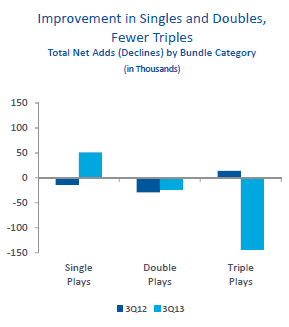
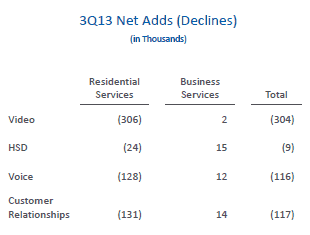
The subscriber losses pushed profits down 34 percent at the cable company, to $532 million. The triple play tragedy saw subscriber losses for all the company’s residential services. At a time when other cable companies cannot process High Speed Internet sign ups fast enough, at least 24,000 Time Warner Cable broadband customers left over rate hikes and equipment fees. Analysts had expected the company to pick up more than 46,000 broadband customers during the last three months, not lose them. The company’s phone service is also in decline. Only rate increases and customers upgrading to higher speed tiers delivered a slight revenue boost.

Outgoing CEO Glenn Britt set the stage for the current forced retreat on its revenue forecast for the year:

  • Time Warner Cable executives made the decision at the end of 2012 to stop heavily discounting service and cut back on promotions. Their theory was the company would attract a larger base of stable customers willing to pay non-promotional rates and tolerate rate increases;
  • Executives announced as Time Warner’s phone service was brought “in-house,” the company would stop aggressively pricing triple play bundles that included phone service. That turned out to be a bad decision for growth because customers, already prone to landline cord-cutting, downgraded their bundle or left when promotions expired and ditched the phone line;
  • A year of broadband price increases and the introduction of a modem rental fee rubbed customers the wrong way. “We have raised prices recently in the form of modem rental fees, but it’s really just broadband price increase,” again admitted Britt this morning. Future rate increases on modem rentals will give broadband customers another push to shop around for a better deal. At least 24,000 did that over the summer and left, mostly for AT&T U-verse in the midwest and Verizon FiOS in the east.

The lengthy dispute between Time Warner and CBS did the most damage and not just to customers directly affected by channel losses. A major increase in call volumes from alienated customers overwhelmed national call centers, creating long hold times for everyone calling in.

Time Warner expects 40 percent of the cable company’s service area will be overlapped by major competitors AT&T U-verse (now 27%) and Verizon FiOS (now 13%). That represents one million more homes than last year.

Bye Bye: Time Warner Cable lost residential customers for all of its services during the third quarter.

Bye Bye: Time Warner Cable lost residential customers for all of its services during the third quarter.

Incoming CEO Robert Marcus said he was dissatisfied with subscriber results from current promotions and rates. New Time Warner Cable customers, Marcus noted, are paying higher prices for fewer or less robust services as part of current promotional packages. Although that has driven a “dramatic improvement in recurring revenue” among customers actually signing up, many choose the lower-priced competition instead.

Marcus also noted customers are taking fewer services and are resistant to upgrading to double or triple play packages, reducing the potential average revenue per customer (ARPU).

“To a great extent, these are expected outcomes of our pricing and packaging strategy and the trade-off between ARPU and volume, but I’m confident we can do better on volume without giving up the ARPU benefits we’ve been achieving,” Marcus told analysts on a morning conference call.

Instead of getting more aggressive on pricing, the company plans to trot out free gifts and pitch discounted slow speed Internet to attract price-resistant DSL customers.

“Next week, we’ll launch our holiday offer, which includes a free Samsung tablet loaded with all of our apps, including TWC TV, with the purchase of higher-end packages,” Marcus said. “I think this will generate lots of interest and really highlight TWC TV and the value it adds to our service offerings.”

Marcus called it inconceivable and unacceptable that at least 4.5 million people are still subscribed to telephone company DSL in Time Warner Cable service areas. The company plans an advertising blitz to steal customers away from companies like AT&T, Verizon, Frontier, CenturyLink, Windstream and FairPoint.

At the center of that effort is the recently announced 2/1Mbps Lite package, which will sell at the everyday price of $14.95 a month. Marcus wants at least 500,000 DSL customers switched to Time Warner over the next 18 months.

“Over time, as these customers’ speed and capacity needs increase, we’ll be well positioned to sell them higher-end product,” Marcus said.

Or they will switch back to the phone company if Time Warner increases the price.

CenturyLink’s Broadband Issues Color Company’s Deregulation Request in Washington

Phillip Dampier October 15, 2013 Broadband Speed, CenturyLink, Community Networks, Competition, Consumer News, Public Policy & Gov't Comments Off on CenturyLink’s Broadband Issues Color Company’s Deregulation Request in Washington

centurylinkCenturyLink is seeking “greater flexibility” to set its own prices, terms and conditions of service without a review by Washington State regulators, even as its broadband customers complain about bait and switch Internet speeds and poor service.

Three years after the Monroe, La., based independent phone company purchased Qwest — a former Baby Bell serving the Pacific Northwest — CenturyLink continues to lose customers to cell phone providers and cable phone and broadband service. Since 2001, CenturyLink and its predecessor have said goodbye to 60 percent of their customers, reducing the number of lines in service from around 2.7 million to just over 1 million.

CenturyLink is apparently ready to lose still more after upsetting customers with a notice it intended to seek deregulation that could lead to rising phone bills.

Docket UT-130477, filed with the Washington Utilities and Transportation Commission (WUTC) proposes to replace currently regulated service with what CenturyLink calls “an Alternate Form Of Regulation.” (AFOR)

broadband wa

If approved, CenturyLink will “normalize” telephone rates in Washington State, language some suspect is “code” for a rate increase. For CenturyLink customers in cities like Seattle, Spokane, and Tacoma, the maximum rate permitted for basic phone service for the next three years will be $15.50 (unless a customer already pays more), before calling features, taxes, and surcharges are applied. Most observers, including the state regulator, suspect CenturyLink will limit rate hikes to $1-2 if approved. A higher increase might provoke more customers to leave.

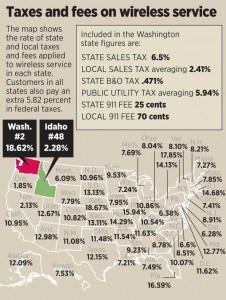
Washington residents already pay the nation's second highest taxes on wireless service. Now landline customers also pay more.

Washington residents already pay the nation’s second highest taxes on wireless service. Now landline customers also pay more. (Graphic: The Spokesman)

“We don’t think they can do much because, in our view, all (a big rate increase) is going to do is accelerate people dropping the landline into their homes,” Brian Thomas, a spokesman for the Washington Utilities and Transportation Commission told The Spokesman-Review. “A lot of people are cutting the cord.”

Frontier Communications, which previously won its own case for deregulation within its service areas including Everett, Wenatchee, and Tri-Cities, raised rates about $1 beginning this month.

A spokesman for the company confessed Frontier’s phone service is becoming obsolete.

“It’s safe to say plain old telephone service is in the process of becoming archaic for some people,” Frontier’s Carl Gipson said. “Five years from now, it will be almost – but not quite – extinct.”

Every rate change seems to provoke a review of whether landline service is still necessary.

Earlier this year, CenturyLink jumped on board legislation that purposely increased phone rates by several dollars a month by removing the sales tax exemption on residential telephone service. Wireless companies did not enjoy the same exemption and sued for parity.

A confidential settlement with state regulators made Washington phone customers, instead of telecom companies, liable for the sales tax starting in August. As a result, some residential phone bills went up at much as $5 based on retroactively charged sales tax.

Customers sticking with CenturyLink often say it is the only broadband provider in rural towns across the state. Although better than satellite broadband, the lack of regulatory oversight and technology investments have allowed CenturyLink to sell Internet speeds it cannot provide to customers.

At a hearing held this week by the San Juan County Council, members criticized CenturyLink officials on hand for selling fast service but delivering slow speeds to the group of islands between the mainland of Washington State and Vancouver Island, B.C.

Hughes

Hughes

“Last night I did a speed test at my house and I am paying for 10Mbps but only getting 4.74Mbps,” complained Councilman Rick Hughes (District 4 – Orcas West). “I am paying for 10 and I am only getting 5Mbps, so how is that fair? There has been a ton of frustration over the last two years we have worked on this broadband issue. Everywhere I go and every meeting I talk to all I hear is complaints about CenturyLink. No matter what they are paying for, it’s a poor broadband connection to the end customer.”

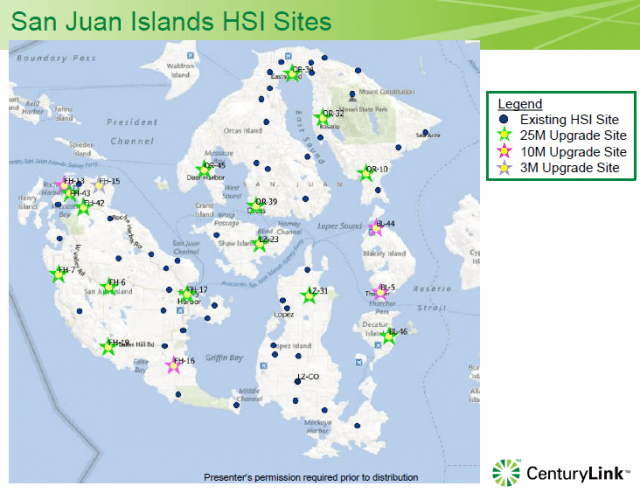
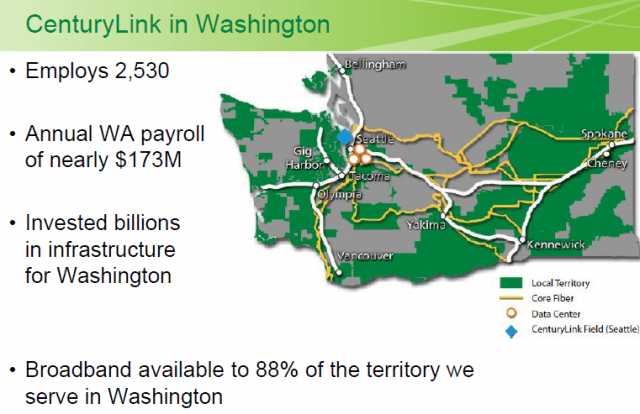
CenturyLink provides broadband to 88% of the territory the company serves in Washington. Like most telephone companies, CenturyLink relies on DSL in much of its footprint and has upgraded central offices, remote equipment, and the telephone lines that connect them. On the San Juan Islands, most customers used to receive 1-3Mbps, but CenturyLink claimed at this week’s hearing it spent billion on infrastructure improvements that can now deliver faster Internet service across the state. In San Juan County, CenturyLink claims:

  • 58% of all qualified addresses were upgraded to 10-25Mbps;
  • 66% now qualify for more than 10Mbps (but less than 25Mbps) versus 46% prior to upgrades;
  • 29% of customers now qualify to sign up for 25Mbps service.

CenturyLink warned the council its speed claims were not to be taken literally, noting DSL “speed is dependent on distance from equipment; speeds drop quickly as distance increases.”

san juan hsi

Hughes told CenturyLink officials residents appreciated the investment, but customers were still disappointed after being promised higher speeds than actually received.

“When people call customer service, there is always an excuse about why there is a problem,” said Hughes. “If people are paying for something, they want to receive it.”

opalco“For our long-term financial interests in this county, we need to have reliable 10-25Mbps service to customers on any part of the islands,” Hughes added. “My goal has always been 90+ percent should be able to get 25Mbps or better connectivity in the county.”
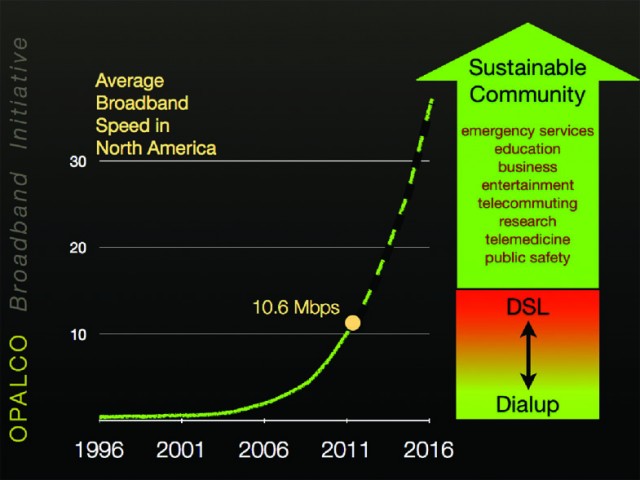
The problem for CenturyLink is the amount of upgrade investment versus the amount of return that investment will generate. San Juan County is disconnected from the mainland and collectively house only 15,769 residents. But it is also the smallest of Washington’s 39 counties in land area, which can make infrastructure projects less costly.

CenturyLink committed to continue investment in its network “where economically feasible.”

San Juan County’s Orcas Power & Light Cooperative (OPALCO), a member-owned, non-profit cooperative electric utility may have a partial solution to the problem of meeting Return on Investment requirements.

BB-growth-chartOPALCO originally proposed a hybrid fiber-wireless system designed to reach 90% of the county with a $34 million investment, to be built over two years. When completed, all county residents would pay a $15 monthly co-op infrastructure fee and a $75 monthly fee for broadband and telephone service. To gauge interest, OPALCO asked residents for a $90 pre-commitment deposit. By the annual meeting in May, the co-op admitted only 900 residents signed up and it needed 5,800 customers to make the project a success.

Some residents balked at the high cost, others did not want wireless broadband technology, and some local environmental activists wanted OPALCO to focus on clean, affordable energy and avoid the competitive broadband business.

The lack of commitment forced the co-op to modify its broadband plans, offering a “New Direction” to residents in June 2013.

OPALCO elected to stay out of the ISP business and instead announced a public-private initiative, providing fiber infrastructure to existing service providers. In effect, the co-op will cover the cost of building fiber extensions where CenturyLink is not willing to invest. For a $3-5 million investment from the co-op, ISPs like CenturyLink will be able to commission OPALCO to build fiber in the right places to make DSL service better. CenturyLink would have non-exclusive rights to the fiber network and would have to pay the co-op a service lease fee.

Unlike ISPs in other communities that have shunned publicly funded fiber infrastructure, CenturyLink says it will contemplate a trial — buying bandwidth from OPALCO instead of enhancing its own fiber middle mile network — to test what level of improved service CenturyLink can offer customers.

Regardless of CenturyLink’s plans, OPALCO is moving forward installing limited fiber connections as part of an effort to develop a more modern electric grid.

logo_broadband“Our data communications network brings exponential benefit to our membership,” OPALCO notes. “It includes tools that allow the co-op to: control peak usage and keep power costs down, remotely manage and control the electrical distribution system, manage and resolve power outages more efficiently, integrate and manage community solar projects and improve public safety throughout the county.”

There are some drawbacks, reports Wally Gudgell from The Gudgell Group.

“It will take longer to implement, and will impact fewer businesses and households,” Gudgell writes. “While about two-thirds of the islands will eventually be covered, more remote areas will have to work with a local ISP and potentially pay more for service.  DSL coverage for homes that are further than 15,000 feet from CenturyLink fiber-served distribution hubs will be challenging. Some homeowners may need to pay for fiber to be run to their homes by Islands Network (fiber direct is costly, estimated at $20/foot).”

Shaw Cable Announces Another Significant Rate Hike; Second Increase So Far This Year

Phillip Dampier September 16, 2013 Broadband Speed, Canada, Competition, Consumer News, Data Caps, Shaw 1 Comment

Shaw-LogoWhen Jeff McDonaghe celebrated the beginning of 2013, his cable and Internet bill from Shaw Communications was roughly $117 a month. In April, Shaw announced a wide-ranging rate increase that cost the Calgary resident an extra $7 a month. Now Shaw is back for more with another rate increase that will cost the McDonaghe family an additional $11 a month. His October bill: nearly $135 — $18 more a month.


“Shaw seems to have gotten quite comfortable raising rates at least twice a year, because my bill has gone up like clockwork every six months or so,” McDonaghe tells Stop the Cap!

Shaw representatives blamed the “price adjustment” on the cost of programming, its upgraded “digital gateway” set-top box, and higher licensing and regulatory fees.

Customer_Bulletin_news_tabletSeptember 2013 Rate Adjustment

At Shaw, we’re committed to providing quality products and services at the best value for all customers.

To continue delivering the best entertainment options, you may notice a few changes to your monthly bill, effective September 1, 2013.

For customers in Manitoba and Ontario (excluding Hamilton), these changes will take effect on October 1, 2013.

Changes are as follows:

Internet Monthly rate as of September 1, 2013
High Speed 10 $55.00
High Speed 20 $60.00
Broadband 50 $80.00
Broadband 100 $90.00
Broadband 250 $120.00
Television Monthly rate as of September 1, 2013
TSN Jets $10.00
Sportsnet World $17.00
Adult Channels
(Playboy, Penthouse, Red Hot, Hustler)
$23.00
Adult Bundles
(pick two channels)
$40.00
Pick and Pays
(at current $2.95 price)
$3.00
Oasis and Discovery World $4.00
Multicultural Channels +$0.05 above current rates
Home Phone Monthly rate as of September 1, 2013
Personal Phone $30.00
Second Phone Line $10.00
Distinctive Ring $4.00
Voicemail and Call Waiting $6.00
Bundle Monthly rate as of September 1, 2013
Starter Bundle
(includes Shaw Gateway Whole Home HDPVR and two Portals on a two-year service agreement)
$119.90
Plus Bundle
(includes Shaw Gateway Whole Home HDPVR and two Portals on a two-year service agreement)
$154.90
Large Bundle
(includes Shaw Gateway Whole Home HDPVR and two Portals on a two-year service agreement)
$174.90
X-Large Bundle
(includes Shaw Gateway Whole Home HDPVR and two Portals on a two-year service agreement)
$209.90

Some of the most significant rate hikes will affect grandfathered service plans, leaving some customers scratching their heads.

Shaw’s old 20Mbps plan (no longer listed on the company’s website) now costs $60 a month, the same price charged for Shaw’s newer 25Mbps tier.

The company’s old “discount” Internet plan delivered DSL-like speed of 7.5Mbps for $45 a month. On Sept. 1, Shaw raised its price to $50. Today, Shaw’s entry-level 10Mbps broadband package sells for $55 a month — only $5 more — with a 125GB monthly usage cap.

Despite the company’s claims of increased costs, Shaw reported $250 million in profits during the third quarter of this year, delivering better than anticipated results with a promise to return some of the excess cash to shareholders in the form of dividends.

telus shaw“Given the improvement in free cash flow and assuming continued favorable market conditions, our board plans to target dividend increases of five to ten percent over the next two years,” said Brad Shaw, CEO of Shaw Communications.


Shaw’s financial gains come at the cost of its declining customer base. During the summer, Shaw lost at least 26,578 basic cable subscribers due to increased competition from Telus’ TV service. The company did better adding broadband customers (4,157), but its greatest growth has come from its phone business, where the company picked up 17,719 new landline customers.

Drew McReynolds from RBC Capital Markets said Shaw was growing revenue mostly by “better monetizing the existing subscriber base.”

“Shaw’s revenue and EBITDA beat was mostly due to price increases,” added Greg MacDonald, managing director at Macquarie Capital Markets Canada.

Former CEO Jim Shaw is costing Shaw some of its earnings as well with a pension payout of almost $500,000 a month. In fact, the Shaw family that founded the cable company has three generations of pension and salary obligations it expects to be honored:

  • J.R. Shaw, the company chairman has an annual pension of $5.4 million;
  • Jim Shaw, J.R.’s son, now gets $5.95 million annually;
  • Bradley Shaw, Jim’s brother and current CEO is eligible for a $3.97 million pension at age 65. His accrued pension obligation is $37.6 million.

Jim Shaw’s pension alone has cost Shaw more than $71 million in financing expenses because the company’s executive pension plan is not pre-financed; the costs are instead paid from annual cash flow as a compensation expense.

“Those price hikes are going to executive compensation and to shareholder dividend payments, because my service has not improved a bit despite paying almost $20 more a month this year,” complains McDonaghe. “The best mere mortals like ourselves can get when threatening to cancel are some temporary credits of around $5 a month for each of their services. Even with those credits, my bill is still higher.”

Time Warner Cable Customers in Upstate New York Howling About Broadband Rate Hikes

frontier offer

Frontier is enticing Rochester-area customers to “say goodbye to Time Warner Cable.”

Time Warner Cable’s relentless rate increases, particularly on its broadband service, are leading to calls for more competition in the upstate New York cities of Buffalo and Rochester, now dominated by Time Warner, Verizon Communications (Buffalo), and Frontier Communications (Rochester).

“Bloodsuckers,” came the terse reply of Cathy Slocum.

Frontier Communications is making the most out of the cable company rate increases with a new “Goodbye Time Warner” ad campaign (that incidentally includes a link to Stop the Cap!’s coverage of TWC’s modem fee). It is pitching $19.99 broadband price-locked for two years — an improvement over its earlier offers thanks to a major reduction in sneaky fine print.

Customers can get up to 6Mbps service (up to 12Mbps available in limited areas) at the special offer price as long as they keep a Frontier landline active with a qualifying calling package. There are no contracts with this promotion, but Frontier’s pesky $9.99 “Broadband Processing Fee” applies if customers ever choose to disconnect Internet service. A free Wi-Fi Internet router is included and the company claims it offers “free Internet activation.” But an installation fee still applies, discounted if customers choose the self-install option. Taxes, governmental and other Frontier-imposed surcharges also apply and new Frontier customers are subject to credit approval, which will show up as an inquiry on your credit report.

In the past, we have taken Frontier to task for its expensive early termination and modem rental fees, as well as its bundling requirements, but the company has since ditched most of these as part of its new self-proclaimed reputation as “BS free.”

Unfortunately, Frontier’s DSL speeds can wildly vary, so if you take advantage of their offer, be sure to verify the speed actually get at your home or office. If the service proves too slow to your liking after installation, you can negotiate canceling within the first two weeks without any termination fees.

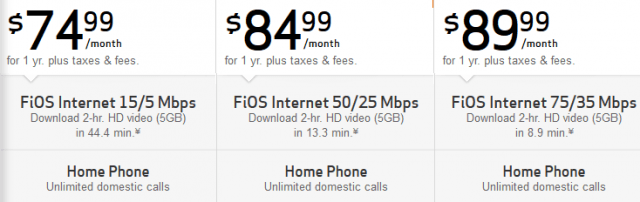
Where FiOS is available in Buffalo, Verizon is offering promotional pricing on its bundled services, including an $84.99 offer including 50/25Mbps Internet with a Verizon landline offering unlimited calling. This is cheaper than Time Warner’s offer with considerably faster upload speeds and no modem fees. In parts of Buffalo, Verizon is authorized to offer broadband and phone service only, although several suburbs have franchise agreements that allow the phone company to also sell television service. A large part of the city and other suburbs are still stuck with Verizon’s copper network, however, which means DSL is the best they can offer.

Time Warner Cable’s new customer promotions, useful when negotiating a customer retention deal, have resumed bundling Standard tier (15/1Mbps service) Internet speeds into most offers. Previously, the company bundled 3Mbps service in many of its promotions. Broadband-only customers can pay as little as $34.99 a month for a year of Internet service at 15/1Mbps speeds, assuming one buys their own cable modem. A double play offer of broadband basic television (around 20 channels, mostly local over-the-air) with 30/5Mbps Internet service is now priced at $94.97 a month after a $5.99 mandatory modem rental fee is included (not optional with this package).

Time Warner Cable executives have repeatedly told investors its higher priced promotions are intentional to increase revenue and profits even if the company loses customers by charging higher prices.

fios offers

Verizon FiOS offers in the Buffalo area.

“I moved here from the New York City area a year ago where we had two cable companies — Cablevision and Verizon FiOS,” noted Stephen O’Brien. “Competition changes everything. Not only were the rates much lower than here, the companies would offer you all kinds of incentives to switch from one to the other. One time we switched and got a free iPod Touch. The argument that the rate increase is needed to cover investment is the biggest red herring of all — Cablevision and FiOS spent many times more on infrastructure, yet their rates were much lower.”

Stop the Cap! recommends Time Warner Cable customers check out our guide to getting the best deal possible from TWC.

[flv width=”640″ height=”380″]http://www.phillipdampier.com/video/WGRZ Buffalo Time Warner Rate Hikes 8-6-13.flv[/flv]

WGRZ in Buffalo reports upstate New York residents are upset about two recently announced broadband rate hikes. Time Warner Cable says it needs the money to keep up its broadband service’s reliability. What alternatives do customers have?  (2 minutes)

Search This Site:

Contributions:

Recent Comments:

Your Account:

Stop the Cap!