Home » public policy » Recent Articles:

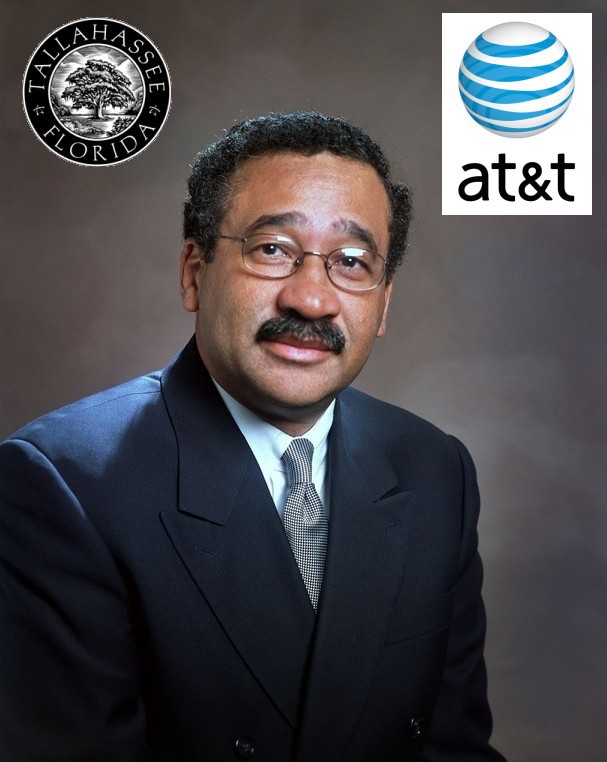
The Mayor from AT&T: Tallahassee Mayor on Hot Seat for Dollar-A-Holler Work for Telecom Giant

Divided Loyalties? -- Mayor John Marks

A growing scandal involving AT&T and the mayor of the state capital of Florida has further exposed the link between AT&T’s pay-for-play public policy agenda and the politicians willing to act as puppets for the phone company’s interests.

Tallahassee Mayor John Marks strongly promoted an Atlanta nonprofit group to participate in a $1.6 million dollar federal broadband grant to expand Internet access to the urban poor and train disadvantaged citizens to navigate the online world, without disclosing he was a paid adviser to the group.

What the rest of the city never knew is that the Alliance for Digital Equality (ADE) is little more than an AT&T astroturf effort — a front group almost entirely funded by AT&T that actually did almost nothing to bring Internet access to anyone.

The Alliance for Digital Equality, a group supposedly focused on erasing the digital divide, spends an inordinate amount of time running radio ads under the alias of “Alliance for Equal Access” for competition in cable-TV… when that competition comes from AT&T U-verse. Listen to two radio commercials run in Georgia and Tennessee, both AT&T service areas, promoting legislation that was introduced at the behest of AT&T and promoted by ADE. (2 minutes)
You must remain on this page to hear the clip, or you can download the clip and listen later.

In fact, an investigation by a Tallahassee newspaper reviewing the group’s federal tax returns found four of every five dollars spent by ADE went to board members, consultants, lawyers, and media companies for the purpose of promoting AT&T’s agenda against Net Neutrality and for the company’s various business interests:

Marks also didn’t mention when he brought ADE to the City Commission in September 2010 that AT&T has been paying him since the early 1990s as a lawyer and consultant.

Tax returns for ADE show it got $7.36 million from AT&T from 2007 through 2009. Among its expenses, it spent $2.7 million on consulting and legal fees, $1.2 million on travel, $1.1 million on media and communications and $931,509 in pay to officers and board of advisers members.

ADE spent nothing on projects to provide Internet access to underserved areas from 2007-09. It wasn’t created to do so. The group’s mission, as reported to the IRS, was to advocate “technology inflows to underserved communities by interacting with elected officials, policymakers at all levels of government and private sectors.”

In those interactions, ADE presented the same message as AT&T in opposition to greater price regulation of the Internet.

View the 2007, 2008, and 2009 tax returns for the Alliance for Digital Equality yourself.

Some of ADE’s officers and board members are familiar to Stop the Cap! readers as loyal AT&T advocates.  Even worse, many of them routinely play the “race card” whenever AT&T’s agenda is threatened.  Take Shirley Franklin.  She is the former mayor of Atlanta, but these days her biggest constituent is AT&T.  Last August, Franklin helped lead an attack against Free Press, a consumer advocacy group, that she said “target[ed] women, African-Americans and other minorities” after the group complained about the ties between several civil and minority rights organizations and AT&T.
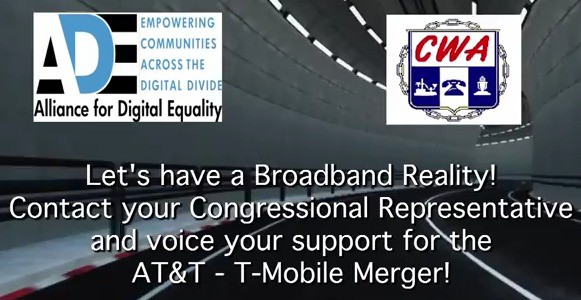
ADE unsurprisingly is also all-for the merger of AT&T and T-Mobile

Julius Hollis, chairman and founder of the Alliance for Digital Equality, was even more strident.

“I am extremely disappointed in the Free Press, not only in its policies and tactics that they are attempting deploy in their strategy paper, but equally disturbing are its attempts to portray the African-American and Latino consumers as expendable in their efforts to promote Net Neutrality,” Hollis said last year. “In my opinion, this is going back to the tactics that were used in the Jim Crow era by segregationists. It’s no better than what was used in the Willie Horton playbook by Lee Atwater who, upon his deathbed, asked for forgiveness for using such political behavior tactics.”

Stop the Cap! exposed ADE ourselves as a “dollar-a-holler” advocate in August 2010 when we learned the majority of the group’s funds came from AT&T.

Anne Landman, managing editor of the Center for Media and Democracy, told the Tallahassee Democrat the purpose of groups almost entirely sponsored by a single corporate interest is to obfuscate the messenger. “It’s a nontransparent way of operating,” she said. “People don’t know who’s behind these efforts. So it’s fake, and it’s phony, and it gives people wrong information. It’s designed to purposely fool people.”

The newspaper spent months trying to track down financial reports, tax filings, and other documentation about the group, and ran into repeated resistance.  At one point, written requests sent to the group’s headquarters in Atlanta were returned unopened and marked “refused.”

ADE’s corporate influence is bad enough, but when the group uses race, gender, and economic cards to attack real public interest groups, it raises eyebrows, particularly when the group doing the attacking is financed by a corporate entity.  The Black Agenda Report, a website that can hardly be accused of racism, called out Franklin and the organization she represents.

The newspaper’s investigation also found all of ADE’s employees were actually independent contractors.  Non-profit group experts claim the entire structure of ADE is unusual because it funnels all of its money through contractors.

Tallahassee Mayor John Marks is apparently one of them, having received $86,000 as a member of ADE’s board of advisers in addition to AT&T paying him directly as a lawyer and consultant.

With the recent revelations, Tallahassee’s broadband grant is now in ruins and will be returned, unspent.  Marks is reportedly under investigation by the FBI for potential corruption.  And another AT&T astroturf effort has been exposed and has blown up in the company’s face.

[flv]http://www.phillipdampier.com/video/WCTV Tallahassee Mayor Under Fire Over ATT-ADE Ethics Scandal 3-29-11 – 9-15-11.flv[/flv]

Stop the Cap! has compiled almost a year of coverage of the burgeoning scandal in the Tallahassee mayor’s office, courtesy of WCTV-TV, which has doggedly pursued the scandal with assistance from its news partner Tallahassee Reports.  (10 minutes)
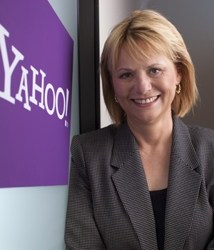
Carol “I Oppose Government Involvement in Broadband” Bartz Out at Yahoo!: Fired-by-Phone

Bartz

The CEO of the Yahoo! has been shown the door, but unlike many recently-unemployed workers who get the bad news during an exit interview, Carol Bartz learned she was out in a humiliating phone call from the board of directors.

That left Bartz telling employees she’d been fired in an internal memo sent from her iPad.

Investors were happy to see the back of Bartz, sending Yahoo! shares higher on the news.  Bartz faced a growing number of critics in the past few years, almost immediately after arriving as CEO in early 2009.  Much like Yahoo! itself, her critics accused her of being out of touch with Internet culture and the realities of today’s high-tech businesses.

Bartz was no friend of coordinating expanded and improved broadband projects through the government.  She opposed the National Broadband Plan and Net Neutrality policies, dismissing both as government interference.  That put her in direct opposition to Google, which has spent millions in the public policy arena to influence expanded broadband in the United States.

Despite the lackluster results Yahoo! managed under her leadership, Bartz remained well-compensated, earning $60 million over the past two years.

Yahoo! has remained a challenged endeavor as a first generation Internet superstar long-faded after the dot.com crash in 2000.  Various efforts to relaunch Yahoo!’s flagging advertising revenue business, long dominated by Google, have not been very successful.  Yahoo!’s biggest problem has been its lack of innovation, creating new reasons for web visitors to return to a company that used to be a household name.

Now some believe the only hope Yahoo! has left is to sell itself to someone else.

[flv]http://www.phillipdampier.com/video/CNBC Broadband Regulation 3-2-10 .flv[/flv]

Free Press’ policy director Ben Scott held his own, despite being hopelessly outnumbered, in a business-friendly CNBC ‘Power Lunch’ debate over broadband public policy held in March 2010.  Scott faced Yahoo! CEO Carol Bartz, Larry Clinton from the “Internet Security Alliance,” which receives substantial support — not disclosed by CNBC — from AT&T and Verizon, and CNBC’s clueless Michelle Caruso-Cabrera, who insisted 99 percent of America already subscribes to broadband.  All of the industry talking points were on hand, which isn’t too surprising when they come from industry front groups like the ‘ISA.’ (3/3/2010 — 5 minutes)

AT&T Lobbyist Talks Up Dollar-a-Holler Advocacy: “We Seem to Be Having Success”

Cicconi

Jim Cicconi, AT&T’s chief lobbyist told Politico the company’s practice of encouraging civil rights and charity groups to advocate on its behalf was “entirely natural,” and claimed opponents of the proposed merger of AT&T and T-Mobile were doing the same thing.

“The difference is that we seem to be having success and they are not. We attribute that entirely to the obvious benefits of the merger and the history of what we have stood for as a company,” Cicconi said. “What seems unnecessary is for opponents to attack the motives and credibility of those who have chosen to support our position and not theirs.”

AT&T has made substantial contributions, both financial and through involvement by key AT&T executives on various boards of directors of non-profit groups, as part of its corporate strategy.  Often, many of the non-profit groups involved thank AT&T by submitting letters of support for various business activities AT&T is engaged in, including public policy debates, mergers and acquisitions, and legislation that could impact the company’s bottom line.

On occasion, the connection between AT&T’s large financial contributions and the advocacy letters that often result becomes a point of contention with rank and file members of the organization, as happened in June with a gay rights organization that culminated in the resignation of its president and an AT&T-connected board member.

But more often than not, the corporate money-and-influence-connection goes unnoticed by the constituents of these organizations, many of whom will be disadvantaged, charge critics, by an outcome favorable to AT&T.

Politico explored the links between AT&T executives, lobbyists, money and civic groups and charities and discovered plenty:

Somehow, letters from the National Urban League and...

• Norelie Garcia, associate vice president of federal affairs at AT&T, who is an executive committee chair on the National Puerto Rican Coalition’s board of directors. The group wrote to the FCC May 27.

• Jerry Fuentes, president of AT&T for the Arizona and New Mexico regions, is the vice president for corporate policy on the National Hispanic Caucus of State Legislators’s business board of advisers. The organization wrote to the FCC backing AT&T on May 26.

• Barbara Winn, AT&T’s Sacramento-area director of external affairs, is listed on the letterhead of the Greater Sacramento Urban League as executive committee chairman in the filing the group sent to the FCC supporting the deal June 17.

• Tanya Lombard, assistant vice president of public affairs at AT&T, is a board member of the National Coalition on Black Civic Participation. The group wrote to the FCC May 25, saying “We believe it will help fulfill President Obama’s vision of an America in which everyone has affordable access to high-speed Internet service.”

AT&T is listed as a sponsor of the Cuban American National Council , the National Puerto Rican Coalition, and among the National Coalition on Black Civic Participation’s 35th anniversary partners. Meanwhile, it costs $25,000 annually to be a full member of the National Hispanic Caucus of State Legislators’s business board of advisers, as AT&T’s Fuentes is.

In 2009, the AT&T Foundation gave the local chapters of the Urban League in Chattanooga, Tenn.; Columbia, S.C.; and Knoxville, Tenn., a total of $45,000.

The National Urban League in 2009 received more funding — $100,000 — from the Sprint Foundation. But Sprint, which has been the most vocal corporate opponent of the AT&T/T-Mobile deal, does not have executives on the boards of any of those groups, the company said.

...the National Action Network turned out to be nearly identical.

Politico found many of America’s most influential civic rights groups received private briefings from AT&T executives promoting the deal — meetings which ultimately led to letters of support from those organizations, despite their having little or no input from those opposed to the merger.  AT&T also has dispatched “advocacy kits” to many groups filled with sample letters and talking points the company encourages groups to use as a template for letters of their own.  Not counting on the laziness among many tasked with writing the letters ultimately dispatched to the Federal Communications Commission, there is often a striking resemblance of correspondence favoring the merger.

Politico notes the text in two filings submitted last month to the FCC by the National Urban League and Al Sharpton’s National Action Network regarding the acquisition are nearly identical.

All of this disturbs ColorofChange, a civil rights group not on the payroll of either those supporting the merger or opposed to it.

“There are long-standing relationships AT&T has with these organizations that we think unfortunately have led some of them to take AT&T’s position on an issue that will negatively impact black people,” Rashad Robinson, executive director of ColorofChange told Politico.

AT&T just disclosed its latest lobbying reports, showing the company has increased its lobbying budget by nearly $1,000,000 compared with the same quarter last year — spending $6.84 million during the first quarter of 2011 alone on lobbying the federal government.

Sprint Nextel, seen by many as the primary opponent of the deal, actually reduced its own lobbying expenses during the same period, spending just $583,000 during the first quarter, down 25% from the $774,100 spent a year earlier.

Cattle Ranchers for AT&T T-Mobile Merger: Will ‘Improve’ Rural Broadband and Other Tall Tales

Phillip Dampier June 15, 2011 Astroturf, AT&T, Broadband Speed, Competition, Data Caps, Editorial & Site News, Net Neutrality, Public Policy & Gov't, Rural Broadband, T-Mobile, Wireless Broadband Comments Off on Cattle Ranchers for AT&T T-Mobile Merger: Will ‘Improve’ Rural Broadband and Other Tall Tales

The U.S. Cattlemen’s Association this week took some time out to go all out for AT&T’s proposed merger with T-Mobile.  In addition to successfully navigating the FCC’s arcane comment filing system to submit their comments in favor of the merger, the group also penned a lengthy, favorable guest blog for Washington, D.C. inside-the-beltway-favorite, The Hill newspaper:

The expansion of next-generation wireless broadband envisioned by the T-Mobile and AT&T merger, for example, is critical for the next stage of rural America’s evolution and success. It will allow ranchers, farmers, and all rural residents who have been traditionally underserved to finally gain access to the best that mobile broadband has to offer, including faster and more reliable connections. We strongly encourage the Federal Communications Commission to support these developments as an investment in both the current and future generations of agricultural producers and small communities across rural America.

The cattlemen’s group has had a lot to say about telecommunications issues, especially mergers and acquisitions.  It was cited by Verizon as a supporter of its merger with Alltel in 2008, signed a joint letter in 2008 from industry-connected Connected Nation for a broadband plan compatible with the interests of the nation’s largest cable and phone companies, wrote a letter to the FCC opposing Net Neutrality in 2009, and submitted two pages of comments in May favoring the merger between AT&T and T-Mobile.

Apparently there is plenty of free time on the ranch to ponder billion dollar telecommunications mergers.

The argument from the group is that permitting mergers and blocking open net policies like Net Neutrality will convince carriers to provide enhanced service in rural areas where cattle ranches predominate.  But facts in evidence illustrate how wrong-headed that argument is:

  • Verizon’s merger with Alltel has done nothing to bring its LTE network to rural America.  Verizon is focusing LTE upgrades on the markets where it makes the most business sense, and that does not include rural Texas or Oklahoma;
  • The National Broadband Plan has directed stimulus funding for rural projects that are most likely to reach their ranch members — wireless ISPs and rural DSL.  The cattlemen’s group has nothing to say about either provider;
  • Net Neutrality and the policies of an open and free Internet have no real impact on rural broadband deployment.  The same companies refusing to provide service yesterday are still refusing to provide service today, and that includes completely exempted wireless providers;
  • T-Mobile’s urban-suburban focus is a mainstay of its business plan.  T-Mobile has never prioritized rural America as a viable service area, relying on roaming agreements to fill in service gaps.  Combining its urban-focused wireless infrastructure with AT&T will add nothing to the rural wireless experience.

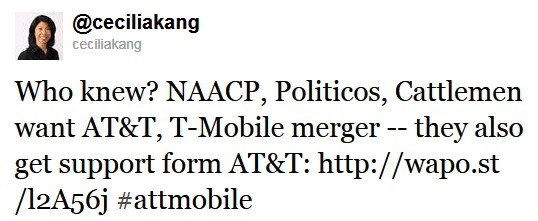
The Washington Post finds financial connections between AT&T and the cattlemen group.

Advocating for a merger with T-Mobile makes about as much sense as the group advocating for a T-Mobile merger with Leap Wireless’ Cricket or MetroPCS.  All have a record of indifference about providing service in rural areas themselves.

So why does the group persist in fronting for AT&T’s public policy agenda?  Cecilia Kang at the Washington Post tweeted the obvious answer — they receive support from AT&T.

The piece for The Hill was penned by Jess Peterson, the cattlemen group’s executive vice president.  But Peterson has a second career: president of Washington, D.C.-based Western Skies Strategies, a lobbying firm that promises “success and profitability to our valued clients every time.”

The concept of dollar-a-holler public advocacy is not new, but AT&T is the Master of the Astroturf Universe.  The Center for Responsive Politics notes that from 1989 to 2010, no single company spent more on campaign contributions than AT&T.  Since 2008, more than $1.25 million has been “donated” to politically-connected charities and those willing to lend their name and reputation to back the company’s public policy agenda.

Facts have a hard time penetrating piles of cash, but here are some anyway:

  1. T-Mobile’s combination with AT&T may create additional capacity for the combined company, but almost entirely in urban and suburban areas that will do nothing to help rural wireless.
  2. No telecommunications company has a track record of providing service in areas unprofitable to serve or fail return on investment demands.  No merger will change that.
  3. Promises for network upgrades already committed in long-range business plans do not sweeten a bitter deal for Americans concerned about competition in the wireless marketplace.
  4. T-Mobile’s track record as being the most market-disruptive in pricing and innovation will be eliminated in a merger with America’s lowest rated wireless carrier.
  5. Any excitement for rural wireless broadband from AT&T is tempered when would-be customers realize the company enforces a 2GB usage cap with an overlimit fee on their smartphone data plans — an Internet Overcharging scheme more punishing than either Verizon or Sprint.

Charity and Civic Groups Continue Dollar-a-Holler Cheerleading of AT&T T-Mobile Merger

Wading through the bulging file of comments at the Federal Communications Commission website reveals some strange and unusual testimonials from groups one would think would have much better things to do with their time and resources than advocate for a multi-billion dollar super merger between AT&T and T-Mobile.  But integrity means little next to a big fat check from AT&T, and many so-called “charities” really do believe it begins at home in their own bank accounts.  So with their hands out, groups like Wisconsin Coalition for Consumer Choice and the Urban League, and politicians like Bobby Jindal become dollar-a-holler advocates for AT&T’s agenda, offering the flimsiest reasons around to push for the merger’s approval.

Among the least savory are groups purporting to represent income-challenged minority communities who advocate for a merger that will promote higher prices for less service.  Such advocacy would taint any group and calls into question whether contributions are really helping those in need or just those who claim to represent them.

As we suspected, after reviewing dozens of submissions favoring the merger, virtually every last supporter either had direct financial ties to AT&T, had AT&T personnel in leadership positions, or were run by Washington, DC lobbying firms that have a past history of doing work on behalf of AT&T.  Ordinary consumers, and there were thousands, submitted comments opposing the merger — citing reduced competition, higher prices, fewer choices, and offering few benefits or improved service.  At least some live in the reality-based community, not AT&T’s field of overpriced dreams and broken promises.

A Sampling:

Klaetsch: The Coalition of One Lobbyist

Wisconsin Coalition for Consumer Choice

Here’s a “group” purporting to represent the interests of consumers, but they’re nowhere to be found.  George Klaetsch, executive director, claims AT&T’s merger will “immediately increase consumer choices and access to quality broadband and mobile services. Thousands of new cell sites will become available, the nation’s broadband footprint will be significantly expanded, and most importantly, more than 46 million more customers will gain instant access to 4G LTE technology – many of them right here in Wisconsin.”

Why if you approve this merger, there will be free candy for everyone, too.

The group’s website offers an unwelcome introduction with a series of technical faults, perhaps a testament to how few consumers ever bother to visit it, and carries an earnest disclaimer:

[…] We make no representations or warranties of any kind, express or implied, about the completeness, accuracy, reliability, suitability or availability with respect to the website or the information, products, services, or related graphics contained on the website for any purpose. Any reliance you place on such information is therefore strictly at your own risk.

Good to know.

Klaetsch’s letter forgets to mention he’s a registered lobbyist for Public Affairs Strategies, Inc.  When he’s not fronting AT&T’s agenda, he also represents the interests of AstraZeneca Pharmaceuticals, the Elevator Industry Work Preservation Fund, and the creepy-sounding Funeral Service & Cremation Alliance of Wisconsin, among other groups.

Wellington Area Chamber of Commerce

This well-meaning local chapter of the Chamber, who counts AT&T as a member, has fallen hook, line, and sinker for AT&T’s promise to deliver 4G service to “97 percent of the country,” assuming the merger gets approved.  Of course, AT&T will upgrade to 4G with or without the merger, and this particular Chamber’s executive director apparently does not realize T-Mobile’s contribution to improving service in rural America is less than robust.  When an active member of a civic or business group happens to be AT&T, getting a letter written on behalf of the company’s agenda comes as soon as the talking points can be handed out at the next Chamber meeting.

Unfortunately for the people of Wellington, losing one more competitor guarantees rural America fewer competitive choices, higher prices, and less service, not more.

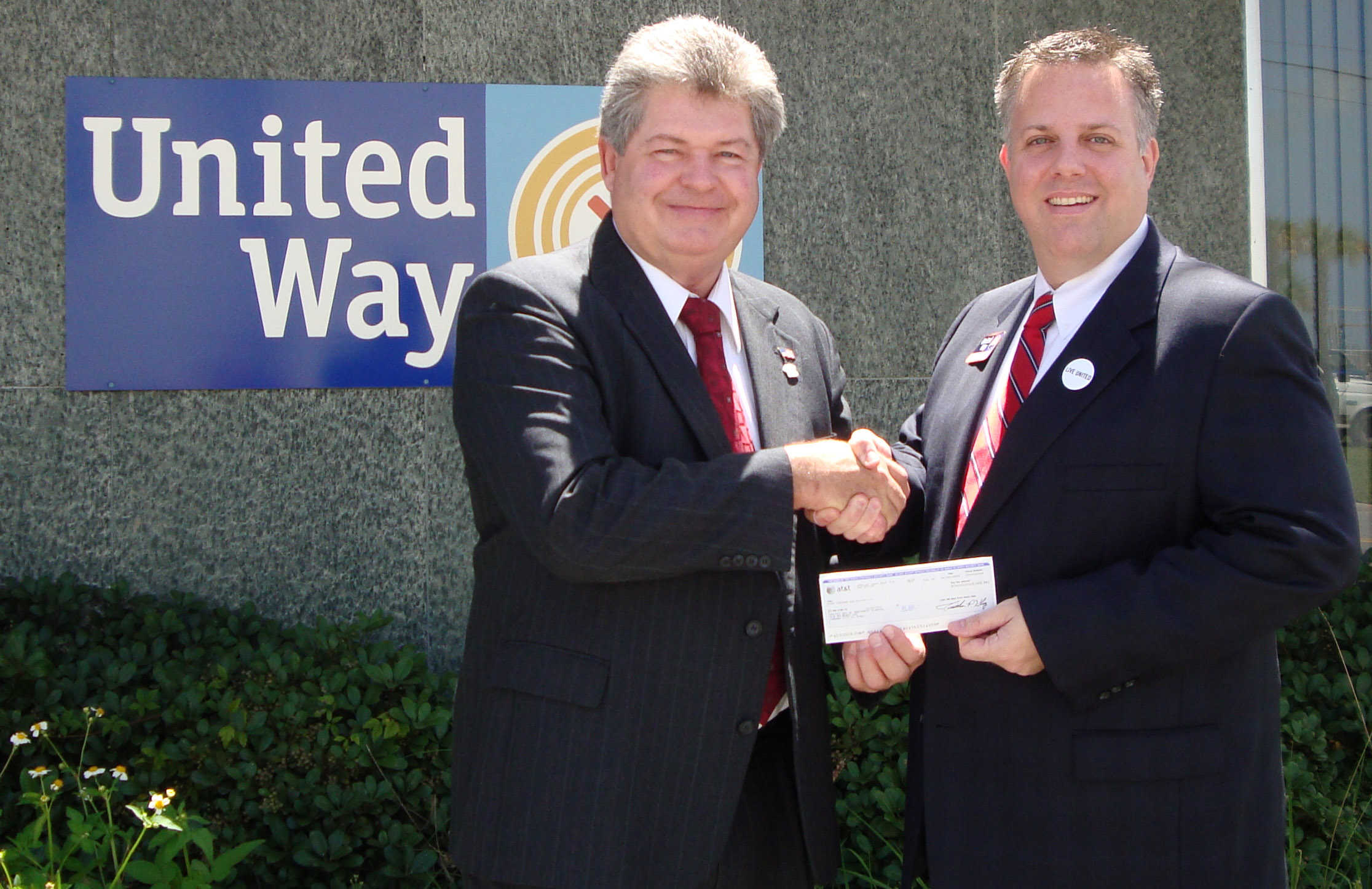
United Way of Northwest Florida

AT&T Donates $9,000 to the United Way of Northwest Florida, which promptly returns the favor with a nice letter to the FCC supporting the telecom company's agenda.

Some residents in northwest Florida could reconsider their future contributions to “charitable groups” who increasingly spend their time and attention involving themselves in big corporate mergers, meeting the needs of some of their biggest donors.  No better example of this comes from the United Way of Northwest Florida, who accepted a $9,000 contribution from AT&T in one hand, while banging out this letter of support for AT&T’s merger with the other.  It’s classic dollar-a-holler advocacy.

While this chapter believes the interests of cell phone users will be best served by an AT&T – T-Mobile merger, we’re wondering what actual charitable endeavors go unserved while its leadership wastes time and resources filing comments with the FCC on a billion dollar telecom deal.

Urban League of New Orleans

This chapter of the Urban League “firmly believes that the greater New Orleans area we serve would greatly benefit by added broadband connectivity. Studies show that the underserved, urban communities with the greatest access to broadband Internet see the strongest economic growth. With high-speed Internet, residents can more easily access important resources online, from educational resources for schools to job opportunities for those who are out of work or seeking to update their skills. High-speed Internet enables greater connectivity between all stakeholders, more able to respond effectively and efficiently to the needs of our city.”

Somehow, for those noble reasons, they are supporting AT&T’s and T-Mobile’s merger.  AT&T is the company that pitches some of the most expensive and most limited wireless broadband plans in the country.  How this benefits urban New Orleans may escape you.

What didn’t escape us was the fact AT&T Louisiana president Sonia Perez is the group’s 2011 Annual Gala Chairperson.  She’s also a participant on the group’s governing board.

In addition to the big oil, chemical, credit card, and health insurance companies sponsoring Jindal's wife's charity is none other than AT&T.

Gov. Bobby Jindal of Louisiana

Gov. Jindal is a big supporter of AT&T’s merger with T-Mobile.  The Washington Post notes he is joined by 13 other governors writing the FCC to push for approval.  Jindal is honoring Louisiana’s time-tested notoriety for questionable political dealings.  Perhaps it is just a coincidence his wife runs the Supriya Jindal Foundation, who counts among its key sponsors… you guessed it, AT&T.  Before one assumes Jindal has a legitimate interest promoting AT&T, which invests money in Louisiana, consider this: Jindal has written only one letter to the FCC on a telecommunications issue since the agency’s electronic filing system was inaugurated in 1992. This one.  Maybe he was busy on those other days.  Then again, maybe he wasn’t.

Jindal closes his letter with these words: “I am confident that this merger will benefit the people of Louisiana.”  That’s true, if you define “people” as his immediate family and the corporate executives of AT&T and T-Mobile who work and live in his state.  Everyone else doesn’t matter.

United States Hispanic Leadership Institute

USHLI does AT&T the honor of penning letters supporting the phone company's agenda.

After reviewing dozens of submissions from charities and non-profit groups, the comments from USHLI really stood out above the others.  Dr. Juan Andrade, president of the group is a downright feisty guy, singing paragraphs of praise for AT&T as a “model corporate citizen”:

“Like you, I too have heard that the merger will have a devastating impact on consumers, promote anti-competitive behavior, and result in higher prices; that the merger will be bad for business, bad for innovation and bad for workers. We’ve heard this all before – when SBC was acquiring Ameritech, when AT&T was merging with SBC, and so forth. And what have we seen? We’ve seen just the opposite. The Federal Communications Commission’s own data show that these concerns proved unfounded as consumers benefited from tremendous innovation and competition in the wireless space, all while seeing wireless voice and data prices drop. This “sky is falling” attitude is replaying itself as AT&T seeks approval to merge with T-Mobile. But the facts speak for themselves. The United States Hispanic Leadership Institute (USHLI) believes the Federal Communications Commission should rise above the skepticism, above the unsubstantiated claims, and above the impractical requisitions.”

What the FCC also needs to rise above is the considerable support Dr. Andrade’s group gets from AT&T.  Undisclosed in Andrade’s spirited defense of one of the worst mergers in telecommunications history is the fact AT&T is the “honorary co-chair” and sponsor of the group’s 2011 fundraising efforts.  It’s the public policy equivalent of “My Dinner With AT&T.”  More wine?

Andrade conveniently ignores the fact AT&T is raising prices on wireless data products with punitive usage caps and overlimit fees.  It’s not the sky falling, Dr. Andrade, it’s your credibility to speak as an independent observer while also enjoying AT&T’s largesse.  When you engage in dollar-a-holler advocacy, American consumers have more than a right to be skeptical.

Search This Site:

Contributions:

Recent Comments:

Your Account:

Stop the Cap!