Home » public policy » Recent Articles:

A History Lesson: Wireless Spectrum “Crisis” Hoopla vs. Solid Network Engineering

Phillip Dampier April 18, 2012 AT&T, Audio, Bell (Canada), Broadband "Shortage", Competition, Consumer News, Editorial & Site News, History, Public Policy & Gov't, Rogers, Sprint, T-Mobile, Verizon, Video, Wireless Broadband Comments Off on A History Lesson: Wireless Spectrum “Crisis” Hoopla vs. Solid Network Engineering

“Somehow in the last 100 years, every time there is a problem of getting more spectrum, there is a technology that comes along that solves that problem. Every two and a half years, every spectrum crisis has gotten solved, and that’s going to keep happening. We already know today what the solutions are for the next 50 years.” — Martin Cooper, inventor of the portable cell phone

Despite the fear-mongering by North America’s wireless phone companies that a spectrum crisis is at hand — one that threatens the viability of wireless communications across the continent, some of the most prominent industry veterans dispute the public policy agenda of phone companies like AT&T, Verizon, Bell, and Rogers.

Martin Cooper ought to know.  He invented the portable cell phone, and remains involved in the wireless industry today.  Cooper shrugs off cries of spectrum shortages as a problem well-managed by technological innovation.  In fact, he’s credited for Cooper’s Law: The ability to transmit different radio communications at one time and in the same place has grown with the same pace since Guglielmo Marconi’s first transmissions in 1895. The number of such communications being theoretically possible has doubled every 30 months, from then, for 104 years.

National Public Radio looks back at the earliest car phones, which weighed 80 pounds and operated with vacuum tubes. Innovation, improved technology, and lower pricing turned an invention for the rich and powerful into a device more than 300,000,000 North Americans own and use today. (April 2012) (3 minutes)
You must remain on this page to hear the clip, or you can download the clip and listen later.
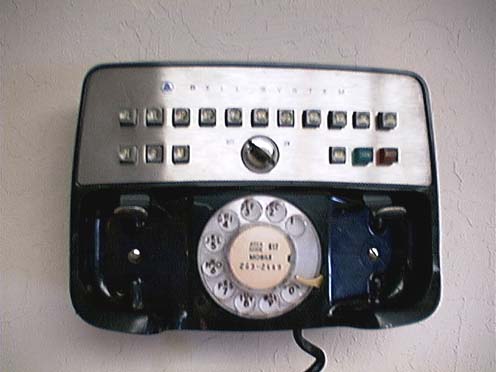
A traditional car phone from the 1960s.

The earliest cell phones have been around since the 1940s.  St. Louis was the first city in the United States to get Mobile Telephone Service (MTS).  It worked on three analog radio channels and required an operator to make calls on the customer’s behalf. By 1964, direct dialing from car phones became possible with Improved Mobile Telephone Service (IMTS), which also increased the number of radio channels available for calls.

In the 1970s, popular television shows frequently showed high-flyers and private detectives with traditional looking phones installed in their cars.  But the service was obscenely expensive.  The equipment set customers back $2-4,000 or was leased for around $120 a month.  Local calls ran $0.70-1.20 per minute.  That was when a nice home was priced at $27,000, a new car was under $4,000, gas was $0.55/gallon, and a first run movie ticket was priced at $1.75.

With many cities maintaining fewer than a dozen radio channels for the service, only a handful of customers could make or receive calls at a time.  The first “spectrum crisis” arrived by the late 1970s, when car phones became the status symbol of the rich and powerful (the middle class had pagers). Customers found they couldn’t make or receive calls because the frequencies were all tied up.  Some cities even rationed service by maintaining waiting lists, not allowing new customers to have the technology until an existing one dropped their account.

Instead of demanding deregulation and warning of wireless doomsday, the wireless industry innovated its way out of the era of MTS altogether, switching instead to a “cellular” approach developed in part by the Bell System.

[flv width=”412″ height=”330″]http://www.phillipdampier.com/video/ATT Testing the First Public Cell Phone Network.flv[/flv]

In the 1970s, when the first cell phone “spectrum crisis” erupted, the Bell System innovated its way out the the dilemma without running to Congress demanding sweeping deregulation.  This documentary, produced by the Bell System, explores AMPS — analog cell phone service, and how it transformed Chicago’s mobile telephone landscape back in 1979.  (9 minutes)

“Arguing that the nation could run out of spectrum is like saying it was going to run out of a color.” David P. Reed, one of the original architects of the Internet

Instead of one caller tying up a single IMTS radio frequency capable of reaching across an entire city, the Bell System deployed lower-powered transmitters in a series of hexagonal “cells.”  Each cell only served callers within a much smaller geographic area.  As a customer traveled between cells, the system would hand the call off to the next cell in turn and so on — all transparently to the caller.  Because of the reduced coverage area, cell towers in a city could operate on the same frequencies without creating interference problems, opening up the system to many more customers and more calls.
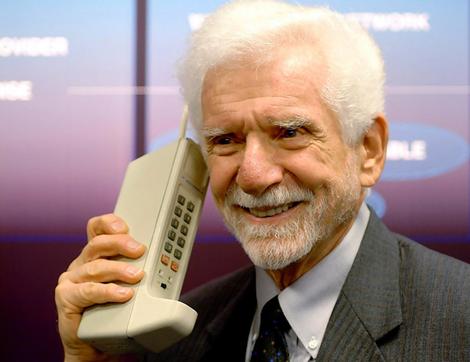
Inventor Martin Cooper holds one of the first portable mobile phones

In Chicago, Bell’s IMTS system only supported around a dozen callers at the same time. In 1977, the phone company built a test cellular network it dubbed “AMPS,” for Advanced Mobile Phone System.  AMPS technology was familiar to many early cell phone users.  It was more popularly known as “analog” service, and while it could still only handle one conversation at a time on each frequency, the system supported better call handling and many more users than earlier wireless phone technology.  By 1979, Bell had 1,300 customers using their test system in Chicago.

AMPS considerably eased the “spectrum crunch” earlier systems found challenging, and subsequent upgrades to digital technology dramatically increased the number of calls each tower could handle and allowed providers to slash pricing, which fueled the spectacular growth of the wireless marketplace.

Yesterday it was voice call congestion, today it is a “tidal wave” of wireless data.  But inventors like Cooper believe the solution is the same: engineering innovation.

“Somehow in the last 100 years, every time there is a problem of getting more spectrum, there is a technology that comes along that solves that problem,” Cooper told the New York Times. “Every two and a half years, every spectrum crisis has gotten solved, and that’s going to keep happening. We already know today what the solutions are for the next 50 years.”

Cooper believes in the cellular approach to wireless communications.  Dividing up today’s geographic cells into even smaller cells could vastly expand network capacity just like AMPS did for Windy City residents in the late 1970s. Using especially directional antennas focused on different service areas, placing new cell towers, innovating further with tiny neighborhood antennas mounted on telephone poles, or building out Wi-Fi networks can all manage the data capacity “crisis” says Cooper.

New technology also allows cell signals to co-exist, even on the same or adjacent frequencies, without creating interference problems. All it takes is a willingness to invest in the technology and deploy it across signal-congested urban areas.

Unfortunately, network engineers are not often responsible for the business decisions or public policy agendas of the nation’s largest wireless companies who are using the “spectrum crisis” to argue for increased deregulation and demanding additional radio spectrum which, in some cases, could be locked up by companies to make sure nobody else can use them.

[flv width=”600″ height=”358″]http://www.phillipdampier.com/video/NY Times Mobile Carriers Warn of Spectrum Crisis.flv[/flv]

The New York Times offers this easy-to-follow primer on wireless spectrum and why it matters (or not) in the current climate of explosive growth in mobile data traffic.  (3 minutes)

“Their primary interest is not necessarily in making spectrum available, or in making wireless performance better. They want to make money.” — David S. Isenberg, veteran researcher, AT&T Labs

Innovation, not wholesale deregulation, allowed the Bell System to solve the spectrum crisis of the 1970s by creating today's "cell system" that can re-use radio frequencies in adjacent areas to handle more wireless traffic.

Spectrum auctions bring billions to federal coffers, but actually deliver a hidden tax to cell phone customers who ultimately pay for the winning bids priced into their monthly bills.  It also makes it prohibitively expensive for a new player to enter the market.  Already facing enormous network construction costs, any new entrant would then face the crushing prospect of outbidding AT&T, Verizon Wireless, Bell or Rogers for the frequencies essential for operation.

As the New York Times writes:

When a company gets the license for a band of radio waves, it has the exclusive rights to use it. Once a company owns it, competitors can’t have it.

Mr. Reed said the carriers haven’t advocated for the newer technologies because they want to retain their monopolies.

Cooper advocates a new regulatory approach at the Federal Communications Commission — one that mandates wireless phone companies start using today’s technology to amplify their networks.

Cooper points to one example: the smart antenna.

Smart antennas direct cell towers to focus their transmission energy towards the specific devices connected to it.  If a customer was using their phone from the southern end of the cell tower’s coverage area, why direct signal energy to the north, where it gets wasted?  New LTE networks support smart antenna technology, but carriers have generally avoided investing in upgrading towers to support the new technology, expected to be commonplace inside new wireless devices within two years.

T-Mobile calls these technology solutions “Band-Aids” that won’t address the company’s demand for more frequencies to manage its network.  But that kind of thinking applied to the mobile phone world of the 1970s would have maintained the exorbitantly expensive IMTS technology discarded decades ago, since replaced by innovation that made more efficient use of the spectrum already on hand.  That innovation also transformed wireless phones from a tool (or toy) for the very wealthy to an affordable success story that now threatens the traditional wired phone network in ways the Bell System could have never envisioned.

[flv width=”412″ height=”330″]http://www.phillipdampier.com/video/Its a Whole New System.flv[/flv]

It’s A Whole New System: AT&T and other wireless phone companies might want to learn the lesson the Bell System was trying to teach their employees back in 1979: Meet Change With Change.  This company-produced video implores the phone company to do more than the same old thing.  No, this video is not “PM Magazine.”  It is about innovation and actually listening to what customers want. With apologies to Mama Cass Elliot, there was indeed a New World Coming — the breakup of the Bell System just five years later.  Don’t miss the diabetic-coma-inducing, sugary-sweet jingle at the end.  Then reach for a can of Tab.  (10 minutes)

AT&T “Wins” Consumerist’s Third-Worst Company in America Award

The Consumerist awards AT&T the "Bronze Poo" Award for Third Worst Company in America. (Image: The Consumerist)

A video game company reviled by game fans and the perennially-shoddy Bank of America managed to beat out America’s lowest rated phone company in The Consumerist’s “Worst Company in America” annual award contest, but not by much.

As Electronic-Arts tries to explain away its top-worst rating, AT&T easily took third place after a consolation round decidedly eliminated Walmart.

Congratulations to the folks aboard the Death Star! As soon as we get some proper bronze-colored paint, we’ll be packing up your Bronze Poo and sending it off in the mail. It will, of course, include a 620-page end-user agreement that preempts any class-action lawsuits by AT&T employees.

Some Consumerist readers wondered why game fans rushed to beat EA over the head over its anti-consumer tendencies when Ma Bell was still ripe for some kicking:

This should be easy call. I’m pulling for AT&T to go all the way. The list of AT&T transgressions is long and wide-ranging. Much more so than EA.

  • AT&T is like the T-1000 Terminator, reassembling itself after Ma Bell was broken up in the 80’s;
  • AT&T caps broadband Internet connections;
  • AT&T is one of Washington’s biggest lobbyists;
  • AT&T blocks important updates from customer’s phones;
  • AT&T tried to buy up a competitor to reduce competition and further monopolize the spectrum which is collectively owned by We The People;
  • AT&T shameless displays its arrogance on its own AT&T Public Policy blog;
  • AT&T opposes Net Neutrality.

I could go on and on…

The Consumerist notes their award epitomizes the last 12 months for AT&T.

“First it attempted to leap-frog to the head of the wireless pack by swallowing T-Mobile whole, only to fail miserably after many months and at a cost of several billion dollars,” the piece reads. “Then it came tantalizingly close to vying for the coveted Worst Company In America Golden Poo trophy, only to be given the smack-down by a video game company. At least it won’t be leaving the tournament empty-handed.”

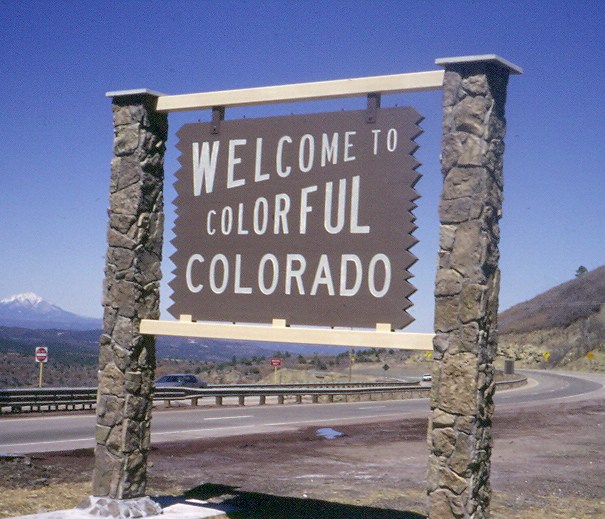
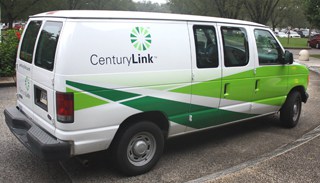
AT&T, Colorado Lawmakers Target Landline Subsidy; Collateral Damage: CenturyLink, Public Broadband

Phillip Dampier April 3, 2012 AT&T, Broadband Speed, CenturyLink, Community Networks, Competition, Consumer News, Editorial & Site News, Public Policy & Gov't, Rural Broadband, Wireless Broadband Comments Off on AT&T, Colorado Lawmakers Target Landline Subsidy; Collateral Damage: CenturyLink, Public Broadband

AT&T’s ongoing efforts to win deregulation and an end to universal landline service have now reached Colorado, where state lawmakers are reacting favorably to an AT&T-sponsored bill that would strip away rural landline subsidies and deregulate basic phone rates, much to the consternation of incumbent provider CenturyLink.

The long-winded bill,  SB 157 – Concerning the Regulation of Telecommunications Service and, in Connection Therewith, Enacting the “Telecommunications Modernization Act of 2012,” is just the latest in a series of deregulation measures co-authored by AT&T that would let phone companies off the hook for guaranteeing affordable, universal landline service to every American.  Instead, AT&T is happy to sell rural consumers pricey mobile phone service.

Ironically, AT&T’s bill would deliver the worst blows to fellow landline provider CenturyLink, the largest phone company in the state. Consumers pay 2.9 percent of their phone bill toward a rural landline subsidy fund, or 87 cents for a $30 bill. It is no surprise CenturyLink is adamantly opposed to the measure, declaring the loss of rural phone service subsidies a guarantee of future rate hikes and discriminatory pricing, if not the end of basic telephone service in rural Colorado.  The company also receives more than 90 percent of the annual proceeds collected from Colorado ratepayers.

“The bill continues to legislate discrimination of one very large group of consumers. It allows a consumer living on one side of the street in rural Colorado to continue to receive High Cost Fund support while his neighbor on the other side of the street will not, simply because of the logo at the top of their telephone bills” said Jim Campbell, CenturyLink regional vice president for regulatory and legislative affairs. “We continue to be baffled that lawmakers voting in favor of this bill feel it is good public policy to write consumer discrimination into Colorado law.”

As with other AT&T-written deregulation bills, the “sufficient competition” test to prove consumers have plenty of choices for phone service is notoriously easy to meet.  SB 157 defines a market competitive when 90 percent of customers in a geographic area have a choice of at least five providers.  While that sounds like competition, in fact the bill defines just about anything resembling a phone company as “competition.”  That includes traditional landline service, mobile phones, satellite telephony, Voice Over IP providers like Skype, and cable company phone service.

Back for More....

A provider declaring service to any particular geographic area on a coverage map is sufficient evidence that competition exists, even if that provider does not deliver a consistently suitable signal, charges extraordinarily high prices, or only markets service in selected areas or in a package that includes other services.  In rural Colorado, wireless companies maintaining roaming agreements with other providers would count as multiple competitors, even though they rely on the same infrastructure to handle calls.  Poor reception? That’s your problem.

The bill also allows phone companies to charge whatever they like for traditional phone service, and only requires one day’s notice of pricing changes.  The bill would also strip away the right of regulators to demand justification for the inevitable rate increases and takes away their right to reject, modify or suspend rate hikes they deem unacceptably unfair.

That could force CenturyLink prices way up in rural Colorado, perhaps to a level that makes AT&T cell phone pricing not that bad after all.

CenturyLink: Victim of Friendly Fire from AT&T?

That suits AT&T’s Colorado president William Soards just fine, as AT&T is willing to sell rural Colorado lots of wireless phones.

“There’s plenty of competition out there that will be very excited to take their business, and AT&T will be one of them,” Soards told the Denver Post.

Colorado’s Rural Broadband Fund: The Fix Is In

One of the boldest provisions of SB 157 is the establishment of a rural broadband fund that delivers up to $25 million of ratepayer money to a select group of telecommunications companies to underwrite the costs of building  non-competitive broadband networks in the most distant, unwired corners of the state.  They wrote the rules, so it comes as no surprise they are, by definition, the intended recipients — often the very same companies that have refused to provide service in rural communities in the past.  Among those they’ve made certain are prohibited from accessing the broadband fund:

  • Broadcasters experimenting with sub-channel broadband data service;
  • Government agencies;
  • Local municipalities;
  • Public-private partnerships;
  • Any organization, including non-profits, controlled in whole or part by a public entity;
  • Electric utilities;
  • Electric co-ops;
  • Non-profit electric companies or associations;
  • Every other supplier of electrical energy.

Who can access the broadband fund?  Why, the backers of the bill of course, especially AT&T:

  • Wireless companies like AT&T;
  • Telephone companies;
  • Cable operators;
  • Wireless ISPs (meeting certain conditions).

Padgett: Let local communities solve their broadband challenges themselves.

The bill is written to require a minimum level of 4/1Mbps service, which may lock out many rural telephone companies unable to deliver those speeds over traditional DSL as well as congestion and distance-sensitive wireless ISPs.  Cable operators are unlikely to provide any service in the most rural areas qualified to receive broadband funding. CenturyLink’s ongoing opposition to the bill suggests they don’t see much broadband funding in their immediate future either. That leaves just one technology most suitable to receive ratepayer funding: heavily capped and expensive wireless 4G broadband from companies like AT&T.

That may leave rural (but potentially not rural enough) Ouray County up the broadband creek without a paddle.

CenturyLink has shown minimal interest in providing ubiquitous broadband across the area dubbed the “Switzerland of America” for its rugged mountainous topography.  With just 4,450 residents, Ouray County is not the phone company’s highest priority.  But the company serves just enough of the county that it might fail the “unserved area” test — a ludicrous notion for broadband-starved Colona, Eldredge, Dallas, Ridgway, Ouray, Thistledown and Camp Bird.

Long-term residents have been through something like this before.  Some remember having to fight for basic electric service as well.  The San Miguel Power Association, a non-profit, member-owned rural electric cooperative established back in 1938, finally brought electric service to the San Miguel Basin area after residents were denied service for years by Western Colorado Power.  The region ultimately had to fend for itself, and did so successfully.

That same electric co-op may just have the best broadband solution for Ouray County — fiber infrastructure already in place, but prohibited from being funded to completion by AT&T’s corporate welfare bill.

Many rural legislators understand the rural broadband problem and see community-owned co-ops as their best chance of getting broadband service in rural Colorado.  They want to amend the bill to strip out the anti-competitive, anti-public broadband language.

Ouray County Commissioner Lynn Padgett is convinced her county’s broadband problems will never be solved by the Colorado Legislature or AT&T.

“Fundamentally, I believe that we need to let those closest to the areas with the rural broadband challenges, and those most accountable, help their communities,” Padgett said.

Rural Broadband Stimulus Under Fire, But Is It All Really an AT&T-Sponsored Smoke Screen?

One of the things we have tried to teach readers over the last few years is how important it is to follow the money trail when encountering a group, politician, or researcher counter-intuitively arguing “up is down” or “right is left.”  So when a business columnist in the Press of Atlantic City slammed rural broadband as a service provided “to a group of people who mostly don’t want it,” we started digging:

The FCC claims this effort will give 7 million rural people reliable access to high-speed Internet connections. So the hundreds of millions of urban and suburban Americans who wish their Internet was faster and more reliable will pay for 2 percent of us to get just that.

Or maybe we’ll be paying for redundant, overpriced telecom work by companies that donate to rural politicians.

Federal stimulus spending in response to the recession already included $7.2 billion for this same purpose. An analysis by Navigant Economics of three big projects under that Broadband Initiatives Program found:

Even “areas in which very high proportions of households were already served by multiple existing broadband providers” were eligible for subsidized broadband work.

The author’s suspicion that money was involved in all this was correct, but he completely missed who was boarding the money train.

Navigant Economics, the “research group” that produced the inflammatory report slamming rural broadband funding, happens to count AT&T as one of its important clients.

The group, a subsidiary of Navigant Consulting, provides economic and financial analysis of legal and business issues to law firms, corporations and government agencies.

In fact, Navigant pitches its services to a range of corporate clients:

Navigant Economics provides economic analysis in litigation and regulatory proceedings involving competition issues. Our experts have provided testimony in proceedings before District Courts, the Department of Justice, the Federal Trade Commission, the Federal Communications Commission, the Federal Energy Regulatory Commission, and numerous state Public Utilities Commissions.

We provide economic analysis and testimony in connection with mergers and acquisitions and antitrust claims of:

  • Anticompetitive horizontal agreements (price fixing, bid rigging, potential anticompetitive effects of joint ventures)
  • Unilateral conduct (predatory pricing, refusals to deal, monopolization via patent fraud)
  • Vertical restraints (exclusive dealing, requirement contracting, tying and bundling)

We also offer economic analysis and testimony on issues of price and rate of return regulation, mandatory access, quality of service, and benefit-cost analysis, with especial expertise in regulatory proceedings involving communications and the Internet (software and hardware sectors, network unbundling and “net neutrality” issues affecting telecom and cable firms, retransmission consent and other content-related issues, and the range of wireless spectrum issues) and all types of energy markets.

Phillip "Making Sense, Not Dollars" Dampier

The result is what critics refer to as “dollar a holler research” — bought-and-paid-for-results that coincidentally fit the framework of a client’s public policy agenda.  In this case, AT&T (among other phone companies) has fretted about broadband stimulus funding ever since the Obama Administration made it clear the industry would not collectively control the program or reward themselves at taxpayer expense.  In addition to criticizing the decision-making process, phone and cable companies have objected to numerous applicants who applied for grants to build networks serving communities those companies have ignored or under-served for years.

To say AT&T has no vested interest in the outcome of rural broadband would be the first major understatement of 2012.

Martyn Roetter with MFR Consulting said Navigant was giving a bad name to researchers.

“Navigant Economics as well as other economists in academia and the consulting profession seem increasingly prepared to support arguments in favor of their clients’ desires and goals regardless of whether they are reasonable or preposterous,” Roetter wrote. “Unfortunately this behavior tends to blur the distinction between (a) respectable advocacy with findings based on evidence and rational arguments and (b) indefensible nonsense, discrediting both academics and consultants.”

Navigant spent much of 2011 trying to convince regulators and the public that T-Mobile actually doesn’t compete with AT&T, so there should be no problem letting the two companies merge.  Readers win no prizes guessing who paid for that stunner of a conclusion.  Thankfully, the Department of Justice quickly dismissed that notion as a whole lot of hooey.

Navigant’s second ludicrous conclusion is that there is no rural broadband availability problem.  Navigant has a love affair with slow speed, spotty DSL (sold by AT&T) and heavily-capped 3G wireless (also sold by AT&T) as the Frankincense and Myrrh of rural Internet life.  With those, you don’t need any broadband expansion (particularly from a third party interloper).

“The notion that a nominal maximum speed in a shared radio access network is comparable to a nominal maximum speed of a fixed broadband line to a location is a striking example of ignorance, wilful or otherwise, of the very different operating characteristics and capabilities of these two transmission media,” Roetter soberly observed.

But he knows better.

Roetter

Kevin Post, columnist for the Press of Atlantic City, bought Navigant’s conclusions hook, line, and sinker and repeated them in the press.  In fact, he upped the ante parroting the time-honored provider argument that rural America doesn’t need 21st century broadband because, well, they just don’t want it:

This costly effort is aimed at bringing broadband to a group of people who mostly don’t want it, according to a 2010 Pew Internet survey.

Half of Americans who don’t use the Internet told Pew that the main reason is they don’t find it relevant to their lives.

Only one in 10 nonusers said they would be interested in starting to use the Internet sometime in the future.

Actually, the Pew Internet survey came well before Navigant’s outlandish conclusions, and didn’t directly address the rural broadband availability problem.  Instead, Pew was looking at broadband adoption rates, primarily in places that already have one or more broadband providers.  Pew found what providers have already realized themselves: broadband growth and adoption is slowing; everyone who wants the service in urban America already has it or wants it.  Those that don’t are typically older and lack computers or are too poor to afford the asking price.

Post’s suggestion that a Pew Study concluded rural America does not want broadband service is an exercise in fixing the facts.

That’s the magic of the Dollar-a-Holler Echo Machine.  Big telecom companies hire public policy consultants and researchers to find their way to “scientific” evidence proving their corporate agenda, and then feeds the “facts” and “research” to receptive reporters, astroturf “consumer groups,” and politicians to bolster their case.  It’s not AT&T suggesting there is no rural broadband problem — it’s Navigant Economics.

As Roetter writes, “A basic knowledge of wireless markets exposes the […] indefensible nature of the positions outlined above. A policy based on ‘tell me what you want to hear, pay me, and I will reproduce it all regardless of its merits’ is a disservice to professionals who try to remain objective and independent, i.e. professional.”

Chanting “Verizon is Destroying the Middle Class,” Employees Join ‘Occupy’ Movement

[flv width=”360″ height=”290″]http://www.phillipdampier.com/video/WBGH Binghamton Verizon Supports Occupy Binghamton 10-28-11.mp4[/flv]

Verizon employees in upstate New York are joining the “Occupy” movement that began protesting Wall Street, but has since broadened to include criticism of some of America’s largest corporations.  Company employees are arriving at “Occupy” protests holding signs attacking the company for “destroying the middle class” through job and benefit cuts.  The protests are also impacting cable operators.  Several arrests were made this week by protestors at Comcast headquarters in Philadelphia.  Most of the protestors are concerned about jobs and the pervasive influence corporate lobbyists have on American public policy.  WBNG in Binghamton covers the protests against Verizon.  (2 minutes)

Search This Site:

Contributions:

Recent Comments:

Your Account:

Stop the Cap!