Home » public policy » Recent Articles:

Still Fighting for Net Neutrality: Does the Internet Belongs to Corporations?

Phillip Dampier

Stop the Cap! reader Kimon discovered the debate over Net Neutrality is far from over when alerting us to a strong rebuke of the net policy in a number of newspapers published regionally by GateHouse Media.

Macedon, N.Y. resident Cheryl Miller doesn’t like the federal government involving itself in the Internet, and considers the “physical part of the Internet” the private property of Internet Service Providers:

When a progressive liberal takes up a cause, you can bet he’s found another way to undermine someone else’s liberty. The issue of “net neutrality” is a prime example of this rule.

The concept of net neutrality has piggybacked into recent public interest stories about groups with high-minded names like Free Press and Public Knowledge — stories about Internet-assisted food, clothing and book drives for the needy around the world, and other such humanitarian and environmental endeavors. It is sneakily implied that the success of such undertakings are the result of net neutrality principles, but they are not.

[…] Proposed net neutrality legislation would prohibit ISPs from charging different rates for various types of content or services, such as is done with cable and satellite television (think pay-per-view and premium channels). Restricting ISPs from operating in profitable ways is a disincentive to invest in more bandwidth to better serve customers, and likewise discourages innovations that could benefit consumers. More regulation will result in less profit, less competition, higher prices and a stunted Internet.

For Miller, any government policy that interferes with AT&T, Verizon, and Comcast’s view of how the Internet should be ordered amounts to a government takeover of the Internet, especially when the government can tell providers they cannot prioritize traffic or charge customers different prices to access different content.

Here at Stop the Cap!, we were unimpressed with Miller’s arguments and partisan cheap shots, especially at the expense of public policy groups like Free Press and Public Knowledge.  Perhaps she does not realize conservative groups like the Christian Coalition of America are also supporters of Net Neutrality.  But we don’t necessarily blame her either, considering all of the money being spent by corporate-funded groups to distort Net Neutrality’s ultimate goal: to ensure the same formula that made the Internet a runaway success is kept firmly in place.

Our formal response appeared in the same newspapers this afternoon:

Canandaigua, N.Y. — The most ironic part of Cheryl Miller’s commentary, “The Internet is no place for neutrality” (May 17 Daily Messenger), is that the Internet itself was created by the government. Government can do some things right, and succeeded with the Internet’s founding principle that all content was to be treated equally — judged on its merits, not the asking price some Internet service providers want to charge for unimpeded access.

Miller has fundamentally misunderstood what “net neutrality” is all about, and that may not be her fault. Millions are being spent by big cable and phone company lobbyists and their “dollar-a-holler” advocacy groups to distort net neutrality’s guarantee of a free and open Internet. This is not a government takeover of the Internet. It’s an insurance policy that keeps rapacious phone and cable companies from finding new ways to raise prices for Internet access and control which websites get priority and which go to the back of the line.

The concept is simple. You already pay plenty to your local phone or cable company to cover their costs providing access to the Internet and the online content you enjoy. Our website, along with every other, contributes our fair share by paying a web hosting company to make that content available online. Now big cable and phone companies want to be paid twice to deliver that content — once by you and once again by me. Imagine paying for a long-distance call and learning AT&T also wants to bill whoever answers.

What happens if a website refuses to pay? They can block access, artificially slow it down or charge a pay-per-view fee each time you visit, on top of your monthly Internet bill. Here’s the real kicker. They could charge you extra to read this newspaper online, and keep all of the proceeds for themselves.

That sure sounds like making money off someone else’s hard work. I’m sure Miller would be displeased if I billed everyone $5 to read her column in a newspaper I don’t own.

The truth is, companies like Verizon and Time Warner Cable are well-paid, overpaid if you ask me, to deliver broadband service they collectively earn billions in profits providing. But anyone who pays a cable bill already knows it’s never enough. These are the same companies that want the right to charge you for every website you visit while opposing letting you pay for only the TV channels you want to watch.

Phillip M. Dampier of Brighton is the editor of Stop the Cap!, a consumer broadband advocacy website.
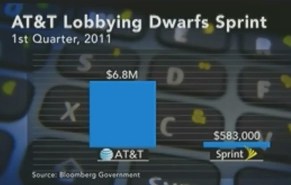

AT&T Lobbying Blitz: Company Spent $6.8 Million in 1st Quarter Pushing T-Mobile Merger

AT&T, one of the country’s most profligate spenders on public policy lobbying, has pulled out all the stops pushing for Washington approval of its proposed merger with T-Mobile.

Bloomberg Government reports AT&T spent $6.8 million during the first quarter of 2011, more than 11 times more than its rival Sprint, which opposes the merger deal.  In fact, AT&T was the nation’s second biggest spender in lobbying dollars, just behind defense contractor Honeywell, which is trying to avoid Pentagon spending cuts.

Sprint’s much smaller lobbying effort had to make do with a budget of just $583,000 during the same period to push back against the telecom giant.

Also raising questions are reports from Bloomberg that AT&T CEO Randall Stephenson direct dialed Federal Communications Commission Chairman Julius Genachowski the weekend before the deal went public.  At the same time, former FCC Chairman Richard Wiley, today a lobbyist for T-Mobile, spoke directly with four of the five FCC Commissioners to directly lobby for the merger’s approval.

Sprint has been trying to beef up its own lobbying star power, recently adding Eddie Fritz, former head of the National Association of Broadcasters as one of their lobbyists.  Sprint has also hired several former high-level Congressional staffers and mid-level employees at the Justice Department, expected to help Team Sprint know how to apply the right pressure to the right people inside the FCC and Justice Department to reject the deal.  The merger hinges on the approval of both agencies.

Left off the speed dial — consumers, who cannot pick up the phone and reach FCC Chairman Genachowski while lounging in his backyard or enjoy lucrative employment opportunities open to government workers in the private lobbying sector.

[flv width=”360″ height=”290″]http://www.phillipdampier.com/video/Bloomberg ATT Lobbying 5-24-11.mp4[/flv]

Bloomberg News breaks down AT&T’s lobbying and strategy for getting its merger deal with T-Mobile approved in Washington.  (2 minutes)

An Open Letter to Content Producers: Netflix, Hulu, Valve, Microsoft, Sony, and Nintendo

Dear Content Producer:

Your money train is leaving the station.

Customers are about to start making some very important choices about what they do on the Internet. AT&T announced this month they are going to start capping their DSL customers at 150GB per month and their fiber-to-the-neighborhood U-verse customers at 250GB per month, with overlimit fees for those who exceed them.

Comcast already has a 250GB per month cap, currently loosely enforced. Time Warner Cable has strongly advocated usage-based billing for years. Other telecommunications companies are all either supporting or considering these Internet Overcharging schemes for one reason, and one reason only:

It makes them absolute boatloads of cash.

Canada already lives with this reality. So does Australia, although they’re backing away from it. South Korea? Japan? Europe? Nope. Flat-rate Internet service is the norm there.  In Europe, mobile customers are demanding the removal of bandwidth caps American providers are still trying to attach to customers’ bills.

So how does this impact you? 250GB a month is a lot, and you’ll be fine? Sure. For now.

But what happens when Sony introduces the Playstation 4, or Microsoft announces the Xbox Next? Games aren’t exactly going to get smaller, and online distribution is far and away the future of games and software in general. Right now a game for the 360 or PS3 can be as large as 20GB. PC game enthusiasts routinely cope with 10-12GB game upgrades, and woe be unto you if you have to reinstall your Steam library and have 20-30 (or more) games to restore.

Internet Overcharging schemes make providers, and the lobbyists who do their bidding, very wealthy.

For the “Massively Multiplayer Online” game universe, incremental software updates and upgrades often come through BitTorrent, which exposes users to peer-to-peer traffic well beyond the size of the update itself.  In fact, as games increasingly turn towards Cloud storage and distribution, the traffic adds up.

For online video companies, your very business model could be at risk.  Netflix? Hulu? People are no longer satisfied with grainy, compressed video.  They want HD content, and you’ve answered the call.  But as consumers increasingly face 8-10GB per movie (at 720p, 15GB+ for 1080p), the usage racked up is going to blow past all of these caps.

Who knows what happens in the next five years, or ten.  Considering Canada, where a similar duopoly of broadband providers have lowered usage allowances, do you really expect anything different down here?  The only thing likely to be raised is the monthly price, which remains higher here than in most places around the world.

Google has the right idea with their experimental 1Gbps fiber-to-the-home network. The problem is, that’s only going to serve one (or perhaps a few) communities in the U.S.  The rest of the country will have to survive with ‘Ultra’ cable broadband packages serving up 10-20Mbps service or DSL that barely manages 6Mbps.  If you don’t live in an urban area, tough luck.  You will be lucky to get 3Mbps service.

Broadband service upgrades come painfully slow in the absence of robust competition.  Time Warner Cable and other providers are slowly starting to roll out DOCSIS 3, which allows speeds up to 100Mbps, assuming the average consumer can afford the Cadillac price that comes with it.  Many phone companies continue to bet the farm on their DSL service, which can also be expensive when it’s the only broadband service in town.

Against this backdrop, the rest of the world marches on, and beyond, North America.

South Korea? They’re promising national speeds of 1Gbps by 2013 — for $27 a month!

How has this happened?  Where have we gone wrong?

For starters, the broadband providers have very powerful lobbyists — quite a few of which are ex-legislators. Together, they wage their public policy battles on both the state and federal level, often writing the bills a compliant legislator is willing to introduce as their own.

Washington regulators take a "see no evil, hear no evil" approach to regulating super-sized corporations who can cause them trouble.

The Federal Communications Commission has adopted a “see no evil, hear no evil” approach to broadband, capitulating when a chairman occasionally strays too far into the industry minefield laid to protect their business agenda.  As a result, the agency is a toothless dog.  It recently adopted a “Net Neutrality” policy all but written by Verizon, who ironically is now spending money to fight the rules they helped write.  As a backup, virtually every Republican and several Democrats have teamed up to pass a Resolution of Disapproval seeking to overturn the weak-kneed Net Neutrality rules the FCC adopted.  Lobbyists are well paid to cover every contingency.

Consumers — your customers — can’t do much about this beyond writing their members of Congress and complaining.  But because they did not enclose a check or money order made payable to the respective politician’s campaign fund, the result will be a form letter response weeks, if not months later… after the corporate agenda is enacted into law.

We just cannot fight this battle all by ourselves.  Recognizing the realities of today’s politics, we need your help to fight money and power with money and power.

The video game industry earns billions yearly. You have already faced battles in Washington, so you know how this works. You can fight for your interests while protecting ours by ensuring broadband service is cheap, plentiful, and unlimited. The same story applies to other content producers, such as online video, software, and any other company that wants to move to online distribution to power their business. You cannot succeed if customers are too afraid of using your service because of a bandwidth cap.

The remarkable thing is that countries many Americans cannot find on a map are now beating the United States with better and cheaper broadband while we hand over our digital economic future to a duopoly. That will not buy us better service, just bigger bills for “fast enough for you” Internet access.

So that’s it. Act now. Act strongly. If you cannot stand up for your customers, you may not have any.

Signed: A gamer. A movie watcher. A music listener. An enjoyer of entertainment. A lover of the Internet.

Broadband consumer and reader Jason Ballew penned this guest editorial, with some editing and additions from Stop the Cap! editor Phillip M. Dampier.

AT&T: Since Courts Recognize Corporations as People, We Now Want Personal Privacy Rights, Too

Phillip Dampier January 24, 2011 AT&T, Editorial & Site News, Public Policy & Gov't 1 Comment

Since federal courts ruled that corporations are people, shouldn’t that mean those corporations also deserve the same privacy rights you and I enjoy?

AT&T intends to find out at the U.S. Supreme Court in the case of FCC v. AT&T Inc., an effort to win privacy rights for itself and keep potentially embarrassing documents out of the hands of third parties.

At least one court — the U.S. Court of Appeals for the Third Circuit, which includes the very-business-friendly state of Delaware, agreed with AT&T.  It ruled that since a corporation is also defined as a  “person,” it deserved enhanced protections available to ordinary citizens.

In AT&T’s world, that includes adjectives — all things personal, as in “personal privacy.”

The implications of such an interpretation are stunning, and judicial activism on this scale would deliver a golden platter of new rights to corporate interests that would wipe away oversight and more than a century of accepted business law.

AT&T could use its new powers to deny requests for documents and other materials, on the principle it would violate its privacy and potentially “embarrass” the company.  AT&T as an entity could get the right to remain silent and enjoy double jeopardy protections from repeated investigations.

It would be like watching a Law & Order episode with a corporate logo propped up at the defense table.

Overreach much, AT&T?

Many members of the U.S. Supreme Court apparently thought so during last week’s arguments, judging from the astonished reactions to AT&T lawyer Geoffrey Klineberg’s reasoning.

“Anything that would embarrass the corporation is – is a privacy interest?” Justice Antonin Scalia asked. “You talk about personal characteristics. That doesn’t mean the characteristics of General Motors. You talk about personal qualities. It doesn’t mean the qualities of General Motors. [The ‘personal privacy’ of a corporation] is a very strange phrase to me.”

Chief Justice John Roberts was also skeptical of AT&T “adjective”-shopping, noting several examples of adjectives with different meanings from their root nouns: “craft and crafty; squirrel and squirrely; pastor and pastoral.”

AT&T is no stranger to the federal court system, pouring millions of dollars into a range of legal actions that suggest the company takes its “Rethink Possible” slogan to literal extremes in some business-friendly legal venues.  [Stop the Cap! covered an earlier California case where AT&T argued consumers do not have the right to file class action lawsuits against the company.]

At Issue: Earlier AT&T Wrongdoing

In 2004, SBC Communications (which now owns AT&T) overcharged the government to provide technology services to several Connecticut schools, under the government’s E-Rate program (funded by telephone ratepayers).  After earlier abuses in the program were exposed and the federal government was threatening to expand investigations, SBC turned themselves in and handed over documents demanded by the Federal Communications Commission.  In return for its cooperation, AT&T got to admit no wrongdoing, but did pay a half-million dollar fine.

That didn’t sit well with CompTel, a Washington-based phone company trade association.  In 2005, Mary Albert, the group’s assistant general counsel e-mailed a request for copies of the documents collected by the FCC in the case.

“I made the request because I was very surprised to see the FCC enter into a consent decree in a case like this,” Albert said. “There has been a serious problem with E-Rate fraud over the years. I don’t mean to accuse AT&T of fraud, but there were clearly [enough] problems with its billing [to the program] that it reimbursed the government.”

Klineberg

Under federal law, documents collected by the government have to be made public under the Freedom of Information Act (FOIA), so long as those documents do not violate national security or expose certain personal, private information (typically home addresses, phone numbers, Social Security numbers, etc.)  Companies also have long-standing, existing exemptions protecting confidential trade secrets and other proprietary business information.

Albert expected to receive documents with “blacked-out” information protecting AT&T’s trade secrets, but instead she ended up with nothing.

AT&T argues the release of -any- of the documents would embarrass the company and violate its personal privacy.  It demanded, and got the FCC to withhold release of the documents and the dispute has been working its way through the court system.

The FCC argues corporations can’t sue over invasion of privacy.  Why?  Because they are an entity, not a person.

How does someone violate the privacy of a corporate entity that doesn’t live, breathe, or even blush?

Legal observers say the case isn’t really about protecting AT&T from potential embarrassment — it’s about curtailing the government’s right to request and receive documents from companies as part of its oversight process and to investigate potential wrongdoing.

On cue, Lawrence J. Spiwak, president of the Phoenix Center for Advanced Legal & Economic Public Policy Studies (which receives substantial funding from AT&T), argues AT&T’s arguments have merit because if corporations are not protected under FOIA’s law-enforcement exemption, they will be less forthcoming to the government.

In other words, if you don’t give AT&T what it wants, it will bury, shred or hide important documents when regulators come looking.

AT&T’s Book Club: Buys Over 700 Copies of Texas Gov. Rick Perry’s Book to Hand Out At Luncheon

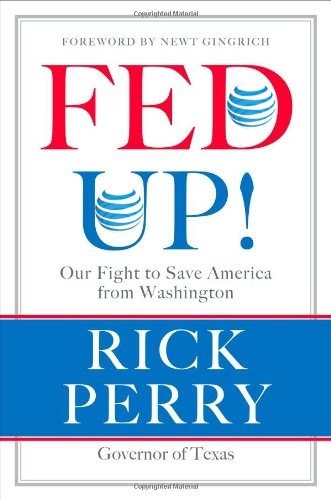
AT&T customers looking for better service need to put down those cellphones and turn off the computer and pick up a good book.  AT&T recommends Fed Up! Our Fight to Save America From Washington, written by Texas Gov. Rick Perry.

Perry’s book, which compares Social Security and FDR’s “New Deal” social programs with a Communist takeover is so popular with the Big Telecom, it purchased over 700 copies to hand out for free to state legislators, lobbyists and activists attending a conservative policy summit luncheon.  Oh, and the company paid for the lunch, too.  Total cost?  More than $13,000 — all ultimately paid for by AT&T’s customers.

AT&T made sure every guest had their own personal hardcover copy of the governor’s book, something that didn’t go unnoticed by former Texas Solicitor General Ted Cruz, who thanked AT&T from the microphone for paying for the books.

“Governor Perry has written a book – a book that all of us very kindly have been given by AT&T,” Cruz said. “Thank you, AT&T.”

AT&T’s gladhanding of conservative state politicians doesn’t come accidentally, reports the Dallas Morning News.  With hundreds of millions in revenue at stake, AT&T’s investment in the state’s Republican dominated legislature guarantees the company’s voice will be heard on important legislative matters.

AT&T has spent as much as $9.3 million to lobby Austin lawmakers and regulators, according to Texas Ethics Commission data. AT&T’s political action committee has donated $494,740 to Perry during his nine years in office, according to Texans for Public Justice.

The latter group told the newspaper AT&T doesn’t get into the book club business lightly.

“It does raise concerns. AT&T has a lot of business before the state of Texas and Texas regulators,” said Craig McDonald, director of Texans for Public Justice, a group that tracks money in politics. “They are generally the largest lobby in the state. They can reach out and touch every lawmaker simultaneously.”

Elected officials who write books routinely find some of their biggest sales come from lobbyists, who buy books in bulk and hand them out at public speaking engagements, or simply shove them into the nearest storage locker.  It’s not about the book, it’s about the access companies like AT&T gain from the goodwill earned from buying copies.

Perry does not profit directly from the book sales, but his political interests do.  Proceeds of the book sales go to the Texas Public Policy Foundation’s Center for Tenth Amendment Studies, a group dedicated to protecting corporate interests and “state’s rights.”

AT&T’s corporate interest is protected by the Policy Foundation’s opposition to Net Neutrality, but the group generally opposes broadband stimulus funding, some of which is likely to end up in AT&T’s pockets.

[flv width=”480″ height=”380″]http://www.phillipdampier.com/video/Texas Public Policy Foundation Net Neutrality.flv[/flv]

The Texas Public Policy Foundation invited two Republican FCC commissioners — one current and one former — to bash Net Neutrality and broadband reforms before a stacked panel and audience of like-minded thinkers.  (1 hour, 50 minutes)

Search This Site:

Contributions:

Recent Comments:

Your Account:

Stop the Cap!