One of the most frustrating things about covering the public policy issues surrounding broadband is an-often lazy mainstream media that cannot tell the difference between an industry sock puppet and a consumer broadband advocate. One expects that the New York Times will do better than most.
New York Times reporter David Streitfeld seemed utterly out of his league from the lede paragraph in the story, where he suggested Google “casually scooped up passwords, e-mail and other personal information from unsuspecting computer users.”
That is a bit histrionic considering any “data theft” would have only occurred for the 5-15 seconds Google’s Street View vehicle was in range of an entirely unprotected home Wi-Fi network, and that you were actively using it at the time of Google’s “drive-by.” If you enabled any wireless network security, Google would have captured nothing beyond the name of your Wi-Fi network (assuming you had not hidden it with another setting) — something anyone could capture with a Wi-Fi sniffer.
Even more concerning was the sudden appearance in the piece of paid Google critic Scott Cleland, who runs a suburban Washington, D.C. corporate public strategy lobbying firm called Precursor LLC that has as its chief mission:
Help companies anticipate change to better exploit emerging opportunities and guard against emerging risks.
Attacking Google and broadband advocacy groups is Cleland’s bread and butter.
The New York Times called him a “consumer watchdog.”
At this point I coughed up my peppermint patty.
Cleland, whose rhetoric about Google ranges from alarmist to lugubrious — America must worry about being on the cusp of a Google-run online dystopia — is well-known to those of us who encounter his various paid-for campaigns. Cleland is best known for his anti-Google rhetoric and his reflexive defense of all-things-Big Telecom, hardly surprising considering his client list.
What is disturbing is that I know this and the reporters at the New York Times apparently do not:
“Google puts innovation ahead of everything and resists asking permission,” said Scott Cleland, a consultant for Google’s competitors and a consumer watchdog whose blog maintains a close watch on Google’s privacy issues. “But the states are throwing down a marker that they are watching and there is a line the company shouldn’t cross.”
At least the Times casually disclosed he was a “consultant for Google’s competitors.” But consumer watchdog? That is a line the Times shouldn’t cross because it is reality only in a world where Goldman Sachs is considered a model for altruistic investment banking.
[flv width=”448″ height=”276″]http://www.phillipdampier.com/video/David Cay Johnston The Fine Print How Big Companies Use Plain English to Rob You Blind 9-19-12.mp4[/flv]
Fellow Brighton, N.Y. resident and Pulitzer Prize-winning journalist David Cay Johnston hits the nail right on the head describing the Big Telecom Swindle that promised America it was going to get something magical called “the information superhighway.”
Over a half-trillion dollars in rate increases later, AT&T and Verizon instead spent a lot of that money on an enormously profitable wireless business that redefines the average American family’s monthly phone bill at $100+. Johnston talks about the broken industry promises of ubiquitous broadband, leaving millions of potential FiOS and U-verse customers behind.
With vast lobbying arms, large cable and phone companies have manipulated public policy to assure they can gouge customers, shortchange workers, and erect barriers to fair play. If consumers don’t pay attention, politicians armed with fat campaign contributions will continue to represent corporate interests, not those of the average American.
[Note to Mr. Johnston: He isn’t the only reporter paying attention. Hat tip to Stop the Cap! reader Pat McDermott who shared the video.] (17 minutes)
Phillip “At Least They Are Transparent About Robbing You” Dampier
The unassailable truth is that if there is a right way for a company to treat its customers and a wrong way, AT&T will always choose the wrong way. It’s the primary reason I refuse to do business with them.
The company’s recent decision to block Apple FaceTime for customers who refuse to be herded to one of AT&T’s new Mobile Share plans is another shot across the bow of Net Neutrality, which declares customers should be able to use the applications and services of their choosing — particularly on networks where they pay for those choices.
Principal #1 of Net Neutrality: Companies should not be playing favorites with applications or services by blocking or restricting those a provider does not favor.
AT&T’s response: ‘Whatever.’
The predictable outrage of customers should have come as no surprise to AT&T, but somehow it did.
The company picked testy senior vice president for regulatory affairs Bob Quinn to mount a rapid defense against the pitchfork-and-torch-yielding throngs on AT&T’s Public Policy Blog. That was their second mistake.
Quinn, who spent last December valiantly defending AT&T against its too-precious CupcakeGate mini-scandal, conjured up this pretzel-twisted logic tap dance to explain away its latest boorish behavior:
Providers of mobile broadband Internet access service are subject to two net neutrality requirements: (1) a transparency requirement pursuant to which they must disclose accurate information regarding the network management practices, performance, and commercial terms of their broadband Internet access services; and (2) a no-blocking requirement under which they are prohibited, subject to reasonable network management, from blocking applications that compete with the provider’s voice or video telephony services.
AT&T’s plans for FaceTime will not violate either requirement. Our policies regarding FaceTime will be fully transparent to all consumers, and no one has argued to the contrary. There is no transparency issue here.
Nor is there a blocking issue. The FCC’s net neutrality rules do not regulate the availability to customers of applications that are preloaded on phones. Indeed, the rules do not require that providers make available any preloaded apps. Rather, they address whether customers are able to download apps that compete with our voice or video telephony services. AT&T does not restrict customers from downloading any such lawful applications, and there are several video chat apps available in the various app stores serving particular operating systems. (I won’t name any of them for fear that I will be accused by these same groups of discriminating in favor of those apps. But just go to your app store on your device and type “video chat.”) Therefore, there is no net neutrality violation.
A company lecturing its customers for daring to question its decisions is always a good way to enhance those warm and fuzzy feelings people have about America’s least-liked wireless phone company. Quinn first scolds customers and consumer groups about their “knee jerk reaction,” for being upset about the issue. Then he declares they have “rushed to judgment,” using a turn of phrase not heard since O.J. Simpson’s defense team pounded it to death, and look where that ultimately got us.
The crux of AT&T’s argument is they get a free pass to “block and herd” because Apple FaceTime was pre-installed on customer phones. Therefore, since AT&T didn’t block you from downloading an app you already had, it cannot possibly be a Net Neutrality violation. Because as we all know, Net Neutrality is only about download blocking.
At least AT&T is keeping their promise to be transparent. They have, indeed, fully informed you they are mugging you while in the process of mugging you. Full disclosure… matters.
Somehow, I missed the “preinstalled does not count” section in the Federal Communications Commission’s December 2010 order to providers telling them to preserve the free and open Internet. So I spent last night with this legalese page-turner (194 pages to be exact) to refresh my memory.
Nope, it isn’t in there. You can read it for yourself from the link above.
So it isn’t me. It is them, making up the rules as they go, again.
Quinn graciously offers customers one concession: AT&T will allow you to use Apple FaceTime over your own home Wi-Fi network. Gosh thanks!
For customers addicted to FaceTime, AT&T’s solution is an expensive plan change. An average customer currently paying $70 for 450-barely used voice minutes and 3GB of data will find FaceTime off-limits on AT&T’s network unless they “upgrade” to AT&T’s $95 Mobile Share plan, which gets you only 1GB of data, but endless voice minutes you don’t want and unlimited texting you don’t need.
Result: Pay $25 more a month and get your data allowance slashed by 2/3rds. That’s a deal — AT&T-style.
But it is one some customers are through taking. Nalin Kuachusri:
The new FaceTime restrictions will usher in the end of my 12+ year relationship with AT&T. I’m tired of the consistent manipulation of plans and features to extract more and more money for services I don’t need. For example: there used to be several text-message options (200, 1000, 1500, unlimited) so I could choose and pay for the one that fit my usage best. Then there was the option to move from unlimited data to 2GB/month to save $5. That was great for me and fit my usage. Then I was forced to move back to $30/month if I wanted to add tethering where I’ll get an extra GB that I’ll never use. Finally, after 12 years as a customer with an account in good standing, I was not allowed to unlock my phone for my 10-day trip to Europe so I could get a local SIM. I couldn’t be happier to give you one final $200 payment as an early-termination fee so I can move to Verizon.
Unfortunately for Kuachusri, the bosses at Verizon Wireless are likely slapping themselves silly because they did not come up with the idea first.
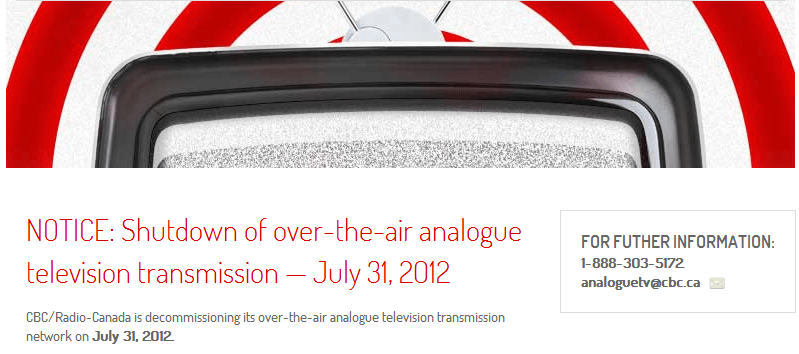
The Canadian Broadcasting Corporation today shut down more than 600 analog television transmitters primarily serving rural viewers, forcing most to either go without television to sign up for commercial satellite or cable television service.
Because of Canada’s great expanse, the country’s public broadcaster has relied on hundreds of terrestrial low-power television transmitters to cover smaller communities and rural areas outside of the reach of CBC stations in larger cities. These transmitters provide relays of 27 regional English and French stations and have allowed rural residents to enjoy free over-the-air television.
While larger communities are now able to watch digital television signals in place of older analog service, the CBC has decided not to replace existing analog repeater transmitters with digital ones, effectively ending service for many rural Canadians who will now receive no over the air signals at all. Budget challenges and a decision from the CRTC that declared the CBC has no obligation to broadcast its programming has been met with resistance across rural Canada, particularly because taxpayers in cities large and small finance the CBC’s operations.
As of today, the CBC will rely entirely on the 27 digital television stations it will continue to operate over the public airwaves nationwide. Critics say that is contrary to the CBC’s mandate in the Broadcasting Act, which declares the CBC is Canada’s “national public broadcaster.”
“The TV transmitter infrastructure is worth millions and was paid for by Canadian taxpayers,” says Catherine Edwards of the Canadian Association of Community Television Users and Stations. “More than 2000 Canadians protested the shutdown in letters to the CRTC last month. They asked that the infrastructure be offered to communities to maintain for themselves. The federal government seems to be doing everything it can to cripple the national broadcaster and turn it into a pay specialty service, available to well-heeled Canadians in big cities.”
“The CBC-TV and Radio-Canada analog transmitter shutdown is a sad chapter in Canada’s digital transition,” says Karen Wirsig of the Canadian Media Guild. “We understand that CBC is in a financial bind with $155 million in cuts required by 2015. Something had to give. Evidently infrastructure outside of major cities is not a priority for the federal government, despite rhetoric about the digital economy.”
The CBC says the change will impact only 2 percent of Canadians that do not already receive digital television service or have signed up with a pay television provider. But the concept of “free TV” has changed forever for rural viewers.
For some cable viewers, the CBC’s digital solution is also presenting problems, especially in the Maritimes. In rural Newfoundland and Labrador, EastLink viewers may lose their closest local CBC station and be forced to watch programming from a CBC station is Halifax, Nova Scotia instead, at least until Shaw begins carrying additional CBC stations on satellite.
The Canadian Broadcasting Corporation today shut down more than 600 relay transmitters providing rural Canada with over-the-air access to the public broadcaster with a mandate to serve all of Canada. Now, viewers in rural Newfoundland and Labrador are going to be stuck watching “local” news and weather intended for Halifax, Nova Scotia. CBC Radio in Newfoundland and Labrador talks with the CBC about the reason for the disruption. (July 30, 2012) (8 minutes)
You must remain on this page to hear the clip, or you can download the clip and listen later.
Shaw’s “Local Television Satellite Solution”
In 2010, Shaw Communications, which owns Shaw Cable and Shaw Direct — a major satellite TV provider, announced its intention to buy Global TV — a major Canadian television network. For Americans, this would be the equivalent of Comcast owning your local cable company, NBC, and DirecTV. The Canadian Radio-television and Telecommunications Commission (CRTC), Canada’s telecommunications regulator, agreed to a deal offered by Shaw to acquire Global in return for offering Canadians who have not had satellite or cable service in the last 90 days a temporary free satellite solution for receiving “local stations.”
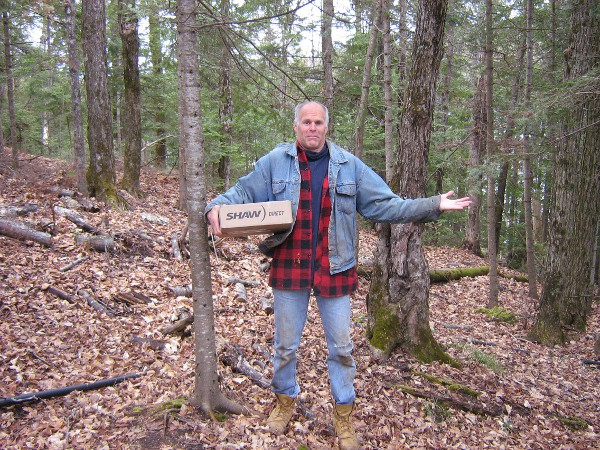
This customer ran out of luck when he needed Shaw to install just over 250 feet of cable from the nearest clear spot for the satellite to his home. Shaw limits installers to 250 feet, no more. The installer packed up and left shortly after learning an exception would have to be made. (Photo: PGM/Dude, ‘Where’s My TV?’ blog)
Shaw’s Local Television Satellite Solution (LTSS) offers qualified Canadians free satellite service with a handful of over-the-air stations, assuming they apply by November 2012.
Assuming your postal code is within a “qualified reception zone,” and you somehow know about the barely promoted service, Shaw will provide a satellite dish, receiver, and reasonable installation at no charge.
Unfortunately, many Canadians have no idea Shaw is offering the service, and are opting to purchase a regular Shaw Direct package, signing up with another satellite provider, or subscribing to cable where available. Very little about the service is found on Shaw Direct’s website, and those interested are required to call the company for further information. Even those made aware of Shaw’s offer have found challenges signing up.
Steven James May, who runs the “Dude, Where is My TV?” blog reports his parents, who live in rural Denbigh, Ontario were first made aware of Shaw’s LTSS when he told them about it. Several initial attempts to sign up for the service were dashed when Shaw responded Denbigh residents were not qualified for LTSS based on the postal code provided. When May’s parents eventually did qualify, they were sent a well-used and scuffed Star Choice satellite receiver retired from the days Shaw Direct was known as Star Choice.
After installation, the Ontario residents ended up with a dozen primarily over-the-air channels from across Canada:
2 Shaw Direct’s home channel
9 Knowledge Network
23 CTV 2 Alberta
37 CBC Toronto
39 Global Toronto
40 CityTV Toronto
41 CHCH Hamilton
42 OMNI
44 CTV Toronto
50 MCTV Sudbury (CTV)
52 Global Thunder Bay
55 TVOntario (Educational)
While enticing, Denbigh residents have effectively lost “local service” because the community is forced to watch local news for Toronto, Hamilton, Sudbury, Thunder Bay, and Calgary — all much further away than the nearest large city for them — Ottawa. Residents that used to watch CJOH (CTV Ottawa) and CBOT (CBC Ottawa) over-the-air now must get accustomed to news and weather for Toronto, a considerable distance to the west.
“This is a major public policy failure,” adds Edwards. “Everyone has known that the digital transition was coming for two decades. It’s supposed to increase our communications services, yet no one would step up to the plate and take leadership to make sure that neither rural Canada nor our national public broadcaster would be crippled: not Heritage, not the CRTC, not the CBC, and certainly not the federal government.”
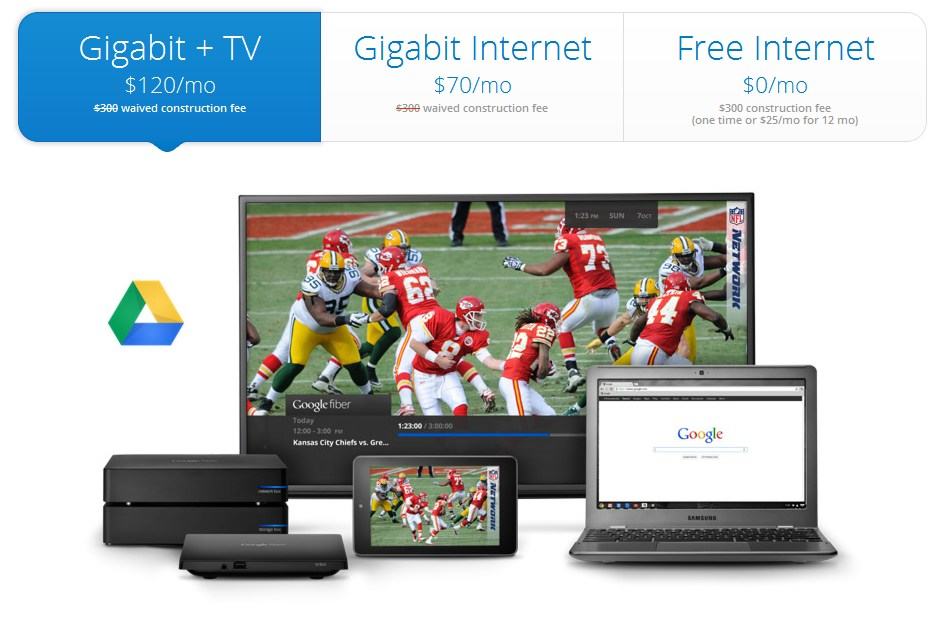
Google formally announced its new fiber to the home service to residents of Kansas City today with game-changing pricing for broadband and television service.
For $70 a month, Google will deliver consumers unlimited 1Gbps broadband service. For an additional $50 a month, customers can also receive a robust television package consisting of hundreds of digital HD channels, and throw in a free tablet (they call it ‘the remote control’), free router, free DVR with hundreds of hours of storage, and access to Google’s cloud backup servers.
Google has also found a solution to affordable Internet for poorer residents. The company is promising free 5/1Mbps service for up to seven years if customers will pay a $300 installation charge, payable in $25 installments.
Customers who agree to sign up for multiple services and a service contract can waive the $300 installation charge.
Google’s new service will roll out to different areas of Kansas City. Google has split neighborhoods into “fiberhoods” that consist of around 800 homes. In a masterful public relations and public policy demonstration, Google intends to show up the cable and phone companies who have repeatedly declared customers have no interest in fiber-fast broadband speeds by asking would-be customers to pre-register for Google Fiber, which will cost $10. Those “fiberhoods” with the largest number of pre-registrations will be the first to get Google’s new fiber service. At least 80 families (around 10%) of each “fiberhood” will have to be willing to sign up for Google to activate the service in each neighborhood.
Google hopes consumers will evangelize the possibilities of fiber broadband with friends and neighbors nearby and get them on board. If the telecom industry’s predictions of lukewarm interest are true, then Google won’t collect many $10 registrations and will not be able to publicize the number of customers who want nothing more to do with incumbent cable and phone companies. If Google is correct, they will have successfully proven America’s phone and cable companies have been dramatically overcharging Americans for service and large numbers are clamoring for a better choice.
[flv width=”640″ height=”380″]http://www.phillipdampier.com/video/Google Fiber In Kansas City 7-26-12.flv[/flv]
Google’s formal introduction of Google Fiber in Kansas City this morning. Presentation begins at around the five minute mark. (1 hour, 6 minutes)
Google has the goods to entice technology fanatics. Those signing up for television service will find Google has moved way beyond the traditional cable set top box that still won’t reliably record your favorite shows. Google will supply customers with:
a free Nexus 7 tablet that will come pre-programmed to function as a remote control (but can be used for other things);
a Bluetooth-based traditional remote;
a combination set top box and DVR system that can record up to 500 hours of programming;
a Wi-Fi enabled Gigabit router;
an iOS (Android coming, of course) app that will let viewers manage everything over their tablet or mobile phone;
a 2TB storage locker;
a free terabyte of Google Cloud storage
But Google’s current television lineup does omit many popular cable networks, either in an effort to control programming costs or because the company has not completed negotiations with every programmer they want on the lineup. Among the missing:
ESPN and regional sports networks
Disney networks
Turner networks like TNT, TBS and Turner Classic Movies
Rainbow Networks’ AMC
Time Warner-owned channels like HBO, CNN and TruTV
Fox-owned networks like Fox News Channel and Fox Business News
Time Warner Cable’s response to Google’s network seems to indicate, publicly at least, they are not that worried.
“Kansas City has been a highly competitive market for a long time and we take all competitors seriously,” said spokesman Justin Venech. “We have a robust and adaptable network, advanced products and services available today, and experienced local employees delivering local service. We are confident in our ability to compete.”
Be Sure to Read Part One: Astroturf Overload — Broadband for America = One Giant Industry Front Group for an important introduction to what this super-sized industry front group is all about. Members of Broadband for America Red: A company or group actively engaging in anti-consumer lobbying, opposes Net Neutrality, supports Internet Overcharging, belongs to […]
Astroturf: One of the underhanded tactics increasingly being used by telecom companies is “Astroturf lobbying” – creating front groups that try to mimic true grassroots, but that are all about corporate money, not citizen power. Astroturf lobbying is hardly a new approach. Senator Lloyd Bentsen is credited with coining the term in the 1980s to […]
Hong Kong remains bullish on broadband. Despite the economic downturn, City Telecom continues to invest millions in constructing one of Hong Kong’s largest fiber optic broadband networks, providing fiber to the home connections to residents. City Telecom’s HK Broadband service relies on an all-fiber optic network, and has been dubbed “the Verizon FiOS of Hong […]
BendBroadband, a small provider serving central Oregon, breathlessly announced the imminent launch of new higher speed broadband service for its customers after completing an upgrade to DOCSIS 3. Along with the launch announcement came a new logo of a sprinting dog the company attaches its new tagline to: “We’re the local dog. We better be […]
Stop the Cap! reader Rick has been educating me about some of the new-found aggression by Shaw Communications, one of western Canada’s largest telecommunications companies, in expanding its business reach across Canada. Woe to those who get in the way. Novus Entertainment is already familiar with this story. As Stop the Cap! reported previously, Shaw […]
The Canadian Radio-television Telecommunications Commission, the Canadian equivalent of the Federal Communications Commission in Washington, may be forced to consider American broadband policy before defining Net Neutrality and its role in Canadian broadband, according to an article published today in The Globe & Mail. [FCC Chairman Julius Genachowski’s] proposal – to codify and enforce some […]
In March 2000, two cable magnates sat down for the cable industry equivalent of My Dinner With Andre. Fine wine, beautiful table linens, an exquisite meal, and a Monopoly board with pieces swapped back and forth representing hundreds of thousands of Canadian consumers. Ted Rogers and Jim Shaw drew a line on the western Ontario […]
Just like FairPoint Communications, the Towering Inferno of phone companies haunting New England, Frontier Communications is making a whole lot of promises to state regulators and consumers, if they’ll only support the deal to transfer ownership of phone service from Verizon to them. This time, Frontier is issuing a self-serving press release touting their investment […]
I see it took all of five minutes for George Ou and his friends at Digital Society to be swayed by the tunnel vision myopia of last week’s latest effort to justify Internet Overcharging schemes. Until recently, I’ve always rationalized my distain for smaller usage caps by ignoring the fact that I’m being subsidized by […]
In 2007, we took our first major trip away from western New York in 20 years and spent two weeks an hour away from Calgary, Alberta. After two weeks in Kananaskis Country, Banff, Calgary, and other spots all over southern Alberta, we came away with the Good, the Bad, and the Ugly: The Good Alberta […]
A federal appeals court in Washington has struck down, for a second time, a rulemaking by the Federal Communications Commission to limit the size of the nation’s largest cable operators to 30% of the nation’s pay television marketplace, calling the rule “arbitrary and capricious.” The 30% rule, designed to keep no single company from controlling […]
Less than half of Americans surveyed by PC Magazine report they are very satisfied with the broadband speed delivered by their Internet service provider. PC Magazine released a comprehensive study this month on speed, provider satisfaction, and consumer opinions about the state of broadband in their community. The publisher sampled more than 17,000 participants, checking […]


 Subscribe