Home » mobile data » Recent Articles:

Time Warner Cable: AT&T, Verizon Cannot Meet Broadband Demand With 4G Wireless Technology

Phillip Dampier October 10, 2013 AT&T, Broadband "Shortage", Broadband Speed, Comcast/Xfinity, Consumer News, Data Caps, Public Policy & Gov't, Verizon, Video, Wireless Broadband Comments Off on Time Warner Cable: AT&T, Verizon Cannot Meet Broadband Demand With 4G Wireless Technology

freewifiA new research report issued by Time Warner Cable concludes cell phone companies like AT&T and Verizon Wireless cannot meet the future data demands of customers over their 4G LTE wireless networks without punitive usage caps and high fees to deter usage, even with new spectrum becoming available for the wireless industry’s use.

The report, authored by Michael Calabrese of the New America Foundation, finds an answer to this problem in Wi-Fi, which can offload wireless traffic and deliver wireless service customers already prefer:

There is simply not enough exclusively licensed spectrum to meet the rapidly rising demand for wireless data, to sustain a competitive market, and to keep prices at an affordable level.

Major mobile carriers are increasingly coming to grips with this reality. The Wireless Broadband Alliance, a global industry group, reports that Wi-Fi offloading has become an industry standard as “18 of the world’s top 20 largest telcos by revenue have now publicly committed to investing in deploying their own Wi-Fi Hotspot networks.” The industry is shifting steadily toward what it calls heterogeneous networks (HetNets)—i.e., a combination of licensed and unlicensed infrastructure—in order to meet their customers’ insatiable demand for data while keeping costs down.

Alcatel-Lucent forecasts an increase of “87 times [the current] daily traffic on wireless networks” over the next five years, with 50 percent of that traffic on cellular networks “while the remaining 50 percent will be offloaded to Wi-Fi.”

Cisco’s own studies back Calabrese’s findings on consumer preference towards Wi-Fi.

twc“Given a choice, more than 80 percent of tablet, laptop, and eReader owners would either prefer Wi-Fi to mobile access, or have no preference,” Cisco concluded. “And, just over half of smartphone owners would prefer to use Wi-Fi, or are ambivalent about the two access networks.”

The Cisco surveys found users are choosing Wi-Fi over mobile connectivity for reasons of cost, “because it doesn’t impose data-usage caps or reduce their mobile data plan quotas.” But the primary reason for choosing Wi-Fi “is that respondents find it much faster than mobile networks.” And since Wi-Fi traffic travels over increasingly upgraded wireline networks, that speed differential may only increase as more and more homes, businesses and retail outlets upgrade to fiber optic or other high-speed connections of 100Mbps or more.

America’s largest wireless carriers have fallen far behind offering Wi-Fi services to customers compared to their overseas colleagues:

  • AT&T: More than 32,000 Wi-Fi hotspots are available at partnered retail businesses, restaurants, and high-traffic areas like stadiums and major tourist destinations;
  • Verizon Wireless: Verizon has an insignificant Wi-Fi presence, with a small number of unadvertised hotspots in selected venues like airports and convention centers;
  • Japan’s NTT DOCOMO: Up to 150,000 hotspots, up from only 8,400 in 2o12.
  • China Mobile: More than 2 million hotspots are up and running carrying 70 percent of the company’s data traffic.
  • France’s Free Mobile: More than 4 million residential hotspots are available through Free’s parent – Iliad.
Comcast could soon be the nation's largest Wi-Fi hotspot provider.

Comcast could soon be the nation’s largest Wi-Fi hotspot provider.

Calabrese argues it is important for the United States to set aside significant spectrum for unlicensed wireless networks like Wi-Fi to meet future wireless demands. Currently, some Republican members of Congress are opposed to significant spectrum set asides they feel could best be monetized for private use through the spectrum auction process.

It is no coincidence that Calabrese’s findings would be released by Time Warner Cable which itself is growing a Wi-Fi presence in certain cities where it provides cable service.

The wireless carriers’ collective lack of interest in an aggressive nationwide Wi-Fi deployment may have provided a strategic opening for cable operators to fill that gap with Wi-Fi networks of their own. Cable operators consider them a useful tool to retain customer loyalty — access is typically free and unlimited for current customers.

This summer, Comcast announced a “neighborhood hotspot initiative” that will turn millions of customer cable Internet connections into shared Wi-Fi hotspots using a dual-use wireless home gateway. The equipment will offer two separate Wi-Fi signals — one intended for the customer and the other open for use by any Comcast customers in the neighborhood. The cable company will provision extra bandwidth for the open Wi-Fi network to ease concerns that guest users could theoretically slow down a customer’s own Wi-Fi channel. In a relatively short period, Comcast could become the nation’s biggest Wi-Fi network offering more than 20 million hotspots hosted by the company’s own broadband customers.

Calabrese points to the future of seamless transitions between wired, wireless 4G and Wi-Fi network access without dropping calls or data connections. Many customers won’t even know the difference.

The author recommends the FCC think about reserving space for new unlicensed “citizens band” frequencies dedicated for public and private Wi-Fi networks:

  • The FCC should reorganize the UHF TV band to ensure the availability of at least 30 to 40MHz of unlicensed spectrum in every media market, perhaps including Channel 37 (now reserved for radio astronomy) and eliminating two dedicated channels reserved for wireless microphones;
  • Open the grossly underutilized 3.5–3.7GHz federal band for unlicensed small cell antennas delivering a ‘Citizens Broadband Service.’ This band is now mostly used for offshore naval radar, allowing both services to co-exist without mutual interference;
  • Expand unlicensed access to the 5GHz band by allocating the 5.35–5.47 and 5.85–5.925GHz bands providing contiguous, very wide channels useful for the 802.11ac Wi-Fi standard that can support very high-speed wireless services.

[flv width=”640″ height=”380″]http://www.phillipdampier.com/video/XFINITY Wireless Gateway Powers Connected Home Summer 2013.flv[/flv]

Comcast talks about their new X3 Wireless Gateway which is capable of providing two separate Wi-Fi networks, one for the customer and another for the neighborhood. (2 minutes)

AT&T, Apple Settle Unlimited Data Class Action Lawsuit; Original iPad Owners Get Payout

Phillip Dampier October 1, 2013 AT&T, Consumer News, Data Caps, Wireless Broadband Comments Off on AT&T, Apple Settle Unlimited Data Class Action Lawsuit; Original iPad Owners Get Payout
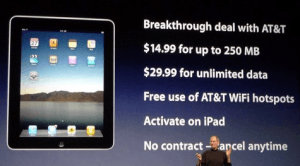
The "breakthrough" unlimited data deal with AT&T didn't last long.

The “breakthrough” unlimited data deal with AT&T didn’t last long.

When Apple first introduced its AT&T 3G-equipped original iPad, both companies marketed it with an unlimited 3G wireless Internet plan that soon became unavailable for new buyers and left grandfathered customers enduring a speed throttle when AT&T decided you used their network too much.

Burned customers banded together and sued both Apple and AT&T for bait and switch unlimited broadband. The two companies have now decided to settle, and as well as a whopper payout for the attorneys who filed the class action case, original iPad owners are going to share the proceeds:

  • Customers purchasing a 3G-ready iPad before June 7, 2010 will receive a $40 check from Apple, even if you still have a grandfathered unlimited data account.
  • Customers purchasing a 3G-ready iPad before June 7, 2010 who never activated an AT&T unlimited tablet mobile data plan will get a $20 discount off AT&T’s current $50 a month data add-on for up to one year.

Customers complained the steep price premium they paid for a 3G-equipped iPad wasn’t worth Apple’s asking price once AT&T removed the unlimited data option that Steve Jobs called part of a breakthrough deal.

Customers will not receive any awards until after February of next year, when the settlement is expected to be approved.

Wireless Spectrum: Highest Bidder Wins in U.S., Competition Wins in Europe… for Now

analysisIn the race to acquire spectrum and market share, AT&T and Verizon Wireless have already won most of the awards worth taking and have little to fear from smaller competitors. The U.S. government has seen to that.

The two wireless giants have benefited enormously from government spectrum auctions that award the most favorable wireless spectrum to the highest bidder, a policy that retards competition and guarantees deep-pocketed companies will continue to dominate in the coverage wars.

Winner-take-all spectrum auctions have already proven that AT&T and Verizon are best equipped to bid and win coveted 700MHz spectrum which provides the best indoor and fringe-area reception. This is why AT&T and Verizon customers often find “more bars in more places” than customers relying on Sprint or T-Mobile. Smaller carriers typically have to offer service over much-higher frequencies that don’t penetrate buildings very well. With a reduced level of service, these competitors are at an immediate competitive disadvantage. They also must spend more for a larger number of cell towers to provide uniform service.
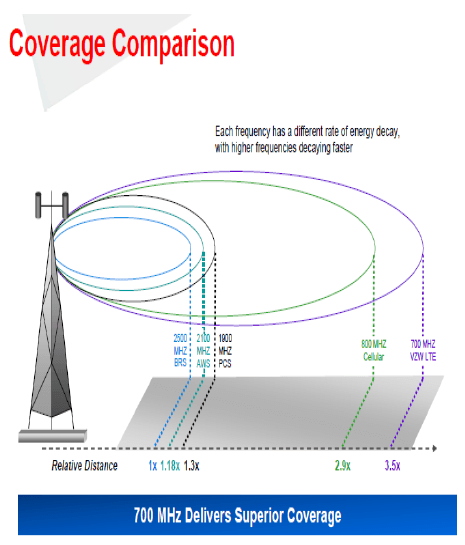
Verizon's own presentation materials tout the benefits of controlling 700MHz spectrum which is less costly to deploy and offers more robust coverage.

Verizon’s own presentation materials tout the benefits of controlling 700MHz spectrum, which is less costly to deploy and offers more robust coverage.

Sprint and T-Mobile have two strikes against them at the outset — less favorable spectrum and much smaller coverage areas. Customers who want the best reception under all circumstances usually get it from the biggest two players. Those focused primarily on price are willing to sacrifice that reception for a lower bill.

The same story is developing in the wireless data marketplace. AT&T and Verizon Wireless have the strongest networks as Sprint and T-Mobile fight to catch up.

Where America Went Wrong: The Repeal of Spectrum Caps

Tom Wheeler: America's #1 Advocate for Repeal of Spectrum Caps is now the chairman of the FCC.

Tom Wheeler: America’s #1 advocate for repeal of Spectrum Caps is now the chairman of the FCC.

Originally, the United States prevented excessive market domination with a “Spectrum Cap,” — a maximum amount of wireless spectrum providers could hold in any local market. The rule was part of the sweeping changes in telecommunications law introduced in the mid-1990s. Wireless spectrum auctions replaced lotteries or strict frequency assignments based on merit. The U.S. government promoted the auction system as a win for the U.S. Treasury, which has been promised $60 billion in proceeds from the wireless industry (not the amount actually collected) since auctions began in 1994.

The cost to U.S. consumers from increasing cell phone bills in barely competitive markets is still adding up.

After the auction system was introduced, the largest carriers acquired some of the most favorable, lower-frequency spectrum, easily outbidding smaller rivals. Most of the smaller regional carriers that ultimately won coveted 700MHz spectrum emerged victorious only when AT&T and Verizon felt the smaller markets were not worth the investment. In larger markets, spectrum caps were a gatekeeper against acquiring excess spectrum and, more importantly, rampant industry consolidation.

Under the pre-2001 rules, wireless companies couldn’t own more than 45MHz of spectrum in a single urban area or more than 55MHz in a rural area. That was when Verizon and AT&T competed with carriers that no longer exist — old familiar names like Nextel, Cingular, VoiceStream, Alltel, Centennial Communications, Qwest, and many others considered safe from poaching because the most likely buyers would find themselves over their spectrum limits.

As the largest carriers realized the caps were an effective merger/buyout firewall, the wireless industry began a fierce lobbying campaign against them. Leading the charge was Tom Wheeler, then-president of the CTIA Wireless Association, the nation’s top cellular industry lobbying group. Today he is chairman of the Federal Communications Commission.

“Today, America faces a severe spectrum shortage for wireless services,” Wheeler said in 2001. “The spectrum cap is a legacy of spectrum abundance, not shortages; the inefficiencies it perpetuates cannot be allowed to continue. While the U.S. government is looking for ways to catch up to the rest of the world on spectrum allocations, removal of the cap can at least increase the efficiency of existing spectrum.”

Copps

Former FCC Commissioner Michael Copps opposed retiring Spectrum Caps: “Let’s not kid ourselves: This is, for some, more about corporate mergers than it is about anything else.”

Wheeler was backed by an intensive lobbying effort funded by the largest wireless companies itching to merge and acquire.

By the end of 2001, the new Bush Administration’s FCC was ready to deal, gradually repealing the spectrum caps and fueling major wireless industry consolidation in the process. Providers everywhere could now own or control 55MHz of spectrum in any market, with the promise the caps would be repealed altogether by March 2003.

The result was already foreseen by former FCC Commissioner Michael Copps in November 2001, when he strongly dissented to the Republican majority gung ho for dissolving spectrum caps.

“Let’s not kid ourselves: This is, for some, more about corporate mergers than it is about anything else,” Copps wrote in his strong dissent. “Just look at what the analysts are talking about as the specter of spectrum cap renewal approaches – their almost exclusive focus is on evaluating the candidates for corporate takeovers and handicapping the winners and losers in the spectrum bazaar we are about to open.”

Just in case Copps might be making headway in his campaign to protect competition, Wheeler began complaining even louder about spectrum caps during the spring of 2003, just before their dissolution.

“The wireless industry fought long and hard to secure this spectrum for America’s wireless consumers,” said Wheeler. “Now we must tread carefully — in this era of rapid technological change, writing rules that are too restrictive would be irresponsible. In order to use this spectrum both efficiently and effectively, those who purchase this spectrum at auction must be allowed the freedom to grow and evolve with the demands of the market.”

Europe: Protecting Consumers from Giant Multinational Competition Consolidators (Some of the same ones AT&T reportedly wants to buy)

There is a reason Europeans are shocked by the costs of wireless service in the United States and Canada. North Americans pay higher prices for less service than our European counterparts. Most of the New World also has fewer choices in near-equivalent service providers.

Much of this difference can be attributed to European regulators maintaining focus on driving competition forward and disallowing rampant industry consolidation. But as Wall Street turns its attentions increasingly towards Europe to push for the next big wave of wireless mergers, the European system of “competition first” could be undermined if providers follow the North American model of high profits and reduced competition through consolidation.

Across much of Europe, at least four national carriers serve each EU member state, almost all controlling a share of the most valued, low-frequency wireless spectrum. European regulators do not allow a small handful of providers to maintain a stranglehold on the most valuable radio spectrum. Competitors have traditionally been offered a spectrum foundation to build networks that can stand up to their larger counterparts — the large multinationals or ex-state monopoly providers who had a head start providing service.

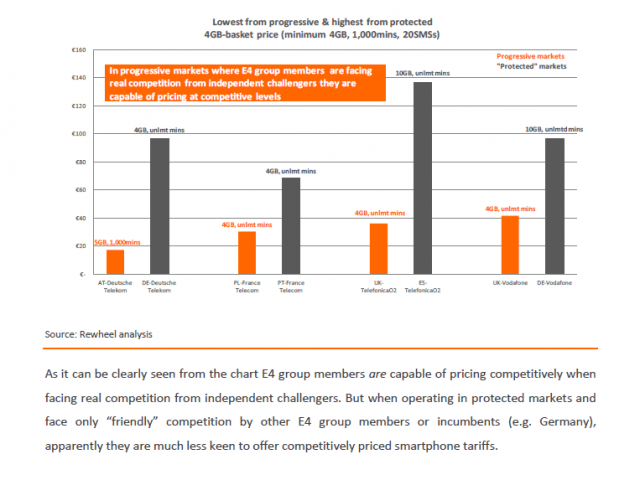
A report released by Finland market research firm Rewheel in May found clear evidence that the European model was benefiting consumers at the expense of rampant provider profits. Europeans in “progressive” markets that welcomed new competitive entrants pay lower prices for far more service. In some cases, the price differences between the five giant multinational providers that dominate Europe — Vodafone, KPN, France Telecom, Telefonica and Deutsche Telekom — were staggering. Competitors like Tele2, TeliaSonera, and “3” charge up to ten times less than the larger companies for equal levels of service.

[flv width=”640″ height=”380″]http://www.phillipdampier.com/video/Bloomberg ATT Takeover List of European Wireless Carriers 7-15-13.flv[/flv]

“Europe is ripe for competition,” reports Bloomberg News. Providers like AT&T may be preparing to embark on a European wireless acquisition frenzy, but Wall Street warns profits are much lower because of robust price competition in Europe that benefits consumers. (4 minutes)

The study also found a number of the largest European providers were following in the footsteps of Verizon Wireless, AT&T, Rogers, Bell, and Telus here in North America:

  • Prices were enormously higher in markets that lack effective competition from an upstart competitor able to deliver a comparable level of service. Smaller cell companies with very limited infrastructure or with non-favored spectrum could not provoke dominant players to cut prices because reception quality was starkly lower and consumers would have to cope with a reduced level of service. In Europe, when new competitors were able to fully build-out their networks using favorable spectrum, incumbents in these progressive markets slashed prices and boosted services to compete. In North America, upstart competitors cannot access favorable spectrum for financial reasons and the investor community has dismissed many of these players as afterthoughts, starving them of much-needed investment.
  • Large dominant European providers are now heavily lobbying for deregulation of merger and acquisition rules and want the right to acquire the competition entering their markets.
  • In almost half of the EU27 member state markets spectrum is utilized very inefficiently by the largest incumbent telco groups who are keen to protect their legacy fixed assets and cement their European dominance with more consolidation at the price of competition. In the United States and Canada, many of the largest providers crying the loudest for more wireless spectrum have still not used the spectrum already acquired.
competition slide

From the Finnish report:

The obvious question that needs to be asked is how is it technologically possible and economically viable for Tele2, 3 and TeliaSonera to offer four times more gigabytes of data usage at a fraction of the price charged by larger companies.

  • Do independent challengers have privileged access to more efficient technologies (i.e. LTE) than the E4 group members?
  • Do they hold relatively more spectrum capacity than the E4 group members?
  • Do independent challengers have access to more radio sites and their spectrum reuse factor is higher than the E4 group members?
  • Or are independent challengers (i.e. Tele2, DNA) unprofitable?

None of the above are true.

The answer is actually very simple. Independent challengers and incumbents such as TeliaSonera present mainly in progressive markets are utilizing the spectrum resources assigned to them. In contrast, incumbent telco groups […] rather than utilizing their spectrum resources instead appear to be more concerned about keeping the unit price of mobile data very high […] by restricting supply, the same way the lawful “cartel” of OPEC controls the price of oil by turning the tap off.

In progressive markets (where at least one independent challenger is present, triggering spectrum utilization competition) such as Finland, Sweden, Austria and the UK, mobile data consumption per capita is up to ten times higher than in protected markets.

In some European countries dominated by the biggest players, consumers are being gouged for service. Where robust competition exists, prices are dramatically lower.

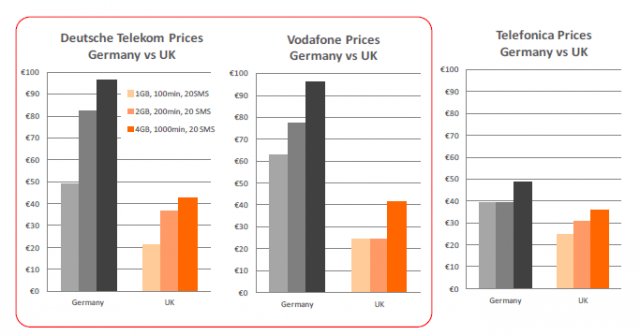
The European nation where market conditions are most similar to the United States is Germany. Two large carriers dominate the market: Deutsche Telekom, the former state-owned telephone company and Vodafone, part owner of Verizon Wireless.

In Germany, consumers spending €20 ($26) end up with a data plan offering as little as 200MB of usage per month. In progressive markets in adjacent countries, spending the same amount will buy an unlimited use data plan or at least one offering tens of gigabytes of usage. In short, German smartphone service is up to 100 times more restrictive than that found in nearby Scandinavia or in the United Kingdom. These same two companies charge Germans double what English customers pay and a Berliner will end up with 22 times less data service after the bill is settled.
competition slide 2

So what is going on in Germany that allows the marketplace to stay so price-distorted? The fact all four significant competitors have close ties to or are owned by the large multinational telecom operators mentioned above. Deutsche Telekom, Vodafone, Telefonica and E-Plus, the latter one belonging to the Dutch KPN Group are all members of a lobbying organization attempting to persuade the EU to invest public funds into improving Europe’s wired broadband networks. Playing against that proposition is a growing number of Europeans moving to wireless. By charging dramatically higher wireless prices in Germany, all four companies have successfully argued that wireless adoption is not a significant reason to stall public financing of private broadband projects. In fact, Germany’s wireless growth is well below other EU nations.

The Finnish researchers point out the evidence of informal provider collusion is pretty stark in Germany:

“One would expect these ‘European Champions,’ especially the ones with lower market shares (Telefonica and E-Plus), to look at the smartphone centric market transformation as an opportunity to secure or improve their market share, especially in light of the fact they should have plenty of unused radio spectrum capacities to make their offers more consumer-appealing,” the report finds. But in fact these new entrants have priced their services very closely in alignment with the larger two.

“Undoubtedly, multinational incumbent telco groups and their investors have good reasons to lobby EU decision makers to enact friendly policies that will protect their inherited oligopolistic high profit margins,” the report states. “But will the German model serve the best interest of consumers and business in other EU member states? In Rewheel’s opinion, clearly not. Enforcing an overly ‘convergent player friendly’ German model would severely limit competition in the mobile markets, leading to high prices for consumers and the Internet of mobile things and sever under-utilization of the member states’ scarce national radio spectrum resources.”

[flv width=”640″ height=”380″]http://www.phillipdampier.com/video/Bloomberg ATT Entry in Europe Not Seen as Competitive Threat 7-15-13.flv[/flv]

Competition is brutal in Europe’s wireless marketplace — a factor Bloomberg News says could temper AT&T’s planned “European Wireless Takeover.” What makes the difference between enormous profits in North America and heavy price discounting in Europe? Spectrum policy, which gives European competitors a more level playing field. Bloomberg analysts speculate AT&T will bankroll its rumored European buyouts and mergers with the enormous profits it earns from U.S. subscribers.  (4 minutes)

Stop the Cap!’s Rebuttal to Verizon: Fire Island Doesn’t Want Voice Link

Last week, Verizon’s Tom Maguire responded to some of our earlier coverage about Verizon’s decision to abandon landline service on portions of Fire Island devastated by last fall’s Hurricane Sandy. We have received several complaints from readers about our decision to grant space to Verizon to present their views without reciprocation. While we understand those concerns, Stop the Cap! believes readers deserve both sides of a discussion that AT&T and Verizon will soon seek to have with customers across many of their rural service areas. For that reason, we invited Verizon’s participation. This is our response:

Phillip "Since when do regulated utilities get to dictate the quality of service customers receive?" Dampier

Phillip Dampier

Raise your hand if you want Verizon’s Voice Link to replace your traditional telephone service and lose your only wired broadband connection.

Almost no one has. Despite the arguments from Verizon Communications and AT&T that wireless is the answer to troublesome copper wiring and maintaining rural telephone service, dozens of Fire Island, N.Y. customers have been sufficiently provoked to file comments with state regulators, making it clear they want no part of the loss of their landline and its accompanying, affordable broadband service. In more than 135 public comments with the Public Service Commission at press time, Stop the Cap! could only find one comment from a Fire Island resident who had no issues with Verizon’s wireless landline replacement. He was upset Verizon had not wired a nearby yacht club for broadband service.

Both AT&T and Verizon have publicly advocated that rural customers would be better served moving from traditional wired landline service to their respective wireless 4G LTE networks. AT&T characterizes it as “an upgrade” that switches customers to an “all IP” 21st century network. Verizon has been less bold in its public policy statements, framing its position mostly in economic terms  — does it make sense to invest large sums to upgrade or repair damaged infrastructure that serves a relatively small number of customers?

Until recently, customers have been free to make the choice between a landline and wireless service themselves. Now, the residents of Fire Island and some barrier islands off the coast of New Jersey have a very different choice: They can accept Verizon’s Voice Link landline replacement, sign up for cell service that has proved troublesome in both areas, or give up phone service altogether. Verizon has made it clear it is not prepared to replace the destroyed infrastructure on portions of the islands, it will not invest in major upkeep and repairs to network facilities that may have been compromised but are still functioning for now, and will likely never offer its fiber FiOS network in the affected areas.

Stop the Cap! has expressed repeated concern that the decision to abandon wired infrastructure in favor of wireless is based primarily on profit motives, is short-sighted, and represents a downgrade in the quality of an important, regulated utility service, particularly in rural and out-of-the-way places that have few, if any alternatives. Fire Island is shaping up to argue our case, based on the testimony of those actually living and working on the island.

Customers Don’t Want the ‘Solution’ Verizon is Offering

Voice Link is not proving a welcome permanent resident on Fire Island for many customers.

The reasons are clear: inadequate wireless service is common on the island, Voice Link does not perform or sound as good as the landline it replaces, and Verizon’s wireless broadband alternative will cost many residents their unlimited-use DSL service in favor of a wireless capped option that could cost more than $100 a month.

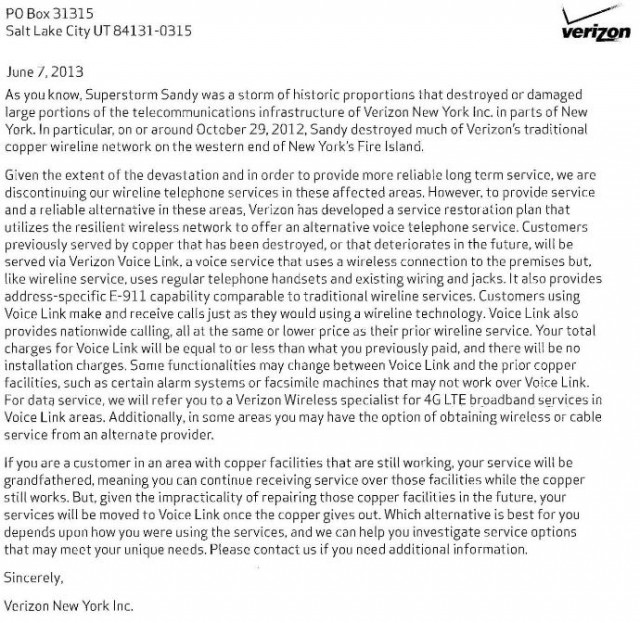
Letter to affected Verizon customers on Fire Island.

Letter to affected Verizon customers on Fire Island.

Verizon’s strongest argument is that landline service has fallen out of favor in the United States, with customers increasingly disconnecting home phones in favor of cell phones. If Verizon’s statistics are correct, 80 percent of the voice traffic on the island is already handled by Verizon Wireless. (Verizon does not specify if that traffic comes from permanent residents or temporary visitors, a point of contention with residents.)

verizonMaguire was very careful to limit Verizon’s advocacy of Voice Link in terms of its capacity to handle voice calls. That is because Voice Link is currently incompatible with a whole range of important services that have worked fine with traditional landlines for years.
Maguire’s words are important: “Verizon’s commitment is to provide our customers with voice service,” — the kind you had in the late 70s. Voice Link fails faxing, home medical monitoring, home alarm systems, dial-up service, credit card transactions, and home satellite equipment that connects to the telephone network.

Voice Link is no upgrade for Fire Island. It represents turning back the clock, especially for broadband customers.

Maguire claimed in his editorial the company was only considering Voice Link for the universe of customers where the copper network was not supporting their requirements, with the exception of Sandy-impacted Fire Island and some New Jersey barrier islands. But that does not tell the whole story. In a filing with the New York State Public Service Commission, Verizon makes it clear it intends to introduce the same solution in other parts of New York:

It also seeks to deploy Voice Link in other parts of the State, both as an optional service in areas where the company also offers tariffed wireline local exchange service, and (subject to the Commission’s approval) as a sole service offering in particular locations and circumstances.

While Verizon has sought to appease regulators by volunteering to offer an equal level of service for the same or less money, there are questions about whether a regulator has any oversight authority over Voice Link.

“It is a remarkable concept in utility regulation that a regulated utility may determine that costs are unreasonable and as a result choose to provide alternative, and potentially unregulated service to affected customers,” said Louis Barash of Ocean Beach. “Verizon proposes to permit the PSC to regulate that activity, but it is not clear that the Commission has such authority. And it certainly isn’t clear that the Commission would have any authority to reverse its decision, or otherwise to sanction the company, if Verizon failed to comply with its undertakings.”

Broadband & Competition Matters: Forcing Customers Off Unlimited DSL in Favor of Near-Exclusive, Usage-Capped, Verizon Wireless Broadband

Offering broadband is a vital part of any telephone company’s strategy to add and keep customers. Yet Verizon’s DSL customers on the western half of Fire Island will have their broadband service canceled unless wired service (copper or fiber) is available. Verizon’s only alternative is a usage-capped, prohibitively expensive Verizon Wireless mobile data plan that may or may not perform well on the signal-challenged island. There is literally nowhere else for customers to go.

Verizon’s own statistics confirm none of its wireless competitors handle significant traffic on and off the island.

Maguire: “A multimillion dollar investment with no guarantee that residents of the island will even subscribe to our services makes no economic sense. In fact, that’s probably why Verizon is the sole provider on the island. None of the companies we compete with in other parts of New York offer services on the island.”

Maguire’s evidence:

“The company discovered that 80 percent of the voice traffic was already wireless.  If other wireless providers were factored in, it is likely that the percentage is closer to 90 percent.”

That means Verizon’s wireless competitors collectively have a traffic share of less than 10%.

Verizon’s Plan & Public Safety

no serviceResidents advise visitors they better have Verizon Wireless and a robust phone that works well in challenging reception areas if they expect to use it while on the island. AT&T, Sprint, and T-Mobile customers are often out of luck. That poses an immediate and direct threat to public safety, according to public safety officials.
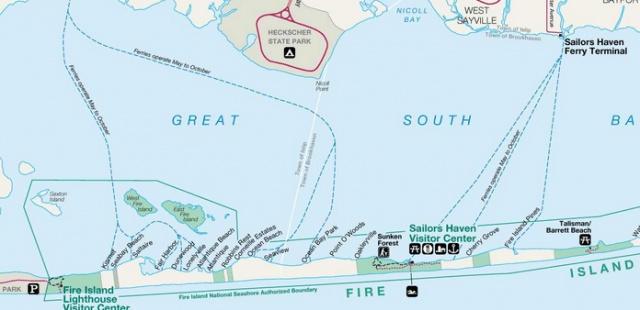

“The cellphone service on Fire Island progressively gets worse every year as more and more people are bringing smartphones out there,” explained Dominic Bertucci, chief of the Kismet Fire Department. “There are some days where you can barely get a signal.”

The Brookhaven Town Fire Chiefs Council, which represents the leadership of 39 fire departments and fire companies in the region is vehemently opposed to Voice Link and considers it a safety menace, especially during frequent summer power outages when the island’s population is at its peak.

“Without a copper wire phone service, a service that still functions even during a power failure, how can we insure that the residents can call for help?” asks president John Cronin. “How will they call for the lifesaving services that are provided by the fire and EMS units of Fire Island? The corporate desire for greater profit cannot be made at the expense of the safety of the residents of Fire Island.”

“Wireless service is not reliable,” adds Fair Harbor resident Meredith Davis. “Imagine being in an emergency and having ‘spotty’ reception which happens out there all the time on cell phones. That is not safe and not okay.”

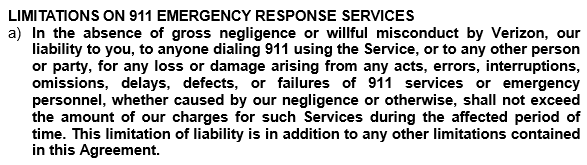
Verizon disclaims legal responsibility for failed 911 calls in its Voice Link terms and conditions.

Verizon disclaims legal responsibility for failed wireless 911 calls in its terms and conditions. The most Verizon owes you is a refund of a portion of your monthly service charges.

“If you are unfamiliar with Fire Island, there is very little medical service and the only way off the island is a scheduled ferry service or, for some people who have permits and trucks, a very long drive,” explains lifelong Fire Island resident Nora Olsen. “When someone needs to be rushed to the hospital, they are evacuated by helicopter, which makes timely emergency calls of the essence to save lives. So you can imagine how important it is to have reliable phone service. It should be up to the individual to decide if they want to switch to a wireless service. They should not be forced into it by Verizon. The people who are most likely to want to stick with the phone service they have been used to all their life — senior citizens — are the most likely to need to use the phone to call for help.”

A number of residents also claim Verizon has overblown the real extent of damage on the island and is not operating in good faith.

“In the larger communities of Ocean Beach and Seaview, I have met no one yet that has their connectivity lost,” said resident Karen Warren. “So for Verizon to assert that the infrastructure is largely destroyed and to repair it would be an enormous expense is simply not true. To add insult to injury, before coming out and finding out that our lines were in fact intact, Verizon offered to ‘replace’ our existing DSL data service with LTE Jetpak wireless broadband. The performance and reliability with only a single device connected was horrendous.”

“[Verizon is] pushing us toward a higher-cost and lower-value solution,” Warren concluded.

Getting specific information about the current state of Verizon’s network on Fire Island and repair/replacement costs are hard to come by. Verizon filed an application with the PSC declaring much of the information confidential or a trade secret, refusing to share it with the public. The company was concerned some might access the Public Service Commission website, find the case number about Fire Island, navigate to the specific Verizon filing containing information about their infrastructure… and then vandalize it.

The worst affected communities on Fire Island.

The worst affected communities on Fire Island.

Barash suspects Verizon might be hiding something, especially considering the company requested to bypass usual waiting periods and public notification requirements:

Verizon asserts that it would cost “$4.8 million for a voice-only digital loop carrier system comparable to the networking serving the eastern part of the island.” It is by no means clear, however, that such a system is the minimum required to restore/repair the western part of the system to the service it had pre-storm. Certainly Verizon’s application makes no representation to that effect. This estimate apparently contemplates an entire new system for the western portion of Fire Island, notwithstanding that a meaningful percentage of the copper wire system is still operational.

Moreover, Verizon’s position on the required scope of repairs has been a constantly shifting target. Verizon apparently advised Commission Staff, and Staff repeated at the April 18 Commission Hearing, that the western Fire Island telephone system was “damaged beyond repair by the storm.” Verizon apparently has abandoned that claim; this application indeed is premised on the assumption that the system can be repaired. Furthermore, in its first (May 3) submission to the Commission, Verizon stated that “five of the six cables that run between Fire Island and the mainland – the five that serve the western portion of the Island – were also badly damaged by the storm.” Just a week later, it has abandoned that claim as well, and instead in its amended Certification asserts “Five of the six cables that run throughout Fire Island were badly damaged by the storm.” It is hard to accept at face value Verizon’s estimated repair costs when even at this late date it does not seem to have a handle on exactly the damage that needs repair.

A full Hearing, with notice to affected customers, is necessary to develop facts sufficient to make such determinations and to be reasonably certain the Commission is acting based on reasonably verifiable facts.

Residents deserve a full voice and full disclosure in discussions that will directly impact their vital telecommunications services for years to come. Verizon’s corporate officials will not have to live with the results. Neither will the staff at the PSC.

Stop the Cap! has chosen to directly participate in the New York State Public Service Commission regulatory process and has filed two formal comments thus far. The first outlines Verizon’s greater strategy to abandon landline service in rural areas outlined by Verizon CEO Lowell McAdam in 2012. We also provided the Commission the prices Verizon Wireless intends to charge Verizon DSL customers switching to wireless broadband service. The second objects to Verizon’s excessive request for secrecy and exposes cell coverage issues on Fire Island.

FreedomPop Set to Introduce Free 500MB of Data a Month on Sprint’s LTE Network

freedompopFreedomPop, which offers 500MB of free wireless data service a month via Clearwire’s WiMAX service on a range of devices, has a better offer for tablet owners coming in the second half of this year.


The FreedomPop Clip is designed to attach to Wi-Fi only tablets and provides wireless Internet connectivity when away from Wi-Fi. Better still, the service will be free for the first 500MB of usage each month and will support Sprint’s up-and-coming 4G LTE network for faster browsing. The add-on hardware only weighs 2.5 ounces and has its own built-in rechargeable battery estimated to last up to six hours.

Tablets enabled with support for mobile data networks have never sold particularly well because of the added cost and expensive two-year contract required to maintain the service. Instead, some customers tether their tablets or enable an add-on Mobile Hotspot feature on their smartphone, which can cost $30 extra per month. The new FreedomPop Clip does not come with a contract or a monthly fee when users keep browsing to under 500MB each month. The forthcoming device will also support up to eight extra connections, in case you want to share.

Those who want more data, and around 30 percent of FreedomPop’s customers reportedly do, they can buy it on-demand without any contract or commitment. If you bug your friends to also buy the device, you can earn additional free browsing. In fact, FreedomPop will try and encourage sharing by including a new “open Wi-Fi” Internet service on a separate SSID. Those connecting through the open feature will likely get a marketing message encouraging them to get their own FreedomPop device, and their usage won’t count against your allowance.

FreedomPop Clip supports Sprint's up and coming LTE 4G network.

FreedomPop Clip supports Sprint’s up and coming LTE 4G network.

Stop the Cap! has FreedomPop’s $99 iPod Touch add-on device, which works exclusively on Clearwire’s network. We’ve used it for about five months and can report the device works well whether you actually have an iPod or not. It is simply a portable hotspot shaped to clip to the back of the 4th generation iPod Touch (it won’t fit ours). But even if it cannot clip on, it still delivers excellent signals up to 12 feet away from the MP3 player.

Its biggest weakness is Clearwire’s hit or miss network. Here in suburban Rochester, N.Y., Clearwire provides service through a nearby cell tower about a mile away. At home, the device works with fair reception indoors, but really needs to be near a window to perform reliably. Outdoors, the device works much better. We found more trouble trying to use the device in a nearby restaurant and while in downtown Rochester because Clearwire reception proved spotty. When it does work, it provides an average of 800kbps-1Mbps downstream speeds, which is superior to most 3G networks, but does not come close to what Verizon’s LTE network can deliver. But then, FreedomPop data comes free.

Just remember to keep usage at 400MB or less every month. As you approach 500MB of usage, FreedomPop will “conveniently” bill you for additional usage it anticipates you will use unless you remember to shut this auto top-up feature off on FreedomPop’s website control panel. You must also use at least 5MB a month to keep the device active, so remember to power it up at least once a month and do some browsing.

The FreedomPop LTE-capable Clip will also reportedly work with 3G service, according to Forbes. This is an important consideration because Sprint’s 4G LTE network is still in its infancy and not yet available in most major metropolitan areas. But if it relies on Sprint’s overwhelmed 3G network, expect much slower performance.

The selling price for the device itself has not yet been announced, but we expect it will be available later this year at $99 or slightly higher.

Thanks to Stop the Cap! reader Jerry for sending this news tip.

Search This Site:

Contributions:

Recent Comments:

Your Account:

Stop the Cap!