Home » mobile data » Recent Articles:

Verizon Wireless Earns More from Wireless Data Traffic That Costs Them Less

Phillip Dampier January 28, 2013 Competition, Consumer News, Data Caps, Editorial & Site News, Verizon, Wireless Broadband Comments Off on Verizon Wireless Earns More from Wireless Data Traffic That Costs Them Less

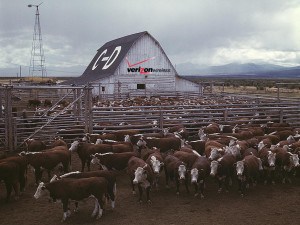
verizoncattleVerizon Wireless has been making a killing herding customers into its Family Share data plans.

Originally introduced last year, Verizon charges outrageously high prices for a paltry mobile data allowance that can be shared (think Oliver Twist on a diet) with other wireless devices attached to your plan.

The company’s latest financial report shows growth in average revenue earned from each account shot up 6.6 percent in the fourth quarter to a budget-busting $146.80 a month. The more Verizon can push customers to its shared data platform, the richer the company will get. With just 23 percent of Verizon customers currently on such plans, there is plenty of room for even more earnings.

Even though the value for money has deteriorated, Verizon has placed its data plans on a usage allowance diet for two years running.

Originally, Verizon charged $29.99 a month for unlimited data usage. In 2011, the company kept the price the same but slapped on a 2GB monthly allowance. This year, new customers pay $50 for just 1GB of data on the company’s data share plan.

The lower the limit and the more devices added to your wireless account, the more money Verizon will collect as customers are forced to upgrade to more expensive plans with more generous data usage allowances.

At the same time, Verizon’s network costs are dropping because the company’s LTE 4G network is five times more efficient moving data than the older 3G network it may eventually replace.

Halloween Scare Stories: Controlling the “Spectrum Shortage” Data Tsunami With Rate Hikes, Caps

Phillip Dampier October 25, 2012 Astroturf, AT&T, Broadband "Shortage", Competition, Consumer News, Data Caps, Editorial & Site News, Public Policy & Gov't, Sprint, T-Mobile, Verizon, Video, Wireless Broadband Comments Off on Halloween Scare Stories: Controlling the “Spectrum Shortage” Data Tsunami With Rate Hikes, Caps

Phillip “Halloween isn’t until next week” Dampier

Despite endless panic about spectrum shortages and data tsunamis, even more evidence arrived this week illustrating the wireless industry and their dollar-a-holler friends have pushed the panic button prematurely.

The usual suspects are at work here:

  • The CTIA – The Wireless Association is the chief lobbying group of the wireless industry, primarily representing the voices of Verizon, AT&T, Sprint, and T-Mobile. They publish regular “weather reports” predicting calamity and gnashing of teeth if Washington does not immediately cave to demands to open up new spectrum, despite the fact carriers still have not utilized all of their existing inventory;
  • Cisco – Their bread is buttered when they convince everyone that constant equipment and technology upgrades (coincidentally sold by them) are necessary. Is your enterprise ready to confront the data tsunami? Call our sales office;
  • The dollar-a-holler gang – D.C. based lobbying firms and their astroturf friends sing the tune AT&T and Verizon pay to hear. No cell company wants to stand alone in a public policy debate important to their bottom line, so they hire cheerleaders that masquerade as “research firms,” “independent academia,” “think tanks,” or “institutes.” Sometimes they even enlist non-profit and minority groups to perpetuate the myth that doing exactly what companies want will help advance the cause of the disenfranchised (who probably cannot afford the bills these companies mail to their customers).

Tim Farrar of Telecom, Media, and Finance Associates discovered something interesting about wireless data traffic in 2012. Despite blaring headlines from the wireless industry that “Consumer Data Traffic Increased 104 Percent” this year, statistics reveal a dramatic slowdown in wireless data traffic, primarily because wireless carriers are raising prices and capping usage.

The CTIA press release only quotes total wireless data traffic within the US during the previous 12 months up to June 2012 for a total of 1.16 trillion megabytes, but doesn’t give statistics for data traffic in each individual six-month period. That information, however, can be calculated from previous press releases (which show total traffic in the first six months of 2012 was 635 billion MB, compared to 525 billion MB in the final six months of 2011).

Counter to the CTIA’s spin, this represents growth of just 21 percent, a dramatic slowdown from the 54 percent growth in total traffic seen between the first and second half of 2011. Even more remarkably, on a per device basis (based on the CTIA’s total number of smartphones, tablets, laptops and modems, of which 131 million were in use at the end of June), the first half of 2012 saw an increase of merely 3 percent in average wireless data traffic per cellphone-network connected device, compared to 29 percent growth between the first and second half of 2011 (and 20-plus percent in prior periods).

[…] What was the cause of this dramatic slowdown in traffic growth? We can’t yet say with complete confidence, but it’s not an extravagant leap of logic to connect it with the widely announced adoption of data caps by the major wireless providers in the spring of 2012. It’s understandable that consumers would become skittish about data consumption and seek out free WiFi alternatives whenever possible.

Farrar

Cisco helps feed the flames with growth forecasts that at first glance seem stunning, until one realizes that growth and technological innovation go hand in hand when solving capacity crunches.

The CTIA’s alarmist rhetoric about America being swamped by data demand is backed by wireless carriers, at least when they are not talking to their investors. Both AT&T and Verizon claim their immediate needs for wireless spectrum have been satisfied in the near-term and Verizon Wireless even intends to sell excess spectrum it has warehoused. Both companies suggest capital expenses and infrastructure upgrades are gradually declining as they finish building out their high capacity 4G LTE networks. They have even embarked on initiatives to grow wireless usage. Streamed video, machine-to-machine communications, and new pricing plans that encourage customers to increase consumption run contrary to the alarmist rhetoric that data rationing with usage caps and usage pricing is the consequence of insufficient capacity, bound to get worse if we don’t solve the “spectrum crisis” now.

So where is the fire?

AT&T’s conference call with investors this week certainly isn’t warning the spectrum-sky is falling. In fact, company executives are currently pondering ways to increase data usage on their networks to support the higher revenue numbers demanded by Wall Street.

If you ask carriers’ investor relations departments in New York, they cannot even smell smoke. But company lobbyists are screaming fire inside the D.C. beltway. A politically responsive Federal Communications Commission has certainly bought in. FCC chairman Julius Genachowski has rung the alarm bell repeatedly, notes Farrar:

Even such luminaries as FCC Chairman Julius Genachowski has stated in recent speeches that we are at a crisis point, claiming “U.S. mobile data traffic grew almost 300 percent last year” —while CTIA says it was less than half that, at 123 percent. “There were many skeptics [back in 2009] about whether we faced a spectrum crunch. Today virtually every expert confirms it.”

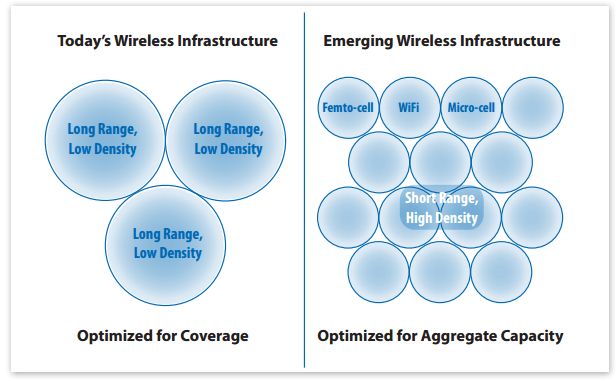
A smarter way of designing high capacity wireless networks to handle increased demand.

So how are consumers responding to the so-called spectrum crisis?

Evidence suggests they are offloading an increasing amount of their smartphone and tablet traffic to free Wi-Fi networks to avoid eroding their monthly data allowance. In fact, Farrar notes Wi-Fi traffic leads the pack in wireless data growth. Consumers will choose the lower cost or free option if given a choice.

So how did we get here?

When first conceived, wireless carriers built long range, low density cellular networks. Today’s typical unsightly cell tower covers a significant geographic area that can reach customers numbering well into the thousands (or many more in dense cities). If everyone decides to use their smartphone at the same time, congestion results without a larger amount of spectrum to support a bigger wireless data “pipe.” But some network engineers recognize that additional spectrum allocated to that type of network only delays the inevitable next wave of potential congestion.

Wi-Fi hints at the smarter solution — building short range, high density networks that can deliver a robust wireless broadband experience to a much smaller number of potential users. Your wireless phone company may even offer you this solution today in the form of a femtocell which offloads your personal wireless usage to your home or business Wi-Fi network.

Some wireless carriers are adopting much smaller “cell sites” which are installed on light poles or in nearby tall buildings, designed to only serve the immediate neighborhood. The costs to run these smaller cell sites are dramatically less than a full-fledged traditional cell tower complex, and these antennas do not create as much visual pollution.

To be fair, wireless growth will eventually tap out the currently allocated airwaves designated for wireless data traffic. But more spectrum is on the way even without alarmist rhetoric that demands a faster solution more than  a smart one that helps bolster spectrum -and- competition.

Running a disinformation campaign and hiring lobbyists remains cheaper than modifying today’s traditional cellular network design, at least until spectrum limits or government policy force the industry’s hand towards innovation. Turning over additional frequencies to the highest bidder that currently warehouses unused spectrum is not the way out of this. Allocating spectrum to guarantee those who need it most get it first is a better choice, especially when those allocations help promote a more competitive wireless marketplace for consumers.

[flv width=”600″ height=”358″]http://www.phillipdampier.com/video/KGO San Francisco FCC considers spectrum shortage 9-12-12.flv[/flv]

KGO in San Francisco breaks down the spectrum shortage issue in a way ordinary consumers can understand. FCC chairman Julius Genachowski and even Google’s Eric Schmidt are near panic. But the best way to navigate growing data demand isn’t just about handing over more frequencies for the exclusive use of Verizon, AT&T and others. Sharing spectrum among multiple users may offer a solution that could open up more spectrum for everyone.  (2 minutes)

AT&T’s Rural Solution? FCC Supports AT&T’s 2.3GHz WCS Spectrum Plan for Nationwide 4G LTE Service

AT&T has secured support from the Federal Communications Commission for authority to deploy 4G LTE service within a 20MHz portion of the 2.3GHz WCS band after cutting a deal with a next door neighbor especially sensitive about potential interference.

WCS spectrum holders have fought for years to develop commercially viable wireless service, but faced regular opposition from the satellite radio industry concerned that interference problems would result from using the band for mobile data. Right in the middle of the WCS band is Sirius XM, which depends on sensitive receivers to pick up the company’s satellite signal.

But now AT&T and Sirius XM have worked out a compromise both companies believe will protect mobile data and satellite radio. AT&T has conceded 10MHz of its total WCS spectrum for two 5MHz guard bands, devoid of signals, around Sirius XM’s frequencies. Sirius XM signal engineers believe this, combined with power limits, will protect radio receivers from overloading whenever near AT&T’s ground-based LTE cell towers.

In August, AT&T announced its intention to acquire WCS spectrum from NextWave Wireless, a spectrum-squatting holding company, for $600 million. The phone company is also attempting to acquire the remainder of WCS spectrum from the last two significant holders — Comcast and Horizon Wi-Com, which both have between 10-25MHz of spectrum in 149 and 132 communities respectively.

When the acquisitions are complete, AT&T will have WCS spectrum covering virtually the entire nation.
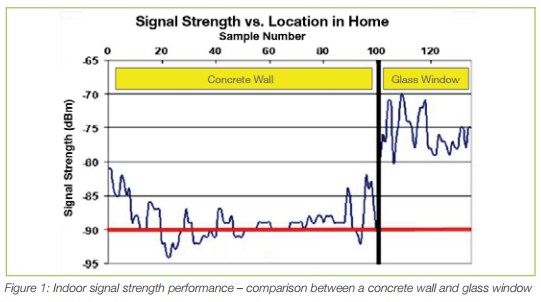
Frequencies in the 2.3GHz band are best received outdoors. Signals crossing windows and walls lose potency. (Courtesy: Greenpacket)

AT&T says it needs the spectrum to further deploy 4G LTE data service across the country. But the company admits it will take up to five years before it can switch on the new frequencies — no current smartphones support the 2.3GHz WCS band.

AT&T has also included provisions to ensure fixed wireless base stations will be able to utilize AT&T’s WCS spectrum, within reasonable limits to protect Sirius XM radios from harmful interference. That has important implications for AT&T’s long-term view that rural landline and broadband service is best delivered over a wireless network.

A major limitation of spectrum in the 2GHz band is the quality of indoor coverage it can deliver. As many Clearwire customers can attest, these frequencies suffer from high transmission loss, poor ability for diffraction, and most importantly, poor building penetration — especially in urban and suburban areas. Tall nearby buildings, homes, and even trees all impede WCS reception. According to Andrea Goldsmith in her book Wireless Communications, there is also a 6dB penetration loss when 2.5GHz signals cross un-insulated glass windows and a 13dB loss for concrete walls, with wood falling somewhere in-between.

But rural areas do better, in part thanks to the higher likelihood of unimpeded line-of-sight access between a cell tower and receiver. AT&T’s fixed wireless solution would place a small antenna on the roof or side of a home, positioned for maximum reception from the nearest cell tower. The signal is then brought indoors through cabling (or in some cases Wi-Fi) and available to customers, comparable to a home broadband connection.

AT&T’s strong spectrum position in WCS gives the company an opportunity to construct a robust, near-nationwide wireless network suitable for rural wireless communications. In more urban areas, WCS could operate seamlessly with AT&T’s lower frequency holdings and offer an extension of its current LTE service.

AT&T’s acquisition of WCS has several important implications for the wireless marketplace:
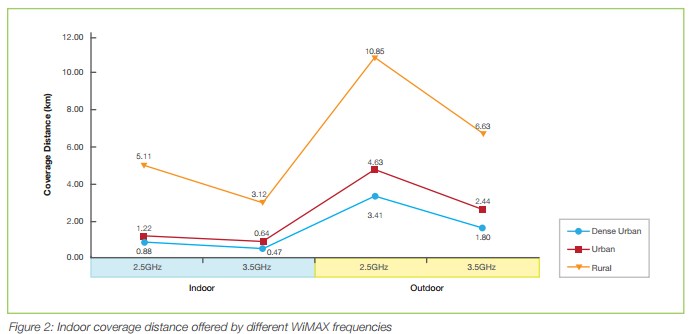
2GHz signals travel the least distance in urban and suburban areas, often blocked or degraded by buildings or trees. But better results in rural areas suggest AT&T’s WCS spectrum could partly be deployed as a fixed wireless broadband solution, if enough towers are available to support it. (Courtesy: Greenpacket)

1. It proves AT&T never needed to acquire T-Mobile USA. Through spectrum acquisitions like WCS, AT&T can still find relatively inexpensive spectrum suitable for mobile broadband use, without spending tens of billions to acquire a competitor just to poach its spectrum and eliminate a competitor.

2. The Competitive Carriers Association worries AT&T’s acquisition of secondary spectrum holders is allowing the company to gather a massive amount of spectrum.

CCA President & CEO Steven K. Berry said, “Allowing the largest carriers to obtain unlimited amounts of  spectrum on the secondary market raises serious competitive concerns.  The only way for the FCC to truly see the devastating consequences of further spectrum aggregation is by consolidating the proposed applications.  On their own, AT&T’s proposed license acquisitions may not seem significant, but when added together, it totals to a significant amount of spectrum.”

Berry continued, “Should the FCC decide to approve the transactions, it must impose conditions to ensure interoperability across the Lower 700 MHz band and to ensure data roaming – both are absolutely essential ingredients to a healthy, competitive marketplace.  Competitive carriers need access to usable spectrum, and I urge the Commission to carefully review the negative impact these transactions will have on the wireless marketplace.”

3. Clearwire’s 2.5GHz spectrum could become more valuable if AT&T can demonstrate its 2.3GHz service can deliver robust service, if provisioned adequately for customers. Clearwire’s capital investments and overall performance of its limited coverage WiMAX network have been deemed inadequate by its biggest partner Sprint, now constructing its own 4G LTE network to replace Clearwire’s WiMAX network.

4. Credit Suisse analyst Jonathan Chaplin notes Verizon will still have a better standing in spectrum even with AT&T WCS: “AT&T will have the following available for LTE: 20 MHz of 700 MHz nationwide; 20 MHz of WCS nationwide; a few AWS licenses (5 MHz on average). With Verizon’s deal with large cable companies, Verizon will have: 20 MHz of 700 MHz nationwide; 20 MHz of AWS nationwide; another 10 MHz of AWS in 60 percent of the country (13 MHz on average). In addition, Verizon’s spectrum is usable immediately, while AT&T’s WCS will take three to five years to deploy.”

FCC Prepares to Sacrifice Free Over the Air UHF TV Channels for Lucrative Wireless Auctions

The FCC’s UHF TV Diet Plan: Slimming Down the Free TV Dial to Make Room for Expensive Wireless Broadband

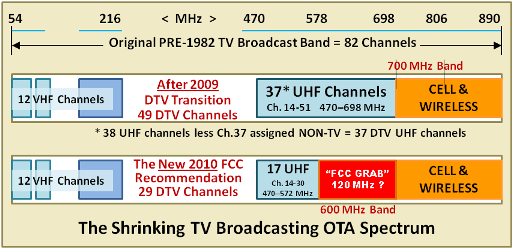
By the end of this month, the Federal Communications Commission will vote on proposed rules governing a planned 2014 auction that will allow over the air TV stations to surrender their “free TV” channels in return for money from the nation’s wireless phone companies looking for more mobile broadband spectrum.

The Commission is considering reallocating UHF TV channels 31-51 for mobile data, compacting the nation’s over the air TV stations onto VHF channels 2-13 and UHF channels 14-30. But the FCC also expects many stations, particularly smaller independent or specialty channels in large cities, will be happier surrendering their broadcast TV licenses in return for cash compensation.

If the five FCC commissioners approve the plan, it will be the largest spectrum auction since 2008, and could earn the U.S. treasury billions, tempered by payouts to television stations agreeing to shut down their transmitters, and to compensate remaining stations for the cost of moving operations to a new channel number, when necessary.

“To ensure ongoing innovation in mobile broadband, we must pursue several strategies vigorously: freeing up more spectrum for both licensed use and for unlicensed services like Wi-Fi; driving faster speeds, greater capacity, and ubiquitous mobile Internet coverage; and taking additional steps to ensure that our invisible infrastructure for mobile innovation can meet the needs of the 21st century,” the agency’s chairman, Julius Genachowski, said in a statement.

The controversial auction would compensate broadcasters even before the FCC knows exactly how much spectrum it will eventually have available to auction to wireless carriers. Nobody is sure how many stations will ultimately choose to abandon their over-the-air audiences, but an FCC report predicts the largest number of station losses would be in large metropolitan areas, which often have more than a dozen stations devoted to infomercials/home shopping, ethnic shows, religious programming, and independent network affiliates. The FCC suspects some of these lower-rated stations will see the money as a strong incentive to surrender their broadcast licenses.

Genachowski

The FCC considered several spectrum-saving proposals that would free up as much channel space as possible to resell to wireless operators. One proposal would have full power broadcast outlets switch to low-powered cellular-style transmitter networks to reduce the potential interference on an increasingly crowded dial. But that proved unpopular and expensive for broadcasters. Instead, the FCC predicts stations could effectively share channels and still retain HD service. For example, a local CBS station could agree to surrender its license and broadcast instead over the transmitting facilities of the local NBC station, splitting one station’s allocated channel bandwidth in half. Other stations will be relocated on the dial or moved to different transmitter sites to reduce potential interference from stations in nearby cities.

Stations that do not require an HD service could share space with those serving several standard definition channels to the public. These are typically public, educational, or ethnic-oriented broadcasters.

As a consequence, the FCC says many stations might have to give up on their “multicast” standard definition secondary services — the 24 hour local weather or news channel, Me-TV, This TV, Retro TV, Antenna TV, and Bounce, for example, because there would be insufficient bandwidth when two services sharing one channel are transmitting in HD.

The FCC does not believe stations would mind too much, quoting from RBR/TVBR:

“So far, nobody’s been able to figure out what can go on a digital side channel and pay for its own presence there. Mostly it’s been used as a revenue-neutral or money-losing place to put 24-hour weather… Nobody watches these things in strong enough numbers to generate any advertising revenue.”

But the FCC did recognize that certain viewers in fringe reception zones could experience a loss of service — one that could be addressed by subsidizing improved antennas for homeowners or requiring cable or satellite operators to develop a “lifeline” television service consisting of local broadcasters, either for free or at a minimal monthly cost.

Some consumer groups worry that any forthcoming spectrum auction would be dominated by Verizon Wireless and AT&T — the nation’s two largest carriers, who could easily outbid smaller cell phone companies also clamoring for spectrum. During the last auction in 2008, which netted nearly $20 billion, Verizon Wireless walked away with the bulk of the spectrum on offer. Without auction rules setting aside significant spectrum for smaller competitors, both dominant carriers could lock up one of the last spectrum auctions for the next 5-10 years, cementing their de facto duopoly.

The FCC is considering reworking its market concentration rules before the bidding begins, which could constrain Verizon and AT&T from bidding and winning the bulk of available frequencies in the cities where they dominate.

[flv width=”640″ height=”380″]http://www.phillipdampier.com/video/Bloomberg FCC Chair on Spectrum Auctions 9-10-12.flv[/flv]

FCC Chairman Julius Genachowski talks about rising demand for mobile broadband access and the outlook for spectrum auctions to free up more airwaves. He speaks with Cory Johnson on Bloomberg Television’s “Bloomberg West.”  (7 minutes)

High Priced Data Plans Hurting LTE Tablet Market

Phillip Dampier July 24, 2012 Consumer News, Data Caps, Wireless Broadband Comments Off on High Priced Data Plans Hurting LTE Tablet Market

A new forecast from an industry research firm predicts sales of tablets with built-in LTE-4G connectivity will continue to drop because of high prices for wireless data from the nation’s cellular phone companies.

CCS Insight notes (via FierceWireless) that only 48 percent of tablets shipped in 2011 were enabled with built-in cellular capability. The researcher predicts that number will drop to 37 percent by 2016.

“Most users do not regard cellular connectivity in tablets as a must-have, especially given the current price of tablets and mobile data subscriptions,” CCS reports.

Customers simply do not find the $100+ price premium for a cellular-enabled tablet worth the expense, especially when they also face costly data charges to use the service. Most tablet owners prefer to rely on Wi-Fi, often provided free of charge. Among those who acquire a cellular-enabled tablet, nearly half never bother to activate the wireless service from the supported carrier.

“In the future, the share of cellular-enabled tablets will be determined by three factors: the availability and attractiveness of multi-device tariffs from mobile operators; the availability of public Wi-Fi networks; and the difference between the retail prices of cellular and Wi-Fi-only tablets,” CCS found.

Carriers like Verizon and AT&T hope their new “family share” data plans will ease the pain for customers who want to use their tablets on cellular networks, but companies still have to overcome the substantially higher price cell modem-equipped tablets carry and the expensive price tag for data usage, shared or otherwise. Verizon Wireless is not making it any easier. It discontinued selling subsidized tablets to customers this month.


Search This Site:

Contributions:

Recent Comments:

Your Account:

Stop the Cap!