Home » Hedge fund » Recent Articles:

Windstream Emerges from Bankruptcy, Promises More Fiber Broadband

Phillip Dampier September 22, 2020 Consumer News, Rural Broadband, Windstream Comments Off on Windstream Emerges from Bankruptcy, Promises More Fiber Broadband

Windstream’s new logo

Windstream has emerged from Chapter 11 bankruptcy as a new privately held company controlled by Elliott Management Corporation, an activist hedge fund known for squeezing expenses out of companies and eventually selling its stake and exiting the business.

As a restructured company, Windstream shed almost two-thirds of its debt, amounting to more than $4 billion. The company will almost immediately tap $2 billion in new capital, targeting more spending on shedding copper wiring in several of its service areas, replaced by gigabit fiber that will primarily target its business customers. Windstream’s budget to upgrade residential customers is reportedly considerably less, but some customers will see upgrades in the future.

“Today marks the start of a new era for Windstream as an even stronger, more competitive company,” Windstream president & CEO Tony Thomas said in a statement released late Monday. “With the support of our new owners and current operational momentum, Windstream will continue advancing our long-term growth objectives while providing our customers with quality and reliable services.”

Thomas

The most immediate change most customers will notice is a new logo, which the company says aligns with the three segments of the business: consumer broadband, business customers, and wholesale/reseller clients.

Paul Sunu, who used to serve as the CEO of FairPoint Communications before it was sold to Consolidated Communications, is Windstream’s new chairman of the board.

“Tony and the Windstream team have made significant strides in the last 18 months to better position the company to compete for the long term,” Sunu said Monday. “The new board and I are confident that we have the right management team and right strategy to accelerate Windstream’s transformation, return to growth and drive sustainable value creation.”

Windstream was a publicly traded company since its 2006 spinoff from Alltel Corporation. As a private company, it will now answer primarily to its debt holders who acquired the company’s old debt in its bankruptcy.

Frontier Urgently Trying to Restructure $17 Billion Debt as Chapter 11 Looms

Frontier Communications is preparing a detailed plan for bondholders explaining how the company hopes to cut its $17 billion in debt before it faces the possibility of bankruptcy.

The Wall Street Journal reports Frontier is ready to begin formal negotiations with those holding its debt to create a new payback plan before it faces the first of several repayment deadlines for bonds running into the billions, starting in 2022. But the strategy is risky because if any of the company’s major bondholders disagree, it could put Frontier on a fast track to Chapter 11 bankruptcy reorganization.

Frontier’s debt problems are a consequence of its decision to expand its wireline footprint through acquisitions of castoff copper landline networks being sold primarily by Verizon Communications and AT&T. Critics have repeatedly called out Frontier for bungling network transitions with extended service outages, billing problems, and other customer service-related failures that left customers and some state regulators frustrated and alienated. The company is still facing regulatory review in states like Connecticut, where it failed to properly manage a customer cutover from AT&T’s systems to its own, and in Utah, West Virginia, California, and Florida where similar cutovers from Verizon Communications left more than a few customers without service and months of billing problems.

As a result, Frontier lost many of the customers it acquired, with many unwilling to consider doing business with the phone company ever again.

Although Frontier’s latest acquisitions of Verizon landline customers in California, Texas, and Florida included large Verizon FiOS fiber to the home territories, Frontier customers continue to disconnect service at a greater pace than the phone company’s chief cable competitors — Comcast and Charter Spectrum. Customer defections are even worse in large sections of Frontier’s stagnant “legacy” markets — service areas that have been managed by Frontier or its predecessor Citizens Communications for decades. That is because almost all of those legacy markets are still serviced by decades-old copper wire networks, many capable only of providing low speed DSL internet access.

Frontier’s large debt load is cited as the principal reason the company cannot embark on upgrade efforts to replace existing copper wiring with optical fiber. In fact, virtually all of Frontier’s fiber service areas have been acquired from AT&T or Verizon. Frontier executives have attempted to placate shareholders by promising to aggressively manage costs. But promises of dramatic savings have proved elusive and frequent media reports have emerged covering extensive service outages, poor network maintenance, ongoing billing and customer service issues, and inadequate staffing to address a growing number of service outages and problems. In several states, repeated 911 outages have triggered regulator investigations with the prospect of stiff fines.

Three Frontier insiders have privately shared their insights with Stop the Cap! about ongoing frustrations with the company and the most recent developments.

“Upper management has no comprehension that in many of our markets, customers have choices and they abandon us when all we can sell is DSL service at speeds often less than 12 Mbps,” one senior regional executive told us. “Our retention efforts are so poor these days, representatives are not really expected to rescue accounts because in most cases there is no legitimate reason to do business with us. In some states where there are high mandated surcharges, we cost more than our cable competitors.”

Another mid-level executive in one of Frontier’s largest legacy markets — Rochester, N.Y., said morale is low and a growing number of colleagues believe the days to bankruptcy are short.
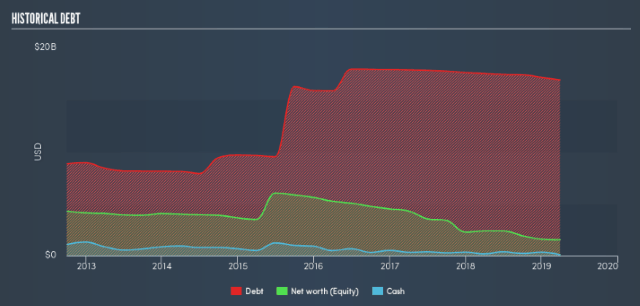
Frontier Communications debt load.

“Our loyal customers are literally dying off, as their adult children disconnect decades-old landline accounts,” said an executive who wished to remain anonymous because they were not authorized to speak with the media. “The customer numbers have been ugly for a long time and are getting worse. Our recently retired customers who have had DSL and voice service with us since the 1990s are disconnecting because some have gone with Spectrum and others are moving out of the area. Some of these customers hate Spectrum and won’t do business with them no matter the price, but we are losing their business anyway when they move out of state.”

The Rochester executive noted Frontier has an impossible job trying to sell its internet and voice products against Charter Spectrum.

“Their offers are $40 a month for 100 Mbps internet and $10 for unlimited local and long-distance calls,” the executive noted. “Ours costs nearly $30 just for the phone line after taxes and fees, and how can you sell someone DSL that delivers less than 6 Mbps to many parts of a market still served by copper trunk lines to a central office several miles away? They also find out they have to lease our modem at an additional fee and there are other fees in the contract many customers have learned to look for. Answer: you can’t.”

A Frontier executive in Ohio shared a similar story.

“We hold our own in our rural markets where we can offer a customer better than dial-up internet, and our service is very good if you live in an area where we expanded broadband thanks to FCC subsidies. Some of these new areas are even served by fiber,” the executive explained. “The problem with this is fewer people live in rural areas and these places cost a lot more to maintain when we dispatch service crews or have to run new cable. For Frontier to be truly successful, we have to get better internet service into our larger older markets, but that means pulling copper off poles and putting up fiber and there is just no interest from the higher ups to spend the money to do this. So instead the company bought new territories to keep revenue numbers up, but we are also quickly losing many of those customers to cable too. I really don’t know what we will do when wireless companies offer 5G internet.”

Some Frontier bondholders recognize Frontier must reduce its debt to have the financial resources to expand fiber service. Others want the company to shed its legacy copper service areas (while keeping FiOS/U-verse enabled markets) either to regional companies willing to invest in upgrades or to hedge funds that would likely ring whatever remaining value still exists out of these abandoned service areas. Some suspect these hedge funds would also load up the spinoff companies with even greater debt to facilitate dividend payouts and other investor-friendly rewards.

It will be up to state and federal regulators to protect Frontier’s customers as the two emerging groups of conflicting bondholders angle to protect their investments, perhaps at the risk of reliable phone and internet service.

The Wall Street Journal:

One, including Elliott Management and Franklin Resources, pushed for an exchange of their bonds at a discount to their face value for new secured debt that would be paid before unsecured debt in a potential bankruptcy.

Still, bondholders including GoldenTree Asset Management have warned the company against doing such a swap since 2018, arguing it violated the terms of their bonds.

The company this week reached out to Houlihan Lokey, which represents a group of bondholders that includes GoldenTree—as well as JPMorgan Chase & Co., Oaktree Capital Management and Brigade Capital Management—to sign up to view a confidential restructuring proposal, a person familiar with the matter said. That group has yet to gather enough holders to form a majority, people familiar with the matter said.


Windstream Declares Bankruptcy; Another Legacy Telco Falters

Phillip Dampier February 25, 2019 Consumer News, Public Policy & Gov't, Windstream 3 Comments

Windstream Holdings, Inc. filed bankruptcy this afternoon, citing its inability to cover $5.8 billion in outstanding debt.

The independent phone company, which provides legacy landline and broadband service to around 1.4 million customers in 18 states, filed voluntary to reorganize under Chapter 11 of the U.S. Bankruptcy Code in the U.S. Bankruptcy Court for the Southern District of New York, citing a judge’s decision almost two weeks ago that the company defaulted on its obligations.

“Following a comprehensive review of our options, including an appeal, the Board of Directors and management team determined that filing for voluntary Chapter 11 protection is a necessary step to address the financial impact of Judge Furman’s decision and the impact it would have on consumers and businesses across the states in which we operate,” said Tony Thomas, president and chief executive officer of Windstream. “Taking this proactive step will ensure that Windstream has access to the capital and resources we need to continue building on Windstream’s strong operational momentum while we engage in constructive discussions with our creditors regarding the terms of a consensual plan of reorganization.”

Windstream received a commitment from Citigroup Global Markets Inc. for $1 billion in debtor-in-possession (“DIP”) financing. Assuming a bankruptcy judge approves of the arrangement, Windstream claims this stop-gap financing will allow it to run its current business as usual.

Windstream provides residential service in 18 states including: Alabama, Arkansas, Florida, Georgia, Iowa, Kentucky, Minnesota, Mississippi, Missouri, Nebraska, New Mexico, New York, North Carolina, Ohio, Oklahoma, Pennsylvania, South Carolina and Texas.

The company claims it was forced into bankruptcy after a judge found Windstream’s attempt in 2015 to shift its valuable fiber optic network assets off its own books into a sheltered real estate investment trust (REIT) named Uniti Group violated the rights of bondholders which hold some of Windstream’s debt. Those debts are backed, in part, by the valuable fiber optic assets Windstream had  spun them off to a new entity. In fact, Uniti’s fiber optic assets are essential to Windstream’s viability. The phone company has the exclusive right to use Uniti’s fiber assets and two-thirds of Uniti’s revenue comes from Windstream, making the two companies inseparable.

Windstream’s bankruptcy is a concern to investors of both companies because it will allow Windstream to renegotiate the terms of its contract with its fiber partner. Windstream customers are equally concerned because the phone company needs Uniti’s network to manage its broadband service.

The judge’s decision on Feb. 15 to declare the arrangement inappropriate was reportedly a shock to the investor community, which has made money buying repackaged corporate debt in the form of bonds for years. Corporations have issued bonds to retire older debt, while giving investors a piece of the action. Since investors are making money, they typically do not complain too loudly about the persistence of corporate debt, frequently repackaged in new bonds. As a result, companies can hold onto more cash used to pay shareholder dividends and executive compensation instead of permanently retiring debt.

Aurelius, a hedge fund, is making some of its money scrutinizing these arrangements looking for contract violations such as the Uniti spinoff. When it finds one, it takes a stake in the company and then threatens to sue as a harmed investor. Based on the judge’s decision, Aurelius won a judgment that will effectively empty the pockets of many of the bondholders and investors that could lose a lot of their investments because of the bankruptcy. If the hedge fund is going to actively seek other questionable arrangements or violations of bondholders’ rights at other companies, it could cause an earthquake in an investment community that has quietly conspired with companies to generate transactions that enrich investors while allowing companies to carry more debt.

Customers could end up covering some of the costs of today’s bankruptcy filing if Windstream files a plan with the Bankruptcy Court promising to raise prices to help it demonstrate ongoing viability.

Windstream’s Thomas complained the phone company is little more than a victim of a predatory hedge fund out to enrich itself at the expense of others.

“The company believes that Aurelius engaged in predatory market manipulation to advance its own financial position through credit default swaps at the expense of many thousands of shareholders, lenders, employees, customers, vendors and business partners,” Thomas said. “Windstream stands by its decision to defend itself and try to block Aurelius’ tactics in court. The time is well-past for regulators to carefully examine the ramifications of an unregulated credit default swap marketplace.”

Comcast Makes Surprise $31 Billion Bid for UK’s Sky Satellite Service

Phillip Dampier February 27, 2018 Comcast/Xfinity, Competition, Consumer News, Public Policy & Gov't, Sky (UK) Comments Off on Comcast Makes Surprise $31 Billion Bid for UK’s Sky Satellite Service

Comcast Corporation today made a surprise $31 billion bid to acquire Sky, the British-based satellite TV, internet, and wireless provider, disrupting a rival bid from 21st Century Fox, which spent years trying to acquire the 61% of Sky it doesn’t already own.

Comcast’s bid of £12.50 a share to acquire Sky outright is significantly higher than the £10.75/share offer Fox made to take total control of the satellite venture. A third player – Disney, has been in talks with Fox to acquire a substantial number of its assets, including its minority ownership stake in Sky, for $52 billion. But Comcast’s bid may change everything.

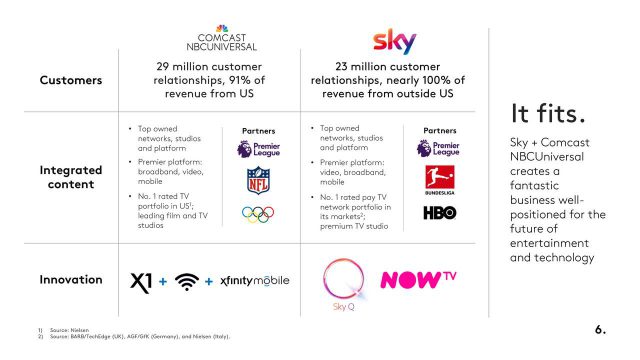
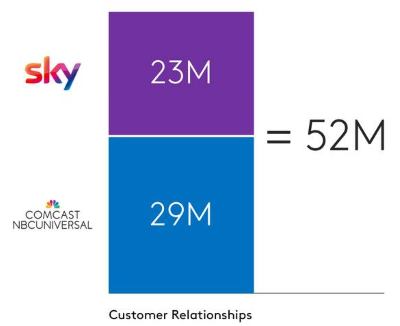
That three American companies are now competing to acquire Europe’s largest media company and biggest pay-TV broadcaster, with more than 23 million subscribers, could create concern among some regulators about foreign ownership of the media. A bid from Comcast is likely to be less controversial than dealing with Rupert Murdoch, however, who already has extensive media holdings in the United Kingdom.
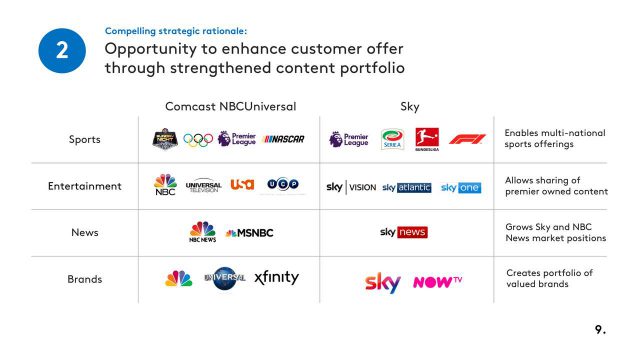

There are three distinct possible bidders for Sky now:

  • Comcast, which prefers to take 100% ownership but will accept a majority stake shared with Fox (or possibly Disney).
  • Disney wants minority stake in Sky through its $52+ billion acquisition of some of Fox’s assets, including Fox’s part-ownership in Sky.
  • Fox, which has sought to take full control of Sky for several years but has met with resistance was originally the most likely buyer. But more recently, Rupert Murdoch has recently shown a willingness to sell some of Fox’s assets, including Sky, if the price is right.

Sky’s share price leaped more than 20% today to £13.47—well above the Comcast offer—as investors believe there will be a bidding war over Sky. Because many hedge funds and investors expect Fox will increase its bid to match Comcast, in turn boosting the value of Sky’s stock, investors are accumulating shares at a rapid pace and driving up share prices further.

Sky has become increasingly valuable because it isn’t just a satellite TV provider. Sky also develops its own original productions, has valuable sports rights deals, and sells broadband and mobile phone service. American media companies are consolidating, preferring to own both the pipes that deliver internet content and the content itself. Acquiring Sky would allow Fox, Disney, and/or Comcast to showcase its own productions in Europe and to a lesser extent import Sky products into the United States.

Regulators in the United Kingdom are likely to press any buyer to protect the independence of Sky News, a well-regarded 24-hour news channel. Many expect regulators to insist that Sky’s buyer  agree to fund Sky for at least 10 years and guarantee its editorial independence.

Hedge Fund Successfully Pressures FairPoint Communications to Sell Itself

fairpoint greedAn activist group of shareholders led by a hedge fund has successfully pressured executives at FairPoint Communications to sell the company to maximize shareholder value.

The buyer, Illinois-based Consolidated Communications Holdings, Inc., said on Monday it would acquire FairPoint in an all-stock deal worth $1.5 billion, debt included.

The buyout will enrich certain shareholders and hedge funds, including Maglan Capital’s David Tawil and Steven Azarbad, who blasted FairPoint CEO Paul Sunu in a letter sent earlier this summer complaining “shareholders have been extremely patient with the company’s operational turnaround and have suffered because the board has not been vigilant in protecting shareholder value.”

Maglan will cash out its investment initially made after FairPoint went bankrupt, when the share price was below $4. As of 4pm this afternoon, FairPoint stock was trading at $18.85 a share, less than the $23 a share and 75% premium Tawil and Azarbad were hoping for back in August. But they will still walk away earners, selling at around $18 a share plus an additional 17.3% premium. Collectively, the two hedge fund managers control 7.6% of FairPoint’s shares.

consolidated-communications-logoConsolidated Communications will inherit residential FairPoint phone and broadband customers in 17 states, most notably those in Maine, New Hampshire, and Vermont. But press releases from Consolidated showed little interest in the residential telecommunications business. Instead, Consolidated executives are looking at FairPoint’s business and enterprise customers, and the benefits of owning FairPoint’s 17,000 fiber route mile network.


Critics suggest the deal effectively enriches shareholders while putting FairPoint’s existing debt and buyout on the new owner’s credit card. Consolidated will inherit $887 million of FairPoint’s current debt plus the $1.5 billion cost of the acquisition.

The combined company will keep the Consolidated Communications name and FairPoint Communications as a brand will eventually disappear if regulators approve the transaction sometime in 2017.

Consolidated Communications currently serves residential phone customers in:

  • Suburban/Exurban Sacramento, Calif.
  • Fargo, N.D.
  • Mankato, Minn.
  • West Des Moines, Ia.
  • Suburban Kansas City, Kan.
  • Mattoon, Ill.
  • Lufkin, Conroe, and Katy, Tex.
  • Suburban Pittsburgh, Pa.
FairPoint workers on strike in the fall of 2014. (Image: Labor Notes)

FairPoint workers on strike in the fall of 2014. (Image: Labor Notes)

FairPoint customers and state regulators in New England expressed concern about the transaction. After FairPoint acquired landlines formerly owned by Verizon Communications a decade ago, the transition was described as “disastrous” by regulators, who received scores of complaints about service and billing problems before FairPoint ultimately declared Chapter 11 bankruptcy, mired in debt.

After emerging from bankruptcy, FairPoint has endured union strikes and was assessed multiple fines for failing to meet service quality standards in Maine.

“The last time these assets were sold to FairPoint it was a disastrous outcome for Maine customers,” says Tim Schneider, Maine’s Public Advocate, who represents consumers on utility matters.

Schneider told Maine Public Radio he is planning to scrutinize the deal to prevent further problems, but customers in Maine, New Hampshire, and Vermont are already expressing concern regulators are just as likely to rubber stamp this sale just like the last one, further saddling them with problematic service.

The owners of Maglan Capital are pleased with themselves, tweeting out this is a “December to Remember.”

Search This Site:

Contributions:

Recent Comments:

Your Account:

Stop the Cap!