LightSquared, the ill-fated venture to bring nationwide 4G wireless broadband to the masses may be all but gone and forgotten in bankruptcy reorganization proceedings, but the wireless spectrum it controls and the drama surrounding it is not.
A battle between billionaires and the hedge funds they support has broken out over who will ultimately control the failed venture — a hedge fund manager deep in LightSquared debt or the richest man in Colorado that often finds a way to get his way.
Harbinger Capital Partners’ Phil Falcone
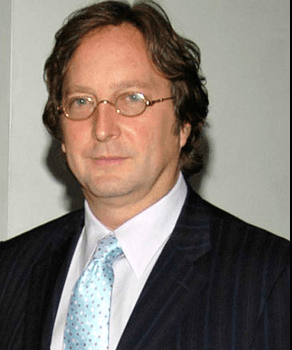
Falcone
Phil Falcone earned his first fortune trading junk bonds in the 1980s. In 2001, he launched Harbinger Capital Partners and by 2007, Falcone and his investors were well-positioned for a blizzard of cash betting against sub-prime mortgages just before the housing collapse and credit crisis that followed. Falcone took home $1.7 billion in compensation that year while an epidemic of foreclosures and upside down mortgages was just getting started.
In late 2008, when the economy was in free-fall, Falcone suspended or limited withdrawals from his largest funds, upsetting investors who couldn’t get their money out. But Falcone reportedly gave special treatment to certain large investors (sources say Goldman Sachs is among them) who were able to clear out their exposed accounts before the losses piled up.
By 2009, Falcone was again making money — so much he vastly underestimated his federal and state tax bills. What’s a cash-strapped billionaire to do? Quietly loan himself $113.2 million from one of his investment funds at a favorable interest rate and keep it a secret from investors for five months. When they eventually found out, they were understandably disturbed. Falcone had barred those same investors from cashing out of the fund he borrowed from.
The Securities and Exchange Commission was not happy either and filed charges against Falcone.
“Today’s charges read like the final exam in a graduate school course in how to operate a hedge fund unlawfully,” Robert Khuzami, director of the S.E.C.’s division of enforcement, said in a statement. “Clients and market participants alike were victimized as Falcone unscrupulously used fund assets to pay his personal taxes, manipulated the market for certain bonds, favored some clients at the expense of others, and violated trading rules intended to prohibit manipulative short sales.”
Despite the publicity generated by the SEC, investors who appreciated Falcone’s ability to earn them money allowed them turn a blind eye to the ethics questions and pour money into Falcone’s latest venture — a wireless network known as LightSquared.
LightSquared was preparing to launch a unique nationwide 4G LTE mobile broadband network powered by satellites and ground-based cell towers, selling wholesale access to third-party wireless companies able to market the service under their own brand. Falcone’s funds poured nearly $3 billion dollars into the venture while getting a waiver from the government to operate high-powered transmitters on the “L” band — 1525-1559 MHz. LightSquared’s plans alarmed the next door neighbors — GPS satellites facing interference issues that would hurt the accuracy of precise location information provided to millions of tracking devices on the “L1” band — 1559 to 1610 MHz.
Initial testing showed that significant interference from the prototype ground-based transmitters would occur and potentially could cripple aviation and public safety GPS users. The FCC eventually withdrew permission for LightSquared to run its network as planned, a potential death-blow to the venture.
Creditors grew anxious wondering how LightSquared would be in a position to repay its loans when it was unable to launch its wireless network.
In May 2012, creditors forced the issue and LightSquared filed for bankruptcy protection, listing assets of $4.48 billion and debts of $2.29 billion. Falcone claimed the bankruptcy filing would give the company more time to overcome the FCC’s objections to its network operations plan. Falcone estimated it would take two years to secure a resolution. Analysts familiar with the FCC suggested Falcone might die of old age before the agency gave way.
Falcone’s subsequent efforts to win back control of the venture have been made more difficult because one man has been quietly buying up large amounts of LightSquared’s debt with designs on the venture’s spectrum.
Dish Networks’ Charles Ergen
 With LightSquared’s debt trading at around 50 cents on the dollar, Charlie Ergen went shopping.
Ergen has been involved in the satellite business for decades. Today, he controls and runs Dish Network, a satellite television provider that has seen the back of high customer growth. Dish and DirecTV are both locked out of the “triple play” business most cable and phone companies offer customers. Neither company can offer broadband or telephone service without partnering with another provider. As cord-cutting continues to take hold, customers willing to pay for increasingly expensive television packages are in decline. That likely explains Ergen’s interest in acquiring wireless spectrum — to build Dish into a broadband, television, and telephone service provider.
In May, Dish publicly bid $2.2 billion for certain spectrum assets from LightSquared. But for more than a year earlier, Ergen was quietly buying up LightSquared’s debt through holding companies and hedge funds.
Ergen created an opaque investment entity named “SP Special Opportunites, LLC” a/k/a “Sound Point” to buy LightSquared debt. Separately, Ergen asked Stephen Ketchum, a former investment banker with close ties to Ergen, to buy over $1 billion in LightSquared debt securities through Ketchum’s hedge fund. From April 2012 until May 2013, Sound Point allegedly spent $1,013,082,326.30 to purchase secured debt for Ergen’s personal benefit and without the knowledge of Dish or its board of directors. Secured debt held by creditors is paid first in a bankruptcy proceeding, and Ergen quietly because LightSquared’s largest single secured creditor.
That puts Charlie Ergen in a major ethical dilemma.
The more Dish offers to pay for LightSquared, the more money Ergen will be paid to cover the shares of LightSquared’s secure debt. Ergen has a controlling interest in Dish, which means he can order Dish to overpay for LightSquared, personally pocketing the proceeds.
Bloomberg’s Matt Levine explains the shady deal:
“An executive going around and buying up an asset for cheap, then convincing his company to buy all of that asset for a higher price – doesn’t come up a lot because it’s so obviously shady,” Levine wrote. “If you’re supposed to be devoting your time and energy to finding opportunities for your company, it looks pretty bad to steal those opportunities for yourself.”
Falcone was outraged when he learned of Ergen’s stealthy acquisitions.
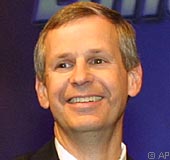
Ergen
In July, Harbinger accused Ergen of “fraudulently” becoming a creditor to block efforts by LightSquared to reorganize and emerge intact from bankruptcy. Instead, Harbinger accused Ergen of seeking to acquire the company’s assets “on the cheap.” Harbinger also points to provisions in a LightSquared debt agreement that forbids certain competitors from buying the company’s debt.
Also upset are several major Dish Network shareholders who are not pleased Ergen’s private deal could make him a lot of money while costing shareholders plenty should Dish overpay for LightSquard’s assets or worse, end up with everything but the spectrum Dish covets.
At least five lawsuits have been filed since August, accusing Ergen and other board members of casting their fiduciary duties to the wind and wasting money along the way. They are also upset Ergen and his connections purchased $1 billion in LightSquared debt at a substantial discount and will likely be repaid the full face value of those debts with Dish Network’s money. That means nearly $300 million in personal profits for Ergen.
The latest shareholder lawsuit was filed by the Louisiana Municipal Police Employees’ Retirement System. It along with the suit filed by the City of Daytona Beach Police Officers’ and Firefighters’ Retirement System claim Ergen’s near-total control of Dish’s board of directors makes it impossible for the board to meet its obligation of representing shareholder interests first.
“Ergen’s control over the company and the board is highlighted by the numerous transactions he has caused Dish to enter into with members of his family,” the lawsuit states.
Ergen and Dish’s efforts to insulate themselves from charges of conflict of interest didn’t fly with many investors.
One lawsuit noted Tom Ortolf, one of the directors on the supposedly independent committee reviewing Dish’s bid, has a daughter that works at Dish; the other, George Brokaw, chose Mr. Ergen’s wife, Cantey Ergen—a Dish director named in the shareholder suit—to be the godmother of his son.
The discomfort level at Dish reached high enough to prompt one board member, Gary Howard, to suddenly resign in early September. Howard was also on the committee formed to vet the LightSquared deal because of the potential conflict of interest on Ergen’s part.
Before Falcone could claim the high road at Ergen’s expense, this week New York’s top financial regulator banned Falcone from managing Fidelity & Guaranty Life Insurance Company of New York for seven years. Harbinger Group bought Fidelity & Guaranty, the U.S. life and annuity unit of London-based Old Mutual Plc, for $350 million in 2011.
[flv width=”640″ height=”380″]http://www.phillipdampier.com/video/Bloomberg LightSquared 9-5-13.flv[/flv]
Bloomberg News discusses the high drama between LightSquared and Dish Network. (4 minutes)


 Subscribe
 After years of financial problems, union problems, and service problems, customers of FairPoint Communications in northern New England report the company has stabilized operations and has been gradually improving service. A hedge fund holding 7.5% of FairPoint agrees, and is now pressuring FairPoint’s board of directors to sell the company, allowing shareholders that bought FairPoint stock when it was nearly worthless to cash out at up to $23 a share.
 “Not as patient as FairPoint’s own customers that spent several years of hell dealing with Verizon’s sale of its landlines in Vermont, New Hampshire, and Maine,” said FairPoint customer Sally Jackman, who lives in Maine. “It looks like the hedge funds want their pound of profits from another sale, exactly what FairPoint customers don’t need right now.”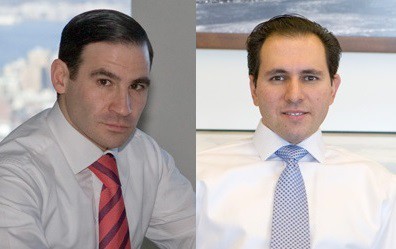
 Independent television in Great Britain
  John Malone’s Liberty Global is seen as a leading contender, already owning a 6.4% stake in ITV acquired from BSkyB for $824 million. Liberty Global and Discovery Networks have maintained close association and jointly bid $930 million to acquire All3Media, the production arm of reality shows like “Undercover Boss.”
 Redbox Instant is 65% owned by Verizon, and could eventually be owned outright by the phone company or shut down. Outerwall entered the video streaming venture with Verizon to cut the company’s dependence on Redbox kiosks, which provided 87 percent of 2012 revenue (with Coinstar coin-counting kiosks and other vending machines covering much of the rest).
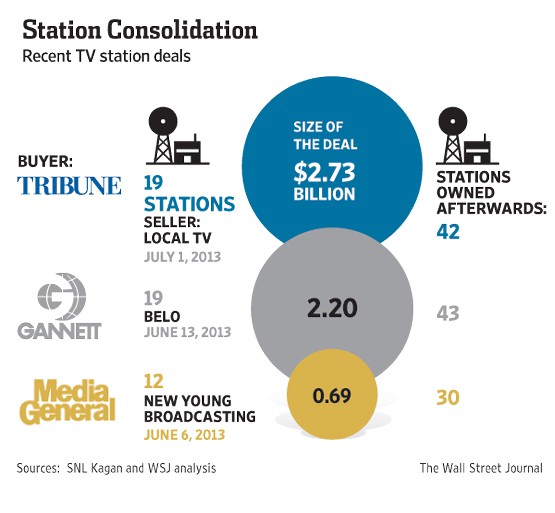
 The company best known for the 10 daily newspapers it publishes, including the Chicago Tribune, the Orlando Sentinel, the Baltimore Sun, and the Los Angeles Times, can’t wait to get out of the newspaper business.
 It expects to pay off the loans and generate returns from the “significant free cash flow” generated by the stations.
 Tribune is not alone bulking up the number of stations they own and control. Last month Gannett nearly doubled its portfolio from 23 to 43 stations with the acquisition of Belo’s TV stations for $1.5 billion in cash and agreeing to cover $715 million in accumulated debt.