Home » fiber optic network » Recent Articles:

Canada’s Fiber Future: A Pipe Dream for Ontario, Quebec, Alberta, and B.C.

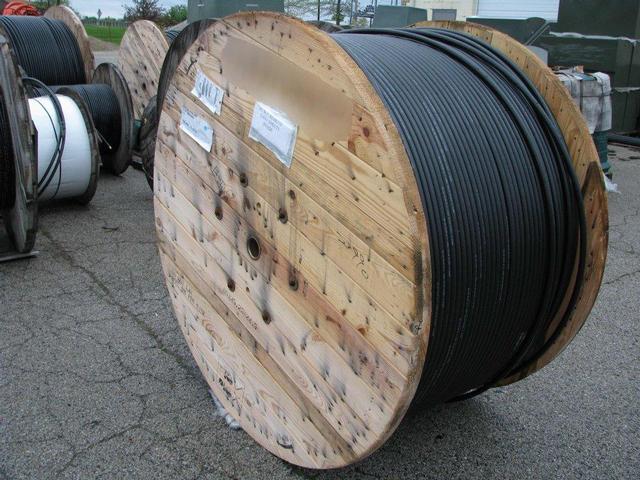
Fiber optic cable spool

For the most populated provinces in Canada, questions about when fiber-to-the-home service will become a reality are easy to answer:  Never, indefinitely.

Some of Canada’s largest telecommunications providers have their minds made up — fiber isn’t for consumers, it’s for their backbone and business networks.  For citizens of Toronto, Calgary, Montreal, and Vancouver coping with bandwidth shortages, providers have a much better answer: pay more, use less Internet.

Fiber broadband projects in Canada are hard to find, because providers refuse to invest in broadband upgrades to deliver the kinds of speeds and capacity Canadians increasingly demand.  Instead, companies like Bell, Shaw, and Rogers continue to hand out pithy upload speeds, throttled downloads, and often stingy usage caps.  Much of the country still relies on basic DSL service from Bell or Telus, and the most-promoted broadband expansion project in the country — Bell’s Fibe, is phoney baloney because it relies on existing copper telephone wires to deliver the last mile of service to customers.

Much like in the United States, the move to replace outdated copper phone lines and coaxial cable in favor of near-limitless capacity fiber remains stalled in most areas.  The reasons are simple: lack of competition to drive providers to invest in upgrades and the unwillingness to spend $1000 per home to install fiber when a 100GB usage cap and slower speeds will suffice.

The Toronto Globe & Mail reports that while 30-50 percent of homes in South Korea and Japan have fiber broadband, only 18 percent of Americans and less than 2 percent of Canadians have access to the networks that routinely deliver 100Mbps affordable broadband without rationed broadband usage plans.

In fact, the biggest fiber projects underway in Canada are being built in unexpected places that run contrary to the conventional wisdom that suggest fiber installs only make sense in large, population-dense, urban areas.

Manitoba’s MTS plans to spend $125-million over the next five years to launch its fiber to the home service, FiON.  By the end of 2015, MTS expects to deploy fiber to about 120,000 homes in close to 20 Manitoba communities.  In Saskatchewan, SaskTel is investing $199 million in its network in 2011 and approximately $670 million in a seven-year Next Generation Broadband Access Program (2011 – 2017). This program will deploy Fiber to the Premises (FTTP) and upgrade the broadband network in the nine largest urban centers in the province – Saskatoon, Regina, Moose Jaw, Weyburn, Estevan, Swift Current, Yorkton, North Battleford and Prince Albert.

“Saskatchewan continues to be a growing and dynamic place,” Minister responsible for SaskTel Bill Boyd said. “The deployment of FTTP will create the bandwidth capacity to allow SaskTel to deploy exciting new next generation technologies to better serve the people of Saskatchewan.”

But the largest fiber project of all will serve the unlikely provinces of Atlantic Canada, among the most economically challenged in the country.  Bell Aliant is targeting its FibreOP fiber to the home network to over 600,000 homes by the end of next year.  On that network, Bell Aliant plans to sell speeds up to 170/30Mbps to start.

In comparison, residents in larger provinces are making due with 3-10Mbps DSL service from Bell or Telus, or expensive usage-limited, speed-throttled cable broadband service from companies like Rogers, Shaw, and Videotron.

Bell Canada is trying to convince its customers it has the fiber optic network they want.  Its Fibe Internet service sure sounds like fiber, but the product fails truth-in-advertising because it isn’t an all-fiber-network at all. It’s similar to AT&T’s U-verse — relying on fiber to the neighborhood, using existing copper phone wires to finish the job.  Technically, that isn’t much different from today’s cable systems, which also use fiber to reach into individual neighborhoods.  Traditional coaxial cable handles the signal for the rest of the journey into subscriber homes.

A half-fiber network can do better than none at all.  In Ontario, Bell sells Fibe Internet packages at speeds up to 25Mbps, but even those speeds cannot compare to what true fiber networks can deliver.

Globe & Mail readers seemed to understand today’s broadband realities in the barely competitive broadband market. One reader’s take:

“The problem in Canada (and elsewhere) preventing wide scale deployment of FTTH isn’t the technology, nor the cost. It’s a lack of political vision and will, coupled with incumbent service providers doing whatever they can to hold on to a dysfunctional model that serves their interests at the expense of consumers.”

Another:

“The problem with incumbents is they only think in 2-3 year terms. If they can’t make their money back in that period of time, they’re not interested. Thinking 20, heck even 10 years ahead is not in their vocabulary.”


China Becoming World Leader in Fiber Optics: Explosive Fiber Upgrades Will Overtake All Others By 2016

Phillip Dampier July 6, 2011 Broadband Speed, Competition, Public Policy & Gov't, Rural Broadband Comments Off on China Becoming World Leader in Fiber Optics: Explosive Fiber Upgrades Will Overtake All Others By 2016

The People’s Republic of China will become the world leader in fiber optic network deployment by 2016, with more than 50 percent of all fiber subscribers worldwide residing in the country, according to a new report from research firm Ovum.

The unprecedented growth in fiber networks comes through a combination of government incentives, including subsidies and private-public partnerships, and cooperating Internet Service Providers, who want to reach more customers.

In fact, with the Chinese government aggressively pursuing and monitoring broadband upgrades, China will rapidly exceed broadband deployments found in other countries in Asia, including Korea and Japan.  That could allow China to become the global leader in broadband before the end of the decade.

China Telecom is one of the providers that is moving the country towards dominance in fiber deployments, on track to pass 26 million homes with fiber networks this year.

Through the company’s “Broadband China — Fiber Cities” project, China Telecom should pass 100 million homes with fiber broadband access by 2015, with the help of contractors like Alcatel-Lucent.

In smaller cities and rural areas, combination fiber and copper networks plan to deliver temporary speed upgrades with technology similar to AT&T U-verse. But China sees such upgrades as interim, until additional fiber networks can be constructed.

The upgrades are a win-win for China and its citizens.  China’s telecommunications companies are enjoying new revenue opportunities for their wired networks, Chinese citizens will eventually obtain some of the fastest broadband speeds on the planet, and the Chinese government wins an advanced telecommunications network on which it plans to continue growing the country’s digital economy and helping spur additional manufacturing and export opportunities.

So far, China’s large expanse and large rural, often poor population found further inland are not inhibiting China’s infrastructure development plans.

“You cannot become one of the world’s most powerful nations if you can’t deliver basic services to your own citizens,” says Wu Dan, a development coordinator for the Chinese government.  “With clean water, good roads, reliable power, and advanced telecommunications, China’s western cities will grow and become as important as coastal cities in China’s progress.  Internet access is a part of that progress.”

Time Warner Cable Officially Unveils DOCSIS 3 Upgrades in San Antonio; Hill Country Residents Yawn

Phillip Dampier June 30, 2011 Broadband Speed, Competition, Data Caps, GVTC Communications, Rural Broadband Comments Off on Time Warner Cable Officially Unveils DOCSIS 3 Upgrades in San Antonio; Hill Country Residents Yawn

Despite a soft launch weeks earlier, Time Warner Cable officially began selling faster broadband packages in San Antonio Tuesday.

Made possible by DOCSIS 3 upgrades (and not by “Time Warner’s fiber optic network” to quote one San Antonio news outlet), the cable company will now sell 30/5Mbps service for $20 above the current price of Standard Service.  Customers looking for more speed can spend a lot more to get it — $99.95 a month buys you 50/5Mbps service, although the sting seems less if you bundle all of your Time Warner services through their $199 Signature Home package, which includes digital cable, broadband, and phone service.  Signature Home includes 50/5Mbps as part of the package.

About 70 percent of the San Antonio market can get the new speeds immediately.  The rest will be upgraded by September.

The upgrades are seen with some amusement by customers of GVTC, a former telephone cooperative that today provides fiber to the home service in parts of the Texas Hill Country and other rural areas to the north of San Antonio.  They recently received speed upgrades from 40Mbps to 80Mbps downstream and 20Mbps upstream as part of a comparably-priced triple play package.  GVTC’s truly fiber optic system was built to accommodate broadband usage growth.

“Consumers obviously enjoy streaming video and downloading HD movies, but these applications use a lot of bandwidth and can slow down other Internet devices in your household,” CEO Ritchie Sorrells said. “The reality is bandwidth consumption will continue to increase. We’re once again ahead of the curve with our 80 Mbps connection, and this tier will be popular with the growing number of households that realize they have a need for speed.”

One thing GVTC customers don’t need and won’t get is the kind of consumption billing Time Warner Cable is reconsidering for their customers in San Antonio and the rest of the country.

Frontier Fires Back at Comcast In Indiana – Comcast is Telling Stories About FiOS

Phillip Dampier June 30, 2011 Comcast/Xfinity, Competition, Frontier 2 Comments

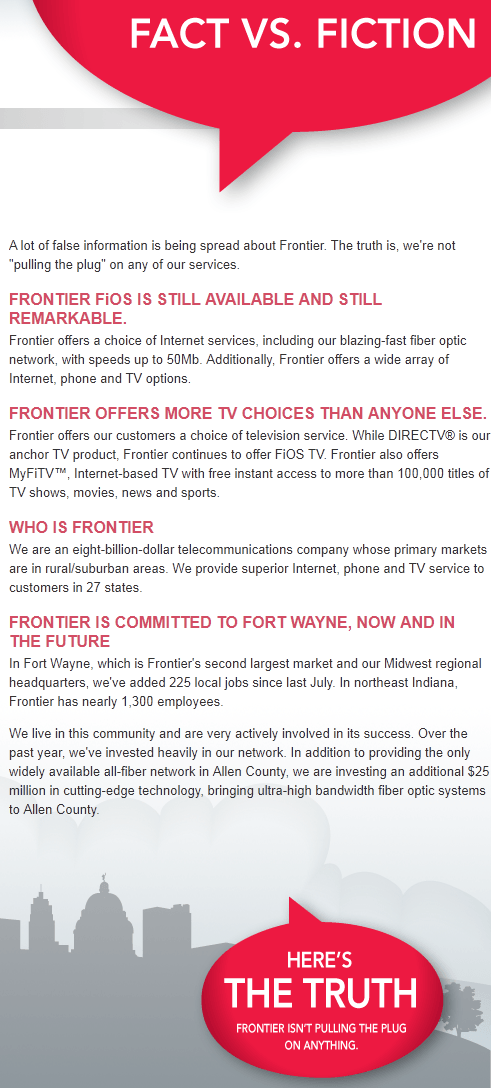
Frontier's Facts - Frontier's new website to counter Comcast's claims about FiOS. (click to enlarge)

Frontier Communications has fired back at Comcast after the Fort Wayne, Indiana cable company erected billboards telling residents Frontier was pulling the plug on its acquired FiOS fiber optic network.

On Wednesday, Frontier purchased a full-page ad in The Journal Gazette headlined, “Comcast Doesn’t Let the Facts Get in the Way of a Good Story! Here’s the Truth: Frontier Isn’t Pulling the Plug on Anything.”  It also launched a new website — Frontier Facts — telling customers it is not “pulling the plug” on any of its services.

Roscoe Spencer, Frontier’s local general manager, tells customers:

Recently, one of our competitors put up billboards, placed inserts in the newspapers and sent mailings to customers indicating we had pulled the plug on FiOS. This statement is simply not true, and we have taken legal action to insist that these false claims be stopped immediately.

Spencer

The spat began when Comcast began trying to recruit disaffected Frontier TV customers who found a massive rate increase notice in bills sent earlier this year.  Frontier blamed the rate increase on the loss of volume discounts former owner Verizon obtained for its FiOS TV service for television programming.  Frontier has sought to negotiate with programmers directly instead of working through a cooperative buying group, so the prices it pays for popular cable networks are much higher than what Comcast pays for a comparable video package.

Frontier watchers suggest the company is well aware its new video pricing is uncompetitive and customers will take their business elsewhere.  Frontier quickly began marketing DirecTV, a satellite provider, as a suitable replacement for those unhappy with the rate increase.  But Comcast also saw an opportunity to pick up new customers at the phone company’s expense, including through the use of billboards Frontier claims are misleading.

Frontier stresses its FiOS platform will continue to provide telephone, television, and broadband service, despite what Comcast’s billboards might suggest.

Despite the involvement of attorneys, Comcast has continued to thumb its nose at Frontier’s legal department.  Frontier spokesman Matt Kelley told the Journal Gazette Comcast was supposed to remove the billboards by Monday of this week, but they remain in place.

The cable company calls it a case of old fashioned competition.

Stop the Cap! reader Kevin calls Frontier’s marketing to get customers to drop FiOS TV for DirecTV a real blast from the past.

“It remains difficult for Frontier to sell people on its advanced fiber network when it is heavily marketing customers to get off of it and switch to DirecTV, a service that looked ultra-modern in the 1990s but today is just a rain-faded, pixellated nuisance,” Kevin says.  “Frontier blew it, Comcast took advantage of their strategic blunders, and now the whining has begun.”

Kevin is a former Verizon FiOS customer who was switched to Frontier when Verizon exited Fort Wayne.

“Verizon knew what they were doing, but eventually decided a few small cities in Indiana were not worth their time or interest, so they sold us off to Frontier, who ended up with a fiber network they’ve shown little interest in running except as an adopted curiosity,” Kevin adds.  “When we got notice of the rate increase, we canceled the TV service and now watch over the air television for free, supplemented with Netflix and Hulu.”

Kevin says Frontier ultimately did him a favor, discovering he was fine without a pay television package.

“Outside of breaking news and sports, you can get most everything else online.  Why pay more?”

Organized Labor Assisting Group Pushing for Verizon FiOS Expansion in Buffalo

Phillip Dampier May 19, 2011 Broadband Speed, Verizon, Video 2 Comments

Buffalo’s communications labor unions are behind an organized effort to push Verizon Communications to expand its fiber-to-the-home service to the city of Buffalo, despite the fact the telecom company has a moratorium on service expansion beyond its existing commitments.

Buffalo AFL-CIO Central Labor Council President Michael Hoffert and CWA (Communications Workers of America) Local 1122 President James Wagner teamed up with the city’s elected officials and community advocates to pressure the phone company to expand service beyond several suburbs that currently get the service.

A professionally designed website, DontBypassBuffalo.com, is the home of the campaign, collecting signatures from interested residents and sharing late-breaking developments.

Verizon has a moratorium on further expansion of its fiber to the home service.

“Verizon’s FiOS service is a cutting-edge technology that brings ultra-fast internet and superior video programming over fiber optic cables that run directly into customers’ homes,” reads a statement from the coalition. “While Verizon is deploying FiOS throughout many of the suburbs of Buffalo, they are not building FiOS in the City of Buffalo.  The residents of Amherst, Tonawanda, Kenmore, Orchard Park, Hamburg, West Seneca and Lackawanna, where Verizon has built FiOS, are, taken as a whole, more affluent and less diverse than Buffalo residents.  The deployment of broadband technologies is a key to economic redevelopment in the City, especially since health care and higher education, both very dependent on cutting edge technologies, are leading employers in our area.  If Verizon continues to bypass Buffalo, residential consumers, children, and area businesses won’t be able to thrive in the 21st century economy.”

The union shares an interest in bringing the advanced service to more residents across Erie County as it collectively represents some of the Verizon employees who will service the fiber network.  Three western New York chapters of the CWA – Locals 1122, 1115 and 1177 – represent nearly 750 Verizon Workers across Erie, Genesee and Niagara counties, as well as across the Southern Tier, including field technicians, central office technicians and clerical staff.

Curry (WIVB-TV)

Verizon stalled new rollouts of its fiber optic network more than a year ago, and has consistently said it would only expand service in areas where it already has signed agreements with local communities.  In many regions, Verizon has completed agreements with towns and villages before reaching accommodations with larger urban areas.  Buffalo is not alone in protesting for improved broadband service.  Washington, D.C., Baltimore and Boston have also complained about being bypassed.

Last week, Coalition Director Janique Curry stepped up the pressure on the phone company at a press conference in front of Verizon’s Elmwood Avenue headquarters.

“Verizon’s lack of commitment to the minority population in the city of Buffalo is unacceptable,” Curry said.  “This community deserves an equal opportunity as our neighbors in the suburbs experience.”

Verizon’s FiOS network in New York State currently serves parts of metropolitan New York City and suburban areas around Albany, Syracuse, and Buffalo.

[flv width=”640″ height=”500″]http://www.phillipdampier.com/video/DontBypassBuffalo Apr-May 2011.flv[/flv]

Here are three reports on the protests: WIVB-TV and WKBW-TV’s coverage of the protest in April, and WIVB’s most recent story covering last week’s return to Verizon headquarters to apply additional pressure on the company.  (3 minutes)

Search This Site:

Contributions:

Recent Comments:

Your Account:

Stop the Cap!