Home » DOCSIS » Recent Articles:

Updated for 2013: Getting a Better Deal from Time Warner Cable… Five Minutes to Save Almost $700

Readers: Please find our 2015 Guide to Getting a Better Deal from Time Warner Cable here. You will find the latest negotiating strategies and deal information in that updated article. 

Time Warner Cable just won’t let you say goodbye, if they can help it.

A year ago, your editor fought for a better deal from the cable company that has served him since the 1980s.  With a tough economy and downsizing, paying a cable bill that was approaching $175 a month in early 2011 for ‘all their best’ was simply no longer an option.  Time Warner Cable’s customer retentions office responded with a promotion that slashed the bill to just $88.44 for Turbo Internet, cable-TV, and unlimited “digital phone” service with nationwide calling.  Incidental charges included leasing a whole house DVR ($7.04), a second cable box ($6.84), $1 for “digital programming” and $0.34 for the remote control.

When the cable operator introduced DOCSIS 3 broadband speed upgrades, an additional $20 a month brought 30/5Mbps speeds.  The total — $123.66 (before taxes and fees).  That’s a whole lot less for a great deal more service.

When the promotion ended in February, the rate shot back up to $160, but $7.95 of that was for a year of Showtime at a special promotional price.  Showtime was destined for the cancel corner anyway (we didn’t watch more than two hours of anything on Showtime in the last year), but even without it, the rate increase was on the steep side.

So we complained.

Unlike last year, which resulted in considerable confusion and arguing back and forth with different representatives to find the best deal, this year we let Time Warner’s social media representatives do the hard work for us.  Within 24 hours, our rate for all of the same services, plus a special promotion that includes HBO, Cinemax, Showtime, and The Movie Channel at no additional charge, brought the bill down even lower than we managed last year: $102.33 a month for a year.  That includes the 30/5Mbps Road Runner Extreme, Whole House DVR, and one extra cable box.  It doesn’t include taxes and fees, which typically add another $6.50 to the bill.

The whole process was painless, and you can follow in our footsteps if you have a Twitter account:

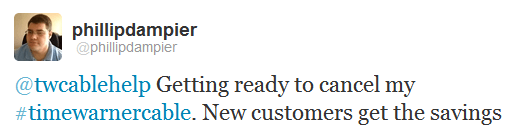
Step One: Tweet Time Warner (Note the Twitter address has changed from @twcablehelp to @TWC_help):

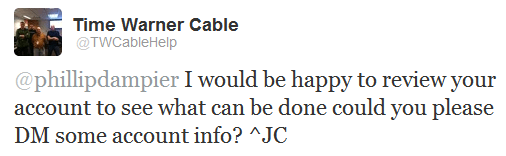
The key phrase in whatever Tweet you send is to include: @TWC_help, which brings you to their social media customer service representatives.  I also “followed” @TWC_help so I could see how active they were.  During business hours, you should expect to see a reply like this within the hour:

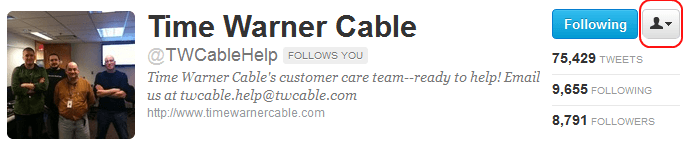
For those new to Twitter, “DM” refers to a “direct message” — a private Tweet seen only by the intended recipient.  I finally found the menu option that allows me to send a “direct message” on Twitter’s page for Time Warner Cable:

Note the red box around the option on the top right.  By clicking that you will see a drop down menu that includes an option to “Direct Message” TWC_help.  You will want to include your Time Warner Cable account number (as seen on your bill) and include your contact phone number.

Within 24-48 hours, a senior retentions specialist should call you to negotiate a better offer for your service.  Make sure you answer those unfamiliar caller ID calls!  But before they call, visit Time Warner Cable’s website and note any currently running new customer promotions.  Also check to see if the competition is offering anything even lower.  Those prices are typically the starting point for your negotiations, and the company should have little trouble meeting them.  However, customers with a poor payment record or past due account may discover the company less willing to negotiate.  Bring account balances current before negotiating for a lower rate.

Some Time Warner Cable territories offer “price protection agreements” or term contracts that lock customers into 1-2 years of service.  Negotiating around these contracts can be difficult to impossible.

An alternative contact method is to direct e-mail Time Warner at: [email protected] (don’t forget the “.” in twcable.help).

The total time spent this year on finding a better deal that will save us $58 a month — $696 a year — about five minutes, far less than the time it took to write this article.  Give it a try and let us know in the comments what kind of deals you can negotiate.

Digging Deeper Into Time Warner Cable’s 2011 Results and What Is Coming in 2012

While a downturn economy continues to afflict middle and lower income America, it doesn’t seem to be doing much harm to Time Warner Cable’s profits.

America’s second largest cable operator saw profits jump more than $150 million higher to $564 million last quarter, compared to $392 million at the same time the year before.  Time Warner’s revenue grew by 4% to $5 billion in the fourth quarter alone.  In fact, the company is performing so well, executives announced they would return $3.3 billion in earnings to shareholders through share buybacks and dividend payouts, in addition to the forthcoming $4 billion share repurchase program.  Wall Street liked what they saw, boosting shares 7% after the company posted its quarterly and annual results on its website.

Time Warner’s biggest success story remains its broadband service, which consistently delivers the company new subscribers and has helped offset the loss of video subscribers, numbered at an additional 129,000 who “cut the cord” in the fourth quarter of 2011.

Time Warner Cable earned $1.148 billion in revenue from broadband in the last quarter, an increase of 8.6% over last year.  For 2011, the cable operator earned $4.476 billion selling residential Internet access, also representing an 8.6% growth rate over earnings across 2010.

The company attributed this to “growth in high-speed data subscribers and increases in average revenues per subscriber (due to both price increases and a greater percentage of subscribers purchasing higher-priced tiers of service).”

The increased costs incurred by Time Warner Cable to upgrade and expand their network and cable systems were well offset by the aforementioned price increases and subscriber upgrades.  The company increased capital expenditures to $942 million in the last quarter.  Results over the full year show just a 0.2% overall increase in capital investment, now at $2.937 billion.  System upgrades, Time Warner’s plans to move their systems to all-digital cable television, the ongoing rollout of DOCSIS 3.0, new home security and automation services, and investment in online video and data centers are included in these costs. But a more significant reason for the increase comes from the company’s ongoing expansion into business services, which requires wiring more office buildings for cable.

Britt

Time Warner Cable CEO Glenn Britt led off the conference call with investors with an explanation for the increased expenses.

“We plan to continue our aggressive growth in business services by expanding product offerings, growing our sales force, improving productivity and increasing our serviceable footprint. This means continued investment, both in people and in capital,” Britt said. “Projects include expansion of our content delivery network, which powers our IP video capability, our 2 international headends, completion of DOCSIS 3.0 deployment, and conversion to all-digital in more cities. We expect to be able to accomplish this while maintaining the capital spending of the last 2 years — that is, between $2.9 billion and $3 billion, which represents a continued decline in capital intensity.”

Nothing in Time Warner Cable’s financial disclosures provides any evidence to justify significant changes in their pricing model for broadband, which currently delivers flat rate, unlimited service to customers at different speed rates and price points.  In fact, the company’s investments in DOCSIS 3.0 upgrades, which can support faster broadband speeds and a more even customer experience, have already paid off with subscriber upgrades.

Robert D. Marcus, president and chief operating officer, noted subscribers are increasingly considering faster (and more profitable) broadband tiers.

“Once again, high-speed data net adds over-indexed to our higher-speed tiers,” Marcus noted. “Roughly 3/4 of residential broadband net adds were Turbo or higher. And DOCSIS 3.0 net adds accelerated for the eighth consecutive quarter to an all-time high of 54,000.”

Time Warner’s biggest challenges continue to be the current state of the economy, which has made subscribers much more sensitive to pricing and rate increases, and cord cutting traditional cable television service.

“One group is extremely price-conscious, perhaps due in part to the ongoing economic malaise,” Britt said. “The other group is willing and able to pay for more features and service. We’re going to focus more attention on products and services that best meet each group’s needs rather than pursuing traditional one-size-fits-all solutions.”

That is clearly evident in the company’s bundled service options, including increasingly aggressive discounted pricing for new customers and for those threatening to leave and Time Warner’s super-premium Signature Home service, which delivers super-profits.  Average revenue from Signature Home customers averages $230 a month.  Traditional “triple play” customers who buy phone, Internet, and cable service only bring the cable company an average of $150 a month.

The company’s plans for 2012 do not include a specific statement about implementing an Internet Overcharging scheme like usage billing or usage caps.  But it is unlikely such an announcement would be made explicitly at an earnings announcement.  In the last quarter, Stop the Cap! reported comments from chief financial officer Irene Esteves that the company was still very interested in the concept of selling broadband with usage pricing as a “wonderful hedge” against cord-cutting.

Esteves told a UBS conference she believes usage-based pricing for Time Warner Cable broadband will become a reality sooner or later.  Charging “heavy users” more would already be familiar to consumers used to paying higher prices for heavy use of other services, and she claimed light users would have the option of paying less.

But despite favorable reception to the idea of usage pricing by Wall Street, Esteves acknowledged the company’s past experiments in usage pricing didn’t go as planned, and she suggested the company will introduce usage pricing “the right way rather than quickly.”

Other developments and highlights

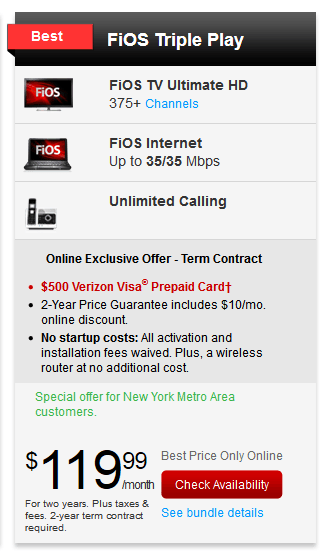
  • Time Warner faces Verizon's $500 rebate offers in NY City

    Time Warner Beats Up DSL: Time Warner Cable’s most lucrative source for new broadband customers comes at the expense of phone companies still relying on DSL to deliver broadband service.  As DSL speeds have failed to stay competitive with cable broadband, the cable operator has successfully lured price-sensitive DSL customers with attractive ongoing price promotions delivering a year of standard 10/1Mbps cable Internet access for $29.99 a month, often less expensive than the total price of DSL service that frequently delivers slower speeds.

  • Stalled Verizon FiOS deployment has limited the amount of competition Time Warner faces from fiber optics to just 12% of the company’s service area.  Where competition does exist, especially in New York State, Time Warner has had to stay aggressive to retain customers with deeply-discounted retention deals to keep up with Verizon’s high value rebate gift cards and new customer offers.  AT&T now provides U-verse competition in about 25% of Time Warner’s service area, but like satellite, AT&T U-verse pricing is less heavily discounted.
  • Retention pricing and new customer deals deliver lower prices than ever.  In November, Time Warner started selling a triple play offer for $89.99 a month that includes DVR service and now also includes deep discounts or free 90 day trials of premium movie channels. That is $10 less than the same time last year.
  • Premium movie channels continue to take a major hit as subscribers try to reduce their bills, especially after Time Warner began increasing rates on those networks.  HBO now sells for as much as $15 a month in many areas.  Time Warner Cable hopes to ‘revitalize’ premium movie channels with online video services like HBO and Max Go and promotional discounts.
  • Long-standing customers of Time Warner’s “triple play” package received a “thank-you gift” — free voice-mail in 2011, something that will continue in 2012.
  • Customers signing up for Time Warner’s premium-priced Wideband (50/5Mbps) service ($99/month) are being offered free phone service to sweeten the deal.

What to Expect in 2012

  • Time Warner is moving forward to create its own Regional Sports Network for southern California;
  • Los Angeles will continue to see large-scale expansion of Time Warner’s growing Wi-Fi network, available for free to premium broadband customers, with thousands of new access points on the way;
  • The cable company will introduce Wi-Fi service in other, yet-to-be-announced cities in 2012, with up to 10,000 access points planned.
  • Time Warner will be making its “digital phone” product more attractive with lower prices and more features, especially in product bundles, as consumers increasingly discard landlines;
  • Expect to see the end of analog cable television in a growing number of Time Warner Cable areas, requiring customers to use new equipment (initially provided free) to continue watching on older televisions and those without existing set top boxes.
  • Time Warner will continue to expand its “TV Everywhere” project to include live streaming TV on smartphones, video game consoles, computers, and more.  On-demand programming will be available as well sometime this year across all platforms.
  • A nationwide channel re-alignment will move subscribers to consistent channel numbers across the country, in part based on grouping them together into “genres.”  Many areas already have digital cable channels arranged this way, but now they will be consistent from coast-to-coast.
  • Time Warner will complete DOCSIS 3 deployment in all areas this year.
  • The company is moving to introduce 2-hour service call windows almost everywhere, and 1-hour windows and weekend appointments in some markets.  Several cities now allow customers to select specific times for service appointments.
  • Self-install kits will become increasingly available for different products, allowing customers to install equipment themselves;
  • Time Warner’s IntelligentHome home security, monitoring, and automation product will expand beyond its launch markets (Syracuse and Rochester, N.Y., Charlotte, N.C. and Los Angeles/Southern Calif.).  The product currently has customers in the thousands, considered relatively small.  But Time Warner has learned subscribers are using the service in surprising ways, which will let them adapt their marketing.  Among the most popular features: remotely watching your pets at home.

Most Memorable Quote: “I think, more than anything else, our pricing strategy is dictated by what the marketplace will bear as opposed to what our underlying cost structure is.” — Robert Marcus, president and chief operating officer, Time Warner Cable


North America Losing Broadband Speed Race: Former Eastern Bloc Scores Major Gains With Fiber

Phillip Dampier January 16, 2012 Broadband Speed, Community Networks, Competition, Consumer News, Editorial & Site News, Public Policy & Gov't Comments Off on North America Losing Broadband Speed Race: Former Eastern Bloc Scores Major Gains With Fiber

North America’s broadband rankings continue to take a beating at the expense of countries deploying fiber optic broadband.  While the United States and Canada cope with aging landline technology and an uncompetitive marketplace that tells consumers they don’t need fiber-fast broadband speed, countries like Bulgaria, Lithuania and Estonia are lighting up 50-100Mbps networks that often charge lower prices than North Americans pay for 1-3Mbps DSL.

Ookla, a global leader in broadband testing and web-based network diagnostic applications, reports that the best performing broadband networks for speed, value, and performance are increasingly in Europe and Asia.  While both the United States and Canada used to be among the world leaders in broadband infrastructure, that is no longer true.

Some examples:

  • The United States now scores 31st in average download speed, Canada is 33rd;
  • In upload speed, America now ranks 37th, Canada a woeful 69th;
  • Ookla’s Household Quality Index, which ranks packet loss and general reliability of home connections found Canada scoring 27th place, the United States 38th;
  • At a cost per megabit, neither the US or Canada offers very good value.  The USA ranked 29th ($4.95 per megabit), Canada 33rd ($5.85 per megabit);
  • Neither country does a great job delivering the speeds and service promised either.  The USA ranked 25th, Canada 32nd.

Ookla found that while speeds are rising in North America, they are not increasing nearly as fast as in other, higher-ranked countries.  Most of the speed gains in North America come from cable or limited fiber-broadband deployments like Verizon FiOS or community-owned fiber to the home networks.  Wireline ADSL service, which represented a larger proportion of home Internet connections in 2008, continues to lose ground to faster options from cable companies, community-owned broadband, and phone company fiber upgrades.  In eastern Europe, the Baltics, Russia and Ukraine, many of the dramatic boosts in broadband speed and quality come as a result of national fiber network upgrade projects.

While speeds in North America are gradually increasing, both the U.S. and Canada are being outpaced by many countries in Europe and Asia.

While providers in the United States and Canada often dismiss fiber as too costly, Ookla found fiber-based networks delivering some of the world’s best values in broadband.

For example, on a cost-per-megabit basis, Bulgaria’s new fiber networks deliver the world’s cheapest Internet service, at an average of just $0.64 per megabit.  The average broadband speeds in the country are now higher than 21/11Mbps.

Elion headquarters in Tallinn. Elion delivers fiber broadband to homes across Estonia.

Contrast that with average speeds in the United States (12.41/2.97Mbps) and Canada (11.95/1.70Mbps).  Other top scoring countries for cost-per-megabit include:

  • Romania $0.97 USD
  • Lithuania $1.11 USD
  • Ukraine $1.17 USD
  • Republic of Moldova $1.41 USD
  • Latvia $1.80 USD
  • Hungary $2.00 USD
  • Slovakia $2.04 USD
  • Hong Kong $2.26 USD
  • Russia $2.51 USD

In terms of download speed, Estonia’s investment in a national fiber network is now paying dividends, with a dramatic increase in national average broadband speeds to 50/28Mbps.  As new cities join Estonia’s fiber network, speeds take a dramatic upswing.  Contrast average speeds in Saue (101.03Mbps), Viimsi (98.98Mbps), Tallinn (69.80Mbps), and Võru (65.58Mbps) with ADSL-rich Pärnu (12.55Mbps), Paide (12.40Mbps), Rapla (8.93Mbps), and Valga (7.71Mbps).

It is much the same story in other fiber-rich countries, where broadband speeds far exceed the averages in the United States and Canada:

Look what happens to Estonia's broadband speed rankings when it switched on its national fiber broadband network.

  • Lithuania 31.65 Mbps
  • South Korea 31.44 Mbps
  • Latvia 25.42 Mbps
  • Sweden 24.62 Mbps
  • Romania 24.47 Mbps
  • Netherlands 24.36 Mbps
  • Singapore 22.94 Mbps
  • Bulgaria 21.12 Mbps
  • Iceland 20.53 Mbps

Despite all of the bad news, the cable industry’s trade publication Multichannel News tried to find victory in the jaws of defeat, noting things could be worse… if they ran traditional phone companies.

Cable operators delivered the fastest average broadband download speeds in 2011 — with major MSOs easily blasting by rival telco and satellite Internet services — according to data from independent testing firm Ookla.

For the full year, the six fastest residential Internet service providers in the U.S. based on average download speed were Comcast, Charter Communications, Cablevision Systems, Time Warner Cable and Insight Communications.

[…] Comcast and Charter delivered average download speeds of 17.19 Megabits per second, followed by Cablevision at 16.40 Mbps, Cox at 15.76 Mbps, TWC at 14.41 Mbps and Insight at 14.22 Mbps.

Verizon Communications fared better than its telco peers with an average download speed of 12.94 Mbps, thanks to FiOS Internet, its fiber-to-the-home service that provides up to 150 Mbps downstream. And overall, Verizon had the highest upstream speeds with an average of 7.41 Mbps. Still, the company’s legacy DSL services dragged down overall speeds.

Behind DSL were woefully slower speeds from the nation’s wireless ISPs (which include 3G broadband from large companies like Verizon Wireless and AT&T), and perennially last place satellite Internet.

Moffett

Despite repeated claims by providers that consumers don’t need fiber-fast broadband speeds, industry analyst Craig Moffett at Sanford Bernstein tells a different story:

“Technology adoption is creating a feedback loop that increasingly favors cable’s physical infrastructure,” Moffett wrote in a research note last month. “As more people are served by higher-speed connections, more and more applications are evolving to take advantage of them. Customers with lower-speed connections are increasingly being forced to upgrade to higher speed connections… or be left behind.”

The conclusion reached by Multichannel News columnist Todd Spangler:

“The relative broadband speeds of cable vs. telco isn’t merely an academic curiosity: Major providers are increasingly touting Internet performance in their marketing as they fight for consumers’ dollars.”

Unfortunately for the cable industry, although DOCSIS 3 upgrades have afforded dramatic increases in broadband download speeds, upload speeds lag behind.  Fiber to the home networks are best positioned to achieve victory in the global broadband race.  That is important not only because it delivers consumer dollars to the best provider in town, but fuels the further development of the digital, knowledge-based economy North America increasingly seeks to lead.

Internet Overcharging Gravy Train: Average Home Wi-Fi Use to Exceed 440GB By 2015

Providers establishing Internet Overcharging schemes like usage caps, so-called “consumption billing,” and speed throttles that force subscribers into expensive upgrades are planning for a growth industry in data consumption.

According to new research from a firm that specializes in market strategies, data usage is going up and fast.  Providers that seek to monetize that usage could win enormous new profits just sitting back and waiting for customers to exceed the arbitrary usage caps some companies are now enforcing with their customers and take the proceeds to the bank.

iGR says the demand for connectivity inside the home is at an all-time high, with the biggest growth coming from wireless Wi-Fi connections.  The more devices consumers associate with their home broadband connection, the greater the usage.

That is one of the reasons why providers are increasingly supplying customers with free or inexpensive Wi-Fi routers, to make the connections quick, simple, and potentially profitable down the road.

Comcast's Wireless Gateway: A Future Money Machine?

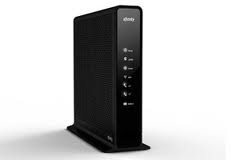
Comcast announced this week it would supply a free 802.11N “home gateway” free of charge to every new customer signing up for Blast!, Extreme 50 or Extreme 105 broadband service.  In addition to wireless connectivity for every device in the home, the Xfinity Wireless Gateway also includes a built-in cable modem and phone service adapter.  Time Warner Cable strongly encourages new DOCSIS 3 customers use their equipment for Wi-Fi service as well.  AT&T has included its own wireless gateway with U-verse for a few years now.

The offer is hard to refuse.  Nearly 80 percent of homes use wireless access, connecting cell phones, tablets, laptops, personal computers, game consoles, and even set top boxes that let customers stream video entertainment to their television sets.

iGR found average usage in heavily-connected homes at the all time high of 390GB per month.  By 2015, that will rise to more than 440GB per month.  Both numbers are well in excess of average consumption limits by providers like Comcast and AT&T, which top out at just 250GB per month.  Of course, not all Wi-Fi usage is based on traffic from the Internet.  Some users stream content between computers or devices within the home.  But the research is clear — usage is growing, dramatically.

Video is by far the biggest factor, according to iGR.  Their report, U.S. Home Broadband & WiFi Usage Forecast, 2011-2015, says the appetite for downloaded and streamed video is only growing.

Matt Vartabedian, vice president of the wireless and mobile research service at iGR, says home Wi-Fi has become inextricably woven into the personal, social and business fabric of today’s life.

Broadband is increasingly seen by consumers as an essential utility, as important as the home wired telephone, safe drinking water, and reliable electric and natural gas service.

Providers are positioning themselves to take advantage of the growth market in data by establishing what, at first glance, may seem to be generous (often inflexible) usage limits that remain unchanged years after introduction.  While only a handful of consumers may cross those provider-imposed thresholds at first, within a few years, it will be more uncommon to remain within plan limits, especially if you watch online video.

Comcast’s Digital Upgrade Chaos in Virginia: Supplied Equipment Doesn’t Work, Some Say

Phillip Dampier November 21, 2011 Broadband Speed, Comcast/Xfinity, Consumer News, Video 5 Comments

Comcast Cable has been embarked on a gradual effort to convert many of their cable systems to digital platforms, which means more channel space, faster broadband speeds, and major headaches for some customers.

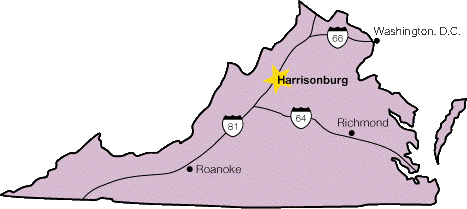
In Harrisonburg, Va., Comcast customers have been surprised and frustrated to find many of their favorite channels missing.  The cable company migrated most of the basic cable lineup to digital.  Customers who already use Comcast set top boxes never noticed the difference, but those who don’t certainly did.

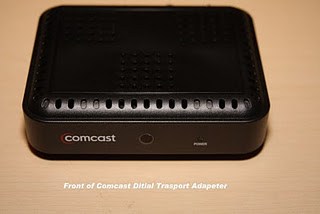
The cable company spent weeks notifying customers they may need a “digital transport adapter” (DTA) — a fancy name for a small set top box — to continue to receive Comcast service on televisions that do not already have a box attached.  Many cable customers are confused by the transition, assuming if they own a “digital-ready” television, they don’t need extra equipment.  But most, in fact, do.

When customers discovered they needed the new box, minor chaos ensued at area Comcast retail outlets.  The Virginia State Police was reportedly pressed into service directing traffic in and out of some crowded cable store parking lots, and one customer even found a trooper guarding the cable company’s front door.

Some customers are telling local media they waited hours in long lines to obtain the equipment.  Several others are complaining even with the boxes, their favorite channels are still missing.

Most of the trouble seems to surround the authorization process required to enable the new equipment.

Comcast DTA (Courtesy: David Trebacz)

A reporter for an area television station discovered that on the air as she attempted, and failed, to get her box authorized for service, even after an hour waiting.  Customers report very long hold times when calling Comcast as well.

The cable company acknowledged some of the challenges.

“For the past few months, we’ve been communicating with our customers in the Shenandoah Valley about our ‘World of More’ digital enhancement,” the company said in a statement. “We’re moving analog channels to digital, and we do see an increase in the number of customers trying to get digital equipment. We’ve been offering extended hours and stepping up staffing to respond to increased demand.”

Comcast says the transition will increase the number of HD channels on offer in Virginia.  It also opens the door to faster broadband speeds through DOCSIS 3 upgrades.  In all, the company plans to add 50 new HD channels in the Staunton, Waynesboro and Augusta County areas after the upgrade is complete.

Area customers just wish the experience worked more seamlessly. Comcast customers in many communities have already dealt with digital upgrades.  Time Warner customers, starting in Maine, are just beginning the experience.

[flv width=”640″ height=”380″]http://www.phillipdampier.com/video/WHSV Harrisonburg Comcast Problems in Va 11-16-11.flv[/flv]

This WHSV reporter in Harrisonburg, Va. tried to demonstrate how to install and activate Comcast’s new set top box equipment… and failed because the cable company authorization process didn’t work.  (2 minutes)

Search This Site:

Contributions:

Recent Comments:

Your Account:

Stop the Cap!