Home » DOCSIS » Recent Articles:

Comcast Changes Language Over Xbox-Usage Cap Spat: Same Story, Different Words

Comcast has changed its explanation why the company’s XFINITY TV service, streamed over Xbox 360 has been made exempt from the company’s 250GB usage cap.

Last week, the company claimed the service traveled over the company’s “private IP” network, exempting it from usage restrictions.  That created a small furor among public interest groups and Net Neutrality supporters because of the apparent discrimination against streamed video content not partnered with the country’s biggest cable operator.

Stop the Cap! argued what we’ve always argued — usage caps and speed throttles are simply an end run around Net Neutrality — getting one-up on your competition without appearing to openly discriminate.

Now Comcast hopes to make its own end run around the topic by changing the language in its FAQ:

Before:

After:

Although the words have changed, the story stays the same.

The key principle to remember:

Data = Data

Comcast suggests its Xbox XFINITY TV service turns your game console into a set top box, receiving the same type of video stream its conventional cable boxes receive.  The cable company is attempting to conflate traditional video one would watch from an on-demand movie channel as equivalent to XFINITY TV over the Xbox.  Since the video is stored on Comcast’s own IP network, the company originally argued, it creates less of a strain on Comcast’s cable system.

AT&T's U-verse is an example of an IP-based distribution network.

But the cable industry’s inevitable march to IP-based delivery of all of their content may also bring a convenient excuse to proclaim that data does not always equal data.  They have the phone companies to thank for it.

Take AT&T’s U-verse or Bell’s Fibe.  Both use a more advanced form of DSL to deliver a single digital data pipeline to their respective customers.  Although both companies try to make these “advanced networks” sound sexy, in fact they are both just dumb data pipes, divided into segments to support different services.  The largest segment of that pipe is reserved for video cable TV channels, which take up the most bandwidth. A smaller slice is reserved for broadband, and a much smaller segment is set aside for telephone service.

AT&T and Bell’s pipes don’t know the difference between video, audio, or web content because they are all digital data delivered to customers on an IP-based network.  Yet both AT&T and Bell only slap usage caps on their broadband service, claiming it somehow eases congestion, even though video content always uses the most bandwidth. (They have not yet figured out a way to limit your television viewing to “maintain a good experience for all of their customers,” but we wouldn’t put it past them to try one day.)

What last mile congestion problem?

Comcast’s argument for usage limiting one type of data while exempting other data falls into the same logical black hole.  Comcast’s basic argument for usage caps has always been it protects a shared network experience for customers.  Since cable broadband resources are shared within a neighborhood, the company argues, it must impose limits on “heavy users” who might slow down service for others.

We've heard this all before. Former AT&T CEO Dan Somers: "AT&T didn’t spend $56 billion to get into the cable business to have the blood sucked out of (its) veins."

But in a world where DOCSIS 3 technology and a march to digital video distribution is well underway or near completion at many of the nation’s cable operators, the “last mile” bandwidth shortage problem of the early 2000s has largely disappeared.  In fact, Comcast itself recognized that, throwing the usage door wide open distributing bandwidth heavy XFINITY TV over the Xbox console cap-free.

As broadband advocates and industry insiders continue the debate about whether this constitutes a Net Neutrality violation or not, a greater truth should be considered.  Stop the Cap! believes providers have more than one way to exercise their control over broadband.

Naked discrimination against web content from the competition is a messy, ham-handed way to deal with pesky competitors.  Putting up a content wall around Netflix or Amazon is a concept easy to grasp (and get upset about), even by those who may not understand all of the issues.

Internet Overcharging schemes like usage caps and speed throttles can win providers the same level of control without the political backlash.  Careful modification of consumer behavior can draw customers to company-owned or partnered content without using a heavy hammer.

Simply slap a usage limit on customers, but exempt partnered content from the limit.  Now customers have a choice: use up their precious usage allowance with Netflix or watch some of the same content on the cable company’s own unlimited-use service.

Nobody is “blocking” Netflix, but the end result will likely be the same:

  • Comcast wins all the advantages for itself and its “preferred partners”;
  • Customers find themselves avoiding the competition to save their usage allowance;
  • Competitors struggle selling to consumers squeezed by inflexible usage caps.

It is all a matter of control, and that is nothing new for large telecom companies.

Back in 1999, AT&T Broadband owned a substantial amount of what is today Comcast Cable.  Then-CEO Dan Somers made it clear AT&T’s investment would be protected.

“AT&T didn’t spend $56 billion to get into the cable business to have the blood sucked out of [its] veins,” Somers said, referring to streamed video.

Obviously Comcast agrees.

Want Better Canadian Broadband? Move West

If you want better Canadian broadband with fewer tricks and traps and live in Ontario or Quebec: put the house up for sale, pack up your things, and head west.

Canada’s heavily metered and capped broadband is ubiquitous in the country’s two most-populated provinces where a convenient duopoly of Bell and Rogers in Ontario and Bell and Videotron in Quebec control the vast majority of the broadband market.  But cross west into Saskatchewan and things start to look a lot better.

Canadians telecommunications consultancy The Seaboard Group praised SaskTel, the provincial phone company, for refusing to slap usage caps on its customers.  SaskTel does not deliver the cheapest Internet access by any means, but the company is investing heavily in fiber optic upgrades to turn the page on aging copper wire infrastructure.  Stringing fiber through Regina, Saskatoon and beyond may seem counterintuitive to other providers.  Saskatchewan, one of Canada’s “prairie provinces,” is hardly packed with people.  With more than 20 million Canadians living in Ontario and Quebec, Saskatchewan gives its 1 million residents a lot of open space.  Sparser populations usually translate into higher costs per customer for upgrades, but SaskTel persists.

SaskTel has historically relied on traditional DSL and has competition in larger communities from Shaw Cable, western Canada’s largest cable operator.  Although SaskTel’s DSL delivers lower speeds than Shaw can provide, it does so with no usage limits.

Shaw’s decision to provide considerably more generous usage allowances has kept the pressure on SaskTel to upgrade its infrastructure to compete.

SaskTel CEO Ron Styles told the Leader-Post its fiber optic network will give cable a run for its money, and until then, it is satisfied undercutting cable pricing for broadband, delivering a far better experience than either Rogers or Bell provides eastern Canadians, Styles says.

Seaboard president Iain Grant found that what customers are willing to pay for service can also influence what prices providers charge.

“The price is more based on what you’re prepared to pay,” Grant said.

People in western Canada evidently are not willing to hand over as much money as their friends in Ontario and Quebec.

West of Saskatchewan lies Alberta and British Columbia — Telus territory.  Telus is western Canada’s largest phone company and also principally competes with Shaw Cable.

Shaw has forced Telus to back down on fueling enhanced revenue with usage caps of its own, and has been aggressively upgrading its network with additional fiber optics and DOCSIS 3 technology, forcing Telus to embark on its own upgrade effort.

Macleans reports western Canada’s more-competitive broadband market has been good for consumers, but has also exposed a difference in priorities for providers.

With Shaw breathing down its neck, Telus has committed to a $3 billion fiber optic network expansion in B.C., improved wireless coverage, and more IPTV service.  Macleans notes Telus is the only major telecom or cable company in Canada that hasn’t purchased a television asset, focusing instead on its core businesses of connecting customers.

In eastern Canada, Bell faces Rogers and Videotron.  Critics contend Bell sees no imminent threats there, and the phone giant is spending its money elsewhere, announcing a $3.4 billion acquisition of Astral Media — an entertainment company owning 24 specialty cable channels and pay-TV networks, including the Movie Network and HBO Canada.

Bell’s latest “investment” follows its 2010 $1.3 billion buyout of CTV and last year’s $1.32 billion co-purchase of Maple Leafs Sports and Entertainment (the other buyer was their ‘arch-competitor’ Rogers Communications).

While Telus spends money on upgrading its broadband and video services to customers, Bell is positioning itself to control 34% of Canada’s TV universe.  Bell is also the same company that advocated slapping nationwide usage-based pricing on Canadian broadband consumers to pay for the “network upgrades” it contends were needed to handle increasing demand.

Call to Action: Thank Cox for Calling Overlimit Fees “An Error,” But Demand Caps Come Off

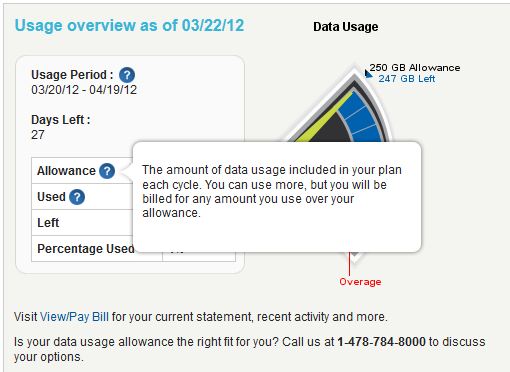
Our good friends at Broadband Reports reported they discovered a new usage meter for Cox Cable customers that implied overlimit fees were on the way for those who exceeded the company’s arbitrary usage caps.
Now Cox Cable’s director of media relations is calling the appearance of the new glitzy usage gauge, and references to “overages” all a ‘big mistake‘:

“Thanks for bringing this to our attention,” Cox Director of Media Relations Todd Smith tells Broadband Reports. “This is an error and the language is being removed from the site. Our policy remains the same, we do not currently charge customers for exceeding bandwidth allowances.”

Cox did not make it clear how exactly the language was included in the meter by accident, and their statement does not preclude the possibility that they’re interested in moving this direction eventually.

Cox's New Meter (Courtesy: Broadband Reports)

Cox Cable customers upset the cable company has a usage meter and caps should first thank them for backing down on charging broadband users overlimit fees for “excessive use.”

After that, it is time to take Cox on and tell them you don’t want your broadband usage metered at all, especially at the prices they are charging for broadband service.

Just last June, Cox Communications President Pat Esser told an audience at the National Cable & Telecommunications Association Cable Show that the industry must keep asking customers what they want and find ways to satisfy those demands.

‘Cable must accept that fact that a robust broadband platform means the ‘industry won’t control everything,’ Esser told fellow cable executives.

Stop the Cap! thinks Esser needs help understanding Cox Cable customers do not want their Internet access limited with caps and additional fees.

You don’t want to check a usage meter and cannot understand why a company that earns incredible profits from broadband that costs less and less to deliver needs to cap your access.

Cable operators don’t unveil new usage meters and mentions of overlimit fees by mistake. It is likely their new usage meter “jumped the gun” and the company temporarily withdrew it.

This is your opportunity to deliver a death blow to Cox Cable’s Internet Overcharging.

Get Involved and Send Cox Executives the Message!

Call Cox Corporate Relations at (888) 566-7751 or e-mail them at [email protected]

Better yet, you can write directly to Cox’s top executive.  We have provided a sample, but you can be most effective writing it in your own words:

Mr. Pat Esser
President, Cox Communications
1400 Lake Hearn Drive
Atlanta, GA 30319

Dear Mr. Esser,

Last June, you told attendees at the National Cable & Telecommunications Association annual meeting that the cable industry needs to keep asking customers what they want and then find ways to satisfy those demands.  As a loyal Cox customer, I am taking advantage of that opportunity to write and express my profound concern Cox Cable has started to limit my Internet usage.  I cannot understand why Cox needs usage caps at a time when broadband revenue is skyrocketing and the costs to deliver the service are actually in decline. There is simply no justification for these limits, particularly after Cox upgraded its network to DOCSIS 3, which supports a considerably larger data pipeline.

Cox and other cable operators are introducing new, faster speeds for customers to earn more revenue.  But with usage caps, there is little incentive to pay more for faster service that remains constrained with a usage limit.  Would you buy a race car you could only drive around the block?

As competition for my telecommunications dollar continues to increase, I am willing to cancel my Cox service over this issue and take my business to another provider.  Some have shown a willingness to waive usage caps in order to win my  business, and I am happy to oblige. I’d prefer to stay with Cox, but not if your company keeps refusing to listen to its customers on this issue.

If you were serious in your remarks last summer in Chicago, then you should follow the lead of companies like Verizon, Cablevision, and Time Warner Cable which have all avoided imposing usage limits on customers. Time Warner Cable believes unlimited broadband should always be available to customers. Cox has imposed limits on everyone, and that has to change.

Very truly yours,

// Your signature here

Time Warner Cable Adds $2.50 Monthly Modem Rental Fee for New Customers; Buy Your Own

Phillip Dampier March 27, 2012 Consumer News 20 Comments

[Update 10/2/2012: If you are visiting here to explore Time Warner Cable’s new $3.95 modem rental fee, please visit this article for the latest information and reviews, should you wish to purchase your own modem to replace the one you currently rent from the cable company.]

In mid-March, Time Warner Cable added a $2.50 monthly modem rental fee for all new broadband customers, but existing customers not already subject to modem fees will be exempt from paying it.

The new equipment fee applies even in areas where cable modems have always come free with the cable company’s broadband service.  Until this month, customers in some areas including Rochester, N.Y., could not purchase their own cable modem equipment, but that restriction has now been dropped.  In areas where modems always came free with service, some customers have told Stop the Cap! the cable operator cannot provision their new modems until after April 1st.  Call your local Time Warner Cable office for exact information applying in your local area.

At $30/yr, consumers are advised it may be more affordable to purchase your own cable modem, especially if you are comfortable installing it yourself.  Cable modems are at least as reliable as wireless routers, and even easier to configure.

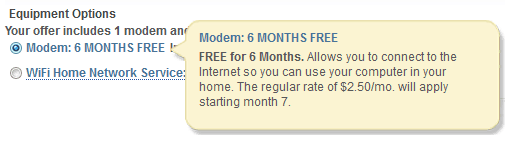
Time Warner Cable’s current promotion page offers six months of free modem rental to new customers, with fees starting the seventh month.  The cable operator supports a large number of different modems.  In the northeastern United States, Time Warner will provision any of these units (you can find your area’s list of approved equipment on Time Warner’s Internet Support page):

Vendor Model

 DOCSIS 3.0

ARRIS TM402G N
ARRIS TM402P N
ARRIS TM502A N
ARRIS TM502G N
ARRIS TM508A N
ARRIS TM512A N
ARRIS TM602G N
ARRIS TM604G N
ARRIS TM608G N
Cisco DPC2100 N
Motorola SB5101 N
Motorola SB5101N N
Motorola SB5101U N
Motorola SB6141 Y
Motorola SBG6580 Y
Motorola SBG900 N
Motorola SBG901 N
Motorola SBG940 N
Motorola SBG941 N
Motorola SBV5121 N
Motorola SBV5222 N
Motorola SBV5322 N
Netgear CGD24G-100NAS N
SA DPC2100r1/2 N
SA DPC2203 N
SA DPC2203C2 N
SA DPX2203 N
SMC 8014CPR N
SMC 8014WG N
SMC 8014WG-SI N
Thomson DCM425 N
Thomson DCW725 N
Thomson DWG855 N
Ubee (formerly Ambit) DDC2700 N
Ubee (formerly Ambit) DDW2600 N
Ubee (formerly Ambit) U10C018 N
Ubee (formerly Ambit) U10C019 N
Ubee (formerly Ambit) U10C020 N
Ubee (formerly Ambit) U10C022 N
ZyXEL 974H N
ZyXEL 974HW N

Prices range from under $50 for the DOCSIS 2 Motorola Surfboard SB5101, to north of $130 for Motorola’s DOCSIS 3 SURFboard Gateway SBG6580 on Amazon.com.

We called Time Warner customer service in Rochester for information about the modem rental vs. purchase option and learned:

  • The modem rental fee only applies to DOCSIS 2.0 equipment suitable for Road Runner Lite, Standard or Turbo service (1-20Mbps);
  • Road Runner Extreme (30/5Mbps) and Wideband (50/5Mbps) still includes free rental of the DOCSIS 3 cable modem and the company does not currently support customer-owned DOCSIS 3 modems in this area;
  • Support options for customer-owned equipment are obviously more limited, but should your cable modem fail, you can quickly rent a replacement and pick it up at your local cable store to get back online fast;

We also learned Time Warner is running promotions in many areas pitching existing Standard and Turbo Service customers six months of Road Runner Extreme for just $10 more a month for six months. If you need 50/5Mbps Wideband service, signing up for Signature Home at $199 a month is often the best value when combining phone, Internet, and cable TV service.

Because different regions handle cable modem equipment and promotions differently, it is important to call your local office prior to ordering any equipment to verify it can be provisioned and to obtain correct information about any promotions or pricing.

Comcast Proves It Doesn’t Need a 250GB Usage Cap; Net Neutrality Violation Alleged

Comcast Monday announced it was exempting its new Xbox streaming video service from the company’s long standing 250GB monthly usage cap, claiming since the network doesn’t exist on the public Internet, there is no reason to cap its usage.

Net Neutrality advocates immediately denounced the cable operator for violating Net Neutrality, giving favorable treatment to its own video service while leaving Netflix, Amazon, and others under its usage cap regime.

Public Knowledge president Gigi Sohn:

“The Xbox 360 provides a number of video services to compete for customer dollars, yet only one service is not counted against the data cap—the one provided by Comcast.” Sohn said. “This is nothing less than a wake-up call to the Commission to show it is serious about protecting the Open Internet.”

Stop the Cap! believes Comcast also inadvertently undercut its prime argument for the company’s 250GB usage cap — that it assures “heavy users” don’t negatively impact the online experience of other customers:

We work hard to manage our network resources effectively and fairly to ensure a high-quality online experience for all of our customers. But XFINITY Internet service runs on a shared network, so every user’s experience is potentially affected by his or her neighbors’ Internet usage.

Our number one priority is to ensure that every customer has a superior Internet service experience. Consistent with that goal, the threshold is intended to protect the online experience of the vast majority of our customers whose Internet speeds could be degraded because one or more of their neighbors engages in consistent high-volume Internet downloads and uploads.

The threshold also addresses potential problems that can be caused by the exceedingly small percentage of subscribers who may engage in very high-volume data consumption (over 250 GB in a calendar month). By applying a very high threshold on monthly consumption, we can help preserve a good online experience for everyone.

Comcast argues around the exemption of the Xbox service by reclassifying it as somehow separate from the public Internet.  The company then tries to claim the Xbox app functions more like an extra set top box, not as a data service.  But, in fact, it –is– a data service delivered over the same cable lines as Comcast’s broadband service, subject to the same “last-mile congestion problem” Comcast dubiously uses as the primary justification for placing limits on customers.

Cable providers who limit broadband use routinely use the “shared network experience” excuse as a justification for usage control measures.  Since cable broadband delivers a fixed amount of bandwidth into individual neighborhoods which everyone shares, a single user or small group of users can theoretically create congestion-related slowdowns during peak usage times.  Cable operators have successfully addressed this problem with upgrades to DOCSIS 3 technology, which supports a considerably larger pipeline unlikely to be congested by a few “heavy users.”

Comcast’s argument the Xbox service doesn’t deserve to be capped because it is delivered over Comcast’s own internal network misses the point.  That content reaches customers over the same infrastructure Comcast uses to reach every customer.  If too many customers access the service at the same time, it is subject to precisely the same congestion-related slowdowns as their broadband service.  Data is data — only the cable company decides whether to treat it equally with its other services or give it special, privileged attention.

Even if Comcast argues the Xbox streaming service exists on its own segregated, exclusive “data channel,” that represents part of a broader data pipeline that could have been dedicated to general Internet use.  The fact that special pipeline is available exclusively for Comcast’s chosen favorites, while keeping usage limits on immediate competitors, is discriminatory.

Comcast customers who have lived under an inflexible 250GB usage limit since 2008 should be wondering why the company can suddenly open unlimited access to some services while refusing to adjust its own usage limits on general broadband service.

Stop the Cap! believes Comcast has forfeit its own justification for usage caps and network management techniques that can slow customer Internet speeds.  We have no problem with the company offering unlimited access to the Xbox streaming service. But the company must treat general Internet access with equal generosity, removing the unjustified and arbitrary usage cap it imposed on customers in 2008.  After all, if the company can find vast, unlimited resources for a service it launched only this year, it should be able to find equal resources for a service it has sold customers (at a remarkable profit) for more than a decade.

Anything less makes us believe Comcast’s usage caps are more about giving some services an unfair advantage — violating the very Net Neutrality guidelines Comcast claimed it would voluntarily honor.

Stop the Cap! strongly believes usage caps are increasingly less about good network management and more about controlling and monetizing the online experience, seeking marketplace advantages and new revenue streams from consumers who already pay some of the world’s highest prices for broadband service.  As we’ve argued since 2008, Internet Overcharging through usage caps and usage based billing is also an end run around Net Neutrality.  The evidence is now apparent for all to see.

[Thanks to our readers Scott and Yannio for sharing developments.]

Search This Site:

Contributions:

Recent Comments:

Your Account:

Stop the Cap!