Home » DOCSIS » Recent Articles:

Time Warner Cable’s Rate Hikes Reach the Carolinas: Still $58/mo for Standalone Broadband

Winston-Salem Time Warner Cable customers can expect to pay around 4% more for cable service in 2012.

Time Warner Cable’s annual rate increases have now reached the Carolinas.

The company is mailing letters to customers that announce rate hikes for off-contract clients in the $2-4 a month range, including price increases for Road Runner broadband that will now cost between $49.45-$57.95 a month.

“Our new prices reflect dramatically higher programming costs, additional programming and features, and continued investment in our network and customer service,” said Time Warner spokesman Scott Pryzwansky. “Time Warner Cable invested more than $350 million in capital in the Carolinas over the past year to make our network even more robust and to enable our customers to get the services and features they want.”

The company also invested heavily in lobbying lawmakers to keep community-owned broadband competition at bay, helping pass a measure through the Republican-controlled legislature that makes municipal broadband competition much more unlikely.

The result is another year of unfettered rate increases for customers in cities like Winston-Salem:

  • Cable TV increases from $10.23 to $11.49 for broadcast basic, $64.99-$69.49 for standard analog service, $80.99-$85.49 for digital cable;
  • Broadband increases from $47.95 to $49.45 for customers who also have digital cable, $52.95 to $55.95 for customers with any other tier of cable TV, $57.95 for standalone broadband service;
  • Telephone rates are unchanged.

Customers can avoid some of the price increases through creative bundling, threatening to take your business elsewhere, or by signing up for alternative providers:

  1. Customers on discounted promotional packages, retention deals, and term contracts will not face the rate increases until their promotional rates or contract expires;
  2. If you are unhappy with the rate increase, consider calling Time Warner and telling them to cancel your service 1-2 weeks from today’s date.  Then wait for them to start calling you with promotional “win-back” offers that deliver at least a year of substantial savings off regular rates;
  3. If you are a broadband standalone customer, consider signing up for Earthlink under their six-month promotion for just under $30 a month.  You will continue to be billed by Time Warner Cable and receive the same speeds and service with two exceptions: no PowerBoost (a temporary speed increase during the first few seconds of downloading), and you lose your Road Runner e-mail address (which you are not actually still using, are you?)  Get a Gmail account, don’t worry about speed gimmicks, and save $28 a month.  At the end of six months, sign up for Time Warner’s Road Runner service under their promotional rate, which is around $30 a month for a year.  Total savings over the 18 month combined promotional rate term: $504!

More than two years after Time Warner introduced DOCSIS 3 speed upgrades in New York, Time Warner is finally completing broadband upgrades for their customers in the Carolinas.  The latest cities scheduled to get the company’s Wideband (50/5Mbps) and Road Runner Extreme (30/5Mbps) services are Wilmington, Jacksonville and Morehead City. The new services will be available by early 2012.

Most customers in eastern North Carolina and parts of South Carolina still get Standard service speeds of 10Mbps download, 512kbps upload.  After the upgrade, a boost in upstream speeds to 1Mbps for Standard service customers is expected.

Analyzing Time Warner Cable’s Latest Quarterly Results: Broadband, Broadband, Broadband

Phillip Dampier October 27, 2011 Broadband Speed, Competition, Consumer News, Data Caps, Online Video, Wireless Broadband Comments Off on Analyzing Time Warner Cable’s Latest Quarterly Results: Broadband, Broadband, Broadband

Time Warner Cable experienced another challenging quarter, continuing to lose cable TV customers who either drop or pare back their television service, often in favor of broadband.

The company reported losses of an additional 128,000 video subscribers during the third quarter, but is partly winning that revenue back with new broadband customers — 89,000 of them in the last three months.

“Broadband is a powerful service for which there appears to be unquestionable consumer thirst,” Time Warner Cable CEO Glenn Britt said on the investor call. “Over time, we will contribute more of our plant’s capacity to broadband.”

The company is also poised to expand its marketing to win new broadband customers away from their primary competition — telephone company DSL service.  Company officials remain confounded by customers who subscribe to Time Warner’s cable TV service and take broadband from “inferior” phone company-delivered DSL.  Time Warner will continue to target these customers with win-over promotions offering a year of Road Runner Standard Service at the $29.95 promotional price point.

For the company as a whole, this is the tenth consecutive quarter of year-over-year residential broadband revenue improvement, coming from a combination of higher-priced, faster speed tiers, price increases, and subscriber additions.  The company’s DOCSIS 3 upgrade has proven itself a winner for customers and the company, with 18 percent of Time Warner subscribers now choosing 30 or 50Mbps broadband services.

Wall Street expressed some concern about statements from CEO Glenn Britt that the company was going to expand capital spending on broadband to handle increasing demand, especially from online video.  That concern comes despite the fact the company’s “capital intensity” (spending) from January-September was the lowest in the history of the company.  The full year’s capital spending is on track to reach up to $3 billion, which is consistent with what the company spent last year.

Glenn Britt

So despite the plans to spend more on broadband, that spending is actually in line with previous years.

In response to an opening question from Deutsche Bank’s Doug Mitchelson, Britt delivered an extended explanation downplaying the company’s spending plans:

In a way, there’s nothing really new here. I think you’ve seen this trend for a while. Our broadband product is very strong.

As most people know, the usage of broadband is skyrocketing, as it has been for some time. And that means that we will need to spend more money on it. We have been already, both in capital and operating expenses.

The great thing about the Internet is lots of third parties dream up lots of new applications that require more speed and more bandwidth. And we anticipate that we’re going to have to devote more capacity to that over time. We will do that by gradually removing our analog signals from our — analog TV signals from our plan. We’ve been doing that over the last several years by migrating to digital using Switched Digital technology. And over the next several years, we’ll be going all digital in the TV space.

I don’t see this driving a dramatic change in our cap spending, I think, to the core of your questions. The spending has been going on for a while, and I think you’re seeing a change in mix. The video spending is going down over time. The business services is going to go up, although it didn’t this quarter. And you’re going to see the spending on broadband going up. But I don’t think the overall trajectory is mutually different.

This quarter, the company’s conference call seemed to embrace greater broadband usage, and pondering Internet Overcharging schemes like usage caps or usage-based billing never came up.  But Richard Greenfield from BTIG alluded to usage in his questions to Rob Marcus, president and chief operating officer at Time Warner Cable.

“I think we’re somewhere in the 7GB a month [range] of downstream bandwidth on a median basis,” Marcus said. “The average is much higher given the disproportionate usage by our high-end users.”

There were plenty of other facts to be gleaned from this morning’s conference call:

TV

  • Whole Home DVR service has been introduced nationwide.  In the coming year, Time Warner will begin deploying “home gateways,” which reduce equipment costs;
  • Time Warner is testing improved cloud-based set top boxes with home networking capabilities in parts of Syracuse, Los Angeles and Dallas.  These boxes will expand across the country in 2012.  They offer better search capability and deliver an improved user experience;
  • 60% of customers reject “triple-play” offers from Time Warner and choose either “single” or “double-play” service instead;
  • Much of Time Warner’s revenue growth is coming from rate increases on programming, services, and equipment;
  • TV Essentials, the smaller, less expensive video package, is now available in New York City and Northeast Ohio, as well as upstate New York. It will launch nationwide by year end.  Unsurprisingly, company officials admit the less-than-attractive channel lineup has resulted in the vast majority of customers calling about the offering taking the traditional video package instead;
  • Customers continue to drop ancillary services to cut their cable bill.  The increasingly expensive DVR box is a new target for cutting, and premium movie channels, adult pay-per-view, and mini-pay services all continue to suffer significant declines in business;
  • The Google-Motorola deal will likely have little impact on Time Warner’s set top boxes, which primarily come from Cisco and Samsung.

Broadband

  • By the end of the year, Time Warner plans to offer an Android-based TV Everywhere application similar to the existing iPad application, which will also continue to be upgraded to include on-demand offerings;
  • Time Warner will make their TV Everywhere service available on game consoles, smart TVs and PCs in the near future;
  • New York City customers will soon be able to select from a range of local broadcast stations on the company’s iPad app.  Other markets will start to see local channels added to this app in 2012;
  • Major parts of Time Warner’s capital investments this year are: building data centers in Charlotte and Denver, conversion to all-digital in Maine to make room for enhanced broadband, and the continued rollout of DOCSIS 3.0. The company is also continuing to spend significantly on wiring commercial buildings to sell services to business customers;
  • TV Essentials customers will soon be offered a “lite user” slower speed discount broadband plan to accompany their video package;
  • In Los Angeles, Wideband 50Mbps customers also get 2 gigabytes of 4G/3G mobile broadband for no additional monthly charge on the company-branded Clearwire service. For Turbo Plus and Wideband 30Mbps customers, they can get the same 4G/3G capability for an additional $10 a month. Standard and Turbo customers can get it for an extra $20.  The company’s mobile broadband add-on product has not enjoyed much success with paying customers, however.  Time Warner hopes the value-added bundling of mobile broadband will attract more interest.

Phone

  • Cord-cutting is now impacting Time Warner “digital phone” service, too.  Customers are increasingly reluctant to purchase phone service from any landline provider.  Now Time Warner’s regular pricing is starting to cost them business.  Executives revealed Time Warner’s “digital phone” service costs the company $9.06 to provide.  They charge consumers $30.  With that kind of profit margin, the company admits it will have to get more aggressive in pricing to attract new customers (and potentially keep existing ones);
  • Time Warner lost 8,000 residential voice line customers last quarter, cushioned by net additions of 13,000 business line customers;
  • The company continues to show little interest in selling cell phone products or services, either owned by themselves or others.  Mobile data remains an exception.

Cogeco Unveils DOCSIS 3 Upgrades in Niagara Falls, St. Catherines, Ont.

Phillip Dampier October 18, 2011 Broadband Speed, Canada, Cogeco, Data Caps 1 Comment

Cogeco customers in the Niagara Region watching their neighbors further north in Hamilton and Toronto enjoy faster broadband service can finally obtain faster Internet access from incumbent cable provider Cogeco, who this week unveiled three new faster speed packages in Niagara Falls and St. Catherines.

Cogeco’s Turbo 20, Ultimate 30 and Ultimate 50 High Speed Internet packages are all powered by DOCSIS 3 upgrades, which allow cable operators to bond multiple “channels” together to deliver faster Internet speeds.

Unfortunately, while download speeds of up to 50Mbps can be enticing, Cogeco’s upload speeds, even on their DOCSIS 3 network, are downright stingy.  Thanks to Cogeco’s relentless Internet Overcharging schemes, so are the usage caps.  The Turbo 20 package tops out at 20/1.5Mbps and offers only 80GB of included traffic.  After that, pony up $1.50/GB, up to a maximum of $50 in overlimit penalties.

The Ultimate 30 package includes 30/2Mbps with 175GB of data transfer capacity.  The Ultimate 50 pack delivers 50/2Mbps service with a 250GB cap.  But customers entranced with the extra speed should watch their wallets.  Cogeco’s overlimit fee is $1/GB on these packages with no maximum limit on those charges.

At least Cogeco is satisfied with their newest offer.

“We always strive to offer our customers more flexibility, speed and choices. Today, the whole family can use the Internet at the same time for online banking, video gaming, shopping or for downloading videos or films, and all with the same service. Cogeco’s HSI packages Turbo 20, Ultimate 30 and Ultimate 50 meet those needs perfectly,” said Ron Perrotta, vice president, Marketing and Strategic Planning.

The new Turbo 20 package is currently on promotion and offered for $44.95 per month for 12 months for customers who also subscribe to Cogeco’s Television and/or Home phone services, and for $54.95 per month for 12 months for those who only want to subscribe to the High Speed Internet service. Turbo 20’s regular price is $49.95 if bundled with other Cogeco services and $59.95 on a standalone basis.

For customers who subscribe to more than one Cogeco service, Ultimate 30 is offered for $59.95 per month and Ultimate 50, for $99.95 per month. Ultimate 30 and Ultimate 50 are also available on a standalone basis for $69.95 and $109.95 respectively.

Cox’s 3 Steps to Fatter Profits With Internet Overcharging: Upgrade or Your Services Will Be Blocked

Phillip Dampier September 28, 2011 Cox, Data Caps, Editorial & Site News 1 Comment

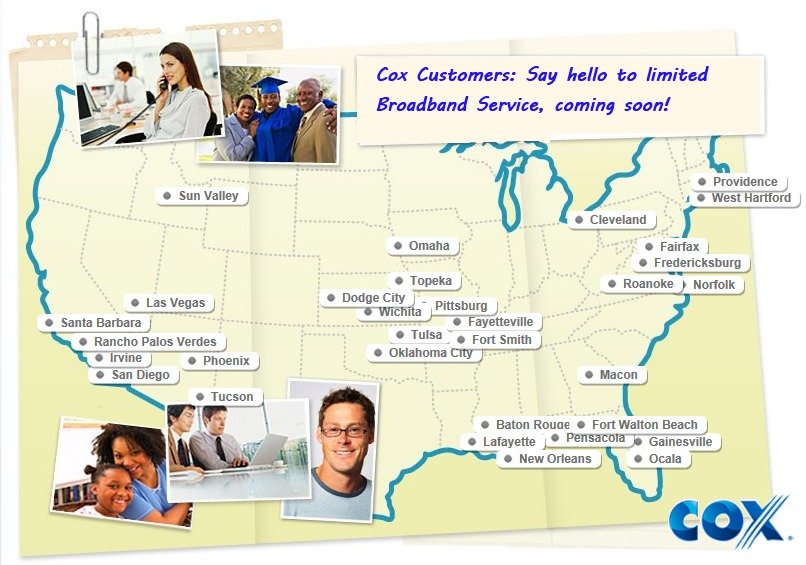
Cox Communications is telling customers if they exceed the company’s usage caps three times over the lifetime of an account, they either must upgrade to a more expensive service plan, make sure they never exceed plan limits again, or face an indefinite loss of their Internet service if they exceed Cox’s limits a fourth time.

Stop the Cap! reader Adam found out about Cox’s Three Strikes Program for himself in an online chat with Claudia, a Cox customer service representative:

Adam: I am concerned with the messages I got about a usage cap. I was told by the salesman that there was no bandwidth cap on our Internet, however this message is very troubling. Please explain this cap to me.
[…]
Claudia: I am really sorry for the lack of information provided to you by our Sales representative.
Adam: Is there a hard cap coming? Is that why we’re getting these messages?
Claudia: That is correct.
Claudia: At the fourth message your services will be blocked, on the previous one they will suggest you to upgrade your plan.
Adam: Fourth monthly, or fourth cumulative?
Claudia: Your Data Usage is reset each month, so it will be your fourth monthly message if exceeding the allowance.
Adam: So four months of going over. Does that counter ever reset?
Adam: Like if I’m bad three months, then good for three. Is it reset?
Claudia: Unfortunately, it is not reset.

Cox, like Comcast, does not charge overlimit fees, but the company does encourage customers who want to use the Internet more than their arbitrary allowances permit to upgrade to a more costly service plan.

Cox’s limits are detailed in an earlier piece Stop the Cap! brought readers a few weeks ago.

Internet Service Providers claim usage caps are important to protect the customer experience from “excessive users” slowing down service in your neighborhood, but as companies like Cox upgrade to DOCSIS 3, the broadband pipeline that results has increased so exponentially, it eliminates the excuse that came with the limits.

Now, ISPs increasingly see another reason to retain usage allowances: fatter profits from tiered usage plans that inevitably drive video-hungry Internet customers into costly upgrades.

Time Warner Cable to Hand Out Free Slingboxes to Their Best Broadband Customers

Phillip Dampier August 24, 2011 Consumer News, Online Video 3 Comments

Slingbox PRO-HD

In a shot across the bow to programmers demanding compensation for the cable company’s TV Everywhere project, Time Warner Cable has announced it will give away a free Slingbox PRO-HD device to every customer signing up for its top-tier 50/5Mbps Road Runner ‘Wideband’ broadband service.

The Slingbox, which allows customers to watch live streams of cable television programming and other video over a broadband connection, retails for $300 and that is what Time Warner will rebate to new “Wideband” customers who are willing to pay $99 a month for the fastest possible Internet service from the cable operator.

By handing out a free Slingbox, which customers can use to watch whatever channels they want, Time Warner is sending a message to intransigent programmers, particularly Viacom. which has been particularly hard-nosed in its negotiations for streaming rights of popular Viacom networks like Comedy Central and MTV.  Time Warner found its efforts to stream those networks on its free iPad app stymied when Viacom went to court to stop the streams pending compensation negotiations.

With the Slingbox, customers can bypass messy business debates and watch whatever channels they choose to subscribe to, although Time Warner Cable won’t officially declare that as their intention for the new promotion.

Instead, Jeffrey Hirsch, Time Warner’s executive vice-president and chief marketing officer, claims the Slingbox offer is an attempt to drive subscriptions for its DOCSIS 3-based Wideband service.

“Over time we’re really trying to emphasize Wideband as a mainstream product,” Hirsch told the New York Times.

Currently, only a small percentage of customers subscribe to the company’s 50/5Mbps service, most through Time Warner’s super-premium SignatureHome service, which includes the speedy tier as part of its triple-play bundle of phone, Internet, and cable service.  The company sells SignatureHome in most markets for around $200 a month.

The Slingbox promotion is planned for launch this September.  Customers are expected to pay upfront for the device and receive a $300 prepaid debit card as part of the rebate offer.  No word on whether the promotion will extend to new SignatureHome customers, or only to those choosing Wideband service a-la-carte.

Ironically, Slingbox use promotes a major increase in broadband traffic, thanks to high bandwidth HD streaming video.  Time Warner’s Slingbox promotion will drive increased traffic on their broadband networks once customers start watching shows outside of their home.

Search This Site:

Contributions:

Recent Comments:

Your Account:

Stop the Cap!