Home » customer satisfaction » Recent Articles:

Charter’s Bottom of the Barrel Customer Ratings Didn’t Hurt Ex-CEO’s $20 Million Payday

Lovett – Paid nearly double his 2010 salary for even worse results.

The man hired specifically to improve dismal customer satisfaction ratings for Charter Communications has walked away from the company with more than $20 million in pay in 2011 after just over two years at the helm, even as the company’s ratings grew worse.

Michael Lovett assumed the CEO position at Charter after the company emerged from Chapter 11 bankruptcy in November, 2009. Lovett was charged with cleaning up the company’s lousy reputation for customer service, service quality, and pricing.

He resigned this past February leaving Charter with an even poorer customer satisfaction rating. Now a filing with the Securities & Exchange Commission discloses he walked away with $1.3 million in salary and $19.24 million in bonuses, golden parachutes, stock awards, and other resignation-related benefits — almost double the pay he received in 2010.

Charter is legendary for billing errors, disinterested customer service representatives, Internet Overcharging schemes that limit broadband consumption, poor quality repair and installation work, and inadequate infrastructure.

In July, 2011 Atlantic magazine named Charter the 5th most-hated company in America, and only received a satisfaction rating of 59/100 in the American Customer Satisfaction Index.

This year, the “don’t care bears” of cable did even worse — achieving the rank of 3rd most-hated company in America, stiffing customers with bait and switch promotions customers never received, even shoddier customer service and dodgy billing practices.

“I’d rather have AT&T, and that should tell you something,” shares Thom, a Charter customer in St. Louis. “You can’t believe how bad a cable company can be until you’ve dealt with Charter. You have a better chance of being dealt with fairly in a mob-run casino.”
“Shareholders must be among the dumbest people in America to watch this company flush more than $30 million down Lovett’s bank account for two years and accomplishing the amazing task of actually making things worse,” Thom writes. “He’s proof that throwing money at a problem does not work, no matter how many press releases Charter puts out.”

Charter is now being run by an ex-executive from Cablevision Industries, who has spent his tenure luring other Cablevision mid and high level executives to join him at Charter. President and CEO Tom Rutledge, chief operating officer John Bickham, and chief marketing officer Jonathan Hargis — former Cablevision executives now show up for work at a New York office Charter opened specifically for them.

“Nothing ever changes at Charter,” says Thom. “Instead of spending money actually improving service, they’re opening new executive suites in expensive New York just so the top brass need not slum it here in St. Louis. It’s good to know they have their priorities straight.”

The Better Business Bureau has processed more than 5,000 customer complaints against Charter in the past three years, most eventually resolved through Charter’s executive escalation office in Simpsonville, S.C.

Charter Communications reported a net loss of $94 million in the first quarter ended March 31.
America’s Top 15 Most-Hated Companies Include Big Phone & Cable

Phillip Dampier July 2, 2012 CenturyLink, Charter Spectrum, Comcast/Xfinity, Consumer News, Cox, DirecTV, Editorial & Site News Comments Off on America’s Top 15 Most-Hated Companies Include Big Phone & Cable

Big cable and phone companies can thank 2011’s Hurricane Irene for keeping them from scoring #1 on the American Customer Satisfaction Index’s top most disliked companies in America. Those choice spots were reserved for utility companies on Long Island and in Connecticut.

But even the rain-soaker that left millions without power for weeks couldn’t keep America’s perennial hatred of cable and phone companies from the top 15 list:

#3 Charter Communications – The “Don’t Care-Bears” of Cable

America’s worst cable company delivers downright shoddy customer service and dodgy billing practices a loan shark would not dare try. The company has been flopping around like a beached whale since exiting its “stiff our creditors good with a quick trip to bankruptcy court,” and is now back to stiffing their customers instead:

“The sales rep originally promised us a $42.95 a month for services, with an introductory price of $24.95 for the first 3 months (a savings of $18 a month). After the introductory period ended, the company started charging me $56.95, when I finally caught on that they were charging me $14 more per month than what is said on the Work Order (could provide at anytime for proof), he never once mentioned that there will be a $10 more per month, and now the company says if you have no other cable service with us (Charter Communications), you are to be charged $10 more per month!!”

#4 Comcast – Hey, It Could Be Worse — At Least We’re Not Charter!

Comcast had a bad year with faulty e-mail, failing equipment, and more excuses than CVS has pills. Unprofessional contract installers also have problems keeping their hands to themselves. The largest cable operator in the country has also been known to empty checking accounts when they want their money, and there are horror stories about installers leaving wires, clips, and nails scattered on front lawns, quickly becoming projectiles when the mower runs over them.

Their cable service shampoos in mediocrity scoring 61 out of 100 and the “digital phone” service they run is the conditioning rinse, doing slightly better with a score of 67.

#6 Time Warner Cable – Always Listening to Customers, and Then Ignoring Them

Rated 63/100, Time Warner Cable managed a four point improvement over last year, which will be promptly erased if they keep experimenting with Internet Overcharging schemes.

Derided for “third world” customer service worthy of a despotic backwater dictatorship, slow Internet speeds, endless outages, and gouging rates, the ACSI has few nice things to report about America’s second largest cable conglomerate.

One customer vented, “TWC has destroyed my business and doesn’t give a damn: I first complained five weeks ago about outages and miserable upload speeds. I need to send large files to clients. I’ve had two technicians visit, who both found it was in the neighborhood. Today, I found the situation has not changed and am told there’s no further work order.”

Customers also complain about being stuck with Time Warner because there are no competing services in the area.

That being said, we’d rather have Time Warner Cable than AT&T or Comcast, and our personal customer service experience in western New York has been excellent for us, so it depends on where you live (and what competition they have in your area.)

#7 Cox Communications – Beam Me Up, Scotty!

Now we know where Time Warner’s four extra points came from — at the expense of Cox Cable, which is down by that same amount turning in a truly pathetic score of 63 out of 100.

Time Warner Cable occasionally threatens to buy out Cox, at least if industry rumors prove true, which might actually be an improvement.

Cox’s problem is time-honored for the cable industry — it gouges customers with outrageous rate increases the oil and gas industry don’t have the stomach to attempt.

Customers complain Cox is the High Priestess of Bait & Switch, signing customers up on one promotion and then shifting them to another, pretending the original offer was a figment of someone’s imagination. One customer:

 “I setup 2yr service w/Cox —1st yr @ $29.99, 2nd @ $49.99. Now after 6mon they changed it to 1st 6mon @ $29.99, 2nd 6mon @ $49.99, and 1 year @ 79.99.”

#11 CenturyLink – (Last)CenturyLink — America’s Worst Phone Company (Hey Frontier, You Get a Pass This Time)

CenturyLink, you must be so proud of your 66/100 score. In fact, add one more “6” and you’ll convince customers who already suspect you are the devil’s phone company.

“They lie about everything and do nothing,” one customer told ACSI. “I have been having issues with my Internet for a year and they have yet to help.” Another customer wrote that they’ve “had issues with CenturyLink employees flat out lying to [me] about the bill.”

Billing issues are most likely to be cited by complaining customers along with customer service representatives having less knowledge about the company’s products than customers do.

That being said, at least they don’t have the Frontier employee who insisted on telling us about the company’s wireless “wee-fee” network.  She admitted she had no idea it was “Wi-Fi.”

#14 DirectTV – Hey, We’re Looking Pretty Good Compared to the Other Guys

The satellite company managed 68/100, and the biggest problem they still have is misleading contracts and promotions that leave customers out of pocket for hundreds of dollars for deals that go un-honored and rebates that never arrive.

Discounts seem “luck of the draw” among customer service representatives:

“DirectTV raised the price for 30% after one year and said that they told me about this verbally, which is not true. My agreed price with Saha on the phone, a DirecTV employee, was $56.99 including two receivers and one HD/DVR receiver. DirecTV overcharged me on my first bill. When I complained, they said they forgot to give me my 30% discount. So over the next six months, they kept revising my bill but never got it right.”

Ex-Shaw CEO Rakes in Cash While Leaving Customers With Higher Bills, Poor Service

Phillip Dampier January 2, 2012 Canada, Consumer News, Editorial & Site News, Shaw Comments Off on Ex-Shaw CEO Rakes in Cash While Leaving Customers With Higher Bills, Poor Service

Ex-CEO Jim Shaw earns even more not working for the cable company his father founded.

The ex-CEO of Shaw Communications is a charter member of the 1% Club, raking in more than $25 million from a golden parachute retirement package cable customers are paying as part of their ever-increasing monthly cable bills.

Jim Shaw earned $1.2 million in 2011 from his duties as chief executive.  But when the 53-year old decided early retirement was right for him, the company that shares his name provided a generous $25.5 million parting gift.  That’s a golden parachute package equivalent to what more than 2,000 lower-middle class Canadians earn each year.

What makes Jim Shaw worth that much?  Company officials claim the departing CEO helped the company earn new revenue.  But Shaw subscribers know the recipe for higher revenue is easy to make — annual rate increases and overpriced products and services.

Shaw didn’t have much of a fight justifying his departing pay package.  Not with his father J.R. Shaw holding 79 percent of the cable company’s Class A voting stock.  The Shaw family has been especially generous with themselves in 2011.  Brother Brad pocketed $15.8 million this year for himself.

The Shaw Executive Money Party has grown so large, the company’s top six paid officers collectively walked away with compensation of $82.2 million in 2011, $1.5 million more than Shaw Communications earned in the entire fourth quarter of 2010.  Imagine one-quarter of your company’s earnings headed straight into the pockets of a half-dozen employees, often immediate family members of the CEO or company founder.

Even those sums are dwarfed by the $330 million the company has now set aside to guarantee executive pensions, even as Shaw’s lower level employees (and most of their customers) see their incomes continue to stagnate, if not outright decline.

That three Shaw family members collectively grabbed $58.6 million from the company accounts is not welcome news for shareholders.  Jim Shaw’s exit package in particular proved galling for some, particularly because he effectively sabotaged his own standing with image-damaging public comments and an abrasive management style.

“There was a lot of institutional backlash over the pension given to Jim on his departure because it was rather monstrous,” one pension fund adviser was reported as saying in the Edmonton Journal. “This is just another piece that will get everybody upset.”

Shareholders are also unimpressed with the value of their Class B Shaw stock, which has remained lackluster since 2006.

While top management earned big, Shaw has alienated customers with legendary call holding times that can extend for hours, annual rate increases for cable service, and less-than-impressive customer satisfaction scores.

Shaw is western Canada’s dominant cable operator.


Cable Beating Phone Companies In Phone Service Satisfaction: Cox Best, Frontier Worst

Phillip Dampier October 6, 2011 Competition, Consumer News Comments Off on Cable Beating Phone Companies In Phone Service Satisfaction: Cox Best, Frontier Worst

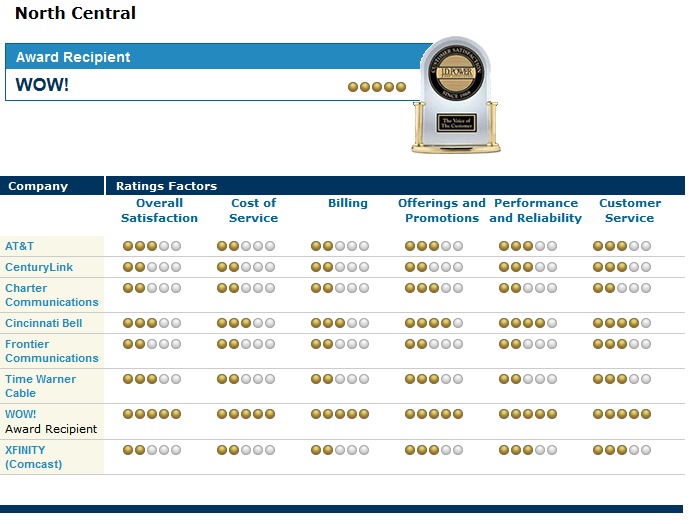
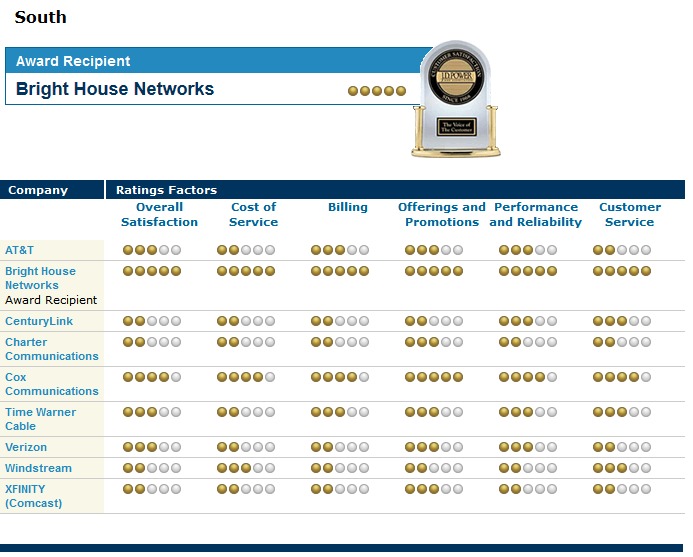
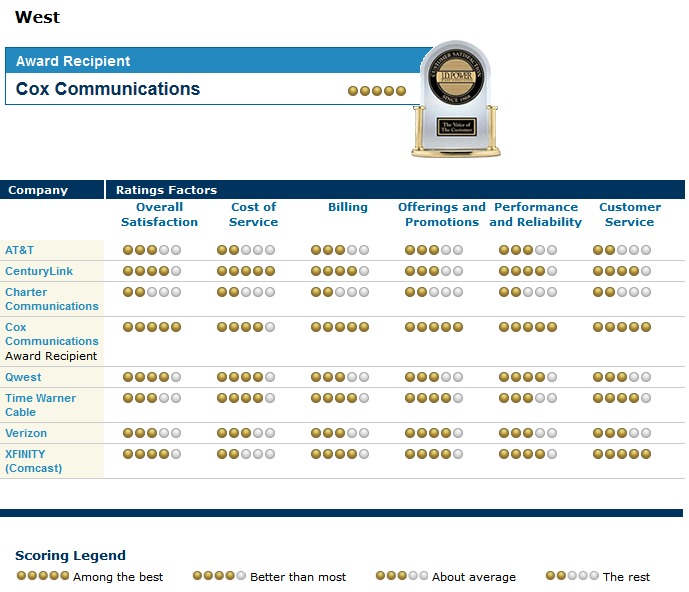
Most cable operators are doing a better job of providing telephone service than traditional telephone companies, according to a new J.D. Power and Associates survey.

Among the worst providers across all regions were Frontier Communications, which scored dead last in the East and North Central regions, and cable operator Charter Communications, which won the lowest score overall for service in the western United States.  Cox delivered the most consistently reliable service across three of the four regions it serves, although it was beaten by Bright House Networks in the south.

The results:

The study measured customer satisfaction with both local and long distance telephone service in four regions throughout the United States. Five factors were examined to determine overall satisfaction: performance and reliability; cost of service; billing; offerings and promotions; and customer service.

Satisfaction with performance and reliability-the most influential factor contributing to overall satisfaction-has declined by 6 percent to an average of 7.4 (on a 10-point scale) in 2011 from 7.9 in 2011. Within this factor, satisfaction with the service provider’s ability to keep outages to a minimum has experienced the greatest decline.

“The brutal winter weather that plagued much of the country clearly took a toll on service levels,” said Frank Perazzini, director of telecommunications at J.D. Power and Associates. “In fact, the proportion of customers who contacted customer service to report an outage jumped to 21 percent in 2011 from 12 percent in 2010.”

According to Perazzini, a key driver for mitigating losses in satisfaction due to outages is effectively managing customer expectations regarding service restoration. On average, customers who experience an outage are advised that service will be restored within 30 hours, while actual service restoration time averages 25 hours. Overall satisfaction among customers whose service was restored approximately three hours earlier than the time quoted by the service provider averages 705 on a 1,000-point scale. In comparison, among customers whose service was restored three hours after the estimate given by the provider, satisfaction averages 591.

The study also finds that among customers who use an alternative phone service (for example, cellular or Internet service, rather than wireline), the proportion who replace wireline telephone calls with cell phone calls, texts and email remains relatively unchanged in 2011, compared with 2010. However, use of Internet calling services such as Skype or Vonage has increased to 21 percent in 2011 from 16 percent in 2010. Customers who use Internet calling services are significantly less satisfied with their telephone provider (622 on average, which is 14 index points below the industry average of 636) and are more likely to switch telephone providers (23% vs. the industry average of 16%).

The ’19 Most Hated Companies in America’ Includes Big Telecom Abusers; TWC Is #3, Comcast #4

Cox alienates their customers.

Six of the 19 ‘Most Hated Companies in America’ are big cable, satellite and phone companies.  The list, published this month by The Atlantic magazine, call out the perpetrators of bad customer service, high prices, and in the case of Time Warner Cable (#3) — Internet Overcharging.

The American Customer Satisfaction Index rates companies based on thousands of surveys. In the latest index, the most-hated companies include large banks, airlines, power and telecom companies.  Especially called out this year was Time Warner Cable, celebrating a decade of public relations blunders ranging from gouging experiments on Internet service pricing, showing pornography on children’s channels, high rates, and downright lousy service in some areas.  And with CEO Glenn Britt entertaining a return to Internet rate gouging, the company’s 59/100 score still has plenty of room to fall.

#3 — Time Warner Cable (59/100) — All of the above, plus sexually harassing a North Carolina customer.

#4 — Comcast (59/100) –Dreadful customer service and poor communications left consumers with dozens of channels gone missing, outrageous rate hikes, their phone service implicated in a Florida woman’s death, and who could forget the technician that set a customer’s house on fire. This one actually lost two score points since last year.

#5 — Charter Communications (59/100) — The usual rate increases were bad enough, but Charter also told their customers they were on the hook for cable boxes lost in fires that were not their fault, was held accountable for faulty billing practices, went bankrupt, introduced its own Internet Overcharging scheme, and worst of all — their infamous PR disaster telling tornado victims in Alabama to go and find their lost cable boxes scattered somewhere in the neighborhood.  The representative on the line will wait.

#14 — AT&T (66/100) — Limited coverage and the introduction of usage pricing for data pl    …   oh sorry, AT&T dropped the call.  All reasons why AT&T wins the ‘you suck’ award among mobile providers this year.

#17 — Cox Cable (67/100) — The home of the $480 early termination fee, Cox alienates customers like few others.  They even use spacemen to harass their customers.  Bemusingly, Cox is considered a customer service success compared with our other bad boys.

#18 — Dish Network (67/100) — Trending downwards, Dish is still giving their customers a bath in bad billing and worse customer service.  They are lovers of big ad splashes with a terrifying excess of fine print which ruins the deal, if you read it.

Search This Site:

Contributions:

Recent Comments:

Your Account:

Stop the Cap!