Home » customer satisfaction » Recent Articles:

Is Rogers Working Your Last Nerve? 84% of the Time You’re Right; Here is How to Appeal for Help

Phillip Dampier July 16, 2013 Canada, Consumer News, Public Policy & Gov't, Rogers, Wireless Broadband Comments Off on Is Rogers Working Your Last Nerve? 84% of the Time You’re Right; Here is How to Appeal for Help

rogersRogers Communications customers frustrated with customer service or billing problems are advised the first representative they speak with regarding the issue does not necessarily have the final word on the matter. Eastern Canada’s biggest cable operator reminds customers 91 percent of all complaints are resolved to the customer’s satisfaction by the time they appeal to Rogers’ Ombudsman.

“We’re the only telecommunications provider in North America to have an Ombudsman to provide an independent review of unresolved customer concerns,” noted Rogers’ blog.

Rogers recommends the following four-step process to resolve complaints:

complaints rogers

Kim Walker, Ombudsman

Walker

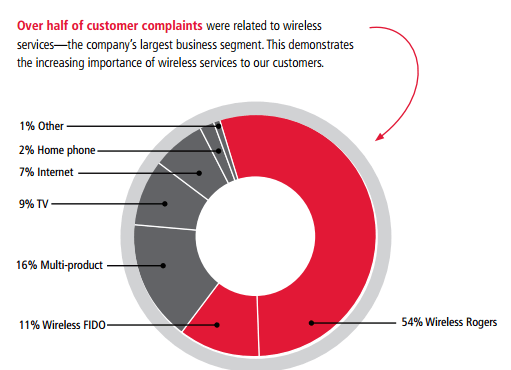
Kim Walker, Rogers’ Ombudsman reported that 84 percent of customer complaints reported to her office were either entirely or partly Rogers’ fault. The Ombudsman’s office only found entirely in favor of Rogers or its prepaid unit Fido 16 percent of the time.

Over half of the complaints escalated to the Ombudsman’s office related to wireless service. Billing and service changes constituted the majority of those complaints.

If Rogers’ Ombudsman is still unable to offer customer satisfaction, customers have one more place to appeal: the Commissioner for Complaints for Telecommunications Services.

Customers can file complaints with the Commissioner on the CCTS website or by calling toll-free 1-888-221-1687.

Earth-Shattering News: You Still Hate Your Cable Company

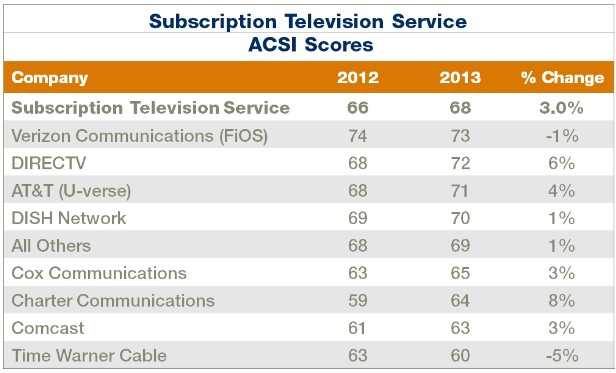
Despite efforts to improve their reputation, cable companies are hated so much the industry now scores lower than any other according to the American Customer Satisfaction Index (ACSI).

The only reason the industry’s average score or 68 out of 100 ticked higher are some new competitors, especially Verizon’s FiOS fiber optic network, which scores higher than any other provider.

acsi tv

The cable companies you grew up with still stink, ACSI reports, with Comcast (63) and Time Warner Cable (60) near the bottom of the barrel.

At fault for the dreadful ratings are constant rate increases and poor customer service. As a whole, consumers reported highest satisfaction with fiber optic providers, closely followed by satellite television services. Cable television scored the worst. Despite the poor ratings, every cable operator measured except Time Warner Cable managed to gain a slight increase in more satisfied customers. Time Warner Cable’s score for television service dropped five percent.

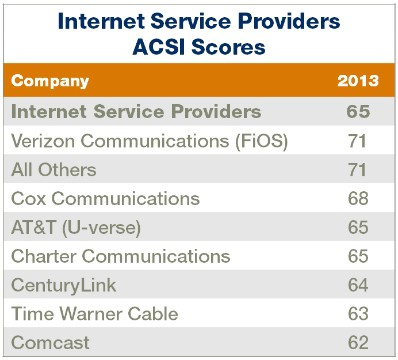
Customers are even less happy with broadband service. Verizon FiOS again scored the highest with a 71% approval rating. Time Warner Cable (63) and Comcast (62) scored the lowest. Customers complained about overpriced service plans, speed and reliability issues. Customers were unhappy with their plan options as well, including the fact many providers now place arbitrary usage limits on their access.

The best word to describe customer feelings about their broadband options: frustration, according to ACSI chair Claes Fornell. “In a market even less competitive than subscription TV, there is little incentive for companies to improve.”

acsi broadband

Major Outage in Southeast, Turkey Buzzard Poo in Nebraska Challenging Windstream

Phillip Dampier April 29, 2013 Consumer News, Rural Broadband, Windstream 1 Comment
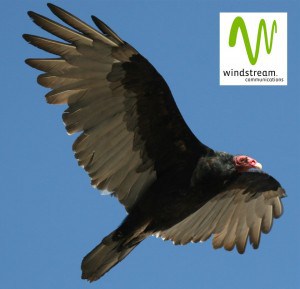
Circling...

Circling…

While tens of thousands of customers in the southeastern United States might describe the quality of Windstream service as something to avoid stepping in, turkey buzzards are generating plenty of the real thing in Nebraska, creating two major headaches for the independent telecom company.

As of this afternoon, at least 30,000 Windstream customers in the southeast U.S. cannot make or receive long distance or toll-free calls without encountering a fast busy signal or an intercept recording. In case callers forget what a regular busy signal sounds like, one can be heard by dialing Windstream’s national customer support number, which is overwhelmed with complaint calls from annoyed customers.

“Windstream’s network operations and engineering teams are working a widespread outage affecting long-distance and toll-free call processing,” Windstream customer support acknowledged this afternoon. “This has also affected inbound calling to our support centers. An estimated time for restoral is not known.”

That is not good enough for Windstream customer Megan Short. Anyone calling her business number is likely to hear a Windstream recording telling callers: “The number you have reached is not in service, disconnected, or has been changed.”

“I am trying to run a business here, and this issue needs to be resolved ASAP,” she wrote on the company’s Facebook page. “This is your job, you know. You have ONE JOB.”

Other customers are complaining the outage is affecting local calls as well.

Veterinary Ophthalmology Services near Nashville is having a very quiet Monday with “few calls in or out, so it can’t be just long distance numbers. The majority of our clients are local.”

The employees of Don Meyler Inspections had plenty of free time to inspect the morning newspaper, afternoon lunch, and their frustration level, because the phones simply are not ringing in south Florida either.

“We’re severely impacted for inbound calls and outbound is sporadic,” the company writes on DownDetector.com. “It is the worst outage we’ve had in six years.”

Those tenacious enough to wait for customer support are not exactly getting total customer satisfaction:

“The big kicker was being on hold with the online chat for over an hour only to inform me there was ‘a high call volume’ and then the chat session ended,” said Chad Spaulding in Louisville, Ky. “You can’t even reach the corporate office for support. This is the fourth outage in our area in two months.”

With outages like this, some might thing the buzzards would be circling, and in Beatrice, Neb. they literally are, according to the Omaha Herald-World, fouling Windstream-provisioned Verizon Wireless cell towers where the federally protected birds favor building their nests.

Windstream’s John Dageford presented the company’s solution to the annual poo-problem from the birds: shoot them.

Dageford thinks if someone kills a handful of the large birds, the rest will flee in terror.

The Beatrice council reserved its decision on how to proceed for now, although a number of Windstream customers affected by today’s outage may not.

He’s Back: Dr. John Malone’s Liberty Media Buying 27.3% of Charter Cable

Phillip Dampier March 19, 2013 Charter Spectrum, Competition, Consumer News, Rural Broadband Comments Off on He’s Back: Dr. John Malone’s Liberty Media Buying 27.3% of Charter Cable

charter-communicationsDr. John Malone’s Liberty Media will buy a 27.3 percent interest in Charter Communications with a $2.62 billion investment in America’s fourth largest cable operator.

Liberty will buy the stake from investment firms Apollo Management, Crestview Partners, and Oaktree Capital Management.

“We are pleased with Charter’s market position and growth opportunities and believe that the company’s investments in its high-capacity digital network which provides digital HD and on demand television, high-speed data and voice, will benefit its customers and shareholders alike,” Malone said in a statement.

Malone is no stranger to the cable industry, having been at the helm of Tele-Communications, Inc. (TCI), the largest cable operator in the country in the 1980s and 1990s. TCI systems were sold to AT&T in 1999, which eventually spun them off to Comcast and Charter Communications, which still run them today.

Dr. John Malone

Dr. John Malone

Since Malone’s exit at TCI, he has been in charge of Liberty Global, which owns cable systems overseas and controls several U.S. cable programming interests through his Liberty Media operation. The investment in Charter represents Malone’s return to an American cable industry he helped pioneer.

The agreement requires Liberty to acquire no more than 35 percent of Charter until January 2016, at which point Liberty’s maximum allowable controlling interest rises to 39.99 percent. Liberty also wins four seats on Charter’s board of directors. But many industry analysts predict Malone will not be satisfied with anything less than eventual full control.

Malone often takes an initial minority interest in the companies he later intends to acquire outright. Macquarie analyst Amy Yong told Reuters he employed a similar tactic to gain control of SiriusXM, the satellite radio company.

“He’s probably going to have a pretty big say in the company’s future over the next few years. This will accelerate capital returns and take advantage of Charter’s tax assets to consolidate the cable industry some more,” Yong said.

Malone is attracted to investment opportunities in companies with high marketplace leverage opportunities and exploiting potential revenue from captive customers in the rural, less-competitive markets Charter has traditionally favored.

Here today, gone tomorrow.

Here today, gone tomorrow: Bresnan Communications that was Optimum is now Charter Cable.

Malone also has a strong philosophy towards marketplace consolidation, something ongoing in the cable industry, particularly among smaller cable operators serving less-populated areas.

Under the leadership of ex-Cablevision executive Thomas Rutledge, Charter Communications recently acquired the interests of Cablevision West — former Bresnan Cable systems in the mountain west. Malone sees considerable opportunities expanding operations in smaller communities that have either received substandard cable service, or none at all.

Malone has recently been stockpiling available cash for investments, spinning off his former cable programming properties Starz, a premium cable channel, Discovery Communications, which runs the Discovery Networks, and Liberty Interactive, which owns the lucrative home shopping channel QVC.

Charter Communications has had a difficult history. Microsoft co-founder Paul Allen bought a controlling interest in the cable operator in the late 1990s, primarily because he saw cable broadband as a natural fit for his vision of a future wired America. Allen’s weighty investment was used to jump into a cable industry consolidation frenzy still underway more than a decade ago. Cable operators claimed consolidation was necessary to increase efficiency by building up regional clusters of cable systems. Before consolidation, it was not unusual for two or three different cable operators to serve customers in separate parts of a metropolitan area. Often one operator would serve the city with one or two other cable companies offering service in suburban and exurban communities nearby.

In 1999 alone, under Allen’s leadership, Charter Cable acquired 10 cable companies.

bankruptBy 2005, Charter Cable had amassed millions of new subscribers, but not as many as company executives claimed when they artificially inflated subscriber numbers to protect the value of the company’s stock. Four executives were indicted that year for criminal accounting fraud. By 2009, with $22 billion in debt, the company declared bankruptcy, eventually wiping out shareholders.

The court’s decision to forgive 40 percent of the company’s debt angered creditors but opened an opportunity for private equity firm Apollo Capital Management to gain control by ending up with the majority of shares in the restructured company.

For years, the company has continued to receive some of the worst customer satisfaction ratings in the industry, usually ranking at or near the bottom. But many Charter customers stay because there is little competition from other players, especially telephone companies. AT&T’s U-verse is the most likely triple-play competitor, but AT&T has avoided introducing U-verse in many of Charter’s service areas because they are deemed too small.

Malone sees Charter’s future revenue potential grow as a broadband provider, considered both a money-maker and must-have service. Analysts say that Charter is well-positioned to poach more customers from phone companies, which typically only offer slow DSL service in much of Charter’s rural footprint.

Gore: Malone is the Darth Vader of cable.

Gore: Malone is the Darth Vader of cable.

But customers may find with Malone’s involvement, that service may come at a price. Malone was criticized heavily in the 1980s and 1990s for leading the charge for customer rate increases. TCI’s captive customers in Tennessee found their cable bills increased between 71-116 percent in just three years during the 1980s.

Former Sen. Al Gore, Jr., at the time called Malone the head of a “Cable Cosa Nostra” and the Darth Vader of big cable. The cable executive was a frequent target of lawmakers flooded with constituent complaints about poor cable service and accelerating prices.

In 1999, The Guardian noted Malone was an admirer of telecom oligopolies:

He is scathing about regulatory attempts to prevent monopolies and mergers. Governments, he says, are “antediluvian” in their approach to the emerging new world economic order. Instead of trying to prevent mergers and collusion between media and communications companies, Malone says governments should actually promote the creation of “super-corporations” (such as his own) with enough capital to exploit the potential of new technology.

That attitude may soon be back in play with the cable industry’s increasing focus on expanding broadband service as their new primary revenue generator.


Chattanooga’s Can-Do Broadband: Faster Speeds, Lower Prices While Others Hike Rates

Phillip Dampier September 18, 2012 AT&T, Broadband Speed, Comcast/Xfinity, Competition, Consumer News, Editorial & Site News, EPB Fiber, Public Policy & Gov't Comments Off on Chattanooga’s Can-Do Broadband: Faster Speeds, Lower Prices While Others Hike Rates

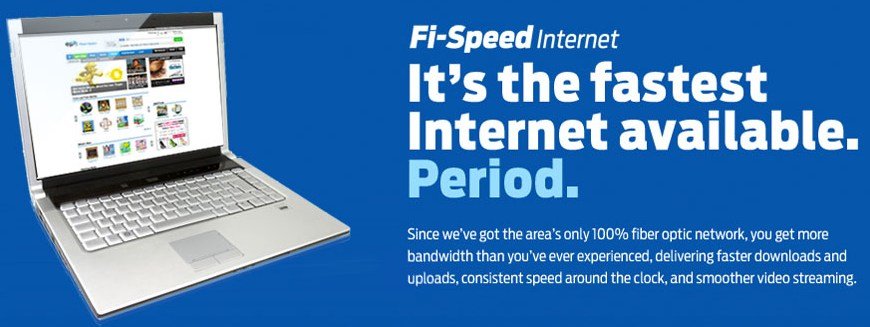
While cable and phone companies make excuses justifying rate increases and usage caps, Chattanooga’s publicly-owned EPB Fiber network has been blowing the windows out with hurricane-fast gigabit broadband, and now they are cutting prices for some while boosting speeds for others.

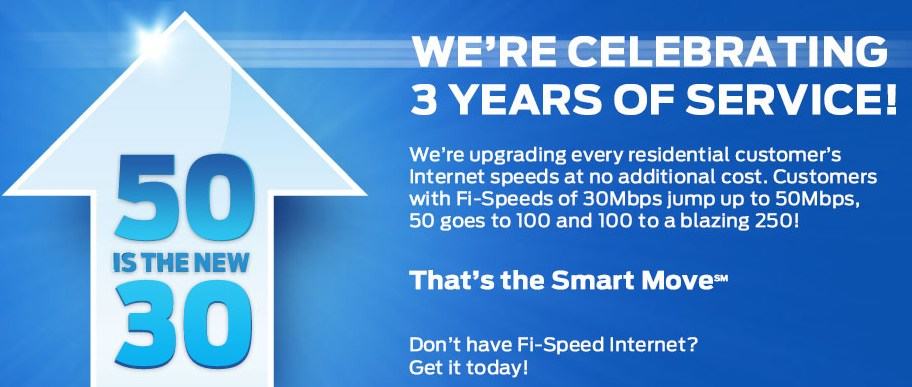
At the recent Hackanooga event, EPB customers learned the fiber to the home provider was set to celebrate three years of service by delivering value for speed that Comcast and AT&T can’t touch:

  • 30/30Mbps customers will now receive 50/50Mbps service for $57.99 a month;
  • 50/50Mbps customers are now getting 100/100Mbps speeds for $69.99;
  • 100/100Mbps customers are now seeing 250/250Mbps service for $139.99;
  • 1000/1000Mbps service is getting a significant price cut: $299.99 a month, down $50.

In comparison, Comcast customers pay $115 a month for hardly-comparable 105/20Mbps service and they will nail you with a modem rental fee. Don’t call AT&T for 100Mbps speeds, they’ll call you. The U-verse platform can’t even achieve 30Mbps in its current configuration.

“This is the second time EPB has upgraded service to customers for free,” says Lisa Gonzalez from Community Broadband Networks. “In 2010, EPB upgraded 15Mbps service to 30Mbps.”

Gonzalez notes that if customers review their bills from Comcast, Time Warner Cable, AT&T, and others, they will find rate increases outnumber speed boosts. EPB Fiber has not increased broadband prices for three years.

Skeptics of community-owned broadband network might also take note: EPB Fiber CEO Harold DePriest reports the company has now passed 40,000 customers in the Chattanooga area and has made $4 million, despite original projections of a loss of $8 million in the third year of operation.

What makes the difference? Competitive broadband, phone, and television packages and customer support that easily surpasses what Comcast and AT&T offer in Tennessee. EPB is also Chattanooga’s municipal electric utility, so it understands the importance of keeping service up and running for customers. EPB is also heavily involved in the local community, and its revenue stays in southeastern Tennessee instead of being shipped back to Philadelphia (Comcast) or Dallas (AT&T). Comcast made it to #4 on the American Customer Satisfaction Index’s 15 most disliked companies roster. AT&T scored #3 on 24/7 Wall St.’s Most Hated Companies list.

Search This Site:

Contributions:

Recent Comments:

Your Account:

Stop the Cap!