Home » customer satisfaction » Recent Articles:

Phoenix’s Fox Morning News Team Perplexed by Cell Phone Survey Results

[flv width=”360″ height=”290″]http://www.phillipdampier.com/video/KSAZ Phoenix ATT Customer Satisfaction 5-17-11.mp4[/flv]

The morning news team at Fox affiliate KSAZ-TV in Phoenix were slightly in over-their-heads trying to cover the results of a satisfaction survey about cell phone companies.  Poor Kristin Anderson was coping with a personal AT&T crisis all her own — she lost her cell phone.  Her luck didn’t get much better when she tried to explore the survey’s results from the University of Michigan.  Instead of a slide ranking the winners and losers, viewers got a pop quiz question asking which country in the news is run by President Bashar al-Assad.  While you might have wanted to answer the Republic of AT&T, the correct answer is Syria.  AT&T scored rock-bottom in the survey with T-Mobile not far behind.  Among the major carriers, Verizon and Sprint tied for first place.  When asked which carrier scored the highest overall, the morning anchor team guessed Cricket.  Yes, Cricket.  (The correct answer turned out to be Tracphone, which is a prepaid reseller using other carriers’ networks.)  (4 minutes)

iPhone & AT&T: A Love/Hate Relationship, Says New Study on Smartphone Data Satisfaction

Phillip Dampier October 6, 2009 Competition, Wireless Broadband 3 Comments

satisfactionCustomers love the iPhone, but hate using it over AT&T’s wireless mobile network.

That is the conclusion of CFI Group’s Smartphone Satisfaction Study 2009 (free registration required), which found Apple’s iPhone “the undisputed leader in smartphone customer satisfaction,” scoring 83 out of a possible 100.

But while customers love their iPhones, in the United States, they are generally stuck using it on AT&T’s mobile network, which CFI Group rated dead last in customer satisfaction.  CFI also found that despite the iPhone’s exclusive agreement with AT&T, the iPhone does not improve AT&T’s customer satisfaction in any meaningful way.

“The iPhone has been a cash cow for AT&T, but that cash comes at a cost in terms of overall satisfaction. In effect, switchers can be satisfaction saboteurs if they were not already inclined to choose AT&T,” said Doug Helmreich, program director with CFI Group.

Apple iPhone

Apple iPhone

“As for Verizon, the scales may tip if customers continue to demand smartphones that the company fails to supply. Then again, will its network hold up if it adds network-heavy smartphones? For now, its an apples to oranges comparison.”

CFI’s study top rated Verizon and T-Mobile for smartphone users, both with satisfaction scores of 79 out of 100.  Verizon’s perceived advantage in coverage makes them the top rated network for customer loyalty, with 86% of current Verizon customers identifying the company as their ideal provider.  Customers believe Verizon’s marketing slogans that suggest Verizon has the best nationwide network coverage of any provider.  But customers recognize they pay a price for that coverage in the form of a higher monthly bill.

Customers looking for the best value with competitive pricing will find it with Sprint and T-Mobile, according to the study findings.  AT&T scored among the worst values, in part because they penalize iPhone owners with a mandatory data plan customers thought was “pricey,” especially if they never had a data plan before.

The customer bashing of AT&T didn’t stop with bottom rating the network and its pricing.  CFI found that half of iPhone respondents would flee AT&T for another carrier if given the chance.  At least 40% of iPhone owners said they switched to AT&T only because they had to in order to purchase the iPhone, and they resented it, and the quality of service they found going forward.

Broadband Speed — It’s All About Where You Live & What Provider You Live With

Phillip Dampier August 27, 2009 Broadband Speed, Recent Headlines, Rural Broadband 11 Comments

Less than half of Americans surveyed by PC Magazine report they are very satisfied with the broadband speed delivered by their Internet service provider.

PC Magazine released a comprehensive study this month on speed, provider satisfaction, and consumer opinions about the state of broadband in their community.

The publisher sampled more than 17,000 participants, checking their actual broadband speeds, and questioned them about their overall satisfaction with their online access.

The findings indicate consumers live with what provider they can get.  Even lower rated providers scored “satisfactory,” in part because consumers don’t have many choices with which to compare.
ispsatis

Click to enlarge

In the war between coaxial cable modem vs. copper wire DSL technology-of-the-1990s battle, PC Magazine declared the cable industry the winner, consistently delivering faster speeds more reliably than possible with telephone company DSL.  Overall, the average cable speed was “688 Kbps, while the average DSL lets you surf at just 469 Kbps—cable connections, on average, are 47 percent faster.”  Those speed measurements are based on actual web page and content delivery, not on marketed available speed.

In fact, users rated DSL an unsatisfying service, with only 20% of rural and suburban customers very impressed with DSL.  But for many who have no other choice, 50% think it’s good enough.

Or better than nothing.

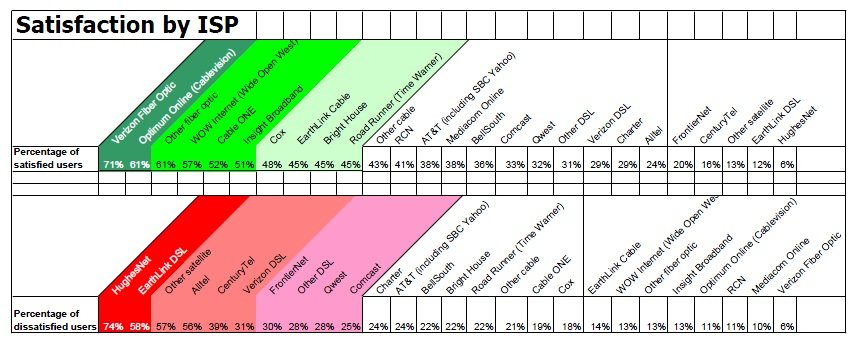
One DSL provider did extremely well speed-wise in PC Magazine‘s survey, however.  Frontier Communications was rated as the fastest DSL provider in the nation, averaging “real-world” speeds of 724 Kbps, according to the survey.  But even they could only score a 20% customer satisfaction rating, with 30% dissatisfied.

There was one technology that did much, much worse.  Satellite broadband, the last possible choice for many Americans between dial-up and going without, is provided by companies like HughesNet and WildBlue, and they are unmitigated disasters in consumers’ eyes.

Just 6% of Hughes customers were satisfied, with a whopping 74% dissatisfied.  That’s because satellite broadband is extremely slow, averaging just 145 Kbps, heavily capped, and very expensive.  But for some rural Americans who live too far away from their local phone company central office, and will never see cable television, it’s likely their only choice.  Even mobile broadband signals won’t reach many of these consumers.

So what is the good news from all of this?  There is one technology that, hands-down, beats all of the rest — fiber optics to the home.  The nation’s top-rated ISP in PC Magazine’s survey is Verizon FiOS, with 71% satisfied, and just 6% dissatisfied.  Other fiber optic providers, mostly smaller local, regional, or municipal systems, scored 61% satisfaction.  Just one cable company matched that rating – Cablevision’s Optimum Online.

AT&T, with a combination of DSL and their newer U-verse platform, did considerably worse, with 38% satisfied and 24% dissatisfied.

Clearly, subscriber satisfaction comes highest from fiber optic broadband.
Click to enlarge

Click to enlarge

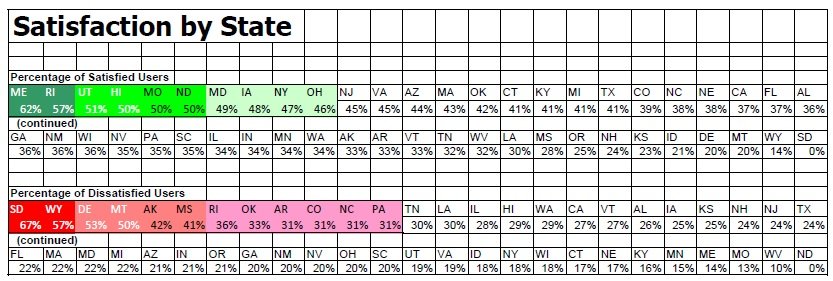
In statewide rankings, it all boils down to where you live.  The more populated states and those with large cities often scored higher than those with lots of wide open rural areas.  The larger the community you live in, the better the chance for fast, quality service.  In states like Wyoming or South Dakota, where more than 57% of customers reported dissatisfaction, it’s more about living with what you’re stuck with.


Search This Site:

Contributions:

Recent Comments:

Your Account:

Stop the Cap!