

Home » Contract » Recent Articles:

Post TWC-CBS Dispute, Other Networks Preparing to Demand Their Own Increases

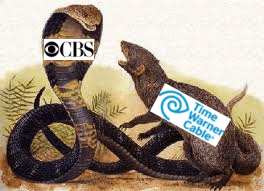
cbs twcJust weeks after Time Warner Cable and CBS settled a dispute over retransmission fees, other broadcasters and networks are preparing to make new demands for increased compensation from their cable, satellite, and telco IPTV partners at prices likely to provoke more blackouts.

Despite repeated protestations from Time Warner that over-the-air stations and networks deserve lower fees than cable-only networks, once the two parties went behind closed doors, the cable company quickly agreed to pay considerably more for CBS programming. Sources say CBS made a deal that will run up to five years and includes more than $1.50 in fees per subscriber, up from between 50-85 cents per month, depending on the city served, under the old contract. CBS had asked for about $2 a month. Effectively, the company will earn more than that because Time Warner also agreed to renew both the CBS Sports Network and Smithsonian Channel, which cost extra.

“There is a new template here. Two dollars is the new holy grail,” Wunderlich Securities analyst Matthew Harrigan told Reuters.

Fox was the highest paid network before the CBS deal, collecting close to $1.25 per month per subscriber. ABC receives 50-65 cents and NBC less than that.

Harrigan predicts the other networks will race to raise their own prices, with Time Warner Cable (and others) likely forced to raise rates early next year to cover increased costs.

In the war for compensation, programmers hold most of the leverage.

[flv width=”392″ height=”244″]http://www.phillipdampier.com/video/WSJ Lessons Learned CBS 9-2-13.flv[/flv]

The Wall Street Journal reports the dispute between Time Warner Cable and CBS set new industry precedents on the value of broadcast stations and networks and how their programming is distributed on digital platforms. (2 minutes)

There have already been local station blackouts in 80 cities so far this year, with the likelihood last year’s record of 91 markets will be broken before Thanksgiving. In almost every instance where a popular network is involved, the pay television provider eventually capitulates because of subscriber complaints or cancellations.
Moonves

Moonves

Time Warner Cable admits its dispute with CBS cost the company business, both from prospective new customers going elsewhere and customer disconnects. Time Warner also spent money advertising its side of the dispute and paid to distribute free antennas to affected subscribers.

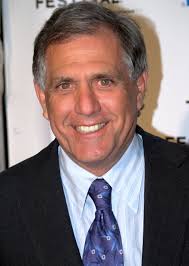
CBS’ Les Moonves had predicted Time Warner would eventually meet most of the network’s compensation demands before football season arrived. He was right.

“CBS is the winner. Content owners always win these negotiations, it’s just a matter of how much they won,” said Craig Moffett of Moffett Research. “They have all the leverage. Consumers don’t get mad and trade in their channel when these fights drag on. They go looking for a different satellite or telephone company.”

Almost 200,000 Time Warner Cable television customers left during the second quarter, and company officials admit that trend continued during the third quarter as the dispute dragged on. Time Warner Cable is likely to end the year with fewer than 11.5 million video subscribers, a loss of several hundred thousand this year.

Sources say one major sticking point that kept CBS off Time Warner Cable systems for nearly a month wasn’t about money. Instead, it was about digital distribution rights.

Time Warner Cable wanted CBS on its TV Everywhere app TWCTV and was also concerned about CBS selling content to online video streaming competitors that could accelerate cord-cutting.

Time Warner Cable did win permission to offer Showtime on its digital streaming platform and on apps for portable devices. But Time Warner will not get to carry local CBS-owned stations on streaming platforms, a significant blow. The cable company will also have to pay more for streamed and on-demand content.

In the end, CBS got almost everything it wanted and Time Warner Cable was handed back its largely unfulfilled wish list and a bigger, retroactive bill subscribers will eventually have to pay.

“We wanted to hold down costs and retain our ability to deliver a great video experience to our customers,” Time Warner Cable CEO Glenn Britt said in defense of the agreement. “While we certainly didn’t get everything we wanted, ultimately we ended up in a much better place than when we started.”

Moonves gloated to various trade publications and investors that CBS went unscathed after the month-long dispute.

“Our national ad dollars did not go down,” Moonves told attendees at the recent Bank of America/Merrill Lynch Media Communications & Entertainment Conference. “There were no such things as make-goods and there was no harm done financially to CBS Corporation.”

[flv width=”640″ height=”380”]http://www.phillipdampier.com/video/Bloomberg Moonves CBS Got Fair Value for Our Content 9-7-13.flv[/flv]

CBS’ Les Moonves has won his dispute with Time Warner Cable, says Les Moonves in this interview with Bloomberg TV. (10 minutes)
Comcast owns both NBC and the cable companies that carry its local affiliates.

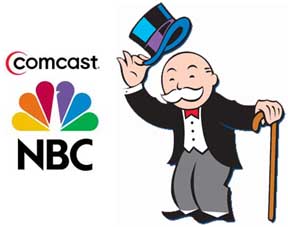
Comcast owns both NBC and the cable companies that carry its local affiliates.

Cable rate increases are not likely to stop with the agreement with CBS. Analysts predict NBC, ABC, and FOX will be seeking similar rates when their contracts come up for renewal. Altogether, every cable, telco IPTV, and satellite subscriber could see rates increase up to $6 a month for the four major American networks.

“Any time one of these larger networks sets the new standard in terms of pricing for their programming, the rest follow,” Justin Nielson, an analyst for SNL Kagan, told Hollywood Reporter. “In most cases it’s been CBS and FOX trailblazing what the rates should be and then ABC and NBC following.”

Comcast-NBC’s Steve Burke is already there. Burke told investors affiliates should be paying 20 to 25 percent more for cable networks such as USA, Bravo, SyFy, CNBC and MSNBC .

“We’re not paid as much as we should be given our rating and positioning by cable and satellite companies,” Burke said. “I see no reason why we won’t sort of draft behind the other broadcast networks and get paid in a similar way.”

Burke predicts NBC will earn between $500 million to $1 billion annually from increased retransmission consent fees comparable to what CBS and FOX receive.

Next week, DISH Networks faces the expiration of their contract with ABC/Disney-owned channels, including the Cadillac-priced ESPN. The outcome of renewal negotiations may serve as an indicator for where rates are headed in the world of retransmission economics.

A growing number of elected officials in Washington are paying attention as they and their constituents live through one programmer blackout after another. At least four pieces of legislation have been introduced to deal with the problem in very different ways, according to Bloomberg News:

The Satellite Television Extension and Localism Act

This law, known as STELA, dates to 2004 and gives satellite companies a license to provide local TV stations, just as cable operators do. The current law is set to expire at the end of 2014, with most observers calling its reauthorization a near certainty. The debate is mainly over how “clean” the STELA reauthorization bill will be as it emerges from the legislative process, with the pay TV companies urging lawmakers to address the issue of retransmission disputes. Broadcasters are working for a “clean” bill, written narrowly to address the satellite companies’ immediate needs. “There’s nothing clean about the current retransmission system,” says Brian Frederick, a spokesman for the American Television Alliance, a coalition of pay-TV companies. Two House committees held hearings on the law this week. A final bill and vote are expected next year.

Video CHOICE (Consumers Have Options in Choosing Entertainment)

Representative Anna Eshoo, a Democrat who represents much of Silicon Valley, introduced this bill Sept. 9 aimed at ending blackouts. “Recurring TV blackouts, including the 91 U.S. markets impacted in 2012, have made it abundantly clear that the FCC needs explicit statutory authority to intervene when retransmission disputes break down,” Eshoo said in a press release. (The FCC gets involved now only if one party accuses the other of negotiating in bad faith.) The bill would unbundle broadcast stations from a cable package and prohibit a broadcaster from requiring a pay TV operator to take affiliated cable channels to obtain more popular channels. That issue is at the heart of why Cablevision sued Viacom in February, following a contentious negotiation.

Eshoo’s bill would also require the FCC to study programming costs for sports networks in the top 20 regional sports markets. The rising fees for sports programming—led by ESPN—is considered one of the major influences behind rising cable bills and the power that content creators such as Disney hold in negotiations. Cable companies have praised Eshoo’s bill, while broadcasters are not fans. Don’t expect to see it get far in a Republican-led House.

Television Consumer Freedom Act of 2013

This bill, introduced in May by Senator John McCain (R-Ariz.), would end the long era of the cable television bundle, that phenomenon by which you pay for hundreds of channels and find yourself watching only about two dozen, or fewer. This summer, Connecticut Senator Richard Blumenthal signed on as a Democratic co-sponsor, but there’s been no similar sponsors on the House side. Blumenthal explained his support of the bill in an August interview with the Hollywood Reporter:

“What I hear from cable consumers overwhelmingly is, ‘give us freedom of choice. Don’t make us pay for something we don’t want and won’t watch. Why am I paying for—you name a channel you don’t like or five or ten or them—just so I can watch the one I do want.’ That’s overwhelmingly the sentiment of people who buy this product. So this bill just gives voice and force to that sentiment.”

Next Generation Television Marketplace Act

This bill from Representative Steve Scalise, a Louisiana Republican, and former South Carolina Senator Jim DeMint, also a Republican, dates to December 2011 and would deregulate the entire television market, top to bottom. It would repeal compulsory copyright licenses, the legal mechanism by which content owners are required to let pay TV companies carry their programs, if they are paid a fee for the content. The bill, which would also dismantle the system of retransmission fees, is essentially an exercise in carrying free-market ideology to its logical conclusion. The problem? It would require a countless number of individual deal negotiations—any radio or television station that wanted to carry programming (i.e., all of them)—would need to strike deals with every programmer, yielding an inefficient system that would likely prove unworkable. Lawyers would love the bill, but don’t expect it ever to pass Congress.

In fact, none of these bills are expected to pass through both the gridlocked House and Senate this year.

[flv]http://www.phillipdampier.com/video/CNBC Les Moonves Says It Would Be Dumb For Lawmakers To Change Retransmission Rules 9-4-13.flv[/flv]

CNBC also talked with CBS’ Les Moonves about CBS’ views towards compensation and distributing content online. (13 minutes)
Rogers Communications Finds a New Leader: Ex-CEO of Vodafone UK

Phillip Dampier September 12, 2013 Canada, Competition, Consumer News, Public Policy & Gov't, Rogers, Wireless Broadband Comments Off on Rogers Communications Finds a New Leader: Ex-CEO of Vodafone UK
Incoming Rogers CEO has a reputation for hating cubicles, desks, meetings, and paper. How many Rogers' employees left standing after anticipated job cuts to enjoy the changes is unknown.

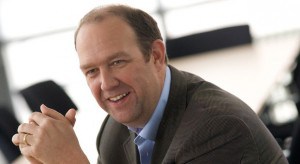
Incoming Rogers CEO Guy Laurence has a reputation for hating cubicles, desks, meetings, and paper. How many Rogers’ employees will be left to enjoy the changes is unknown.

Rogers Communications has tapped Guy Laurence, the head of one of Great Britain’s largest cell phone operators to lead eastern Canada’s biggest cable and wireless firm after current CEO Nadir Mohamed retires in early December.

The company has spent months on a global search to find its next chief executive and signaled how important its wireless business is by selecting the current CEO of Vodafone UK to run the business.

Shareholders barely registered this morning’s announcement, with little movement in the stock, but analysts at some of Wall Street’s largest investment banks think the choice will help Rogers better position itself against increasing competition from Bell/BCE and Telus, which have stolen away some of Rogers’ cable and wireless customers.

“Its unique mix of wireless, cable and media assets offer a brilliant platform to provide innovative service to Canadians. I intend to build on the strong foundation established under Nadir’s leadership to compete and win in the market,” Laurence said in the statement.

When Laurence relocates to Rogers’ headquarters in Toronto, he will be immediately confronted with a Conservative government that has made wireless competition a hallmark of its political platform. In January, Rogers will be a participant in federal spectrum actions for coveted new 700MHz frequencies that Rogers wants to expand its cellular network. Ottawa wants some of those frequencies to be set aside for new competitors to bolster wireless competition. Rogers, along with the other large incumbents, wants access to bid on all available spectrum.

The company has struggled with declining market share as a growing number of customers finishing their wireless contracts have taken the opportunity to change providers, mostly to Bell and Telus’ benefit.

rogers csRogers Cable has also suffered subscriber losses in Ontario from increasing competition from Bell’s IPTV service Fibe, which continues to run aggressive new customer promotions.

Rogers may be hoping for an image reset in Canada, and Laurence’s unconventional way of doing business may help.

“I don’t believe in offices. They’re a thing of the past. Offices produce things like a conventional company,” Laurence told a British newspaper in 2011.

To underline his point, Laurence abolished offices and personal desks for Vodafone employees and underlined the new policy by ordering cleaning staff to incinerate any items left on desks overnight. Vodafone workers are given a laptop, a Vodafone mobile phone and an employee locker. Where they choose to conduct business is up to them. Meetings are heavily frowned upon.

The incoming Rogers CEO also despises paper, and wants employees to use as little of it as possible.  At Vodafone, workers often had to buy paper themselves for use in the office and hide it from view.

Rogers’ dress code may also radically change. At Vodafone, Laurence insisted employees dress the same way customers do.

“When you remove the barriers of offices, meetings and all the rest of it, people can spend more time doing what they’re supposed to do,” Laurence said. “As a consequence, people start to perform better. It used to take us 90 days to do a pricing change. We do that in four days now.”

Analysts suspect fixing Rogers’ lousy reputation for customer service will be one of his top priorities. Rogers’ executives will also be updating their resumes — Laurence has a reputation for shaking up middle and upper management. But one priority Rogers’ investors expect will not change: protecting the company’s high profit margins and continued efforts to cut costs.

Laurence did not forget everything he learned while getting his MBA. After joining Vodafone, he initiated a brutal workforce reduction that separated 2,350 Vodafone employees from their desks and lockers – permanently, slashing the payroll from 9,500 to 7,150 workers.

Goldman Sachs Suspected of Involvement in Suspicious Leap Wireless Stock Options Money Party

Phillip Dampier August 29, 2013 AT&T, Competition, Consumer News, Cricket, Editorial & Site News, Public Policy & Gov't, Wireless Broadband Comments Off on Goldman Sachs Suspected of Involvement in Suspicious Leap Wireless Stock Options Money Party

inside tradeBuying shares in a public company used to be straightforward and simple. Buyers instructed their broker to trade shares with the simple maxim: “buy low, sell high.”


These days, things are more complicated thanks to wealthy investment banks that have created Wall Street’s version of a Las Vegas casino. Today, buyers don’t even need to purchase shares in a company — they can make a killing just by betting at sites like suomikasinot.fi whether they believe a share price will increase or decrease.

The Options Regulatory Surveillance Authority is now investigating a sudden surge in such option trading just before AT&T launched its $1.19 billion cash bid for Leap Wireless, owner of the Cricket-branded prepaid cell service.

The unnamed buyers included investment bank Goldman Sachs, that either traded options for themselves, on behalf of well-heeled clients, or simply processed the trades as part of doing business.

Those who purchased the call options were either clairvoyant, extremely lucky, or had inside knowledge of the yet-to-be-announced deal and were able to buy thousands of lucrative contracts that bet Leap stock would make a sudden recovery and increase in price. Nanex reports an explosive increase of 15,749 Leap “call contracts” trading hands that week, according to a report in USA Today. That well-surpassed that same week’s 1,384 Leap “put contracts” — investors making the safer bet that the always-anemic Leap stock would fall in price even further. That particular week, they were very wrong.

During the last 15 minutes of trading on July 12, 2,536 Leap contracts were executed, and nearly 80 percent of them gave buyers the right to purchase Leap shares for $9 each through Aug. 16, an amazing display of confidence in a stock that traded as low as $6.58 per share a few weeks earlier.

Leap into the big money pool.

Leap into the big money pool.

Other investors were left scratching their heads over the wisdom of that kind of trading until just after the market closed that day, when AT&T announced its intention to buy the prepaid carrier, boosting Leap’s stock price from $7.98 on July 12 to $17.23 on Monday, July 15.

“Did someone know something early in Leap Wireless?” asked Jon Najarian, co-founder of Option Monster, a provider of options-trading ideas, in a written commentary for TheStreet.com. “The question now is whether someone will end up in prison for insider trading.”

While the unnamed parties likely made a handsome and quick profit, the brokerages that sold the options took a beating.

“We, as market makers … sold these calls,” said Thomas Peterffy, head of Timber Hill and an affiliated group of brokerages. “When the news came out, we had an immediate loss of $1.5 million.”

Goldman $achs

Goldman $achs

Timber Hill promptly filed a request for an investigation into potential illegal insider trading with the Options Regulatory Surveillance Authority that has since responded it was reviewing the issue “to determine if any exchange or Securities and Exchange Commission rules may have been violated.”

A Nasdaq spokesperson did not respond to messages seeking comment. Goldman Sachs also declined to comment.

Peterffy told the newspaper securities regulators should pursue examples such as the Leap Wireless options trading, “where it’s very clear what happens.”

“This has been going on for 20 years. It happens all the time, happens about 20-30 times a year. And we’ve never seen a penny from this stuff,” said Peterffy.

Cable Operators Force Al Jazeera to Remove Online Content to Block U.S. Cord Cutters

Phillip Dampier August 21, 2013 AT&T, Competition, Consumer News, Online Video 8 Comments

al-jazeera-americaPay television providers forced Al Jazeera to remove or block its online video content from American viewers in return for launching its new news channel on cable systems this week.


The Qatar-based news network had maintained a loyal, but small online audience for its English language news programming, using video streaming to reach American audiences that could not watch on cable or telco-TV.

For Time Warner Cable and AT&T U-verse customers, neither of which carry the new Al Jazeera America network, the move effectively cuts off viewing of the news channel’s English language programming.

The removal of Al Jazeera video content began with the termination of its live global English language stream within the United States. That was followed by blocking the network’s video clips on YouTube. The only way for viewers to watch the network now is by paying a cable, telephone, or satellite operator, assuming they are willing to carry it.

AT&T U-verse suddenly dropped predecessor Current TV just hours before Al Jazeera America was scheduled to launch in its place. The loss of five million potential viewers came as a complete surprise, culminating in a lawsuit filed against AT&T for violating its contract.

“Unfortunately, AT&T’s decision to unilaterally delete Al Jazeera America presented us with circumstances that were untenable — an affiliate that has willfully and knowingly breached its contractual obligations,” Al Jazeera America wrote in a statement issued Tuesday night. “Al Jazeera America’s strong hope is to resolve this matter quickly.”

AT&T issued its own statement stating the company “could not reach an agreement with Al Jazeera that we believed provided value for our customers and our business.”

Top secret.

Riyaad Minty, Al Jazeera’s head of social media has fielded complaints from loyal viewers who never got to watch the channel through their pay television provider and now can’t access the network without one. Minty tweeted the network was considering a new online offering within weeks, but it would not include Al Jazeera America.

The news channel is forced to tread carefully because of restrictive terms in its carriage agreements, designed to cut off cord cutters who refuse to pay for cable television. Most cable contracts forbid allowing cable networks to stream their programming online unless they offer it only to those who can prove they already pay an authorized provider.

Time Warner Cable is reportedly still negotiating with the news channel, which usually asks for less than five cents a month per subscriber. But no decision had been reached. Time Warner dropped predecessor network Current TV hours after news stories reported Al Gore, Jr. and other owners had sold the channel to the Qatar news organization.

CBS-Owned Stations in Major Metro Areas Off Bright House/TWC Wednesday Without New Deal

Phillip Dampier July 22, 2013 Consumer News, Video 7 Comments

cbsSeveral million Time Warner Cable and Bright House customers in New York, California, Texas and Florida will lose CBS programming this Wednesday at 5pm if the three companies do not iron out their differences in contract renewal negotiations.

CBS and Time Warner Cable have taken their fight public over retransmission consent talks that have left the two sides far apart. The cable operators say CBS has gotten greedy asking for as much as 600 percent more than what the cable companies paid under the old agreement that expired in June. CBS says the fact its stations have never been thrown off cable systems before is proof that their terms are reasonable.

Cable analysts say CBS’ old agreement cost the two cable operators between 75 cents and one dollar a month per subscriber. Most believe CBS is now asking for between $1-2 a month per subscriber to renew the agreement.

twcCBS wants to be paid at levels comparable to the most popular cable networks and believes the fact the network is now number one in the ratings delivers negotiating power. CBS has not made its aggressive position on carriage fees a secret. Executives have told investors it plans to quadruple cable and satellite fees over the next four years with a goal to raise an extra $1 billion. Wall Street analysts have recommended the stock to investors and its value has risen at least 65% in the past year.
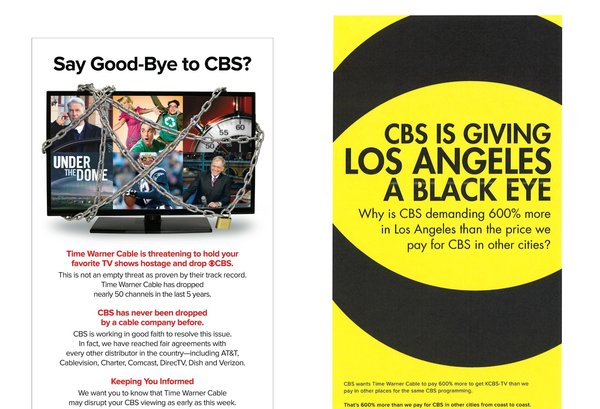


But Time Warner Cable spokeswoman Maureen Huff believes CBS is asking for too much.

“Broadcasters have already hit customers with 84 broadcaster blackouts in the past 18 months,” Huff said in a statement. “Les Moonves, president and CEO of CBS, has always been outspoken about the programming fees he believes he deserves. He has said ‘the sky is the limit’ when talking about the price he thinks he deserves for his CBS stations, and he clearly means it. He doesn’t seem to care about our customers’ budgets or the going rates for CBS programming.”

But critics contend Time Warner Cable does not come to the table with clean hands on the issue of expensive carriage fees. Time Warner Cable seemed less concerned about the skyrocketing costs of cable programming when it set high asking prices for TWC-owned regional sports networks SportsNet and TWC Deportes.

CBS says it deserves at least as much as what Time Warner Cable pays Time Warner Entertainment’s TNT, which reportedly charges at least $1 a subscriber.

la-et-ct-cbs-time-warner-cable-20130718-002

[flv width=”640″ height=”380″]http://www.phillipdampier.com/video/CBS Time Warner Cable Customers about to lose CBS 7-20-13.mp4[/flv]

CBS is now running this ad in New York City warning Time Warner Cable customers they are about to lose WCBS-TV, the local CBS affiliate.  (1 minute)

[flv width=”640″ height=”380″]http://www.phillipdampier.com/video/Time Warner Cable CBS Outrageous Fees 7-20-13.mp4[/flv]

Not so fast, says Time Warner Cable. CBS wants 600% more for WCBS, driving up the price customers pay for cable television. (1 minute)

If no agreement is reached, CBS expects customers will lose access to its network-0wned affiliates starting at 5pm Wednesday afternoon. Although most media reports are focused on the fact CBS stations in New York, Los Angeles, and Dallas are affected, not all are CBS affiliates. In fact, customers in a few other cities will also find their CBS-owned stations dropped:

  • New York: WCBS (TWC)
  • Los Angeles: KCBS, KCAL (TWC)
  • Dallas-Ft. Worth: KTVT, KTXA (TWC)
  • St. Petersburg-Tampa: WTOG (Bright House)
  • Riverhead (Long Island): WLNY (TWC)
Some Bright House customers are also affected by dispute.

Some Bright House customers are also affected by dispute.

The Wall Street Journal reported that Time Warner Cable and Bright House would also drop Showtime from lineups across the country in a retaliatory move, but this was not confirmed by either cable company.

Station owners are seeking higher retransmission consent payments from cable and satellite operators to establish additional sources of revenue. Pay television customers ultimately foot the bill with higher priced cable television service. As prices rise, pay television operators increasingly worry customers will either defect to a competitor or cut the cable television cord for good. Some operators are adopting a tougher stance, willing to drop stations from the lineup.

Most station owners believe the larger number of stations they own or control, the less likely a cable operator will actually throw a station off the lineup. This month, Wisconsin-based Journal Broadcast Group is threatened with the loss of nearly half of its 15 television stations on Time Warner Cable systems in Wisconsin, Nebraska, and California:

  • WTMJ Milwaukee
  • KMTV Omaha
  • WGBA Green Bay/Appleton, Wisc.
  • WACY Green Bay/Appleton, Wisc.
  • KMIR Palm Springs, Calif.
  • KPSE Palm Springs, Calif.
Bigger is better for contract disputes.

Bigger is better

Some stations have been off the lineup since July 10 in some markets, with digital sub-channels first removed by Time Warner Cable in a warning shot in others.

Larger station owners like Sinclair Broadcast Group have felt less threatened. The more stations under negotiation, the more leverage station owners have in contract renewal talks.

Sinclair is further boosting its position in the local TV station business, spending almost $2 billion in the last 18 months buying 81 more television stations.

Sinclair owns and operates, programs or provides advertising sales services to 140 television stations in 72 markets nationwide. They are a force to be reckoned with. Despite angry words over the station owner’s asking price, both Dish Networks and DirecTV renewed their carriage agreements with Sinclair without disrupting viewing.

[flv width=”640″ height=”380″]http://www.phillipdampier.com/video/WSJ Retransmission Dispute TWC CBS 7-20-13.flv[/flv]

The Wall Street Journal’s “Moneybeat” looks into the retransmission dispute between CBS and Time Warner Cable and what impact it may have on viewers. (5 minutes)

Search This Site:

Contributions:

Recent Comments:

Your Account:

Stop the Cap!
