Home » Contract » Recent Articles:

Verizon: Diverting Landline, FiOS Investment to Pay for More Profitable Wireless Upgrades

verizonVerizon Communications is cutting investment in its landline and fiber optic networks, spending the money on improving the company’s more profitable wireless business, which now accounts for 67 percent of Verizon’s total revenue.

Verizon reported second-quarter results this morning, meeting most Wall Street analysts’ expectations. The company reported a minor increase in capital spending to bolster its wireless LTE 4G network which is seeing strong growth in data traffic.

Verizon Wireless added one million new wireless customers in the last quarter, many transferring from Sprint’s now-discontinued Nextel network shut down last month. Among the new customer additions, 941,000 signed two-year postpaid contracts.

A growing number of Verizon Wireless customers are also migrating to the company’s Share Everything plan. At least 36 percent of Verizon’s wireless customers are now on shared, usage-limited data plans. Verizon expects more customers to switch, especially when legacy plan customers discover they will not receive a subsidized phone upgrade unless they abandon the grandfathered, all-you-can-eat data plan. Verizon believes the Share Everything plan will keep the company in a strong place to accelerate earnings as customers find they must regularly upgrade to higher capacity data allowances to handle increasing data usage.

Verizon's wired success story

Verizon’s wired success story

The growing adoption of more expensive data plans means higher bills for Verizon Wireless’ 35 million contract customers. The average Verizon Wireless customer now pays $152.50 per month, an increase of 6.4 percent. In total, over 100 million Americans now use Verizon’s prepaid and postpaid wireless services.

In June, Verizon Wireless reported its nationwide upgrade to LTE 4G service was now essentially complete, with 99 percent of 3G service areas also covered by 4G. Verizon reports 59% of its total data traffic is carried on the 4G LTE network, which is five times more efficient than the 3G network.

Wireline: Success When Verizon Invests in Upgrades, Ongoing Customer Defections Where Verizon’s Copper Network Continues to Deteriorate

Verizon’s success story in wireless is not repeated on its wireline network. Verizon lost another 5.2 percent of its residential copper landline customers during the quarter, down from 6.6 percent at the same time last year. In contrast, where Verizon’s fiber optic network FiOS is in place, customer numbers are growing along with revenue.

In fact, 71 percent of the revenue Verizon now earns from its wired residential network now comes from FiOS. The fiber network helped Verizon boost revenues by another 4.7 percent in the second quarter. With an average Verizon FiOS bill now at over $150 a month, the company saw a 9.4 percent increase in the average revenue per wireline customer over last year.

Verizon added 161,000 new FiOS Internet customers and another 140,000 new video customers in the second quarter. FiOS Quantum, which offers a broadband speed upgrade to 50/25Mbps for $10 more a month, has continued to be a hit with customers. More than one-third of all FiOS Internet customers have upgraded to faster Quantum speeds.

Shammo

Shammo

With continued growth possible in the wired network business, Verizon could increase investment in expanding FiOS fiber into more markets, but instead the company continues to divert its attention and money to Verizon Wireless.

Verizon’s legacy copper wire phone and FiOS businesses saw a further reduction of 5.9 percent in capital expenditures in the second quarter — just $1.5 billion spent in the quarter and $2.9 billion year to date. Verizon’s full-year capital spending outlook which includes wireless, in contrast, is on track to spend between $16.4-16.6 billion this year. The majority of Verizon’s capital investments are aimed at improving its wireless network. Verizon’s aging copper wire network will continue to see a declining percentage of investment, and the company continues to leave FiOS fiber expansion on hold.

Fran Shammo, Verizon’s chief financial officer, this morning told investors they should expect to see a continued decline in spending on Verizon’s wired networks and more cost savings wrung out from Verizon’s declining unionized workforce, which has been asked to make concessions in labor contracts and increase work rule flexibility.

Other highlights:

  • 51 percent of new phone activations were Apple iPhones during the second quarter;
  • Over 64 percent of all activated phones on Verizon Wireless’ network are now smartphones;
  • Verizon’s 3G network will increasingly be used by prepaid and reseller (MVNO) customers not allowed on Verizon’s LTE network;
  • Verizon’s proposed entry into the Canadian wireless market is primarily focused on serving southeastern Canada from roughly Montreal to Toronto;
  • 60 percent of Verizon’s revenue declines in its enterprise division were due to the federal government’s sequestration — automatic spending cuts, and declining spending by state and local governments;
  • Verizon has no interest in competing with AT&T to acquire Leap Wireless (Cricket);
  • The impact of Verizon’s agreement with cable operators to sell each other’s products has underwhelmed, at least so far;
  • Voice Over LTE service, which will dramatically improve sound quality on voice calls, will arrive in Verizon handsets later this year with an aim to introduce the service sometime in 2014. But Verizon Wireless wants to be certain 4G LTE coverage is robust, because if reception deteriorates, VoLTE calls are not backwards-compatible with its current CDMA network and the call will get dropped. Getting it right is more important for Verizon than getting the service out quickly.

Verizon and AT&T’s ‘Early Upgrade’ Trojan Horses: Flimflam – Pay Twice for Your New Phone

trojan horses

Now what: AT&T Next and Verizon Edge

Wireless carriers know that the average relationship between a smartphone and its owner is becoming shorter every day. Sometimes the relationship is over when a customer drops or loses their phone and needs a replacement. Others simply covet the next best thing. When a large enough contingent of customers is willing to open their wallets and let their money fall out, what’s a poor wireless company to do? Ignore the pile of twenties falling to the floor? Not on your life.

AT&T last month announced it was dumping its 20-month early upgrade offer, following Verizon (again) which announced it was pulling the rug out on a similar plan in April. ‘Customers should wait a full 24 months before expecting a new subsidized phone,’ said both companies.

Then came scrappy T-Mobile, the company AT&T originally wanted to put out of business. TMO decided to apply some European competitive logic in the U.S. market. No more two-year contracts with nasty termination fees, declared CEO John Legere. But no more “phone subsidy” either. In return for the end of contracts, customers should expect to pay retail price for their smartphone, but at least they can finance it through T-Mobile and have the somewhat affordable monthly installments added to their bill.

Now, in a remarkable about-face for Verizon Wireless and AT&T, the features and promotions diet imposed on customers that has eroded discounts, ended early upgrades, and slapped on early termination fees and opaque junk bill charges might be coming to an end. Early upgrades are back… for a price.

It is the first step in a major shift away from the North American wireless business model which traditionally offers customers cheap devices at massive discounts known as “device subsidies.” Since the early days of cell phones, wireless companies in the U.S. and Canada typically grant customers up to $350 off their phone purchase in return for a 24 month contract (until recently, 36 months in Canada). But wireless providers don’t just give away free money. Carriers get back every penny of this subsidy over the life of a cell phone contract by setting their plan rates artificially high.

T-Mobile isn’t giving away the store either, but at least everything is on sale. By jettisoning the subsidy, T-Mobile’s plan rates are dramatically lower than those offered by its competitors. That is no surprise because TMO no longer has to worry about recouping device subsidies.

When a customer walks into a T-Mobile store, they can buy the latest iPhone for $650 or agree to finance it at the retail price through the carrier. They can even buy it somewhere else. But T-Mobile’s new Jump plan also offers customers a chance to “jump” to a newer phone every 6-9 months with its trade-in program. For avid phone upgraders, the end effect is like leasing your phone. You will always have a device newer than the next guy, and you will always be paying a monthly fee for the phone itself. That looks a lot more attractive than trying to wait 24 months with AT&T or Verizon or frequently buying a new phone for north of $500 and trying to recoup part of the cost by selling your old phone on eBay or Craigslist.

Wall Street would normally punish carriers that do anything to shorten the 24-month traditional upgrade cycle because investors generally hate the whole concept of the phone subsidy. It costs companies liquidity to tie up money fronting that $350 discount and waiting up to two years to get the money back. But since T-Mobile can immediately book the full purchase price of a phone for accounting purposes and does not need to show the amount of money dedicated towards phone subsidies, analysts are not pummeling the stock into the ground.

As Stop the Cap! has written for more than a year, the wireless Golden Calf Wall Street really wants to worship is a cell phone plan priced artificially high to recover a subsidy providers no longer give. That’s a plan only Ma Bell and its shareholders could love. But nobody thought AT&T and Verizon Wireless could get away with it.

Silly people.

Introducing The Wireless Trojan Horses: AT&T Next from AT&T and VZ Edge from Verizon

yay att

Yay!: No more expensive subsidies and extra free money

AT&T yesterday introduced AT&T Next — the company’s response to T-Mobile’s Jump with AT&T’s usual gouging touch.

The highlights of the plan include:

  • No membership, activation or upgrade fees;
  • Buying a new phone under AT&T Next does not require a down payment, any finance charges, or early payoff penalty;
  • Customers can trade-in for an upgrade after one year or keep the device for 20 months and own it.

VZ Edge is still a rumor, but leaked promotional material indicates it is nearly identical to AT&T Next, with some important exceptions:

  • VZ Edge appears to be an extension of Verizon’s existing 12-month financing plan, limited to two devices at a time with a combined financed balance not to exceed $1,000;
  • First payment due at time of purchase with a recurring finance charge of $2 for each month there is a remaining balance;
  • No upgrade fees, no contracts, no pre-payment/payoff penalty;
  • Customer qualifies for their next upgrade after 50 percent of their current phone’s retail price is paid;

The leaked document does not include details about the disposition of your device when beginning an upgrade. Presumably, Verizon will accept it for trade-in or the customer can pay the remaining balance off immediately and own it.

What sets Verizon and AT&T far apart from T-Mobile are the prices of their service plans. Both AT&T and Verizon are effectively ending their subsidy program for those participating in these early upgrade plans. Customers must purchase (or finance) their next device at the regular retail price, which will range between $500-650 for most top-of-the-line smartphones.

Bunco

But neither Verizon or AT&T are lowering their service plan pricing, which was specifically designed to recoup a subsidy they are no longer providing. T-Mobile has appropriately lowered their plan pricing because the company no longer needs to win back that $350 subsidy they might have given you for the newest Apple iPhone or Galaxy device. That means you are effectively paying AT&T and Verizon twice for the same phone. It’s Wall Street’s dream come true: kill the subsidy and keep the money still being charged to recoup it. That amounts to as much as $29 a month out of your bank account and into theirs.

For now, only those itching for fast upgrades will get the pinch, at least until AT&T and Verizon decide this is the new and improved way to sell phones to everyone without a two-year contract. Now if we can only get AT&T and Verizon to rescind the contract taken out on our wallets….

T-Mobile Set to Unveil Phone ‘Leasing’; Upgrade Whenever You Want

Phillip Dampier July 10, 2013 Competition, Consumer News, T-Mobile, Wireless Broadband Comments Off on T-Mobile Set to Unveil Phone ‘Leasing’; Upgrade Whenever You Want

[Image: The Verge]

[Image: The Verge]

T-Mobile is expected to announce a new phone plan/club today called “Jump” that will allow customers to upgrade to the latest smartphones when they like, at a “new customer” price.

Details remain sketchy, but The Verge and TMONews report the new plan will continue T-Mobile’s efforts to break free from the traditional 24-month upgrade cycle for phones offered by other carriers.

Although new by North American standards, providing an “equipment plan” is not unprecedented in Europe. O2 offers a “Refresh” plan specifically targeting likely early upgraders who want the latest devices and do not want to wait through a two-year upgrade cycle.

In North America, customers buy the phone at a subsidized price and then pay back that discount subsidy over the life of the traditional two-year contract (through artificially higher cell phone plan rates).

When one buys a phone on the O2 Refresh plan in Europe, the customer signs up for a 24-month equipment plan which covers both the cost of the phone, the Refresh feature and an airtime plan which covers everything else.

Customers who want to upgrade early simply pay off the remaining balance on their equipment plan (at a rate lower than the usual penalty fee) and upgrade the device at a discounted, new customer price.

T-Mobile has done away with the two-year contract most North Americans are familiar with, so the Jump plan will be different from O2’s Refresh Plan.

The Verge suggests T-Mobile will introduce a type of lease-to-own financing with Jump.

Customers will presumably pay a monthly fee to join the Jump “club” offering early upgrades. When a customer wants a newer phone, they might pay the same upfront fee a new customer would, but instead of being forced to pay off the full remaining balance due on their old phone, they would return it to T-Mobile and start a new financing arrangement for their next phone. If a customer keeps the phone until it is paid off, the customer would presumably own it.

CNET reports customers will also be provided with handset insurance, important if T-Mobile intends to keep an ownership interest in the phone until it is returned or paid off.

The details are forthcoming, but such a “lease-to-own” arrangement would still leave plenty of room for T-Mobile to recoup their costs, depending on how much they charge for the “upgrade anytime” feature.

The downside is that some customers may decide it is easier to pay off the remaining owed balance on a traditional T-Mobile financing contract and sell the phone to a third-party instead of sending it back to T-Mobile.

New Jersey Train Commuters May Eventually Get Optimum Wi-Fi; Free for Customers

Phillip Dampier June 11, 2013 Cablevision (see Altice USA), Competition, Public Policy & Gov't, Wireless Broadband Comments Off on New Jersey Train Commuters May Eventually Get Optimum Wi-Fi; Free for Customers
optimum wifi

Optimum Wi-Fi is available from thousands of “hotspots” across New York, New Jersey and Connecticut. You can find them by starting your Wi-Fi device and viewing the available networks in range. The network name will be ‘optimumwifi’.

Cablevision broadband subscribers may soon get free Optimum Wi-Fi service on New Jersey commuter trains and inside railway stations, if the NJ Transit board approves an agreement with the cable company.

On Wednesday, the board will vote on a 20-year contract with Cablevision to build and maintain a wireless network entirely at the cable company’s expense and offer NJ Transit free use of its facilities to assist in its operations.

With more than two-thirds of all rail commuters using Internet service during their travels, the network will vastly improve Wi-Fi access and offload data traffic from nearby cellular towers.

Providing Wi-Fi on trains has proved more difficult than Cablevision and the transit group originally thought.

The NJ Transit system first issued a “request for proposals” from interested Wi-Fi vendors back in 2010. Three years later, the transportation agency finally chose Cablevision over Illinois-based RAILband Group.

Cablevision has also been dragging its feet installing Wi-Fi on the Long Island Railroad and Metro North, despite agreeing to offer service by 2011.

“Wi-Fi on the trains is complicated,” explained Tad Smith, Cablevision president of local media.

On a March 2013 conference call with Wall Street analysts, he admitted the service is still not up and running, but should be sometime in the future.

“We are in active, productive, very positive conversations with the trains,” said Smith. “I am optimistic for the future.”

nj transitThe project in New Jersey is not anticipated to be complete until 2016. Wi-Fi will first be made available in railway stations. Individual railway cars will then gradually get the service.
Cablevision now provides its Optimum Wi-Fi service as a benefit exclusively for subscribers. Non-subscribers are limited to three 10-minute sessions per 30-day period, with a further limit of one 10-minute session per day.

The MTA required Cablevision to provide “reasonable” access to non-Cablevision subscribers, which may include daily, weekly, or monthly access passes at an additional cost. But no pricing or further details are now available.

NJ Transit is the nation’s largest statewide public transportation system providing more than 895,000 weekday trips on 240 bus routes, three light rail lines and 12 commuter rail lines. It is the third largest transit system in the country with 165 rail stations, 60 light rail stations and more than 18,000 bus stops linking major points in New Jersey, New York and Philadelphia.

AT&T Takes Away 20 Month Upgrades, Affordable Prepaid Data Plans

Phillip Dampier June 10, 2013 AT&T, Competition, Consumer News, Data Caps, Wireless Broadband Comments Off on AT&T Takes Away 20 Month Upgrades, Affordable Prepaid Data Plans

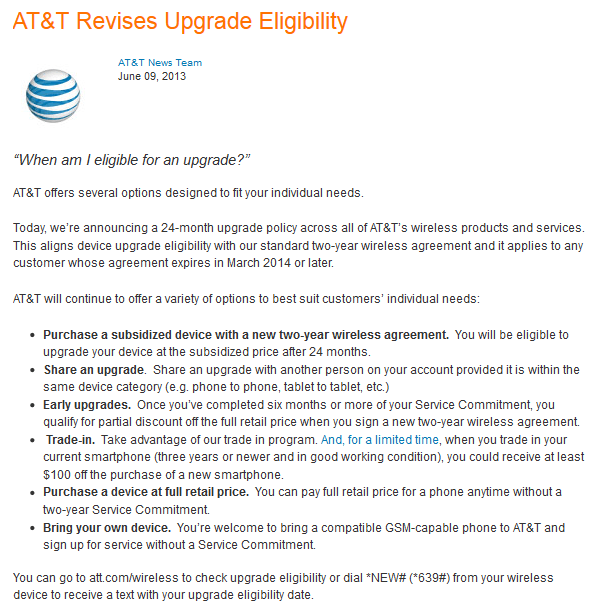
att upgradeAT&T has once again followed Verizon Wireless’ lead by ending early upgrades for contract customers, making it impossible to upgrade a handset with a full device subsidy until 24 months have passed.

The changes took effect last Sunday. Customers that bought their current device after March 1, 2012 must now wait four more months before they can get a discounted upgrade. AT&T also will only allow upgrades within the same “device category,” meaning a customer with an expiring smartphone contract cannot use their upgrade discount on a tablet device.

Previously, both Verizon and AT&T offered customers loyalty discounts and early upgrades for customers not minding a two-year contract extension. Device subsidies — discounts extended to customers to cut prices on new smartphones or tablets, are anathema to many Wall Street analysts because they can drag down provider earnings. Cell companies quietly win back the subsidy discount within two years by charging artificially higher rates on service plans. But Wall Street does not like waiting for a two-year payback.

Verizon Wireless and AT&T both charge nearly the same rates and have almost identical policies and discounts. When one carrier raises prices, the other quickly follows. In the past three years, both companies have ended a number of discounts and plan features — notably loyalty upgrade credits and flat rate data plans — in moves to cut costs and increase profitability.

Both Verizon and AT&T have spoken positively about the idea of doing away with phone upgrade subsidies altogether, but neither would say current rates would be lowered in tandem with such a move. Wall Street wants carriers to consider maintaining current pricing and ending phone subsidies, which would dramatically stimulate company earnings. A device subsidy on a top of the line smartphone is worth $150 a year — money that would come from the customer’s pocket, not AT&T or Verizon.

Customers who don’t want to pay AT&T’s contract prices will not find a better deal from its prepaid division. AT&T has also announced it is discontinuing several  affordable data plan options effective June 20.

The most-affected plan is AT&T GoPhone’s $25 monthly plan, which includes unlimited texting and 250 minutes of calling. That plan allowed customers to choose between three data packages:

  • 50MB for $5/month;
  • 200MB for $15/month;
  • 1GB for $25/month.

Effective June 20, the only available data add-on for this plan will be the 50MB option. Customers exceeding this will have to re-subscribe for an extra $5 for each renewal.

AT&T’s $50 monthly plan includes unlimited texting and calling. But customers will no longer be able to add data service. Instead, they will have to upgrade to AT&T’s premiere $65 plan, which includes the same features as the $50 plan but adds up to 1GB of data.

AT&T says it will have new options for consumers in the coming weeks, but until then, data customers will often pay an average of at least $15 more per month as the changes take effect.

Search This Site:

Contributions:

Recent Comments:

Your Account:

Stop the Cap!