
Home » Contract » Recent Articles:

Verizon Wireless Closing Unlimited Data Plan Upgrade Loopholes; The Latest Party Ends 8/24

610px-Verizon-Wireless-Logo_svgVerizon Wireless is closing several loopholes that customers have used to acquire new subsidized, on-contract smartphones and keep their unlimited data plans intact for an extra two years.

Since Verizon Wireless stopped enrolling customers in unlimited use data plans in 2012, current customers have been able to hang on to their unlimited use plans with the understanding they will not be entitled to subsidized upgrades or new lines with unlimited data. Despite that, Verizon still aggressively pursues unlimited data customers at almost every contact encouraging them to ditch their unlimited plan in favor of much more profitable Family Share plans, which feature usage-based billing tiers that customers will need to regularly upgrade to stay ahead of increasing data usage trends.

A study from Consumer Intelligence Research Partners showing Verizon has successfully convinced all but 22% of their customers to dump their unlimited plans. Those still hanging on guard their unmetered plans zealously. Some have even managed to find loopholes that let them keep unlimited data while getting subsidized device upgrades. But Verizon has caught on and is slowly closing the loopholes, increasing restrictions on unlimited data plan customers.

The Loopholes

One of the newer loopholes is a type of subsidized upgrade through Best Buy. A number of careful steps are required to win the upgrade without changing your data plan, and there are several side effects explained exhaustively on the Slickdeals website. If you try, read the instructions very carefully or you could lose your unlimited plan. The upgrade has been successful for many who have kept their unlimited packages, signed a new two-year contract exempting them from Verizon Wireless’ 4G speed throttle, and getting a new device at a subsidized discount. it won’t be easy to tell when this loophole is closed, and you might have to fight to win back your unlimited data package if it is removed from your account.

Another loophole involves shifting upgrades around on your current family plan. As different family members become eligible for device upgrades, it is possible to an upgrade to an existing number with an unlimited data plan without losing that feature. This is the most popular loophole at the moment and the one Verizon Wireless wants to kill the most.

"Tina, bring me the axe!"

“Tina, bring me the axe!”

Verizon Takes the Axe to Loopholes, Discounts, and Finance Plans for Unlimited Data Customers

Verizon has declared a virtual war on their grandfathered unlimited data plan customers, and has gradually tightened the noose:

  1. Verizon Wireless will begin throttling 4G/LTE speeds of off-contract, unlimited data plan customers deemed heavy users who consume more than 4.7GB of data per month beginning this fall;
  2. On July 13, Verizon Wireless quietly terminated its Device Payment Plan for unlimited data customers seeking to finance the cost of an unsubsidized device upgrade over 12-20 months. Instead, customers must enroll in Verizon Edge to get a phone with little cash upfront and monthly payments. One of the conditions of the Edge program is forfeiting your unlimited data plan;
  3. Verizon will no longer allow customers with unlimited data plans to transfer an available device upgrade from another line on the account to get a subsidized device upgrade while keeping their unlimited data plan.

In the past, some customers who love upgrading devices a lot either grabbed other family members’ device upgrade offers or opened up extra lines on the account. For each additional $9.99 a month basic line, a customer could qualify for a new subsidized device with a two-year contract, initially attaching a basic 2GB $30/month data plan they can immediately drop when the phone is switched to a line with unlimited data. Some customers have even maintained two or three unused phantom lines just so they can upgrade their phone every 10 months or so.

Beginning Aug. 24, Verizon will close that loophole by forcing customers to keep a data package associated with every subsidized device on their account for the length of the contract. This means customers must pay at least $30 for a 2GB data package, plus the usual $9.99 a month fee for service over the next two years for each line with a smartphone attached, regardless of what number it gets associated with.

According to information received by Droid Life, Verizon believes that when it “gives customers a discount on the retail price of a smartphone, we expect them to pay for data services and keep the smartphone activated for two years. This change closes the loopholes which allowed customers to activate/upgrade a smartphone and immediately revert back to a basic phone, resulting in a discontinued smartphone with no associated data plan.”
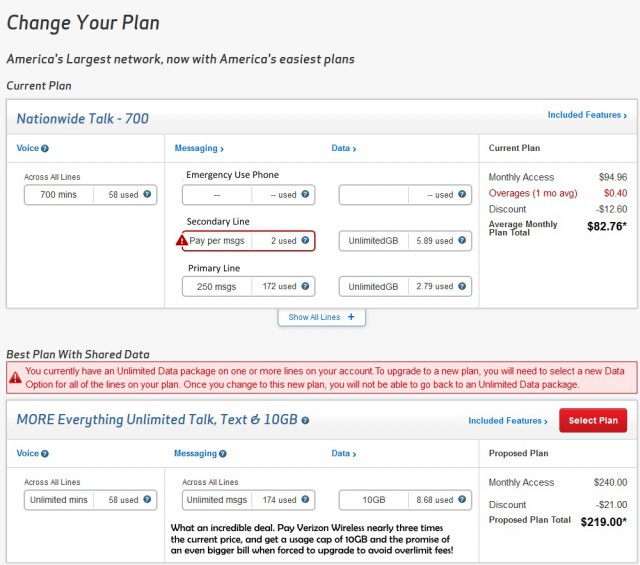
This may explain why Verizon Wireless is so gung-ho about getting me to switch to their "money-saving" Family Share Plan. In fact, it's a Family Theft plan -- nearly three times more expensive with a data cap that will force even more upgrades at a higher cost in the future.

Here’s an offer I’d like to refuse: This may explain why Verizon Wireless is so gung-ho about getting customers to switch to their “money-saving” Family Share Plan. In fact, it’s a Family Theft plan — nearly three times more expensive with a data cap that will force even more upgrades at a higher cost in the future.
How Comcast’s Volume Discounts Will Kill Cable-TV Competition

Phillip Dampier August 11, 2014 Comcast/Xfinity, Competition, Consumer News, Editorial & Site News, Online Video Comments Off on How Comcast’s Volume Discounts Will Kill Cable-TV Competition

psctest

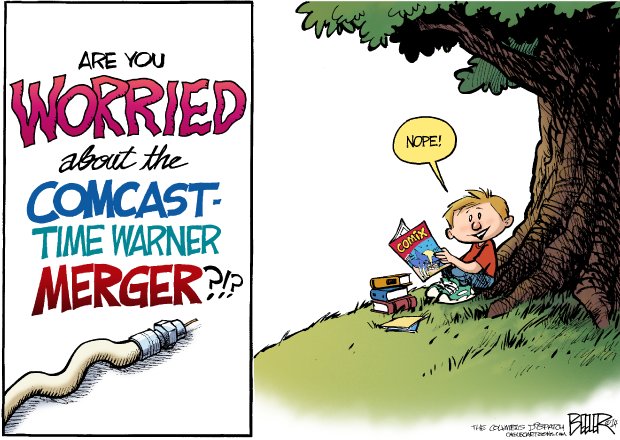
You can still read a book instead of everything else.

You can still read a book instead of everything else.

Allowing Comcast to dominate New York’s cable television marketplace will deter future competitors from entering the market, particularly for television programming.

One of the arguments made by proponents of the merger is the possibility of decreased wholesale television programming costs won through volume discounts available to the largest nationwide providers. Unfortunately for consumers, Comcast has already declared customers will not benefit from those discounts in the form of lower cable bills.

A prospective new entrant considering providing cable television service will face competition with Comcast without any benefit of volume discounts on programming.[1] That makes it unlikely a provider will offer a competing television package.

This is not a theoretical problem.

In Ohio, independent cable company MCTV discovered that while large cable operators like Comcast were benefiting from volume discounts, it faced contract renewal prices more than 40 times the rate of inflation.[2] Cable ONE, owned by the Washington Post, had to drop more than a dozen Viacom owned channels for good because it could not afford the asking price.[3]

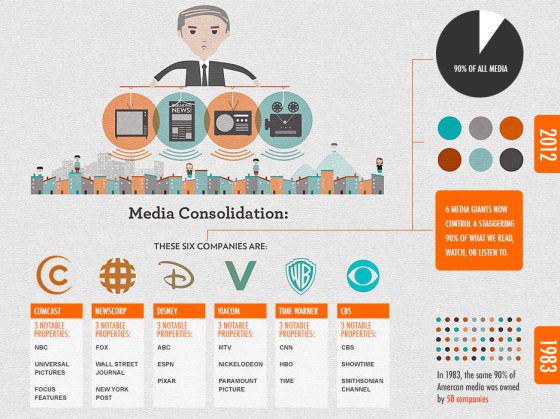
MCTV president Bob Gessner reminds us of just how concentrated the entertainment business has become, noting that nine media companies (Comcast is one of them) now control 95% of all paid video content consumed in the United States.[4]

MCTV’s survival plan includes membership in the 900-member National Cable Television Cooperative, the only way smaller providers can pool resources and win discounts of their own. It is no longer effective as mergers and acquisitions continue to consolidate the cable and telco-TV business. All 900 NCTC members serve a combined five million customers. Comcast has 21 million, DirecTV: 20 million, Dish Networks: 14 million, and Time Warner Cable: 11 million.[5]

media_consolidation

AT&T confesses it cannot compete effectively with Comcast and other larger competitors for the same reason. AT&T’s solution, like Comcast, is to buy a competitor, in this case DirecTV.[6]

Frontier Communications faced a similar problem after adopting Verizon FiOS franchises in Indiana and the Pacific Northwest after purchasing Verizon landline networks in several states. When Frontier lost Verizon’s volume discounts on programming, Frontier’s solution was to begin a marketing campaign to convince its fiber customers to abandon the technology and switch to one of its satellite television partners.[7]

[1]https://www.fiercecable.com/cable/comcast-twc-deal-will-squeeze-programming-and-technology-vendors
[2]http://stopthecap.com/2014/06/05/independent-cable-companies-unify-against-cable-tv-programmer-rate-increases/
[3]http://online.wsj.com/articles/viacom-60-cable-firms-part-ways-in-rural-u-s-1403048557
[4]http://stopthecap.com/2014/06/05/independent-cable-companies-unify-against-cable-tv-programmer-rate-increases/
[5]http://stopthecap.com/2014/06/05/independent-cable-companies-unify-against-cable-tv-programmer-rate-increases/
[6]http://www.bloomberg.com/news/2014-05-02/dish-or-directv-need-deal-most-in-at-t-love-triangle-real-m-a.html
[7]http://stopthecap.com/2011/08/16/frontiers-fiber-mess-company-losing-fios-subs-landline-customers-but-adds-bonded-dsl/

Miss. Taxpayers Pay for “Sweetheart Deal” With AT&T; Competitive Bids and Public Scrutiny Prohibited

Phillip Dampier July 29, 2014 AT&T, Broadband Speed, C Spire, Competition, Consumer News, Data Caps, Public Policy & Gov't, Rural Broadband Comments Off on Miss. Taxpayers Pay for “Sweetheart Deal” With AT&T; Competitive Bids and Public Scrutiny Prohibited

att loveAT&T couldn’t have gotten a better deal for itself if it tried.

Mississippi state officials that awarded AT&T a 10-year State Master Contract, compelling the majority of state government offices to do business only with AT&T, have just given the phone company an early two-year extension without allowing for any public discussion or competitive bidding.

In 2005, when the contract with AT&T was first signed, it was unlikely most government offices, schools, and libraries would be able to find any bidder other than AT&T. The state contract spells out a series of requirements that critics contend were tailor-written with the full knowledge only AT&T could offer the full menu of required services. Nearly 10 years later, and more than a year before the contract was up for renewal, the state suddenly granted AT&T a two-year contract extension, potentially exposing taxpayers to overpriced, taxpayer-funded broadband services.

Interested members of the public who want to examine the state contract for telecommunications with AT&T have run headlong into a roadblock erected by a Hinds County judge who ruled it was off-limits for public inspection and has since been sealed under court order. To this day, only government customers of Mississippi’s Department of Information Technology Services, the agency in charge of the state government’s broadband, are allowed to see the document.

Mississippi-welcomeThe state contract comes at a significant cost to taxpayers if Marvin Adams’ figures are correct. Adams, who works for the Columbia School District, suspects a lot of money has been frittered away because of the lack of competitive bidding. Only the state’s schools and libraries have the option of either securing a contract with AT&T or requesting bids from competitors like Ridgeland-based C-Spire, which supplies fiber and wireless connectivity.

Adams says AT&T’s contract with the state costs taxpayers $5 per Mbps. But AT&T also charges a “transport circuit charge” of between $10-45 per Mbps. Adams said his colleagues have seen competitive bids averaging $6 per Mbps and the transport circuit charge is included in that price.

The Mississippi Watchdog delivered the understatement of the year when it called AT&T’s contract with Mississippi “lucrative.” Attempts to modify the contract have met with fierce opposition in Jackson, the state capital. Senate Bill 2741, a modest measure that would have compelled school districts to seek competitive bids before signing a multi-year contract with a provider, died in committee earlier this year.

AT&T has close political ties in several southern states. The company co-authored an article with Gov. Phil Bryant and donated at least $42,500 to his various campaigns for political office. In 2012, Bryant signed a bill into law removing most of Mississippi’s remaining regulatory authority over AT&T.

Mississippi Governor Phil Bryant

Next door in Louisiana, Gov. Bobby Jindal also maintains close ties with AT&T. The company has funneled more than $250,000 to his wife’s charitable foundation – the Supriya Jindal Foundation for Louisiana’s Children, which also takes substantial contributions from oil and chemical companies, the insurance industry and defense contractors. The New York Times reported back in 2011 that telecom companies like AT&T were increasingly contributing to politically connected charities they could use in campaigns to influence legislation and regulation. Companies can write off their unlimited charitable giving while politicians take credit for the work done by the non-profit groups while also quietly understanding exactly where the money is coming from.

What is Al Jazeera Trying to Keep Secret in Its Settled Lawsuit Against AT&T?

Phillip Dampier June 10, 2014 AT&T, Consumer News, Public Policy & Gov't 1 Comment

al-jazeera-americaAT&T U-verse television customers: Al Jazeera America is coming soon to your television lineup whether you want the network or not.


Just days after the final closedown of Current TV — purchased by Qatar-based Al Jazeera as a platform to launch Al Jazeera America, a new U.S. based news network — AT&T suddenly threw the network off its lineup.

Both companies accused each other of violating the contract. AT&T said it never signed on to carry Al Jazeera America, it signed a contract to carry Current TV. Al Jazeera said it bought Current TV and had an iron clad contract with AT&T to carry whatever programming came from the channel.

Whether called Current TV or Al Jazeera America, it wasn’t on AT&T’s lineup after launching last August. Al Jazeera promptly sued AT&T for violating its contract in its complaint: Al Jazeera America LLC v. AT&T Services Inc.

What made the case unusual is that Al Jazeera filed a confidential lawsuit in the Delaware Chancery Court. In most program disputes, the players are only too happy to supply the media with their respective sides, including copies of any legal complaints.

When the media requested a copy of Al Jazeera’s lawsuit, it arrived heavily redacted to a four line summary Bloomberg News called “nonsense.”

A group of five journalists and Bloomberg filed their own complaint with the court requesting to unseal details of the case, arguing if the Qatari news channel wanted to use the U.S. court system, it had to follow court procedure and respect America’s First Amendment.

Top secret.

Vice Chancellor Sam Glasscock III agreed with the journalists, ruling the American public was being kept in the dark about the case with redactions so severe, no one could learn about the disputed contract terms, much less read a complete description of the dispute.

Desperate to avoid having to make the case public, Al Jazeera quickly appealed Glasscock’s decision, but that appeal was dismissed by the Delaware Supreme Court last week as having been accepted improvidently.

That decision appears to have rung alarm bells back in Qatar and Al Jazeera’s owners announced it would drop the case completely after reaching a quick settlement with AT&T. They claimed their actions would wipe the public record clean of the lawsuit, erasing the complaint and related papers from the public record and preventing Bloomberg and other journalists from getting access to the lawsuit.

chanceryDespite the court order to unseal the lawsuit, the Delaware Court of Chancery granted a 10-day stay to allow the parties to finish their settlement and seek an order to expunge the record of the lawsuit.


That brought a hostile response from the journalists. David Finger, a lawyer for some of the media challengers, said Al Jazeera’s argument around the unsealing order “lacks any basis in law.”

“If the complaint was improperly filed under seal (as this court has already found), the public had the right to review the complaint at the moment of filing,” Finger’s letter states. “That right cannot be taken away retroactively.”

Finger also argued the right to public access is not squelched because an action is close to settlement and the Chancery Court has rejected arguments to the contrary in past cases.

The strenuous objections from Al Jazeera are only bringing more attention to the case. AT&T has decided to steer clear of the controversy, only stating it had reached an agreement in principle to add Al Jazeera America to the U-verse lineup.

Houston Family Pays Comcast $2000 Over 7 Years for Home Insecurity System; $20 Credit Offered

Phillip Dampier June 3, 2014 Comcast/Xfinity, Consumer News, Public Policy & Gov't, Video Comments Off on Houston Family Pays Comcast $2000 Over 7 Years for Home Insecurity System; $20 Credit Offered
xfinity alarm

Toy Alarm: No peace of mind here.

A Houston couple paid Comcast $30 a month over seven years for Comcast’s home security system they believed would help keep them safe. But the alarm system hadn’t worked right from the day Comcast’s technicians installed it, and the cable company’s final offer of compensation was a $20 service credit.

Understandably, the couple wasn’t happy paying for Comcast’s pretend peace of mind.

“I’m a loyal customer and my thing is I don’t mind paying for a service if you’re providing the service,” Lisa Leeson told KPRC-TV, “but they weren’t.”

Comcast’s Insecurity System finally revealed its true self one windy February day. The Leeson family had left to do some errands and just as they had done more than 2,500 times before over the past 80 months, they armed Comcast’s home security system from its control panel before heading out.

“We would set it,” explained Leeson. “It would make the little noise that it makes like it was activating.”

When they arrived home, the family was surprised to find their back door wide open. Fearing a break-in, they wondered why Comcast’s alarm wasn’t blaring, with notified authorities standing by to investigate.

Despite more than 26,000 burglaries in Houston every year, the Leeson family was lucky. A wind gust had blown the door open and their possessions were safe. The revelation the family was robbed anyway only came after calling Comcast to ask why their alarm never went off.

A representative promptly told the family it had monitored the status of the Leeson’s alarm 24/7 for the last seven years and it was offline for almost the entire time. Comcast knew about its non-security system since 2007, but never bothered to tell the family. A follow-up visit from a Comcast technician this month quickly revealed the alarm was installed improperly by the cable company.

“It was unable, even if wanted to, to actually call the police and or Comcast once it was activated,” explained Leeson.

So ultimately whose fault is it that Comcast’s home security system never worked? The company that improperly installed it and knew it wasn’t working for the duration of 80 monthly payments it faithfully collected for service never rendered, or the customer?

In the corporate world of Comcast, it’s absolutely the customer’s fault — exactly what both a customer service representative and a corporate spokesman told the Leeson family.

A Comcast customer service representative was only willing to offer a one-time $20 “inconvenience credit” and the corporate spokesman apologized but pointed to a line in Leeson’s alarm agreement where she agreed to “test her system on a regular basis.”

It simply wasn’t good enough to trust Comcast’s alarm control panel notifying the family the alarm was armed and security monitoring was enabled. She’d have to trigger the system, potentially annoying the neighbors and first responders to prove the system worked properly.

Houston police and fire officials beg to differ.

In an ongoing effort to reduce costly and unnecessary false alarms, the city has implemented alarm permit and penalty fees for wasting the time of emergency personnel.

burglarA residential burglar alarm in the city of Houston requires an annual permit ranging in cost from $37-50. A fire alarm permit costs $80.29 the first year, $53.52 each year thereafter. Three false burglar alarm calls are allowed without a charge with a burglar alarm permit per year. The 4th and 5th false alarm call is chargeable at $50.00 each and the 6th and 7th call is chargeable at $75.00 each. Thereafter each false alarm call is chargeable at $100.00 each. Permits are subject to revocation after the 7th false call. Burglar alarm systems without a permit are chargeable at $107.05 per response and/or no response.

Hold-up/panic alarm systems are allowed one false call without charge with a hold-up/panic permit. Thereafter the 2nd call is chargeable at $128.45, the 3rd false call at $256.92 and the 4th false call is chargeable at $385.37. Thereafter the 5th false alarm and above are chargeable at $513.84 (each). Panic alarm systems without a permit are chargeable at $282.61 per response and/or no response.

False fire alarms carry penalties up to $385.37 per incident with a $115.61 collection fee.

After a local television station got involved in the dispute, Comcast softened their hard-line and refunded every penny Leeson paid for the home security system that had left the family vulnerable since the day Comcast incorrectly installed it.

But after what the Leeson family endured, other alarm system customers should check their contracts and make sure they verify their system is working properly. Don’t depend on the alarm provider to notify you.

Most modern alarm systems alert the monitoring company when activated. That company in turn notifies the police, fire department or ambulance. All three agencies recommend using a monitoring company to reduce the instances of false alarms. Older systems often used a built-in message tape recorded by the homeowner. When the alarm triggered, the system would phone 911 and play back the recorded message. Those systems are responsible for the largest percentage of false alarms.

Comcast says customers with its XFINITY alarm can test their systems using the My Account app on their smartphones. The Leeson family uses an older model Comcast security system that doesn’t work with the app.

[flv]http://www.phillipdampier.com/video/KPRC Houston Comcast Insecurity System 5-28-14.flv[/flv]

KPRC in Houston has words of wisdom for Comcast security system owners. Are you really protected? (2:07)

Search This Site:

Contributions:

Recent Comments:

Your Account:

Stop the Cap!