Home » Contract » Recent Articles:

Federal Trade Commission Suing AT&T Over Unfair Speed Throttles for Unlimited Data Customers

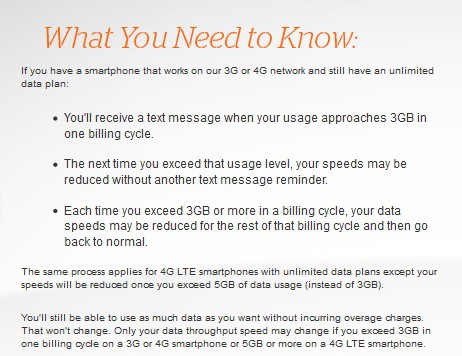
throttleThe Federal Trade Commission today filed a lawsuit against AT&T for its practice of subjecting grandfathered unlimited data customers to speed throttles that dramatically cut speeds up to 90 percent after customers use more than 3GB of data on AT&T’s 3G network or 5GB on its 4G network. Thus far, according to the FTC, AT&T has throttled at least 3.5 million unique customers a total of more than 25 million times.

The FTC’s complaint alleges that the company failed to adequately disclose to its customers on unlimited data plans that, if they reach a certain amount of data use in a given billing cycle, AT&T reduces – or “throttles” – their data speeds to the point that many common mobile phone applications – like web browsing, GPS navigation and watching streaming video –  become difficult or nearly impossible to use.

“AT&T promised its customers ‘unlimited’ data, and in many instances, it has failed to deliver on that promise,” said FTC Chairwoman Edith Ramirez. “The issue here is simple: ‘unlimited’ means unlimited.”

FCC chairman Thomas Wheeler publicly complained about Verizon’s plans to start a similar throttling program on its wireless network, questioning the fairness of cutting speeds for certain customers while exempting others. Both Verizon and AT&T have claimed speed throttles are part of a fair usage policy that allows all customers to share its wireless resources. Broadband providers have often painted a picture of a “bandwidth hog” taking a disproportionate share of network resources away from other customers, but there is no evidence heavier users are creating conflicts for other users, especially as wireless carriers encourage customers to use more data.
throttle att

From AT&Ts website

The logic of rationing Internet use for unlimited customers while providing unlimited access to those willing to pay usage-based charges escaped the FTC, which is what brought the suit.

According to the FTC’s complaint, AT&T’s marketing materials emphasized the “unlimited” amount of data that would be available to consumers who signed up for its unlimited plans. The complaint alleges that, even as unlimited plan consumers renewed their contracts, the company still failed to inform them of the throttling program. When customers canceled their contracts after being throttled, AT&T charged those customers early termination fees, which typically amount to hundreds of dollars.

The FTC alleges that AT&T, despite its unequivocal promises of unlimited data, began throttling data speeds in 2011 for its unlimited data plan customers after they used as little as 2 gigabytes of data in a billing period. According to the complaint, the throttling program has been severe, often resulting in speed reductions of 80 to 90 percent for affected users.

According to the FTC’s complaint, consumers in AT&T focus groups strongly objected to the idea of a throttling program and felt “unlimited should mean unlimited.” AT&T documents also showed that the company received thousands of complaints about the slow data speeds under the throttling program. Some consumers quoted the definition of the word “unlimited,” while others called AT&T’s throttling program a “bait and switch.” Many consumers also complained about the effect the throttling program had on their ability to use GPS navigation, watch streaming videos, listen to streaming music and browse the web.

The complaint charges that AT&T violated the FTC Act by changing the terms of customers’ unlimited data plans while those customers were still under contract, and by failing to adequately disclose the nature of the throttling program to consumers who renewed their unlimited data plans.

FTC staff worked closely on this matter with the staff of the Federal Communications Commission.

The Commission vote authorizing the staff to file the complaint was 5-0. The complaint was filed in the U.S. District Court for the Northern District of California, San Francisco Division.
Half of AT&T’s Customers Are Paying $100 for 10GB Data; Unlimited Customers Still Throttled After 3-5GB

Phillip Dampier October 23, 2014 AT&T, Broadband "Shortage", Broadband Speed, Competition, Consumer News, Data Caps, Public Policy & Gov't, Wireless Broadband Comments Off on Half of AT&T’s Customers Are Paying $100 for 10GB Data; Unlimited Customers Still Throttled After 3-5GB
Speed bump

Speed bump

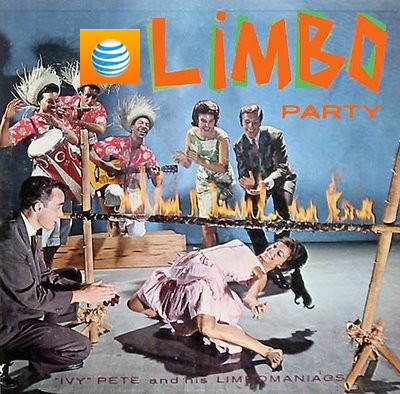
More than half of AT&T’s wireless customers are paying at least $100 a month for 10GB or more of wireless data on AT&T’s Mobile Share Plans at the same time AT&T continues to throttle its legacy unlimited data customers who use more than 3GB of data on its 3G network or 5GB of data on its 4G LTE network.

AT&T claimed in 2012 it implemented its “fair usage policy” for unlimited customers to assure all could receive reasonable service during peak usage times when cell towers become congested.

AT&T also blames “a serious wireless spectrum crunch” for the speed throttling, implying access to more spectrum could help ease the problem. But there is a much faster way to overcome AT&T’s “spectrum crunch:” agree to pay them more money by ditching that $30 unlimited plan for a tiered plan.

John Stephens, AT&T’s chief financial officer, told investors Wednesday that nothing boosts revenue more than pushing customers into usage-cappped data plans that customers are regularly forced to upgrade.

“On the ARPU (average revenue per user/customer) story, I think the biggest issue with the improvement is people buying the bigger [data] buckets and buying – upping plans,” said Stephens. “We had over 50% of the customer base at the 10GB or bigger plans.”

Stephens added that AT&T benefited from customers upgrading to 4G LTE devices that are handled more efficiently by AT&T’s mobile data network.

Increased usage and upgraded data plans delivered a 20% increase in data billings over the last quarter.

Since 2012 AT&T has paid out more than $50 billion to shareholders through dividends and share buybacks. The company benefited from nearly $20 billion a year in free cash flow and asset sales over the last two years and is expected to repeat those numbers this year. Consolidated revenue at AT&T grew to $33 billion, up $800 million since the same time last year.

Miraculously, despite the “alarming spectrum crunch,” AT&T found more than enough spectrum to award its best customers with a “double data” promotion that turns a 15GB data plan into a 30GB plan, a 20GB plan to 40GB, a 30GB plan to 60GB, a 40GB plan to 80GB, or a 50GB plan to 100GB. Importantly, AT&T boasts its double data promotion won’t “explode” — their language for “expire” — on customers until their contract ends.

Lowering the bar on "unlimited use" customers.

Lowering the bar on “unlimited use” customers.

“Those exploding offers — customers hate those offers,” said AT&T Mobility CEO Ralph de la Vega at a recent investor conference. “Unless they change their mind, we won’t offer those kinds of promotions.”

But de la Vega doesn’t mind leaving the company’s most loyal legacy customers in the penalty box if they cling to their grandfathered unlimited data plans. The throttles stay and the allowances have remained unchanged since first announced, despite the bountiful spectrum obviously ready and available to serve AT&T’s deluxe customers. Unlimited customers are regularly reminded they can easily avoid the throttle — just abandon that unlimited data plan. According to Stephens, more than 80% of AT&T’s customers already have.

The excuses for wireless speed throttles and killing off unlimited data plans at AT&T and Verizon Wireless don’t seem to wash with FCC chairman Thomas Wheeler, who demanded Verizon offer the “rationale for treating customers differently based on the type of data plan to which they subscribe, rather than network architecture or technological factors,” after it announced it was planning speed throttles for its remaining unlimited data plan customers. Verizon canceled the plan after Wheeler began scrutinizing it, but the throttles are still in place at AT&T.

AT&T’s 10GB Mobile Share Plan starts with a $100 data plan. Customers also pay:

  • $10 a month for each auto-based smart-locator;
  • $10 a month for each tablet, camera or game device;
  • $15 a month for each basic phone;
  • $20 a month for each wireless home phone replacement;
  • $20 a month for each connected Internet device;
  • $40 a month for each connected smartphone.

A family of four with four smartphones, a tablet, and AT&T’s wireless home phone replacement would be billed $290 a month before at least $39 in taxes, fees, and surcharges — well north of $300 a month for most.

Rural America: Welcome to Verizon LTE Broadband – $120/Mo for 5-12Mbps With 30GB Cap

They are coming.

With both AT&T and Verizon petitioning various state regulators for permission to switch off rural landline phone and broadband customers and force customers to use wireless alternatives, getting affordable broadband in the countryside is becoming increasingly difficult.

Last week, Millenicom — a reseller of wireless broadband service specializing in serving rural, long-haul truckers, and recreational vehicle users notified customers it was transferring their accounts directly to Verizon Wireless and will no longer have any role selling discounted Verizon Wireless broadband service.

Reports indicate that Millenicom’s contract renewal negotiations with Verizon did not go as expected and as a result customers are facing potential price increases and long-term contracts to continue their wireless broadband service.

Both AT&T and Verizon have told regulators they can satisfactorily serve rural customers with wireless LTE broadband service as an alternative to maintaining rural landline infrastructure. Neither company likes to talk about the price rural customers will pay if they want to keep broadband in their homes or businesses.

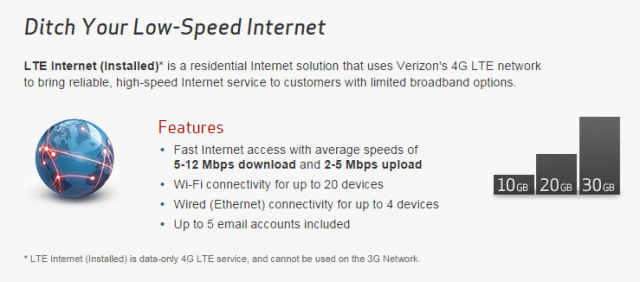
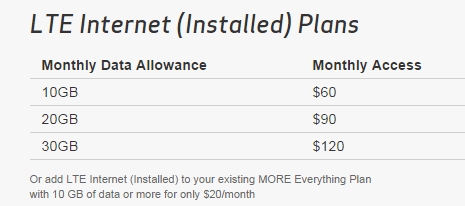
Some Millenicom customers have been invited to preview Verizon Wireless’ Home LTE Installed Internet plans (formerly known as HomeFusion) and many are not too pleased with their options:

lte1

lte2

Verizon’s overlimit fee is $10/GB for those that exceed their plan limit. According to several Amazon.com reviews of the service (it received 1.5 stars), customers are quickly introduced to “Verizon’s shady usage meter” that consistently measures phantom usage. Bills of $400-500 a month are not uncommon. One customer was billed for 18GB ($180) in extra usage despite following Verizon’s suggestion to stop using the service when it reported he reached 29GB of usage.

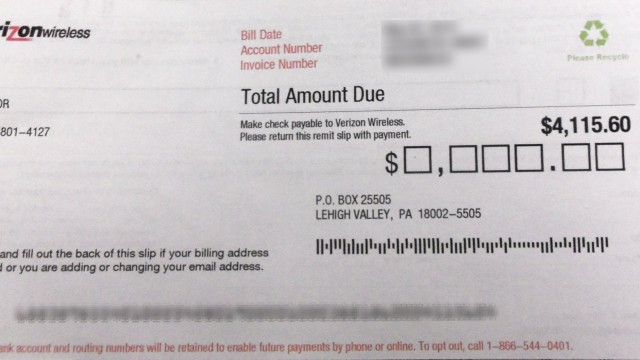
verizon bill

This bill includes more than $3,000 in data overlimit fees.

“The bill came with the bogus data charges, and it was twice as much as the meter detected,” the customer reported.

In fact, the phantom usage has become so pervasive, Verizon customers have dubbed the phenomenon “ghost data,” but the overlimit fees Verizon expects customers to pay are very real.

“[It] went out more than my DSL and my first bill from Verizon was $1300+,” reported Jill Kloberdanz. “I want this demon out of my house.”

“According to [Verizon], I used over 65GB in just one week,” reported Aron Fox. “And they want almost $800 for it. My wife and I are two 60-somethings that never game and rarely stream.”

“Definitely stay away […] unless you like to see your data charges skyrocket (in my case more than doubling) when your use doesn’t,” reported Richard Thompson. “I’ve pulled the plug on it — literally.”

“We have the same problem – huge data overages, meter does not match our usage,” writes Heather Comer. “We turn the router off at night and when we check the next morning, it is still accumulating data.”

There are close to a dozen more complaints about Verizon’s usage meter, all stating they were charged for usage even when the equipment was switched off.

While both Verizon and AT&T stand to save millions disconnecting rural landline customers, they stand to earn even more switching rural customers to their more costly (and profitable) wireless alternatives.

Home Invasion Victims Sue Comcast Over Home Security System That Only Protected… Comcast

Phillip Dampier October 9, 2014 Comcast/Xfinity, Consumer News, Video Comments Off on Home Invasion Victims Sue Comcast Over Home Security System That Only Protected… Comcast
Vincent Sisounong and Blessing Gainey were charged with attempted murder.

Vincent Sisounong and Blessing Gainey were charged with attempted murder.

A Kirkland, Wash. family nearly lost their son in a brutal home invasion that Comcast’s home security system failed to deter and now the family is taking the cable company to court.

Leena Rawat and her family depended on Comcast’s home security system to keep their home intruder-proof, and that is precisely what the company and its contractor, Pioneer Cable, promised.

But the night two teenage neighbors went looking for blood, they had no trouble bypassing Comcast’s unarmed basement sensor and entering the family’s home.

Within minutes, the two men grabbed 18-year old Deep and began torturing him while his family slept.

“They were going to play a game with him tonight – and the game would be that he would be fighting for his life,” Rawat told KING-TV in Seattle. “He was full of blood from head to toe, with gashes. He was in the worst situation possible that a mother wants to see her child in.”

The intruders’ impromptu mission: to chop off one of Deep’s arms and legs with various cutting tools while robbing the family home.

Police say Vincent Sisounong and Blessing Gainey began the attack in Deep’s bedroom, then dragged him to the basement, where Sisounong instructed Gainey to hack at Rawat’s leg down to the bone, and then stabbed Rawat himself. Court documents said Sisounong told detectives that he wanted the victim to “fight for his life,” and when asked if the experience was enjoyable, he said, “yeah.”

Rawat eventually managed to break free, prompting Gainey to leave the scene. But Sisounong chased after Rawat as he ran to the bathroom, further slashing him with a knife. Rawat mustered enough strength to punch the intruder in the face and escape, but not before the men stole keys, electronics, and money before walking out the door.

[flv]http://www.phillipdampier.com/video/KIRO Seattle Police Suspects tried to kill for pleasure and greed 11-4-13.flv[/flv]

KIRO-TV in Seattle reported on the home invasion back in early November 2013 and learned horrified neighbors were arming themselves to protect against another random attack. (2:27)

During the incident, the only alert that something might be wrong came from the family’s car alarm that accidentally went off during a struggle for the keys. At no time did Comcast’s alarm system activate or signal police an intrusion was underway. Authorities were summoned only after Deep arrived, bleeding and badly injured, on a neighbor’s doorstep.

Vincent Sisounong, 21, and Blessing Gainey, 19, were located by authorities after matching fingerprints were found inside the Rawat home and both were charged with first-degree attempted murder and first-degree burglary.

When interviewed by police, Sisounong said he “really wanted” to kill the teenager, court documents said, noting that neither man knew the Rawat family.

“I just say God was there that night,” said an incensed Leena. “God, but not Comcast security. It’s been very tough. It was not a one night thing. It’s changed our life.”

That night and every night, the one thing Comcast’s security system manages to protect more than anything else is the cable company itself.

The traumatized family quickly learned Comcast was disavowing any and all responsibility for the failure of their alarm system, and Comcast’s contracts include clauses that require customers to waive all liability, even if Comcast is later found negligent. In fact, customers who sign Comcast’s contract must also side with the cable company and against their own insurance company during any claims process.

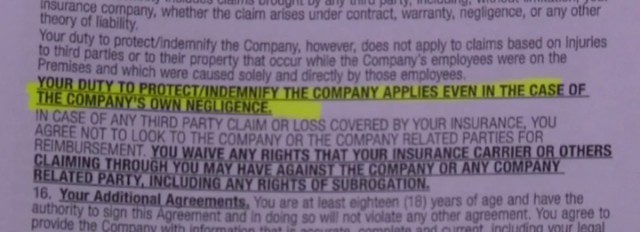
Comcast's security contract lets the company walk away from responsibility for virtually everything.

Comcast’s security contract lets the company walk away from responsibility for almost everything.

The first duty of every Comcast home security customer is to protect Comcast, as made clear in particularly bold, all-capital letter print:

YOUR DUTY TO PROTECT/INDEMNIFY THE COMPANY APPLIES EVEN IN THE CASE OF THE COMPANY’S OWN NEGLIGENCE.

“If their argument is to be accepted, they could put in empty black boxes throughout the house and say, ‘That’s your system.’ And then something goes wrong, and they say, ‘We never promised you it would work,'” said Ken Friedman, attorney.

Comcast’s response:

“We want to take this opportunity to extend our sympathies to the Rawat family. However, after a review of our records, we are confident that our home security system functioned properly.”

[flv]http://www.phillipdampier.com/video/KING Seattle Comcast Sued Over Home Security System Failures 10-1-14.flv[/flv]

KING-TV in Seattle talked with Leena Rawat about how Comcast let her and her family down on the worst night of their lives. (2:29)

Time Warner Cable Can Raise Pricing on 2-Year Promotions; Customer Sees $15 Surprise Rate Hike

Phillip Dampier September 15, 2014 Comcast/Xfinity, Competition, Consumer News, Editorial & Site News Comments Off on Time Warner Cable Can Raise Pricing on 2-Year Promotions; Customer Sees $15 Surprise Rate Hike

fine printTime Warner Cable customers believing they can “lock in” prices for up to two years with one of the company’s service promotions might be surprised to learn the fine print allows the cable company to adjust prices after just one year of service, as this reddit user just discovered:
My bill went up $15. They tell me it’s ok because I’m still on the same promotion, it just went up in price. That I’m still saving over full retail price so it’s ok. The phrase “it’s only $15” was used by the service rep.

This is complete bulls***.

edit: I really wish I thought ahead to record the call. Now that I’m off the phone he offered me a one time $15 credit to make next month better. Like that changes anything.

How can the term two-year promotion be used if it’s only good for 1 year you ask? Well Time Warner’s answer is that it’s still the same promotion, it just goes up after a year.

edit again: The one time $15 just posted to my account. They don’t even call it a customer service adjustment or anything, they call it a “Save a Sub adjustment.” Not even trying to hide it.

09/06/2014 Save a Sub Adj -15.00

This and many other Time Warner Cable customers probably missed the fine print, which reveals pricing for the promotion can, and often does, adjust after the first 6-12 months. Comcast, the potential new owner of Time Warner Cable, also runs promotions the same way. Here are examples from both companies:

Time Warner Cablecomcast twc: Three-product offers valid for new residential and existing customers. After 12 months, regular rates apply. Offers expire 10/19/14. Standard TV for $39.99 available for 12 months; in months 13-24, price will go up to $44.99; after month 24, price will go to retail.

Comcast: After first 6 months, monthly service charge increases to $109.99 for months 7-12. After 12 months, or if any service is cancelled or downgraded, regular charges apply. After 6 months, the monthly charge for HBO is $15 for 12 months and thereafter, regular rates apply.

Some cable operators bill promotions by charging the customer the regular price for service and then apply a fixed promotional credit for the length of the promotional offer. If rates increase during the promotion, the customer will see the rate increase on their bill and will end up paying more because the service credit they receive does not change to offset the increase.

Why are they allowed to do this? Because cable companies like Time Warner Cable have gradually moved away from term-length service contracts, especially where they do not face a new competitor like U-verse or FiOS entering their service area for the first time. With both competitors well-established, cable operators have moved away from two-year “contracts” to two-year “promotions,” but customers often do not know the difference.

This customer can switch providers at any time without a penalty. Instead he called and complained and received a one-time service credit. Chances are if he calls and threatens to cancel service, the retention agent will put him back on the original promotion or one offering a similar promotional price. The key word is “cancel,” which works like nothing else to motivate representatives to keep your business.

Search This Site:

Contributions:

Recent Comments:

Your Account:

Stop the Cap!