Home » Contract » Recent Articles:

AT&T U-verse Expansion Peaks This Year; Company Raked in $6.9 Billion in Profits Last Quarter

Phillip Dampier January 29, 2014 AT&T, Broadband Speed, Competition, Editorial & Site News, Net Neutrality, Online Video, Rural Broadband, Video, Wireless Broadband Comments Off on AT&T U-verse Expansion Peaks This Year; Company Raked in $6.9 Billion in Profits Last Quarter

att-logo-221x300AT&T’s investment in U-verse expansion is expected to peak this year as part of its “Project VIP” effort to bring the fiber to the neighborhood service to more areas and offer faster broadband speeds to current customers.

AT&T is spending $6 billion over three years to broaden the footprint of U-verse, which now earns AT&T 57% of its total consumer revenues. In 2013, AT&T earned $13 billion in revenue from U-verse, up 28%.

AT&T’s investment in U-verse is dwarfed by the company’s efforts to benefit shareholders. In the last quarter of 2013, AT&T realized $6.9 billion in profits on revenue of $33.2 billion. For 2013, AT&T repurchased 366 million shares of its own stock for around $13 billion and paid out another $10 billion in shareholder dividends. Together, the total return for shareholders for the year was $23 billion and in the last two years AT&T achieved a new record benefiting shareholders with $45 billion in returns. In contrast, AT&T will spend just $6 billion on the current round of U-verse upgrades, with those markets left out likely pushed to wireless-only service if the company succeeds in winning approval to decommission its rural landline network.

Most of AT&T’s revenue growth is coming from its wireless business, particularly wireless data. After AT&T eliminated its flat rate plans, monetizing data usage has become very profitable — $23 billion per year and growing at 17% annually. Because increasing wireless usage forces customers to upgrade to higher cost plans offering more generous usage allowances, AT&T’s average revenue per customer increased by 3.9% — the highest in the wireless industry and the 20th consecutive quarter of customers collectively paying higher cell phone bills.

“The next steps are to make our networks even more powerful and layer on services that will drive new growth in the years ahead,” said AT&T CEO Randall Stephenson.

AT&T is counting on even higher customer bills as the company moves forward on several revenue-enhancing initiatives:

  1. Moving an increasing number of customers away from subsidized handsets. AT&T Next allows wireless customers to get a new handset every year, but in return AT&T no longer subsidizes equipment purchases. Instead, most Next customers finance their current phone and will finance their next one, assuring AT&T of a constant revenue stream for equipment. AT&T expects to gradually move away from phone subsidies altogether;
  2. Data plans for cars are forthcoming, as auto manufacturers install wireless capability in new vehicles. Many are signing agreements with AT&T that will make it easy for current customers to add vehicles to their existing plan, but customers of other carriers may find signing up for a new plan prohibitively expensive;
  3. Internet-connected home security systems are getting a major marketing push in 2014 with advertising blitzes and other promotions. The alarm systems are connected to and use AT&T’s wireless data network;
  4. AT&T customers are being pushed to wireless data plans with much higher data allowances than they need, delivering extra profits for AT&T with no impact on its wireless network;
  5. AT&T wants to begin selling “sponsored data” services to companies willing to foot the bill for accessing preferred websites. AT&T calls it “toll-free data” but Net Neutrality advocates complain it monetizes data usage and establishes a unlevel playing field where deep pocketed companies can help customers avoid AT&T’s usage meter while others have to contend with customers worried about their data allowance.

[flv]http://www.phillipdampier.com/video/ATT Next – Get A New Smartphone Every Year from ATT Wireless 1-2014.flv[/flv]

AT&T explains its Next program, which lets customers upgrade to a new smartphone every 12 or 18 months. AT&T doesn’t tell you the plan is effectively a lease that benefits them by not having to pay a phone subsidy worth hundreds of dollars to discount a phone they will eventually refurbish and resell after you return it. AT&T Next, as intended, is an endless installment payment plan that never stops as long as you keep upgrading your phone. You also can’t leave AT&T until you pay your current phone off. (1:30)

A new way for AT&T to end phone subsidies.

A new way for AT&T to end phone subsidies.

Despite fierce competition from T-Mobile, AT&T so far has seen little impact from T-Mobile’s aggressive marketing. AT&T added 566,000 new contract customers in the last quarter and sold 1.2 million smartphones to its customer base. AT&T’s customer churn rate — the number of customers coming and going — remains very low despite T-Mobile’s latest offer to cover AT&T’s early termination fees to encourage customers to switch.

Stephenson says AT&T’s superior wireless 4G LTE network and its larger coverage area make customers think twice about taking their business to a smaller carrier.

In 2014, AT&T laid out these plans during its quarterly results conference call this week:

  • U-verse will get an expanded TV Everywhere service allowing customers to view programming on smartphones and tablets inside their home and out;
  • U-verse broadband speed enhancements should be available to at least two-thirds of customers, with speeds up to 45Mbps;
  • LTE coverage expansion targets are expected to be ahead of schedule;
  • AT&T will begin a “big effort” on network densification — adding overlapping cell towers and small cell technology in current coverage areas — to handle network congestion;
  • AT&T will focus on improving its wired and wireless networks to prioritize video delivery;
  • If approved by the government, AT&T will use its acquired Leap/Cricket brand for aggressive new no-contract plans marketed to customers with spotty credit without tainting or devaluing the AT&T brand;
  • AT&T will use its agreements with GM, Ford, Nissan, Audi, BMW, and Tesla to offer AT&T wireless connectivity in new 2015 model year vehicles.

[flv]http://www.phillipdampier.com/video/Bloomberg ATT Latest Results Good 1-28-14.flv[/flv]

Bloomberg notes AT&T’s latest financial results are ahead of analyst expectations. Despite competition from T-Mobile, AT&T’s customer defection rate is at a historic low. (2:03)

Time Warner Cable Tells Charter Cable to Get Lost; War of Words Ensues

analysisTime Warner Cable executives brushed away Charter Communications’ first public offer to acquire the second largest cable company in the country in a debt-financed deal that Time Warner considers a lowball offer.

“[Charter’s] proposal is grossly inadequate,” Time Warner Cable said in a statement. “We are confident in our standalone plan and we are not going to let Charter steal the company.”

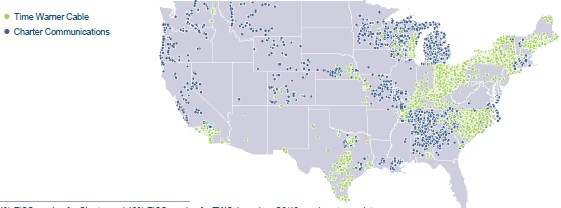
Charter;s new service areas, if they win Time Warner Cable.

Charter’s combined service areas, if they win control of Time Warner Cable.

On Tuesday, Charter violated a long-standing, informal Code of the Cable Cartel that keeps cable companies from attacking each other.

twc charterCharter Communications chief operating officer John Bickham launched an investor presentation that trashed Time Warner Cable and its leadership, and contended fixing the cable company will take more work than first envisioned.

Bickham claimed Time Warner has exhibited a decade of a “failed operating strategy revealed by fact that they are losing customers at an alarming rate,” while Charter has a proven track record of performance.

Bickham

Bickham

Historians recollect Charter’s recent past differently. In 2009, mired in debt and lacking a disciplined business plan, Charter declared Chapter 11 bankruptcy, wiping out shareholders and stiffing creditors.

Bickham capitalized on Time Warner’s 2013 summer of discontent, when a dispute with CBS resulted in the loss of the network from Time Warner Cable lineups (along with Showtime) in some of the biggest cities in the country. Combined with rate increases, subscribers began switching to the competition, especially where Verizon FiOS and AT&T U-verse gives cable operators stiff competition from money-saving new customer promotions.

Bickham described TWC as a company in shambles:

On Time Warner Cable TV: “It appears that Time Warner didn’t want to spend the money to go all-digital,” adding that the quality of TWC’s TV signal is poor and the company still lacks enough HD channels that could have been on the lineup if the cable company dropped analog service long ago.

On Time Warner Cable Internet: Bickham complained Time Warner is offering deep discounts on slow Internet packages, particularly its campaign targeting DSL customers with 2Mbps service for $14.99 a month. Bickham complains the large variety of Internet speed tiers are unnecessary, resulting in “nickel-and-dime charges to customers.” He argues Time Warner needs to simplify its offering by adopting a digital lineup and boost Internet speeds, so customers get at least 30Mbps service. Bickham did not mention Charter Communications also has a usage cap on its broadband products. TWC does not on most offerings.

On Time Warner Cable employees: “TWC never had a vision on high standards” for how the company manages its 50,000 employees. Bickham feels the workmanship of TWC installers leaves a lot to be desired.

[flv]http://www.phillipdampier.com/video/Bloomberg Time Warner Cable Rejects Charter Offer 1-15-14.flv[/flv]

Time Warner Cable rejected an acquisition offer from Charter Communications valued at more than $61 billion including debt, spurning the biggest unsolicited takeover bid since 2008. Manus Cranny examines why the offer was rejected on Bloomberg Television’s “Countdown.” (2:06)

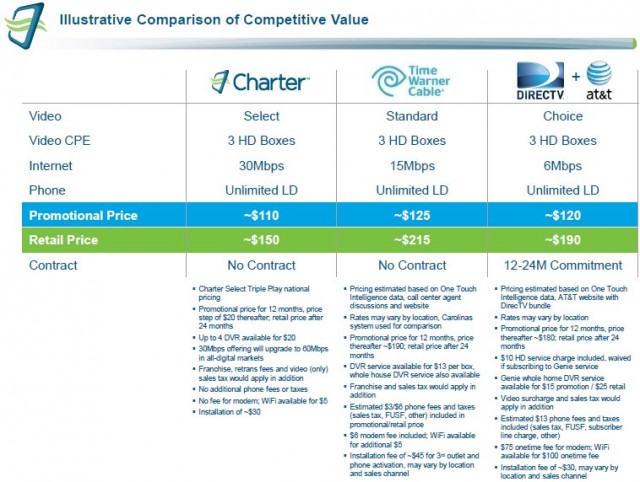
Charter's price comparison chart for the benefit of Time Warner Cable shareholders lacks accuracy. Virtually nobody has to pay TWC's quoted retail rates and the chart assumes worst-case pricing for TWC customers, while also ignoring Charter's very high customer dissatisfaction score.

Charter’s proposed price comparison chart, produced for the benefit of Time Warner Cable shareholders, assumes worst-case pricing almost no Time Warner Cable customer actually has to pay.

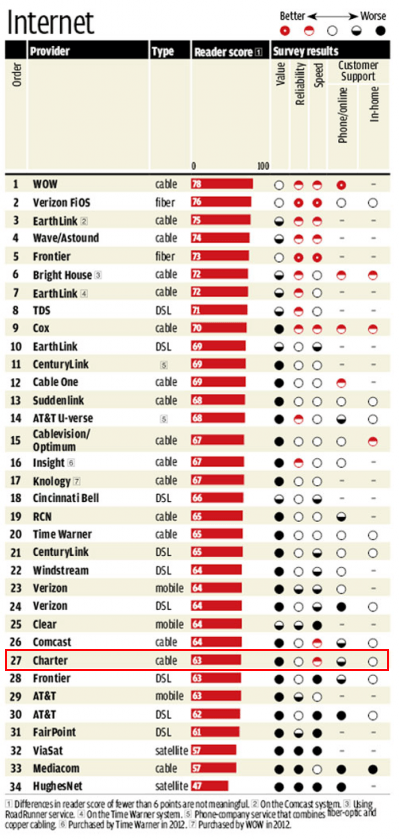
Charter is America's second worst rated cable company. (Consumer Reports, 2013)

Charter is America’s second worst rated cable company. (Consumer Reports, 2013)

On its face, Charter’s plan for Time Warner Cable doesn’t look all bad, but execution is critical and Charter has a long-standing and very poor record of customer satisfaction, typically ranked in consumer surveys as America’s second worst cable operator year after year.

Should Charter win control of Time Warner Cable, big changes will be in store for TWC customers under the Charter umbrella:

  • Analog television would be phased out, along with “limited basic” packages. Charter wants to repurpose analog spectrum for faster Internet speeds, but that also means video customers will be required to get more set-top boxes;
  • Eliminate “Switched Digital Video” technology now in place on TWC systems. SDV is a bandwidth saver – only delivering digital TV signals customers in a particular neighborhood are actively watching. But those using inexpensive digital-to-analog set-top boxes on analog-only televisions can’t watch SDV channels, inconveniencing customers;
  • Increase the number of HD channels to 200+;
  • All residential set-top boxes would now support HD signals at no added cost and customers will be able to get up to four DVR boxes for $20 a month;
  • Time Warner Cable’s new minimum Internet speed would be 30Mbps with much faster added-cost tiers available, but usage caps will apply;
  • Time Warner Cable’s phone product would be repriced at $30 a month in the first year, $20 in the second with all calling features and voicemail included;
  • No term contracts will be offered and modem rental fees, regulatory surcharges, added taxes on Internet and Phone, and service visit fees will no longer be charged.

Charter customers can expect aggressive sales pitches for their “high value” triple-play bundle which may include services customers don’t want at a price that is largely non-negotiable. The more boxes and services you add, the greater the discount you will receive. In contrast, Time Warner Cable began de-emphasizing its triple play promotions in early 2012 and now aggressively promotes single and double play packages that typically omit phone service.

Unlike TWC, Charter has been more difficult when trying to negotiate customer retention discounts. Charter generally charges the same prices everywhere.

Their proposed offer for Time Warner customers will be a triple play offer starting at $110 a month for the first 12 months, then increase $20 in the second year to $130 a month and in year three the price will rise again to $150 a month. Charter’s typical “step-up” pricing is in $20 increments.

Charter is reluctant to allow customers to add or drop package components, so for most customers packages will be all-inclusive with no discounts for dropping channels or features. That means customers will likely end up with more television channels, more phone features, and faster Internet speeds, but at the cost of an eventually higher cable bill.

Any buyout could also mean some Time Warner Cable territories could be put up for sale to a third-party. Charter is especially interested in the New York and Los Angeles markets, but may have little interest in western New York and Ohio, New England, Kentucky and Wisconsin. Any orphaned TWC customers would likely be snapped up by companies like Comcast, which may join Charter’s takeover bid.

Any sale would need approval by the Federal Communications Commission and potentially the Justice Department’s Antitrust Division, especially in Comcast becomes involved.

[flv]http://www.phillipdampier.com/video/CNBC Tom Rutledge Explains Charter Offer for TWC 1-15-14.mp4[/flv]

Time Warner Cable rejected a merger proposal from Charter Communications. Tom Rutledge, Charter Communications president and CEO, explains the offer as he describes as “rich and fair.” We feel like we’ve come a far way and have not received a serious response, Rutledge says. A CNBC exclusive. (4:35)

Before Being Lured Away from T-Mobile With Promises of $450 from AT&T, Read the Fine Print

Phillip Dampier January 8, 2014 AT&T, Competition, Consumer News, Data Caps, T-Mobile, Video, Wireless Broadband Comments Off on Before Being Lured Away from T-Mobile With Promises of $450 from AT&T, Read the Fine Print

switchAT&T is offering T-Mobile customers — and only T-Mobile customers — up to $450 to switch their wireless service to AT&T, but is the switch actually worth it? A close inspection of AT&T’s fine print suggests some customers might want to think twice.


According to AT&T, beginning Jan. 3, under the limited-time offer, T-Mobile customers who switch to AT&T can trade-in their current smartphone for a promotion card of up to $250, which can be used toward AT&T products and services.  Trade-in values will vary based on make, model and age of the smartphone, but many of the latest and most popular smartphones will qualify for a value of $250.  T-Mobile customers can receive an extra $200 credit per line when they transfer their wireless service to AT&T and choose an AT&T Next plan, buy a device at full retail price or activate a device they currently own. The “Next” plan offers customers a chance to upgrade to a new device every year under an installment plan that divides the retail price of the phone over 20 months.

[flv]http://www.phillipdampier.com/video/CNN The Most Dangeous Man in Wireless 1-8-14.flv[/flv]

The Wall Street Journal’s ‘Digits’ explores the open marketing warfare between AT&T and T-Mobile. (3:34)

Although $450 sounds like an outstanding deal, some Wall Street analysts that usually panic when a company seems to be giving away the store, are still sleeping well at night.

“It’s not as great an offer as it appears on the surface,” Michael Hodel, equity analyst at Morningstar tells MarketWatch. “The fine print is critical.”

  1. Not every smartphone will qualify for the $250 “promotional card.” Only the latest model smartphones showing no signs of wear and tear are going to earn full value. Customers with older feature or basic phones will not qualify for anything at all. Customers may be able to get just as much selling their old phone themselves.
  2. AT&T is not offering a cash rebate. The value of the “promotional card” and the $200 ‘switch from T-Mobile’ bonus can only be spent on AT&T products and services. The promotional card will help defray the cost of buying a new smartphone from AT&T (which may not have the best price) and the $200 bonus will appear as a credit on a future AT&T bill.
  3. By accepting the $200 bonus, customers give up any device subsidies, an important distinction if you want an Apple iPhone. AT&T’s device subsidy on this phone is higher than $200.
  4. AT&T has tighter credit standards than T-Mobile. Customers with spotty credit may be asked to put down a deposit with AT&T before the company will take your business.
Legere

Legere

AT&T argues its offer will benefit T-Mobile customers by giving them access to the larger coverage area of AT&T’s wireless network and more widespread 4G service. But AT&T customers pay higher prices for access to that network. A T-Mobile customer is more likely to be sensitive to the price of the service — one of the strongest marketing points T-Mobile has in its favor. Most customers unhappy with T-Mobile’s less robust coverage tend to cancel service at the end of their contract (or earlier) and switch to either AT&T and Verizon Wireless.

According to an October report from MoffettNathanson Research, a typical T-Mobile family with 3-5 lines on a single account usually save around $50 a month off AT&T’s prices. That represents $600 a year in savings.

T-Mobile’s scrappy and aggressive marketing has had an impact, particularly on AT&T. Just a few years earlier AT&T tried to buyout T-Mobile in a consolidation move rejected by the Justice Department’s Antitrust Division. After the merger collapsed, incoming T-Mobile CEO John Legere has long forgotten whatever niceties existed between the two companies when they were trying to join forces. Legere has been on the attack against both AT&T and Verizon Wireless all year, and the effort is clearly beginning to pay off as T-Mobile adds customers.

Last year at the Consumer Electronics Show (CES) Legere called AT&T’s network “crap” on stage. So when Legere crashed AT&T’s party at this year’s CES convention, still sporting his pink T-Mobile t-shirt, AT&T’s security guards threw him out.

[flv]http://www.phillipdampier.com/video/CNN The Most Dangeous Man in Wireless 1-8-14.flv[/flv]

CNN calls T-Mobile’s John Legere the most dangerous man in wireless, for exposing “disgusting” AT&T and Verizon’s over 90% gross margin on their wireless services and their consumer unfriendly business practices. (2:41)

AT&T Subject of a Movie Script; Company Demanded Operators Help Nigerian Scammers

Phillip Dampier December 10, 2013 AT&T, Consumer News, Public Policy & Gov't Comments Off on AT&T Subject of a Movie Script; Company Demanded Operators Help Nigerian Scammers

attrelayAT&T supervisors ordered operators to aid Nigerian fraudsters making free calls that cost millions in credit card fraud and the life savings of some victims, while AT&T collected more than $16 million in reimbursements paid by telephone ratepayers across the country.

Last week, AT&T admitted no wrongdoing but agreed to pay a $3.5 million settlement to the operator the company fired after complaining about widespread fraudulent use of a service intended to help the hearing and speech impaired.

The story is now the subject of a movie script, reports The New Castle News. It begins in 2003, when AT&T was required by the Americans with Disabilities Act to provide operators willing to relay conversations from hearing or speech impaired individuals typing on a computer or device and the people they called.

AT&T employed at least 150 operators at a western Pennsylvania call center in a former shopping mall just to assist with international relay calls. One of them was Constance Lyttle.

new castleAT&T’s international relay service offered those overseas the opportunity to make a free, untraceable relay phone call to any number in the United States. AT&T billed the FCC-administered fund $1.30 a minute for calls placed through the relay operator.


The service quickly became popular… with Nigerian scammers who used it to make free calls to American businesses. In fact, according to a lawsuit filed in 2010, around 95 percent of all calls placed through AT&T’s international relay service came from con artists peddling various scams and ordering merchandise with stolen credit cards from unsuspecting businesses.

The Nigerians used hard-to-track public Internet terminals to initiate calls through AT&T’s relay center. An AT&T operator would read the words typed by the con artist over the phone to the person called and type back any responses.

Lyttle testified the usual target for the scam was a unknowing small business willing to accept credit card orders from Nigeria or an individual willing to advance their life savings in return for promised larger payout unlocked by their deposit. It was all made possible with the help of AT&T, which earned several dollars for every successfully completed call.

Lyttle said the operators in the call center immediately understood what was going on and complained repeatedly about the abuse of the system. In response, AT&T “made workers sign agreements that they would put through the scam and fraudulent calls, and they actually used those words,” said Lyttle’s attorney, who also happens to be her sister. “The workers at the call center were afraid they would lose their jobs. AT&T paid very well and good-paying jobs are hard to come by in western Pennsylvania.”

Nigerians exploited the AT&T Relay service call center located at this former mall in New Castle, Penn.

Nigerians exploited the AT&T Relay service call center located at this former mall in New Castle, Penn.

The lawsuit against AT&T alleged the phone company had full knowledge of what was going on but didn’t want to lose a lucrative contract that resulted in at least $16 million in reimbursements.

“They were getting $1.30 per minute for these calls,” said Lyttle’s attorney. “Think about the volume of calls that were being made.”

Lyttle’s attorney said Constance would sabotage some calls to stop the fraud, falsely claiming the party at the other end had hung up. Her 2010 lawsuit alleged her effort to protect the public from Nigerian scam artists was the reason she was fired in 2010 after 13 years with AT&T.

Her lawsuit soon attracted the interest of the U.S. Department of Justice. In March 2012, the federal agency joined the case. Lyttle was designated a “whistleblower” and her involvement in the federal lawsuit was initially kept secret. Earlier this year AT&T agreed to reimburse the Federal Communications Commission more than $18 million for abandoning their responsibility to block the overseas scammers not qualified to use the relay service. AT&T also admitted a percentage of callers did use the service for illicit purposes.

Lyttle herself received a settlement proposal of $3.5 million in her whistleblower case. AT&T also offered her old job back but she turned them down, saying she preferred her current part-time job over returning to AT&T.

It’s just as well. The New Castle, Penn. call center at the epicenter of more than $20 million in reimbursements and settlements was ordered closed by an unnamed AT&T executive in November.

“I was told 125 employees would lose their jobs in the next 12 to 15 months,” said New Castle Mayor Anthony Mastrangelo. “I don’t know if the local people will lose their jobs or have the option to be transferred.”

How to Get a Better Deal for Verizon FiOS; $79.99 Triple-Play Offer With $300 Rebate Card

Cablevision CEO Jim Dolan may have to eat his words when he told shareholders he was done giving promotional discounts to customers bouncing back and forth between competing providers. Now Verizon has given Cablevision customers an excuse to say goodbye to the cable company for at least the next two years.

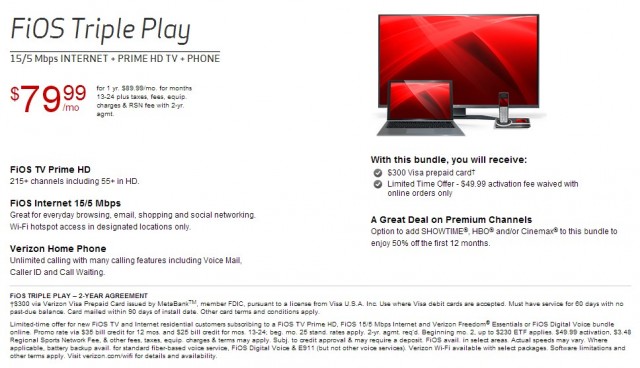
The Verizon FiOS $79.99 Triple Play promotion is back and includes a $300 Visa rebate card and free activation when ordering from Verizon’s website.

fios triple play

The package includes:

  • FiOS TV’s “Prime HD” tier, which includes around 215 channels, 55+ in HD. (See channels);
  • FiOS Basic Internet (15/5Mbps), upgradeable to 50/25Mbps for $10 more per month;
  • Verizon Home Phone including unlimited calling and features including Voice Mail, Caller ID and Call Waiting;
  • a 50% optional discount off HBO and Cinemax for one year.

The fine print:

  • Promo rate shows up on your Verizon bill as a $35 credit during months 1-12 and a $25 credit for months 13-24. That means you will pay $79.99 for the first year, $89.99 for the second. Factoring in the $300 gift card, your rate is still under $88 a month for two years;
  • Offer for new FiOS customers only. (Existing customers – see below);
  • A $230 early termination fee applies to this 2-yr contract offer, with the dollar amount gradually decreasing for each month of service;
  • Equipment costs, a $3.48 Regional Sports Network fee, taxes, franchise fees and other similar charges are extra.

fiosHere are some tips for current FiOS customers:

  1. Current FiOS customers may be able to negotiate a very similar deal (without the gift card) by talking to Verizon’s “Elite Team,” a/k/a Customer Retentions. Call Verizon’s customer service line (1-800-837-4966) and select the option to cancel service and your call will be transferred.
  2. Customers off-contract will have the best results securing a new promotional deal. On-contract customers nearing the end of their agreement can suggest they are willing to pay the last few months of a pro-rated early termination fee to leave if they cannot get a better deal with Verizon.
  3. Let the representative know you can always cancel your existing service and take advantage of a new customer promotion under your spouse’s name, but “to save both of us time and aggravation, let’s work out a comparable deal with my existing service.”
  4. Verizon often has one-year customer retention deals available that do not impose any term commitments. Make sure to ask the representative about no-contract options, if not volunteered, because certain off-contract retention deals can actually cost less. It is very unlikely you will get the gift card, but you might be able to win a one time courtesy credit.
  5. Request a free upgrade to Verizon FiOS Quantum (50/25Mbps service) as part of a retention deal.

Earlier this year, customers told Stop the Cap! they had success securing a 12 month, no-contract retention offer that included a mid-range television package, 50/25Mbps broadband, and home phone service for $95 a month with an invitation to call back and sign up for a similar deal one year later.

Verizon’s pricing is very aggressive and beats both Cablevision and Comcast in the northeast.

Cablevision now offers a triple play bundle for $84.95 a month for one year that doesn’t include installation charges or other ancillary equipment, service, programming, taxes, and franchise fees. Cablevision isn’t offering a $300 gift card either. But the cable company does include a free Smart Router and free Optimum Online Ultra 50 for six months.

A similar two-year promotion from Comcast runs $89 a month in northern New Jersey and includes a $300 gift card and then a nasty surprise after the first year. Once a customer reaches month 13, the promotional rate increases to a whopping $109.99 for the remainder of the two-year agreement — quite an increase. The Comcast promotion also offers far fewer television channels (80+), but does bundle HBO and X1 Advanced DVR service for one year, includes 20Mbps download speeds, and Streampix free for three months. The usual extra fees also apply.

Search This Site:

Contributions:

Recent Comments:

Your Account:

Stop the Cap!