Home » Cell site » Recent Articles:

Verizon Making Storm Preparations for Sandy’s Impact on Landline/Wireless Network

Phillip Dampier October 29, 2012 Consumer News, Verizon, Wireless Broadband Comments Off on Verizon Making Storm Preparations for Sandy’s Impact on Landline/Wireless Network

Verizon Communications is on high alert to monitor the potential impact of Hurricane Sandy on the company’s landline, FiOS, and wireless networks — primarily from line damage and extended power outages that could come as a consequence of the slow-moving Category 1 hurricane. Top wind speeds from Sandy have been upgraded this morning to 90mph, making the storm’s impact even more severe for residents along the Atlantic coastline.

Verizon retail outlets are stocking up on car phone chargers and universal charging devices to help customers who endure extended power outages, but some retail stores may close early or stay closed if local weather conditions warrant.

Non-essential construction projects and internal training programs have been suspended so the company can focus on network repairs, as needed.

Verizon wireline and wireless business units have activated national and regional command and control centers, enabling Verizon operations teams to monitor the storm’s progress and company operations, including network performance. Verizon has established communications with power and other service providers to ensure proper coordination in the event of storm damage. The company also has contacted vendors and other outside partners so that critical communications equipment and supplies can be prioritized, stocked and shipped as needed.

Company equipment — including poles, fiber-optic and copper cable, portable cell sites that can replace a damaged cell tower and mobile emergency generators that can be used when local electrical power fails — is being staged in and around the mid-Atlantic and Northeast regions.

Verizon is the dominant phone company and wireless provider in the northeastern U.S.

In addition, Verizon managers are communicating the company’s storm preparation efforts and coordinating pre-planned response activities with the public-safety community, as well as state, county and municipal agencies along the East Coast and the Midwest.

“Verizon Wireless stands ready to serve our customers, and I urge everyone first and foremost to stay safe,” said Dan Mead, president and CEO of Verizon Wireless. “We live and work in the towns and cities in the storm’s path, and we are dedicated to keeping our friends, families and neighbors connected in times like these. We prepare for situations like this year-round, and pride ourselves in our ability to be there for our customers when they count on us most.”

As Sandy’s track came more into focus, the company began communicating with its customers on Friday, posting consumer tips on various company websites, issuing a news release to media outlets in the threatened region and nationally, engaging customers through social media such as Twitter and Facebook, and sending emails to consumers, with key links for troubleshooting and reporting service problems.

Bob Mudge, president of Verizon’s Consumer and Mass Business division, said: “In addition to communicating with customers and ensuring that we will be working to keep the network operating and responding quickly to issues as they arise, we have reminded our employees of the need to work safely, be alert, and help our customers in any way they can. But our people know this well and are at their best in these critical situations when our customers depend on us the most.”

Mudge noted that even though Verizon technicians may be ready to repair storm-damaged Verizon facilities, they may have to wait for approval from local power companies, first-responders or law enforcement before beginning restoration work.

Customers may contact Verizon online at www.verizon.com/outage to report any wireline service-related issues; or call 1-800-VERIZON (1-800-837-4966). Business customers are advised to contact their regular customer service centers or account teams as needed.


Halloween Scare Stories: Controlling the “Spectrum Shortage” Data Tsunami With Rate Hikes, Caps

Phillip Dampier October 25, 2012 Astroturf, AT&T, Broadband "Shortage", Competition, Consumer News, Data Caps, Editorial & Site News, Public Policy & Gov't, Sprint, T-Mobile, Verizon, Video, Wireless Broadband Comments Off on Halloween Scare Stories: Controlling the “Spectrum Shortage” Data Tsunami With Rate Hikes, Caps

Phillip “Halloween isn’t until next week” Dampier

Despite endless panic about spectrum shortages and data tsunamis, even more evidence arrived this week illustrating the wireless industry and their dollar-a-holler friends have pushed the panic button prematurely.

The usual suspects are at work here:

  • The CTIA – The Wireless Association is the chief lobbying group of the wireless industry, primarily representing the voices of Verizon, AT&T, Sprint, and T-Mobile. They publish regular “weather reports” predicting calamity and gnashing of teeth if Washington does not immediately cave to demands to open up new spectrum, despite the fact carriers still have not utilized all of their existing inventory;
  • Cisco – Their bread is buttered when they convince everyone that constant equipment and technology upgrades (coincidentally sold by them) are necessary. Is your enterprise ready to confront the data tsunami? Call our sales office;
  • The dollar-a-holler gang – D.C. based lobbying firms and their astroturf friends sing the tune AT&T and Verizon pay to hear. No cell company wants to stand alone in a public policy debate important to their bottom line, so they hire cheerleaders that masquerade as “research firms,” “independent academia,” “think tanks,” or “institutes.” Sometimes they even enlist non-profit and minority groups to perpetuate the myth that doing exactly what companies want will help advance the cause of the disenfranchised (who probably cannot afford the bills these companies mail to their customers).

Tim Farrar of Telecom, Media, and Finance Associates discovered something interesting about wireless data traffic in 2012. Despite blaring headlines from the wireless industry that “Consumer Data Traffic Increased 104 Percent” this year, statistics reveal a dramatic slowdown in wireless data traffic, primarily because wireless carriers are raising prices and capping usage.

The CTIA press release only quotes total wireless data traffic within the US during the previous 12 months up to June 2012 for a total of 1.16 trillion megabytes, but doesn’t give statistics for data traffic in each individual six-month period. That information, however, can be calculated from previous press releases (which show total traffic in the first six months of 2012 was 635 billion MB, compared to 525 billion MB in the final six months of 2011).

Counter to the CTIA’s spin, this represents growth of just 21 percent, a dramatic slowdown from the 54 percent growth in total traffic seen between the first and second half of 2011. Even more remarkably, on a per device basis (based on the CTIA’s total number of smartphones, tablets, laptops and modems, of which 131 million were in use at the end of June), the first half of 2012 saw an increase of merely 3 percent in average wireless data traffic per cellphone-network connected device, compared to 29 percent growth between the first and second half of 2011 (and 20-plus percent in prior periods).

[…] What was the cause of this dramatic slowdown in traffic growth? We can’t yet say with complete confidence, but it’s not an extravagant leap of logic to connect it with the widely announced adoption of data caps by the major wireless providers in the spring of 2012. It’s understandable that consumers would become skittish about data consumption and seek out free WiFi alternatives whenever possible.

Farrar

Cisco helps feed the flames with growth forecasts that at first glance seem stunning, until one realizes that growth and technological innovation go hand in hand when solving capacity crunches.

The CTIA’s alarmist rhetoric about America being swamped by data demand is backed by wireless carriers, at least when they are not talking to their investors. Both AT&T and Verizon claim their immediate needs for wireless spectrum have been satisfied in the near-term and Verizon Wireless even intends to sell excess spectrum it has warehoused. Both companies suggest capital expenses and infrastructure upgrades are gradually declining as they finish building out their high capacity 4G LTE networks. They have even embarked on initiatives to grow wireless usage. Streamed video, machine-to-machine communications, and new pricing plans that encourage customers to increase consumption run contrary to the alarmist rhetoric that data rationing with usage caps and usage pricing is the consequence of insufficient capacity, bound to get worse if we don’t solve the “spectrum crisis” now.

So where is the fire?

AT&T’s conference call with investors this week certainly isn’t warning the spectrum-sky is falling. In fact, company executives are currently pondering ways to increase data usage on their networks to support the higher revenue numbers demanded by Wall Street.

If you ask carriers’ investor relations departments in New York, they cannot even smell smoke. But company lobbyists are screaming fire inside the D.C. beltway. A politically responsive Federal Communications Commission has certainly bought in. FCC chairman Julius Genachowski has rung the alarm bell repeatedly, notes Farrar:

Even such luminaries as FCC Chairman Julius Genachowski has stated in recent speeches that we are at a crisis point, claiming “U.S. mobile data traffic grew almost 300 percent last year” —while CTIA says it was less than half that, at 123 percent. “There were many skeptics [back in 2009] about whether we faced a spectrum crunch. Today virtually every expert confirms it.”

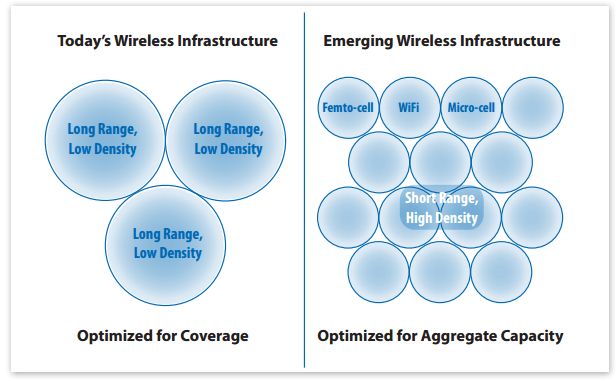
A smarter way of designing high capacity wireless networks to handle increased demand.

So how are consumers responding to the so-called spectrum crisis?

Evidence suggests they are offloading an increasing amount of their smartphone and tablet traffic to free Wi-Fi networks to avoid eroding their monthly data allowance. In fact, Farrar notes Wi-Fi traffic leads the pack in wireless data growth. Consumers will choose the lower cost or free option if given a choice.

So how did we get here?

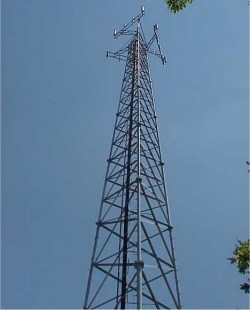
When first conceived, wireless carriers built long range, low density cellular networks. Today’s typical unsightly cell tower covers a significant geographic area that can reach customers numbering well into the thousands (or many more in dense cities). If everyone decides to use their smartphone at the same time, congestion results without a larger amount of spectrum to support a bigger wireless data “pipe.” But some network engineers recognize that additional spectrum allocated to that type of network only delays the inevitable next wave of potential congestion.

Wi-Fi hints at the smarter solution — building short range, high density networks that can deliver a robust wireless broadband experience to a much smaller number of potential users. Your wireless phone company may even offer you this solution today in the form of a femtocell which offloads your personal wireless usage to your home or business Wi-Fi network.

Some wireless carriers are adopting much smaller “cell sites” which are installed on light poles or in nearby tall buildings, designed to only serve the immediate neighborhood. The costs to run these smaller cell sites are dramatically less than a full-fledged traditional cell tower complex, and these antennas do not create as much visual pollution.

To be fair, wireless growth will eventually tap out the currently allocated airwaves designated for wireless data traffic. But more spectrum is on the way even without alarmist rhetoric that demands a faster solution more than  a smart one that helps bolster spectrum -and- competition.

Running a disinformation campaign and hiring lobbyists remains cheaper than modifying today’s traditional cellular network design, at least until spectrum limits or government policy force the industry’s hand towards innovation. Turning over additional frequencies to the highest bidder that currently warehouses unused spectrum is not the way out of this. Allocating spectrum to guarantee those who need it most get it first is a better choice, especially when those allocations help promote a more competitive wireless marketplace for consumers.

[flv width=”600″ height=”358″]http://www.phillipdampier.com/video/KGO San Francisco FCC considers spectrum shortage 9-12-12.flv[/flv]

KGO in San Francisco breaks down the spectrum shortage issue in a way ordinary consumers can understand. FCC chairman Julius Genachowski and even Google’s Eric Schmidt are near panic. But the best way to navigate growing data demand isn’t just about handing over more frequencies for the exclusive use of Verizon, AT&T and others. Sharing spectrum among multiple users may offer a solution that could open up more spectrum for everyone.  (2 minutes)

AT&T Blamed for Oakland’s Public Safety Communications Interference; Partial 2G Shutdown

AT&T is being fingered as the party responsible for rendering Oakland’s $18 million dollar P25 digital public safety radio communications system unreliable, because police and fire radios are often inoperable near the company’s cell towers.

After more than a year of repeated failures and complaints from Oakland police over garbled communications, dead spots, and reception problems, investigators dispatched from the Federal Communications Commission finally identified the source of most of the problems: AT&T.

“If the officer is in an area close to one of their cell sites, essentially the cell site overpowers their radios,” said David Cruise, Oakland’s public safety systems adviser.

The system, built by Harris Corporation of Melbourne, Fla. is suspected of being intolerant of strong cell signals operating on nearby frequencies. The digital nature of the system means degraded communications often go unheard, and firefighters and police officers have complained loudly and repeatedly they have been unable to summon dispatchers while experiencing interference problems. The investigation found the problems are worst within a quarter to a half-mile from one of AT&T’s many cell sites.

The source of the interference is AT&T’s 2G network, operated on 850MHz. Oakland’s public safety P25 system operates on multiple frequencies nearby from 851-854MHz.

Under federal law, public safety communications have priority over cell phone service, and AT&T has cooperated by shutting down 2G service on 850MHz on at least 16 cell towers, immediately reducing complaints from police officers and firefighters.

“AT&T would never do anything to jeopardize law enforcement,” AT&T spokesman John Britton told the San Francisco Chronicle. “This spectrum has been out there since the 1990s. Thursday or Friday was the first time we were notified by Oakland. We reacted quickly.”

AT&T won’t say exactly how many cell sites are located in Oakland, but there are more than 1,000 AT&T-owned towers across the greater San Francisco Bay Area. Oakland officials plan to press AT&T to shut down more 2G data service on 850MHz until a solution can be found.

AT&T says only customers with the oldest phones are likely to notice the network shutdowns, because most current customers use 3G or 4G data service, which has not posed an interference problem. AT&T says it still maintains 2G service in San Francisco on 1900MHz, which should be accessible to customers with older phones, although the service may not operate as well on the higher frequency band when obstructions are present between a cell phone user and the nearest cell tower.

Representatives for law enforcement personnel hope the city is on the right track, but point out the Harris-built digital radio system has been nothing but trouble since it was first activated. The system has suffered repeated glitches, does not work inside hundreds of area buildings, and failed the night President Obama visited Oakland in July. Some critics note the Harris system does not even provide reception in the basement of Oakland’s police headquarters.

City officials are also investigating other contributing potential sources of interference, including T-Mobile, which also operates on similar frequencies in the area.

Ironically, the interference problem may have begun after Sprint Nextel committed to spending over a billion dollars to cover the costs of relocating public safety communications further away from its own cellular frequencies. Sprint Nextel paid $10.5 million to move Oakland’s radio system to a frequency further from its own network, but as it turns out, closer to AT&T’s.

[flv width=”640″ height=”380″]http://www.phillipdampier.com/video/KCBS San Francisco Oakland Police Radios Failed During Presidents Visit 7-26-12.mp4[/flv]

KCBS in San Francisco has been pursuing the dilemma of Oakland’s public safety communications system for months. Back in July, police were alarmed when the radio system failed the night President Obama arrived in town.  (3 minutes)

[flv width=”640″ height=”380″]http://www.phillipdampier.com/video/KCBS San Francisco Closer Look Oakland Police Fed Up With Flawed Radio System 8-14-12.mp4[/flv]

Oakland police are fed up with the year-old $18 million dollar emergency radio system that they say simply does not work. KCBS investigates in this mid-August report.  (4 minutes)

[flv width=”640″ height=”380″]http://www.phillipdampier.com/video/KCBS San Francisco ATT Cellphone Towers Blamed For Oakland Police Radio Failures 8-21-12.mp4[/flv]

Investigators from the Federal Communications Commission finally identified a major source of Oakland’s radio problems: AT&T cell sites.  (2 minutes)

New Cell Tower Nightmare: Industry Canada Math Intrudes on Reality

Phillip Dampier June 13, 2012 Canada, Consumer News, Public Policy & Gov't, Vidéotron, Wireless Broadband Comments Off on New Cell Tower Nightmare: Industry Canada Math Intrudes on Reality

Canadians: Get ready for more cell towers in your neighborhood.

Industry Canada’s fuzzy math threatens to allow cell phone companies to erect new cell towers in some of the country’s most scenic areas, which often coincidentally offer the best reception.

Residents in Pontiac, Quebec are learning that first-hand, as Industry Canada approves a controversial proposal from Vidéotron to install an 82-meter cell tower in the middle of a vista that tourist officials use in brochures to promote travel in the Ottawa River region.

It turns out the regulator now only considers an antenna’s base as a factor in determining whether to approve a new cell tower. That base amounts to just one square meter, “too small” by Industry Canada’s standards to conduct an environmental assessment. No matter that the antenna will tower nearly 270 feet into the skyline. Industry Canada is only interested in measuring the three legs of the tower (each leg is evaluated individually, not collectively), and at just one tiny meter, it isn’t worth their time.

That means local residents will have to contend with a new tower 25-stories high. As the Ottawa Citizen puts it, Vidéotron’s tower is smaller in the government’s eye than any pre-fabricated garden shed from Home Depot, which often requires a permit to install.

The new tower will be installed on Hurdman Heights, much to the consternation of area residents and naturalists opposed to its presence, ruining what many call the most scenic place in the region.

The local government of Pontiac has opposed the new Vidéotron tower since it was first announced, but the cable/wireless company pulled an end run around the municipality claiming there was a negotiating impasse and local officials would not meet to work it out, a good enough reason for the regulator to approve the new tower. Pontiac Mayor Eddie McCann says there was no impasse and the local council has been trying hard to reach a deal with the telecommunications company and never cut off talks:

“I myself had two or three meetings on sites with the representatives of Vidéotron,” he said. “As far as saying we were not responsive or willing to discuss — it’s pretty near stupid. We even offered our own municipal land as an option but they said it was too far between their existing towers.” He was exploring other possible sites as well.

“In fact it was Industry Canada that were non-responsive to us,” he said. “They accepted the proposal of Vidéotron without consulting us at all.”

And he believes Industry Canada could impose the same authority in any municipality.

“Certainly for anybody from Industry Canada to say that the municipality wasn’t interested in working out an arrangement was just ridiculous.”

Resident James Riordan wrote to Minister Christian Paradis last month objecting that the “impasse” was a misunderstanding somewhere, and had in fact never occurred.

A letter from the minister’s office tells him to take his objection to Vidéotron, and adds “the Department considers the matter closed.”

Rogers Relents: Company Starts to Give on Controversial Backyard Cell Towers in PQ

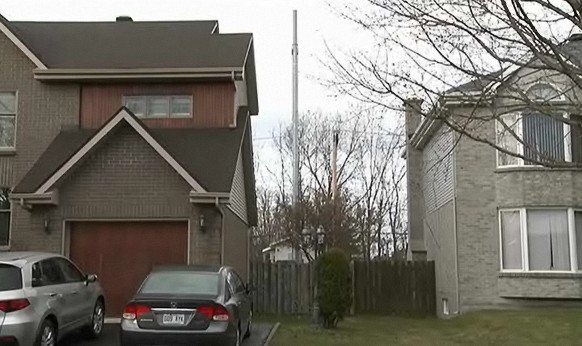
This monopole cell tower antenna just showed up one day in the backyard of this Kirkland, PQ resident.

Kirkland, Que. residents are encouraged by news Rogers Communications has begun to relent on installing nearly-15 meter-high monopole cell towers in residential neighborhoods after the company agreed to relocate a similar antenna in Dorval.

Neighbors in both communities are upset Rogers has located new antennas that tower over homes and trees in residential areas, often in the backyards of residents who permit their presence in return for a monthly check.

The Dorval tower was particularly obtrusive to residents, installed in a city right-of-way adjacent to Morris Avenue. Residents there complained about possible health effects of the nearby tower, and called it an eyesore.

Rogers has now agreed to relocate the antenna to the nearby Sarto Desnoyers Community Centre at company expense.

When the new towers suddenly appear, nearby neighbors feel sandbagged. One Kirkland resident told The Gazette the towers are monstrosities. But Rogers is within the law if it keeps the towers below the 15 meter mark, and the company does not require advance zoning or government approval.

Rogers defends the towers, claiming the unprecedented demand for cellular service requires the company to get creative in finding new places to fill in coverage gaps. Unfortunately, with a shrinking number of suitable commercial or industrial locations, the company has been forced to consider residential installations.

Stop the Cap! has been following the Kirkland tower saga for several weeks. The Gazette reports no immediate progress has been made to get Rogers to relocate that specific antenna, but the company’s responsiveness in Dorval gives local officials and residents optimism an agreement can be reached in Kirkland as well.


Search This Site:

Contributions:

Recent Comments:

Your Account:

Stop the Cap!