Home » Providers » Recent Articles:

Sprint CEO Says Provider “Could” Discontinue Unlimited Pricing, But Not Now

Phillip Dampier September 22, 2010 Competition, Data Caps, Sprint, Wireless Broadband 2 Comments

Sprint CEO Dan Hesse told a crowd of Wall Street investors the wireless provider could drop unlimited wireless pricing if the costs to deliver it begin to upset shareholders.

“We are watching very closely,” Hesse said during a Goldman Sachs-sponsored conference.

“Clearly, I’m not ruling out metered [price packages],” he said. “But customers value simplicity.”

While Hesse stressed the company had no immediate plans to drop its “Simply Everything” plans, it does acknowledge a small percentage of its customers are using enough of Sprint’s network to cost the company more than it earns from its heavy users.

But Hesse argued the marketing benefits of unlimited service may have brought the number three wireless carrier more business (and revenue) than it loses.  Sprint has been trying to recapture a stronger position in the wireless market lost after years of notoriously poor customer service and reduced coverage areas.

Most customers who left Sprint switched to AT&T or Verizon Wireless.  Both of its larger competitors have been seeking to impose more usage limits on its customers, especially for data.  Sprint hopes to win some of them back, but Hesse admits the company still has a long way to go to improve customer numbers.

AT&T Sticks Texas Students With Lousy Wi-Fi Service They’re Forced to Pay to Receive

Phillip Dampier September 22, 2010 AT&T, Broadband Speed, Wireless Broadband 1 Comment

University of Texas students living in a Richardson on-campus apartment complex are stuck paying a mandatory $15 monthly “technology fee” for AT&T-provided Wi-Fi service that works so poorly, many residents are signing up with other providers and paying twice for Internet access.

Residents of Waterview Park have complained about Wi-Fi access inside the complex for some time, but they were never forced to pay for it until May, when the complex’s governing board notified residents that the mandatory fee would be imposed once AT&T took over the service.

Although AT&T doesn’t bill for, or collect the fee, they do provide the service, and students have complained loudly about its weak signals and poor performance.

The Mercury, the university newspaper, ran a story this weak outlining the complaints:

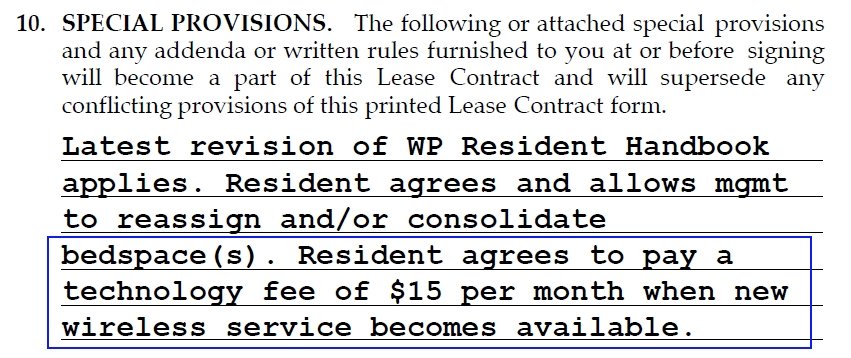
A sample lease agreement obtained from Waterview shows the mandatory technology fee of $15/month.

Computer science junior Kenny Rodriguez said the problems stem from the use of hotspot Wi-Fi as residential internet for students. Hotspot Wi-Fi generally broadcasts an internet signal from a fixed location that becomes weaker the further you move away from it.

“When I was living in building 29, my roommates and I could only pick up a signal by standing in one corner of the living room,” junior Michael Stettler said.

Stettler and his roommates moved to building 31 and are now able to pick up a signal in two of their bedrooms, albeit a slow one.

Rodriguez, who lives in building 8, can only pick up a signal in his living room and sometimes can’t even log on to use it.

“Frequently, the access points are broadcasting but aren’t routing traffic anywhere,” Rodriguez said.

Once a student finds a place in his apartments where a signal can be received, the speed of the connection becomes a problem because the more students who share the available bandwidth the slower the speed becomes.

“It was decently fast at the beginning of this school year, then when everyone came back for fall it crawled to like a tenth or a fifth of a MB per second,” Stettler said.

Waterview’s management has been forced to issue refunds of up to $30 to affected students for poor or non-existent service, but the complex won’t waive the ongoing monthly fee, despite the fact the service can’t deliver much more than 1Mbps on a good day.

Several residents opted to sign up with other providers instead, paying $30 a month or more for service they can actually use.  Stettler and his three roommates decided it was worth it and signed up with Time Warner Cable for 15Mbps service.

The student newspaper took note of another bulletin issued by Waterview management issued August 31 that claimed every resident would have reliable internet within the next 7-14 days or else a non-specific contingency plan would be implemented.

“Nobody has actually stated what will happen if AT&’T doesn’t make their service reliable,” Rodriguez told the paper.” They’ve just vaguely implied that something will happen.”

Twenty-two days later, students report no verifiable improvements have been made in the reliability of the network or the service.

Cablevision Chief Warns of Consumer Revolt, Tells Operators to Exercise “Restraint” in Cable Rates

Phillip Dampier September 22, 2010 Cablevision (see Altice USA), Consumer News, Video 1 Comment

Dolan

Cablevision Systems CEO James Dolan warned cable executives the combination of rate increases and the poor economy could spark a consumer revolt, driving a legislative agenda that could force a-la-carte pricing on cable companies.

“At some point you reach a point where the consumer rebels,” Dolan said. “You’re likely to see that in a reaction in Washington on the government side because it will become a politically easy issue for politicians to jump on and a-la-carte [pricing] is an obvious answer. But the impact of a-la-carte on the programming industry would be devastating. It behooves all the participants to exercise restraint.”

Dolan pointed to high unemployment and a deterioration in earnings among those still employed combined with continuing rate increases as a potentially dangerous combination.  Dolan was especially concerned about payments for local broadcasters and major broadcast networks which have sparked high-profile carriage battles.  Earlier this year, Cablevision briefly dropped programming from ABC and Scripps Networks’ HGTV and Food Network.

Dolan was speaking at the Bank of America Merrill Lynch Media, Communications & Entertainment conference in Newport Beach, Calif.

His comments come at the same time Cablevision is preparing for yet another carriage battle, this time with News Corporation.

On October 15th, Cablevision’s contract to carry FOX’s television stations in New York (WWNY 5 and WWOR 9) and Philadelphia (WTXF 29) will expire. Unless Cablevision renews its agreement with FOX, Cablevision may no longer carry the three over-the-air stations. Also impacted are several FOX Networks’ cable channels: FOX Sports en Español, Nat Geo WILD and FOX Business Network.

News Corporation’s website, KeepFoxOn, turned its attention to the dispute, urging viewers to contact Cablevision.  Viewers are being warned of the potential loss of the channels through advertising messages that began last weekend.

The issue of a-la-carte pricing, which allows cable customers to pick and choose individual channels, has been the nightmare scenario for cable systems and programmers, who fear it would force most niche channels out of business and dramatically cut earnings for cable systems.  The industry also warns it would force every cable subscriber to rent set top boxes to manage channel lineups for every television in the home.

But as programming costs continue to exceed the rate of inflation, relentless rate increases and restrictive contracts that keep most networks out of specialty programming tiers makes cable television a service many Americans are contemplating doing without.

[flv width=”640″ height=”380″]http://www.phillipdampier.com/video/Keep Fox On.flv[/flv]

FOX has begun informing Cablevision viewers they could lose access to their local FOX stations and several FOX-owned cable networks.  (30 seconds)

AT&T’s Net Neutrality Ads Fail “Truth in Advertising” Standards

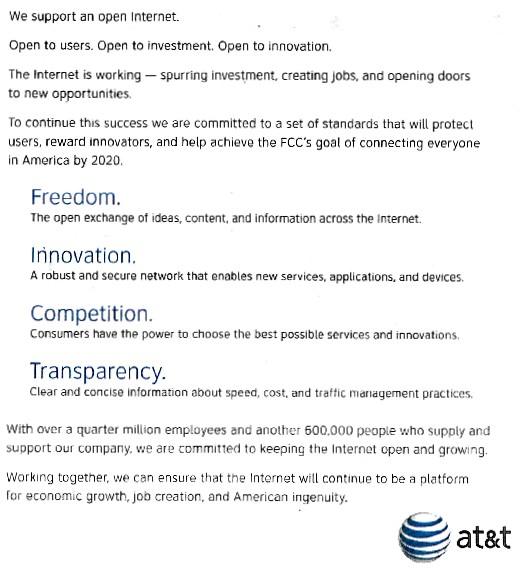
AT&T is buying newspaper ad space to publish a feel good message about Internet Openness that bears no reality to the company’s multi-million dollar lobbying effort to derail broadband reform, taking guarantees of a free and open Internet with it.

The advertisement’s appearance is remarkable, coming at the same time the company’s “government affairs” team of paid lobbyists and friends are browbeating elected officials and the Federal Communications Commission.  AT&T wants the right to allow preferential treatment of its selected content partners while dumping everyone else on the Internet slow lane.

The only opening AT&T supports is a new way to cash in even further on the Internet.  An “open network” to the phone giant means one that is totally deregulated and open to whatever AT&T wants to do with it.

AT&T’s “innovation” is to monetize the traffic that happens to cross their network on its way to AT&T customers.  By manipulating broadband traffic, AT&T will sell its “selected partners” priority access, shoving uncompensated traffic out of the way to make room for whatever AT&T’s special friends want you to see.  While that’s great news for companies that agree to pay AT&T’s tolls, it’s very bad news for everyone else, because the websites you choose to visit may or may not be available on the second rate “free lane.”  Given the choice between AT&T-backed video streaming or a third party provider like Netflix, guess what traffic will never get stuck “buffering” or face glitches.

Investors love the concept because AT&T can collect revenue just by sitting back and demanding tolls from content they neither produce nor host.  It’s not as if they haven’t been paid already — by their customers — to obtain access to that content.  AT&T wants another payday for their shareholders while sticking you with second-rate service.

The problem with AT&T’s world view is… AT&T’s world view.  Real innovation would mean delivering customers a world class broadband service the envy of anyone, delivered on America’s most advanced communications network, not re-purposed copper wire phone lines.  Then, “traffic management” on a mega-sized information highway wouldn’t have to squeeze the speed of some traffic to make room for “premium content.”  There would be plenty of room for one and all.

AT&T’s proposed answer for broadband reform is all about their interests, never yours.

America already experienced a corporate-sanitized online experience with preferred content partners. It was called Prodigy, and by 2000 it was fed to 77 million SBC (later AT&T) customers.

Some examples:

  • Net Neutrality has been a part of AT&T’s corporate life for several years as a condition of its 2005 merger with SBC.  It didn’t harm their ability to provide all of the innovation, service, and speeds they could have, but never did.  Nothing about Net Neutrality protection harms AT&T’s ability to deliver broadband service to more of its customers. Giving AT&T whatever it wants won’t change that fact or deliver service to a single new customer;
  • The freedom AT&T writes about is their idea of a Corporate Bill of Rights, which grants them the freedom to exchange their ideas and content, but says nothing about protecting your freedom of speech;
  • A robust and secure network should exist regardless of Net Neutrality, considering the enormous amount of cash AT&T harvests from their Internet customers month after month.  AT&T is free to innovate all they like, on a level-playing-field, where customers can choose the best applications at the best prices, not the ones AT&T provides to them on a paid fast lane;
  • AT&T’s record on competition is laughable when it spends its free cash on an army of lobbyists and “dollar-a-holler” interest groups.  Their mission?  To oppose potential competitors and enthusiastically support AT&T’s competition-busting mergers and acquisitions that further concentrate their market power;
  • For AT&T’s customers, transparency alone is hardly the kind of consumer protection Internet users need.  Yes, it’s nice to be told when you are overpaying for broadband service that is “network managed.” Admitting AT&T seeks to throttle broadband speeds and potentially block websites in a monopoly/duopoly market doesn’t help much when customers can’t find another provider.  Disclosing the fact AT&T is sticking it to you is not the same thing as prohibiting them from trying in the first place.

AT&T has no interest in working with anyone that opposes their corporate interests.

The Internet should not be AT&T’s personal playground, ready and able to be “managed” out of its unique ability to deliver ideas equally — to be judged on their merit — not on the money backing them.

Americans have already experienced a corporate-sanitized online service for pre-approved ideas, products, and services.  It was called Prodigy, and by 2000 it was to become the Internet experience for 77 million SBC (later AT&T) customers. By the time the bottom fell out in 2001, SBC owned 100 percent of the service nobody wanted.  In 2005, SBC tried to sell the Prodigy brand in the United States.  There were no buyers.

That should be the outcome of AT&T’s proposal for “an open Internet.”  No deal.

Australian ISP Says National Broadband Network’s 1Gbps Speeds Are “Crap”; Old People Don’t Care So Why Do It?

John Linton, CEO Exetel

Australia’s planned National Broadband Network (NBN) delivering the country access to broadband speeds up to 1Gbps face many of the same criticisms American municipal providers hear when incumbent commercial providers face imminent competition from fiber broadband.

But nobody can top the venomous spray of Exetel’s CEO John Linton, who called the entire concept of public broadband for the public good “a load of crap” and those behind it a mix of ‘thugs,’ ‘pretenders,’ and generally incompetent and stupid.

Linton’s Internet Service Provider delivers broadband to most of its customers over Telstra landlines, using DSL.  But the company has grudgingly agreed to participate in the NBN project, even while still despising it to the core.

Exetel’s pricing on NBN’s fiber network charges for speed and usage.  Much like cable broadband, Exetel delivers much faster downstream speeds (up t0 100Mbps), with upload speeds maxing out at 8Mbps. The higher the speed, the higher the monthly access fee.  Users receive no usage allowance, paying fees per gigabyte for all of their usage.  Exetel still reserves the right to throttle customer speeds for certain online applications, and “traffic shape” users based on their usage.

In Tasmania, Exetel has introduced a 25/2Mbps broadband plan with no usage allowance — but no monthly access fee either — charging a flat $2 per gigabyte of usage.

Exetel Fiber Pricing In Tasmania

Plan Speed Down Speed Up Monthly Access Download Charges Upload Charges Contract Length Usage Allowance
A 25 mbps 2 mbps $0.00 $2.00 per GB Nil 12 Months None
B 50 mbps 4 mbps $25.00 $1.00 per GB Nil 12 Months None
C 100 mbps 8 mbps $50.00 $0.75 per GB Nil 12 Months None

Linton spews most of his angry commentary on his personal blog, which he closed to non-Exetel customers unless they made a $20AUS contribution to the company’s endangered wildlife protection programs.  But he rarely pulls punches in public either.

Is this Australia's broadband future?

A sampler:

With wireless broadband waiting in the wings, those excited by NBN’s 1Gbps speeds are “unthinking and just plain stupid, pretty much along the same lines as the stone age cargo cult dwellers in the jungles of New Guinea are excited about the next ‘goods drop’ from the strange colored bird.”

Australia’s aging population, “who don’t play computer games or get a surrogate sex life from pornography” have zero interest in getting terabyte broadband speeds, making the whole endeavor a giant waste of money.

“The number of people who want 100Mbps are almost none today and aren’t going to be very many in five years time.   Probably 40-50% of people today will never want to use a piece of fiber […] and they’re certainly not gamers playing, or those other things.  They’re the other half of Australia that has a life rather than a half life.”

On the results of the recent election and the decision to move forward with the NBN: “God help us all.”

On Communications Minister Stephen Conroy (Australia’s version of FCC Chairman Julius Genachowski): “He was his usual mixture of bewilderment, ignorance and barely concealed thuggery, but I was amused at his reference to Exetel (not by name).” Linton wrote on his blog. “While I’m grateful for the ‘free plug’ I thought it was an obvious example of “straw clutching” if it wasn’t based on appallingly bad briefing, which I would doubt, because for him to have been aware of any actual pricing would have required some sort of briefing,” added Linton.

On NBN co-chief Mike Quigley, who will help manage NBN service: “Is [Mike Quigley] god? Can he reverse 100 years of telecommunications going one way and say, ‘Oh, I’m Mike Quigley, and I haven’t worked here in 30 years, I know nothing about running major networks, but someone has paid me $2 million a year so I can pretend I can’.  The only one who can do it is Telstra. It would do it cheaper than a bloody government.”

Linton blames all of the talk about a publicly-owned broadband network for the decrepit state of Australia’s commercial broadband market, claiming it dried up private investment in new ADSL products: “The situation as I see it is that the suppliers — Telstra, Optus, AAPT — are not really investing in anything new, especially when you’re referring to ADSL type broadband products. The current suppliers are holding on to the margins they have at the moment, and if anything they will seek to increase them rather than reduce them,” says Linton.

Since nearly every broadband user in Australia knows Linton hates fiber broadband, what technology does he believe represents Australia’s future?
Or this?

3G wireless.

“Most people that I know, including me, put a much higher priority on mobility than they do on speed,” he told ZDNet. “The average person needs a 100Mbps internet connection about as much as they need to have their arms amputated.”

While mobility is important, his critics charge, there is no way 3G wireless can deliver Australia its broadband future.  Service is not ubiquitous across the country, speeds are far below even what DSL offers, streaming multimedia is challenging at best, and the usage fees and limits that accompany wireless service plans in the south Pacific would create an even greater divide between those who can afford wireless broadband, and those who cannot.

A report released yesterday by the Bureau of Statistics shows Australians are downloading more data than ever before, increasing more than 50 percent in the second quarter compared to the same period last year. The amount of data downloaded every three months is now 11 times higher than March 2005 and 126 times higher than March 2002.

Australia’s National Broadband Network is open to all Internet Service providers that wish to participate, reselling their broadband plans using NBN’s infrastructure.


Search This Site:

Contributions:

Recent Comments:

Your Account:

Stop the Cap!