Home » Providers » Recent Articles:

Salisbury Launches Fibrant Service Bringing Fiber-Fast Broadband to More North Carolinians

The city of Salisbury on Monday “soft-launched” its fiber to the home service Fibrant to the community of 27,000.  Fibrant joins Wilson’s GreenLight system in giving residents a real choice between Time Warner Cable and phone companies like AT&T, Windstream and CenturyLink.

But the launch did not come without controversy.

The system has drawn some complaints from beta testers about set top DVR boxes that are not working as expected, video channels that are not ready for launch, a porn channel controversy, and some negative anonymous comments that suspiciously draw from the well of telecom talking points complaining about Fibrant’s business model.

Yet Fibrant’s eager group of more than 100 beta testers may quickly become the service’s first paying customers, delighted with the exceptionally faster broadband speeds finally available in the community.
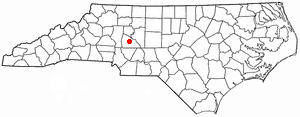
Salisbury, North Carolina

Indeed, some of the biggest complaints are that Fibrant didn’t arrive sooner and the speeds are not fast enough.  The city-owned service is still fighting its way to wire fiber optic cable on utility poles where its competitors have engaged in foot-dragging to move their existing cables to make room for Fibrant.  The company’s waiting list for sign-ups now numbers well into the hundreds.

Local media has been buzzing about Fibrant’s published pricing, which undercuts Time Warner Cable’s regular prices but not its promotional deals.  The cable company recently launched a national promotion marketing broadband, cable, and telephone service for $99 for the first year.  That’s about $45 cheaper than a comparable “deluxe” package from Fibrant.

Fibrant marketing director Len Clark told the Salisbury Post they cannot compete with those special deals.

“We can’t afford it,” he said.

But many municipal providers have turned these promotions upside down and told their potential customers their pricing does not come with tricks, traps, or temporary discounts that expire exposing customers to much higher prices down the road.

EPB, the utility provider in Chattanooga, has been successful with everyday pricing that beats Comcast and delivers far better service — faster broadband speeds, better picture quality, and no annoying Internet Overcharging schemes.

Clark hopes Salisbury residents will take notice that their temporarily higher prices include better quality service and faster broadband.

Also important: the money earned by Fibrant stays in Salisbury and could eventually help defray city expenses.

The Post explains the differences between the cable company and Fibrant:

The $99 special includes Road Runner High Speed Online with a download speed of 7 megabits per second and upload speed of .384 Mbps. For a limited time, subscribers can upgrade for free to Road Runner Turbo, boosting their Internet speed to 10 Mbps for downloads and .512 Mbps for uploads.

Fibrant’s standard Internet speed of 15 Mbps for both downloads and uploads is twice as fast as Road Runner High Speed Online and 50 percent faster than Road Runner Turbo. Fibrant customers can go faster — 25 Mbps up and down — for an additional $20 per month.

Both Time Warner’s $99 special and Fibrant’s comparable package offer about 150 TV channels. High definition is free for Time Warner subscribers, while Fibrant customers must pay more.

Time Warner’s package does not include a digital video recorder. Fibrant’s does.

However, people who sign up for the $99 Time Warner special this month get Showtime for free, Dan Ballister, director of communications for Time Warner Cable Charlotte said. Next month, it could be a free DVR, he said.

Time Warner’s phone service offered in the $99 deal has about a dozen features, including the popular caller ID that appears on the TV screen. Fibrant’s phone service offers 17 calling features.

Some area consumers and businesses expressed concern about Fibrant’s broadband speeds topping out at just 25Mbps, which is slow in comparison to many other fiber to the home providers.  They are also concerned the company did not more aggressively price services at launch.

Many municipal providers have learned from the mistakes of others who have tried to engage in all-out pricing wars with large cable companies.  Most cable companies can cross-subsidize rates to ridiculously low, predatory prices to win such pricing wars, making them untenable for municipal providers with bonds to pay back.  But at the same time, municipal providers are in serious danger or obliterating the marketing benefits fiber brings by not showcasing fiber’s capabilities and giving customers the motivation to throw their current provider overboard.  We urge Fibrant officials to consider reducing the price or increasing the speed of Fibrant’s 25Mbps service, which appears too expensive and slow priced at $65 a month.  It needs to be at least $10 less a month to make it an attractive alternative to Time Warner’s inevitable future speed upgrades in the area to 10/1 standard service and 15/2 for “turbo” service, commonly found wherever fiber competes.  Remember, Time Warner also markets “Speedboost” to consumers as though those temporary speeds are delivered consistently.

As EPB quickly learned, the “wow” factor can drive sign-ups, and they doubled their broadband speeds to get more bang for the buck.  Fibrant needs to remember the valuable marketing lesson of driving customers towards “sweet spot” premium tier pricing customers feel they got for a steal.  If 15Mbps service is $45 a month, how many would spring for 20 or 25Mbps for just $5-10 more?  Time Warner learned this selling their “turbo” speed package.  And most importantly of all, Fibrant risks harming their own argument fiber optics brings new businesses and jobs when their current price schedule shows speeds topping out at just 25Mbps.  Admittedly those are residential service offerings, but we encourage them to deliver faster speeds, especially to businesses.
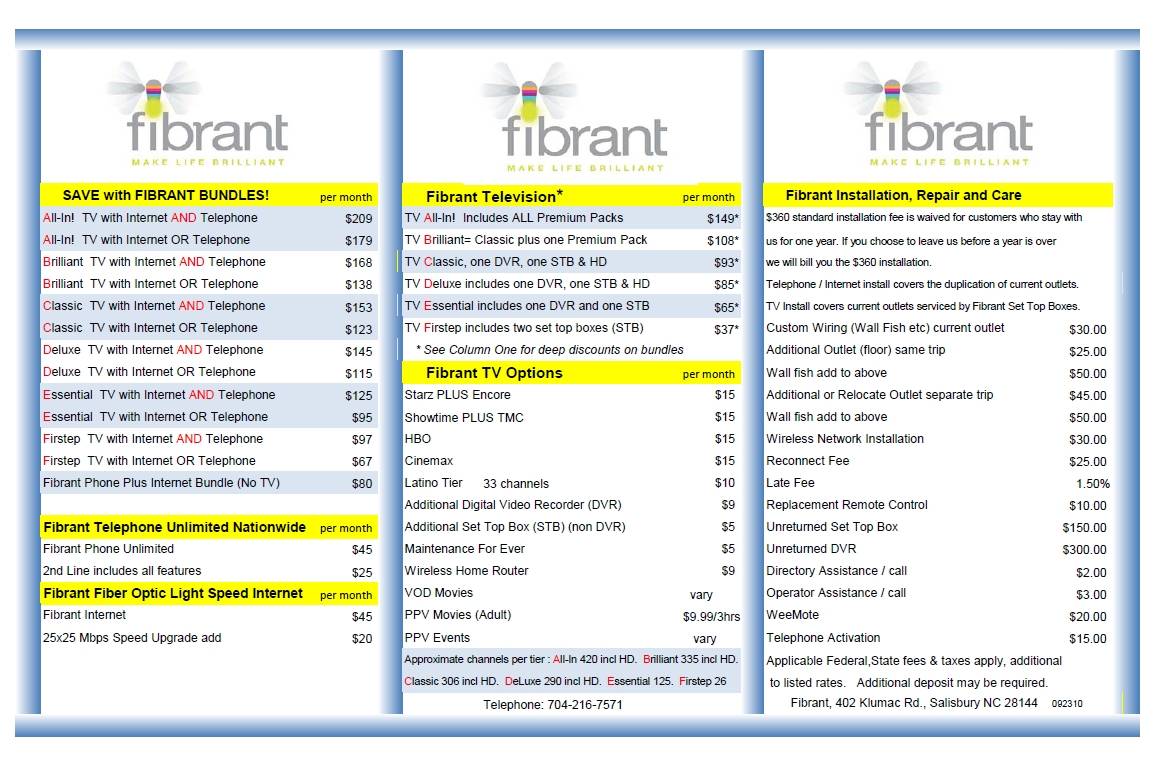
Fibrant's Price List (click to enlarge)

Fibrant even hides the names of its adult channels

The controversy about Fibrant carrying porn pay per view channels also popped up in the local media and drew complaints from conservative residents upset with their local government accommodating such programming.

Fibrant handily dealt with the controversy, noting tax dollars do not pay for Fibrant, it needs to compete with cable and satellite providers who offer such content, and Fibrant has gone beyond the competition in masking even the names of the channels to those who do not want such pay per view programming in their homes.

Time Warner Cable readily provides not only the names of the adult channels they carry, but also includes program titles that leave absolutely nothing to the imagination.  And who can forget Time Warner accidentally promoted its adult content on a free on-demand children’s channel earlier this year.

Fibrant officials also said the right thing telling residents they absolutely do not want to be in the business of telling people what they can and cannot watch.  It’s a personal decision, and the provider will go out of its way to make sure customers who do not want such material coming into their homes need not see a single bit of evidence it’s there.

That goes a long way to ameliorating a politically sensitive issue.

[flv width=”640″ height=”500″]http://www.phillipdampier.com/video/WBTV Charlotte Fibrant Porn Controversy 10-12-10.flv[/flv]

WBTV-TV covered the controversy of Salisbury’s Fibrant service carrying adult pay per view programming.  (3 minutes)

A vocal minority of comments left on the Post‘s website have also attacked the service with a considerable amount of false information.  Some are upset with a $360 installation fee that actually will only be charged to a customer leaving within the first year of service.  Others invented monthly fees that don’t exist, and one actually wrote:

“The field is already crowded enough with Windstream, Time Warner, AT&T and a slew of decent wireless ops. The existing internet providers offer far better deals. Fibrant which was supposed to have high speed fiber optic, really doesn’t. Fibrant’s download speeds are not as fast as Time Warner and higher end Windstream. Fibrant doesn’t seem to want to compete pricewise or service wise–so why bother?”

Of course, Fibrant’s matched upstream and downstream speeds leave Windstream’s DSL gone with the wind.  Time Warner Cable currently delivers standard speeds half that of Fibrant’s lowest speed service (and as you can see in the video below doesn’t even actually deliver that), and AT&T’s U-verse maxes out under the best conditions at real world speeds below what Fibrant can deliver.  Anyone who has used wireless broadband knows speed is the first thing sacrificed.  Unlimited, unthrottled wireless broadband is second.  Fibrant needs some social networking to put out these kinds of BS brushfires before they become accepted memes.  Stop the Cap! helped, at least for today.

Meanwhile, Time Warner Cable officials used Fibrant’s launch to, once again, draw false connections between local government funds paying for a cable system that duplicates existing services.

Back to the Post:

Time Warner is still surprised by “municipal overbuilds,” or city-owned fiber optic networks like Fibrant in Salisbury and Greenlight in Wilson, Ballister said.

“It’s just interesting that during these economic times, when city and county budgets are being cut back, that they would want to spend millions of dollars providing services that are already out there,” Ballister said.

Salisbury borrowed $33 million to launch Fibrant.

Cities have an unfair advantage in offering communication services, Ballister said.

“We’re all for competition, as long as people are on a level playing field,” he said.

Cities pay no property or income taxes. They can operate the utility at a loss and cross-subsidize from other areas of government, Ballister said.

“They can level taxes on citizens to recover their operating costs,” he said.

Fibrant is expected to operate at a loss for three years and have a positive cash flow by year four. It will take longer to make a profit, Clark said.

Eventually, Fibrant is supposed to generate revenue for the city.

Cities in the fiber optic business also can hike the fees their competitors must pay to get access to their subscribers, Ballister said.

“They are the gatekeepers to rights of way and pole attachments,” he said.

The company has no specific examples of fee hikes to hurt Time Warner, but “these are valid concerns that exist right now,” Ballister said.

It’s ironic Ballister complains about utility pole fees considering Fibrant is currently a victim of Time Warner’s slow progress making space on those poles to accommodate the city’s fiber optics.  No vendetta by city officials is apparent, as they patiently wait for the cable company to handle its responsibilities.

Ballister should not be surprised the city of Salisbury did for itself what Time Warner Cable refused to do in the community.  Just like in Wilson, Salisbury city officials pleaded with the cable company to deliver improved service in the community but it fell on deaf ears.  Many sections of the city center cannot access reliable broadband from the cable company to this day.  But most of them can now get service from Fibrant.  Cable companies like Time Warner have spent millions of subscriber dollars trying to legislatively ban networks like Fibrant, fearful of the competition they can bring.

Salisbury Assistant City Manager Doug Paris notes the enormous amount of money poured into North Carolina’s state legislature trying to ban projects year after year.  That Time Warner money could have made a real difference for residents and small businesses in Salisbury and other parts of North Carolina if used to improve service, not fight competition.

Kirk Knapp of Tastebuds Coffee and Tea doesn’t care what Time Warner does with the money at this point, so long as he can finally be liberated from them.  He told the Post he feels “held hostage by Time Warner.”

“Time Warner has the worst customer service I have ever dealt with,” Knapp said in an e-mail to the Post.

“Fibrant may have these same kind of issues, however I can actually go to the source to deal personally with someone who is vested in the community, not spend two hours on the phone and never solve the problem as I do with TWC,” he said.

“Even if pricing is higher, I would make the change. Price is important, but quality and service is tantamount.”

[flv width=”640″ height=”500″]http://www.phillipdampier.com/video/Fibrant Intro 11-2-10.flv[/flv]

Folks from the Walser Technology Group, Inc. in Salisbury gave an informal introduction of Fibrant on its YouTube channel, including a very revealing speed test comparing broadband service from Fibrant with Time Warner Cable.  (7 minutes)
Pay Per View: Cablevision-Fox Programming Dispute Post-Game Wrapup Show

Phillip Dampier November 1, 2010 Cablevision (see Altice USA), Competition, Consumer News, Editorial & Site News, Online Video, Public Policy & Gov't, Video Comments Off on Pay Per View: Cablevision-Fox Programming Dispute Post-Game Wrapup Show

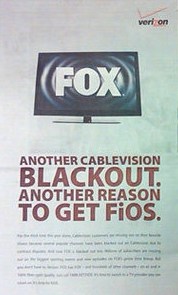
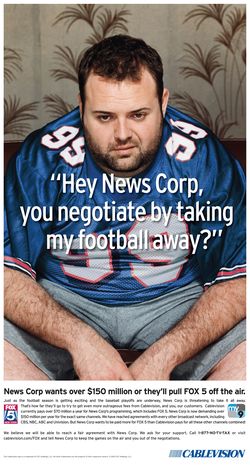
A Cablevision ad against Fox

Cablevision and Fox finally settled their two week programming dispute Saturday when two local Fox-owned broadcasters and an assortment of cable channels returned to suburban New York area-television screens.  Cablevision ultimately capitulated to Fox’s increased programming fees and grumbled it was stuck paying an “unfair price” for the programming.

“In the absence of any meaningful action from the FCC, Cablevision has agreed to pay Fox an unfair price for multiple channels of its programming including many in which our customers have little or no interest,” Cablevision said, adding that it “conceded because it does not think its customers should any longer be denied the Fox programs they wish to see.”

But in reality, Cablevision subscribers who suffered through the two week outage will ultimately pay the price for Fox-owned programming in the next round of cable company rate increases.

While Cablevision subscribers can now watch the remaining games of the World Series from home, the cable-broadband industry post-game wrap-up show is now underway, surveying the winners and losers.

Let’s take a look:

WINNER: Fox Networks

Fox got everything it wanted, and then some, from Cablevision.  Consumers never take the side of the cable companies that have overcharged them for years. All most know is that when their favorite channels are not on the cable system that charges them more than $50 a month for service, it’s the cable company’s fault. While the terms of the final deal were not disclosed, it’s a safe bet Cablevision is paying rates even higher than those charged to New York’s other cable company Time Warner Cable.  The cave-in by Cablevision means Time Warner and other cable systems will likely also see higher rates for Fox programming now set as a precedent by Cablevision.  So will telco and satellite TV providers.  That’s money Fox will take to the bank.

LOSER: Cablevision

Not only did they alienate their customers, at one point telling them to watch Fox programming on third party websites, they are now facing a $450 million class action lawsuit from subscribers (filed by an attorney with prior connections to Fox parent company News Corporation.)  It is difficult to feel sympathy for a cable company deprived of Fox programming that still charged subscribers full price for channels they could not watch.  One industry executive praised Cablevision for “taking one for the team,” a phrase consumers have heard before to defend corporate pickpocketing.

Cablevision was actively promoting ivi last week through their customer service representatives

WINNER: ivi Networks

Stop the Cap! reported on upstart ivi several weeks back.  The service carries all of metropolitan New York’s broadcast stations and Cablevision ended up recommending its blacked-out subscribers buy an ivi subscription to watch Fox-owned broadcast channels no longer on the cable lineup.  The new online cable system, which started in September, added New York subscribers in droves, annoying Fox to the point of sending a cease-and-desist letter to Cablevision CEO James Dolan to get cable company representatives to stop recommending the service, which Fox claims is “illegal, and perhaps criminal.”

WINNER: Verizon & Satellite Dish Companies

Many subscribers fleeing Cablevision for competitors have probably left for good, especially if they scored substantial discounts and promotions during their first year or two of service.  Verizon FiOS always faced resistance from customers not wanting to devote the time needed to install the service, and when customers have been with a cable company for 20 or more years, change does not come easy.  But die-hard sports fans already inconvenienced by earlier channel interruptions pulled the trigger just to get away from the endless programming disputes.

Verizon scored new customers over the dispute.

LOSER: Comcast-NBC Merger

Lawmakers set to either applaud or introduce roadblocks to the proposed merger between Comcast and NBC saw first hand what can happen when big media companies duel it out over money — millions of customers can be left in the middle with nothing to show for it.  Bloomberg reports the dispute could force significant concessions to prevent or limit such disputes in the future.  U.S. Representative Maxine Waters, a California Democrat, said the Fox-Cablevision spat made her “increasingly concerned with the potential harm” if a dispute arose between an enlarged Comcast and competing video provider. In a letter to FCC Chairman Julius Genachowski last week, she called for “substantive and enforceable conditions” to preserve competition.

WINNER: NFL Networks – Where is Our Binding Arbitration?

Cablevision’s demands for binding arbitration to settle their disputes with Fox rang hollow, if not hypocritical, for NFL Network officials, who have been calling on Cablevision for the same binding arbitration the cable operator demanded of Fox.  The NY Post quoted an unnamed executive at the cable network: “Cablevision has been urging Fox to agree to binding arbitration — the same strategy we’ve been offering Cablevision — but we continue to get sacked.”

LOSER: The Federal Communications Commission

Despite demands from most consumer groups and Cablevision to intervene in the programming disputes, the FCC delivered a rebuke telling all sides to stop with the stunts and start with serious negotiations.  Beyond that, the agency did what it has done best under the Obama Administration: sit on its hands.

THE BIGGEST LOSER: You

With the grandstanding by both sides finally over Saturday — the shouting and expensive publicity campaigns wrapped up and put away for next time (KeepFoxOn.com now renders a blank page) — the person left standing with the bill in hand was you.  Fox wrapped the costs of its expensive publicity campaign into the rate increase Cablevision finally conceded to paying.  The bags of money to be handed from the Dolan family that owns Cablevision over to Rupert Murdoch will be filled from your pockets.  And there is no end in sight to future disputes raising programming costs even higher than ever.

[flv width=”640″ height=”500″]http://www.phillipdampier.com/video/Bloomberg Cablevision Fox Dispute 11-1-10.flv[/flv]

Bloomberg News delivers three reports detailing the impact of increased programming costs on cable bills, inaction by the FCC, and whether Americans are fleeing cable TV for online video instead.  (10 minutes)

Cablevision Customers: Get $20 Off Your Monthly Bill for 2 Years

Phillip Dampier October 28, 2010 Cablevision (see Altice USA), Consumer News 4 Comments

Stop the Cap! reader James dropped us a note to let us know Cablevision customers calling to cancel their cable service are scoring $20 a month off their cable bills for two years if they decide to stay with the cable company. It’s all because of the ongoing dispute between Cablevision and Fox over programming fees.

That $500 goes a long way towards compensating Cablevision customers for at least a year of petty programming disputes between executives who think of $500 as tip money.

So if you are a Cablevision customer, here is how to get your money back:

  1. Call Cablevision at this number – 1-800-918-2581, which takes you directly to the customer retention department.
  2. Tell the representative you wish to cancel your cable service because of the ongoing dispute with Fox and your loss of local and cable channels.
  3. When they argue with you about why you should stay, tell them you are tired of being put in the middle of these disputes and forced to pay for programming you are not getting.
  4. They may offer a $20 credit for just 12 months.  Tell them that is not long enough and if the representative won’t do any better, hang up and call back.

Be polite, persuasive, but persistent.  Customers on existing promotional deals may not qualify for this, but if you are paying regular Cablevision prices, you do.

The sooner you call, the better as word is getting out about this deal which could be withdrawn at any time.

Shaw’s Shark-Like Wallet Biters Are Back for More of Your Money: Company Response Rebutted

Phillip Dampier October 28, 2010 Canada, Competition, Data Caps, Editorial & Site News, Shaw 5 Comments

A firestorm erupted this week on Broadband Reports over news that Shaw Cable was turning its existing “soft” Internet Overcharging scheme into a “hard” system filled with usage limits and overlimit fees.  One of Shaw’s social media representatives tried to throw some water on the fire:

I’ve seen a lot of discussion here about the new policy, and quite a bit of inaccurate or incomplete information and speculation, so I’d just like to set all of this straight.

Essentially, the system works like this: your package includes an allowance for a certain amount of traffic. If you exceed that traffic for one billing cycle, you will receive a notice on your bill advising you of the fact. We also automatically activate your traffic monitor so that you can monitor your usage from that time forward.

Since the bill arrives, of necessity, after your billing cycle ends, we give you a cycle’s grace between the period when you exceeded and when we start charging. That is to say that if you exceed in billing cycle one, you’ll receive your bill part of the way through billing cycle two, and so we won’t start charging for excess traffic until billing cycle three.

As to how much bandwidth will cost, here’s how it works:

If you exceed your monthly traffic allowance, you’ll receive a bill for $1 per GB for Extreme and above, $2 per GB for High Speed and High Speed Lite. Considering how much media, etc, you can obtain in 1 GB, $1 is not expensive.

However, if you plan to exceed by a considerable margin, data packs are also available, and what these do is allow you to increase the traffic allowance by the following amounts:

  • $5 for 10 GB
  • $20 for 60 GB
  • $50 for 250 GB

So this gives you the option to increase your monthly traffic allowance to meet your needs. It’s also considerably less expensive than the standard $1-$2 per GB rate.

The best part about the data packs is that you can apply them at any time up to three days before the end of your billing cycle. So if you discover that you’ve exceeded your included usage allowance, and still have three days to the end of the billing cycle, just give us a call (or chat) and ask that we add the appropriate data pack for you.

[…]I’ve seen some posts here suggesting that this new policy has been financially motivated to avoid upgrading our networks. That’s actually not the case. In fact, just a few weeks ago we increased the included usage for all of our services by 25%, just in time for NetFlix. If you want to think about it in financial terms, just consider how much more bandwidth the network would need to allow a 25% increase for every customer, and how much that kind of network upgrade would cost. It’s pretty clear that our motives are not financial. If they were, increasing the included usage would not be very sensible, would it? It would, after all, considerably reduce the number of customers exceeding their monthly traffic allowance, would it not?

I hope that this clarifies the situation, but if there are any questions, please do feel free to ask.

James – Shaw

Shaw tinkers with their Internet Overcharging scheme

In part, this rebuttal was also directed to Stop the Cap!, because we are actively participating in that discussion.  Shaw’s argument about usage limits and how the company’s implementation of them benefits their customers is familiar to many of our readers who fought off usage caps proposed by Time Warner Cable last year.  Somehow, the same company that sets unjustified limits and penalty prices on already-overpriced broadband service is doing customers a real favor by offering alternative pricing plans for heavier users that reduces war-crime profiteering to pickpocketing.

That’s logic Stalin might have appreciated, but most customers already burdened with high cable and broadband bills won’t.

Our response:

Don’t you just love it when Internet Overchargers always claim their new gotcha fees are never about the money?

“James” from Shaw offers a classic example of what happens when your broadband provider implements a scheme to boost your broadband bill and then claims it’s good news that the company has some options to keep those overlimit fees from stinging too badly.

When Internet Overchargers tell you it’s not about the money, it’s really ALL about the money.

Here's what happens when a third provider ruins a Canadian broadband duopoly

Who knew that an invisible border that makes unlimited Internet possible in Vancouver, Washington makes it impossible in Vancouver, B.C. Using Shaw’s argument, providers south of the border are headed straight for bankruptcy court while companies like Shaw barely hold on with “free usage upgrades” of existing limits.

But of course the financial reports for shareholders Shaw’s social media mavens don’t talk about tell the real story. Shaw enjoys considerable revenue from their broadband division thank you very much, and plans to do even better now that they can achieve ‘revenue enhancers’ from their enforced Internet Overcharging schemes.

That’s another way of saying Shaw’s Wallet Biters are back for more of YOUR money.

Whether it’s 20 cents per gigabyte (at least a 100 percent markup) or $2 (rape and pillage pricing), these schemes are hardly good news for Shaw customers. Indeed, if Shaw was truly concerned about saving their customers something under their cap ‘n tier regime, they’d deliver those “usage paks” to customers automatically instead of forcing them to call the company to add them when they go over the limit. If you remember to ask, Shaw gets extra profits they can take to the bank. If you forget, Shaw throws a Money Party on the extra high everyday overlimit rates.

What Shaw forgets to tell you is the cost to deliver increased usage and bandwidth to customers is ALWAYS dropping, and dropping fast. The price charged to move 10GB of traffic not too long ago moves 100GB today. So it’s hardly rough on Shaw to expand yesterday’s unjustified limit to today’s higher, still unjustified limit.

When one also considers yesterday’s “soft cap” is about to become tomorrow’s budget-busting “hard cap,” few Shaw customers are calling 1-800-FLOWERS to send a thank-you bouquet to Calgary.

Having been to Calgary, I know the people in Alberta and elsewhere across western Canada know a ripoff when they see one. They ask, “why is our broadband so overpriced and usage limited?” They wonder where the CRTC has been. They wonder why countries in Asia and even eastern Europe are now beating the pants off Canadian broadband with faster speeds at lower prices.

The fact is, Shaw pulls these overcharging tricks on their customers because they can. The broadband duopoly in Canada from cable and phone companies deliver punishing usage limits on Canada that are being banished in other countries around the world. Even notorious cappers like Australia and New Zealand are finally ridding themselves of broadband that is always capped, always throttled.

What would be sensible is that Shaw, a multi-billion dollar major player in Canada would plow some of their enormous profits into network capacity upgrades that can accommodate the needs of Canada’s growing knowledge economy, not inhibit its growth. Then, earn additional profits by selling even faster speed tiers and content customers can access over those networks.

Considering even Shaw admits only a small percentage of customers create traffic problem on their networks, it’s not hard to see the company’s new reliance on hard Internet Overcharging is designed to capture new revenue from those hitting their caps, thanks to the increasing number of broadband customers using their fast connections for high bandwidth content.

And hey — bonus: it also discourages those customers from even considering pulling the plug on their cable package to watch everything online.

Salt Lake City TV Station Puts Broadband Speeds to the Test: Most Don’t Get What They Pay For

Recently, the FCC issued a report claiming Americans are often only getting half the broadband speeds they are promised by providers.  KTVX-TV, the ABC station in Salt Lake City, recently investigated whether that held true for local residents.

The results?  Most Salt Lake City Internet users don’t always get a good deal from providers that often deliver inconsistent speeds, even on premium priced plans that can cost up to $130.

Ookla, which has been compiling speed test data as well, reports the United States was in 11th place globally when it comes to being honest about what broadband speeds providers actually deliver.  Don’t get too excited — we score 30th on the download speed index.  More than two dozen nations deliver faster service.

Which nation scores at the very top of the honesty chart?  The Republic of Moldova, a largely-Romanian speaking former Soviet Republic.  In fact, ISPs in Chişinău, the capital city, are too modest, claiming speeds lower than they actually provide customers.  The rest of the top-10 honesty ranking contains a number of countries in eastern Europe — countries that blow the United States out of the water when it comes to telling the truth about broadband speed:

  1. Republic of Moldova, 109.21%
  2. Russia, 98.65%
  3. Slovakia, 98.64%
  4. Lithuania, 97.97%
  5. Ukraine, 97.58%
  6. Hungary, 96.80%
  7. Switzerland, 96.72%
  8. Bulgaria, 95.96%
  9. Latvia, 94.83%
  10. Norway, 93.97%

Five states manage to score high marks on the honesty chart, most of which are served by Verizon.  We suspect FiOS may be a major factor in why these states lead the others:

  1. Delaware, 100.85%
  2. Massachusetts, 100.07%
  3. Maryland, 99.56%
  4. Rhode Island, 98.83 %
  5. Virginia, 98.36 %

KTVX found that the area’s incumbent cable company Comcast did manage to deliver promised broadband speeds, often when most customers are not using the service.  Speeds were far lower in the evening — prime-time usage hours — sometimes as low as 3Mbps.

“Qwest’s DSL is best forgotten,” says Stop the Cap! reader Sangi, who writes from the city of Roy.  “It’s so bad a lot of us think of it as dial-up on caffeine.”

Sangi used to receive DSL service from the phone company, which is planning to merge with CenturyLink.

“When we moved closer to town, cable was an option and that made Qwest something we could live without,” Sangi says.  “They never came close to the speeds they marketed and when we complained, they claimed we wouldn’t notice the difference when browsing web pages and checking e-mail.”

“Apparently Qwest considers the Internet good for little else, at least how they deliver it,” he added.

[flv]http://www.phillipdampier.com/video/KTVX Salt Lake City You Are Getting Half Your Promised Broadband Speed 10-22-10.flv[/flv]

KTVX-TV in Salt Lake City investigates broadband speed claims and finds residents don’t always get what they pay for.  (3 minutes)

Search This Site:

Contributions:

Recent Comments:

Your Account:

Stop the Cap!