Home » Providers » Recent Articles:

West Virginia Engages in Major Broadband Battle as Frontier Service Problems Keep Coming Up Nationwide

Phillip Dampier November 4, 2010 Broadband Speed, Community Networks, Competition, Editorial & Site News, Frontier, Public Policy & Gov't, Rural Broadband, Video, Wireless Broadband Comments Off on West Virginia Engages in Major Broadband Battle as Frontier Service Problems Keep Coming Up Nationwide

Frontier Communications is continuing to suffer service outages and problems across many of their respective service areas.  Some of the most serious continue in West Virginia, especially in the northern panhandle region where emergency response agencies continue to complain about sub-standard service from the phone company that took over Verizon phone lines this past summer.

Hancock County officials report their T1 line that connects emergency dispatchers with the county’s dispatch radio system was out of service again early Wednesday evening.  This Frontier-owned and maintained circuit has suffered repeated outages over the past year, and the latest outage comes after company officials promised to inspect the 12,000 foot line inch-by-inch.  Once again, the county’s emergency agency is relying on help from nearby counties and a backup radio system to communicate with at least some of the area’s police and fire departments.

Outages of 911 service are not just limited to West Virginia.  Illinois Valley (Oregon) Fire District Chief Harry Rich was forced to rely on amateur radio operators and extra staffing in county firehouses to cope with a 911 system failure caused by Frontier service problems in late September.  Rich called a public meeting in late October with Cave Junction Mayor Don Moore, Josephine County Sheriff Gil Gilbertson and Josephine County Commissioner Dave Toler to discuss the implications of Frontier’s outage and what steps the region needs to take to mitigate future outages.

In Greencastle, Indiana a Frontier phone outage disrupted service for DePauw University and the Putnam County Hospital Oct. 20.  In Meshoppen, Pennsylvania an outage caused by a downtown fire on Oct. 24 left 1,200 homes in the community without telephone service for most of the day.  Frontier has also suffered periodic copper wire thefts, particularly in the Appalachian region where illicit sales of copper can bring quick cash for those addicted to drugs.  In Eastern Kanawha County, West Virginia, some 100 customers lost service for at least a day after thieves yanked phone cables right off the poles.

Sandman

In Minster, Ohio village officials have hired a law firm to sue Frontier Communications over a wiring dispute.  Village officials accuse Frontier of being intransigent over the removal of telephone lines from poles to bury them underground.  Village Solicitor Jim Hearn told the local newspaper utility companies should be responsible for the costs of installing underground wiring.

In Wenatchee, a community in north-central Washington state, Frontier’s general manager is going all out to try and assuage customers Frontier will provide better service than Verizon.  Steve Sandman went as far as to hand out his direct number to the local media, inviting residents with service problems to call.  It’s (509) 662-9242.

Sandman promises other changes for his customers, according to The Wenatchee World:

Sandman said all Frontier technicians will be fully trained in the installation of phones, internet and TV. No more modems sent through the mail for the customer to install by themselves, he said.

“We’ll be there on the premises for complete installation,” he said. “And, if the customer needs it, we’ll provide some fundamental training on how to turn on the computer, hook up to the internet and get started using online services. Or give advice on how to use the TV remote.”

But all of these issues pale in comparison to the all-out battle forming in the state of West Virginia over broadband stimulus money awarded to help Frontier extend fiber broadband service to local government and community institutions.  One of their biggest competitors, Citynet, has launched a well-coordinated attack on what it calls “a flawed plan that does nothing to provide faster Internet speeds or lower the majority of Internet costs for West Virginians.”
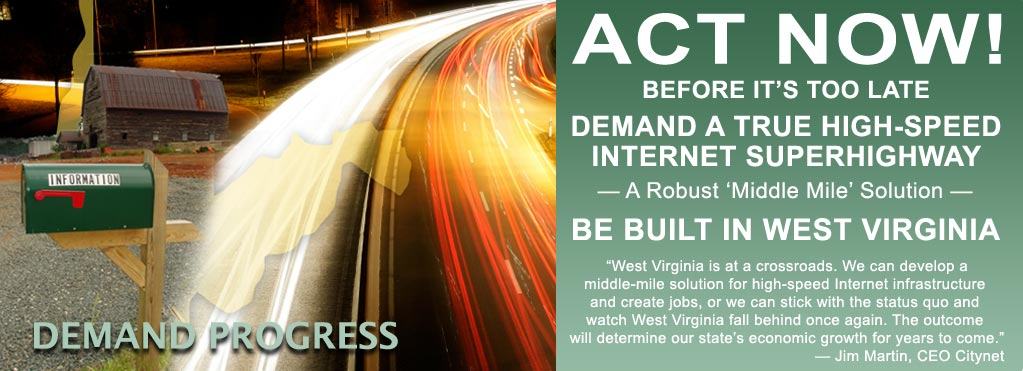
Frontier will spend $40 million of federal broadband stimulus money on a network that will deliver fiber-fast speeds only to government, educational, and health care institutions.
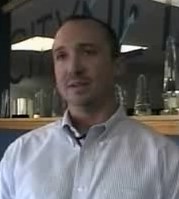
Martin

James Martin II, president and CEO of Citynet argues Frontier is building a state of the art fiber network very few West Virginians will ever get to use, from which it will profit handsomely delivering service to government entities with which it already has contracts.  For the rest of West Virginian homes and businesses, Frontier will deliver outdated DSL service delivering an average of 3Mbps service at a time when adjacent states are enjoying service 2-4 times faster.

Citynet argues funding would be better spent on a middle mile, open fiber backbone available for use by all-comers.  Martin notes West Virginia is one of the few states in the northeast and mid-Atlantic region almost completely bypassed by the core Internet backbone.  The only exception is a fiber link connecting Pittsburgh with Columbus, Ohio, which briefly traverses the northern panhandle of West Virginia.  Citynet’s perspective is that West Virginia cannot improve its poor broadband standing — 48th in the nation, unless it has appropriate infrastructure to tap into for service.

As an example, Martin points to the community of Philippi, served by fiber to the home cable TV and broadband service.  The community’s fiber network is capable of Lamborghini speeds between homes within Philippi. But the community can only afford a single 45 megabit DS-3 connection to the outside world, provided by Citynet for just under $8,000 a month.  That line is shared among every broadband customer in Philippi trying to get out onto the Internet. The result is that Philippi residents can only buy a broadband account with speeds up to 2Mbps for $60 a month on that all-fiber network. That’s equivalent to being forced to drive that Lamborghini on a dirt road.

Martin says if the broadband stimulus money was spent on constructing a statewide open fiber backbone, they could sell the community a 1Gbps pipeline for around $3,000 a month.
Philippi's fiber optic broadband is not so fast, thanks to a bottleneck between the community and the rest of the Internet

“West Virginia is at a crossroads,” Martin said in a prepared statement. “We can build a ‘middle-mile’ solution for high-speed Internet infrastructure and create jobs, or we can stick with the status quo and watch West Virginia fall behind once again. The outcome will determine our state’s economic growth for years to come.”

The state, according to Martin, is reneging on its promise to build a broadband network that will deliver improved service to institutional users as well as at least 700,000 homes and 110,000 business in the state.

Instead, the project would only serve 1,000 “points of interest,” he said. The state’s plan would limit Internet speeds and make broadband service unaffordable, Martin argues.

“If the state were to build a true middle-mile solution, then businesses and residential Internet customers would see a significant reduction in price, as well as an increase in quality, capacity and speed,” Martin said. “Regretfully, the state chose to support a plan that relies on outdated telephone lines and a monopoly.”

Of course, Citynet does have a vested interest in the outcome of the project.  As a provider specializing in selling bulk broadband lines, they would be a prime beneficiary of a government-backed middle-mile broadband network.  Citynet’s argument that funding should be spent primarily on that network ignores the reality few new entrants are likely to enter West Virginia’s rural broadband market, with or without the benefit of a robust broadband backbone.  One of the biggest flaws of broadband stimulus spending is that much of the money will never directly provide “last mile” access to individual consumers and businesses that want broadband service where none is available.

Citynet needs to acknowledge much of West Virginia’s broadband is going to come from the phone company or a local municipality that elects to build its own network.  While cable companies deliver service in larger cities and suburban areas, large swaths of the state will never be wired for cable.  In fact, West Virginia is poorly covered even by wireless companies who see little benefit building extensive cell tower networks in the notoriously mountainous areas of the state that serve few residents.  The only existing rural telecommunications infrastructure universally available is copper telephone wires.  Like it or not, Frontier Communications will be the biggest provider of broadband in rural West Virginia.  A fiber backbone network alone delivers minor benefits to those residents who either cannot connect at any broadband speed, or are stuck with Frontier’s current 1-3Mbps DSL service.

Still, Citynet’s campaign is a useful reminder that too many broadband stimulus projects direct most of their money to networks ordinary consumers and businesses will never access.  And so long as local governments, schools, and hospitals “get theirs,” they have little interest in fighting to share those networks with consumers and for-profit businesses.

Citynet produced two radio ads criticizing West Virginia’s allocation of broadband stimulus money, and Jim Martin appeared on a local radio show to explain to West Virginia why this issue matters. (Ads from 11/2010 — Interview with Jim Martin: September 16, 2010) (18 minutes)
You must remain on this page to hear the clip, or you can download the clip and listen later.

<

p style=”text-align: center;”>

Ultimately, Verizon may get the last word, even after they abandoned the state’s landline customers.  Charleston, the state capital, has been selected as one of the early communities to receive Verizon Wireless’ new 4G LTE wireless broadband network, according to WTRF-TV:

Verizon subscribers in Charleston with devices that are 4G compatible will see changes within the next six to seven weeks. The whole city is expected to be covered by the network by mid-2011, according to company officials. From there, it will be expanded to cover Huntington, Parkersburg, Wheeling, Weirton, Beckley, Clarksburg, Morgantown, Fairmont and Martinsburg by 2013.

The company also plans to expand coverage along the entire Interstate 79 corridor from Charleston to Clarksburg.

The decision to include Charleston among the 39 metropolitan areas where Verizon would deploy its 4G network left many analysts of the industry scratching their heads, although they noted in online posts that Rockefeller chairs the Senate committee that regulates the telecommunications industry.

Should West Virginians find Verizon Wireless a suitable replacement for their landlines, Frontier may have bought themselves a pig in the poke.

[flv width=”640″ height=”500″]http://www.phillipdampier.com/video/West Virginia Frontier 11-4-10.flv[/flv]

WTOV-TV covers the emergency services outage in northwestern West Virginia in two reports, WBOY-TV covers the Citynet-Frontier controversy, and WTRF-TV covers the arrival of Verizon’s LTE upgrade, starting with Charleston.  (7 minutes)
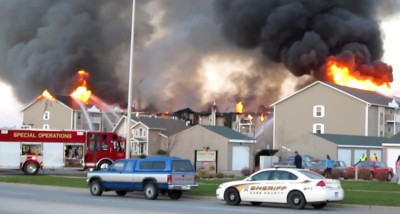
150 Residents Lose Homes in Fargo; Greedy Cable One Pokes Around Ashes Looking for DVR’s or Cash

Phillip Dampier November 4, 2010 Cable One, Consumer News, Video 6 Comments

A massive fire raced through 62 apartments at the Galleria apartment home complex in Fargo, N.D., in mid-October leaving two firefighters temporarily trapped and 150 residents with nowhere to stay.

As displaced residents contemplated the loss of their personal possessions, dealt with insurance company red tape in trying to get temporary housing allowances, and coped emotionally through the devastation, Cable One, the complex’s cable operator (owned by the Washington Post), wanted to let fire victims know they were thinking of them… and the hundreds of dollars in cable equipment lost in the fire.

“We’ve been hurt too,” Cable One’s General Manager Scott Geston actually told NBC’s Today show.

Two days after the fire, Cable One started reaching out to some fire victims demanding payment for their lost cable equipment, payable with cash, check (with proper ID of course), or money order… or else.

Cash, check, or money order?

“When may we expect payment?” was the most important question on the cable company’s mind according to several residents infuriated by Cable One’s completely unsympathetic attitude.

In Fargo, local stores, churches, community groups and individuals are donating time, money, and even places to stay for displaced Galleria residents or their pets. Cable One’s disaster recovery plan is to hurry out bills for $1,000 or more for their lost equipment.

“They can… exhale rapidly on me,” writes former Galleria resident Jim who found Stop the Cap! thanks to the Washington Post‘s opposition to Net Neutrality.  “I ‘re-phrased’ that because I am sure your group has readers of all ages, but I think most can put it together.”

Jim said Cable One is trolling around looking for at least $1,000 from him for equipment incinerated in the fire.

“We are staying at a extended-stay motel on an emergency stipend and these bloodsuckers have started demanding money,” he writes. “If only my renter’s insurance agent was as aggressive in handling my claim.”

Other fire victims are reporting similar experiences of unparalleled aggressiveness by the cable operator, literally hours after the fire.

It’s also the talk of Fargo:

"Where's my money?"

You have to wonder if anyone at Cable One stopped to think, “This might be a bad idea”, or if the company itself is made up entirely of morons.

As mostly everyone has stated, the company has to have insurance. It’s not like this is the first time this has happened to a cable company in the history of the world, so they have to cover their bases as a company.

But to ask those who lost everything and could only take a box (if that) of items out of their charred apartments to go back and check to see if there are any remnants of their precious DVR boxes left? Nice work, Cable One. You’ve somehow reached a new low.

I feel dirty knowing that I purchase services from this company. I guess they can act as cold as they want and not worry about public perception since they’re the only cable provider available in Fargo.

Some fire victims say the pain and suffering they endured from the cable company didn’t start with the fire, because Cable One provided bad service all along.  But now that the fire is over, the company’s attitude towards the fire victims shows the true extent of how low this cable company can go.

“It’s all about the money with them — they want their money, and some fellow victims tell me the company has been increasing the dollar amounts demanded,” Jim writes.

When will Jim be paying Cable One?  “When hell freezes over.”

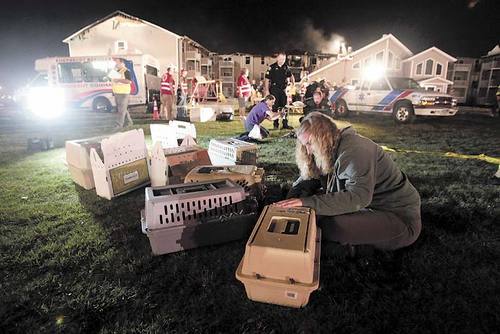
Pets rescued from the fire at the Galleria

That’s an attitude shared by several Galleria residents.

It’s also an attitude expressed by many other cable and satellite companies who would not think of charging fire victims for equipment lost in tragic circumstances like this.  The damage to the company’s reputation would be worth more than the value of the lost equipment.

“If you have a crappy reputation to start with, there is little to lose acting like insensitive thugs in cases like this,” according to Jim.

Many residents have other issues more important than repaying the cable company for cable boxes.  Many Galleria renters with pets are discovering finding a new permanent home may mean giving up their dogs and cats — they are not allowed at most Fargo apartment complexes.

After the local and national media pounced on the story, Cable One retracted their earlier insistence on being paid… slightly.

The Associated Press reported Cable One has now agreed to “eat the cost of damaged equipment for customers with modems, telephones or digital receivers.”

But the company still demands payment for lost DVR boxes, which Geston says are worth $500 new. The company wants residents with renter’s insurance to submit claims. For those without insurance, Geston says Cable One is open to resolving the issue by determining a fair payment plan.

Customer Rick told a Fargo TV station they shouldn’t hold their breath waiting for his check. He won’t be paying them. “No. On principle, I’m not.”

[flv]http://www.phillipdampier.com/video/KVLY Fargo Cable One Wants Their Money 10-17-10.flv[/flv]

KVLY-TV in Fargo shares the story of upset fire victims horrified Cable One is demanding hundreds of dollars to replace lost cable equipment, in some cases just 48 hours after the fire.  (3 minutes)

Charlotte, N.C. Gets Speed Boost Same Week Fibrant Arrives; TWC Recaptures Speed Leader Status

Charlotte, N.C. Time Warner Cable customers can thank city officials in nearby Salisbury for finally provoking Time Warner Cable into boosting speeds for residents across the region.  Just as community-owned Fibrant was opening its doors for business promoting its new fiber to the home service, the area’s dominant cable company managed to steal some of their thunder.

Time Warner Cable this week announced the entire Charlotte service region, which encompasses Salisbury, is getting a free broadband speed upgrade this week.

“We substantially increased our download speeds and essentially doubled upload speeds for all of our Turbo and Standard Internet service customers,” said Mike Smith, area vice president for Time Warner Cable’s Charlotte operation.

Product Name New Speed Old Speed
Turbo Internet 15/1Mbps 10Mbps/512kbps
Standard Internet 10/1Mbps 7Mbps/384kbps

The announcement allows Time Warner Cable to maintain its position as the fastest downstream Internet provider in the Charlotte region because Fibrant’s marketing department decided that 25Mbps service was fast enough.  No, it’s not, and Time Warner Cable showed them up.

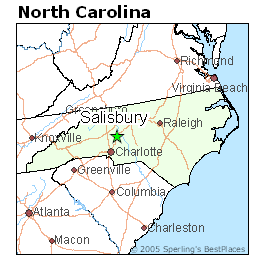
Salisbury is located northeast of the city of Charlotte, N.C.

“This service upgrade demonstrates our commitment to deliver enhanced value to our customers. We are satisfying their thirst for more throttle,” said Smith. To access the new speeds, customers need to reboot their cable modem which is easily accomplished by leaving it unplugged for about one minute.

The company is also introducing two speed tiers in Charlotte this week. Customers will have the option of purchasing or upgrading to DOCSIS 3 Wideband Internet or Road Runner Extreme service. Wideband Internet–the fastest residential Internet experience in Charlotte–provides customers with speeds up to 50 Mbps downstream and 5 Mbps upstream for $99.95 per month.

Road Runner Extreme delivers speeds up to 30 Mbps downstream and 5 Mbps upstream for as low as $64.95 per month when bundled with any other Time Warner Cable Service.

As Stop the Cap! has strongly advised all municipal providers — there is not much point in providing fiber to the home service if you are not willing to capitalize on its benefits.  Offering a maximum speed of 25Mbps just is not going to cut it, as Time Warner Cable demonstrates.

Fibrant’s pricing models are also endangered by this week’s developments.  Road Runner Extreme delivers 30Mbps downstream for $65 a month (admittedly a bundled price) while Fibrant offers 25Mbps service for the same price (standalone service).  Fibrant still kills Time Warner on upload speed, but that’s a distinction that could be lost among many potential customers, and is easily solved by boosting download speeds as well.

Fibrant must immediately consider speed upgrades for their existing tiers to assure its value proposition and launch a new super-premium speed tier that can show off fiber to the home’s true capacity to deliver the best possible Internet speeds in the region.

Shut Up About Peer-to-Peer Traffic: Video Now Biggest Broadband Traffic Source on the Net

Peer to peer traffic no longer represents the largest single source (by application) of broadband traffic on the Internet.  Cisco’s Visual Networking Study now finds online video streamed from websites like Hulu and Netflix to account for more than one-quarter of all broadband traffic, displacing file swapping from the number one position.

File sharing activity has routinely been used by providers dreaming of Internet Overcharging as an excuse to introduce usage limits and throttled speeds for their broadband customers.  Peer to peer software allows customers to exchange pieces of files back and forth until everyone manages to secure their own copy.  Cable operators, in particular, have complained this network traffic saturates their shared broadband lines because customers upload far more data than they would without this software.  Up to 44 percent of all upstream traffic from residential accounts comes from peer to peer traffic, according to Cisco.

Providers and their friends have started to give up on their scare stories of peer-to-peer “exafloods” and data tsunamis triggered from too many online users engaged in file swapping.  As we’ve argued for two years now, the glory days of growth in peer to peer are behind us for a variety of reasons:

  1. Downloading copies of TV shows and movies, always popular on file sharing networks, has declined now that content producers are finally serving the growing market for on-demand video programming;
  2. The growing popularity of downstream delivery direct to consumers has reduced wait times for downloading to near nothing — to the point where some users are abandoning peer-to-peer altogether;
  3. An increasing amount of fake files filled with viruses and spyware has made peer to peer-sourced files from underground websites more risky;
  4. Copyright enforcement and other legal actions have made file trading less palatable for some.

While peer-to-peer traffic is still growing along with other online usage, online video is growing far faster.

Now some want to move the goal post — blaming online video for “forcing their hand” to implement overcharging schemes.

Broadband Traffic by Application Category, 3rd Quarter – 2010

Traffic Share
Data* 28.05%
Online Video* 26.15%
Data Communications (Email and Instant Messaging) 0.28%
Voice and Video Communications* 1.71%
P2P File Sharing 24.85%
Other File Sharing 18.69%
Gaming Consoles* 0.16%
PC Gaming 0.65%
  • The marked categories contain video.

Karl Bode at Broadband Reports writes that he found Sanford Bernstein analyst and cable stock fluffer Craig Moffett telling CNET that if customers cut the cord, cable broadband companies will simply turn around and begin metering broadband customers’ bandwidth. In fact, Karl adds, Moffett goes so far as to insist ISPs will have “no choice” in the matter as streaming services like Netflix gain popularity.

Instead of simply raising prices on cable broadband, Moffett said it’s more likely that cable operators would move toward usage-based pricing. That way consumers who use more bandwidth to stream movies and TV shows end up paying more per month for service than people who may be getting their video from the traditional cable TV network. Time Warner has tested usage-based billing, but the company faced a huge backlash from consumers. Still, Moffett said that broadband service providers may have no choice as bandwidth-intensive video streaming services like Netflix become more popular.

CNET’s Marguerite Reardon calls that scenario a “heads we win; tails we win” situation, especially for cable companies.

Would you tell this man you are dropping your Comcast video package to watch everything online for free? (Neil Smit, president - Comcast's cable division)

Last quarter, some companies saw the number of subscribers actually drop for the first time ever.  Now Comcast reports in its latest earnings call the same thing is happening to them — losing 56,000 TV package subscribers during the third quarter.  Comcast surveyed some of their customers calling to fire their cable company.  Most of them are not switching to a pay TV competitor, said Neil Smit, president of Comcast’s cable division.  Comcast characterized them as “going to over the air free TV,” but would you tell your cable company you are dropping their video package to watch everything on their broadband service for free?  For a lot of cable customers, that would be tantamount to calling them up and saying you are now getting free HBO on your TV.

Both companies are still denying online video is cutting into their cable TV package business, but it’s an argument some stock analysts have begun to make as they watch cable profits struggling to hit targets.  Watching extra fat profits bleed away because “broadband piggies are watching all of their TV online for free” just won’t do for folks like Mr. Moffett, who will be among those leading the call to slap limits on broadband usage to protect industry profits.  Why leave good money on the table?

But before Moffett encourages cable companies to install coin slots and credit card readers on cable modems, he has another idea: jack up the prices of broadband higher than ever while cutting video pricing, making it pointless for customers to jump ship:

“Cable’s broadband dominance opens the door for renewed share gains in the adjacent video market,” Moffett said in his report. “Cable companies could simply increase their a la carte broadband prices (since in most markets, households have no other choice for sufficiently fast broadband) and simultaneously drop their video pricing, leaving the price of the bundle unchanged, to recapture video share.”

He pointed to an example of this in Albany, N.Y., where Time Warner Cable raised its broadband price by 10 percent for its Internet-only customers to a rate just $2 below its promotional bundled rate for both services. The Internet-only price increased to $54.95 from $49.95. The 12-month promotional rate for video and data was $56.95.

Of course, Albany has Verizon FiOS breathing down Time Warner’s neck.  In late October, Verizon announced it was launching its video FiOS service in Scotia, just outside of nearby Schenectady. Bethlehem, Colonie, Schenectady and Guilderland already have FiOS phone and Internet services available, so getting a TV franchise to deliver competition to Time Warner Cable isn’t a big leap.

In Rochester (where Frontier Communications idea of video is a satellite dish), a similar promotional package from Time Warner runs $84.90 a month.

Highlights of the Cisco Report

  • The average broadband connection generates 14.9 GB of Internet traffic per month, up from 11.4 GB per month last year, an increase of 31 percent;
  • “Busy hour” traffic grew at a faster pace than average traffic, growing 41 percent since last year. Peak-hour Internet traffic is 72 percent higher than Internet traffic during an average hour. The ratio of the busy hour to the average hour increased from 1.59 to 1.72, globally;
  • Peer-to-peer (P2P) file sharing is now 25 percent of global broadband traffic, down from 38 percent last year, a decrease of 34 percent. While still growing in absolute terms, P2P is growing more slowly than visual networking and other advanced applications;
  • Peer-to-peer has been surpassed by online video as the largest category. The subset of video that includes streaming video, flash, and Internet TV represents 26 percent, compared to 25 percent for P2P;
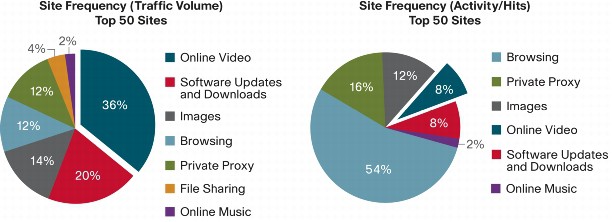
  • Over one-third of the top 50 sites by volume are video sites. There is a high degree of diversity among the video sites in the top 50, including video viewed on gaming consoles, Internet TV, short-form user-generated video, commercial video downloads, and video distributed via content delivery networks (CDNs). Video sites appeared more frequently than any other type of site in the top 50.

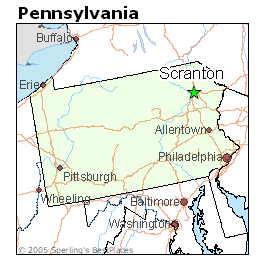
Sorry Scranton, You’re Stuck With Comcast Cable… Indefinitely

Phillip Dampier November 3, 2010 Comcast/Xfinity, Competition, Verizon 1 Comment

When people in Scranton and Wilkes-Barre noticed their neighbors in Philadelphia, Pittsburgh —  even Allentown were getting super high-tech fiber upgrades from Verizon, they wondered why northeastern Pennsylvania has been bypassed, left to contend with Comcast as the only cable company in town.

The Scranton Times-Tribune went to Verizon to find out why they snubbed the region.

Starting four years ago, Verizon made FiOS available in Philadelphia and surrounding counties, South Central Pennsylvania, Pittsburgh and even Allentown. Now the company wants to cultivate those market, said Verizon spokesman Lee Gierczynski.

“We are focusing on the commitments we have,” he said. “No plans have been outlined for future expansion.”

Smaller local phone carriers don’t have the money involved in providing their own Internet television. Instead, those such as Frontier Communications, re-sell satellite service.

“Offering out television service is expensive, too expensive for most smaller telephone companies,” said telecom industry analyst Jeff Kagan. “So many are reselling satellite service to keep customers who want one bundle and one bill.”

Because of that, satellite television providers, who were never a formidable challenge to conventional cable companies, gained market share, Mr. Kagan said.

Lowell McAdam (left) speaks with Ivan Seidenberg (right). (Courtesy: Fortune)

Verizon ended their FiOS expansion partly because of ongoing negative reaction from Wall Street.  Now with a change in CEO’s, things don’t look promising for upgrades anytime soon.  It was former CEO Ivan Seidenberg that green-lit the idea of replacing old copper wire networks with new state-of-the-art fiber optics.  Seidenberg got his start in the phone business as a cable splicer’s assistant, working with the copper wires and fiber-optic cables that are the backbone of today’s phone companies.

His successor, Lowell McAdam grew up in the wireless industry, which is increasingly responsible for Verizon’s revenue.

At a telecommunications crossroads, Seidenberg’s vision of fiber optic service replacing antiquated copper phone cables may be at risk from new leadership at the helm of Verizon — leadership that lives and breathes in a wireless world.

For phone companies, the choices are clear: suffer ongoing landline losses and hope wireless profits can cover the difference, sell off your landline customers to a third party that specializes in rural areas where wireless signal penetration is insufficient, or make required upgrades to stay competitive with cable companies that are also eroding your market share.

As far as the cable industry is concerned, they’d prefer Verizon just stay out of the video business altogether.  Dr. John “Darth Vader” Malone, a former cable kingpin that owned Tele-Communications, Inc. (TCI), said there is room for only one player in the wired video business — cable companies.

“I’ve never seen overbuilds work … it always ends up badly,” Malone has said repeatedly about cable competition.

So for northeastern Pennsylvania, and millions of other Verizon customers hoping for something better, prepare for a long wait.  Save for satellite services, your local cable company is likely to remain the only television service provider for the foreseeable future.

Search This Site:

Contributions:

Recent Comments:

Your Account:

Stop the Cap!