Home » Providers » Recent Articles:

Verizon Workers on Strike in Northeast: Employees Face Up to $20K Benefit Cut if Verizon Wins

Phillip Dampier August 8, 2011 Consumer News, Verizon, Video 2 Comments

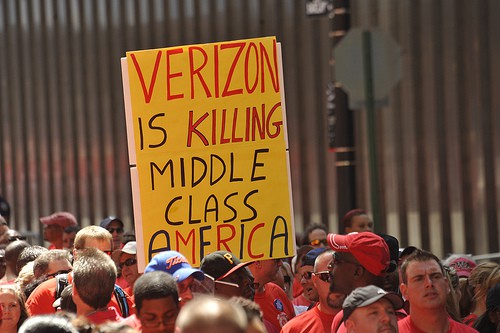
Verizon employees rally in New York. (Photo: Gary Schoichet)

More than 45,000 Verizon landline workers are on strike this morning after union workers overwhelmingly rejected a proposed contract from Verizon Communications that could result in as much as $20,000 in reduced benefits per employee, per year.

Workers employed by Verizon East, which serves the company’s northeastern and mid-Atlantic regions from Massachusetts to Virginia, left their jobs as their contract with the company expired over the weekend.  Two unions — the Communications Workers of America and the International Brotherhood of Electrical Workers, are pitting the dispute as part of a corporate war on the middle class.

Verizon has been demanding serious concessions from union workers in negotiations for a new contract agreement.  But employees are expressing serious concern over draconian salary and benefit concessions that could drastically reduce their pay and benefits package.  According to William Huber, president of IBEW Local 827:

  • Verizon is seeking to tie pay increases to company-defined performance reviews;
  • Employees would pay significant sums towards health care premiums;
  • Pensions would be frozen at the end of 2011;
  • Sickness and death benefits would be eliminated;
  • Disability benefits would be slashed from 52 to 26 weeks and authorized “sick time” curtailed.

Verizon officials claim the benefit and pay concessions are part of the reality of today’s landline telephone business, which has been in decline for several years.

“We need to reach a contract that addresses economic realities,” said Lee Gierczynski, a Verizon spokesman. “The wireline business is constantly in decline. In order for Verizon to compete, Verizon and the unions need to make some difficult decisions.”

That contention is seriously disputed by the two unions and employees.  The CWA called Verizon one of the most profitable companies in the U.S., noting the company earned $19.5 billion in profits in the last four years and paid over $258 million in compensation to just five top executives.

“So tell me, where is their loss?” said Dino Cantillo, a facilities technician and 17-year employee. Cantillo told the Star-Ledger that Verizon’s CEO, Ivan Seidenberg, earned more than $18 million in total compensation in 2010 – roughly $49,000 every day.

“It takes these guys a year to make that,” said Cantillo, pointing at the two dozen or so protesters who picketed in Howell, N.J.

“They are trying to get rid of the working class,” said Bill Gebhart, a lineman who has worked for Verizon for 15 years. “They are totally annihilating it.”

The unions are especially upset Verizon has been aggressively trying to contract work out of the region, hiring workers offshore in Mexico, the Philippines, and other countries to perform tasks formerly done by regional employees.  The unions also point to significant corporate welfare Verizon received recently — a $1.3 billion federal tax rebate paid for by taxpayers.

“These negotiations are all about good jobs,” said CWA District 1 Vice President Chris Shelton. “Companies like Verizon should be investing in rebuilding the American economy, not contributing to the destruction of good, middle-class jobs.”

Verizon appears to be in no hurry to negotiate, cancelling several bargaining sessions last weekend.

During the last strike by Verizon employees in 2000, requests for repair service, installation, and other construction work languished for weeks, so it is very likely consumers with phone or Internet service problems or new order requests will face growing delays the longer the strike lasts.  Union officials plan to move against company plans to reassign managers and workers from other regions with strike protests and what one union official said would be a “blizzard of paperwork.”

Union workers also suggest the quality of repairs and installations done by those pressed into service with little experience may be below standard.

The CWA recommended that union workers and supporters retaliate against Verizon by canceling their phone, Internet, and cell phone service.  That could be an expensive proposition, particularly for wireless customers who would certainly face the prospect of early termination fees.

[flv width=”640″ height=”500″]http://www.phillipdampier.com/video/Verizon Strike 8-8-11.flv[/flv]

Visible strike actions by Verizon workers have served as catnip for local reporters, who are extensively covering the strike up and down the eastern seaboard.  Stop the Cap! has assembled coverage from stations all across the region. (28 minutes)

Windstream’s 2nd Quarter: “Broadband For Us Is About Revenue Growth”

Phillip Dampier August 8, 2011 Broadband Speed, Competition, Online Video, Public Policy & Gov't, Rural Broadband, Video, Windstream Comments Off on Windstream’s 2nd Quarter: “Broadband For Us Is About Revenue Growth”

“We’ve been talking for some time that broadband for us is not just about customer growth… it’s about revenue growth.” — Anthony Thomas, Windstream’s Chief Financial Officer

For the first time in some time, Windstream reported revenue growth during the second quarter of 2011.  The independent landline telephone company that last week acquired Rochester-based PAETEC Corporation managed to win new revenue from its business services unit and equipment sales, even as it continues to lose core landline customers, who are disconnecting service in favor of cell phones or cable telephone products.

It added up to a measurable, but meager growth of 0.1 percent for the company year-over-year during the second quarter.

Like many traditional wireline phone companies, Windstream is betting the farm in their largely rural and suburban service areas on selling broadband and maintaining the allegiance of their business customers, challenged in larger cities by increasingly aggressive “Business Class” products from competing cable companies.

Windstream executives responded to questions from Wall Street bankers during their second quarter conference call held last Friday.

While several investment firms were happy to see Windstream manage some revenue growth, several zeroed in on the company’s increased capital expenditures.  Windstream reports the company will continue major investments in fiber and broadband services, but not primarily for their residential retail customers.  Instead, Windstream hopes to capitalize on the “high margin” business of selling fiber-based cell tower services, primarily to support forthcoming 4G deployments.

Windstream officials faced some hesitancy from Wall Street about the company’s spending during Friday’s conference call, particularly from Bank of America and Goldman Sachs.

Anthony Thomas, chief financial officer for Windstream, defended the investments.

“The most important part of fiber-to-the-tower projects are the initial investments. Those are very high-margin businesses,” Thomas said. “But you have be comfortable with the upfront capital and be patient at recognizing those are 6-to 12-month investment time horizons. But once you start bringing those revenues in, the actual cost of operating a tower is low.”

Wall Street also expressed concerns about consumer broadband traffic growth, but did not broach the subject of usage control measures like usage caps or metered billing.  Windstream acknowledged the growth, primarily from online video, and said it had well-equipped data centers to handle the traffic.

Windsteam’s Consumer Strategy: Bundle Customers & Keep Them Away from Cable TV

It's all about the bundle.

Online video may be an asset for Windstream, which is facing increasing challenges retaining landline customers and up-selling them other products like broadband.  That competition comes primarily from cable companies, who are targeting Windstream customers with invitations to cut their landline service and bring all of their telecommunications business to cable.

Traditional phone companies have a major weakness in their product bundle: video.  Independent phone companies, in particular, are usually reliant on satellite TV partners to support the television component of a traditional “triple play” bundle.  Windstream’s network is capable of telephone and slow speed broadband in most areas, but the company’s involvement in video is largely left to a third party satellite-TV provider.

Customers who do not want satellite TV service may be easily attracted to a local cable provider.  But as an increasing amount of video viewing is moving online, Windstream may find customers increasingly tolerant of doing their viewing online, reducing the importance of a video package.

Windstream’s strategies to keep customers:

  • Sell customers on product bundles, now enhanced with online security/antivirus options and on-call technical support for computer-related technical issues;
  • Pitch Windstream’s Lifetime Price Guarantee, which locks in a single price for basic services, good as long as you remain a customer;
  • Challenge cable competitors head-on with its “Quitter Campaign,” which tries to convince cable customers to “quit cable” in favor of Windstream;
  • Offer faster broadband speeds in limited areas to satisfy premium customer demand.

Windstream Tries to Convince Customers the Broadband Speeds It Doesn’t Offer Do Not Matter for Most

Windstream’s efforts at winning over new broadband customers have been waning as of late.  One of the primary issues Windstream faces is the cable industry’s effective portrayal of DSL as “yesterday’s” technology, incapable of delivering the broadband speeds consumers crave.

Instead of investing in improved broadband speeds for everyone, Windstream spends its time and efforts trying to convince most customers they don’t need the faster speeds being pitched by most cable companies in the first place.


Windstream tries to convince customers they can make do with less speed (as low as 1.5Mbps), and there is no difference in speed between different providers — both questionable assertions.  (4 minutes)

The COO says 3Mbps is Windstream's biggest seller -- their website says something else.

Windstream chief operating officer Brent Whittington says his customers “don’t want to pay for incremental speed,” but is expanding their capacity to offer somewhat faster speeds.

“We still see that long term as [an increased revenue opportunity] because we know the demand is going to be there,” Whittington told investors.  “As we’ve rolled it out currently, it’s largely to — from a marketing benefits standpoint to talk about our competitiveness relative to our cable competition, but [consumers] are largely buying at 3Mbps.”

Either Whittington is mistaken, or Windstream’s website is, because it promotes the company’s 6Mbps $44.99 option as its “top seller.”  Many of Windstream’s cable competitors charge less for almost twice the speed, which may be another reason why Windstream’s broadband signup numbers are lagging behind.

Finding More Revenue: Universal Service Fund Reform & Business Services

Among the most important components of Windstream’s strategy for future growth are reform efforts underway in Washington to overhaul the Universal Service Fund.  Rural, independent phone companies like Windstream have reaped the rewards of this subsidy for years in its rural service areas.  But now Washington wants to transform the program away from simply underwriting rural landline phone service and redirect revenues to enhancing broadband access in areas too unprofitable to service today.

Windstream sees the reform as a positive development.

“It focuses USF on high-cost areas,” said Windstream CEO Jeff Gardner. “If you were a customer in a rural area of Windstream versus a customer in a rural area of a small carrier, your subsidy would much be higher, and we would get very little USF for that going forward. In this proposal, USF is really targeted towards those high-cost areas, so we kind of deal with this issue that we refer to as the rural-rural divide.”

Gardner says USF reform will end disparity of access.

“All rural customers are going to have the opportunity to get broadband out to them under this plan,” he said. The more customers paying monthly service fees, the higher the company’s revenues, assuming nothing else changes.

While redirected subsidies may help rural broadband customers, Windstream’s capital investments in expanding their network are going primarily to benefit their business clients, not consumers.

“On the small business side, our service there is very superior to our cable competitors,” said Windstream’s chief financial officer Anthony Thomas. “We’ve made investments in our network to offer VDSL and higher-speed data services. That’s going to be directed predominately toward those small business customers.”

Whittington added most of the company’s efforts at deploying VDSL technology are focused on the company’s small business segment to bring faster speeds to commercial customers.  For consumers, Windstream’s efforts are targeted primarily at keeping up with usage demands.

“Like a lot of folks in the industry, we’ve definitely seen increases in network traffic really due to video consumption,” Whittington said. “No question Netflix and other related type services are driving some of that demand. We continue to invest in broadband transport like we have in years past. And the good thing with a lot of things we’ve been doing from just a network perspective like rolling out as I mentioned before, VDSL technology in our larger markets. That’s really all about fiber deployment, which helps solve some of those transport issues. So we feel like we’ve been in good shape there, but it’s certainly something we’ve been very focused on operationally so our broadband customers don’t see a degradation in the quality of their experience.”

Still Unofficially Tethering Your Phone? You Will Lose Your Unlimited Data Plan, Says AT&T

Phillip Dampier August 4, 2011 AT&T, Consumer News, Data Caps, Wireless Broadband 4 Comments

AT&T is keeping the pressure on their grandfathered unlimited data plan customers.  Earlier today, AT&T confirmed rumors they are prepared to revoke customers’ unlimited usage plans if they are caught tethering their phones without an authorized tethering and mobile hotspot plan purchased directly from the company.  BGR quotes an AT&T spokesperson:

Earlier this year, we began sending letters, emails, and text messages to a small number of smartphone customers who use their devices for tethering but aren’t on our required tethering plan. Our goal here is fairness for all of our customers. (This impacts a only small percentage of our smartphone customer base.)

The letters outline three choices:

  1. Stop tethering and keep their current plan (including grandfathered unlimited plan)
  2. Proactively call AT&T or visit our stores and move to the required tethering plan
  3. Do nothing and we’ll go ahead and add the tethering plan on their behalf — after the date noted in their customer notification.

An AT&T customer told 9to5 Mac he was threatened with the unilateral loss of his unlimited data plan if he was still unofficially tethering his phone after Aug. 11th, a date AT&T has since said may not be everyone’s “cutoff date”:

I was just informed that as of Thursday, August 11th, if you use MyWi or any tethering on the phone or using the phone as a modem, AT&T will automatically change your unlimited plan to a 2GB tethering plan for 45 dollars without the customer’s consent. This is for those who received emails or texts about the use of tethering without an AT&T tethering plan.

It’s clear AT&T is going hard line on their unlimited data plan customers, first sending notice they will throttle the speeds of any customer on an unlimited plan deemed a “heavy user,” and now threatening to terminate unlimited usage plans for customers who violate the company’s tethering terms and conditions.

Size Queens: Verizon Puts FiOS Boxes on 20-Foot Poles in Brooklyn; Neighbors Don’t Like Them

Verizon's 20' Monolith (Courtesy: Macro/micro Brooklyn)

Verizon Communications has found a way to outdo AT&T’s enormous and unsightly “lawn refrigerators.”  They have installed 20 foot fiberglass poles in the middle of historic neighborhoods in Flatbush, Brooklyn on top of which the phone company plans to mount boxes containing equipment to support its FiOS fiber to the home service.

The enormous polygonal poles went up suddenly without advance warning, and neighbors left their homes to gaze up at the mysterious new addition to the Victorian-era community.

“The neighbors started gathering around it like it was the monolith in ‘2001,’ ” Rev. Jeanne Person, told the New York Times.

Nobody seemed to know who installed the poles, or more importantly why.

It turns out they are Verizon’s answer to AT&T’s enormous and unsightly 4-6 foot tall metal cabinets that the latter has been installing on street corners and in front of homes throughout U-verse service areas.

John J. Bonomo, Verizon’s director of media relations, told the Times the poles provide an interface between underground cables and above-ground wires that thread through backyards.  Bonomo recognized the way AT&T does it attracts vandals and graffiti.  Verizon’s solution tries to hide the unsightly boxes in the canopy of neighborhood trees, to varying degrees of success.  It also prevents anyone other than Spiderman from stealing equipment inside.

Besides, Bonomo says, the company got all of the necessary permits from the Department of Transportation.  Well, almost all of the necessary permits.

They forgot the Landmarks Preservation Commission, which regulates the look and feel of protected, historic neighborhoods — like Flatbush.  Install 20-foot plastic poles without a permit at your peril.

A spokesperson for the Commission says they hope to reach a resolution with Verizon soon.

It’s not that neighbors are ungrateful that Verizon is extending FiOS into Brooklyn, where it will provide real competition to Cablevision.  Many applaud the fiber service and look forward to signing up.  They just don’t believe randomly placed 20′ poles are the way to do it.

“First we wanted to know what it was,” Rev. Person said. “Then when we figured out what it was, we wanted to get rid of it. What does landmarking mean if it doesn’t protect us?”

[flv width=”640″ height=”380″]http://www.phillipdampier.com/video/WCBS NY Verizon 20 Pole 6-7-11.mp4[/flv]

Brooklyn residents complained to WCBS-TV about the 20 foot unwelcome additions to their neighborhoods.  (2 minutes)

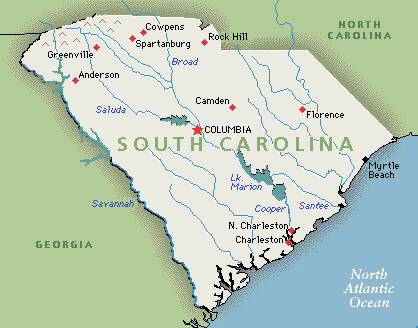
South Carolina: America’s Broadband ‘Corridor of Shame’

In the fall of 2009, South Carolina’s Budget and Control Board approved a fire-sale deal that leased out 95 percent of the state’s public wireless broadband spectrum to two private companies in a 30-year contract valued at $143 million, with the promise South Carolina would enjoy better broadband as a result.

Two years later, South Carolina’s broadband standing has been called “a Corridor of Shame” according to one provider that is trying to expand service while Clearwire and DigitalBridge — the contract winners, sit on their respective hands.

Both companies secured access to the statewide Educational Broadband Service spectrum they get to control with near-exclusivity for less than $5 million annually — around $1 a year for every South Carolinian that could eventually be served with improved broadband.  But nobody is getting service from either provider, indefinitely.

Columbia’s Free-Times notes neither company has concrete plans to bring broadband to anyone in South Carolina.  Clearwire, now in financial trouble, provides no service in the state and DigitalBridge refused to comment for the newspaper’s story.  Free-Times reporter Corey Hutchins could not find anyone able to provide any definitive information about either company’s short or long-term plans to hold up their end of the bargain.

Khush Tata, chief information officer for the S.C. Technical College System suspects one might not even exist.  So long as these two companies maintain a lock on the spectrum, nobody else can deliver the wireless service either.

“I haven’t seen any big cohesive strategy since [the leasing] at all,” Tata told the newspaper. “I think that it’s still based on market and business viability for each provider so they’re sort of on their own. Each provider, they invest based on their return on investment, which is good for their business, but as a state there isn’t any overall planning or approach — and I think the leasing of spectrum provided the largest overall strategy opportunity, which is a pity that it hasn’t panned out yet.”

Don’t tell that to industry-connected Connected Nation, whose South Carolina chapter claims the state is doing better than most providing broadband service.  The group has published maps, based entirely on data provided by the state’s phone and cable companies, that suggest most residents not only get the service, but have a choice in providers.

“That’s just plain bull,” says Stop the Cap! reader Jeff Lodge, who lives outside of Columbia.  Not only does the local cable company pass him by, but there is no DSL either.  He relies on an unlimited wireless data plan from AT&T and does most of his web browsing during breaks at work.

No Plans

“I live in a community of 22,000 people and only those along the main streets in this community have access to broadband,” he says. “The cable company doesn’t go far off the beaten path, and the here-and-there DSL some get is dreadful.”

Even Connect South Carolina acknowledges broadband speeds in the state are often woefully behind others in the region.  Many well-populated census tracts have no wired broadband at all.

With the pervasive lack of broadband, incumbent providers have been heavily lobbying the state to keep others off their spartan turf — pushing for the same type of legislation effectively banning community broadband networks that North Carolina passed earlier this year.

“It’s Time Warner Cable and AT&T… again, that are behind most of this effort, and those two companies treat South Carolina like a forgotten bastard child now,” Lodge says. “Can you imagine the arrogance of big cable and phone companies to keep competition away even when they, themselves, won’t compete?”

No Comment

One company trying to make a difference: GlobalCo and their partner On-Time-Communications.  A review of the under-developed website of the latter suggests neither entity is well-positioned or backed to deliver broadband without significant financial assistance.  But at least they recognize the problem.

“In South Carolina there’s 10 counties that made [the FCC’s report on broadband unavailability] and the majority of them come out of what’s commonly referred to as the ‘Corridor of Shame’,” Ronnie Wyche, GlobalCo’s vice president of sales told Free-Times.

None of this comes as a surprise to Brett Bursey, director of the South Carolina Progressive Network, who opposed the spectrum sell-off.

“The bargain basement lease of the nation’s only statewide broadband system was a theft from, and insult to, the taxpayers who built and own the system,” Bursey told the paper. “The system is not being developed by the companies who won the lease and the Legislature is ideologically opposed to public ownership.”

Search This Site:

Contributions:

Recent Comments:

Your Account:

Stop the Cap!