Home » Providers » Recent Articles:

Sprint Customers’ Treatment of 4G WiMAX: So Unimpressive They Shut It Off to Save Battery Life

Sprint’s 4G experience has been nothing to write home about for a number of their customers, who are increasingly disabling the service to save on battery life.

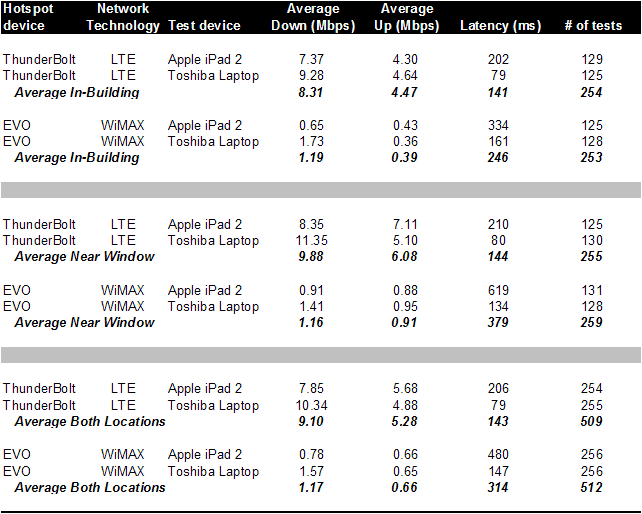
Speed tests of Sprint’s 4G WiMAX experience show increasingly unimpressive results, as the network grows exponentially more crowded with customers trying to capitalize on the higher speeds 4G is supposed to deliver.  The result?  BTIG Research in April found, after exhaustive testing, the average Sprint 4G customer was now getting around 1/1Mbps service from a network that promised to deliver speeds many times that.

This isn't even a contest. (Source: BTIG Research)

Now an increasing number of customers are simply switching the 4G service off completely to extend battery life.

Doug Mahoney, a contributing editor for TechZone360, says he has about given up on WiMAX:

WiMAX tends to stay turned off so I run 3G and there’s no big differences in the convenience of reading email or using simple apps like Twitter and Foursquare.  With more public places starting to offer free WiFi, the case for WiMAX — or LTE — on a smart phone starts to grow weaker between the extra cost and the battery life issue.

Mahoney complains Sprint’s 4G network is simply not robust enough to support consistent speeds and access.  In suburban Washington, he compares Sprint’s 4G coverage to an open air tree, with spotty service scattered across the region.  As a result, his 4G phone spends a lot of time desperately-seeking-signal — a process that accelerates battery depletion.

Given Sprint’s WiMAX “tax” of an additional $10 a month for the service, Mahoney isn’t so certain he’d pay it again on a future Sprint phone.

Are the same speed reductions in store on Verizon’s currently-lightning-fast LTE 4G network few customers use right now?  Perhaps, but Verizon’s brand may force the company to make sure coverage is much stronger than what Sprint customers currently tolerate:

LTE has the same power consumption issues as WiMAX. I suspect Verizon will have better, more ubiquitous LTE coverage just due to the characteristics of the 700 MHz spectrum and physics involved, so I should have faster broadband available in more places rather than the abstract green tree coverage map.

Cricket Drives Away Mobile Broadband Customers With Internet Overcharging Scheme

Phillip Dampier August 4, 2011 Audio, Broadband Speed, Competition, Cricket, Data Caps, Wireless Broadband Comments Off on Cricket Drives Away Mobile Broadband Customers With Internet Overcharging Scheme

Leap Wireless is trying to save face on less-than-impressive second quarter financial results showing the company is losing its mobile broadband customers who are increasingly weary of Cricket’s price increases and speed throttles.

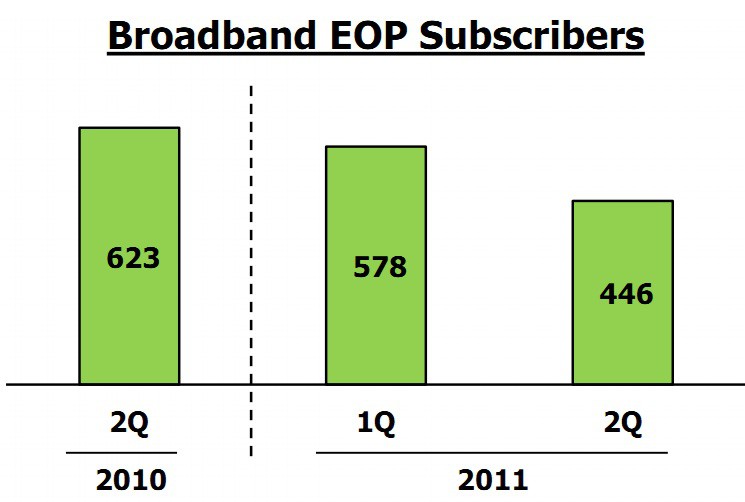
The company lost at least 132,000 broadband customers since the first quarter, mostly due to price increases, reduced usage allowances and “network management” practices, which reduce speeds to near dial-up for customers who are deemed to be “using too much.”

“On broadband, we tightened our focus to more profitable customers while shedding less profitable ones,” said Leap Wireless CEO Douglas Hutcheson.

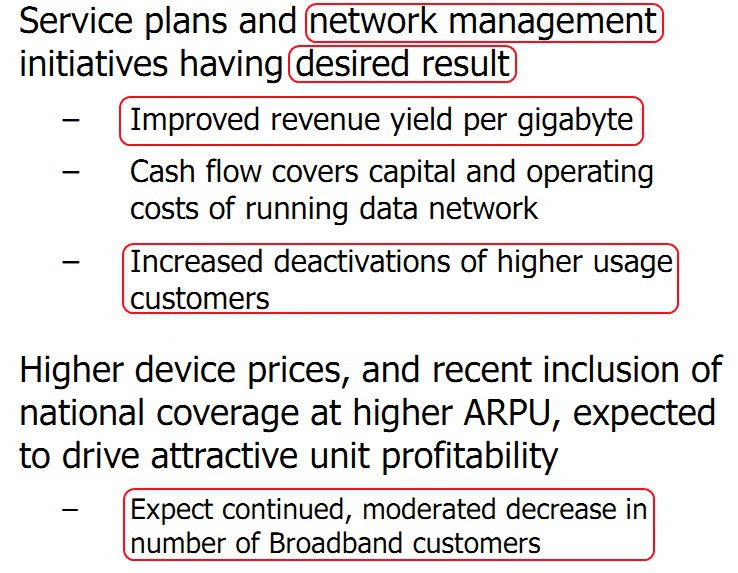
Internet Overcharging Facts of Life: What 'Network Management' tools are really used for. (Courtesy: Cricket's Second Quarter Results Investor Presentation)

Cricket recently announced increased pricing on their usage limited plans: $45/month for 2.5GB, $55/month for 5GB, or $65/month for 7.5GB.

With a less-than-robust regional 3G network and higher pricing, broadband customers have decided to take their business elsewhere, despite the company’s recently announced expanded data roaming agreement with Sprint.

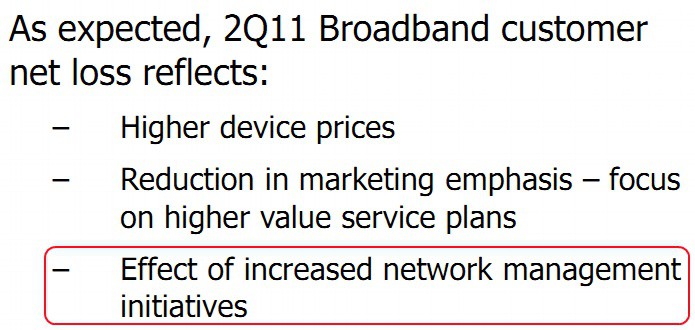
Cricket acknowledges their “increased network management initiatives” are partly to blame for the loss, but the company also says increased prices for mobile broadband devices, which used to be available for free after rebate, are also responsible.  Cricket’s least expensive mobile broadband modem now runs just under $90.

Company officials told investors the losses “were expected,” and that the company has been trying to make up the difference with higher value smartphone data plans.  Mobile broadband customers tend to consume more data than smartphone users, so the company’s emphasis on smartphone data users, who use less, will deliver increased revenue at a reduced cost.

Cricket’s CEO explains the company’s renewed focus on keeping highly-profitable mobile broadband customers while effectively getting rid of “heavy users” who have been targeted with aggressive speed throttling over the past year, and now face higher prices for lower usage allowances. Also explored: Cricket’s future 4G LTE network buildout.  August 3, 2011.  (4 minutes)
You must remain on this page to hear the clip, or you can download the clip and listen later.

Cricket's declining mobile broadband business

In fact, the company’s presentation to investors credits network management tools for driving away “higher usage customers,” allowing Cricket to reap the benefit of “improved revenue yield per gigabyte.”  In short, that means Cricket profits handsomely from data plans they hope customers will only occasionally use.

One of Cricket’s biggest product priorities this year is pitching its Muve Music service, bundled into an all-inclusive $55 wireless prepaid phone plan.  It gives Muve phone customers unlimited access to an enormous downloadable music library accessed on the phone.  Since the service does not allow customers to transfer the music to other devices, record companies are happy to participate.

The biggest downside for some is that the Muve phone becomes your music player — a phone many customers consider a work in progress.  Some critics have labeled the service a “total fail” because of sound quality and DRM restrictions. But since the service is already bundled into the wireless plan at no additional cost, more than 100,000 customers are using it, downloading at least 130 million songs since it was first introduced in January.

Muve Music is another way Cricket is trying to differentiate itself from other wireless providers, and the company may try to expand the Muve Music service to much-more-profitable smartphones in the near future. Cricket hopes to begin selling no-contract smartphones at prices below $100 by Christmas.

Cricket executives answer questions from Wall Street about how the company intends to deal with a decline in mobile broadband customers, and explains their use of network speed throttles. Cricket plans to “follow industry trends” and experiment with “session-based” throttles sometime next year. These allow customers to pay an extra charge to temporarily remove the speed throttle when they need additional bandwidth. It’s just one more source of lucrative revenue from conjured up network management schemes.  August 3, 2011.  (4 minutes)
You must remain on this page to hear the clip, or you can download the clip and listen later.

Cricket is also planning further expansion of its ‘welfare wireless’ plan — a Universal Service Fund-backed home phone replacement for customers receiving public assistance.  The Lifeline USF subsidy is designed to provide affordable home telephone service to the most income-challenged among us.  Many landline providers charge around $1 a month for the service (before fees), and then charge for every call made.

Cricket’s implementation of this subsidy could draw some controversy because it delivers a $13.50 monthly discount off -any- of their rate plans.  That means qualified customers could pay just over $40 a month for a high end smartphone service plan, subsidized by every telephone ratepayer in the country.

Cricket also plans to launch LTE 4G service starting in early 2012.

Cricket plans to introduce 4G LTE service in 2012.

Cogeco Customers Pay for Company’s European Mess: Rate Hikes Sooth Portuguese Write-Off

Phillip Dampier August 3, 2011 Canada, Cogeco, Competition, Consumer News, Data Caps 5 Comments

Cogeco Cable customers are about to pay for the company’s tragic financial results from its Portuguese operations in the form of broad-based price increases the company is selling as service “improvements.”

July’s financial results for Cogeco, which owns cable systems in Ontario, Quebec, and Portugal, are not good.  With mass subscriber defections and downgrades from Cogeco’s Portuguese cable system Cabovisao, company officials have decided to write off their European investment, resulting in a $56.7 million loss in the third quarter.

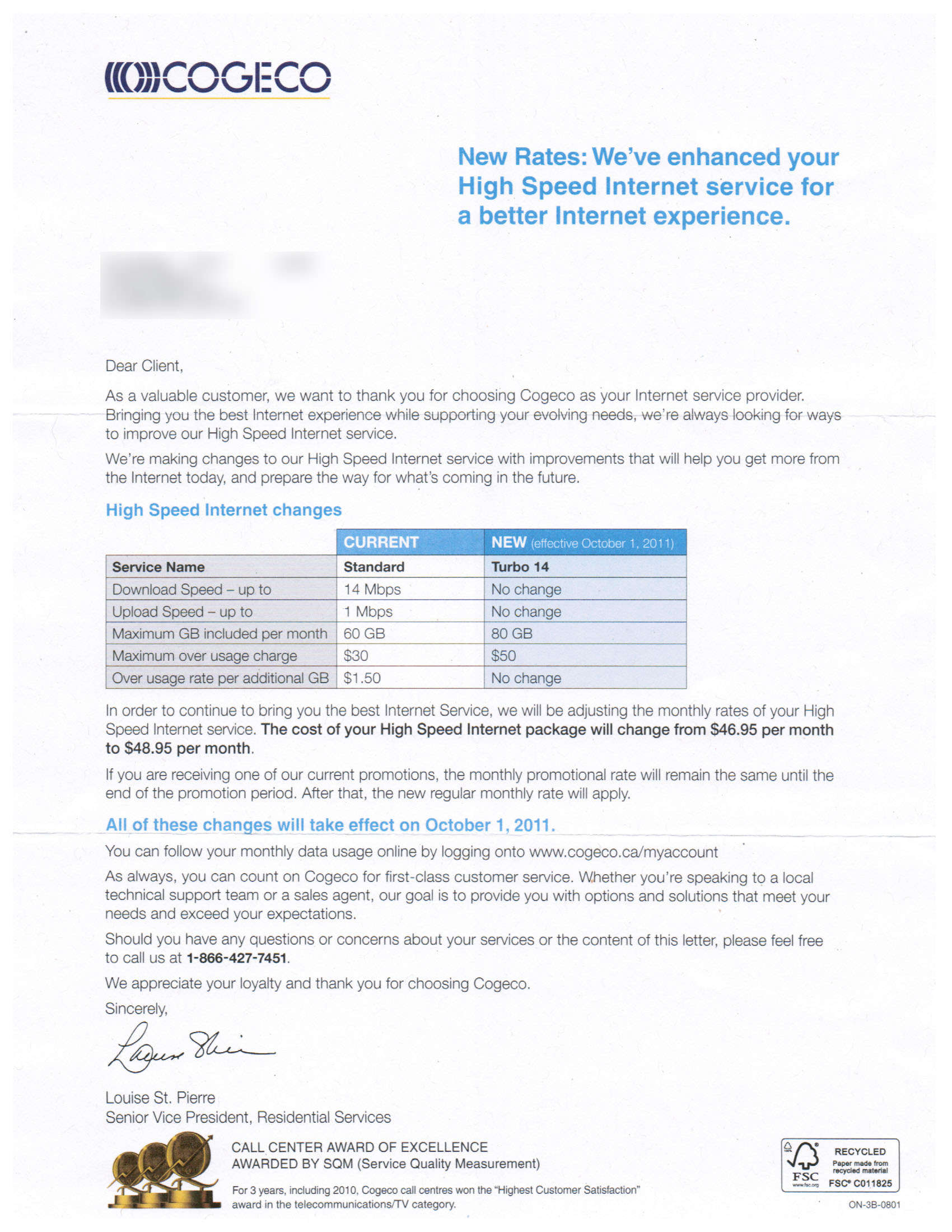
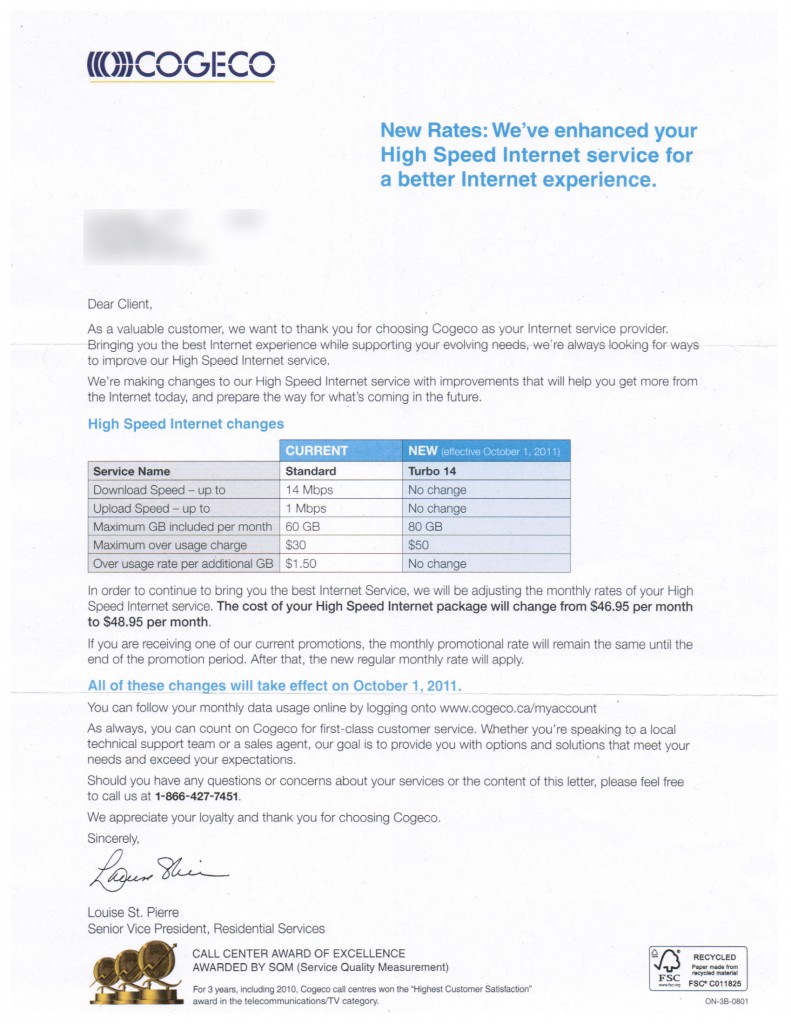
Tempering the damage is the company’s decision to raise broadband prices for Canadian customers by $2 a month for their Standard broadband package, soon to be priced at $48.95.
(Courtesy: 'Gone' from Fort Erie, Ontario)

“To add insult to injury, they are calling these changes ‘improvements,'” writes Stop the Cap! reader Claudette, who is a Cogeco customer in Ontario.  “In fact, the only thing Cogeco is improving is their skill at overcharging us.”

Cogeco's financial mess in Portugal.

Cogeco has sent letters to subscribers notifying them about the “improvements,” mostly in the form of a name change for the company’s ‘Standard’ plan, soon to be renamed ‘Turbo 14.’  They have also launched a new section on their website to break down the changes.

The only benefit Cogeco is introducing for customers with their Standard plan is a slight bump in usage allowances, from 60 to 80GB.  But that change comes with a major catch.  Cogeco charges customers a $1.50/GB overlimit fee with a monthly maximum overcharge of $30.  When ‘Turbo 14’ premieres Oct. 1, the maximum overlimit fee will jump to $50 a month.

“That is a total ripoff, because the next plan up with bigger allowances — just over 100GB a month — costs nearly $77 a month, for a whopping 16Mbps,” she adds.  “They just raised our rates last July and now they want more.”

Cogeco is punishing their premium customers even more by taking the maximum overlimit fee cap completely off their DOCSIS 3-based Ultimate 30Mbps and 50Mbps plans.  Available in some Cogeco service areas at prices of $60 and $100 a month respectively, the plans come with usage limits of 175-250GB.  The sky is the limit for overlimit fees, racked up at $1 per gigabyte.

Cogeco customers are outraged, and have begun shopping for alternatives, just like their counterparts in Portugal who have put their cable service on the chopping block.

The ongoing Portuguese financial crisis has been met with tax increases and benefit reductions by the government, and Portuguese consumers have responded with wholesale cord-cutting, cancelling Cabovisao cable-TV service in droves.
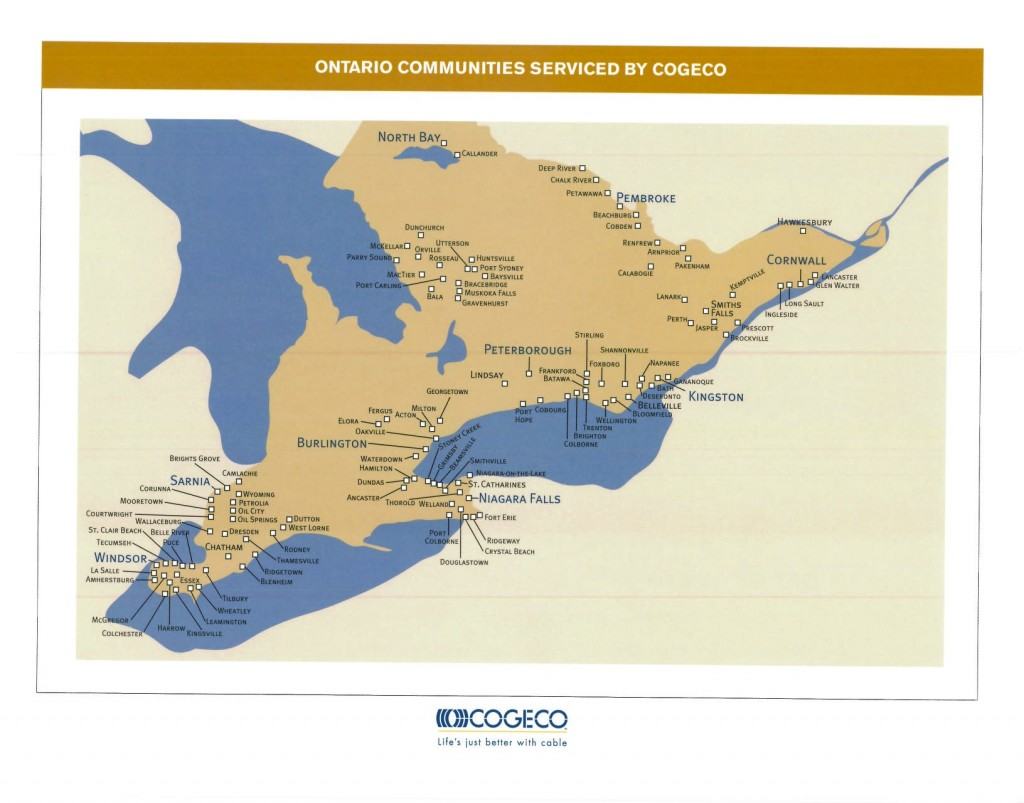
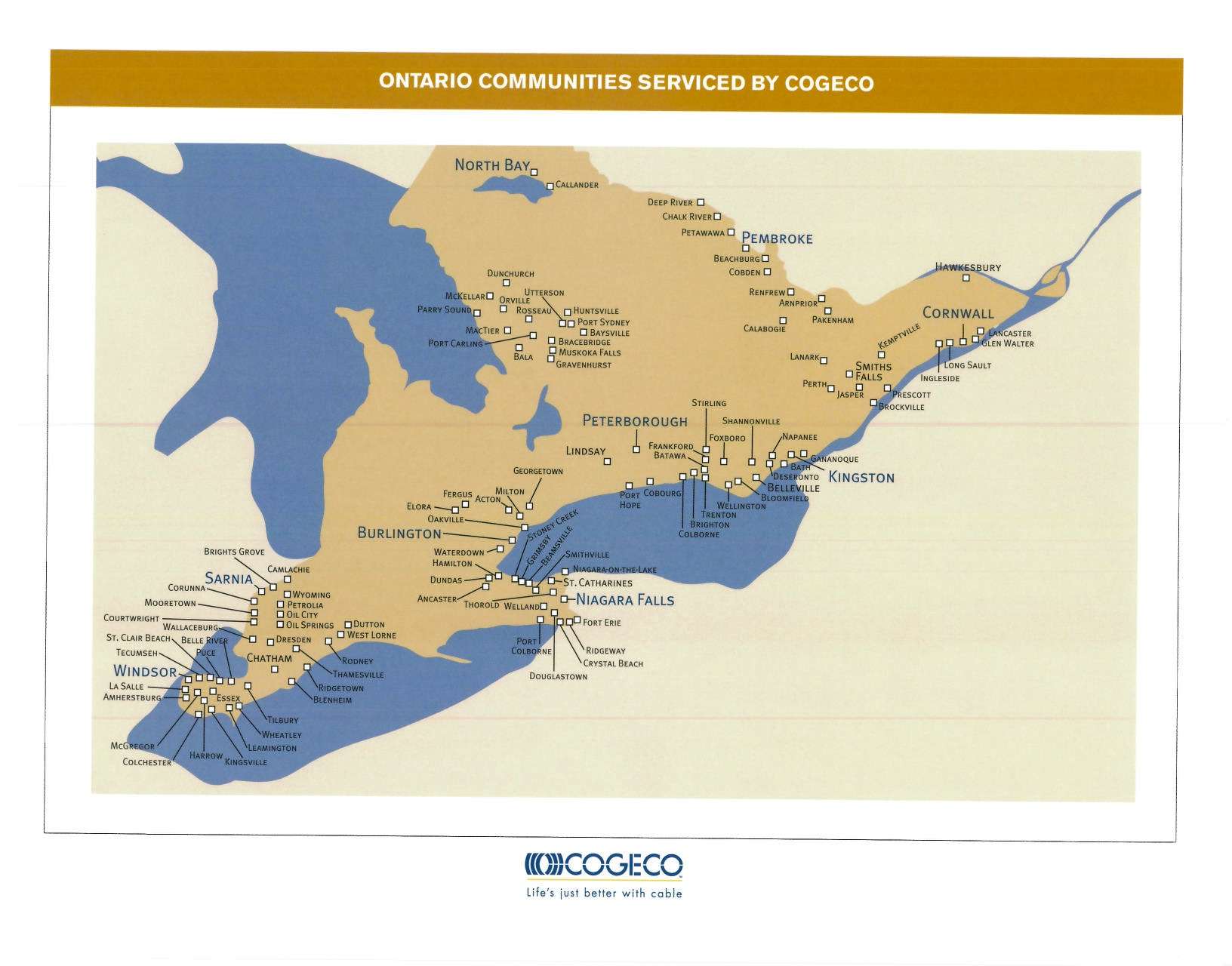
Cogeco's systems in Ontario (click to enlarge)

“You now have customers squarely opting out of [cable TV],” said Louis Audet, Cogeco’s president and chief executive officer. “These are economic circumstances that we have not, nor has anyone here, witnessed in North America. These are very unique to the circumstances in Portugal.”

At least Audet hopes they are.

With fewer competitive choices in the rural and suburban Ontario and Quebec markets Cogeco favors, consumers have a tougher time finding alternative providers, but not an impossible one.  Many are dropping Cogeco’s phone and broadband packages, moving to Voice Over IP or cell phone service for the former, and independent broadband providers like TekSavvy for the latter.  TekSavvy still retains unlimited use plans and has been traditionally more generous with allowances for the usage-based plans the company also sells.

Investors have been placated with a boost in Cogeco’s dividend payout… for now.  But many have adopted a “told you so” attitude about the company’s controversial decision to invest in overseas cable to begin with.

Scotia Capital analyst Jeff Fan said he had a negative view about Cogeco’s Portuguese venture.

“We hope this paves the way for a sale,” he wrote in a note to investors, “as Portugal is still cash-flow negative and dilutes the strong Canadian results.”

In fact, many investor groups dream of an even bigger sale — of Cogeco itself.

Joseph MacKay of Mackie Research said Canada’s fourth-largest cable company is ripe for a takeover by a larger cable operator, presumably Rogers or Shaw Communications.  Rogers already blankets Ontario with cable services, so Cogeco’s operations in eastern provinces would be a ‘natural fit’ for the company.  Shaw’s interest in expanding eastward could also get a boost from the buyout of Cogeco.

But one significant roadblock remains — the controlling interests of the Audet family, which have no intention of selling and control enough voting shares to stymie a hostile takeover.  In fact, despite the poor showing of the company’s Portuguese operations, the Audet family claims to be interested in acquiring other providers and expanding Cogeco’s size.

With the benefit of a two-dollar rate increase and the proceeds of Internet Overcharging, they’ll be in a position to put more dollars toward that goal.


AT&T Math: A ‘Heavy User’ Subject to Throttling Uses 4GB and Up

Loyal AT&T customers grandfathered on unlimited data plans are being paid back for their loyalty to the company with the threat of a speed throttle hanging over their heads if they don’t limit the use of their unlimited use plan.

The Washington Post reports, by AT&T’s calculations, anyone using 4GB of usage and up during the month is likely to find their smartphone neutered to near dial-up speed for the rest of the month:

The company said that it will throttle back data use for the top 5 percent of data consumers, who use “twelve times” what its average smartphone data customers use.

A recent Consumer Reports survey found that the average smartphone user on AT&T’s network uses 360 megabytes per month — meaning that only power users will feel the pinch. Using AT&T’s formula, the company’s likely scaling back its network for users who exceed 4 gigabytes per month.

Four gigabytes of usage on a smartphone is a considerable amount, if all you do is browse web pages, read e-mail, and access a handful of apps.  But consumers who increasingly rely on GPS navigation and streaming multimedia content, particularly videos, will find they don’t have to live on their smartphones to put themselves on AT&T’s bad side.  Even devoted attention to video streams from a home security system could consume a considerable amount of data on a usage plan that was supposed to be unlimited.

“It’s a slap in the face to loyal customers who have been with AT&T for a decade or longer,” says Stop the Cap! reader Paul.  “Wireless providers used to operate on rewarding loyalty by letting customers keep their plans intact unless and until they change plans or depart for another provider.  Now AT&T is literally cattle-prodding their most loyal customers who pay $30 a month for an unlimited plan that will now have limits.”

Paul wonders why anyone would want to keep an unlimited plan that will be throttled to punish customers with unusable speeds.

“Clearly, Verizon moving away from unlimited data allowed AT&T to stick it to customers who know they have few places to run,” Paul writes. “This is probably only the beginning.  Why again would we want AT&T to get any bigger than it already is?”

‘Measuring Broadband America’ Report Released Today: How Your Provider Measured Up

Phillip Dampier August 2, 2011 AT&T, Broadband Speed, Cablevision (see Altice USA), CenturyLink, Charter Spectrum, Comcast/Xfinity, Consumer News, Cox, Frontier, Mediacom, Online Video, Public Policy & Gov't, Rural Broadband, Verizon Comments Off on ‘Measuring Broadband America’ Report Released Today: How Your Provider Measured Up

The Federal Communications Commission today released MEASURING BROADBAND AMERICA, the first nationwide performance study of residential wireline broadband service in the United States.  The study examined service offerings from 13 of the largest wireline broadband providers using automated, direct measurements of broadband performance delivered to the homes of thousands of volunteers during March 2011.

Among the key findings:

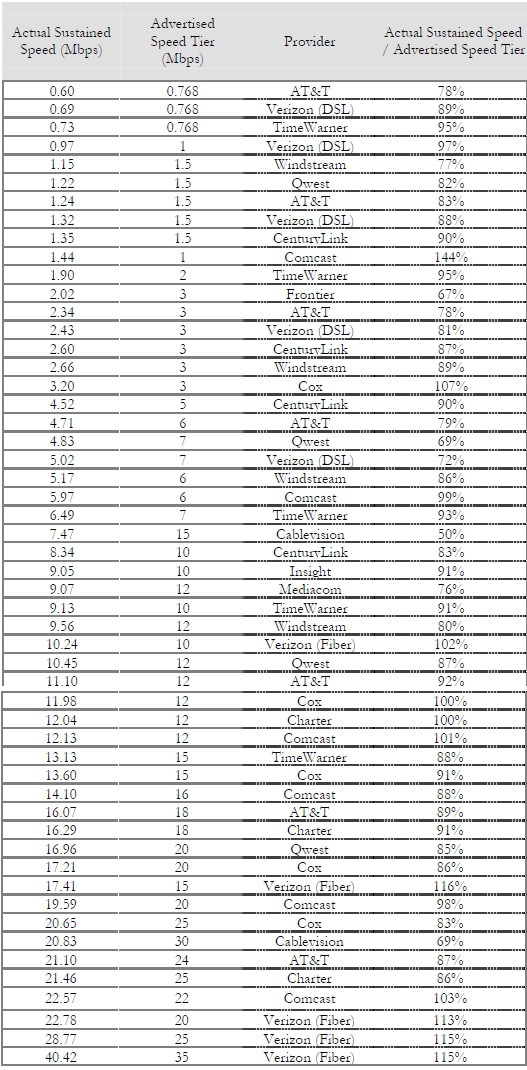
Providers are being more honest about their advertised speeds: Actual speeds are moving closer to the speeds promised by those providers.  Back in 2009, the FCC found a greater disparity between advertised and delivered speeds.  But the Commission also found that certain providers are more likely to deliver than others, and certain broadband technologies are simply more reliable and consistent.

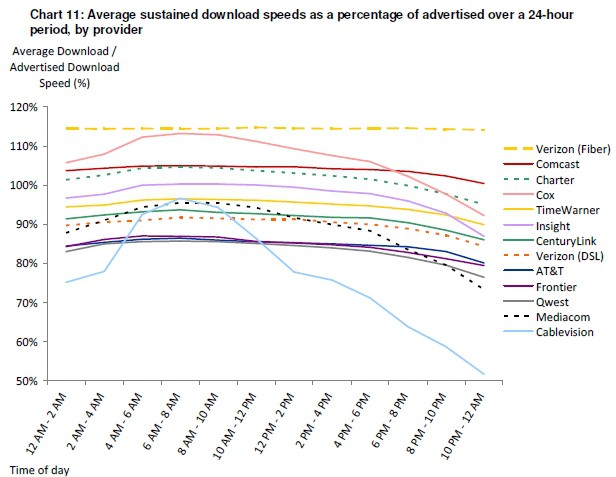
Fiber-to-the-Home service was the runaway winner, consistently delivering even better speeds than advertised (114%).  Cable broadband delivered 93% of advertised speeds, while DSL only managed to deliver 82 percent of what providers promise.  Fiber broadband speeds are consistent, with just a 0.4 percent decline in speeds during peak usage periods.

Cable companies are still overselling their networks.  The FCC found during peak usage periods (7-11pm), 7.3 percent of cable-based services suffered from speed decreases — generally a sign a provider has piled too many customers onto an overburdened network.  One clear clue of overselling: the FCC found upload speeds largely unaffected.

DSL has capacity and speed issues.  DSL also experienced speed drops, with 5.5 percent of customers witnessing significant speed deterioration, which could come from an overshared D-SLAM, where multiple DSL customers connect with equipment that relays their traffic back to the central office, or from insufficient connectivity to the Internet backbone.

Some providers are much better than others.  The FCC found some remarkable variability in the performance of different ISPs.  Let’s break several down:

  • Verizon’s FiOS was the clear winner among the major providers tested, winning top performance marks across the board.  Few providers came close;
  • Comcast had the most consistently reliable speeds among cable broadband providers.  Cox beat them at times, but only during hours when few customers were using their network;
  • AT&T U-verse was competitive with most cable broadband packages, but is already being outclassed by cable companies offering DOCSIS 3-based premium speed tiers;
  • Cablevision has a seriously oversold broadband network.  Their results were disastrous, scoring the worst of all providers for consistent service during peak usage periods.  Their performance was simply unacceptable, incapable of delivering barely more than half of promised speeds during the 10pm-12am window.
  • It was strictly middle-of-the-road performance for Time Warner Cable, Insight, and CenturyLink.  They aren’t bad, but they could be better.
  • Mediacom continued its tradition of being a mediocre cable provider, delivering consistently below-average results for their customers during peak usage periods.  They are not performing necessary upgrades to keep up with user demand.
  • Most major DSL providers — AT&T, Frontier, and Qwest — promise little and deliver as much.  Their ho-hum advertised speeds combined with unimpressive scores for time of day performance variability should make all of these the consumers’ last choice for broadband service if other options are available.

Some conclusions the FCC wants consumers to ponder:

  1. For basic web-browsing and Voice-Over-IP, any provider should be adequate.  Shop on price. Consumers should not overspend for faster tiers of service they will simply not benefit from all that much.  Web pages loaded at similar speeds regardless of the speed tier chosen.
  2. Video streaming benefits from consistent speeds and network reliability.  Fiber and cable broadband usually deliver faster speeds that can ensure reliable high quality video streaming.  DSL may or may not be able to keep up with our HD video future.
  3. Temporary speed-boost technology provided by some cable operators is a useful gimmick.  It can help render web pages and complete small file downloads faster.  It can’t beat fiber’s consistently faster speeds, but can deliver a noticeable improvement over DSL.

More than 78,000 consumers volunteered to participate in the study and a total of approximately 9,000 consumers were selected as potential participants and were supplied with specially configured routers. The data in the report is based on a statistically selected subset of those consumers—approximately 6,800 individuals—and the measurements taken in their homes during March 2011. The participants in the volunteer consumer panel were recruited with the goal of covering ISPs within the U.S. across all broadband technologies, although only results from three major technologies—DSL, cable, and fiber-to-the-home—are reflected in the report.

Search This Site:

Contributions:

Recent Comments:

Your Account:

Stop the Cap!