Home » Providers » Recent Articles:

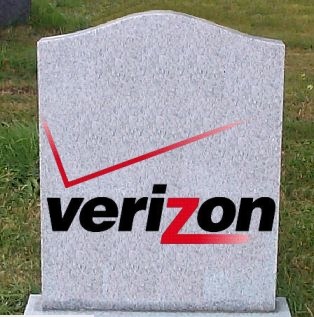
If You Die, Verizon Wireless Will Take Away Your Family’s Unlimited Data Plans

Phillip Dampier June 26, 2012 Consumer News, Verizon, Wireless Broadband 2 Comments

If you die, Verizon Wireless will bury your family’s unlimited data plans with you.

Amidst the brouhaha over Verizon Wireless’ impending transition to new Share Everything plans that will raise the wireless phone bills of a lot of Verizon customers, the wireless company is also quietly inserting a change in the terms and conditions that will strip away the unlimited data plans of surviving family members if the primary account holder passes away.

While the departed may no longer care about keeping worry-free data, surviving family members might:

Verizon Wireless has confirmed to PhoneNews.com that, effective June 28, Assumptions of Liability will be stripped of unlimited data plan codes during the account transfer. New customers receiving the account will be required to select from Verizon’s metered data plan add-ons for legacy Nationwide and America’s Choice II accounts, or switch to a new Share Everything plan.

The main problem, is that this will negatively impact those who suffer a loss in the family. If someone passes away, say a husband, the surviving widow can no longer keep the same plan terms. Worse, a customer cannot port out without an assumption of liability. This creates an awful Catch-22 potential for families looking to keep their phone numbers; either accept massively higher bills under Share Everything, or pay massively high Early Termination Fees to port out.

For many, the move is seen as unsurprising. Verizon’s CFO Fran Shammo stated that “all customers” would be forced onto a Share Everything plan once they went into effect, and upgraded devices. Verizon quickly clarified that customers who waived handset subsidies would still be permitted to keep their unlimited data plans, even when migrating from a 3G smartphone, such as an iPhone 4/4S, to a future LTE smartphone.

Verizon’s move wasn’t intended to directly target dead people, but rather stop customers from selling off their unlimited plans to the highest bidder on eBay. Using the Assumptions of Liability clause, the winning eBay bidder could take over control of a Verizon line grandfathered with a more favorable plan than the company sells today. Bids running several hundred dollars for the assumption of a line with unlimited data were not uncommon.

As PhoneNews reports, “Verizon Wireless defended the lack of a specific mention of this change, citing that they have said all along that Share Everything plans will apply to all new customers. For those suffering the loss of a family member, and use a Verizon unlimited data plan, it will be adding insult to injury that they may be forced off their plans.”

Sandra Bernhard: Dealing With Time Warner “An S&M Experience Without the Pleasure”

Phillip Dampier June 26, 2012 AT&T, Consumer News, Verizon 3 Comments

Recognizable New Yorkers are fed up trying to keep track of new security measures thrown at them by their telecommunications companies.

The New York Times Fashion & Style section (really?) took a dive into the frustrating world of pre-assigned passwords, captcha codes, and user verification questions that confound New York’s more prominent citizens, sometimes with hilarious results.

“It’s a nightmare,” the comedian Tracey Ullman told the newspaper. “These passwords just keep getting longer and longer. I try to think of a startling emotional thing that jogs my memory or something that’s frightening, or my grandmother’s name with 666 at the end. But I really don’t know what to do.”

In an effort to respond to an increasingly security-conscious online world, providers are password protecting subscriber information and equipment to keep prying eyes out. But sometimes those anti-hacking, anti-eavesdropping, anti-identify theft efforts become mind-boggling to confused customers who end up locked out of their own accounts.

Among the latest trends: locking down wireless routers with passwords straight out of the box.

Bernhard

Any long time Wi-Fi user already knows America’s largest open wireless network does not come from AT&T or Verizon Wireless. It comes from a company formerly known as “Linksys” (today Cisco). Customers confounded by wireless security simply plug in their new routers and start using them without setting any Wi-Fi password or enabling security measures.

Time Warner Cable tried to lick that problem by issuing pre-assigned passwords to customers using the company’s wireless router. Unfortunately, comedian Sandra Bernhard, never smart to antagonize, ended up with one that came with a mish-mosh of letters and numbers (they range from 13 to 28 characters) that cannot be changed.

“We have that one written down somewhere, but where it is I’d be hard pressed to tell you,” Bernhard told the newspaper, noting that her relationship with the cable provider is “an S&M experience without the pleasure.”

Verizon and AT&T love their creative security questions, designed to verify you are who you say you are. But New Yorkers who think too deeply about the questions are sure to be tripped up by the experience.

Jeffrey Leeds, a fixture on the New York social scene, tells the Times he hates questions like, ‘What is the name of your first girlfriend,’ because he unsure if that means the first girl he slept with or the first one he liked who never returned his phone calls.

The confusion inevitably leaves hapless customers writing down their password and security questions on sticky notes or in a notebook, which entirely defeats the purpose of private “only you should know” passwords.

Courtney Love thought she could outwit the hackers with her own system, based on mnemonics.

“You use the lyrics to a song,” she said, for example, “ ‘Lucy in the Sky With Diamonds’ — litswd-1 — and that way you can’t forget it.”

But the newspaper reports that worked until Love was tripped up by “Hey Jude.”

“I kept forgetting if it was ‘Hey Jude, don’t make it bad’ or ‘Hey Jude, don’t make it sad,’ ” she said. “So I gave up on that.”

But the most reviled security measure of all is the deadly, incomprehensible “captcha” code — the barely decipherable slanted text and numbers that real humans are supposed to be able to identify but spammers using automated tools cannot.

“Don’t you hate those?” Ullman said. “I always get those wrong because it looks like they were written by someone on LSD. It’s awful.”

CenturyLink Doesn’t Want to Serve Low Income Neighborhoods, Charges Colorado City Mayor

Phillip Dampier June 26, 2012 CenturyLink, Competition, Consumer News, Public Policy & Gov't Comments Off on CenturyLink Doesn’t Want to Serve Low Income Neighborhoods, Charges Colorado City Mayor

Prism is CenturyLink’s fiber to the neighborhood service, similar to AT&T U-verse.

CenturyLink is feuding with the mayor of Colorado Springs, Colorado over whether or not the company intends to roll out its Prism IPTV service in lower income neighborhoods in the city.

The phone company is planning expansion of its fiber-to-the-neighborhood television service in Colorado for the first time, but has run into problems negotiating a franchise agreement with city officials that guarantees equal access to the upgraded broadband, phone, and television service.

“To be candid, CenturyLink does not want to put in the franchise agreement any specificity as to serving lower-income neighborhoods,” Mayor Steve Bach said last Wednesday during a meeting with City Council. “I don’t know about you, but that doesn’t work for me.”

CenturyLink wants to secure a franchise agreement that will permit the company to gradually roll out their Prism service to 22 percent of the city of Colorado Springs. But the company has refused to commit to a specific percentage of homes in lower income neighborhoods the company will wire for the new service.

Bach has the apparent support of incumbent cable operator Comcast, who seems in agreement CenturyLink should deliver its service equitably across the city.

Comcast spokeswoman Cindy Parsons told The Gazette any new cable company should be held to the same standards as Comcast was.

“Just as Comcast was required to make video services available throughout the city, we believe a new entrant into the video business should also be held to those same regulatory requirements,” she said.

“I honestly thought we had reached an understanding about the language that was to be included in the agreement,” Mary LaFave, CenturyLink’s director for public policy told the newspaper. “What we have discussed with the city is something that we have never discussed (in other communities). I’ve never seen it before.”

Bach

The newspaper last week met with CenturyLink executives to discuss the dispute and found them to be unaccommodating.  The newspaper issued an editorial critical of CenturyLink’s apparent unwillingness to get specific:

To lay fiber, the company needs to use public right-of-way. That means it needs permission of city government, in the form of a franchise agreement.

Allocation of right-of-way is a subsidy, given that companies are granted permission to use a public resource in pursuit of profits. As such, some politicians take quite seriously any request for an agreement.

Mayor Steve Bach went public this week with a concern that CenturyLink might choose to serve only the most affluent neighborhoods, giving no assurance to the city that it would invest in less advantaged areas. His concern has led to a proposed agreement in which CenturyLink would provide a “significant” amount of service to low-income areas.

[…] “What we have discussed with the city is something that we have never discussed. I’ve never seen it before,” said Mary LaFave, CenturyLink’s director for public policy.

Welcome to the new Colorado Springs. We don’t try to match best practices elsewhere. We try to surpass them.

In our meeting, a Gazette editorial board member expressed concern about a contract that relies on the wiggle word “significant.” That could mean 10 percent to some, 80 percent to others. It’s a recipe for potential consternation and even litigation. We suggested a contract that specified a percentage of service, even a very low percentage, to low-income neighborhoods. LaFave said no way.

Low-income households often buy cable. So Bach’s concern may be mostly political, as market demand will likely cause CenturyLink to reach into a cross section of neighborhoods.

Given this likelihood, and the heartfelt assurance that CenturyLink will serve a broad socioeconomic spectrum, it is hard to understand why the company balks at committing to a base-level percentage.

We urge City Council and Bach to approve a business-friendly agreement with a specified safety-net percentage of service that will go to low-income households. Set a number slightly below CentryLink’s anticipated service to low-income areas, but achieve contractual specificity.

When local government trades in right-of-way, it allocates a resource that belongs to every resident of Colorado Springs. A reasonable effort to protect them, with a contract that codifies at least the minimal goals stated by CenturyLink, makes good business sense. This is not just any old town, and it should not settle for just any old contract.

CenturyLink was already awarded a cable franchise in Monument and is seeking franchises in Fountain and unincorporated El Paso County. The company currently operates Prism in eight cities nationwide.

Rogers Slashing Hundreds More Jobs In New Round of Cuts

Phillip Dampier June 26, 2012 Canada, Competition, Consumer News, Rogers Comments Off on Rogers Slashing Hundreds More Jobs In New Round of Cuts

While Rogers top-level executives remain safe, hundreds of lower level employees are on the chopping block as Canada’s largest wireless provider announces the second round of job cuts to cut costs, the company confirmed today.

Just under 400 employees will be terminated, many in middle management positions in both the cable and wireless divisions Rogers operates. Rogers slashed at least 300 jobs earlier this year.

Rogers blames increasing competition from Bell, Telus, and smaller wireless carriers for the cost cutting. Rogers position in the market has stalled as other carriers increase their promotional offers to win over Rogers’   customers.

Bell is also cutting into Rogers’ position in cable television and broadband, especially in Ontario where the company’s Fibe TV is eroding Rogers’ margins.

“Where we actually saw the losses in subscribers, again more at the bottom end of the market with bundled offers that were extremely cheap, what we would call unsustainable, aggressive bundled offers with price points down in the mid-$70 range for a triple-play for the first six months,” Robert Bruce, president of communications told investors during an April conference call.

Rogers’ knife-wielder is its new chief financial officer Tony Staffieri, a former executive vice-president of finance at Bell. Staffieri was hired earlier this year to launch a new cost-cutting philosophy. But top executives at Rogers have been largely immune to the job and cost cuts.

Call to Action: AT&T and ALEC Pushing Anti-Consumer Telecom Bill in California

The Communications Workers of America says when it comes to “stealthy” bills like S.B. 1611 that deregulate telecommunications in California, “no price is too high — no lie is too big.”

AT&T and the American Legislative Exchange Council (ALEC) are back again fighting for more deregulation of California’s telecommunications industry with a bill that will strip oversight of vital telecommunications services and stop punishing bad actors that leave customers without telephone service, sometimes for weeks.

California legislators are typically not responsive to the wholesale deregulation efforts that seem to draw support in more conservative states, so AT&T’s lobbyists are trying a more “incremental” approach in the state. But AT&T has also inserted “stealth” language into the bill that would dismantle consumer protections, allow companies to abandon unprofitable landlines, and strip away important oversight “checks and balances” needed to ensure good service.

Sen. Padilla’s top corporate contributor is AT&T.

S.B. 1611 illustrates that AT&T can buy its way into any legislator’s office, Democrat or Republican. The bill’s chief sponsor, Rep. Alex Padilla (D-20th Senate District) has received more contributions from AT&T than from any other corporation in both the 2006 and 2010 elections.

The bill ostensibly claims to limit its scope narrowly to “Voice over Internet Protocol” (VoIP) and “Internet Protocol enabled service.” That brings to mind services like “digital phone service” from cable companies or alternative telephone services like Vonage, magicJack or Skype.

S.B. 1611:

The bill would prohibit any department, agency, commission, or political subdivision of the state from enacting, adopting, or enforcing any law, rule, regulation, ordinance, standard, order, or other provision having the force or effect of law, that regulates VoIP or other IP enabled service, unless required or delegated by federal law or expressly authorized by statute. The bill would specify certain areas of law that are expressly applicable to VoIP and IP enabled service providers. The bill would provide that its limitations upon the commission’s regulation of VoIP and IP enabled services do not affect the commission’s existing authority over non-VoIP and other non-IP enabled wireline or wireless service….

To the layperson who generally believes services like Skype and Vonage might not deserve the same oversight as AT&T, Frontier, or Verizon — which provide Californians traditional landline service, consider Section 2 (a)(2) of the bill, which describes and defines VoIP and IP enabled service as anything that:

“Permits a user generally to receive a call that originates on the public switched telephone network and to terminate a call to the public switched telephone network” and “any service, capability, functionality, or application using existing Internet Protocol, or any successor Internet Protocol, that enables an end user to send or receive a communication in existing Internet Protocol format, or any successor Internet Protocol format through a broadband connection, regardless of whether the communication is voice, data, or video.”

This “narrow” deregulation bill just grew as wide as the Gulf of Mexico and can realistically allow any phone company in California to ignore state oversight and regulation forever.

Traditional telephone companies increasingly utilize exactly these technologies for calls placed over ordinary landline phones. Using broadband service to engage in two-way communications also qualifies. With this kind of defining language, virtually every telecommunications service in the state of California would win near-total deregulation and walk away from important oversight. The California Public Utilities Commission certainly understood the implications of this bill when the majority of commissioners came out in opposition to S.B. 1611.

Goodbye Universal Service: S.B. 1611 Allows Phone Companies to Abandon Rural and Economically Distressed California Communities

Several public interest groups also discovered language in the bill that is a perennial favorite of AT&T — eliminating universal service requirements that assure every citizen that wants a telephone line can get one. S.B. 1611 lays waste to Section 709 of the California Code which guarantees: “our universal service commitment by assuring the continued affordability and widespread availability of high-quality telecommunications services to all Californians.”

With that language gone, the state’s phone companies can unilaterally decide to abandon the customers they no longer want to serve. That could spell disaster in rural northern and eastern California, and leave low income residents with nothing but a dead phone line, unable even to call 911 in an emergency.

One AT&T Lobbyist for Every California Lawmaker

The importance AT&T places on influencing lawmakers is readily apparent when one realizes there are at least 120 AT&T lobbyists working in the state capital Sacramento, one for every California lawmaker.

But when one considers the track record of California phone and cable companies in the last few years, is less oversight and regulation the right answer?

“SB 1161 is a stealth vehicle for the gradual deregulation of telecommunications in California,” the Consumer Federation of California declared on their website. “Consumers need the CPUC to have the power to investigate complaints of bad service or unfair charges on bills, regardless of the technology used to provide phone service.”

Call to Action!

Consumers across California need to get on board immediately to stop S.B. 1611. You can file online opposition courtesy of Free Press, but it is far more effective to also directly phone your own legislator and leave a message to urge this bill be defeated. It literally takes only 2-3 minutes to call and the money and phone service you could save will be your own. Use this district finder to contact your representatives.

S.B. 1161 is scheduled for hearing in the Assembly Appropriations Committee this Wednesday, so time is of the essence!

Search This Site:

Contributions:

Recent Comments:

Your Account:

Stop the Cap!