Home » Providers » Recent Articles:

Frontier Contract Shenanigans: Getting Stuck With a 2-Yr Agreement & Slower Speeds

Your modem needs an expensive upgrade, even if you own your own.

Frontier Communications customers may get less than they bargained for when calling the company about a malfunctioning modem or problem with service. Andrew, a Stop the Cap! reader from Tennessee discovered a simple service call left him stuck with two separate contracts for phone and Internet service, a major broadband speed reduction, and a sense that Frontier is willing to sign up customers without fully disclosing what they are selling.

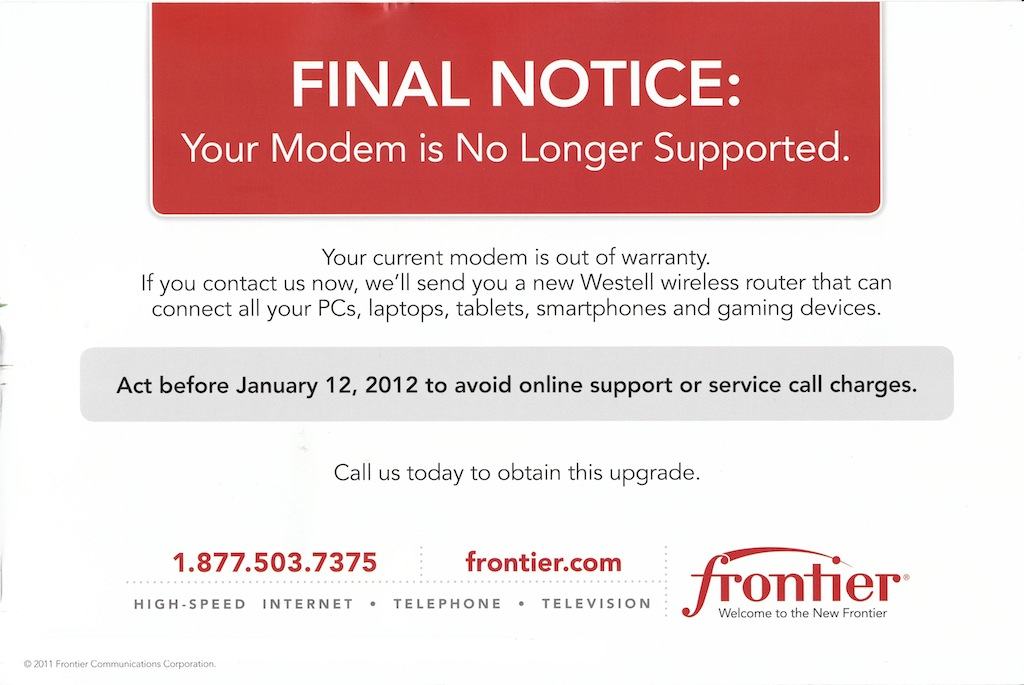
Andrew reports he originally called Frontier to discuss a possibly damaged DSL modem. Upon hearing the model number, a Frontier customer service representative needed to hear no more — the modem “needed to be upgraded.” In fact, Frontier has been mailing postcards to customers with older modems not subject to monthly rental fees telling them their existing modem was “no longer supported” and needed to be replaced with a new model. In the fine print, the customer learns if they proceed, they will end up paying a monthly modem rental fee starting at $6.99… forever.

But things got much worse for this Frontier customer after he contacted the company to say he’d be keeping his current DSL modem, which turned out to be working just fine:

I was then told there would be about a $20 price drop on my next bill (for July). I asked the agent why and her response was, “oh, our prices are going down.” I said okay, thanked her and hung up the phone.

The next morning, I got an email from Frontier thanking me for my ”recent purchase or renewal of services,” further asking me to click and view the Terms of Service agreement for High Speed Internet (and to submit the PIN number associated with my account).

I then called Customer Service about the email. I was told that I had upgraded my phone service the previous day. It turned out that the agent upgraded my phone service to include their ”Digital Essentials” phone features package and had locked me into two price protection plans for both services. There was a one-year plan regarding the phone service and a two-year plan for the High Speed Internet.

I was shocked and informed the agent that I had made no such changes to my phone/Internet services and that I had simply called about cancelling a support ticket on my account regarding the modem.

He later tried to claim that I had given the previous agent authorization when I said okay after she had informed me about the price drop. I told him that was absolutely ridiculous, especially since she never discussed any upgrades to my phone service or any changes regarding my Internet. I asked him how it could be an authorization when what was done to my account was never fully explained (or asked for).

We’ve got a deal too good to refuse.

The Frontier agent then proceeded to hard-sell Andrew the same plan the former agent already applied to his account. The Frontier representative did not bother to mention the “upgrade” and “savings” he was getting included a drastic speed reduction. Frontier sold Andrew a package that included just 1.2Mbps broadband.   That is less than half the speed of his original 3Mbps service, for which he paid $40 a month with no modem rental fee.

Now Andrew is stuck with two contracts, both which carry early termination fees that will total well in excess of $100, the likelihood of a modem rental fee for a new modem he has never received and does not want, and less than half the broadband speed he used to get.

“I was never told by either agent I spoke with that my Internet speed would be [reduced] once the ‘upgrade’ was performed,” Andrew writes. “This, in my opinion, is fraud. Had I known a slower speed would be the end result of their price drop, I would have never [signed up].”

Now Andrew wants his old plan back and Frontier is stalling.

Frontier has a track record of retiring older service plans and packages, but leaving existing customers grandfathered on them until a representative can convince a customer to switch to something else. Unfortunately, newer plans often come with higher prices and more surcharges than older ones, which is part of the company’s effort to increase average revenue earned from each customer. Once off a discontinued plan, low level customer service representatives typically cannot re-enroll a customer.

But those who complain the loudest can get back the service they used to have, just by becoming a nuisance. Start by calling Frontier and asking to speak to a supervisor or manager. If that fails, ask to be transferred to the department that handles disconnections and threaten to drop all Frontier services if the company does not relent and put you back on the plan you started with.

Customers can also file complaints with their state utility regulators. In Tennessee, that is the Tenessee Regulatory Authority. Their online complaint form is here. Unfortunately, many states have succumbed to deregulation rhetoric and state regulators lack significant enforcement powers. But utilities that routinely filibuster state officials risk generating enough legislative energy to support a “re-regulation” effort, so most utilities will connect complainers to an executive level customer service department that can cut through red tape.

Customers can also file complaints with the Better Business Bureau and their state’s Attorney General. The more noise you generate, the more likely Frontier will satisfy your request.

Frontier customers are advised that anytime a customer service representative asks you to complete an online agreement using your PIN number, it signals you are about to commit yourself to a term contract or other major change in service that could prove costly to undo.

Always ask the Frontier representative to e-mail you a copy of the terms of the plan you are enrolling in, including broadband speeds, phone features, contract length and early termination fees.

Always read the agreement you are being asked to complete online.

If you have any questions, call Frontier before you sign. Some plans include a 14 or 30 day penalty-free cancellation provision. While this alone may not restore your old service, it can prove an important negotiating tool to win back the service you had before.

Verizon Sells ‘Excess Spectrum’ to T-Mobile USA, With Conditions

Phillip Dampier June 25, 2012 Broadband "Shortage", Competition, Public Policy & Gov't, T-Mobile, Verizon, Wireless Broadband Comments Off on Verizon Sells ‘Excess Spectrum’ to T-Mobile USA, With Conditions

Despite perpetual claims of a wireless spectrum shortage, Verizon Wireless expects to have capacity to spare and has agreed to sell airwave licenses worth millions to T-Mobile USA if it can get federal regulators to approve a separate $3.6 billion acquisition of spectrum from some of America’s largest cable operators.

The deal will transfer surplus frequencies Verizon expects to acquire from its deal with Comcast, Time Warner Cable, Cox, and other cable companies in return for undisclosed compensation from the German-owned carrier. In return, T-Mobile will also turn over some of its spectrum to Verizon, most likely to give both companies a larger pool of contiguous spectrum.

The frequencies involved are expected to be in the Advanced Wireless Services (AWS) band (1700/2100MHz).

Wall Street analysts say the deal will remove T-Mobile from the list of concerns critical of Verizon Wireless’ deal with cable operators. It also may alleviate some criticism that Verizon is “hoarding” spectrum.


Attack on Your ‘Fast Forward’ Button by Copyright ‘Enforcers’

In the eyes of many entertainment executives, pressing fast forward to skip past commercials recorded by your DVR is a crime, and they want it stopped.

We’ve made progress. In the 1970s and early 1980s, those same executives were arguing recording a television show itself was a crime.

The copyright infringement wars continue, beyond college students facing ruinous lawsuits from the recording industry or movie studios sending a blizzard of subpoenas to Internet Service Providers seeking the names and addresses of those suspected of using file swapping networks.

With the increasing concentration and combination of entertainment conglomerates, the reflexive need to “control” the medium and means of distribution is gaining a receptive audience in Washington and in the courts, threatening to influence what you can and cannot do with the programming you pay to watch.

The impact is also weighing on innovative new technology from small companies like Aereo and much larger ones like Dish Network that have attempted to launch new services that challenge the conventional ways Americans watch entertainment. The result for all concerned: lawsuits designed to stifle anything the media business perceives as an imminent threat.

Dish Network has a new DVR box that can automatically skip past commercials on selected networks. The satellite company’s new “Hopper” DVR automatically records eight days’ of prime time programming from the four major American broadcast networks, analyzes the programming to find commercials, and allows subscribers to watch the recorded shows “ad-free” just hours after the original broadcast.

Major entertainment moguls immediately denounced the feature as criminal theft.

“If there were no advertising revenues, the free broadcast television model in the United States would collapse,” wrote an alarmed News Corp. (owner of FOX Broadcasting) in its complaint filed in Los Angeles federal court. That network also accuses Dish of violating their contract with FOX and copyright infringement.

“Of course, you know this means war.” — Dish’s new AutoHop feature raises the ire of the entertainment industry.

“This service takes existing network content and modifies it in a manner that is unauthorized and illegal,” CBS said in a prepared statement, echoing earlier statements that have historically argued recording, modifying, or re-purposing broadcast content in any way is automatically a violation of federal law, copyright, or the terms and conditions under which the network makes programming available for viewing.

NBC and ABC filed their own complaints against the technology as well.

Technically speaking, subscribers who pay a cable or satellite provider for television programming are already paying extra for the programming they are watching, negating the usual arguments commercial sponsorship covers the cost of watching “free TV” (that isn’t always free) and skipping commercials is the same as stealing.

Commercial television business models in the United States increasingly rely on “retransmission consent” fees — money paid by your satellite, cable, or phone company to the programmer for permission to carry a channel on their lineup. Virtually all of those fees are passed along to consumers as part of their monthly bill.

Some station owner groups are willing to play extreme hardball to get viewers to pay up -and- win the right to put a piece of tape over their fast forward buttons to keep them from skipping commercials on their stations.

Dallas-based Hoak Media is an example. Viewers in Panama City, Fla. were without WMBB-TV, the Hoak-owned ABC affiliate, on Dish Network for a week. Hoak Media pulled the plug on viewers earlier this month after Hoak demanded a 200% increase in retransmission consent payments and the disabling of Dish’s AutoHop commercial-skipping technology. Thirteen other Hoak stations around the country were also pulled off the satellite TV service.

“WMBB and Hoak don’t respect customer control — they are telling customers they must watch commercials,” Dave Shull, senior vice president of programming for Dish, said in a news release. “Channel skipping has been around since the advent of the remote and we think Hoak has taken an incredibly hostile stance toward their viewers.”

WMBB’s station management appeared caught off guard by their owners back in Dallas. WMBB General Manager Terry Cole admitted he didn’t even know about the AutoHop feature Hoak was demanding be disabled. A week later, the dispute appeared settled and the stations were back on Dish.

Entertainment executives are hopeful their deep pockets and industry partnerships with content distributors will ultimately win the day. They have a few things they can count in their corner.

In 2002, some of the same companies protesting Dish filed suit against ReplayTV, which had its own automated commercial skipping technology. The case dragged its way through the courts, with mounting legal expenses eventually forcing ReplayTV out of business. Problem solved.

The use of deep pockets have also intimidated other innovative ventures such as Aereo, which delivers over-the-air New York City stations online to a paying local subscriber base.

Innovation like that is also a concern to the cable industry, which itself has been around since the 1970s. Developing an online alternative to the local cable company puts cable TV executives in the same position entertainment industry executives live to fear: a threat to the business model that has earned billions in profits. In those terms, some cable operators seem willing to support the entertainment industry, even at the expense of their own customers.

That may explain why Time Warner Cable applied for, and won, their own patent for technology that disables fast-forward functionality on digital video recorders.

“Advertisers may not be willing to pay as much to place advertisements if they know that users may fast forward through the advertisement and thus not receive the desired sales message,” the cable company explains in its patent application. “Content providers may not be willing to grant rights in their content, or may want to charge more, if trick modes are permitted.”

The technology would look for digitally embedded cue tones, which are today used mostly to let local stations and cable operators insert their own local advertising messages on a network feed, to block fast forwarding past those ads.

Time Warner Cable is not likely to implement the technology anytime soon, not if they expect customers to continue to pay well over $10 a month for a recording device that won’t allow them to skip commercials.

Comcast is taking a different approach, considering plans to insert billboard advertising messages that automatically appear on-screen whenever a customer hits their fast-forward button. Broadcasters and networks have no love for that feature either, claiming it changes the programming the consumer recorded and represents… yes, copyright infringement.

Courts will once again have to find a balance between consumers’ home recording rights and the rights of large entertainment and cable companies. With more courts increasingly favorable to the notion of corporate rights enjoying equal prominence with those of citizens, who ultimately wins the right to your fast forward button remains a toss-up.

Bright House Says It Isn’t Concerned About Verizon FiOS Speed Upgrades

Phillip Dampier June 21, 2012 Broadband Speed, Competition, Verizon Comments Off on Bright House Says It Isn’t Concerned About Verizon FiOS Speed Upgrades

Customers don’t care who wins, because they don’t need faster broadband, claims Bright House Networks.

Bright House Networks thinks customers do not need or want faster broadband speeds and have no plans to match newly-announced speed increases offered by its competitor Verizon FiOS.

The cable operator, which serves central Florida, is downplaying the importance of Verizon’s upgraded service which will bring 300Mbps broadband to cities like Orlando and Tampa.

“Research indicates that the vast majority of customers do not have interest in these types of speeds for their homes, not to mention the potential expense,” Bright House spokesman Joe Durkin told the Tampa Bay Times. “Our network can deliver these speeds if we felt there was a residential market for it.”

Bright House speeds currently max out at 40Mbps. The cable operator says customers seeking faster service won’t face the sticker shock Verizon delivers for their fastest speed package, which comes in at $200 a month. Bright House sells its fastest package at “an additional $15 or $30 a month,” Durkin said.

Durkin believes most consumers can survive just fine with a slower speed package, even with multiple wireless devices sharing the connection.

“Whether you are downloading music or streaming video to your laptop or iPad, you can do it all with Road Runner Lightning,” he said.

Bright House retains the Road Runner brand for its broadband service that Time Warner Cable retired earlier this year. Bright House has partnered with Time Warner to handle programming and certain other contract negotiations.

AT&T: The Official Cell Phone Company of the Democratic National Convention

Phillip Dampier June 21, 2012 AT&T, Consumer News, Public Policy & Gov't, Verizon, Video, Wireless Broadband Comments Off on AT&T: The Official Cell Phone Company of the Democratic National Convention

AT&T is ingratiating itself with both sides of the political divide, as the Democratic National Convention Committee names the company the “official carrier” of the convention.

While that is likely to bring good will for AT&T among convention delegates, politicians, and their families, Charlotte, N.C. residents are also welcoming the major upgrades that are coming with AT&T’s presence at the event.

The phone company is installing at least 50 micro-tower antennas atop light poles in downtown Charlotte, designed to boost capacity for both AT&T’s Wi-Fi and cellular networks. Another 10 mobile cell towers will be in place during the event to accommodate the anticipated 35,000 visitors attending the convention at Time Warner Cable Arena.

Verizon Wireless is also expanding capacity for their customers in Charlotte, announcing five new cell antenna sites and several portable mobile towers.

While the portable mobile-based towers will leave Charlotte at the end of the convention, the other upgrades are permanent, improving service in the city.

[flv width=”640″ height=”380″]http://www.phillipdampier.com/video/WSOC Charlotte ATT to be official carrier of DNC 6-20-12.flv[/flv]

Bipartisan AT&T is the official carrier of both the Republican and Democratic National Conventions. AT&T is already making improvements in Tampa for the RNC convention, now it is Charlotte, N.C.’s turn with upgrades on the way for the Democratic convention, ironically held at the Time Warner Cable Arena. WSOC-TV reports.  (2 minutes)


Search This Site:

Contributions:

Recent Comments:

Your Account:

Stop the Cap!