Home » Online Video » Recent Articles:

Shaw Cable & Vidéotron Introduce Canadians to “TV Everywhere” Online VOD, But Data Caps Enforced

Phillip Dampier June 18, 2010 Canada, Data Caps, Online Video, Shaw, Video, Vidéotron Comments Off on Shaw Cable & Vidéotron Introduce Canadians to “TV Everywhere” Online VOD, But Data Caps Enforced

TV Everywhere isn’t just for the United States.  Canadian cable operators are also threatened by cable cord-cutters, although their pervasive Internet Overcharging schemes have kept TV addicts from watching too much video online.

Both Shaw Cable (serving western Canada) and Vidéotron (best known in Quebec) have this week introduced their own online video portals providing “authenticated” cable subscribers with access to on-demand movies and television programming as an extension of their cable package.  But neither company is willing to exempt its customers from Internet Overcharging schemes which apply data caps and overlimit fees to broadband accounts.

Of the two services, Shaw Cable’s is bare bones, offering a relative handful of TV shows and a movie library.  No live video is provided, and many titles carry per-viewing fees, even for cable subscribers.  Non-subscribers face even higher fees to view programming.  Vidéotron takes a different approach, offering a video portal called Illico Web that offers on-demand and live streaming feeds of a wide range of cable networks, mostly in French for its Quebec subscriber base.

Shaw positioned its video-on-demand service as an extension of its cable service.  It hopes its announced acquisition of Canwest Global, which runs the Global television network in Canada and 18 cable networks will vastly expand its offerings in the future.

Vidéotron warns its subscribers watching its service eats into monthly broadband usage allowances.

“Technology continues to evolve with the ability to watch content on multi-platforms,” said Peter Bissonnette, President, Shaw Communications. “That’s why Shaw is investing in bringing exceptional content delivered in various ways. Our new broadband VOD Player provides our customers the convenience of watching their favorite movies and television shows when and where they want to.”

Pierre Karl Péladeau, the president and chief executive officer of Vidéotron’s parent Quebecor was more abrupt when he said on Wednesday that its TV Everywhere service would offer “an alternative to piracy.”

But in Canada, there is a catch.  Neither cable provider offers subscribers unlimited broadband service.  Both employ Internet Overcharging schemes ranging from usage caps to consumption billing schemes with overlimit penalties.  Vidéotron reminds its subscribers to “keep an eye on your Internet usage.”  That’s because they don’t exempt their online viewing service from their usage limits.  Vidéotron’s video portal does eat its way through subscriber allowances.  The company provides these estimates to help guess by how much:

Movie 1h30 825 MB
TV show 30 min 275 MB
Video 10 min 90 MB

[flv width=”432″ height=”263″]http://www.phillipdampier.com/video/Welcome to illico web 6-10.flv[/flv]

Illico Web produced this video introduction to its TV Everywhere service. (French with English subtitles — 3 minutes)

Time Warner Cable Starting “TV Everywhere” and IPTV Trials in NYC

Phillip Dampier June 16, 2010 Competition, Online Video, Video 6 Comments

Despite claims that broadband is not eroding Time Warner Cable’s cable television business, the nation’s second largest cable operator has begun a “TV Everywhere” trial to expand broadband viewing options for “authenticated cable subscribers” and plans IPTV tests by the end of this year.

A “small number” of subscribers are now participating in the TV Everywhere trial in the New York City area, accessing premium channel content online, if they also subscribe to the channel.

James Manchester, regional president of network operations and engineering in the company’s New York City system told Broadcasting & Cable that the tests will verify whether the authentication process functions properly.

Manchester expressed urgency that unless Time Warner Cable moves to manage video content online, the company will continue to lose subscribers.

He told B&C cable’s erosion of video subscribers, at a time when digital voice and broadband subscriptions continue to grow, makes it essential to move to more of an IPTV environment.

“It’s no secret that we’re losing video subscribers as an industry,” he said. “We can’t afford to wait.”

Time Warner Cable sees challenges from several potential competitive threats:

  • Online video: Services like Hulu and Netflix, and time-shifting services that allow viewers access to on-demand programming online represent a real threat to the traditional cable-TV model.  Customers can cut the cable cord and watch everything online for free or for around $10 a month.
  • IPTV: Niche and ethnic programming delivered over IPTV networks allows third parties to create mini broadband-based cable systems using hardware that mimics a cable box, delivering potentially dozens of channels to subscribers without giving a cut to the cable company.

[flv]http://www.phillipdampier.com/video/Skyangel IPTV.flv[/flv]

SkyAngel used to deliver its lineup of Christian television channels over satellite, but switched to an IPTV platform in 2007.  This video explains how the service works.  (3 minutes)

TV Everywhere allows Time Warner Cable to control who has access to cable programming, restricting it only to those who haven’t cut cable’s cord.

Time Warner Cable’s solution for IPTV competition is to bring those services under TWC’s own menu of offerings.

One example in KyLin TV, a multi-channel Chinese language IPTV service.  Today, customers pay KyLin TV for service they watch over Road Runner’s network.  But Time Warner Cable could potentially get a piece of the action if it moved KyLin TV into its own IPTV package.

Manchester says TWC would like to be able to make such IPTV programming services an extension of the TWC offering.

Despite some earlier assertions made by company officials that DOCSIS 3 upgrades were designed to improve broadband service for Time Warner Cable customers, it turns out DOCSIS 3 is the foundation for the cable company’s future IPTV and “big pipe” platform.  Manchester says DOCSIS 3 will enable the company to service the wired home of the future.  It will deliver content to an edge device (such as an advanced router) with a hard drive and caching capacity that will link to home computers, MP3 players, or any other device on which consumers want to view content.

Wisconsin Wireless ISP Bans Online Video, Imposing 5 GB Monthly Usage Limit With Up to $90 Overlimit Fee

AirRunner Wireless serves a small portion of central Wisconsin from its headquarters in Marathon.

A wireless Internet provider serving central Wisconsin has banned online video streaming from its wireless Internet service, telling its customers WISPs are not designed for it.  To drive home the point, the service is jumping on the bandwagon of AT&T’s mobile network 2 GB usage limit with some stringent limits of its own.

Bill Flood, owner of AirRunner Networks LLC dispatched e-mail to every one of its central Wisconsin customers informing them some are violating the company’s use policies by streaming online video on its service, which it cannot accommodate.  Flood blamed companies like Netflix for forcing him to carry the costs of transporting movies and TV shows to his customers:

Hello! Over the past month we have been seeing an increasing issue on the network during peak times. From our investigation we have determined these problems stem from customers who are streaming Netflix or other ‘instant movie or movie on demand’ type services.

These types of products should not be used on the network for these reasons:

First, a wireless network uses access points, those by design do not handle continuous connections without affecting the other customers of that access point. Because the movie stays connected for a longer period of time, eventually other customers simply get less access and as a result see a severe network degradation.

Our Acceptable Use Policy over the years has grown as a result of new technology.

Not all new technology works well on every type of Internet platform. Although some customers have told me they have been using this type of service in the past, the increased usage spurred on by recent Netflix advertising, a CD for Wii devices and now by one of the satellite TV companies has brought this issue to the forefront.

These companies see the Internet as a means to save their resources and push the load onto the Internet.

Welcome to the Internet circa 2010.  The days of a voice declaring “You’ve got mail” from your AOL account are long gone.  Customers are demanding access to a much richer multimedia experience available online today.  That demand is beginning to regularly collide with the limitations some networks have to deliver the service.

To make sure his customers understand the implications of streaming video, Flood is also introducing one of the most punitive Internet Overcharging schemes we’ve yet to encounter, starting with a monthly usage limit of 5 GB accompanied by some vicious overlimit fees:

  • All non-business customers will be allotted 5 GB of total aggregate usage.
  • If the customer exceeds 5GB of total aggregate usage on any given monthly billing cycle, they will be assessed an additional $30.00 to cover their bandwidth use.
  • If any customer exceeds 10GB of total aggregate usage on any given monthly billing cycle, they will be assessed an additional $60.00 to cover their bandwidth use.
  • If any customer exceeds 15GB of total aggregate usage on any given monthly billing cycle, they will be assessed an additional $90.00 to cover their bandwidth use.
  • Although these additional charges seem excessive, we are not alone on making such changes as the rest of the ISP’s [Internet service providers as well as cellular providers] are also implementing similar programs on their networks to deal with network congestion issues caused by ‘on demand’ type products. The good news is, the typical Internet customer never exceeds 5GB of aggregate usage. Only a small percentage of our customers are involved in this ‘on demand streaming activity’. Here is what can be done by the typical customer while not exceeding the 5GB threshold: Our basic residential Internet packages will offer 5GB of usage — that’s the equivalent of 500,000 basic text e-mails, 2,500 photos, 40,000 web pages, over 300 hours of Online game time, 1,250 downloaded songs, or a mixture of the above! 1,000 megabyte (MB) = 1 gigabyte (GB) We will send out a notice to everyone again when we are ready to implement these changes.

Flood’s e-mail doesn’t tell the whole story to his customers, however.

First, his imposed overlimit fees are ludicrously high.  A customer using 16 GB for the month would face an overlimit penalty of $90.  Considering AirRunner’s pricing, that’s a potentially enormous bill:

AirRunner offers six rate plans for residential and small business:

  • $15.00 256K/256K, tiered access. New accounts only
  • The below programs require a contract.

  • $19.00 1.0 Mbps/768K, tiered access. New accounts only
  • $45.00 2Mbps/1Mbps, tiered access
  • $55.00 2Mbps/2Mbps, tiered access Bi-direction connection; useful for working from home.
  • $65.00 3Mbps/1Mbps, tiered access
  • $75.00 5Mbps/1Mbps, tiered access

Second, “the rest of the ISPs” are not in fact imposing similar programs.  AT&T just abandoned theirs for DSL customers in two cities.  Attempts to ration broadband access typically meets resistance from consumers, if not an outright revolt.  As soon as customers get a bill with a $90 overlimit penalty on it, they will revolt as well.

It is true that wireless providers do face bandwidth challenges, but that’s not always disclosed to customers until after they sign up for service.  In 2010, would you sign a two year contract for a broadband service that banned online video?  Of course, if Flood offers the only service in town, for all practical purposes he can dictate the terms of the service provided.  But many customers have long memories and when another provider does arrive, they’ll take their business elsewhere.

Therein lies a potential problem for Flood.  A considerable part of central Wisconsin has been served by Verizon North, one of the divisions Verizon has sold to Frontier Communications.  Verizon dramatically cut investment in Wisconsin broadband expansion as soon as it became apparent they were leaving.  Frontier Communications is betting its long-term survival on bringing at least 1-3 Mbps DSL service to areas just like central Wisconsin.  It’s a safe assumption at least some parts of Flood’s service area will be challenged by Frontier DSL within the next year.

At that point, perhaps Flood will adopt a less hostile attitude towards his own customers.  Some of those who departed didn’t appreciate Flood’s tone or actions and shared some of his hostile communications on the subject.  Taking an adversarial stance even with former, paying customers never works well.  Among the thoughts Flood has shared:

  • If you don’t like his caps, move to the city;
  • One customer was told his service was canceled because he just doesn’t get it — besides, Flood wrote, he can do whatever he wants;
  • Customers who are caught streaming are gone;
  • If you complain too much, watch out.

Third, Flood follows the discredited playbook of trying to convince customers a 5 GB usage limit for the Internet in 2010 is reasonable with generous-sounding e-mail and web page browsing allowances.  Flood himself exposes the real issue — customers want to watch YouTube, Netflix, and Hulu and his network can’t handle it.  Of course, his marketing materials never bother to mention any of this.  Only after customers sign up, many under a two-year contract, does the truth come out (underlined emphasis ours):

In the case of ‘streaming video/movies or on demand type products or services’ recent weeks shows exactly what happens when these types of products are used. Everyone who uses ‘on demand or streaming products or services’ also knows there is an alternative which does not have an affect on any other user. We suggest the alternative as the best solution. We would appreciate everyone’s cooperation in resolving this current issue. If you are streaming movies you are making everyone mad!! Someday you may want to use the Internet and your neighbor will be streaming, then you won’t work. Wireless Internet was not designed to watch TV or movies.

If you are a ‘on demand user’ you may want to look at other options in lieu of streaming movies over the Internet. A basic resolution movie is typically 700Mb of data. So 1000Mb is equal to 1GB. So roughly 3-6 on demand or streamed movies will draw and additional charge to your account. All paying customers have the right to access their Internet connection, however any customer cannot deny any other customer access as the result of their usage. When this occurs policy is made to correct such actions. We make every effort to provide the best service we can, sometimes new Internet based programs and products do not work well on this type of network, that is not the fault of AirRunner Networks LLC and we cannot guarantee that any type of program or product will work properly or as advertised.

At least Flood was finally honest about the implications of watching online video from a provider with a low monthly usage allowance.  Just watching 3-6 online movies blows right through it, even fewer if it’s an HD title.

Unfortunately for Flood and other WISPs with similar network constraints, the evolution of the Internet and its online resources will increasingly place pressure on many networks that were built for a 1990s-era Internet.  As advanced video game streaming technology, online movies and television, online file backup, and other high bandwidth innovations not yet envisioned become increasingly popular, companies like AirRunner will be forced to upgrade their network or add new applications to the ban list, eventually facing obsolescence if a better provider arrives in town.


Cable Trade Press Understands AT&T’s 2GB Cap – ‘You’ll Blow Right Through It’

Spangler

While the mainstream media and some of AT&T’s apologists tell consumers AT&T’s 2 GB monthly usage limit will impact only a handful of “abusers,” the cable trade press is telling its readers the industry insider’s secret — consumers will blow right through those caps.

Todd Spangler, who is an Internet Overcharging advocate and columnist for Multichannel News, a cable industry trade magazine, writes the implications of AT&T’s usage cap couldn’t be clearer to him.

The new iPhone 4, introduced yesterday to the predictable media crush, provides 10 hours of battery life for playing video, among other features.

But now that AT&T has eliminated its all-you-can-eat plan for smartphones, you will blow through the maximum 3G usage for the entry-level 200 MB plan if you watched just 4 minutes of streaming video per day. That would include commercials.

Even AT&T’s more generous DataPro 2-GB plan would allow just 35 minutes per day of streaming video (assuming you used your iPhone for nothing else), according to the carrier’s online data calculator.

Like a stopped watch, at least he’s right twice a day.

Spangler celebrates the opportunity AT&T’s overcharging scheme provides the cable industry to “grease the skids” for data caps and overpriced consumption billing on cable modem service.

In Spangler’s “Cable companies pay my salary”-world-view, it wasn’t that Time Warner Cable did the wrong thing when it tried to triple broadband pricing — to $150 a month — for the exact same level of service customers previously enjoyed.  It was all about its execution.

Spangler characterizes Time Warner Cable CEO Glenn Britt as a victim, burned over the company’s failed overcharging experiment in 2009.  When one plays with matches, is it any surprise there are consequences?

Consumers will respond to more overcharging schemes the same way they did a year before — with overwhelming condemnation and opposition.  It’s hard to convince consumers to pay a higher price for limits on usage while telling shareholders you’ve invested less to expand your network, charged more to access it, all while the costs to provide the service have dropped dramatically.  Consumers call that out for what it is: greed.

Make no mistake, consumers hate usage caps and overpriced consumption billing and Time Warner Cable has no justification to introduce either.

[flv]http://www.phillipdampier.com/video/CNBC ATT Cuts Unlimited Data 6-2-10.flv[/flv]

Normally business-friendly CNBC covers the introduction of the 2 GB usage cap on AT&T smartphone data usage.  Then the CNBC anchor got skeptical about AT&T’s claims this was good news for consumers, admitting she hates overcharging schemes that deliver a surprise on the bill at the end of the month.  Lance Ulanoff, editor of PC Magazine expressed some doubts himself.  (8 minutes)

Susan Crawford Warns the Tech Community: Protect the Gilded Age of Communications from a Corporate Takeover

Phillip Dampier June 8, 2010 Broadband Speed, Competition, Net Neutrality, Online Video, Public Policy & Gov't, Rural Broadband, Video Comments Off on Susan Crawford Warns the Tech Community: Protect the Gilded Age of Communications from a Corporate Takeover

“If (Comcast) can’t rape and pillage, it’s probably not a great investment.” — Dr. John Malone, former CEO Tele-Communications, Inc. (TCI Cable)

Susan Crawford

The age of content producers blissfully producing websites and ignoring broadband policy is over.

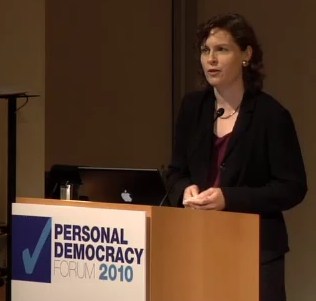
That message comes courtesy of President Barack Obama’s former Special Assistant for Science, Technology, and Innovation Policy, Susan Crawford, who rang warning bells over corporate control of the Internet last week at the Personal Democracy Forum in New York City.

Crawford, now a law professor at the University of Michigan, delivered a presentation arguing that increased corporate dominance over broadband has stalled the Gilded Age of the communications revolution.

Even as broadband becomes an increasingly important component of an American economy in recovery, marketplace concentration and laissez-faire broadband policies have combined to allow a handful of companies to control broadband access, with the potential of limiting access to web services and stalling entrepreneurial online innovation.

Crawford builds her case for a threatened broadband future:

  • As of 2010, 75-85 percent of the population will have only one choice of provider capable of delivering 50-100Mbps speeds — their local cable company;
  • Major cable systems have clustered their operations and do not compete with each other;
  • Verizon has suspended expansion of FiOS, its fiber to the home service, indefinitely;
  • Comcast, the nation’s largest cable operator with 24 million customers, 16.3 million of which take their broadband service, seeks a merger with NBC-Universal, providing a built-in incentive to limit broadband distribution of video content to non-subscribers who cut cable’s cord.

[flv width=”640″ height=”380″]http://www.phillipdampier.com/video/Susan Crawford at PdF 10 Rethinking Broadband 6-2-2010.flv[/flv]

Watch Susan Crawford’s presentation warning the tech community about the implications of America’s broadband duopoly given free rein.  (17 minutes)

Search This Site:

Contributions:

Recent Comments:

Your Account:

Stop the Cap!