Home » Online Video » Recent Articles:

Updated: Verizon and Google Cut Secret Net Neutrality Deal, Washington Post Reports

Verizon and Google have reached an agreement in principle to deal away Net Neutrality protections for American broadband users according to a late report in today’s Washington Post.

Cecilia King writes the agreement is days away from being revealed in public, but two sources verified Verizon and Google have agreed to a split the difference on Net Neutrality — abandoning the open Internet concept for wireless broadband, but protecting against service providers holding bidding auctions over the speed of web content delivery.

Verizon wouldn’t confirm that a deal was struck but said in an e-mail statement:

“We’ve been working with Google for 10 months to reach an agreement on broadband policy. We are currently engaged in and committed to the negotiation process led by the FCC. We are optimistic this process will reach a consensus that can maintain an open Internet and the investment and innovation required to sustain it.”

Specifically, Google and Verizon’s agreement would prevent Verizon from offering paid prioritization to the biggest bidders for capacity on its DSL and fiber networks, according to the sources. But any promises regarding open-Internet access wouldn’t apply to mobile phones, the sources said, speaking on the condition of anonymity because the companies have not officially made their announcement.

And Verizon could offer managed services — better quality to some Web sites such as those offering health care services, the sources said. But some analysts speculate that managed services could also include discounted YouTube and other services to FiOS customers at better quality.
Public interest groups, some occasionally accused of being in bed with Google, were outraged at the news.

“The fate of the Internet is too large a matter to be decided by negotiations involving two companies, even companies as big as Verizon and Google, or even the six companies and groups engaged in other discussions at the Federal Communications Commission (FCC) on similar topics,” said Gigi Sohn, president of public interest group Public Knowledge.

The clear distancing from Google’s settlement illustrates these pro-consumer groups are not simply shilling for Google’s public policy positions.

For Stop the Cap!, the implications are extremely disturbing.  As outlined, this compromise deal would relegate wireless broadband to usage caps, speed throttles, and content blockades indefinitely.  Should “improved quality” service on the wired side be an available option, it could allow the broadband industry to mount a devastating campaign to end would-be competitors, especially to their video businesses.  Cable and phone companies could pick winners and losers (with their products being the winners, and would-be competitors the losers) by prioritizing high quality video services, exempting their partners from Internet Overcharging schemes like usage caps, and subjecting would-be, “non-preferred” content providers to usage and speed-restricted broadband lines.

Offering preferred content producers discounted rates would also completely change the business models of content distribution and discourage investment in would-be challengers that could provide consumers with other video options.

More importantly, it provides an example of an Obama Administration ruthlessly willing to cut consumers out of the debate about Net Neutrality, while forcing them to live with the results.  King notes the priorities of Google and Verizon don’t exactly include consumers:

According to the sources, Verizon and Google have met separately to reach an agreement they will tout as an example of successful self-regulation. Once bitter opponents in the so-called net neutrality debate, the firms have grown closer on the issue as their business ties have also strengthened. Verizon partners with Google on their Android wireless phones.

Their actions could set a course for the FCC meetings and what ultimately the parties could present to lawmakers, analysts said.

Voluntary self-regulation worked so well with Wall Street banks and the housing market that a disconnected crowd inside the beltway is willing to give it another try with a broadband industry that is already a duopoly for most consumers.  Psychic abilities are not required to guess at the eventual outcome.

Update 12:30pm — The denials are flying over a NY Times piece that claims Google has agreed to pay Verizon’s asking price for prioritized traffic:

Google: “The New York Times is quite simply wrong. We have not had any conversations with Verizon about paying for carriage of Google traffic. We remain as committed as we always have been to an open internet.”

Verizon: “The NYT article regarding conversations between Google and Verizon is mistaken. It fundamentally misunderstands our purpose. As we said in our earlier FCC filing, our goal is an internet policy framework that ensures openness and accountability, and incorporates specific FCC authority, while maintaining investment and innovation. To suggest this is a business arrangement between our companies is entirely incorrect.”


The Internet Video Revolution Will Be Interrupted By Broadband Usage Caps

The Internet video revolution will increasingly be blocked by Internet Service Providers who will leverage their duopoly markets with restrictive usage limits to keep would-be video competitors from ever getting their business plans off the ground.

William Kidd, industry forecaster for iSuppli, an industry analyst group, sees a future of Internet Overcharging schemes like usage caps, overpriced pay-per-use pricing, and other limitations designed to erect roadblocks for online video content, which increasingly threatens the cable-TV products of both cable and phone companies.

The latest scheme to limit usage of streaming media come not from concerns about bandwidth costs but rather the “unknown risks” online video could have for cable and phone companies’ other products.

Such risks, Kidd believes, will compel broadband providers to increasingly implement caps in order to mitigate any long-term gambles that providers might have to take to make streaming media available to home and mobile environments.

At present, content can be streamed over TV from online service offerings such as Hulu and Netflix, or accessed through a device such as the PlayStation from Sony Corp. In addition, new-media business models continue to emerge with the introduction of new platforms that circumvent services currently provided by traditional cable or satellite pay-TV providers.

The caps planned for implementation will sink virtually all of the video streaming services that are not partnered with cable and phone companies.  Kidd notes the caps he’s seen offer limited viewing — as little as three hours for wireless 200kbps video streams or standard definition video streamed on wired networks for up to 25 hours per month.  True HD viewing is simply not going to happen with caps on many providers planned to cut off viewing after only seven hours.

Business plans and would-be investors must take notice of what providers have in store for would be competitors, Kidd argues.  Since the phone and cable companies maintain a near-monopoly on broadband, they ultimately control what Americans can do (and see) on their broadband accounts.

Rogers reduced usage allowances on several of its broadband plans days after Netflix announced a streaming service for Canadians.

One need only look to Rogers Communications in Canada for a timely example.  Rogers promptly lowered usage limits on some of its broadband plans just days after Netflix announced a video streaming service for Canadians that could directly compete with the cable giant’s video rental stores and cable pay per view services.

“These new-media business models imagine that they don’t have to pay the network through which their data traverse,” he said. “However, such a theory is directly at odds with the ambitions of cable and satellite-TV operators, which increasingly are unwilling to provide heavy data access through their networks for free—especially if a way can be found to monetize ongoing data traffic into viable revenue streams.”

In addition, new Internet-born content providers wrongfully take for granted that the way their largely free content has been consumed now also will apply in the future to premium services. The assumption is a bad one, Kidd observed, because in order for consumers to consider the Internet as a true substitute for their big-screen TV, content would need to be comparable in both technical quality and entertainment value. And to achieve the same level of value, such content necessarily would be extremely bandwidth intensive.

As a result, for any number of these emerging TV-substitute models to work someday, one has to assume that the picture quality being proffered is acceptable for viewing on large-screen TVs.

But providers have a trick up their sleeves by implementing seemingly tolerable usage caps as high as 250GB per month, which seem generous by today’s usage standards.  But they will be downright paltry tomorrow, especially if they do not increase over time, as online video increases in quality and size.

“By implementing caps now that don’t impinge on the way subscribers use the Internet today, cable and telco operators are able to create for themselves an advantageous situation,” Kidd said. “Under these circumstances, emerging media competitors must work more directly with the network owners before getting their services off the ground—as opposed to around them, as they may have previously hoped.”

That means giving them exactly what they want — a piece of the action and control over the content that crosses over their wires to broadband consumers.

Rogers Limbo Dance – Company is Lowering Usage Caps on Its Broadband Packages So You’ll Pay More

Rogers Cable: Setting the Bar Lower Than Ever

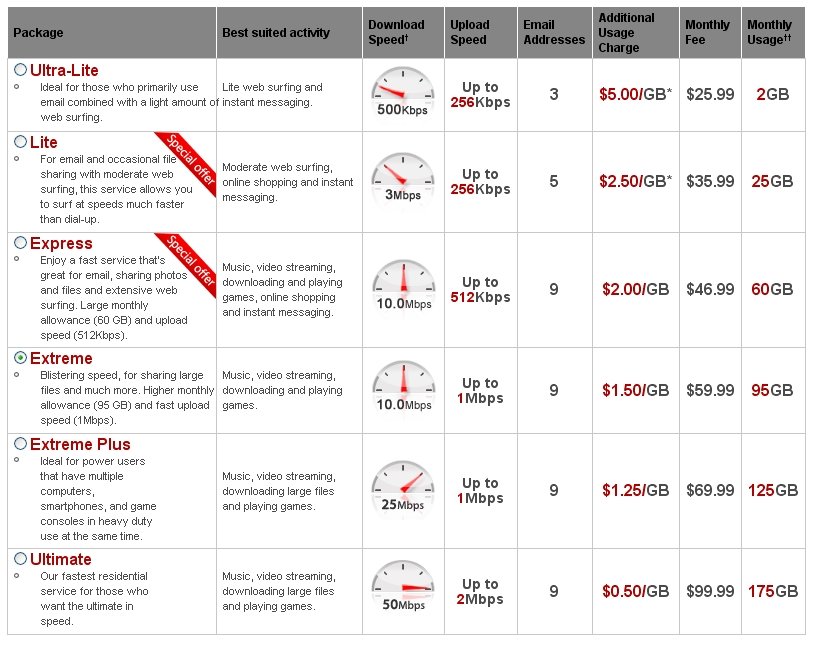
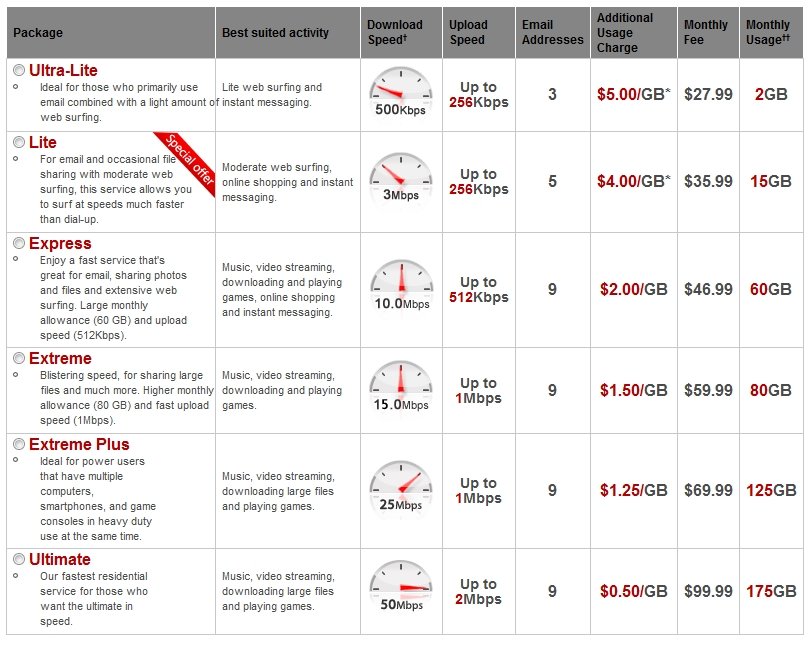
Just a day after Netflix announced they are coming to Canada, Rogers Cable has responded by announcing it is lowering the usage allowances of its customers.  Stop the Cap! reader Munly writes to inform us Rogers Lite service plan, intended for occasional users, has dropped its 25GB usage allowance to 15GB per month, making it suitable for even less usage.

New customers on Rogers’ popular Extreme plan will find their usage limit cut from 95GB to just 80GB per month.  But if you accept the cut in your allowance, Rogers will increase the speed on that tier from 10Mbps to 15Mbps, allowing customers to blow through that usage limit that much quicker.

Existing customers may be grandfathered in, at least temporarily, but Rogers is notorious for eventually terminating grandfathered plans and moving customers to higher-priced alternatives.

All this from a company that claims it offers its customers “abundant usage.”

Rogers buries in the fine print the fact customers can stay with their current higher allowance if they forego the speed increase.

AND AN EVER INCREASING BILL

With the new lowered usage allowances, Rogers offers tips for customers to reduce their usage, including our favorites:

Use medium quality photos when sending them through e-mail. Your family’s cherished memories don’t deserve high resolution, even if you want to send them to a digital photo lab for printing.  Maybe you could get the kids together and have them draw copies of those vacation pictures with crayons.  At least they won’t be online using up your Rogers Internet ration.

Be aware of how others in your home use your Internet connection.  If you are not spying on your family’s online usage, it’s your own fault if we send you an enormous bill.  In the time it took you to read these tips, your kids could have downloaded over 20 e-mails, looked at more than three web pages, or watched almost a minute of online video.  Don’t make us bill you for that.

Turn off Peer-to-peer programs when you’re not downloading. Better yet, since we know you are using them to steal the content we’d like to sell or rent you, stop using them altogether… or else.

Try the tools. No, we’re not talking about us, silly.  If you are doing more than reading your e-mail or browsing web pages, look out because we’re coming for your wallet.  You can try and outwit our overcharging ways by using our usage notifications service, which will flash messages to you that we’re about to cash in on your over-usage.  Hey, don’t say we didn’t warn you!  Remember, if you use Rogers Internet to download files, stream video or music or play online games, we own you.

Does this mean I should use the Internet less to avoid paying more? Is Sarah Palin American?  You betcha.  We want to get the most out of our customers who use their Internet service too much, which is why we expose them to up to $5.00 per gigabyte if they exceed our ever-dwindling usage allowances.  Our goal is for you to feel free to use the Internet as you always have, just so long as you recognize it’s not free and that you’ll need to pay us for every web page your read, more if you dare to watch cable programming online you should be watching on our cable TV service.  The only surprise you’ll have about your bill is that we haven’t found a way to charge you even more… yet.

What About Netflix? Seriously? You weren’t really thinking of using that service on Rogers were you?  A word to the wise — we can cut your allowance down even further.  Go outside.  Read a book.  Rent a movie from Rogers Plus or enjoy some great Rogers Cable TV.

Rogers Cable’s Internet Packages

A Before And After Comparison

Rogers Old Pricing and Usage Allowances

Rogers All-New Pricing and Usage Allowances, Effective July 21, 2010

Netflix to Launch Unlimited Streaming for Canadians Stuck With Limited Broadband

Netflix is coming to Canada.  Sort of.

Canadians will be able to sign up for Netflix’s on-demand video streaming service beginning this fall, but will Canadians be interested in using the unlimited service on their usage-limited broadband accounts?

Netflix is not planning on bringing its rental-by-mail service to Canada, instead relying exclusively on streaming its library on-demand over the Internet. Netflix currently licenses streaming rights for over 17,000 titles in its 100,000 plus library.  How many of those titles with be licensed for Canadian subscribers is not yet known, nor is an exact price for the service.  Netflix will launch for English-speaking Canadians at the outset, with French to come later.  This is the first time Netflix is making its service available outside of the United States.

But many Canadians are questioning the value of Netflix in their heavily-usage-limited country.  Most Canadian ISPs have either chosen or been forced to limit subscribers’ broadband usage.  Even ISPs that want to offer unlimited service find flat rate wholesale pricing nearly impossible to get because of Bell’s stranglehold on the market.  Cable providers like Rogers have implemented their own usage limits to boost revenue and keep costs down.

For Canadians living under an average usage cap of 40-60 gigabytes per month, adding streaming video will only eat their allowance that much faster.

“Netflix and the Canadian press covering this story have ignored the reality of bit-capped Canada,” writes Stop the Cap! reader Jeffrey from Calgary.  “I would be paying $75 a month for a broadband account and be limited in how I could use the service.  The CRTC (Canada’s equivalent of the Federal Communications Commission) has been in the providers’ pockets for years and this is why high bandwidth services bypass Canada or risk failure if offered here.”

Rogers, one of Canada's biggest cable companies, also happens to own one of the largest chains of video rental stores: Rogers Plus

Jeffrey believes Canada’s largest broadband providers, including Bell, Rogers, Shaw, Telus, and Vidéotron will never allow Netflix.ca to gain the kind of foothold it has in the United States.

“These companies all own or control Canada’s cable, IPTV, and satellite TV services, all of which are threatened by an American company like Netflix,” Jeffrey notes. “They’ve already got universal usage limits on their accounts, but these guys will also run to the CRTC and Canadian government to throw up roadblocks over everything from copyright and licensing issues to Canadian content rules and the initially ignored Québécois.”

Jeffrey believes more than anything else, Internet Overcharging schemes will serve their role in keeping would-be competitors under control.

“In Canada, we already had the debate about who gets to use our pipes for free,” he says. “Thanks to the CRTC, only the providers get to use them for free.  Everyone else pays a usage tax to them which fattens their bottom lines while stunting the growth of Canadian broadband.”

In Quebec, it’s much the same story.  Asperger notes Zip.ca, a Canadian rent-by-mail service, can get him 20 new DVD releases a month for around $25.  If he signed up for Netflix, anything beyond five DVD’s a month would put him over his limit forcing him to “pay and pay, and then pay some more.”  With Canadian ISP’s increasing their penalty rates for exceeding usage allowances, the overlimit fee could easily exceed the cost of just sticking with Zip.ca’s by-mail service.

Or, for many Quebecers, the next best alternative is Bibliothèque et Archives nationales du Québec, which offers an enormous collection of DVD’s that can be checked out for free.

Canadian press accounts of Netflix’s imminent entry into Canada have largely ignored the limits Canadian Internet providers impose on their subscribers, something readily noted by readers who comment on those stories.  Canadian consumers are well aware of their usage limits, and they avoid services that could expose them to even higher broadband bills.

Those who use their Internet service heavily, unaware of overlimit fees up to $5 per gigabyte, will be educated by bill shock when their next bill arrives in the mail.  After that, no more Netflix.ca for them.

Still, Netflix.ca will probably deliver a challenge to the already-stressed Canadian video rental market where Blockbuster and Rogers Plus duke it out for a dwindling number of renters.  Price cuts have not stopped the erosion of interest in DVD rentals, and Blockbuster is mired in more than $900 million in debt, trying to avoid bankruptcy.

The Canadian Radio-television Telecommunications Commission's support of industry-promoted Internet Overcharging schemes may limit Netflix's success in Canada.

If Netflix’s streaming library, mostly of titles two or more years old, is deemed sufficient by many Canadians, it could also cause a wave of cancellations of premium movie channels and other cable services.

The Ottawa Citizen reports some analysts believe Netflix.ca will cause an earthquake in the Canadian entertainment marketplace.

Carmi Levy, an independent technology analyst based in London, Ont., believes Canadians can expect a major entertainment industry shakeup this fall.

Levy says Netflix will sound the death knell for movie-rental services such as Blockbuster and Rogers Video and will force a pricing war among traditional cable and satellite TV providers who will be forced to scramble to keep customers.

“Netflix is not some Johnny-Come-Lately to the market. Even though they are new to Canada, they have been so successful in the U.S. that only a Canadian living underneath a rock wouldn’t be aware of their brand,” Levy said. “It’s the most seismic change to the content distribution system landscape that we have seen. It forces the incumbents to change their business model.”

Levy said the arrival of Netflix will allow casual TV watchers to cut their satellite and cable TV bills in favour of Netflix’s all-you-can-eat monthly offering. He said the $9 U.S. a month charged by the company was carefully thought out and he expects to see a similar price on the service later this year.

[flv width=”640″ height=”500″]http://www.phillipdampier.com/video/CBC News Netflix Comes to Canada 7-19-10.flv[/flv]

CBC News discussed the introduction of Netflix Canada and how it will work with Netflix vice president Steve Swasey.  (5 minutes)

[flv width=”512″ height=”388″]http://www.phillipdampier.com/video/CTV News Netflix Canada 7-19-10.flv[/flv]

CTV News and its Business News Network ran four reports on the impact usage caps might have on the service, what kinds of titles will be available, and what it means for Canada’s entertainment businesses.  (12 minutes)

Hulu Plus is No TV Everywhere – Online Video With a Price Tag

Phillip Dampier June 30, 2010 Data Caps, Online Video, Video 6 Comments

Hulu has announced a new premium service that will deliver entire seasons of network TV shows at 720p high definition resolution for $9.99 per month (plus applicable taxes).

The concept of Hulu Plus has been around for months now, as Hulu’s owners (Disney, NBC Universal, News Corp and Providence Equity Partners) contemplate the increasing cost of delivering video to millions of Americans during an advertising industry crisis.  Advertising revenue no longer covers the costs, so Hulu hopes paying subscribers will.

The free version of Hulu isn’t going anywhere — in fact the service has just signed agreements with CBS and Viacom to bring shows that formerly were seen on Joost over to Hulu.  Time Warner (the entertainment company, not the cable operator) is also bringing some of its shows to Hulu.

But free viewers will continue to find access to the latest shows limited, typically to the last four to five episodes.  If you want to catch up on an entire season, you’ll need to pony up ten bucks.

The prospect of watching nearly every network show from ABC, CBS, Fox, and NBC over your home computer, television or other devices including the iPhone, iPod Touch, iPad, PlayStation 3, Xbox 360, and Blu-Ray players from Samsung, Sony, and Vizio would give you more than 3,000 viewing options to choose from.  But before getting too excited, there are some downsides to Hulu Plus:

  1. You’re still going to watch commercials. Just like basic cable, you are going to pay to watch commercials on Hulu Plus.  That will be a deal-breaker for many who believe if you pay a monthly fee for it, you shouldn’t have to watch advertising.  Netflix offers online viewing as part of its $9.99 monthly service and there is no advertising.
  2. You still have to wait to watch shows. There is no live streaming of network shows.  You’ll have to wait until the next day like everyone else on Hulu to catch the latest episode.
  3. Don’t you dare watch on your smartphone. With Internet Overcharging schemes in place at AT&T and presumably on the way at Verizon, nothing eats your allowance faster than online video.  Paying $10 a month for Hulu Plus will be dirt cheap compared to the overlimit fees you’ll pay if you exceed your usage allowance.

The cable industry still thinks it could have a better product in the end.  TV Everywhere’s variations from Comcast and other cable operators are provided free of charge to existing cable subscribers (although the advertising load may end up being greater).  Many cable network shows are better received than some of the swill served up by the networks, and cable could be free to provide season passes right from the outset.

<

p style=”text-align: center;”>
An introduction to Hulu Plus. (2 minutes)

Search This Site:

Contributions:

Recent Comments:

Your Account:

Stop the Cap!