
Home » Online Video » Recent Articles:

Alaskan Snow Job: GCI Selling Unlimited Broadband That Isn’t

unlimited

Main Entry: un·lim·it·ed
Pronunciation: \-ˈli-mə-təd\
Function: adjective

1 : lacking any controls : unrestricted <unlimited access>
2
: boundless, infinite <unlimited possibilities>
3
: not bounded by exceptions : undefined <the unlimited and unconditional surrender of the enemy — Sir Winston Churchill>

An Alaskan Internet service provider is baffling its broadband customers with a blizzard of BS regarding just how unlimited its “unlimited” service plans really are.

A Stop the Cap! reader in The Last Frontier drops us a note to alert us of yet another provider trying to pull a fast one on its customers.

GCI markets cable-TV, telephone and broadband service in larger communities across many parts of the state.  Its broadband service, dubbed “Xtreme,” offer DSL-like speeds at a significant price premium over what users in the lower 48 pay for Internet access.

Since 2007, our reader writes, GCI offered customers a deal.  In return for letting the company provide all of your telecommunications needs — cable, phone, and Internet, GCI would provide you with unlimited broadband service.  The triple-play package was sold for at least $80 a month, and many customers agreed to the bundled route to avoid GCI’s restrictive, data-capped plans sold to its broadband-only customers.

GCI is now reneging on its end of the deal thanks to a creative redefinition of the word “unlimited.”  For the convenience of those who may be English-challenged, Stop the Cap! has provided the Merriam-Webster definition of the word “unlimited” above, which hasn’t changed much since its first use in the 15th century.

Broadband providers like GCI think they are clever enough to change all that.

Much to the chagrin of GCI’s bundled customers, the company unfairly slapped a “Fair Access Policy” on all of its unlimited customers on April 1st.  Customers started receiving usage warnings this spring, which came as quite a surprise for an “unlimited” service plan.  But the company insists it hasn’t limited its “unlimited” plans at all:

GCI offers some cable modem Internet service plans with “unlimited downloads”, meaning GCI does not bill customers additional fees for usage in a given month.

Actually, that isn’t the meaning of “unlimited” at all, no matter how much the company wishes it was.  Again, see the definition above.

In fact, even using GCI’s own definition, nonsensical as it is, it isn’t reality-based either.

Customers who exceed the arbitrary limits GCI determines as “fair,” could be subjected to higher pricing.  GCI’s website currently lists the overlimit fee starting at an impenetrable $0.005 per megabyte, which sounds pretty low until you realize it’s $5.00 per gigabyte, which is significantly higher than what most other naughty cappers charge.  On slower speed plans, GCI’s overlimit fee is a whopping $0.03 per megabyte — $30 per gigabyte.

What happens when you overuse your GCI unlimited Internet?  GCI will contact you to discuss your account and then ask you to agree to either reduce usage or pay additional fees for usage in a given month.

GCI loves to make its limits look mighty big by representing them in megabytes instead of the more commonly used gigabyte measurement.  They also include the usual comparisons: over 10,000 web pages, 250,000 e-mails, 1,000 pictures, etc.  On the lower speed plans, GCI avoids defining the far-smaller allowances for higher bandwidth services like near-DVD HD video streaming some Alaskan families may want to use during those cold and dark Alaskan winter evenings.

Here are the limits GCI assigns to its “unlimited” service plans:

Plan Name Usage
Ultimate Xtreme 40,000 MB
Ultimate Xtreme Family 60,000 MB
Ultimate Xtreme Entertainment 80,000 MB
Ultimate Xtreme Power 100,000 MB

That’s usage ranging from 40-100 gigabytes.  What this illustrates yet again is that Internet Overcharging schemes are ridiculously arbitrary.  A provider in rural Alaska defines “fair” use of its slowest speed “unlimited” broadband tier (3 Mbps/512 Kbps for $45 a month) at 40 gigabytes.  Meanwhile, Frontier Communications considers it fair to define its DSL service usage allowance at just 5 gigabytes per month.  Comcast says 250 gigabytes a month is fair.  AT&T’s wireless smartphone data plan now carries a 2 gigabyte limit AT&T claims is about right.

As is also commonly the case among Internet Overchargers, any unused allowances do not “roll over” to the next month.

GCI considers anyone exceeding these limits engaged in continuous high-volume data transfers, extensive use of streaming video and peer-to-peer file sharing programs, or using an unsecured wireless signal everyone in the neighborhood has hopped on to use.  But just backing up your family computer through an online backup service over a month could easily put you over these limits.  If a “mutually agreed on” solution cannot be reached to either limit your use or increase your price, GCI will show you the door.

Essentially, GCI hobbles its broadband service plans by imposing limits on services that could challenge some of its other products.  For standalone broadband customers, GCI builds in plenty of protection against customers potentially using its Internet service to bypass its cable and phone offerings, despite some recent speed and usage allowance increases.  How much online viewing will you feel safe doing on some of these Internet service plans:

Standalone Xtreme Plans Current Speeds & Included Usage New Speeds & Included Usage Usage Allowance Increase
Xtreme 1 Mbps/512 Kbps – 5.12 GB usage 3 Mbps/512 Kbps – 7.5 GB usage 2.38 GB
Xtreme Family 2 Mbps/512 Kbps – 10.24 GB usage 6 Mbps/512 Kbps – 15 GB usage 4.76 GB
Xtreme Entertainment 3 Mbps/768 Kbps – 20.48 GB usage 8 Mbps/768 Kbps – 25 GB usage 4.52 GB
Xtreme Power 4 Mbps/1Mbps – 30.72 GB usage 10 Mbps/1Mbps – 40 GB usage 9.28 GB

Monthly service fees

Standalone Xtreme Plans Anchorage, Fairbanks, Juneau, Kenai, Mat-Su, & Soldotna Ketchikan, Petersburg, Seward, Sitka, Valdez, & Wrangell
Xtreme $44.99/m $54.99/m
Xtreme Family $54.99/m $64.99/m
Xtreme Entertainment $74.99/m $104.99/m
Xtreme Power $104.99/m $154.99/m

Our reader in Alaska thinks the usage limits are unjustified considering GCI’s capacity, and its prices:

GCI has well over 600 Gigabits of capacity across two undersea fiber optic cables.
Since 2007, the only way to get an unlimited download option for the company’s various speed tiers was through its bundled packages.  With the new limit on “unlimited” downloads, GCI fraudulently misrepresents its service to Alaskans.

GCI is the poster child for the cable industry’s push for metered billing. I think you’re well aware that cable companies view metered billing as an anti-competitive solution to fend off emerging competition from online content providers like Hulu and Netflix Online. Time Warner backed down when confronted with the possibility of regulation for the entire industry. They will however try again if companies like GCI continue to have success over a long term. This is why it’s imperative that groups like Stop the Cap! fight beyond your region and get regulation passed to bar forced bundling and data transfer limits entirely. Content providers (video services) should be separate entities from network providers (ISPs). It’s the only way to keep rates low and businesses competitive. Thank you for keeping up the good fight.

Provider Admits Caps & Overlimit Fees Are About Deterrence, Forcing Upgrades, Or Going Elsewhere for Service

Customers of Vistabeam in Nebraska and Wyoming who subscribe to the company’s rural Wireless Internet Service are about to discover their online activities are about to be capped… for real this time.

Matthew Larsen, who runs the Wireless Cowboys blog, includes some illustrative examples of Internet Overcharging schemes in action and what they’re all about.  He writes about his experiences at Vistabeam, which serves rural Nebraska and Wyoming with wireless broadband service.  The company started operations with an admittedly-unenforced 3GB usage limit, backed up with a stinging $25/GB penalty overlimit fee to underscore the point.  Today that cap is described by Larsen as “a joke” — too low to be taken seriously.  [Note to Frontier: Are you reading this?]

But the company was determined to monitor and measure its customers’ online activities and developed an in-house tool that is providing daily insights into customer usage, and gives Vistabeam the ability to begin penalizing customers who exceed the limits established by the provider.

Wireless providers, known as WISPs, often provide the only Internet access in rural areas that are too sparsely populated to deliver DSL service and where cable television is a financial impracticality.  For Nebraska and Wyoming residents bypassed by cable and underserved by DSL (if at all), it’s often a choice between dial-up, satellite fraudband service barely capable of 1Mbps service with a punitive “fair access policy,” or an independent WISP.  A number of customers have chosen the latter.

Vistabeam offers service plans for its 2000 customers ranging from 384kbps for $29.95 a month to 4Mbps service for $99.95 a month, with a discount for paying in six month increments.  That’s not cheap by any means.  But rural Americans routinely face higher broadband bills because of the inability of providers to achieve economy of scale.  Fewer customers have to share the expenses to construct, operate and maintain the service.

But those bills could soon grow even higher if customers exceed the new harder-line Vistabeam will take on usage cap offenses.

Larsen’s measurements identified what their customers were doing with their broadband connections and identified Vistabeam’s biggest users:

Out of 2000+ customers, 80 used more than 10 gigs for the month.

One customer – a 1 meg subscriber at the far eastern edge of our network, behind seven wireless hops and on an 802.11b AP – downloaded 140gig.

Another one, on the far western side of our network, downloaded 110gig.   We called them and found out that they were watching a ton of online video.

We discovered a county government connection that was around 100gig – mostly because someone in the sheriff’s department was pounding for BitTorrent files from 1am to 7am in the morning, and sometimes crashing their firewall machine because of the traffic.

One wonders what the sheriff’s department was grabbing off BitTorrent, but the question itself opens the door as to whether or not your provider (and by extension, you and I) should know what they are doing with their broadband connection in the first place.

Larsen says the other subscribers on his list were watching lots of online video, had a virus, or had “mistakenly” left their file sharing programs running.

Larsen’s solution is usage caps and overlimit penalties for his subscribers.

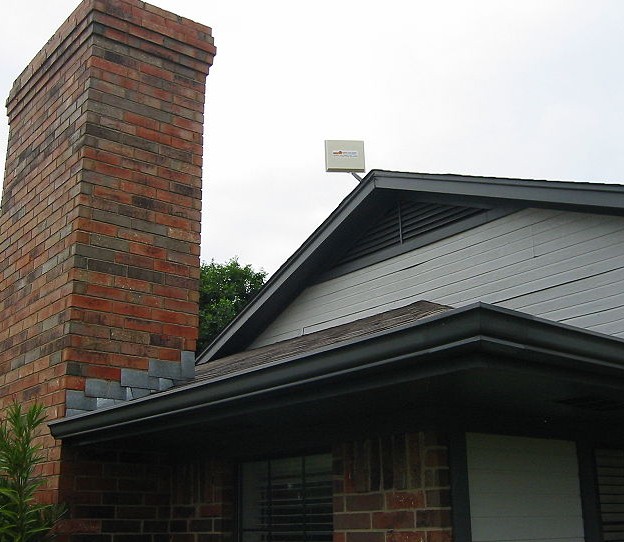
A home equipped with a WISP antenna on the roof

Package                                                               Monthly Download Cap

384k                                                                       10 gigabytes

640k                                                                       10 gigabytes

1 meg                                                                    20 gigabytes

2 meg                                                                    40 gigabytes

3 meg                                                                    50 gigabytes

4 meg                                                                    60 gigabytes

8 meg                                                                    80 gigabytes

Additional capacity over cap                        $1 per gigabyte over the cap

Although Larsen claims the cap and the overlimit fee isn’t “a profit center,” it would be disingenuous to suggest it isn’t about the money (underline emphasis ours):

I feel that these caps are more than generous, and should have a minimal effect on the majority of our customers.   With our backbone consumption per customer increasing, implementing caps of some kind became a necessity.    I am not looking at the caps as a new “profit center” – they are a deterrent as much as anything.    It will provide an incentive for customers to upgrade to a faster plan with a higher cap, or take their download habits to a competitor and chew up someone else’s bandwidth.

Customers upgrading to a faster plan have to pay a correspondingly higher price for that service and taking their “download habits to a competitor” reduces the cost for the provider no longer encumbered with serving the higher-usage-than-average customer now heading for the door.  Among his 2,000 customers, the end effect will be what Larsen himself hopes is a deterrent for customers using increasingly common higher bandwidth applications like online video, file backup, and uploading and downloading files.  Larsen himself admits that one of his customers was a little bit upset to be told he was using too much.

Rural providers do face higher costs to provide service than their urban counterparts.  But before they enjoy any benefits from Universal Service Fund reform or other government-provided stimulus, customer-unfriendly Internet Overcharging schemes should not be part of the deal.

Getting First-Run Movies On Your TV Means Giving Your Remote Control to Hollywood Studios, Cable Companies

Phillip "Will Wait for it to Hit Netflix" Dampier

Hollywood studios have a proposition to make.

How would you like to gain access to the latest Hollywood releases on your cable, satellite, or broadband connection even while those movies are still playing in area theaters?

The Motion Picture Association of America says it’s willing to let you watch first-run Hollywood blockbusters from home, but in return, they want the right to control what you can do with your television set.

Time’s up for you to make up your mind.  The Federal Communications Commission has decided you were going to say “yes” to this proposition anyway, so they went ahead and approved it on your behalf.

Specifically, the MPAA appealed to the Federal Communications Commission to get approval for its proposed Selectable Output Control technology.  You probably never heard of that, but the concept actually has been around for a few years now.  When movie studios float trial balloons about enabling the technology, public interest and consumer groups start hollering and it typically gets shelved for awhile.  Not this time.

While the public policy debate continued, chances are the manufacturer of your television set or monitor manufactured after 2004 has probably already included some support for SOC — just waiting to hand over control of your television to Hollywood studios, cable, satellite, or IPTV companies.  On May 7th, while we were debating Net Neutrality, the FCC released its order approving the Hollywood Remote Control Confiscation Act (my name sounds far better than the FCC’s — Petition for Waiver of the Commission’s Prohibition on the Use of Selectable Output Control.)

Here’s how it works:

Let’s say your cable company wants to offer you Iron Man II through pay-per-view starting today.  It’s a movie currently playing in many theaters nationwide.  The MPAA believes there is compelling demand among the elderly, the home-bound, and the too-lazy-to-haul-themselves-to-the-Movieplex to make it available in the comfort of your own home on early pay per view.  However, Hollywood and your local cable company don’t want you making copies of the movie to hand out to all your friends.  With SOC technology, that becomes less of a problem because the cable company can selectively disable the outputs on the back of your television that don’t use copy control technology.  That means old fashioned analog outputs can be disabled for up to 90 days during SOC-enabled programming, making sure you cannot record any of the content without the approval of the studio or your cable company.

Is it worth losing control of your television to watch Iron Man 2 before it arrives on DVD?

Certain digital outputs will still function, as long as they support robust anti-recording/copying technology.  No more time-shifting SOC-protected content on digital video recorders to watch later, no more analog VCR taping of shows the industry doesn’t believe you have a right to record anyway.

For decades, Americans have fought for fair use rights that permit home recording and copying for personal use.  The entertainment industry has never fully accepted that, and have eroded away the ability for consumers to make legitimate personal use of content they have already purchased with digital rights management schemes, copy protection, region coding, and other limiting technologies.

SOC technology effectively forfeits all of your rights.  The only consumer protection the FCC provides is a requirement that your cable, satellite, or broadband provider warn you when they are employing SOC anti-recording technology.  At least you’ll know when your home recording rights are being trampled.

If your television set doesn’t have support for SOC built-in, the FCC just made your television set obsolete.  Write and thank them.  While initial deployment of SOC is only expected to be used for “early pay per view,” don’t believe for a moment such powerful controlling technology available to entertainment companies won’t be used in the future for other types of content they don’t want you recording.  Premium movie channels like HBO or Cinemax would be obvious examples.  TV networks that would like to sell you their network shows on DVD or through online services might find it worth their while to disable your ability to record your favorite shows.  If you don’t have an SOC-capable set, it’s likely you won’t be able to access protected programming at all.

With the ongoing convergence of broadband, television, and other forms of home entertainment distribution, SOC is a foot in the door to permit third parties to make decisions about how you can view or use content you’ve already paid to receive.  That’s a bad precedent.  The FCC approval of this gift to the entertainment industry is a travesty that needs to be reversed.

[flv width=”640″ height=”500″]http://www.phillipdampier.com/video/KCTV Kansas City FCC Ruling Could Bring New Movies Into Homes 5-16-10.flv[/flv]

KCTV-TV in Kansas City ignored the consumer’s loss of control over their own television set to focus instead on the implications for theater owners, who may become natural allies with consumers in opposition of SOC.  (1 minute)

[flv]http://www.phillipdampier.com/video/Public Knowledge – Selectable Output Control.flv[/flv]

Public Knowledge developed this web-ready video that takes a less formal look at SOC and its impact on your consumer rights.  (3 minutes)

AT&T U-verse Relaunches Video Site Filled With Shows You Can Already See Elsewhere Online

Phillip Dampier May 5, 2010 AT&T, Online Video, Video 3 Comments

Another day, another re-purposed video portal.  Last September, AT&T launched AT&T Entertainment, little more than a site filled with embedded TV shows from Hulu you could already watch… on Hulu.  Today, AT&T launched the same concept under the rebranded “AT&T U-verse Online.”

“The benefits of multi-screen convergence are coming to life for AT&T U-verse customers,” said Dan York, president of content, AT&T. “With AT&T U-verse, you can enjoy your favorite content on U-verse TV, U-verse Online, and soon, your mobile device with U-verse Mobile. We have an unmatched ability to deliver on the multi-screen vision, and working with leading programmers, we’re providing entertainment to consumers in new and integrated ways not yet offered by our competitors.”

“U-verse Online features tens of thousands of hours of entertainment, and since its initial launch in September 2009, has continued to add content from additional networks and studios,” says a statement from the company.

But in reality, U-verse Online remains almost entirely a Hulu affair, with the majority of its video content coming from the popular video site.  Only the name of the site is changed to give customers the perception of value from something anyone could build themselves.

Watch how easy it is for Stop the Cap! to launch its own amazing video portal, Stop the Capped Video Online!:

<

p style=”text-align: center;”>

The Abbott & Costello Show, one of the featured titles on AT&T’s U-verse Online (and also on Stop the Capped Video Online!)

Stop the Cap! reader Michael, who sent along the tip, wonders if this is AT&T’s version of TV Everywhere.  If it is, AT&T’s shows are already available everywhere without the phone company’s help.  Just like AT&T Entertainment, AT&T U-verse Online is little more than a tool to give customers perceived value for money, even if the only cost to AT&T came from hiring some web designers to clip and paste embedded video codes from Hulu’s website.

One in Eight Americans Will Drop Cable/Pay Television by 2011: It’s Too Expensive

Phillip Dampier May 3, 2010 Consumer News, Online Video, Video 7 Comments

One in eight Americans are poised to drop or curtail their cable, satellite, or telco-TV packages in the coming year because the bill has gotten too expensive, according to a new study.

With an average cable bill now $71 a month and rising an average five percent a year, middle class consumers are being priced out of pay television according to the Yankee Group.  The Boston research firm conducted the study of cable, satellite and telephone-company IPTV services and surveyed 6,000 consumers from across the country.

“At the most basic level, the decision to cut off pay TV services is an economic one,” says Vince Vittore, principal analyst and co-author of the report. “As programmers continue to demand ever higher fees, which inevitably get passed on to consumers, we believe more consumers will be forced to consider coax-cutting.”

Coming on the heels of a steady erosion away from traditional telephone landline service which has threatened the fortunes of major phone companies, the implications of millions of consumers coax-cutting are not lost on cable operators or phone companies getting into the IPTV business.

Back to the Future: Older Americans Going Back to Rabbit Ears When Confronted With Today’s Cable Prices

Retro TV is a network that piggybacks on digital television sub-channels in many cities across the country. The network airs classic television shows popular with older audiences.

Those dropping service often take diverging paths for their future entertainment in a cable-free household.  Among older consumers, especially those on fixed incomes, it is back to the future with over the air television and a pair of rabbit ears or rooftop antenna designed to receive digital television broadcasts.

Among these consumers, the most common reason for canceling service is cost.  Many signed up for cable in the 1970s and 1980s for better picture quality, and with the right rooftop antenna, last year’s conversion to digital television solved that problem for over the air viewers.  Post-cable, many are pleasantly surprised to discover new channels piggybacking on traditional stations, several offering classic TV shows from decades past that are familiar and welcome in older Americans’ homes.  Even better — no confusing equipment to deal with.

Jesus Chea, 59, of Queens, told the NY Post he ditched his Time Warner subscription “because I’m on a fixed income and I believe it’s not worth the money.”

To get around the $136 monthly bill, the retiree, who lives with his wife and two grown sons, had antennas installed on both of his TVs — at a cost of $298 — taking advantage of last summer’s national conversion from analog to digital broadcasts.

“Antenna is great,” he says, “because they don’t charge you for rent on digital boxes and they don’t charge you for the remote control. When you add up all those extra fees and so many extra [cable] charges, even if it’s three or four extra dollars, they all add up.”

For many others, the arrival of Redbox video rental kiosks in area grocers has replaced the HBO subscription, and has proven to be a worthwhile supplement to the coax-cutter who drops cable service altogether.

The savings from cord cutting can be dramatic.  Some have saved upwards of $60 a month — $720 a year just by dropping the cable-TV part of their package.  Those kinds of savings have become important when wages are frozen or in decline, jobs are hard to find, and everything else is still going up in cost.

The cable industry has never imagined a country where consumers have quit cable (or satellite) and gone “cold turkey,” especially when upwards of 90 percent of Americans pay for some type of entertainment — pay television, movie rentals, or broadband video.

But as the Yankee Group discovered, Americans are simply tapped out.

Your Father’s Cable TV: Why Would Anyone Under 30 Subscribe?

For younger Americans, the addiction to cable or pay television was something that afflicted their parents.  They never had a problem dropping service from a cable company with whom they never did business.  The teens and twenty-somethings have spent most of their video dollar on broadband and DVD’s for much of their viewing, not cable.

Younger cable subscribers are most at risk for coax cutting, rationalizing they can watch most of their favorite shows online through services like Netflix, Hulu, or websites run by the major American networks.  Others download content (legally or otherwise), rent or buy DVD’s, or subscribe to services like Netflix which combine video streaming with DVD rentals-by-mail.

Many of these viewers also own devices that can bring web-based viewing right to their 50-inch television sets, using set top boxes or video game consoles with web connections.

“Admittedly, this is a small phenomenon now, but a number or recent transactions and new items point to a shift in consumer thinking,” said Vittore.

With the increasing ubiquity of Internet-capable devices, the challenge to traditional coax-based cable TV has never been greater.

“Just like with telephone land lines, it’s going to become hard to sell pay TV to anyone under 30,” Vittore said.

Provider Revenge: You Won’t Get Away That Easy!

With billions of dollars at stake, providers and content producers are intent on not allowing a repeat of what happened to the newspaper industry to afflict their business plans.  Giving it all away for free is not their idea of a sustainable business model.  Keeping tight control over content and its distribution is their ticket to maintaining profits.

Many Olympic events were not aired on NBC television, instead moved to NBC Universal-owned cable networks.

Older Americans who’ve gone back to over the air television are least susceptible to provider revenge, but content is still king and the cable industry will own an increasing percentage of it if the NBC-Comcast merger is approved.  While the two companies are currently promising not to dispense with free over the air broadcasting, an increasing amount of content could be diverted to pay television channels like cable sports networks, movie networks, and general interest basic cable channels.  Broadcasters themselves are now hungry for the same dual-revenue stream their cable competitors already enjoy – advertising income and subscription fees.

Most of the coming wars over pay entertainment are expected to be fought on the broadband battlefield.  For younger Americans relying on Hulu and other video streaming services, subscription fees are coming.  Hulu promises to keep some free viewing options open, but additional access to back episodes or certain series are likely to be restricted only to those who agree to pay an anticipated $9.95 per month.  The cable industry’s own TV Everywhere streaming services offers a clearer dividing line — its available only for those who maintain their pay television package.

Broadband providers, often the same companies that stand to lose from the retreat from television subscriptions, are considering making up the difference with limits on broadband service to make sure consumers can’t watch too much online, or charging consumption fees for heavy online viewers to make up their losses on the TV side.

The long-standing business relationship between content producers and distributors, such as those between Hollywood studios and cable companies, have led to a united front against would-be competitors.  For consumers seeking access to the latest Hollywood movies through low cost rental services or online video, expect to wait longer.  The window of time between a movie release in the theaters and when it becomes available for rental through Redbox or Netflix is growing longer to protect video-on-demand revenues for the cable industry and DVD sales for Hollywood.

Some consumers don’t mind the wait, but are still regularly reminded what they can miss when they don’t agree to a monthly pay television bill.

Jeremy Levinn, a 27-year-old personal trainer from Manhattan, told the Post he jumped the cable ship last year, but Time Warner Cable reminded him whose still boss during the Olympics, when numerous events were available only on Universal-owned cable channels including USA, CNBC and MSNBC and not broadcast over the air.

[flv width=”384″ height=”236″]http://www.phillipdampier.com/video/CNN Converging Broadband and Television April 2010.flv[/flv]

CNN aired this review of the next generation of television sets capable of connecting with your broadband service to receive television shows and movies over the Internet.  (4 minutes)

Search This Site:

Contributions:

Recent Comments:

Your Account:

Stop the Cap!