Home » Competition » Recent Articles:

Astroturf Snow Job: Telecom Industry Promised ‘Big Savings’ For Wisconsin — They Got A 21% Average Rate Hike Instead

Dick Armey, head of FreedomWorks, a notorious industry-backed astroturf group, was a big proponent of Wisconsin's "statewide video franchise" bill pushed by AT&T

Wisconsin residents, in 2007 you were promised more competition, lower prices, and better service from your pay television and broadband provider.  Two years later, two things are certain:

  1. The Wisconsin Video Competition Act was didn’t exactly deliver what was promised to consumers by those pushing the legislation, but paid off handsomely for the one company lobbying the hardest for its passage — AT&T.
  2. You had a lower bill in 2007 than you now have in 2009.

A new audit released by the Wisconsin Legislative Audit Bureau exposes the truth AT&T’s astroturfing friends never wanted you to know: despite the passage of a new law in December 2007 that promised increased competition and lower rates, the average basic cable rate in Wisconsin actually increased an average of 21 percent over the past two years.

The Bureau analyzed ten providers’ monthly charges for basic and expanded basic service in 17 Wisconsin municipalities at two points in time—July 2007 and July 2009—using data reported to us by the providers. Over this two-year period, charges for basic service increased an average of 21.2 percent, and charges for expanded basic service increased an average of 11.5 percent. The reported data do not suggest that competition has had a substantial effect in reducing either basic or expanded basic video service charges or in slowing their rates of growth during the period we reviewed.

Wisconsin consumers were promised something very different.  So just how did Wisconsin get snookered into passing legislation that was supposed to help consumers, but in reality just helped AT&T?

Dick Armey, chairman of FreedomWorks, an industry-backed astroturf group that heavily promoted the bill, emphatically promised the Competition Act would bring prices down.  On November 19, 2007 Armey wrote:

The Wisconsin Video Competition Act would allow consumers to take advantage of new technologies by streamlining the franchise application process for potential providers. When companies compete to provide service, consumers win through more choices, lower prices and better service.

Unfortunately for consumers, the Video Competition Act was little more than a custom-written giveaway to AT&T.  From the bill’s earliest draft language crafted by lobbyists working with legislative aides, to the big budget sales job employing 15 lobbyists and a major media budget, AT&T ran the show from start to finish according to Madison’s Capital Times newspaper.

TV4US counts AT&T among its corporate sponsors

TV4US (also known as WeWantChoice.com), an AT&T-supported astroturf group, ran television ads around Wisconsin promoting the bill.  In May 2007 the group sent every state legislator binders filled with what it claimed were the names of their constituents who wanted “an end to the cable monopoly” and competitive choice.  As The Center for Media & Democracy discovered, several people named, including two state lawmakers, didn’t support the bill and hadn’t given permission for their names to be included.

[flv]http://www.phillipdampier.com/video/TV4US Ad Wisconsin.mp4[/flv]

TV4US ran this ad across Wisconsin in 2007, promoting “cable competition.”

TV4US’ primary press contact Lizanne Sadlier just also happened to be employed by lobbying firm Fleishman-Hillard, which “has built its reputation by using strategic communications to deliver what its clients value most: meaningful, positive, and measurable impact on the performance of their organizations,” according to a press release from the group.

Fleishman-Hillard and AT&T are well acquainted with each other.  In fact, the PR firm was instrumental in rebranding the phone company as “the new AT&T” after the SBC-AT&T merger.  To this day, AT&T has several company bloggers actually employed by Fleishman-Hillard.

In March of 2007, the Wisconsin Merchants Federation turned up at a state hearing about the Competition Act. This struck several observers as odd, considering the WMF primarily concerns itself with retail store tax policies and strengthening retail theft laws. The WMF seemed well-prepared to articulate the proposed law’s benefits, which included, according to them:

  • increased competition in the video entertainment business;
  • creation of good-paying jobs;
  • bring (literally) hundreds of millions of dollars in capital investment to our state.

PR Watch wanted to know exactly what prompted the WMF to not only testify about a non-issue for retail stores, but also who wanted the group to get involved, and who exactly belongs to the WMF.

WMF’s David Storey told PR Watch that his group sees AB 207 / SB 107 as an economic development issue. “Where consumers have choices, not only are the consumers served, but the economy in general is served. The economy is made stronger,” he explained. “And this is all about consumer choice in the video entertainment field.”

Storey said that no particular member had asked WMF to support AB 207 / SB 107, but that he was personally interested in the issue, as the former Deputy Secretary of the Wisconsin Department of Commerce. Asked for a list of WMF members, Storey responded that one was not available, but that information would hopefully be added to the WMF website in the future.

One thing that is clear is that many of WMF’s partners in lobbying for AB 207 / SB 107 have ties to the telecom industry. The Coalition of Wisconsin Aging Groups, which is a member of the Wisconsin Video Choice Coalition, has received funding from AT&T and from SBC Wisconsin, which is now part of AT&T. The group also offers “discounts on assistive devices for the telephone such as volume amplifiers from the AT&T Special Needs Center.” Another Wisconsin Video Choice Coalition member, the Wisconsin Technology Council, lists AT&T among its major sponsors. Fellow coalition member Women Impacting Public Policy is a Washington DC based group that receives funding from AT&T and Verizon, among other corporate sponsors.

[flv]http://www.phillipdampier.com/video/Press event promoting Wisconsin bill Aug 2007.flv[/flv]

In August 2007, WMF turned up at a press event with other bill supporters to promote the results of a poll conducted by the Mellman Group, which isn’t a respected polling firm but rather a Washington, DC public relations firm that “develops effective communications strategies that lead people to choose our client’s product or service, join their organization, hold their opinion, or vote as we would like.” [1] (13 minutes, video begins at ten second mark)

In short, no matter where consumers turned during the push for the Wisconsin Video Competition Act, that big AT&T logo was always somewhere in sight.

Before the legislation was passed, some were warning Wisconsin the dog and pony astroturf show wasn’t actually working for the best interests of Wisconsin consumers, but were instead looking out for the best interests of AT&T.  Charles Uphoff is chair of the Fitchburg Broadband Telecommunications Commission, and wrote this back in 2007:

Lobbyists for telecommunications giant AT&T have been pressuring Wisconsin legislators to pass sweeping changes in the laws regulating cable TV with a million-dollar media campaign and behind the scenes arm-twisting that would make Karl Rove blush.

Under the guise of promoting increased consumer choice, lower cable rates and high-paying union jobs, AT&T is trying to steamroller bills that would prohibit any meaningful regulation of video service rates; eliminate funding for public access, educational and government channels; and effectively guarantee statewide franchises for the telecom giant in perpetuity.

Among the more astonishing features of this dubious legislation is a provision that specifically prohibits the state or local municipalities from reviewing franchise transfers. While initial applicants would have to establish their legal, financial and technical qualifications to obtain a statewide franchise, once granted, statewide franchises can be literally transferred to anyone — even politicians. Video franchise holders wouldn’t even have to inform the affected communities until 10 days after the transfer had been completed.

[…]

So how about the claim being made in the TV ads that cable rates have gone up 246 percent and the “Video Competition Act” would increase choice and save consumer millions? It sure sounds good, but these assertions are, at best, misleading. In the city of Fitchburg, for example, the basic cable rate has risen less than 6 percent over the past 10 years and is currently at $8.19 a month. Admittedly, premium packages have risen much more sharply, largely driven by the cost of content providers like the NFL Network, MTV and ESPN, but AT&T would be facing the same kind of costs if they want to include these offerings.

So if you are expecting whopping decreases in your cable TV bills if this legislation passes, don’t hold your breath. In fact, the ability of municipalities or the state to even regulate basic cable rates would be gone.

What’s happening in Wisconsin isn’t an isolated incident. Wholesale deregulation of the video services industry under the guise of fostering competition is being pushed in legislatures all across the country, backed by big money and conservative ideologues like former House Majority Leader Dick Armey, a Texas Republican whose right-wing “think-tank” has been pushing this legislation since before it had a bill number. Weeks before most members of the Wisconsin Legislature had even seen the bill, Armey’s Freedom Works Foundation was trying to line up sponsors. Major contributors to Dick Armey’s cause include AT&T, Verizon and Exxon-Mobile.

Sadly, the recent trend in video services and telecommunications has been toward increasing the concentration of ownership and control of the media, resulting in fewer consumer choices and less competition, not only in terms of price, but also in terms of ideas. The opinions expressed here are strictly my own, but it seems to me that in the arena where competition is most important to our democracy and our future, the competition of ideas, the net effect of these bills will be to decrease competition through the elimination of public access as a vehicle for information, dialogue and discussion of things that matter to our communities.

Despite playing fast and loose with the facts, the astroturf groups, aided by AT&T’s generous campaign contributions to Wisconsin state legislators helped grease the way towards passage of the Video Competition Act, which was signed into law in December 2007.

But rate increases for consumers aren’t the only problem impacting Wisconsin residents.  Collateral damage for those interested in public affairs television programming is now also becoming apparent.

One of the biggest opponents of the statewide video franchising law has been the Wisconsin Association of PEG Channels (WAPC).  “PEG” stands for public access, educational, and government access channels found on virtually every cable system in the country.  These non-profit channels are provided in the public interest to give subscribers access to customer-produced video programming, local government public meetings and hearings, and educational programming from local schools and universities.  They are traditionally financed by the cable system as part of their franchise agreement.  In return for tearing up local streets and yards, systems give something back to the community by making room for these public access channels, and often also provide equipment and training to assist in program production and distribution.

The Video Competition Act was no friend to PEG channels.  By moving to statewide video franchise agreements, local communities no longer had much say over their public access channels, and the bill’s passage quickly provided a convenient opportunity to bury PEG channels, kill their funding, or outright renege on local agreements.

[flv]http://www.phillipdampier.com/video/Hunting PEG Channels on U-verse.mp4[/flv]

AT&T’s U-verse doesn’t make it easy for video customers to find PEG channels.  In Wisconsin, the channels are housed on a website that appears on screen on channel 99, the equivalent of TV Channel Siberia for the remote control channel surfer.  From there, consumers have to navigate a series of menus on their remote control to find the right channel.  Mike Ryan, director of West Bend Community Television, discovers just how ponderous this procedure is, even for those dedicated to finding his channel.

In the case of Charter Cable, they’ve managed to go one step further and help destroy one city’s public access channels.

Funding for the Wausau Area Access Channels had been provided in part by the franchise agreement between the City of Wausau and local cable provider Charter Communications. While Wausau Access Channels served the greater Wausau area, only the City of Wausau franchise agreement provided any funding.

When the state passed the Competition Act replacing local franchise agreements with a standard state wide franchise, Wausau PEG support fees were eliminated after a three year sunset. That sunset would occur December 31, 2010. The City of Wausau has not received any PEG support fees from Charter Communication during the three year sunset period.

Apparently unwilling to meet even a three year commitment, Charter Cable’s non-payment led Wausau mayor Jim Tipple to announce Monday that the city would not continue to fund the station in 2010 because of budget constraints.

“We realize this is a tough decision, not only for the city of Wausau but for the entire community,” Tipple said.

The City of Wausau is pursuing legal remedies against Charter. PEG fee revenue had funded 60% of the station’s annual budget of $100,000.

“The City does not want the channels to go dark, but it can no longer fund them alone,” said John Jordan, Wausau Access Coordinator.

“We are stunned to hear about the closure of the Wausau community channels. It is hard to believe that residents of Wausau will no longer be able to see and participate in community television. We warned this could come with the passage of the Video Competition Act. We just didn’t expect it quite this soon,” said Mary Cardona, WAPC Executive Director.

On January 1, 2011, more stations will be in Wausau’s position. On that date, all dedicated PEG fees end as a result of the passage of the Video Competition Act.

[flv]http://www.phillipdampier.com/video/WSAW-WAOW Wausau Public Access Cut 12-21-09.flv[/flv]

WSAW & WAOW-TV, both in Wausau, Wisconsin headlined their newscasts with news that the community’s public access channels were on the chopping block. Loud Volume Alert (4 minutes)

The Cable Consumer Repair Bill (AB606) recently introduced by Representative Gary Hebl (D – Sun Prairie) could resolve serious problems with the Video Competition Act that took effect in January 2008. Since then, cable companies and AT&T have moved community channels to out of the way locations on the line-up, subjected the channels to interference problems, imposed transmission equipment costs, and withdrawn a commitment to provide dedicated revenue for public, education, and government access stations.

Of course, the industry players don’t like it one bit.  “Wired Wisconsin,” a non-profit group claiming to seek cutting edge broadband technology for Wisconsin, who unsurprisingly counts AT&T as a “partner,” thinks Hebl’s bill will gut the Competition Act.

“Even though the VCA was passed less than two years ago, we’ve already seen a great deal of progress under the bill.  It’s generated real competition, helped improve prices, created hundreds of new jobs, spurred millions in investment in infrastructure, improved customer service and expanded consumers’ access to new video providers, services and features all across the state,” said Wired Wisconsin’s executive director Thad Nation.

The state’s audit of cable pricing would seem to belie Nation’s views. That he holds them should come as no surprise.  After all, Nation is the former executive director of TV4US, the AT&T-backed astroturf effort that helped enact the law Nation seeks to defend.

“On balance, the law hasn’t been good for consumers but has been very good for the companies that wanted it. Two years from now, I don’t think you will be able to say that consumers saved a lot of money if any at all,” Barry Orton, a telecommunications professor at the University of Wisconsin-Madison, told the Milwaukee Journal Sentinel.

Has the bill brought about any savings for Wisconsin consumers?

“We haven’t seen it. I think the short answer is ‘no,’ ” said Curt Witynski, assistant director of the League of Wisconsin Municipalities, which represents 582 local governments.

“I think the public relations effort of AT&T and others was remarkable in convincing state legislators that this law would bring about all kinds of competition, and that consumers would benefit from it. But that hasn’t been the case,” Witynski added.

Indeed, with additional rate increases announced this week by AT&T’s U-verse, the much-heralded savings promised by AT&T and its various astroturf elements have become only more elusive for the hard-hit consumer struggling through ongoing economic challenges.  Those challenges aren’t exactly the same for AT&T, which increased its dividend payment to stockholders and has plenty left over to continue astroturfing its way to statewide video franchises in other states it serves.

Verizon FiOS Planning $360 Early Termination Fee, Substantial Rate Increases for 2010

Phillip Dampier December 22, 2009 Competition, Data Caps, Verizon 6 Comments

Broadband Reports has obtained documents accidentally publicly posted outlining some significant changes to how Verizon markets and prices its fiber optic to the home FiOS service.

Most customers can “look forward to” price hikes of $10-20 for their FiOS bundled service package January 17th, if the leaked documents are accurate.  The company will also replace its “TV Essentials” package and bring back symmetrical broadband service options (same upload and download speeds), according to Broadband Reports.

More concerning is the introduction of a uniform $360 early termination fee for customers who sign up for broadband or television service from Verizon and decide to switch providers.  Although the fee will not apply if customers agree to stay with Verizon for their home phone service, the justification for such a high charge will be open for debate.  The company promises to pro-rate the fee for every month a customer does stay with FiOS, but according to the report will impose it against a consumer that finds themselves having to relocate to a non-Verizon service area.  For someone in western New York between Buffalo and Rochester, a move just down the street into Frontier Communications territory could result in a final Verizon bill several hundred dollars more than expected.

Currently, Verizon charges broadband customers on an annual contract a $99 early termination fee.  Television customers pay a $179 fee if they cancel before the year is up.

Some customers reacting to the cancellation fee suggest opting for the month-to-month service plan for an additional $20 a month if a move is imminent or if a customer isn’t sure they’ll keep the service.

Early termination fees are designed to capture and hold customers in place and are common in competitive markets where consumers bounce back and forth between new customer promotions.  Locking a customer in with a multi-year service agreement makes promotion-bouncing expensive, and gets customers to think twice before switching providers.

Verizon’s pricey exit charge could also reflect the company’s desire to recoup wiring expenses to bring fiber to and inside customer homes.

Most Verizon FiOS promotions we’ve seen lately expire January 16th.  That would suggest promotions starting the 17th will carry higher pricing.

A late December 2009 Verizon promotion. Note the expiration date.

Karl Bode notes the price hikes come even though costs are declining for major providers.

Keep in mind of course that these broadband hikes come as the cost of wholesale bandwidth and network hardware continues to drop. The television hikes, meanwhile, come despite the fact that Verizon and AT&T lobbied state lawmakers in dozens of states promising lower TV prices — if they were willing to reconfigure the video franchise system to make life easier on the baby bells.

It also appears that Verizon will be further expanding their free Wi-Fi offer to include customers on 15 Mbps tiers. The service previously was restricted to FiOS customers that subscribed to 20 Mbps service or faster. Like speed? It looks like Verizon’s symmetrical 35 Mbps tier, which is only available in select markets, will be showing up in all Verizon markets next year. The company’s 25/15 Mbps tier will officially become 25/25 (most customers report those speeds already).

New Report Says Wireless Broadband Providers May Have to Implement Usage Caps… But They Already Have

A new report from Frost & Sullivan (pricey subscription required) warns wireless broadband providers may have to implement limits on the amount of data consumed by customers, a surprising result considering the vast majority of carriers already do.

The business research and consulting firm says some wireless carriers are struggling to balance the consumption they encouraged with the physical capacity of their networks.  Citing AT&T’s iPhone and its data-rich App Store, which lets consumers download data applications to run on their phone, the research shows data consumption has increased dramatically as consumers integrate smartphones into their daily lives.

“We all knew as an industry that mobile data would grow, and we saw these growth curves that were a 45-degree angle upward,” said James Brehm, senior consultant at Frost & Sullivan. “But the true growth of the iPhone, when you chart it, looks more like a hockey stick.”

The demand for data is pressuring the industry to invest additional money for upgrades, and Wall Street isn’t happy with a trend that guarantees expensive upgrades will be required to meet customer demand — upgrades that would come straight out of revenue, unless a dramatic shift takes place towards consumption-based billing.

“You’re going to see some push back from consumers, but AT&T’s not going to be the only one that’s going to have to do this,” Brehm said. “Every service provider out there is going to ultimately change the way mobile data is consumed and priced over the next few years.”

The argument essentially comes down to how much revenue wireless carriers will be forced to invest in their networks, and how much noise they will hear from investors for doing so.  Wall Street prefers customers pay the costs for upgrades by increasing prices for data service, which would assure revenue expectations remain stable.  Customers demand wireless carriers invest some of their profits back into their networks to improve service and in return enjoy customer loyalty and any revenue earned from selling additional services.

Some carriers are choosing to stay out of the fight, claiming they already have sufficient capacity to serve customers.  Besides, most of them already have usage limits on their services, traditionally set at a maximum of 5GB of consumption per month.

T-Mobile believes it already has enough capacity to meet the growing demand from data-hungry smartphones.  It has invested in new technology that claims to triple current 3G speeds and works with current 3G phones,  meaning customers don’t have to buy a new phone to enjoy the faster speeds.

Sprint is constructing its 4G network and already sells service in several cities through Clearwire.  Sprint claims unlike some of its competitors, it intends to stay ahead of the growth curve by investing now in additional spectrum and technology to manage its networks.  Sprint claims it has plenty of room to expand capacity.

Verizon Wireless says it has more consistently upgraded its network over the past decade than any other carrier, and is well prepared to accommodate even the iPhone.

“We have put things in place already,” Verizon Wireless Chief Technology Officer Anthony Melone tells Business Week. “We are prepared to support that traffic.”  Next year, the nation’s largest wireless carrier will be rolling out 4G upgrades in America’s 30 largest cities, although primarily for mobile broadband service accessed through a mobile broadband dongle.

Verizon already limits consumption on its wireless plans to a maximum of 5GB per month, with overlimit penalties for those that exceed it.

Most of the attention remains focused on AT&T and the iPhone, because the data plan provided for iPhone customers does not carry a specified limit.

Vipin Jain, chief executive of Retrevo, a consumer electronics shopping Web site told the Chicago Tribune, “As soon as you put a cap (on data usage), there’s going to be a backlash.”

So what keeps wireless providers from upgrading their networks and keeping consumption billing and usage caps away?

In addition to pressure from Wall Street, another Frost & Sullivan report points to an unsettled marketplace.  The progression towards 4G has been stalled because of the economic downturn, the report says.

Frost & Sullivan ICT Program Manager Luke Thomas says carriers are still waiting for consensus on several issues, including support for voice and SMS and a harmonized frequency band for 4G traffic.  Thomas also says many cell towers have limited capacity to support additional traffic.  A tower can deliver only as much data as its connection back to the provider’s network can handle.  Once the “backhaul” link is saturated, calls start to drop and data speed slows.  Many still rely on dedicated, relatively slow copper wire circuits, although fiber optic links are becoming increasingly common.

Thomas also believes carriers will need additional spectrum, a minimum of 20MHz, to make 4G upgrades worthwhile.

Without all of these factors, Thomas believes the potential return on investment won’t be high enough to justify moving forward any time soon.

Verizon’s Doubling of Early Cancel Fee ‘Good for Consumers’

Verizon Wireless has defended their decision to double the early cancellation fee (ETF) for consumers purchasing “smartphones” and netbooks from the wireless carrier.  In a letter from Kathleen Grillo, Senior Vice President of Federal Regulatory Affairs, Verizon claims the new $350 fee is justified and actually benefits consumers by providing them with a substantial discount on the cost of the equipment they might not otherwise be able to afford.

“The higher [cancel fee] associated with Advanced Devices (click link to see a list of impacted equipment) reflects the higher costs associated with offering those devices to consumers at attractive prices, the costs and risks of investing in the broadband network to support these devices, and other costs and risks,” Grillo wrote as part of a 77-page submission to the Federal Communications Commission, which demanded an explanation for the price increase.

Grillo claims Verizon’s fees are actually good for consumers:

Verizon Wireless’ term contracts with ETFs promote consumer choice and broadband deployment. This pricing structure enables Verizon Wireless to offer wireless devices at a substantial discount from their full retail price. By reducing up-front costs to consumers, this pricing lowers the barriers to consumers to obtaining mobile broadband devices. It thus enables many more consumers, including those of more limited means, access to a range of exciting, state of the art broadband services and capabilities. The company’s pricing structure therefore promotes the national goal of fostering the greater adoption and use of mobile broadband services. At the same time, consumers are protected by Verizon Wireless’ detailed disclosure practices described in this response, by the Worry Free Guarantee, which allows customers to terminate within 30 days of activation without an ETF, and by the monthly reduction in the ETF amount.

Grillo claims Verizon customers can also purchase a phone at the retail price and avoid a service contract.  Verizon Wireless, for example, charges contract customers $199.99 for the Motorola Droid.  But customers who do not want a contract can purchase the phone from Verizon for $559.99.

In North America, most major cell phone companies subsidize the cost of wireless handsets and make up the difference over the life of a typical two-year service contract.  Cell phone companies claim consumers benefit from the arrangement because they are able to acquire a new phone every two years at a substantial discount.  Some consumer advocates and members of Congress disagree, suggesting carriers more than earn back the cost of the subsidized phone over the life of the contract.  Although customers purchasing a retail-priced phone don’t have to worry about a two year contract, they pay artificially higher prices for service plans designed to recoup the costs from those who did take discounted phones.  The result is a strong incentive to commit to a contract and take the phone, since you will essentially be paying for it anyway.

The Government Accountability Office found early termination fees to be among the top four consumer complaints filed with the FCC about wireless carriers.  Sen. Amy Klobuchar (D-Minnesota) re-introduced legislation December 3rd to try and limit early termination fees.

Senator Amy Klobuchar

“Changing your wireless provider shouldn’t break the bank,” Klobuchar said in a Dec. 3 statement. “Forcing consumers to pay outrageous fees bearing little to no relation to the cost of their handset devices is anti-consumer and anti-competitive.”

The Cell Phone Early Termination Fee, Transparency and Fairness Act would prevent wireless carriers from charging an ETF that is higher than the discount on the cell phone that the company offers consumers for entering into a multi-year contract. For example, if a wireless consumer enters into a two-year contract and receives a $150 discount with the contract, the ETF cannot exceed $150.

The legislation would also require wireless carriers to prorate their ETFs for consumers who leave their contracts early so that the ETF for a two-year contract would be reduced by half after one year and to zero by the end of the contract term. In addition, the bill would mandate that wireless carriers would provide “clear and conspicuous disclosure” of the ETF at the time of purchase.

Co-sponsoring the bill with Klobuchar are Sens. Russ Feingold, Jim Webb and Mark Begich.

[flv]http://www.phillipdampier.com/video/CNBC Amy Klobuchar ETF Fees 9-13-07.mp4[/flv]

Back in 2007, Sen. Klobuchar introduced nearly identical legislation to deal with mobile phone providers charging high termination fees.  CNBC ran this debate between Klobuchar and the cell phone trade association.  Klobuchar found herself in a 2-against-1 debate when the CNBC anchor defended the wireless industry.  (9/13/07 – 5 minutes)

Canadian Government Overturns CRTC, Admits Globalive’s Wind Mobile to Canadian Mobile Phone Marketplace

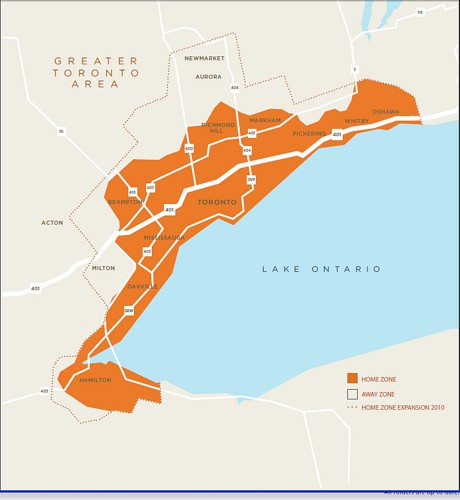
Wind Mobile uses "home zones" as their version of "on network" calling.  Placing calls outside of your home zone is akin to "roaming" and can incur additional costs.

Wind Mobile uses "home zones" as their version of "in network" calling. Placing calls outside of your home zone is akin to "roaming" and can incur additional costs. Here is their service area in the metro GTA (Toronto-Hamilton).

The Canadian Radio-television and Telecommunications Commission has been overruled in an upset decision by the Harper government to admit new competition into Canada’s mobile phone marketplace.  Earlier this fall, the CRTC denied a license to Globalive to begin mobile service under its Wind Mobile brand, agreeing with objections from incumbent providers Bell, Rogers, and Telus that the company was not sufficiently “Canadian enough” in its ownership to operate legally in the country.  The CRTC decision upset many consumers who saw the regulatory body overprotecting the interests of the country’s three large mobile providers, effectively keeping competition out of Canada.

Canada’s version of the FCC ruled that because the Toronto-based company received most of its funding from Naguib Sawiris, an Egyptian billionaire that runs Egypt’s telecommunications provider Orascom, it disqualified Globalive from doing business in Canada.  Cell phone providers in Canada must be majority owned by Canadian citizens.

Apparently the decision was so egregiously wrong, the Harper government overturned it on December 11th.  Industry Minister Tony Clement said a government review of Globalive found the company did meet Canadian ownership requirements and reversed the CRTC decision effective immediately.

The Harper government’s direct intervention in the Globalive matter rocked Canada’s existing mobile providers.

“If Wind is Canadian, then so was King Tut,” Michael Hennessy, head of regulatory affairs for Telus, wrote on his Twitter page. “When you have no effective opposition party, you can make the rules you want.”

Rogers has repeatedly insisted there is no room for a fourth player in Canadian mobile, claiming there isn’t enough business to go around.  Stockholders apparently agreed and shares of all three incumbents dropped when the news broke that Wind Mobile was on the way in Toronto and Calgary in as little as a week.  Indeed, some analysts predict Globalive’s entry could force two of the existing carriers to merge — most likely Bell and Telus.

Rogers CEO Nadir Mohamed: “There’s no question in my mind that Canada cannot support more than three national facilities-based players,” he said in an interview with Bloomberg News the day before the government decision. “It’s inconceivable to me.”

“We think Globalive clearly does not meet the requirements for Canadian control,” Bell officials said in a statement. “We’ll be taking a close look at the reasoning behind this decision.”

Canadian consumers are excited about the arrival of competition in a marketplace with three providers charging essentially identical high pricing for mobile service.

Wind Mobile could dramatically change the the entire business model of Canada’s cell phone marketplace because most of its plans offer flat rate service for Canadian customers with no overage fees.  It also does away with the nickle-and-dime fees consumers hate, with no charges for “system access,” “911,” and other non-government-imposed fees and surcharges.  Wind doesn’t even charge for incoming text messages or received long distance phone calls.  That means text spam doesn’t cost you anything beyond irritation.

In return for not subsidizing the cost of your phone, the company doesn’t compel subscribers to remain on lengthy service contracts.  That Blackberry Bold 9700 that costs $199 on AT&T or T-Mobile’s network in the United States costs $450CDN from Wind Mobile, but no two year contract is required.

The only downside?  Wind Mobile’s network is very limited at present to Toronto and Calgary, and while service is available throughout Canada, using it will incur roaming charges around 25 cents per minute.  Most early Wind Mobile customers will likely be those who don’t roam too far from home because of these limitations.

[flv width=”640″ height=”388″]http://www.phillipdampier.com/video/CBC Coverage Wind Mobile 12-11-09.flv[/flv]

CBC Television ran extensive coverage of the government decision to admit Globalive into the Canadian mobile marketplace.  We’ve combined several reports into a single clip that explores consumer reaction, the government’s logic in permitting Wind Mobile to start service, as well as the discontent from existing providers who feel the decision is unfair.  (12/11/09 – 21 minutes)

[flv width=”512″ height=”308″]http://www.phillipdampier.com/video/CTV Coverage Wind Mobile 12-11-09.flv[/flv]

CTV News also covered the story, and included a more extensive review of what consumers can expect from the deal.  (12/11/09 – 5 minutes)

[flv]http://www.phillipdampier.com/video/Global CRTC Decision Lets Wind Mobile In 12-11-09.flv[/flv]

Global Television led its newscast with the story on December 11th, and included a pouting Telus representative.  (2 minutes)

More video coverage can be found below.

Wind Mobile Pricing & Features (provided by Wind Mobile, all prices in Canadian dollars)

Handsets / Devices:

BlackBerry Bold 9700 …… $450
HTC Maple ………………….. $300
Samsung Gravity 2 ……….. $150
Huawei U7519 ……………… $130
Huawei E181 data stick…….$150

Here’s what we don’t have:

  • No system access fees
  • No 911 fees
  • No activation fee
  • Never a charge for incoming texts
  • No charge for incoming long distance calls
  • No difference between plans for postpaid and prepaid
  • No contracts. Our Customers stay with us because they want to, not because they have to.

What we do have:

  • Nation-wide coverage with a domestic roaming partner
  • Unlimited calling (incoming and outgoing) in the GTA and Calgary to start, followed by Edmonton, Vancouver and Ottawa in early 2010
  • Unlimited WIND to WIND calling across Canada included on all plans
  • Unlimited province-wide calling on the $35 plan
  • Unlimited Canada-wide calling on the $45 plan
  • Call control included on all plans (missed call alerts, caller ID, call forward, call waiting)
Wind Mobile's Voice & Text Plans

Wind Mobile's Voice & Text Plans

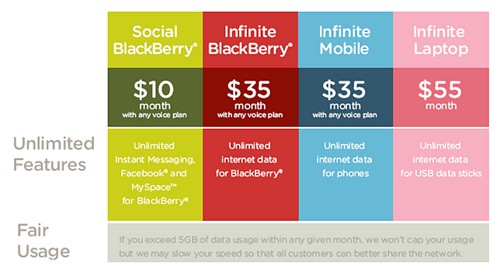
Wind Mobile's data plan has a 5GB per month "fair access policy" limit, similar to that offered by Cricket Wireless.  Exceed it, and the company reserves the right to throttle your speeds until the month is up.

Wind Mobile's data plan has a 5GB per month "fair access policy" limit, similar to that offered by Cricket Wireless. Exceed it, and the company reserves the right to throttle your speeds until the month is up.

Watch more video coverage below.

… Continue Reading

Search This Site:

Contributions:

Recent Comments:

Your Account:

Stop the Cap!